168
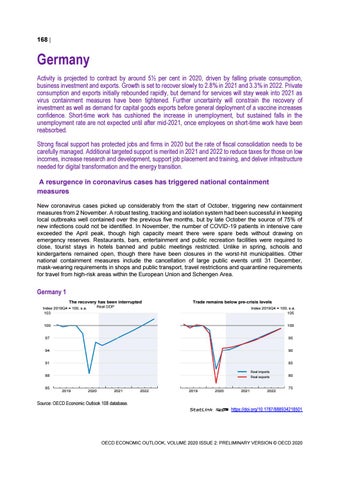
Germany Activity is projected to contract by around 5½ per cent in 2020, driven by falling private consumption, business investment and exports. Growth is set to recover slowly to 2.8% in 2021 and 3.3% in 2022. Private consumption and exports initially rebounded rapidly, but demand for services will stay weak into 2021 as virus containment measures have been tightened. Further uncertainty will constrain the recovery of investment as well as demand for capital goods exports before general deployment of a vaccine increases confidence. Short-time work has cushioned the increase in unemployment, but sustained falls in the unemployment rate are not expected until after mid-2021, once employees on short-time work have been reabsorbed. Strong fiscal support has protected jobs and firms in 2020 but the rate of fiscal consolidation needs to be carefully managed. Additional targeted support is merited in 2021 and 2022 to reduce taxes for those on low incomes, increase research and development, support job placement and training, and deliver infrastructure needed for digital transformation and the energy transition. A resurgence in coronavirus cases has triggered national containment measures New coronavirus cases picked up considerably from the start of October, triggering new containment measures from 2 November. A robust testing, tracking and isolation system had been successful in keeping local outbreaks well contained over the previous five months, but by late October the source of 75% of new infections could not be identified. In November, the number of COVID-19 patients in intensive care exceeded the April peak, though high capacity meant there were spare beds without drawing on emergency reserves. Restaurants, bars, entertainment and public recreation facilities were required to close, tourist stays in hotels banned and public meetings restricted. Unlike in spring, schools and kindergartens remained open, though there have been closures in the worst-hit municipalities. Other national containment measures include the cancellation of large public events until 31 December, mask-wearing requirements in shops and public transport, travel restrictions and quarantine requirements for travel from high-risk areas within the European Union and Schengen Area.
Germany 1 The recovery has been interrupted Index 2019Q4 = 100, s.a. 103
Trade remains below pre-crisis levels
Real GDP
Index 2019Q4 = 100, s.a. 105
100
100
97
95
94
90
91
85 Real imports
88 85
Real exports
2019
2020
2021
2022
0
0
2019
2020
2021
2022
80 75
Source: OECD Economic Outlook 108 database. StatLink 2 https://doi.org/10.1787/888934218501
OECD ECONOMIC OUTLOOK, VOLUME 2020 ISSUE 2: PRELIMINARY VERSION © OECD 2020
169
Germany: Demand, output and prices 2017
2018
Current prices EUR billion
Germany GDP at market prices Private consumption Government consumption Gross fixed capital formation Final domestic demand Stockbuilding1 Total domestic demand Exports of goods and services Imports of goods and services Net exports1
2019
2020
2021
2022
Percentage changes, volume (2015 prices)
3 263.3 1 705.5 648.2 667.5 3 021.2 13.1 3 034.2 1 541.6 1 312.5 229.1
1.3 1.5 1.2 3.6 1.9 -0.1 1.8 2.5 3.8 -0.4
0.6 1.6 2.7 2.6 2.1 -0.7 1.3 1.0 2.6 -0.6
-5.5 -6.2 4.2 -4.3 -3.5 -1.0 -4.5 -11.1 -9.6 -1.2
2.8 3.2 1.6 2.0 2.6 -0.5 2.1 4.5 3.0 0.8
3.3 4.0 0.9 3.9 3.3 0.0 3.3 4.5 4.7 0.2
3260.0 _ _
1.3 1.7 1.9
0.6 2.2 1.4
-5.2 1.4 0.4
2.8 0.8 1.1
3.2 1.2 1.3
1.3 3.4 10.9 1.8 69.5 61.7 7.5
1.3 3.1 10.9 1.5 68.1 59.5 7.2
0.7 4.2 16.6 -6.3 82.5 73.9 7.0
1.1 4.8 15.2 -4.4 84.7 76.2 7.2
1.3 4.3 12.7 -1.8 84.3 75.8 7.1
Memorandum items GDP without working day adjustments GDP deflator Harmonised index of consumer prices Harmonised index of core inflation2
_ _ _ _ _ _ _
Unemployment rate (% of labour force) Household saving ratio, net (% of disposable income) General government financial balance (% of GDP) General government gross debt (% of GDP) General government debt, Maastricht definition (% of GDP) Current account balance (% of GDP)
1. Contributions to changes in real GDP, actual amount in the first column. 2. Harmonised index of consumer prices excluding food, energy, alcohol and tobacco. Source: OECD Economic Outlook 108 database.
StatLink 2 https://doi.org/10.1787/888934218520
Germany 2 Re-emergence of the virus has affected services
Short-time work has protected jobs
Business climate
Balance, s.a. 40
% of labour force, s.a. 10
% of employees 20
← Unemployment rate
30
Short-time workers →
20
8
16
6
12
4
8
2
4
10 0 -10 -20 -30
Service sector Manufacturing
-40 -50
2018
2019
2020
0
0
2018
2019
2020
0
Source: ifo business surveys; Federal Statistical Office; and Federal Employment Agency. StatLink 2 https://doi.org/10.1787/888934218539
OECD ECONOMIC OUTLOOK, VOLUME 2020 ISSUE 2: PRELIMINARY VERSION © OECD 2020
170
A rapid rebound has slowed The sharpest decline in GDP since quarterly national accounts calculations began was followed by a rapid rebound, led first by services and subsequently manufacturing. Following a peak in disruption in April, retail turnover was already above its pre-crisis level in May. Despite substantial falls in business investment, construction activity largely continued and public investment expanded. Exports were a key contributor to the contraction as major trading partners were severely affected, with the value of exports declining by one-third between February and April. Despite significant recovery from May, in September the value of exports remained 10% lower than one year earlier and key capital goods exports, such as automotive manufacturing, were still around 15% below pre-crisis levels. Manufacturing export orders continued to increase sharply in September, even as the re-emergence of the virus in Europe saw business confidence in service industries, consumer confidence and personal mobility decline. The unemployment rate increased by 1.4 percentage points over the first six months of 2020 before levelling off, with increases tempered by widespread take-up of government-supported short-time work. Survey data indicate that a quarter or more of employees in hospitality, metal, mechanical engineering and vehicle construction were still in short-time work as of September, against less than 10% in retail, construction and finance.
Fiscal support will be removed gradually in 2021 and 2022 Two fiscal packages were announced in March and June 2020, financed by supplementary budgets of EUR 156 billion (4.5% of GDP) and EUR 61.8 billion (1.8% of GDP) respectively as the exception clause to the public debt brake was triggered. The first package focussed on protecting health, jobs and firms through health spending, cash payments to the self-employed and small businesses, social benefits, expanded access to short-time work, loan guarantees and tax deferrals. The second package contained measures to boost consumption, notably a temporary reduction in VAT rates between 1 July and 31 December 2020, a follow-up hardship fund for the self-employed, and measures to boost public and private investment in digitalisation, education, health, public transport and green energy. Exceptional fiscal support has protected jobs and assisted firms, though some measures, such as guarantees and the hardship fund for the self-employed, have been underutilised. Further support of approximately EUR 10 billion (0.3% of GDP) was added as containment measures tightened in November and a similar magnitude of additional spending and transfers is assumed in response to weak demand in 2021. Highly accommodative monetary policy and expanded asset purchases by the European Central Bank are also supporting aggregate demand. Fiscal consolidation will initially reflect the end of exceptional support measures in 2021 such as the temporary VAT cut and hardship fund, offset to some extent by increased public investment and reduction of the solidarity surcharge to personal income taxation. The federal government’s draft budget plan for 2021 includes EUR 96.2 billion (2.8% of GDP) in net borrowing, which will require the exception clause to the fiscal brake to be triggered again. Re-imposition of the debt brake in 2022 will entail further consolidation.
The crisis will continue to weigh on the economy The rapid rebound in the third quarter of 2020 is giving way to contraction in the fourth quarter and only gradual recovery in 2021. Containment measures reduced activity in November and are assumed to ease only slightly over the rest of the winter, with service industries where physical distancing is not possible most severely affected. Strong orders, including export orders, will continue to support manufacturing growth to the end of 2020, but this will slow as the rebound in durables consumption ends. Fiscal consolidation will also weigh on growth from the start of 2021. Growth will gradually gain momentum in 2022, as the general deployment of a vaccine reduces uncertainty and hence precautionary saving by consumers, increases export demand and underpins business investment. Price inflation will in general OECD ECONOMIC OUTLOOK, VOLUME 2020 ISSUE 2: PRELIMINARY VERSION © OECD 2020
171 remain low, though the end of the temporary VAT cut at the start of 2021 will cause a one-off increase in consumer prices. Unemployment is expected to rise further, reaching a peak in the first half of 2021, as slow growth constrains job creation and the reabsorption of employees on short-time work leaves less space for new hires. The evolution of the pandemic in Germany and key trading partners is the most important risk to the projection. A further increase in cases would reduce private consumption and could require extension or tightening of containment measures if healthcare capacity is threatened. Unexpected hurdles in implementing vaccination against the virus would similarly hold down growth. Conversely, success in containing the outbreak through local measures combined with widespread testing, tracking, tracing and isolating, or faster-than-expected progress with inoculation, would support the economic recovery. Financial amplification of the crisis could lead to a protracted recession if corporate and household defaults trigger a collapse in credit availability or even insolvencies among banks, though this has been avoided to date.
The pace of fiscal consolidation should be moderated The premature withdrawal of considerable discretionary fiscal support in 2021 and 2022 (just under 2% of GDP in total) risks derailing a recovery already impaired by the re-emergence of the virus. The extent of consolidation will depend crucially on the magnitude of discretionary support actually delivered in 2020, estimated at 4¼ per cent of GDP. Extension of expanded short-time work until the end of 2021 will provide needed support to a weak labour market, but also hinders job reallocation. Job placement assistance and training for those on short-time work or unemployed will become increasingly important. There are other opportunities for targeted fiscal measures to support demand while contributing to inclusive growth, such as reducing tax rates for those on low incomes and increasing tax incentives for research and development. Measures in the recovery package to boost infrastructure investment are appropriately targeted at key challenges facing the German economy (digital transformation and the energy transition), but need to be complemented by further steps to remove delivery bottlenecks through more funding to municipalities, bolstering local planning capacity and streamlining planning processes.
OECD ECONOMIC OUTLOOK, VOLUME 2020 ISSUE 2: PRELIMINARY VERSION © OECD 2020