55
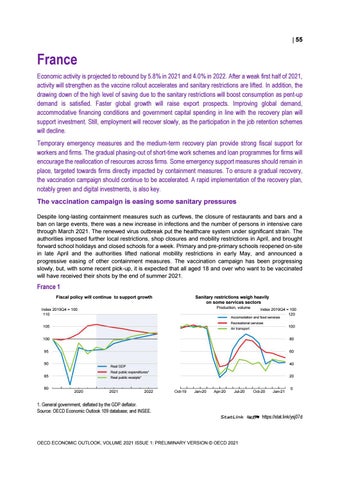
France Economic activity is projected to rebound by 5.8% in 2021 and 4.0% in 2022. After a weak first half of 2021, activity will strengthen as the vaccine rollout accelerates and sanitary restrictions are lifted. In addition, the drawing down of the high level of saving due to the sanitary restrictions will boost consumption as pent-up demand is satisfied. Faster global growth will raise export prospects. Improving global demand, accommodative financing conditions and government capital spending in line with the recovery plan will support investment. Still, employment will recover slowly, as the participation in the job retention schemes will decline. Temporary emergency measures and the medium-term recovery plan provide strong fiscal support for workers and firms. The gradual phasing-out of short-time work schemes and loan programmes for firms will encourage the reallocation of resources across firms. Some emergency support measures should remain in place, targeted towards firms directly impacted by containment measures. To ensure a gradual recovery, the vaccination campaign should continue to be accelerated. A rapid implementation of the recovery plan, notably green and digital investments, is also key. The vaccination campaign is easing some sanitary pressures Despite long-lasting containment measures such as curfews, the closure of restaurants and bars and a ban on large events, there was a new increase in infections and the number of persons in intensive care through March 2021. The renewed virus outbreak put the healthcare system under significant strain. The authorities imposed further local restrictions, shop closures and mobility restrictions in April, and brought forward school holidays and closed schools for a week. Primary and pre-primary schools reopened on-site in late April and the authorities lifted national mobility restrictions in early May, and announced a progressive easing of other containment measures. The vaccination campaign has been progressing slowly, but, with some recent pick-up, it is expected that all aged 18 and over who want to be vaccinated will have received their shots by the end of summer 2021.
France 1 Fiscal policy will continue to support growth
Sanitary restrictions weigh heavily on some services sectors Production, volume
Index 2019Q4 = 100 110
Index 2019Q4 = 100 120
Accomodation and food services Recreational services
105
100
Air transport
100
80
95
60
90
40
Real GDP Real public expenditures¹
85 80
20
Real public receipts¹
2020
2021
2022
0
0 Oct-19
Jan-20
Apr-20
Jul-20
Oct-20
Jan-21
0
1. General government, deflated by the GDP deflator. Source: OECD Economic Outlook 109 database; and INSEE. StatLink 2 https://stat.link/ysj07d
OECD ECONOMIC OUTLOOK, VOLUME 2021 ISSUE 1: PRELIMINARY VERSION © OECD 2021
56
France: Demand, output and prices 2017
2018
Current prices EUR billion
France GDP at market prices Private consumption Government consumption Gross fixed capital formation Final domestic demand Stockbuilding1
Net exports1 Memorandum items GDP deflator Harmonised index of consumer prices Harmonised index of core inflation2 Unemployment rate3 (% of labour force) Household saving ratio, gross (% of disposable income) General government financial balance (% of GDP)
_ _
General government gross debt (% of GDP) General government debt, Maastricht definition (% of GDP) Current account balance (% of GDP)
_ _ _ _ _ _ _
2020
2021
2022
Percentage changes, volume (2014 prices)
2 298.6 1 241.0 543.4 517.3 2 301.7 21.6 2 323.4 711.6 736.4 - 24.8
Total domestic demand Exports of goods and services Imports of goods and services
2019
1.8 0.8 0.9 3.2 1.4 0.0 1.4 4.6 3.1 0.4
1.5 1.5 1.7 4.3 2.2 -0.4 1.8 1.8 2.6 -0.3
-8.2 -7.3 -3.0 -10.4 -7.1 0.2 -6.8 -16.6 -12.0 -1.3
5.8 4.4 4.4 9.8 5.6 -0.3 5.3 9.4 7.6 0.3
4.0 6.5 0.3 2.0 4.0 0.0 4.0 8.2 7.9 -0.1
1.0 2.1
1.2 1.3
2.3 0.5
-0.6 1.4
0.9 0.8
0.9 0.6 0.6 1.1 0.8 9.0 8.4 8.0 8.8 8.7 14.1 14.6 20.8 18.7 14.1 -2.3 -3.1 -9.3 -8.4 -4.8 121.4 124.3 147.9 149.3 147.6 98.0 98.0 116.3 117.6 116.0 -0.6 -0.7 -2.3 -2.4 -2.2
1. Contributions to changes in real GDP, actual amount in the first column. 2. Harmonised index of consumer prices excluding food, energy, alcohol and tobacco. 3. National unemployment rate, includes overseas departments. Source: OECD Economic Outlook 109 database.
StatLink 2 https://stat.link/7rscy1
France 2 Saving will decline Index 2019Q4 = 100 110
Labour market slack will hold back inflation
% of disposable income 35
← Private consumption
105
% of labour force 14 Harmonised headline inflation → 13
Households' gross saving ratio →
30
100
25
Y-o-y % changes 1.8
← Unemployment rate
1.6
12
1.4
11
1.2
10 95
20
1.0
9 0.8
8 90
15
85
10
80
2020
2021
2022
5
0.6
7 6
0.4
5
0.2
4
2020
2021
2022
0.0
Source: OECD Economic Outlook 109 database. StatLink 2 https://stat.link/89zl2v
OECD ECONOMIC OUTLOOK, VOLUME 2021 ISSUE 1: PRELIMINARY VERSION © OECD 2021
57
The economic impact of restrictions has eased but remains concentrated in services After a weak start into 2021, the easing of some sanitary restrictions and stronger confidence indicators point to a significant but unequal recovery in manufacturing and services. Activity has been resilient to new restrictions, supported by the development of alternative work arrangements, significant fiscal and liquidity measures and an increase in online shopping. The estimated number of workers on short-time work schemes was close to 12% of private dependent employment in March and dependent private employment increased in all sectors in the first quarter. While supply-chain constraints weakened the industrial momentum in early 2021, industrial production is set to strengthen further. Yet, activity in restaurants, bars, personal and air travel services (around 14% of production in the non-financial market-services sectors in 2015) remained more than 50% below its end-2019 level in early May, before sanitary restrictions started to be eased.
Policy responses are extensive The authorities have taken comprehensive measures to support the ongoing recovery. The extension of the strengthened short-time work scheme and support for the smallest firms and the self-employed cushioned the impact of the end-2020 and early-2021 restrictions. The implementation of the EUR 100 billion medium-term recovery plan (France Relance) is set to lead to discretionary fiscal spending worth 1.7% of GDP in 2021 and 1.8% of GDP in 2022. This will provide broad support for the recovery. Higher public investment in infrastructure and digitalisation, as well as additional financing for training programmes, will improve productivity and resource reallocation. The EUR 10.5 billion business tax cut and hiring subsidies will support firms and jobs. Car and investment subsidies for households are targeted to green alternatives and to kick-start durable goods consumption and housing investment. The already planned housing and corporate income tax cuts, as well as higher funding for the health sector, will also partly damp the negative impact of the crisis on household income and business profit margins. The European Central Bank’s accommodative monetary policy continues to support aggregate demand. The Next Generation EU plan will help finance fiscal measures in France (France is set to receive EUR 40 billion of European grants to be used over two years) and in its main trading partners, thereby boosting domestic and external demand. The French authorities have also prolonged to 2021 emergency measures for hard-hit sectors and firms to alleviate corporate costs, notably through tax holidays and high public subsidisation of wages under short-time work agreements, and to support firm financing (via public guarantees of loans and quasi-equity long-term loans). At the same time, in most sectors, the increased cost sharing of the short-time work schemes and additional funding for training will encourage resource reallocation.
The recovery path remains uncertain Economic activity is projected to reach its pre-crisis level around the spring of 2022. Some sectors, such as transport and hospitality, which represent around 9% of pre-crisis GDP, will be durably affected by the pandemic. After a weak first half of 2021, the slow improvements of sanitary conditions and the rollout of the vaccination campaign will support consumption, with households reducing their high saving, notably among low and middle-wealth groups. Yet, targeted restrictions in services sectors requiring close physical interaction are set to remain until the autumn of 2021. The temporary rise of unemployment will keep affecting poorer and more precarious households negatively, and delay the housing market recovery. As demand in trading partners rebounds rapidly, exports will catch up gradually from their current historically low levels. Business investment, which has been resilient, will slowly strengthen, as improving economic
OECD ECONOMIC OUTLOOK, VOLUME 2021 ISSUE 1: PRELIMINARY VERSION © OECD 2021
58 prospects, accommodative financing conditions and the support from the recovery plan will compensate reduced profit margins, high gross debt and persistent uncertainty. The budget deficit and public debt are projected to remain at high levels relative to GDP, with debt (Maastricht definition) reaching 116% of GDP in 2022. Passenger transport, tourism and cultural services, as well as the aeronautical industry are likely to bear enduring scars. Demand for such services and goods has decreased and, in addition, its future recovery remains highly dependent on the evolution of the sanitary situation and the associated measures. Furthermore, businesses have built up sizeable debt, notably through government loan guarantees. As a result, some may face liquidity and solvency problems, which could precipitate large-scale firm bankruptcies and dent economic prospects. A slower recovery of the main trading partners in the euro area would also delay the recovery in France. On the upside, stronger pent-up domestic demand and spending of large accumulated savings, a swift use of European recovery funds and a faster-than-projected recovery in the international tourism sector would raise growth.
Policies will help strengthen the recovery The French recovery plan is set to provide well-balanced fiscal support and the current flexible approach of adapting policies to the evolution of the pandemic should be maintained. The priority is to accelerate the vaccination campaign further, notably for the most exposed workers and precarious population groups, which have had lower take-up rates so far, and to continue to increase high-speed testing capacities for adults and younger children to ensure that the strategy of mass testing, tracking and isolation is successful. Specific emergency measures should also continue to target viable firms affected by renewed local restrictions or temporarily depressed demand. Allowing an efficient reallocation of workers in the aftermath of the crisis is another key challenge, as gross corporate debt has soared and unemployment and bankruptcies are set to rise. The increased targeting of the short-time work schemes is welcome, but ensuring broad access to lifelong learning for low-skilled and long-term unemployed people, as well as an efficient implementation of quality standards for these programmes, is needed. Reviewing collective restructuring procedures and speeding up court processes, by encouraging some early debt restructuring, such as the planned fast-track restructuring procedures for small firms, and expanding court capacity, would ease the required adjustments. Strengthening innovation and management training initiatives for small firms, and providing them with extended hiring support programmes, would raise economic activity by facilitating the adoption of new technologies and removing barriers to growth of businesses.
OECD ECONOMIC OUTLOOK, VOLUME 2021 ISSUE 1: PRELIMINARY VERSION © OECD 2021