125
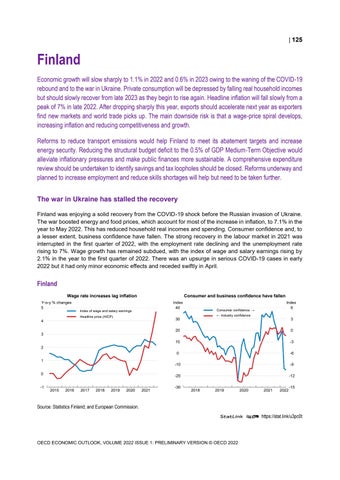
Finland Economic growth will slow sharply to 1.1% in 2022 and 0.6% in 2023 owing to the waning of the COVID-19 rebound and to the war in Ukraine. Private consumption will be depressed by falling real household incomes but should slowly recover from late 2023 as they begin to rise again. Headline inflation will fall slowly from a peak of 7% in late 2022. After dropping sharply this year, exports should accelerate next year as exporters find new markets and world trade picks up. The main downside risk is that a wage-price spiral develops, increasing inflation and reducing competitiveness and growth. Reforms to reduce transport emissions would help Finland to meet its abatement targets and increase energy security. Reducing the structural budget deficit to the 0.5% of GDP Medium-Term Objective would alleviate inflationary pressures and make public finances more sustainable. A comprehensive expenditure review should be undertaken to identify savings and tax loopholes should be closed. Reforms underway and planned to increase employment and reduce skills shortages will help but need to be taken further. The war in Ukraine has stalled the recovery Finland was enjoying a solid recovery from the COVID-19 shock before the Russian invasion of Ukraine. The war boosted energy and food prices, which account for most of the increase in inflation, to 7.1% in the year to May 2022. This has reduced household real incomes and spending. Consumer confidence and, to a lesser extent, business confidence have fallen. The strong recovery in the labour market in 2021 was interrupted in the first quarter of 2022, with the employment rate declining and the unemployment rate rising to 7%. Wage growth has remained subdued, with the index of wage and salary earnings rising by 2.1% in the year to the first quarter of 2022. There was an upsurge in serious COVID-19 cases in early 2022 but it had only minor economic effects and receded swiftly in April.
Finland Wage rate increases lag inflation Y-o-y % changes 5
Consumer and business confidence have fallen Index 40
Index of wage and salary earnings Headline price (HICP)
← Industry confidence
30
4 3
Index 6
Consumer confidence →
3
20
0
10
-3
0
-6
-10
-9
-20
-12
2 1 0 -1
2015
2016
2017
2018
2019
2020
2021
0
-30
2018
2019
2020
2021
2022
-15
Source: Statistics Finland; and European Commission. StatLink 2 https://stat.link/u3pc0t
OECD ECONOMIC OUTLOOK, VOLUME 2022 ISSUE 1: PRELIMINARY VERSION © OECD 2022
126
Finland: Demand, output and prices 2018
2019
GDP at market prices Private consumption Government consumption Gross fixed capital formation Final domestic demand Stockbuilding¹,² Total domestic demand Exports of goods and services Imports of goods and services Net exports¹ Memorandum items GDP deflator Harmonised index of consumer prices Harmonised index of core inflation³ Unemployment rate (% of labour force) Household saving ratio, net (% of disposable income) General government financial balance (% of GDP) General government gross debt (% of GDP) General government debt, Maastricht definition⁴ (% of GDP) Current account balance (% of GDP)
2021
2022
2023
Percentage changes, volume (2015 prices)
Current prices EUR billion
Finland
2020
233.5 123.9 53.5 56.2
1.2 0.7 2.0 -1.5
-2.3 -4.1 0.4 -0.3
3.5 3.1 3.2 1.2
1.1 0.8 1.4 3.3
0.6 -0.2 -0.8 1.4
233.6 2.8
0.5 -1.0
-2.1 0.1
2.7 0.8
1.5 0.2
0.0 0.0
236.4 89.8 92.7 - 2.9
-0.3 6.7 2.4 1.6
-1.2 -6.8 -5.8 -0.4
4.0 4.2 4.6 -0.2
1.7 -2.0 3.3 -2.1
0.0 3.0 1.6 0.6
1.5 1.1 0.7 6.7
1.6 0.4 0.5 7.8
2.7 2.1 1.2 7.6
5.7 6.2 3.8 7.2
3.7 4.6 4.2 7.7
0.4 -0.9 73.1 59.6 -0.3
4.7 -5.5 85.0 69.0 0.7
1.0 -2.6 78.6 65.8 0.7
-0.3 -3.1 86.3 73.5 -0.4
0.0 -3.2 92.2 79.4 0.0
_ _ _ _ _ _ _ _ _
1. Contributions to changes in real GDP, actual amount in the first column. 2. Including statistical discrepancy. 3. Harmonised index of consumer prices excluding food, energy, alcohol and tobacco. 4. The Maastricht definition of general government debt includes only loans, debt securities, and currency and deposits, with debt at face value rather than market value. Source: OECD Economic Outlook 111 database.
StatLink 2 https://stat.link/c8w4on
Goods exports to Russia (5.5% of 2021 goods exports) will shrink drastically this year and remain low. Oil imports from Russia have fallen sharply since the beginning of the war and are likely to end in July. Following Finland’s application in May to join NATO, Russia terminated gas and electricity exports to Finland. While most gas was imported from Russia, gas only represents 5% of total energy consumption and plans are advanced for sourcing it elsewhere, in LNG form. Additional electricity from local sources and from Sweden and Baltic countries has replaced imports of electricity from Russia, which represented 10% of electricity consumption. The new nuclear power plant that will come on stream in July will supply 14% of Finland’s electricity. The government estimates that there will be 60 000 (1.1% of the total population) applications for temporary protection in 2022 from people fleeing Ukraine.
The war is slowing fiscal consolidation Following marked consolidation in 2021, fiscal policy will be expansionary in 2022 despite a further reduction (by 1.5% of GDP) in COVID-19 support measures, and neutral in 2023. Measures in response to the war in Ukraine contribute 0.8% of GDP to the structural deficit this year and next. These include a large increase in defence expenditure and in refugee-related expenditures (0.1-0.3% of GDP annually). Modest budget measures have been announced to cushion the impact of higher energy prices, including a temporary increase in the maximum income tax deduction for commuting expenses and in net social security benefits. The government is committed to reducing the structural budget deficit over time by
OECD ECONOMIC OUTLOOK, VOLUME 2022 ISSUE 1: PRELIMINARY VERSION © OECD 2022
127 implementing reforms to increase employment, which will reduce transfers expenditure and increase government revenue. Reforms that will increase employment include a progressive increase in the pension eligibility age, the phasing out of the unemployment tunnel to early retirement and measures to incentivise job search and strengthen municipalities’ incentives to reduce unemployment.
Economic growth will be low GDP growth will slow sharply to 1.1% in 2022, despite substantial carryover from the COVID-19 rebound in late 2021, and 0.6% in 2023. Private consumption expenditure will be dragged down by weak growth in real household incomes, reflecting both an increase in inflation to a peak of around 7% and lower employment, but will begin to recover towards the end of 2023 as the direct and indirect contributions of higher energy and food prices to inflation diminish and employment expands. The unemployment rate will increase to a peak of 7.9% in early 2023 and decline slowly thereafter. Wage growth will increase to 4% in 2023 as unions seek to claw back part of the real wage losses endured since late 2021. Export growth will be down sharply this year as exports to Russia plummet and exports to other European countries fall, but should rise in 2023 as exporters find new markets and export markets strengthen. A key downside risk is that wage increases are significantly higher than projected, increasing inflation and reducing cost competitiveness, employment and growth. On the upside, private investments catalysed by the Recovery and Resilience Facility could be higher than projected.
Reforms are needed to support a stronger and more sustainable recovery The programmed investments to reduce greenhouse gas emissions will support the recovery and make it more sustainable, including by enhancing energy security. The government should go further in supporting retrofits to make buildings more energy efficient, reducing demand for car use, supporting the deployment of electric vehicles and, if necessary, should introduce an emissions trading scheme for the transport sector. Reforms to increase employment will also strengthen the eventual recovery but need to be taken further if the government’s objective of increasing employment by 80 000 by the end of the decade and thereby reducing the structural budget deficit by 0.4-0.8% of GDP are to be realised. It will also be vital to reduce the severe skills shortages Finland faces by facilitating skilled immigration and increasing the tertiary attainment rate.
OECD ECONOMIC OUTLOOK, VOLUME 2022 ISSUE 1: PRELIMINARY VERSION © OECD 2022