48
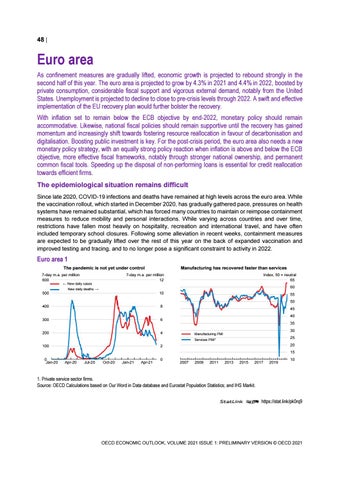
Euro area As confinement measures are gradually lifted, economic growth is projected to rebound strongly in the second half of this year. The euro area is projected to grow by 4.3% in 2021 and 4.4% in 2022, boosted by private consumption, considerable fiscal support and vigorous external demand, notably from the United States. Unemployment is projected to decline to close to pre-crisis levels through 2022. A swift and effective implementation of the EU recovery plan would further bolster the recovery. With inflation set to remain below the ECB objective by end-2022, monetary policy should remain accommodative. Likewise, national fiscal policies should remain supportive until the recovery has gained momentum and increasingly shift towards fostering resource reallocation in favour of decarbonisation and digitalisation. Boosting public investment is key. For the post-crisis period, the euro area also needs a new monetary policy strategy, with an equally strong policy reaction when inflation is above and below the ECB objective, more effective fiscal frameworks, notably through stronger national ownership, and permanent common fiscal tools. Speeding up the disposal of non-performing loans is essential for credit reallocation towards efficient firms. The epidemiological situation remains difficult Since late 2020, COVID-19 infections and deaths have remained at high levels across the euro area. While the vaccination rollout, which started in December 2020, has gradually gathered pace, pressures on health systems have remained substantial, which has forced many countries to maintain or reimpose containment measures to reduce mobility and personal interactions. While varying across countries and over time, restrictions have fallen most heavily on hospitality, recreation and international travel, and have often included temporary school closures. Following some alleviation in recent weeks, containment measures are expected to be gradually lifted over the rest of this year on the back of expanded vaccination and improved testing and tracing, and to no longer pose a significant constraint to activity in 2022.
Euro area 1 The pandemic is not yet under control 7-day m.a. per million 600
Manufacturing has recovered faster than services
7-day m.a. per million 12
← New daily cases
Index, 50 = neutral 65 60
New daily deaths →
500
10
400
8
300
6
200
4
55 50 45 40 35 30 Manufacturing PMI
25
Services PMI¹
100
20
2
15 0 Jan-20
Apr-20
Jul-20
Oct-20
Jan-21
Apr-21
0
0
2007
2009
2011
2013
2015
2017
2019
10
1. Private service sector firms. Source: OECD Calculations based on Our Word in Data database and Eurostat Population Statistics; and IHS Markit. StatLink 2 https://stat.link/pk0rq9
OECD ECONOMIC OUTLOOK, VOLUME 2021 ISSUE 1: PRELIMINARY VERSION © OECD 2021
49
Euro area: Demand, output and prices 2017
2018
Current prices EUR billion
Euro area GDP at market prices Private consumption Government consumption Gross fixed capital formation Final domestic demand Stockbuilding1 Total domestic demand
2019
2020
2021
2022
Percentage changes, volume (2015 prices)
11 191.4 6 025.0 2 296.8 2 305.2 10 627.0 79.3 10 706.3
1.9 1.5 1.2 3.2 1.8 0.1 1.8
1.3 1.3 1.7 5.7 2.5 -0.5 1.9
-6.7 -8.0 1.2 -8.5 -6.1 -0.3 -6.4
4.3 2.5 2.9 5.7 3.3 0.0 3.4
4.4 6.0 0.9 5.6 4.7 0.0 4.7
485.1
0.1
-0.5
-0.5
1.0
-0.1
_ _
1.4 1.8
1.7 1.2
1.6 0.3
0.9 1.8
1.3 1.3
Net exports1 Memorandum items GDP deflator Harmonised index of consumer prices Harmonised index of core inflation2
_ _ _ _ _ _ _
Unemployment rate (% of labour force) Household saving ratio, net (% of disposable income) General government financial balance (% of GDP) General government gross debt (% of GDP) General government debt, Maastricht definition (% of GDP) Current account balance (% of GDP)
1.0 1.0 0.7 1.2 1.1 8.2 7.5 7.9 8.2 7.9 6.5 6.8 13.7 11.9 7.5 -0.5 -0.6 -7.2 -7.2 -3.7 102.4 103.5 121.9 124.6 123.2 87.7 85.9 100.2 102.8 101.4 3.5 3.1 2.9 3.3 3.2
Note: Aggregation based on euro area countries that are members of the OECD, and on seasonally-adjusted and calendar-daysadjusted basis. 1. Contributions to changes in real GDP, actual amount in the first column. 2. Harmonised index of consumer prices excluding food, energy, alcohol and tobacco. Source: OECD Economic Outlook 109 database.
StatLink 2 https://stat.link/j8iwr1
Euro area 2 National fiscal policies remain supportive
GDP will remain below its pre-pandemic growth path
Change in the underlying primary balance¹ % pts 2.0
Index 2019Q4 = 100 105
1.5 1.0
100
0.5 0.0
95
-0.5 -1.0 90
-1.5 -2.0 Current growth path
-2.5
85
Pre-crisis growth path²
-3.0 -3.5
2006 2008 2010 2012 2014 2016 2018 2020 2022
0
0
2020
2021
2022
80
1. Measured in percent of potential GDP. 2. The pre-crisis growth path is based on the November 2019 OECD Economic Outlook projection, with linear extrapolation for 2022 based on trend growth in 2021. Source: OECD Economic Outlook 106 and 109 databases. StatLink 2 https://stat.link/m5bgsi
OECD ECONOMIC OUTLOOK, VOLUME 2021 ISSUE 1: PRELIMINARY VERSION © OECD 2021
50
Activity has remained subdued, held back by services After contracting in the final quarter of 2020 and in the first quarter of 2021, activity has displayed signs of an uptick more recently. Private consumption has been a key driver of GDP dynamics. In early 2021, retail sales fell to levels well below those recorded before the pandemic started, with a subsequent recovery in February and March. More directly affected by lockdowns, consumption of services has likely been weaker. A rise in core inflation in early 2021 was mostly transient, due to the updating of consumer price index weights and temporary effects associated with tax changes and the postponement of winter sales. The corresponding increase in headline inflation has lasted longer, due to higher energy prices. Amidst continued widespread resort to short-time work schemes, unemployment remained broadly stable in the initial months of this year. After a sustained recovery throughout the second half of 2020, activity in manufacturing and construction was mostly flat in early 2021. Nonetheless, export-oriented industrial segments have tended to fare better, benefitting from greater external demand dynamism. Reflecting these different developments, confidence indicators in manufacturing have remained stronger than in services, where nonetheless a recovery has been observed in recent months.
Policies remain supportive at European and national levels The ECB has taken further action to preserve very favourable financing conditions for public and private borrowers. In December 2020, it announced additional targeted and non-targeted longer-term refinancing operations and expanded its pandemic emergency purchase programme (PEPP) by another EUR 500 billion, with net purchases to run until at least March 2022 (extended from June 2021). In March 2021, the ECB decided to significantly accelerate PEPP purchases in the following months. These measures have helped to mitigate the increase in long-term interest rates in the euro area, in a global context of yield curve steepening, and prevent a widening of government bond spreads within the euro area. Given that inflation is projected to remain at levels well below 2 per cent, ECB policy rates are assumed to remain unchanged in 2021 and 2022, amidst broadly stable sovereign debt spreads. National fiscal policies are expected to provide substantial support to activity, especially in 2021. On top of the operation of automatic stabilisers, governments provided discretionary stimulus estimated at around 2 percentage points of euro area GDP in 2020, which suggests that not all announced measures were fully implemented last year. A discretionary fiscal expansion of slightly larger magnitude is projected for 2021, followed by some contraction in 2022, as some crisis-related measures, such as those pertaining to short-time working, will likely be much less needed. This welcome fiscal support partly relies on the substantial implementation of national recovery and resilience plans, which benefit from EU grants. The projections thus assume that the outstanding procedural steps for making the EU recovery plan operational, not least ratification by all member states to enable common debt issuance, are completed by this summer. The fiscal support is also backed by the likely prolongation of the suspension of Stability and Growth Pact constraints until end-2022, which would have otherwise triggered a stronger fiscal consolidation in some countries in 2022, and possibly a more prudent stance even this year. Before the Stability and Growth Pact is reactivated, the European fiscal framework needs substantial revision, aiming to ensure debt sustainability, sufficient cyclical stabilisation and greater national ownership.
Growth will rebound strongly, but scars will remain After a strong acceleration in the second half of this year, GDP growth is projected to moderate, but remain robust. In the remainder of 2021, private consumption is set to benefit from the lifting of containment measures and a concomitant fall in household saving, which finances sizeable pent-up demand. Activity will be further supported by considerable fiscal stimulus and vigorous export growth. In 2022, growth will continue to be spurred by exports and capital formation, the latter relying on a significant contribution from public investment. Nonetheless, household saving, albeit declining, is projected to remain higher than before the crisis, and the recovery of private investment will be only moderate. At the end of 2022, unemployment is projected to return to close to pre-pandemic levels, and inflation will remain subdued.
OECD ECONOMIC OUTLOOK, VOLUME 2021 ISSUE 1: PRELIMINARY VERSION © OECD 2021
51 Maastricht public debt will peak in 2021 at 103% of euro area GDP. Output developments are projected to remain asymmetric across the euro area, with southern countries worst hit, even though the prospects of greater divergence are now less severe than in earlier stages of the crisis. The expected lifting of confinement measures and the associated rebound in activity could come under threat if vaccination proved ineffective against new virus variants. Besides greater short-run output losses, higher unemployment and insolvencies would compound medium-term reallocation challenges. Slow or inefficient implementation of the EU recovery plan, possibly accompanied by the reinstatement of essentially unreformed European fiscal rules in 2023, would slow the recovery, risk reigniting sovereign debt tensions and, more generally, weaken the cohesion and further integration prospects of the euro area. Conversely, prompt and efficient deployment of national recovery and resilience plans, with an emphasis on structural reforms to crowd in private investment and promote skills and activation, would bolster confidence, durably enhance growth and help Europe succeed in the green and digital transitions.
Fiscal and financial policies should support resource reallocation As lockdown measures are gradually lifted, fiscal policy should promote resource reallocation from activities that may face long-lasting subdued demand towards those likely to expand. Towards this end, enhanced activation policies and public capital formation, including in research and innovation, are essential policy levers. On this count, it is encouraging that the moderate fiscal consolidation projected for 2022 is accompanied by a strong increase in public investment, and it is essential that this increase corresponds to carefully selected productivity-enhancing projects. In the future, creating a permanent common fiscal stabilisation capacity in the euro area would reduce risks of cyclical divergence, which has tended to permanently damage potential output. The likely surge in non-performing loans in the near future may hamper credit supply and its reallocation towards more productive firms. Speeding up the disposal of such loans calls for reforming foreclosing procedures and supporting the development of secondary markets for distressed debt. Setting up asset management companies, at national or European levels, could also be considered.
OECD ECONOMIC OUTLOOK, VOLUME 2021 ISSUE 1: PRELIMINARY VERSION © OECD 2021