115
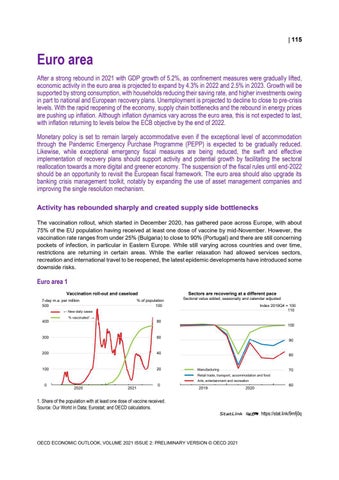
Euro area After a strong rebound in 2021 with GDP growth of 5.2%, as confinement measures were gradually lifted, economic activity in the euro area is projected to expand by 4.3% in 2022 and 2.5% in 2023. Growth will be supported by strong consumption, with households reducing their saving rate, and higher investments owing in part to national and European recovery plans. Unemployment is projected to decline to close to pre-crisis levels. With the rapid reopening of the economy, supply chain bottlenecks and the rebound in energy prices are pushing up inflation. Although inflation dynamics vary across the euro area, this is not expected to last, with inflation returning to levels below the ECB objective by the end of 2022. Monetary policy is set to remain largely accommodative even if the exceptional level of accommodation through the Pandemic Emergency Purchase Programme (PEPP) is expected to be gradually reduced. Likewise, while exceptional emergency fiscal measures are being reduced, the swift and effective implementation of recovery plans should support activity and potential growth by facilitating the sectoral reallocation towards a more digital and greener economy. The suspension of the fiscal rules until end-2022 should be an opportunity to revisit the European fiscal framework. The euro area should also upgrade its banking crisis management toolkit, notably by expanding the use of asset management companies and improving the single resolution mechanism. Activity has rebounded sharply and created supply side bottlenecks The vaccination rollout, which started in December 2020, has gathered pace across Europe, with about 75% of the EU population having received at least one dose of vaccine by mid-November. However, the vaccination rate ranges from under 25% (Bulgaria) to close to 90% (Portugal) and there are still concerning pockets of infection, in particular in Eastern Europe. While still varying across countries and over time, restrictions are returning in certain areas. While the earlier relaxation had allowed services sectors, recreation and international travel to be reopened, the latest epidemic developments have introduced some downside risks.
Euro area 1 Vaccination roll-out and caseload 7-day m.a. per million 500
Sectors are recovering at a different pace Sectoral value added, seasonally and calendar adjusted
% of population 100
Index 2019Q4 = 100 110
← New daily cases
400
% vaccinated¹ →
80
300
60
200
40
100
20
100
90
80
Manufacturing
70
Retail trade, transport, accommodation and food Arts, entertainment and recreation
0
2020
2021
0
0
2019
2020
60
1. Share of the population with at least one dose of vaccine received. Source: Our World in Data; Eurostat; and OECD calculations. StatLink 2 https://stat.link/9mfj0q
OECD ECONOMIC OUTLOOK, VOLUME 2021 ISSUE 2: PRELIMINARY VERSION © OECD 2021
116
Euro Area: Demand, output and prices 2018
2019
GDP at market prices Private consumption Government consumption Gross fixed capital formation Final domestic demand Stockbuilding¹ Total domestic demand Net exports¹ Memorandum items GDP deflator Harmonised index of consumer prices Harmonised index of core inflation² Unemployment rate (% of labour force)
2021
2022
2023
Percentage changes, volume (2015 prices)
Current prices EUR billion
Euro area
2020
11 571.0 6 203.7 2 364.5 2 426.7
1.6 1.4 1.8 6.8
-6.5 -8.0 1.2 -7.4
5.2 3.5 3.6 4.1
4.3 5.9 1.1 5.0
2.5 2.4 0.7 3.8
10 994.8 108.5
2.7 -0.1
-5.9 -0.4
3.7 0.4
4.6 -0.1
2.3 0.0
11 103.3 467.7
2.5 -0.8
-6.2 -0.4
4.0 1.4
4.4 0.1
2.3 0.3
_ _ _ _ _ _ _ _ _
1.7 1.2 1.0 7.6
1.6 0.3 0.7 7.9
2.0 2.4 1.3 7.7
2.3 2.7 1.8 7.2
1.8 1.8 1.8 7.0
Household saving ratio, net (% of disposable income) General government financial balance (% of GDP) General government gross debt (% of GDP) General government debt, Maastricht definition³ (% of GDP) Current account balance (% of GDP)
7.2 13.8 11.1 6.9 6.1 -0.6 -7.2 -6.7 -3.8 -2.7 103.1 120.9 122.0 120.4 119.9 85.5 99.5 100.6 99.0 98.5 3.0 2.7 3.4 3.1 3.3
Note: Aggregation based on euro area countries that are members of the OECD, and on seasonally-adjusted and calendar-daysadjusted basis. 1. Contributions to changes in real GDP, actual amount in the first column. 2. Harmonised index of consumer prices excluding food, energy, alcohol and tobacco. 3. The Maastricht definition of general government debt includes only loans, debt securities, and currency and deposits, with debt at face value rather than market value. Source: OECD Economic Outlook 110 database.
StatLink 2 https://stat.link/bhorad
Euro area 2 The inflation surge is projected to moderate
The recovery is stronger than expected Real GDP
Y-o-y % changes 4
3
Headline inflation
China
Core inflation¹
United States
Index 2019Q4 = 100 130
120
EA17 EA17 December 2020 projection
2
110
1
100
0
90
-1
2013
2015
2017
2019
2021
2023
0
0
2019
2020
2021
2022
2023
80
1. Harmonised index of consumer prices excluding food, energy, alcohol and tobacco. Source: OECD Economic Outlook 108 and 110 databases; and OECD calculations. StatLink 2 https://stat.link/f9nty6
OECD ECONOMIC OUTLOOK, VOLUME 2021 ISSUE 2: PRELIMINARY VERSION © OECD 2021
117 Economic activity rebounded sharply in the first half of 2021, with growth remaining very dynamic in the third quarter. Private consumption, fuelled by pent-up demand and a rise in labour compensation, has been a key driver so far. This has helped to support the recovery in service sectors, following that in manufacturing. However, this rapid resumption of economic activity has now slowed due to a series of supply chain bottlenecks, particularly in the construction and transportation sectors. As a result, the manufacturing PMI has eased since its peak in the summer 2021. Bottlenecks, combined with a rise in energy prices, have also caused a surge in the annual rates of headline and core inflation, which reached 4.1% and 2% respectively in October 2021. While long-term inflation expectations have rebounded from their trough, they remain anchored below the ECB inflation target so far.
Fiscal and monetary policy shifts must be managed carefully The ECB has maintained very favourable financing conditions for public and private borrowers through the crisis. Targeted and non-targeted longer-term refinancing operations and the expansion of its pandemic emergency purchase programme (PEPP) have played a critical role supporting the euro area recovery. Still, with net emergency purchases only set to run until March 2022, this will be an important policy shift and could increase the importance of the Public Sector Purchase Programme (PSPP). The new monetary policy strategy and forward guidance rightly raise the bar for policy normalisation and may in fact warrant a more flexible use of the PSPP programme, which could be extended until headline inflation is anticipated to stay durably at 2%. With inflation projected to return to levels below 2% by the end of 2022 and until the end of 2023, and given the global context of policy normalisation in other advanced economies, ECB policy will be central to prevent undue monetary tightening. Policy rates are assumed to remain unchanged in 2022 and 2023. National fiscal policies have provided substantial support to activity in 2020 and 2021. On top of the operation of automatic stabilisers, governments provided discretionary stimulus above 2 percentage points of euro area GDP in 2021, but a gradual consolidation is expected in 2022 and 2023 as exceptional support measures are phased out. Member States will benefit from the implementation of national recovery plans, financed in part by EU grants and loans over the projection horizon. The medium-term fiscal outlook at the national level is in part contingent on the timing and conditions for the reinstatement of the Stability and Growth Pact.
After a strong rebound, growth will progressively return to potential Growth is projected to be 5.2% in 2021 before gradually slowing to 4.3% in 2022 and 2.5% in 2023. Private consumption and investment will continue to benefit from the lifting of containment measures and buoyant household spending. In 2022, unemployment is projected to be at pre-pandemic levels and to fall below that in 2023 but, assuming the absence of sustained wage pressures, inflation is set to fall below 2% by the end of 2022. Activity will be further supported by strong export growth fuelled by the recovery in the rest of the world. This will bring the euro area current account surplus well above 3% of GDP as early as 2021.
OECD ECONOMIC OUTLOOK, VOLUME 2021 ISSUE 2: PRELIMINARY VERSION © OECD 2021
118 Regarding risks to the outlook, the effectiveness of the vaccination campaign could be hampered by implementation challenges (third doses, vaccination reluctance) as well as the emergence of new variants. This could lead to renewed restriction measures. In this context, a hasty and generalised fiscal consolidation or a too rapid reduction in the pace of the asset purchase programmes by the ECB could slow the recovery and could potentially reignite sovereign debt tensions and, more generally, weaken the cohesion of the euro area and cyclical convergence across its member states. Finally, persistent supply bottlenecks could lead to higher-than-expected inflation and uncertainty about the recovery. Conversely, prompt and efficient deployment of national recovery and resilience plans, combined with an ambitious reform of the EU fiscal framework would bolster confidence, durably enhance growth and help Europe succeed in the green and digital transitions.
Economic policies should support sectoral resource reallocation The need for policy support to encourage resource allocation across sectors and boost potential growth remains. Emergency fiscal policy support should become more targeted as the economy recovers. Public investment, especially for energy transition and digitalisation, including via research and innovation, is an essential policy lever to support economic transition. The Recovery and Resilience Facility (RRF) will be particularly important in that respect. In the future, creating a permanent common fiscal stabilisation capacity in the euro area would reduce risks of cyclical divergence, which has tended to permanently damage potential output. In spite of the importance of the RRF, national fiscal policy will remain the main fiscal tool. The current uncertainty over the evolution of European fiscal rules is creating risks about the fiscal policy stance. The debate opened by the European Commission’s communication on the reform of the fiscal framework is encouraging, but a consensus is yet to emerge. Before that, the Commission will have to consider how to reintroduce the Stability and Growth Pact without harming the recovery or undermining green investment needs. Structural reforms should remain a central part of the European economic agenda. They are critical to the sustainability of the ongoing economic rebound and are needed to foster convergence. They should focus in particular on reforms related to education, digitalisation, and the environmental and energy transition, as well as the financial sector. For example, an upgraded crisis management framework, which allows faster restructuring of banks is needed. This calls for a new toolkit that may include Asset Management Companies, asset protection schemes, reforms to loan foreclosure procedures and support for the development of secondary markets for distressed debt.
OECD ECONOMIC OUTLOOK, VOLUME 2021 ISSUE 2: PRELIMINARY VERSION © OECD 2021