45
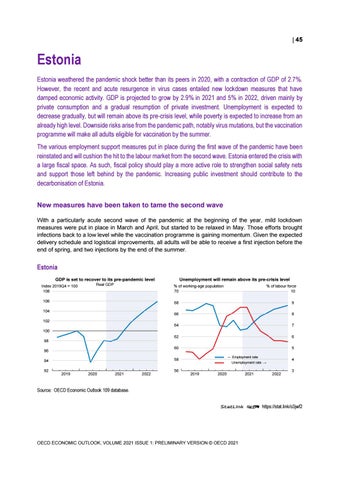
Estonia Estonia weathered the pandemic shock better than its peers in 2020, with a contraction of GDP of 2.7%. However, the recent and acute resurgence in virus cases entailed new lockdown measures that have damped economic activity. GDP is projected to grow by 2.9% in 2021 and 5% in 2022, driven mainly by private consumption and a gradual resumption of private investment. Unemployment is expected to decrease gradually, but will remain above its pre-crisis level, while poverty is expected to increase from an already high level. Downside risks arise from the pandemic path, notably virus mutations, but the vaccination programme will make all adults eligible for vaccination by the summer. The various employment support measures put in place during the first wave of the pandemic have been reinstated and will cushion the hit to the labour market from the second wave. Estonia entered the crisis with a large fiscal space. As such, fiscal policy should play a more active role to strengthen social safety nets and support those left behind by the pandemic. Increasing public investment should contribute to the decarbonisation of Estonia. New measures have been taken to tame the second wave With a particularly acute second wave of the pandemic at the beginning of the year, mild lockdown measures were put in place in March and April, but started to be relaxed in May. Those efforts brought infections back to a low level while the vaccination programme is gaining momentum. Given the expected delivery schedule and logistical improvements, all adults will be able to receive a first injection before the end of spring, and two injections by the end of the summer.
Estonia GDP is set to recover to its pre-pandemic level Index 2019Q4 = 100 108
Unemployment will remain above its pre-crisis level
Real GDP
% of working-age population 70
106 104
% of labour force 10
68
9
66
8
64
7
62
6
60
5
102 100 98 96
92
← Employment rate
58
94 2019
2020
2021
2022
0
56
4
Unemployment rate →
2019
2020
2021
2022
3
Source: OECD Economic Outlook 109 database. StatLink 2 https://stat.link/o3jwf2
OECD ECONOMIC OUTLOOK, VOLUME 2021 ISSUE 1: PRELIMINARY VERSION © OECD 2021
46
Estonia: Demand, output and prices
StatLink 2 https://stat.link/xwz3l1
The resurgence of the pandemic has damped the recovery After one of the mildest GDP declines in Europe in 2020, the escalation of the second wave started to hit the economy at the end of last year. However, despite restrictions on mobility and economic activity during the first and the beginning of the second quarter of 2021, general economic sentiment remains strong after a record low a year earlier. With a very flexible labour market, employment has continued to drop, and unemployment has risen, offsetting the gains achieved before the pandemic. Wage growth has eased but not stalled, with most of the slowdown in the higher and lower salary ranges. High-frequency indicators signal robust growth in households’ demand deposits, suggesting there is large pent-up demand to be released.
Effective economic support has been reinstated A new pandemic-related fiscal stimulus was passed in March 2021, amounting to around 2.6% of 2020 GDP, to support the economy throughout the first half of the year. The new measures consist mainly of a salary top-up scheme, similar to the effective support put in place last year, help for businesses demonstrably heavily hit by the second round of restrictions, compensation for the temporary suspension of state contributions to the second pillar of the Estonian pension scheme, and healthcare expenses. Given the improved sanitary situation and the momentum of the vaccination programme, there is no plan for further action at the moment.
OECD ECONOMIC OUTLOOK, VOLUME 2021 ISSUE 1: PRELIMINARY VERSION © OECD 2021
47
A strong recovery is down the road Thanks to the rollout of the vaccination programme and the full lifting of COVID-19 restrictions by the end of spring, GDP is projected to grow by 2.9% in 2021, with growth expected to strengthen in the second half of the year. This momentum should then propel growth to 5% in 2022. In both years, private consumption, driven by the normalisation of saving after the increase in 2020, and investment will be the main drivers of growth. The expected pick-up in EU fund absorption, as the current financing cycle approaches its end in 2023, and future spending related to the EU Recovery and Resilience Facility, will also underpin growth in 2022. After having turned negative in 2020, inflation is expected to remain subdued in 2021 before rising above 2% in 2022, once the situation on the labour market improves and excise taxes on diesel are reestablished to their previous rates. Apart from a resurgence of the pandemic with virus strains that current vaccines may not be able to address, lower consumption due to persistently high unemployment remains the key risk to growth.
Policies need to address looming poverty and climate challenges The crisis could unwind the social benefits of past reforms, offsetting the strong gains in labour force participation and employment for the low-skilled before the pandemic and aggravating an already high level of relative poverty. Moreover, the recent changes to the second pillar of the pension system, which allow savers to withdraw accumulated pension assets before pension age, could amplify old-age poverty. The relative weight of the elderly among the poor has already increased over the past decade as pensions have failed to keep pace with wages. With still ample fiscal room, and to meet the government´s goal of reducing relative poverty to 15% by 2023, the social safety net needs to be strengthened, notably passive support to the unemployed. Vulnerable groups should also be encouraged to obtain basic health insurance, for instance at the level of the social tax paid by minimum wage earners for health insurance. While protecting low-income households from rising energy bills, especially for heating their homes, further efforts to decarbonise should be encouraged. Public investment should target the interconnection of the electricity network with the European grid.
OECD ECONOMIC OUTLOOK, VOLUME 2021 ISSUE 1: PRELIMINARY VERSION © OECD 2021