112
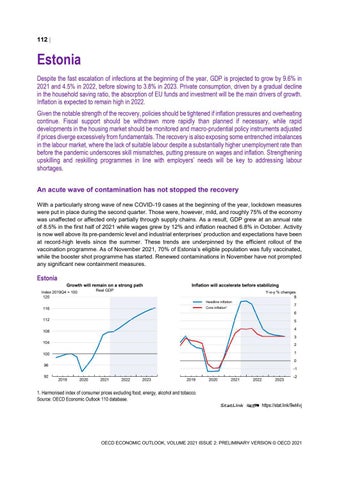
Estonia Despite the fast escalation of infections at the beginning of the year, GDP is projected to grow by 9.6% in 2021 and 4.5% in 2022, before slowing to 3.8% in 2023. Private consumption, driven by a gradual decline in the household saving ratio, the absorption of EU funds and investment will be the main drivers of growth. Inflation is expected to remain high in 2022. Given the notable strength of the recovery, policies should be tightened if inflation pressures and overheating continue. Fiscal support should be withdrawn more rapidly than planned if necessary, while rapid developments in the housing market should be monitored and macro-prudential policy instruments adjusted if prices diverge excessively from fundamentals. The recovery is also exposing some entrenched imbalances in the labour market, where the lack of suitable labour despite a substantially higher unemployment rate than before the pandemic underscores skill mismatches, putting pressure on wages and inflation. Strengthening upskilling and reskilling programmes in line with employers’ needs will be key to addressing labour shortages. An acute wave of contamination has not stopped the recovery With a particularly strong wave of new COVID-19 cases at the beginning of the year, lockdown measures were put in place during the second quarter. Those were, however, mild, and roughly 75% of the economy was unaffected or affected only partially through supply chains. As a result, GDP grew at an annual rate of 8.5% in the first half of 2021 while wages grew by 12% and inflation reached 6.8% in October. Activity is now well above its pre-pandemic level and industrial enterprises’ production and expectations have been at record-high levels since the summer. These trends are underpinned by the efficient rollout of the vaccination programme. As of November 2021, 70% of Estonia’s eligible population was fully vaccinated, while the booster shot programme has started. Renewed contaminations in November have not prompted any significant new containment measures.
Estonia Growth will remain on a strong path
Inflation will accelerate before stabilizing
Real GDP
Index 2019Q4 = 100 120
Y-o-y % changes 8 Headline inflation
7
Core inflation¹
116
6 112
5 4
108
3 104
2 1
100
0 96 92
-1 2019
2020
2021
2022
2023
0
0
2019
2020
2021
2022
2023
-2
1. Harmonised index of consumer prices excluding food, energy, alcohol and tobacco. Source: OECD Economic Outlook 110 database. StatLink 2 https://stat.link/9wt4vj
OECD ECONOMIC OUTLOOK, VOLUME 2021 ISSUE 2: PRELIMINARY VERSION © OECD 2021
113
Estonia: Demand, output and prices 2018
Estonia GDP at market prices Private consumption Government consumption Gross fixed capital formation Final domestic demand Stockbuilding¹ Total domestic demand Exports of goods and services Imports of goods and services Net exports¹ Memorandum items GDP deflator Harmonised index of consumer prices Harmonised index of core inflation² Unemployment rate (% of labour force) Household saving ratio, net (% of disposable income) General government financial balance (% of GDP) General government gross debt (% of GDP) General government debt, Maastricht definition³ (% of GDP) Current account balance (% of GDP)
2019
_ _ _ _ _ _ _ _ _
2021
2022
2023
Percentage changes, volume (2015 prices)
Current prices EUR billion
25.8 12.9 5.0 6.4 24.3 0.8 25.1 19.2 18.5 0.7
2020
4.0 3.9 3.1 5.9 4.4 -1.2 3.0 6.5 3.8 2.1
-2.7 -2.5 3.1 16.5 3.9 -1.0 2.2 -5.0 0.5 -4.1
9.6 6.9 3.5 28.1 12.9 3.8 16.3 15.3 27.4 -8.4
4.5 5.4 1.1 4.7 4.3 0.4 4.7 7.7 8.6 -1.3
3.8 2.8 0.8 3.3 2.6 0.0 2.6 5.3 3.8 1.0
3.3 2.3 2.4 4.4 8.7 0.1 13.6 8.6 2.5
-0.5 -0.6 0.0 6.8 11.9 -5.6 24.8 19.0 -0.2
1.7 4.1 2.5 6.2 10.2 -6.4 33.4 20.8 -6.9
4.7 6.0 3.6 5.4 7.2 -3.5 37.8 22.4 -5.5
3.6 3.2 3.0 5.3 5.8 -2.3 40.6 24.2 -2.1
1. Contributions to changes in real GDP, actual amount in the first column. 2. Harmonised index of consumer prices excluding food, energy, alcohol and tobacco. 3. The Maastricht definition of general government debt includes only loans, debt securities, and currency and deposits, with debt at face value rather than market value. Source: OECD Economic Outlook 110 database.
StatLink 2 https://stat.link/9c0bjt
Effective economic support has helped mitigate social and economic impacts The 2021 supplementary budget has provided further resources to cover the extraordinary additional COVID-19-related costs, notably the enlargement of testing and vaccinations capacities. The wage support scheme passed in 2020 and re-instated in 2021 was withdrawn in May amid the improved sanitary situation and the progress in the vaccination programme. Other measures such as excise tax cuts, tax incentives, and the deferral of tax debt have been maintained. However, they are assumed to fade out completely in 2022 and 2023 given the strength of the recovery. Due to the low take-up of financing support to businesses in 2020, the unused amounts have been carried over for 2021, but no plan has been announced to extend this support further.
The recovery is expected to continue but overheating is looming Strong growth is expected to continue in 2022 before slowing in 2023. Thanks to the rollout of the vaccination programme and the perspective of a restrictions-free economy, GDP is projected to grow by 9.6% in 2021. In 2022 GDP growth will continue to be strong, supported by private consumption and the gradual decline in the saving rate from the peak achieved at the beginning of 2021, and by investment. The expected pick-up in EU fund absorption, as spending under the previous 2014-2020 financing cycle approaches its end in 2023, and future spending related to the EU Recovery and Resilience Facility, just under EUR 1bn, will also underpin growth in 2022. The use of savings in individual pension funds will also continue to sustain private consumption in 2022. However, these effects are expected to fade in 2023, with
OECD ECONOMIC OUTLOOK, VOLUME 2021 ISSUE 2: PRELIMINARY VERSION © OECD 2021
114 GDP growth projected to slow down to 3.8%, with inflation easing to 3.2% once the situation in the labour market returns close to the pre-pandemic conditions. Estonia’s positive outlook is subject to risks that are skewed to the upside. Virus mutation, or the lack thereof, further disruptions or recovery of supply chains, weaker or stronger-than-expected domestic and external demand, could all have negative or positive impacts on GDP growth. If euro area monetary policy remains very accommodative, a stronger-thanexpected domestic recovery could reduce spare capacity and result in overheating, pushing up domestic inflation substantially.
Policies need to keep the economy in balance Diverging economic conditions and inflation developments between Estonia and the euro area should be kept in check by withdrawing fiscal support and reducing spending more rapidly than announced if overheating and rapid inflation and wage developments continue. On the other hand, when justified, targeted fiscal support should be maintained if some hard-hit sectors, such as transport, tourism, culture and sports, are struggling to benefit from the recovery. Macro-prudential instruments, such as debt-to-income and loan-to-value ratios, should also be promptly adjusted if real-estate market prices continue to rise rapidly due to favourable financing conditions and the expected gradual withdrawal of deposits accumulated during the pandemic that could be used inthis market. Inflation and wage pressures could also be eased by addressing imbalances in the labour market. Stepping up the engagement of employers and trade unions in vocational education and training programmes, promoting pathways from these programs into higher levels of education, and creating specific training programmes, notably for those with inadequate skills, would allow low-skilled and displaced workers to strengthen their attachment to the labour market and benefit from the recovery, while alleviating labour shortages.
OECD ECONOMIC OUTLOOK, VOLUME 2021 ISSUE 2: PRELIMINARY VERSION © OECD 2021