118
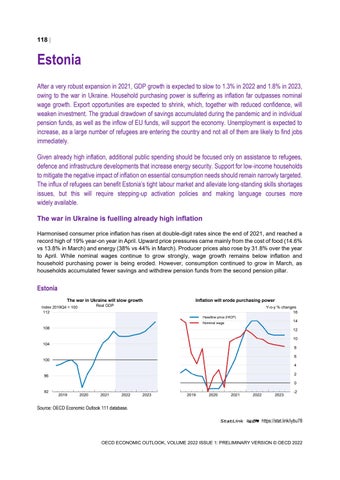
Estonia After a very robust expansion in 2021, GDP growth is expected to slow to 1.3% in 2022 and 1.8% in 2023, owing to the war in Ukraine. Household purchasing power is suffering as inflation far outpasses nominal wage growth. Export opportunities are expected to shrink, which, together with reduced confidence, will weaken investment. The gradual drawdown of savings accumulated during the pandemic and in individual pension funds, as well as the inflow of EU funds, will support the economy. Unemployment is expected to increase, as a large number of refugees are entering the country and not all of them are likely to find jobs immediately. Given already high inflation, additional public spending should be focused only on assistance to refugees, defence and infrastructure developments that increase energy security. Support for low-income households to mitigate the negative impact of inflation on essential consumption needs should remain narrowly targeted. The influx of refugees can benefit Estonia’s tight labour market and alleviate long-standing skills shortages issues, but this will require stepping-up activation policies and making language courses more widely available. The war in Ukraine is fuelling already high inflation Harmonised consumer price inflation has risen at double-digit rates since the end of 2021, and reached a record high of 19% year-on year in April. Upward price pressures came mainly from the cost of food (14.6% vs 13.8% in March) and energy (38% vs 44% in March). Producer prices also rose by 31.8% over the year to April. While nominal wages continue to grow strongly, wage growth remains below inflation and household purchasing power is being eroded. However, consumption continued to grow in March, as households accumulated fewer savings and withdrew pension funds from the second pension pillar.
Estonia The war in Ukraine will slow growth
Inflation will erode purchasing power
Real GDP
Index 2019Q4 = 100 112
Y-o-y % changes 16 Headline price (HICP)
14
Nominal wage
108
12 10
104
8 6
100
4 2
96
0 92
2019
2020
2021
2022
2023
0
0
2019
2020
2021
2022
2023
-2
Source: OECD Economic Outlook 111 database. StatLink 2 https://stat.link/iybu78
OECD ECONOMIC OUTLOOK, VOLUME 2022 ISSUE 1: PRELIMINARY VERSION © OECD 2022
119
Estonia: Demand, output and prices 2018
Estonia GDP at market prices Private consumption Government consumption Gross fixed capital formation Final domestic demand Stockbuilding¹ Total domestic demand Exports of goods and services Imports of goods and services Net exports¹ Memorandum items GDP deflator Harmonised index of consumer prices Harmonised index of core inflation² Unemployment rate (% of labour force) Household saving ratio, net (% of disposable income) General government financial balance (% of GDP) General government gross debt (% of GDP) General government debt, Maastricht definition³ (% of GDP) Current account balance (% of GDP)
2019
2020
2021
2022
2023
Percentage changes, volume (2015 prices)
Current prices EUR billion
25.8 12.9 5.0 6.4
4.0 3.9 3.1 6.0
-2.6 -2.5 3.1 17.0
8.2 6.5 4.0 7.3
1.3 4.4 1.4 -21.8
1.8 2.6 0.6 3.7
24.2 0.8
4.4 -1.2
4.1 -0.8
6.8 2.3
-4.1 -2.2
2.5 0.0
25.1 19.2 18.5 0.7
3.0 6.4 3.9 2.0
2.5 -4.9 0.6 -4.1
8.4 19.9 20.9 -0.6
-6.4 14.1 3.4 8.6
2.4 6.3 7.3 -0.5
3.3 2.3 2.4 4.4
-0.6 -0.6 0.0 6.8
5.4 4.5 2.8 6.2
6.5 14.5 7.3 7.1
2.8 10.9 5.3 8.3
8.7 0.1 13.5 8.6 2.5
11.9 -5.6 25.4 19.0 -0.2
6.2 -2.4 25.4 18.1 -1.6
0.4 1.0 25.4 19.8 3.9
-2.9 2.3 23.7 21.9 3.5
_ _ _ _ _ _ _ _ _
1. Contributions to changes in real GDP, actual amount in the first column. 2. Harmonised index of consumer prices excluding food, energy, alcohol and tobacco. 3. The Maastricht definition of general government debt includes only loans, debt securities, and currency and deposits, with debt at face value rather than market value. Source: OECD Economic Outlook 111 database.
StatLink 2 https://stat.link/qrweto
Economic links with Russia have weakened considerably since 2014 and Russia’s share in Estonian exports is now below 2%. Estonia is the least energy-dependent country in the European Union. Disruption to imports could still have an adverse impact on specific sectors such as agriculture and construction, due to foreseen shortages in wood products and fertilisers, which will necessitate seeking new sources of supply. Refugees will also likely have a substantial impact on the labour market. So far, Estonia has received 30 000 refugees from Ukraine (2.3% of the total Estonian population), two thirds of whom are adults, and 10 000 of whom are expected to join the labour market, increasing unemployment in the short term.
Fiscal support will strengthen security and help the most vulnerable With ample fiscal room, notably fiscal reserves accumulated from unspent funds during the COVID crisis, a supplementary budget has been passed, amounting to almost 3% of GDP. As such, fiscal policy is anticipated to have a broadly neutral impact on growth in 2022. The budget includes EUR 257 million for strengthening energy security, notably establishing gas reserves and investing in liquefied natural gas capacity, EUR 247 million for strengthening defence and EUR 243 million for initial expenses related to integrating refugees. There are also plans to raise the subsistence level from EUR 150 to EUR 200, while one-off payments will be made to cushion high energy prices for families with children and pensioners.
OECD ECONOMIC OUTLOOK, VOLUME 2022 ISSUE 1: PRELIMINARY VERSION © OECD 2022
120
The war in Ukraine will reduce growth Growth is expected to slow considerably in 2022, to 1.3%, as a sustained fall in real wages will hamper consumption. In 2023, as price pressures on energy will remain elevated, due to the recently announced EU embargo on Russian oil imports, nominal wage growth will remain below inflation and GDP is projected to grow at 1.8%. An expected pick-up in EU fund absorption will underpin activity, with rising spending as the previous 2014-2020 financing cycle approaches its end in 2023 and through the EU Recovery and Resilience Facility. The use of savings accumulated during the pandemic and in individual pension funds will sustain private consumption. Nonetheless, risks are skewed to the downside. Additional disruptions to supply chains, more persistent inflation or prolonged weakness in growth in major trading partners could all further weaken the outlook.
Further public spending should avoid stoking inflationary pressures Core inflation will remain high in 2023 and the outlook remains highly uncertain. Thus, further spending should avoid stoking inflationary pressures by remaining tightly targeted to refugees and the most vulnerable, building defence capacity and investing in energy infrastructures. Regarding the latter, the leasing of the floating liquified natural gas terminal should be expedited in order to become fully independent of Russian gas and enhance energy security. Inflation pressures could be eased by addressing entrenched skills shortages. The influx of refugees may help, but it will be important to conduct a rapid assessment to identify the newly unemployed that could quickly join the labour market, and expand training and active labour market policies for the others. Moreover, as language skills are a key factor for integration into the Estonian labour market, the availability of language training should be increased.
OECD ECONOMIC OUTLOOK, VOLUME 2022 ISSUE 1: PRELIMINARY VERSION © OECD 2022