42
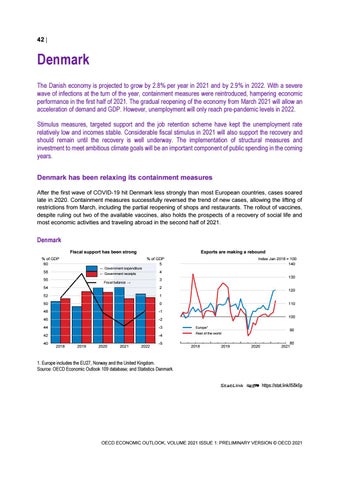
Denmark The Danish economy is projected to grow by 2.8% per year in 2021 and by 2.9% in 2022. With a severe wave of infections at the turn of the year, containment measures were reintroduced, hampering economic performance in the first half of 2021. The gradual reopening of the economy from March 2021 will allow an acceleration of demand and GDP. However, unemployment will only reach pre-pandemic levels in 2022. Stimulus measures, targeted support and the job retention scheme have kept the unemployment rate relatively low and incomes stable. Considerable fiscal stimulus in 2021 will also support the recovery and should remain until the recovery is well underway. The implementation of structural measures and investment to meet ambitious climate goals will be an important component of public spending in the coming years. Denmark has been relaxing its containment measures After the first wave of COVID-19 hit Denmark less strongly than most European countries, cases soared late in 2020. Containment measures successfully reversed the trend of new cases, allowing the lifting of restrictions from March, including the partial reopening of shops and restaurants. The rollout of vaccines, despite ruling out two of the available vaccines, also holds the prospects of a recovery of social life and most economic activities and traveling abroad in the second half of 2021.
Denmark Fiscal support has been strong
Exports are making a rebound
% of GDP 60
% of GDP 5
Index Jan 2018 = 100 140
← Government expenditure
58
4
← Government receipts
56 54
2
52
1
50
0
48
-1
46
-2
44
-3
42
-4
40
2018
2019
2020
2021
130
3
Fiscal balance →
2022
-5
120 110 100 Europe¹
90
Rest of the world
0
2018
2019
2020
80 2021
1. Europe includes the EU27, Norway and the United Kingdom. Source: OECD Economic Outlook 109 database; and Statistics Denmark. StatLink 2 https://stat.link/l58k6p
OECD ECONOMIC OUTLOOK, VOLUME 2021 ISSUE 1: PRELIMINARY VERSION © OECD 2021
43
Denmark: Demand, output and prices
StatLink 2 https://stat.link/89b1gt
The virus and containment measures interrupted the recovery The second wave of infections in late 2020, and the associated containment measures, restricted consumption and hampered growth in early 2021, with GDP contracting by 1½ per cent in the first quarter. However, the impact of restrictions was milder and more heterogeneous than in March 2020. Some sectors were particularly hard hit, notably culture, accommodation and food services, while, in contrast, employment in construction and the public administration continued to grow. The rebound of global trade supported external demand in early 2021. The easing of containment measures, an increase in business confidence and the maintenance of policy support measures pave the way for a quick rebound of domestic demand later in 2021.
Fiscal stimulus in 2021 is largely focused on green measures Fiscal stimulus, together with strong automatic stabilisers, mitigated the impact of COVID-19 on the economy. In order to buffer the effects of the second wave, the government recently agreed on a green recovery package for 2021-22, partly funded by the EU, amounting to 2.6% of GDP, adding to measures for green housing initiated in 2020 (0.4% of GDP). Specific measures include a second disbursement of holiday payments from the mandatory pension scheme, support for firms affected by restrictions and subsidies for investments to reduce greenhouse gas emissions in energy, buildings, transport and agriculture. Substantial further support (about 0.7% of GDP) was allocated to compensate the mink industry, which had to cull its stock in late 2020 following infection with a mutated strain of COVID-19.
OECD ECONOMIC OUTLOOK, VOLUME 2021 ISSUE 1: PRELIMINARY VERSION © OECD 2021
44
A rebound is projected in the second half of 2021 GDP is forecasted to grow by 2.8% in 2021 and at a similar rate in 2022. Growth will be supported by the increase in global trade, the fall in infections and an effective vaccine rollout. The country will benefit from dynamic global growth and its specialisation in cutting-edge technologies for green energy and pharmaceutical goods. Household consumption is set to rebound, with a gradual decline in the saving ratio in 2022. The upsurge of new virus variants globally remains a risk. Exports of services, such as tourism, are also at risk while the evolution of global mobility is still precarious. Uncertainty about the economic situation may restrain consumption and skill development, as unemployment is still higher than in 2019. However, Denmark showed resilience during the COVID-19 crisis, implementing effective measures to protect people’s health and incomes. A quicker normalisation of consumption and faster spending of the excess saving of past months might also accelerate the recovery.
Targeted and structural measures can underpin future growth Strong fiscal discipline prior to the pandemic provides fiscal space for further action, if necessary. Past experience shows that support should not be removed too quickly, to avoid the risk of undermining the recovery. However, the government should avoid further general stimulus unless growth disappoints, as spare capacity is expected to be exhausted in 2022 and is already limited in key sectors such as construction. Rather, measures should be demand-driven, targeted at supporting badly affected households and enhancing long-term growth. Structural measures to ease rigidities, particularly in the housing market, would facilitate workers’ mobility. Investing in a cost-effective climate strategy would also support growth while contributing to achievement of environmental goals. This would require a substantial domestic or EU-wide price on greenhouse gas emissions, strong public and private investments, innovation and measures to compensate vulnerable households.
OECD ECONOMIC OUTLOOK, VOLUME 2021 ISSUE 1: PRELIMINARY VERSION © OECD 2021