151
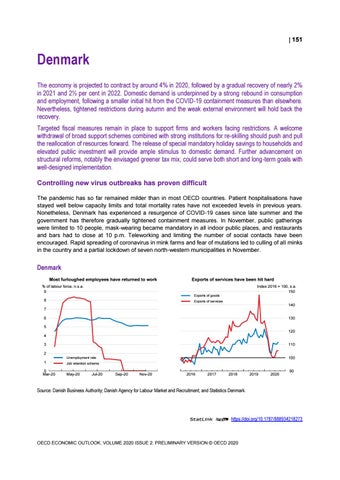
Denmark The economy is projected to contract by around 4% in 2020, followed by a gradual recovery of nearly 2% in 2021 and 2½ per cent in 2022. Domestic demand is underpinned by a strong rebound in consumption and employment, following a smaller initial hit from the COVID-19 containment measures than elsewhere. Nevertheless, tightened restrictions during autumn and the weak external environment will hold back the recovery. Targeted fiscal measures remain in place to support firms and workers facing restrictions. A welcome withdrawal of broad support schemes combined with strong institutions for re-skilling should push and pull the reallocation of resources forward. The release of special mandatory holiday savings to households and elevated public investment will provide ample stimulus to domestic demand. Further advancement on structural reforms, notably the envisaged greener tax mix, could serve both short and long-term goals with well-designed implementation. Controlling new virus outbreaks has proven difficult The pandemic has so far remained milder than in most OECD countries. Patient hospitalisations have stayed well below capacity limits and total mortality rates have not exceeded levels in previous years. Nonetheless, Denmark has experienced a resurgence of COVID-19 cases since late summer and the government has therefore gradually tightened containment measures. In November, public gatherings were limited to 10 people, mask-wearing became mandatory in all indoor public places, and restaurants and bars had to close at 10 p.m. Teleworking and limiting the number of social contacts have been encouraged. Rapid spreading of coronavirus in mink farms and fear of mutations led to culling of all minks in the country and a partial lockdown of seven north-western municipalities in November.
Denmark Most furloughed employees have returned to work
Exports of services have been hit hard
% of labour force, n.s.a. 9
Index 2016 = 100, s.a. 150 Exports of goods
8
Exports of services
140
7 6
130
5 120
4 3
110
2
100
Unemployment rate
1 0 Mar-20
Job retention scheme
May-20
Jul-20
Sep-20
Nov-20
0
0
2016
2017
2018
2019
2020
90
Source: Danish Business Authority; Danish Agency for Labour Market and Recruitment; and Statistics Denmark.
StatLink 2 https://doi.org/10.1787/888934218273
OECD ECONOMIC OUTLOOK, VOLUME 2020 ISSUE 2: PRELIMINARY VERSION © OECD 2020
152
Denmark: Demand, output and prices 2017
2018
GDP at market prices Private consumption Government consumption Gross fixed capital formation Final domestic demand Stockbuilding1 Total domestic demand Exports of goods and services Imports of goods and services Net exports1
2020
2021
2022
Percentage changes, volume (2010 prices)
Current prices DKK billion
Denmark
2019
2 192.9 1 016.6 535.4 465.5 2 017.5 18.1 2 035.6 1 207.8 1 050.5 157.3
2.2 2.7 0.3 4.8 2.6 0.3 2.9 3.2 4.8 -0.5
2.8 1.4 1.2 2.8 1.7 -0.3 1.4 5.0 2.4 1.6
-3.9 -4.3 1.4 -0.3 -1.8 0.2 -1.5 -11.5 -8.9 -2.1
1.8 3.4 1.5 0.0 2.0 0.0 2.0 3.8 4.4 -0.1
2.5 2.5 0.7 2.5 2.0 0.0 2.0 5.2 4.5 0.7
_ _ _ _ _ _ _ _ _
0.6 0.8 0.6 5.1 6.2 0.7 51.0 34.0 7.0
0.7 0.8 0.8 5.0 3.7 3.8 51.7 33.3 8.9
1.2 0.4 0.9 5.7 7.7 -3.9 62.5 44.1 7.6
0.4 0.7 0.7 6.2 6.7 -2.9 58.5 40.1 6.8
0.8 0.9 0.9 5.7 5.9 -1.8 59.2 40.9 7.1
Memorandum items GDP deflator Consumer price index Core inflation index2 Unemployment rate (% of labour force) Household saving ratio, net (% of disposable income) General government financial balance (% of GDP) General government gross debt (% of GDP) General government debt, Maastricht definition (% of GDP) Current account balance (% of GDP) 1. Contributions to changes in real GDP, actual amount in the first column. 2. Consumer price index excluding food and energy. Source: OECD Economic Outlook 108 database.
StatLink 2 https://doi.org/10.1787/888934218292
The economy initially rebounded quickly but the recovery has now slowed Most economic sectors had reopened by early summer after a comparatively soft shutdown. Mobility data and consumption covered by credit card transactions had returned to the levels in 2019 by June. International travel restrictions gave a boost to domestic tourism, and the housing market rebounded strongly with prices and sales exceeding pre-pandemic levels. Consumer price inflation has picked up in recent months, driven by an increase in tobacco duty rates. Half of the 3% drop in dependent employment during spring had been restored by August. Since then, the recovery has slowed according to daily unemployment figures. Weak external demand is also holding back the recovery, notably in services exports, while a high share of pharmaceuticals and food products partly cushions goods exports.
Large stimulus measures and targeted support will continue Fiscal policy reacted strongly and next year’s budget envisages further stimulus of about 1% of GDP. The government has successfully replaced broad and large-scale subsidy schemes created during the shutdown by targeted measures. The job retention scheme, protecting more than 8% of workers at the peak, was rolled back by the end of August to cover only firms forced to close. Suspension of local governments’ expenditure ceilings in 2020 and energy renovation of social housing will stimulate demand through 2022. The government boosted household gross incomes by up to 2.6% of GDP in October by releasing special mandatory pension savings from a recent reform of employees’ holiday payment schemes. Income taxation of the freed funds improves the public budget in 2020 by almost 1% of GDP.
OECD ECONOMIC OUTLOOK, VOLUME 2020 ISSUE 2: PRELIMINARY VERSION © OECD 2020
153
A prolonged and fragile recovery is projected The resurgence of the COVID-19 pandemic makes the near-term outlook particularly uncertain. The economy is set to recover gradually as authorities need to tackle local virus outbreaks until a vaccine becomes generally available in the latter part of 2021, leaving economic activity below its pre-pandemic level until mid-2022. The job retention scheme has protected household incomes, which along with freed holiday savings and high wealth will bolster private consumption. High uncertainty will keep business investment subdued through 2021, although the high content of R&D in medical and green technologies is shielding the setback. The speed of recovery depends critically on international trade coming back, not least since Denmark’s exports increasingly reflect trade of goods produced and sold abroad by Danish multinationals without crossing Danish borders. The United Kingdom is a key trading partner and a hard Brexit without a trade agreement with the European Union is a large downside risk to the projections. On the upside, better tracking and effective use of the enormous test capacity (more than 1% of the population per day in November) could accelerate the recovery by removing the need for many costly containment measures.
Structural reforms should continue Firms and workers would benefit from clear guidance on likely containment measures and compensation schemes to plan for an uncertain future. Liquidity support, loan guarantees and targeted subsidies should be the main measures to get through the pandemic. In case of renewed shutdown needs, the short-time work scheme agreed with the social partners in August will provide backing with fewer distortionary costs than the job retention scheme being phased-out. Through 2020, the government has maintained its structural reform agenda, notably on climate change. This should continue and would help to facilitate the needed reallocation of resources from some services losing demand towards expanding sectors, such as environment protection activities.
OECD ECONOMIC OUTLOOK, VOLUME 2020 ISSUE 2: PRELIMINARY VERSION © OECD 2020