109
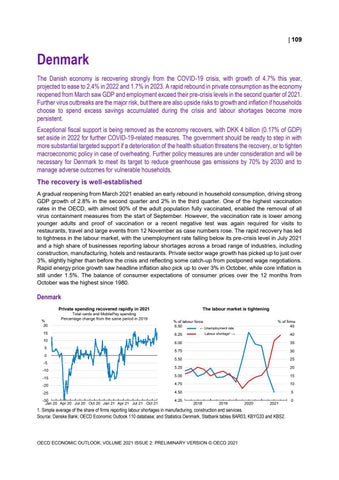
Denmark The Danish economy is recovering strongly from the COVID-19 crisis, with growth of 4.7% this year, projected to ease to 2.4% in 2022 and 1.7% in 2023. A rapid rebound in private consumption as the economy reopened from March saw GDP and employment exceed their pre-crisis levels in the second quarter of 2021. Further virus outbreaks are the major risk, but there are also upside risks to growth and inflation if households choose to spend excess savings accumulated during the crisis and labour shortages become more persistent. Exceptional fiscal support is being removed as the economy recovers, with DKK 4 billion (0.17% of GDP) set aside in 2022 for further COVID-19-related measures. The government should be ready to step in with more substantial targeted support if a deterioration of the health situation threatens the recovery, or to tighten macroeconomic policy in case of overheating. Further policy measures are under consideration and will be necessary for Denmark to meet its target to reduce greenhouse gas emissions by 70% by 2030 and to manage adverse outcomes for vulnerable households. The recovery is well-established A gradual reopening from March 2021 enabled an early rebound in household consumption, driving strong GDP growth of 2.8% in the second quarter and 2% in the third quarter. One of the highest vaccination rates in the OECD, with almost 90% of the adult population fully vaccinated, enabled the removal of all virus containment measures from the start of September. However, the vaccination rate is lower among younger adults and proof of vaccination or a recent negative test was again required for visits to restaurants, travel and large events from 12 November as case numbers rose. The rapid recovery has led to tightness in the labour market, with the unemployment rate falling below its pre-crisis level in July 2021 and a high share of businesses reporting labour shortages across a broad range of industries, including construction, manufacturing, hotels and restaurants. Private sector wage growth has picked up to just over 3%, slightly higher than before the crisis and reflecting some catch-up from postponed wage negotiations. Rapid energy price growth saw headline inflation also pick up to over 3% in October, while core inflation is still under 1.5%. The balance of consumer expectations of consumer prices over the 12 months from October was the highest since 1980.
Denmark Private spending recovered rapidly in 2021 % 20
Total cards and MobilePay spending Percentage change from the same period in 2019
15 10
The labour market is tightening % of labour force 6.50 ← Unemployment rate
% of firms 45
Labour shortage¹ →
6.25
40
6.00
35
5.75
30
5.50
25
5.25
20
5.00
15
-20
4.75
10
-25
4.50
5
-30 0 Jan 20 Apr 20 Jul 20 Oct 20 Jan 21 Apr 21 Jul 21 Oct 21
4.25
5 0 -5 -10 -15
2018
2019
2020
2021
1. Simple average of the share of firms reporting labour shortages in manufacturing, construction and services. Source: Danske Bank; OECD Economic Outlook 110 database; and Statistics Denmark, Statbank tables BAR03, KBYG33 and KBS2.
OECD ECONOMIC OUTLOOK, VOLUME 2021 ISSUE 2: PRELIMINARY VERSION © OECD 2021
0
110 StatLink 2 https://stat.link/omt5dg
Denmark: Demand, output and prices 2018
2019
GDP at market prices Private consumption Government consumption Gross fixed capital formation Final domestic demand Stockbuilding¹ Total domestic demand Exports of goods and services Imports of goods and services Net exports¹ Memorandum items GDP deflator Consumer price index Core inflation index² Unemployment rate (% of labour force) Household saving ratio, net (% of disposable income) General government financial balance (% of GDP) General government gross debt (% of GDP) General government debt, Maastricht definition³ (% of GDP) Current account balance (% of GDP)
2021
2022
2023
Percentage changes, volume (2010 prices)
Current prices DKK billion
Denmark
2020
2 253.6 1 052.8 546.7 496.4
2.9 1.4 1.2 2.8
-2.7 -1.9 -0.1 2.1
4.7 3.3 4.7 8.3
2.4 3.7 -0.3 3.2
1.7 1.7 0.5 3.1
2 095.9 25.2
1.7 -0.3
-0.5 -0.2
4.9 -0.3
2.5 0.2
1.7 0.0
2 121.1 1 268.6 1 136.1 132.5
1.4 5.0 2.4 1.6
-0.8 -7.7 -4.8 -2.1
4.5 3.4 2.8 0.5
2.7 3.2 3.8 -0.1
1.7 3.6 4.0 0.0
0.7 0.8 0.8 5.0
2.3 0.4 0.9 5.6
1.4 1.8 1.2 4.9
1.6 2.6 2.0 4.2
2.3 2.3 2.3 4.2
3.6 4.0 48.1 33.3 8.7
5.8 -0.2 58.8 42.2 8.2
5.7 -1.5 56.4 39.8 7.6
3.8 0.3 55.0 38.4 7.7
3.7 0.8 54.6 38.0 7.7
_ _ _ _ _ _ _ _ _
1. Contributions to changes in real GDP, actual amount in the first column. 2. Consumer price index excluding food and energy. 3. The Maastricht definition of general government debt includes only loans, debt securities, and currency and deposits, with debt at face value rather than market value. Source: OECD Economic Outlook 110 database.
StatLink 2 https://stat.link/8zoeyr
Exceptional support during the crisis has largely been withdrawn Fiscal support helped Denmark weather the crisis through its job retention scheme, transfers to households and liquidity support for firms. The job retention scheme and access to interest-free loans finished in June 2021, with repayment of loans beginning from April 2022. The deficit in 2021 was amplified by one-off expenditure of around 0.7% of GDP to compensate the mink industry for mandated stock culls during 2020. The underlying primary balance is projected to improve by 0.3 percentage points of GDP in each of 2022 and 2023. The government’s recovery plans include over DKK 10 billion in measures assessed to have positive environmental impacts, including tax deductions for emission-reducing investments by firms, support for energy renovations, green innovation and transportation, as well as measures to rehabilitate carbon-rich soils. Much of this is financed by EU grants for Denmark’s recovery and resilience plan, 59% of which are allocated towards climate initiatives. Monetary policy became more expansionary from October 2021, with the current-account rate cut by 0.1 percentage points to -0.6% in order to maintain the peg to the Euro, and interest rates are projected to remain negative in line with European Central Bank policy rates.
OECD ECONOMIC OUTLOOK, VOLUME 2021 ISSUE 2: PRELIMINARY VERSION © OECD 2021
111
Capacity use is set to tighten as the recovery continues Accommodative monetary policy under the peg to the Euro and strong external demand as other economies recover will underpin a continuation of solid GDP growth. The rate of private consumption growth will slow as the recovery matures, with the household saving rate returning to around its pre-crisis level in 2023. The end of the immediate reopening bounce and the availability of a large number of workers temporarily employed in virus testing and vaccination is likely to ease immediate labour market pressures, as will increases in the retirement age. Employment is set to rise gradually along with wages, pushing core inflation above 2% in 2023. There are risks that overheating could see a tighter labour market and an acceleration of inflation, particularly if households reduce saving more rapidly and spend the savings accumulated during the crisis. On the downside, further virus outbreaks in Denmark and abroad could see another contraction in private consumption, investment and external demand.
Policies are needed to mitigate financial and climate risks Tighter macroprudential regulations may be necessary to reduce macroeconomic and financial stability risks if a strong recovery combines with low interest rates to drive further asset price growth. Conversely, further virus outbreaks could require substantial additional targeted support to the worst affected households and firms. Denmark has made impressive progress in deploying renewable energy and reducing emissions without derailing economic growth or employment. However, more action is needed to meet Denmark’s legal commitment to cut emissions by 70% by 2030, and managing the socioeconomic consequences of such a rapid transition will be challenging. Clear policy signals are needed to encourage private investment and innovation in clean technologies, along with measures to ensure a just transition for those adversely affected.
OECD ECONOMIC OUTLOOK, VOLUME 2021 ISSUE 2: PRELIMINARY VERSION © OECD 2021