115
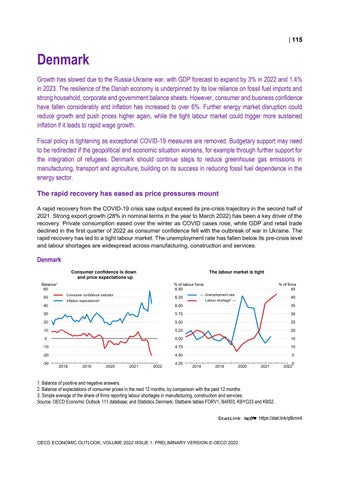
Denmark Growth has slowed due to the Russia-Ukraine war, with GDP forecast to expand by 3% in 2022 and 1.4% in 2023. The resilience of the Danish economy is underpinned by its low reliance on fossil fuel imports and strong household, corporate and government balance sheets. However, consumer and business confidence have fallen considerably and inflation has increased to over 6%. Further energy market disruption could reduce growth and push prices higher again, while the tight labour market could trigger more sustained inflation if it leads to rapid wage growth. Fiscal policy is tightening as exceptional COVID-19 measures are removed. Budgetary support may need to be redirected if the geopolitical and economic situation worsens, for example through further support for the integration of refugees. Denmark should continue steps to reduce greenhouse gas emissions in manufacturing, transport and agriculture, building on its success in reducing fossil fuel dependence in the energy sector. The rapid recovery has eased as price pressures mount A rapid recovery from the COVID-19 crisis saw output exceed its pre-crisis trajectory in the second half of 2021. Strong export growth (28% in nominal terms in the year to March 2022) has been a key driver of the recovery. Private consumption eased over the winter as COVID cases rose, while GDP and retail trade declined in the first quarter of 2022 as consumer confidence fell with the outbreak of war in Ukraine. The rapid recovery has led to a tight labour market. The unemployment rate has fallen below its pre-crisis level and labour shortages are widespread across manufacturing, construction and services.
Denmark Consumer confidence is down and price expectations up
The labour market is tight
Balance¹ 60 50
% of labour force 6.50 Consumer confidence indicator
6.25
Inflation expectations²
% of firms 45
← Unemployment rate
40
Labour shortage³ →
40
6.00
35
30
5.75
30
20
5.50
25
10
5.25
20
0
5.00
15
-10
4.75
10
-20
4.50
5
-30
2018
2019
2020
2021
0 2022
4.25
2018
2019
2020
2021
0 2022
1. Balance of positive and negative answers. 2. Balance of expectations of consumer prices in the next 12 months, by comparison with the past 12 months. 3. Simple average of the share of firms reporting labour shortages in manufacturing, construction and services. Source: OECD Economic Outlook 111 database; and Statistics Denmark, Statbank tables FORV1, BAR03, KBYG33 and KBS2. StatLink 2 https://stat.link/q6kmn4
OECD ECONOMIC OUTLOOK, VOLUME 2022 ISSUE 1: PRELIMINARY VERSION © OECD 2022
116
Denmark: Demand, output and prices 2018
2019
GDP at market prices Private consumption Government consumption Gross fixed capital formation Final domestic demand Stockbuilding¹ Total domestic demand Exports of goods and services Imports of goods and services Net exports¹ Memorandum items GDP deflator Consumer price index Core inflation index² Unemployment rate (% of labour force) Household saving ratio, net (% of disposable income) General government financial balance (% of GDP) General government gross debt (% of GDP) General government debt, Maastricht definition³ (% of GDP) Current account balance (% of GDP)
2021
2022
2023
Percentage changes, volume (2010 prices)
Current prices DKK billion
Denmark
2020
2 253.3 1 058.6 547.0 489.6
2.1 1.2 1.5 0.1
-2.1 -1.3 -1.7 5.1
4.7 4.2 3.7 5.6
3.0 1.3 -2.4 4.8
1.4 1.2 0.9 4.3
2 095.2 19.6
1.0 -0.2
0.1 -0.1
4.4 0.3
1.2 0.6
1.9 0.0
2 114.9 1 274.5 1 136.0 138.5
0.9 5.0 3.0 1.4
-0.1 -7.0 -4.1 -2.0
4.7 7.8 8.2 0.3
1.7 3.5 1.1 1.5
1.8 2.9 3.8 -0.3
0.7 0.8 0.8 5.0
2.6 0.4 1.0 5.6
2.4 1.9 1.2 5.2
5.8 5.2 3.0 5.1
3.1 3.9 3.4 5.5
3.6 4.1 48.4 33.6 8.8
5.8 -0.2 58.7 42.1 8.1
4.9 2.3 50.3 36.7 8.3
4.5 3.7 46.0 32.5 9.6
3.3 4.3 42.4 28.8 9.2
_ _ _ _ _ _ _ _ _
1. Contributions to changes in real GDP, actual amount in the first column. 2. Consumer price index excluding food and energy. 3. The Maastricht definition of general government debt includes only loans, debt securities, and currency and deposits, with debt at face value rather than market value. Source: OECD Economic Outlook 111 database.
StatLink 2 https://stat.link/os1drh
The war in Ukraine has exacerbated accelerating price growth, with consumer prices rising by 6.7% in the year to April. Annual energy price growth exceeding 30% is a key driver, though Denmark is somewhat insulated from the effect of energy price growth due to domestic production of North Sea oil and gas and relatively low fossil fuel consumption. Asset price growth, notably housing, has eased, but asset price levels remain elevated following rapid growth during the crisis. Over 20 000 people (0.3% of the Danish population) have applied for residency under the Danish special law for Ukrainian refugees.
Macroeconomic policy is normalising gradually Fiscal policy is set to be moderately contractionary in 2022 and 2023. Exceptional support during the COVID-19 crisis (around 1.5% of GDP) has largely been withdrawn, more than offsetting additional spending on refugees (0.1% of GDP, financed primarily from the existing development aid budget) and on defence (0.15% of GDP in 2022 and 2023). Increases in the statutory retirement age will improve the fiscal position while increasing the labour force by around 30 000 people (1% of the labour force) over 2022 and 2023. Policy interest rates are expected to increase gradually from the current low level as euro area rates rise, in order to maintain the strong peg to the euro.
OECD ECONOMIC OUTLOOK, VOLUME 2022 ISSUE 1: PRELIMINARY VERSION © OECD 2022
117
Output and price growth will ease Growth is forecast to slow to 3% in 2022 and 1.4% in 2023 due to weaker business and consumer confidence, erosion of household real incomes and wealth with rapid price growth, and weakening export demand as European growth slows with the war in Ukraine. Labour shortages and increased inflation expectations are nonetheless expected to drive an acceleration of wage growth from around 3% to over 4%. Inflation is expected to moderate in 2023 once energy prices and supply constraints gradually ease, but strong wage growth will keep core inflation above 3%. There is a risk that higher inflation could become entrenched if there are further energy market disruptions or if wage growth exceeds expectations. There are important downside risks to growth from an escalation of the war in Ukraine or further COVID-19 outbreaks, while more complete spending of household savings accrued during the crisis could drive higher growth.
The energy transition and integrating refugees should continue to be priorities More may need to be done to integrate Ukrainian refugees if a large number remain in Denmark, as there are large gaps in employment outcomes between immigrants and native Danes as well as regional variation in the quality and implementation of integration programmes. Denmark’s successful transition to an energy sector dominated by renewables has increased resilience to the impacts of the war by reducing its dependence on fossil fuels for electricity and heating. Policy steps to broaden progress to other sectors should continue, such as exploiting low-cost abatement opportunities in agriculture and encouraging the shift to low carbon vehicles by incentivising expansion of the charging network to remote areas. The high share of renewables in electricity generation (over 80%) provides an opportunity to cushion the effect of high energy prices on vulnerable households by reducing high electricity taxes as greenhouse gas pricing ramps up.
OECD ECONOMIC OUTLOOK, VOLUME 2022 ISSUE 1: PRELIMINARY VERSION © OECD 2022