145
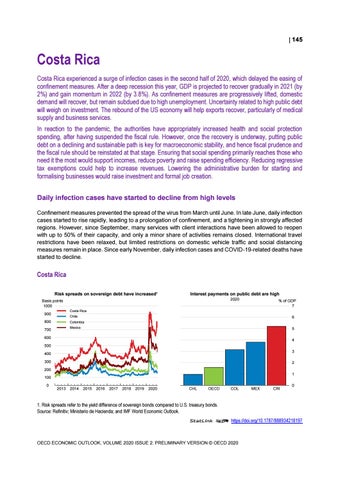
Costa Rica Costa Rica experienced a surge of infection cases in the second half of 2020, which delayed the easing of confinement measures. After a deep recession this year, GDP is projected to recover gradually in 2021 (by 2%) and gain momentum in 2022 (by 3.8%). As confinement measures are progressively lifted, domestic demand will recover, but remain subdued due to high unemployment. Uncertainty related to high public debt will weigh on investment. The rebound of the US economy will help exports recover, particularly of medical supply and business services. In reaction to the pandemic, the authorities have appropriately increased health and social protection spending, after having suspended the fiscal rule. However, once the recovery is underway, putting public debt on a declining and sustainable path is key for macroeconomic stability, and hence fiscal prudence and the fiscal rule should be reinstated at that stage. Ensuring that social spending primarily reaches those who need it the most would support incomes, reduce poverty and raise spending efficiency. Reducing regressive tax exemptions could help to increase revenues. Lowering the administrative burden for starting and formalising businesses would raise investment and formal job creation. Daily infection cases have started to decline from high levels Confinement measures prevented the spread of the virus from March until June. In late June, daily infection cases started to rise rapidly, leading to a prolongation of confinement, and a tightening in strongly affected regions. However, since September, many services with client interactions have been allowed to reopen with up to 50% of their capacity, and only a minor share of activities remains closed. International travel restrictions have been relaxed, but limited restrictions on domestic vehicle traffic and social distancing measures remain in place. Since early November, daily infection cases and COVID-19-related deaths have started to decline.
Costa Rica Risk spreads on sovereign debt have increased¹
Interest payments on public debt are high 2020
Basis points 1000
% of GDP 7
Costa Rica
900
Chile
800
6
Colombia Mexico
700
5
600
4
500 3
400 300
2
200 1
100 0
2013
2014
2015
2016
2017
2018
2019
2020
0
0
CHL
OECD
COL
MEX
CRI
0
1. Risk spreads refer to the yield difference of sovereign bonds compared to U.S. treasury bonds. Source: Refinitiv; Ministerio de Hacienda; and IMF World Economic Outlook. StatLink 2 https://doi.org/10.1787/888934218197
OECD ECONOMIC OUTLOOK, VOLUME 2020 ISSUE 2: PRELIMINARY VERSION © OECD 2020
146 ď ź
Costa Rica: Demand, output and prices 2017
2018
Current prices CRC trillion
Costa Rica GDP at market prices Private consumption Government consumption Gross fixed capital formation Final domestic demand Stockbuilding1 Total domestic demand Exports of goods and services Imports of goods and services Net exports1
2019
2020
2021
2022
Percentage changes, volume (2012 prices)
33.2 21.2 5.7 5.7 32.6 0.7 33.3 10.9 11.0 - 0.1
2.7 2.0 0.5 3.0 1.9 -0.7 1.1 4.7 0.1 1.6
2.1 1.8 4.9 -8.1 0.5 0.8 1.1 2.7 -0.1 1.0
-5.6 -6.8 1.7 -5.1 -5.0 1.2 -4.1 -14.3 -10.0 -1.4
2.0 1.8 1.2 0.2 1.4 -0.1 1.5 4.1 2.4 0.5
3.8 4.4 -0.8 3.9 3.3 0.0 3.4 8.8 7.1 0.4
_ _ _ _ _
2.5 2.2 2.1 10.3 -3.3
1.8 2.1 2.4 11.8 -2.2
0.6 0.7 1.2 19.9 -2.6
1.3 1.5 1.6 19.3 -2.6
1.7 2.0 2.0 14.6 -2.7
Memorandum items GDP deflator Consumer price index Core inflation index2 Unemployment rate (% of labour force) Current account balance (% of GDP) 1. Contributions to changes in real GDP, actual amount in the first column. 2. Consumer price index excluding food and energy. Source: OECD Economic Outlook 108 database.
StatLink 2 https://doi.org/10.1787/888934218216
A gradual recovery is underway After a strong drop in economic activity in the second quarter of 2020, the spread of the virus and the prolongation of confinement measures have postponed the recovery. High unemployment is weighing on household incomes and private consumption. Confinement measures and lower demand have particularly affected labour-intensive services sectors, such as hotels and restaurants, retail, transport services, domestic services and construction. Recent episodes of road blockades around port areas temporarily disrupted economic activity further. However, activity in free trade zones has bounced back, driven by strong export demand for medical supplies and IT and business services from the United States. Employment is starting to recover, and the unemployment rate has fallen slightly from a historical high of 24.4% in July to 23.2% in August. Due to sovereign financing needs of 15.7% of GDP in 2021 and high uncertainty about the fiscal strategy, risks of near-term financing stress have increased. Sovereign bond spreads have recently picked up further, weighing on business confidence and investment. The authorities have initiated consultations with the IMF on a three-year financing assistance programme.
Social spending has helped to protect those most in need The authorities have appropriately increased health and social protection spending to mitigate the adverse effects of the pandemic. A direct cash transfer programme supports individuals who lost their job or face reduced working hours, including informal and self-employed workers. A loan programme provides working capital finance for firms. Payments of value added, income and tourism taxes, customs duties and social security contributions have been deferred towards the end of the year. The central bank has reduced the policy rate to 0.75% and created additional loan facilities to support firms and households. The temporary reduction of countercyclical buffer provisions for banks has created space for the reprofiling of credit repayments of distressed borrowers.
OECD ECONOMIC OUTLOOK, VOLUME 2020 ISSUE 2: PRELIMINARY VERSION Š OECD 2020
147
The recovery will be partial and gradual GDP is projected to grow by 2% in 2021 and 3.8% in 2022. Exports will continue to lead the recovery, driven by rising demand from the United States. The gradual easing of confinement measures supports strongly affected services sectors. Private consumption will slowly improve, but high unemployment continues to weigh on household incomes. The economic contraction has led to a significant loss of government revenues, exacerbating an already vulnerable fiscal situation. The fiscal deficit is set to widen to around 9½ per cent of GDP in 2020, and the ratio of central government debt to GDP will rise to around 80% over the coming years. Investment and confidence will remain subdued until fiscal uncertainty dissipates. Downside risks relate to political gridlock leading to a failure to pursue needed fiscal reforms. Severe new COVID-19 outbreaks may require retightening of confinement measures on a regional basis. Upside risks relate to a stronger recovery in the United States and increasing export demand.
Pursuing structural reforms is key for the recovery Buttressing the health system and targeting fiscal support to those hit hardest by the recession should continue to be the short-term priority. Eliminating regressive tax exemptions and improving public spending efficiency, including through a public employment reform, could provide more fiscal space and set the basis for a medium-term fiscal strategy that puts public debt on a sustainable path. Continuing the implementation of structural reforms, such as those aimed at strengthening domestic competition, is key to support formal job creation. A comprehensive strategy to reduce informality, including by lowering social security contributions for low-wage workers, and constructing a social safety net for all workers, combined with improvements in the quality of education and training, would make growth more inclusive. Continuing to develop country-wide tracking and testing capabilities would help to reduce risks of new virus outbreaks.
OECD ECONOMIC OUTLOOK, VOLUME 2020 ISSUE 2: PRELIMINARY VERSION © OECD 2020