109
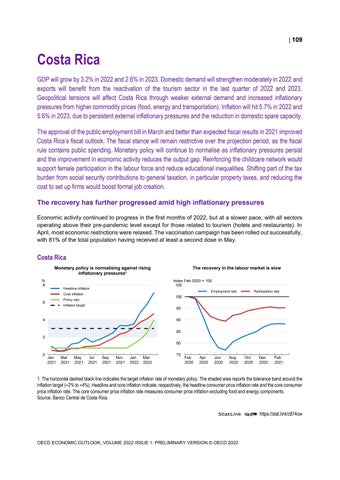
Costa Rica GDP will grow by 3.2% in 2022 and 2.6% in 2023. Domestic demand will strengthen moderately in 2022 and exports will benefit from the reactivation of the tourism sector in the last quarter of 2022 and 2023. Geopolitical tensions will affect Costa Rica through weaker external demand and increased inflationary pressures from higher commodity prices (food, energy and transportation). Inflation will hit 5.7% in 2022 and 5.6% in 2023, due to persistent external inflationary pressures and the reduction in domestic spare capacity. The approval of the public employment bill in March and better than expected fiscal results in 2021 improved Costa Rica’s fiscal outlook. The fiscal stance will remain restrictive over the projection period, as the fiscal rule contains public spending. Monetary policy will continue to normalise as inflationary pressures persist and the improvement in economic activity reduces the output gap. Reinforcing the childcare network would support female participation in the labour force and reduce educational inequalities. Shifting part of the tax burden from social security contributions to general taxation, in particular property taxes, and reducing the cost to set up firms would boost formal job creation. The recovery has further progressed amid high inflationary pressures Economic activity continued to progress in the first months of 2022, but at a slower pace, with all sectors operating above their pre-pandemic level except for those related to tourism (hotels and restaurants). In April, most economic restrictions were relaxed. The vaccination campaign has been rolled out successfully, with 81% of the total population having received at least a second dose in May.
Costa Rica Monetary policy is normalising against rising inflationary pressures¹ % 8
The recovery in the labour market is slow Index Feb 2020 = 100 105
Headline inflation
Employment rate
Core inflation Policy rate
6
Participation rate
100
Inflation target
95
4
90 85
2 80 0
Jan 2021
Mar 2021
May 2021
Jul 2021
Sep 2021
Nov 2021
Jan 2022
Mar 2022
0
75
Feb 2020
Apr 2020
Jun 2020
Aug 2020
Oct 2020
Dec 2020
Feb 2021
0
1. The horizontal dashed black line indicates the target inflation rate of monetary policy. The shaded area reports the tolerance band around the inflation target (+2% to +4%). Headline and core inflation indicate, respectively, the headline consumer price inflation rate and the core consumer price inflation rate. The core consumer price inflation rate measures consumer price inflation excluding food and energy components. Source: Banco Central de Costa Rica. StatLink 2 https://stat.link/c874ow
OECD ECONOMIC OUTLOOK, VOLUME 2022 ISSUE 1: PRELIMINARY VERSION © OECD 2022
110
Costa Rica: Demand, output and prices 2018
2019
GDP at market prices Private consumption Government consumption Gross fixed capital formation
2021
2022
2023
Percentage changes, volume (2017 prices)
Current prices CRC trillion
Costa Rica
2020
36.0 23.4 5.8 6.6
2.4 1.7 5.9 -8.2
-4.1 -5.0 0.6 -1.7
7.8 6.4 1.4 8.7
3.2 4.7 1.0 11.9
2.6 2.7 -0.2 3.9
Final domestic demand Stockbuilding¹
35.8 0.1
0.6 -0.3
-3.5 -0.1
5.9 1.7
5.4 0.7
2.5 0.1
Total domestic demand Exports of goods and services Imports of goods and services Net exports¹
35.8 12.2 12.0 0.2
0.2 4.3 -2.3 2.2
-3.6 -10.9 -10.2 -0.6
7.6 15.9 16.2 0.3
5.3 8.2 15.2 -1.9
2.3 9.3 8.8 0.3
_ _ _ _ _
2.6 2.1 2.7 11.8
0.2 0.7 1.3 19.5
2.1 1.7 0.9 16.4
5.8 5.7 3.4 13.2
5.6 5.6 5.2 12.0
-1.2
-1.3
-3.2
-5.8
-5.9
Memorandum items GDP deflator Consumer price index Core inflation index² Unemployment rate (% of labour force) Current account balance (% of GDP) 1. Contributions to changes in real GDP, actual amount in the first column. 2. Consumer price index excluding food and energy. Source: OECD Economic Outlook 111 database.
StatLink 2 https://stat.link/eugvra
The war in Ukraine has strengthened inflationary pressures from logistics costs and imported commodity prices, especially of energy and food, which were rising already in 2021. Annual headline and core inflation hit 7.1% and 4.7%, respectively, in April, and the average wage in the formal sector increased by 5.7% in March. One-year ahead survey-based inflation expectations have reached 5.3%, above the upper end of the inflation target range of 2-4%. Trade linkages with Russia and Ukraine are negligible, but for imports of metals (construction) and fertilisers, finding alternative suppliers may imply higher costs in the short run. Fiscal measures to reduce the impact of the increase in energy prices on retail fuel are being discussed, but remain unlegislated.
Fiscal prudence will continue and monetary policy will normalise Fiscal projections assume that current government spending is contained by the fiscal rule and government fiscal targets are met during 2022 and 2023. Net government lending is projected to fall to 4.4% in 2022 and 3.3% in 2023. Under these assumptions, public debt will peak at around 69% in 2022 before starting to decline. A swift and full implementation of the public employment bill would further support Costa Rica’s fiscal sustainability via substantial savings in public spending. In reaction to increasing inflationary pressures and improved domestic conditions, the central bank started normalising monetary policy in December 2021 to avoid the de-anchoring of inflation expectations and the depreciation of the exchange rate. Since then, the target rate has increased from the historically low level of 0.75%, to 4% in April 2022. The monetary policy target rate is assumed to increase by 50 basis points in both the third and fourth quarters of 2022 and the first quarter of 2023, and then by 25 basis points each quarter from the second quarter of 2023, reaching 6.25% by end-2023.
OECD ECONOMIC OUTLOOK, VOLUME 2022 ISSUE 1: PRELIMINARY VERSION © OECD 2022
111
Domestic demand will slow but remain solid Growth is projected to slow to 3.2% in 2022 and 2.6% in 2023. The elimination of the remaining economic restrictions in the first half of 2022 and a successful vaccination campaign will support domestic demand despite the negative impact on private consumption and investment of high inflation and faster monetary policy tightening. The gradual reactivation of tourism will reinforce the recovery of labour intensive sectors and improve employment. Export growth in 2022 will slow due to lower global growth, especially in the United States. The flow of foreign direct investment will continue over the projection period. Inflation is projected to reach 5.7% in 2022, hitting household real disposable incomes, and to remain high at 5.6% in 2023, as external inflationary pressures continue. Higher interest rates will contain domestic inflationary pressures. The high degree of dollarisation exposes Costa Rica to risks associated with sharp exchange rate movements due to an unexpected tightening of global financial conditions. A higher-than-expected recovery in the tourism sector would boost exports and the recovery in the labour market.
Continuing with structural reforms would increase growth and economic resilience Continuing the implementation of the structural reforms initiated during the OECD accession process would increase growth and economic resilience and reduce large income inequalities. Strengthening the governance and performance of state-owned enterprises would benefit the economy as a whole, as they play a dominant role in many key sectors, such as electricity and banking. The high administrative burden to start a company could be reduced by establishing virtual one-stop shops. Phasing out remaining exemptions to the competition law would boost productivity and lower prices. Costa Rica continues to implement the National Decarbonisation Plan as to achieve net-zero emissions by 2050 through actions such as increasing the share of zero-emission vehicles in the public transport fleet and maintaining the 100% share of electricity produced from renewable sources at a competitive price.
OECD ECONOMIC OUTLOOK, VOLUME 2022 ISSUE 1: PRELIMINARY VERSION © OECD 2022