OECD Roundtable on Competition and Regulation in the Healthcare Sector

June 22, 2026
Prof. dr. Marco Varkevisser
June 22, 2026
Prof. dr. Marco Varkevisser
1. Health care provider competition: helpful or harmful?
Barros, Brouwer, Thomson & Varkevisser, 2016, EJHE, 17: 229-233
2. Typology of private investor-ownership in health care and regulatory frameworks
Berardi, Hellowell & Varkevisser, 2026, HEPL, forthcoming
3. Price dispersion for similar hospital services in the Netherlands
Franken, Douven, Van der Geest & Varkevisser, 2025, EJHE, 26: 1137–1147

1. Health care provider competition: helpful or harmful?
“No other market of substantial importance violates the requirements of perfect competition so radically.”

David Dranove &
Mark
Satterthwaite Handbook of Health Economics, 2000, p.1096


In health care, markets are far from perfect. But neither is government intervention!
Improving health systems is therefore all about: how to navigate between market failure & government failure?
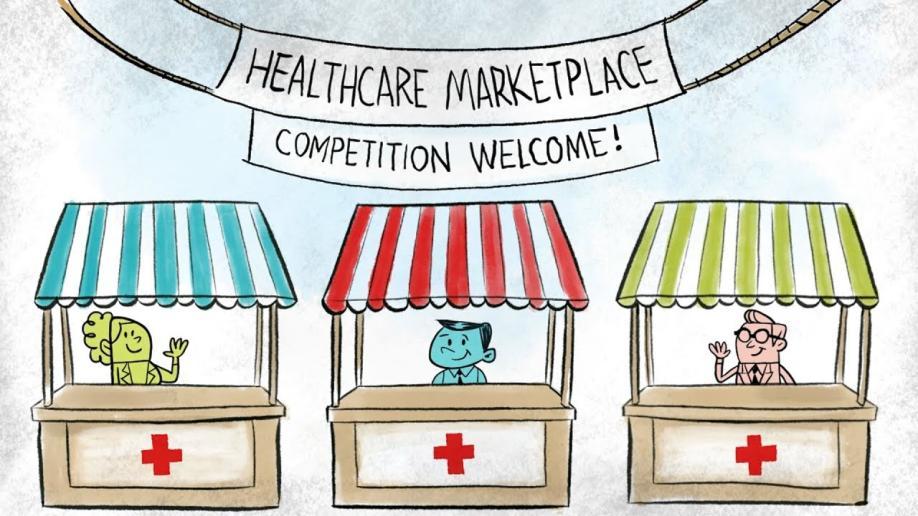

1. Health care provider competition: helpful or harmful?
• Competition is an instrument, not a goal in itself
• Appropriate policy design, including antitrust enforcement, is crucially important
• Impact of competition depends on specific context
• Anticipate unintended consequences be prepared to act swiftly
• Competition is not a panacea; it is unlikely to contribute simultaneously and positively to all health system objectives
Private-investor ownership: pros
Private-investor ownership: cons
• Strengthening equity
• Resolving financing problems
• Promoting market dynamics
• Contributing to innovations

• Supplier-induced demand
• Unreasonable price increases

• Too much focus on lower costs
• Selection of favourable patients
Contract failure due to a combination of asymmetric information and wrong financial incentives


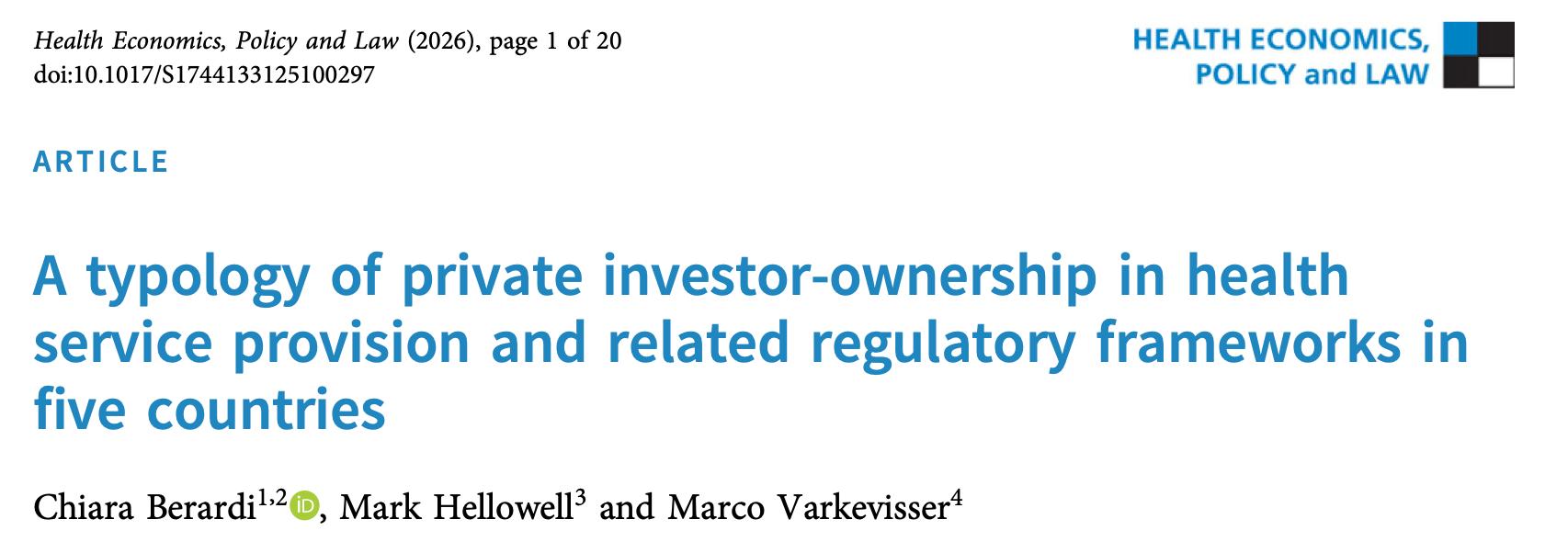





“While existing literature largely focuses on private equity firms in the US, private investment in healthcare is more diverse, with different ownership models operating under distinct regulatory systems, giving rise to different incentives. Without a nuanced understanding of the diverse configurations of private investor-ownership and regulatory models across countries, it is impossible to engage in informed policy analysis.”
• Typology of private investor-ownership in the healthcare sector
a) Non-profit ownership
b) Sole-proprietor and partnership models
c) Shareholder ownership (corporation)
d) Venture capital
e) Private equity

➢ Highly responsive to investor expectations
➢ Highly leveraged capital structures
➢ Aggressive focus on profit maximisation
➢ Short investment time-horizon

• Main conclusions in Berardi et al. (2026):
➢ Urgent need for more anticipatory, rather than reactive, regulatory strategies
➢ Focus should be on protecting against investor-ownership types that focus on aggressive, short-term profitability with high leverage, while ensuring that owners focused on long-term growth can achieve that goal in a manner consistent with key health policy goals of equity, efficiency and quality of care
➢ Combination of entry regulation and behavioural oversight [incl. competition policy] to better align the incentives of diverse private investors with public health objectives is crucially important

• Introduction of price transparency mandate in 2016
• Disclosure of insurer-provider negotiated prices for hospital products up to €885
• Overall aim was to increase price awareness among and price transparency for consumers, insurers, and providers ⟹ increased price competition
• Franken et al. (2025): did price dispersion for similar products reduce over time?
• Negotiated price data from 3 major Dutch health insurers on >200 hospital products
• Main finding: price dispersion has significantly decreased between 2016 and 2022 (while price level increase did not exceed general inflation rate)
• Underlying causes and mechanisms remain unknown, but price transparency mandate is likely to have influenced insurer-hospital negotiated prices
• Limitation: decrease in price dispersion for products below €885 may be accompanied by an increased prices for products above €885
• However, less random out-of-pocket payments across providers for the same hospital products which benefits patients
Prof. dr. Marco Varkevisser
Professor of Health Care Market Regulation
Research group leader Health Systems & Insurance (HSI)
Erasmus School of Health Policy & Management (ESHPM)
Erasmus Centre for Health Economics Rotterdam (EsCHER)

varkevisser@eshpm.eur.nl
www.eur.nl/people/marco-varkevisser