33
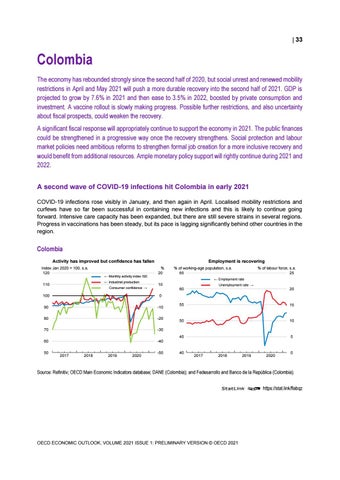
Colombia The economy has rebounded strongly since the second half of 2020, but social unrest and renewed mobility restrictions in April and May 2021 will push a more durable recovery into the second half of 2021. GDP is projected to grow by 7.6% in 2021 and then ease to 3.5% in 2022, boosted by private consumption and investment. A vaccine rollout is slowly making progress. Possible further restrictions, and also uncertainty about fiscal prospects, could weaken the recovery. A significant fiscal response will appropriately continue to support the economy in 2021. The public finances could be strengthened in a progressive way once the recovery strengthens. Social protection and labour market policies need ambitious reforms to strengthen formal job creation for a more inclusive recovery and would benefit from additional resources. Ample monetary policy support will rightly continue during 2021 and 2022. A second wave of COVID-19 infections hit Colombia in early 2021 COVID-19 infections rose visibly in January, and then again in April. Localised mobility restrictions and curfews have so far been successful in containing new infections and this is likely to continue going forward. Intensive care capacity has been expanded, but there are still severe strains in several regions. Progress in vaccinations has been steady, but its pace is lagging significantly behind other countries in the region.
Colombia Activity has improved but confidence has fallen Index Jan 2020 = 100, s.a. 120
← Monthly activity index ISE ← Industrial production
110
Consumer confidence →
Employment is recovering % 20
0
90
-10
80
-20
70
-30
60
-40
2017
2018
2019
2020
% of labour force, s.a. 25
← Employment rate
10
100
50
% of working-age population, s.a. 65
-50
Unemployment rate →
60
20
55
15
50
10
45
5
40
2017
2018
2019
2020
0
Source: Refinitiv; OECD Main Economic Indicators database; DANE (Colombia); and Fedesarrollo and Banco de la República (Colombia). StatLink 2 https://stat.link/flabqz
OECD ECONOMIC OUTLOOK, VOLUME 2021 ISSUE 1: PRELIMINARY VERSION © OECD 2021
34
Colombia: Demand, output and prices 2017
2018
Current prices COP trillion
Colombia GDP at market prices Private consumption Government consumption Gross fixed capital formation Final domestic demand Stockbuilding1 Total domestic demand Exports of goods and services Imports of goods and services Net exports1
2019
2020
2021
2022
Percentage changes, volume (2015 prices)
920.5 630.6 137.0 200.0 967.6 - 1.1 966.4 139.4 185.4 - 46.0
2.6 3.2 7.4 1.0 3.4 0.1 3.5 0.6 5.8 -1.1
3.3 3.9 5.3 3.1 4.0 0.2 4.1 3.1 7.3 -1.0
-6.8 -5.6 3.7 -20.6 -7.1 0.0 -7.2 -18.3 -17.3 0.8
7.6 7.3 3.9 20.6 9.2 0.0 7.1 13.8 14.8 -1.1
3.5 2.9 0.7 7.4 3.4 0.0 3.5 9.0 6.7 0.0
_ _ _ _ _
4.6 3.2 3.9 9.7 -4.1
4.0 3.5 3.3 10.5 -4.4
1.4 2.5 2.0 15.9 -3.3
3.4 2.1 1.8 13.9 -3.5
3.2 3.0 3.0 12.2 -3.3
Memorandum items GDP deflator Consumer price index Core inflation index2 Unemployment rate (% of labour force) Current account balance (% of GDP) 1. Contributions to changes in real GDP, actual amount in the first column. 2. Consumer price index excluding primary food, utilities and fuels. Source: OECD Economic Outlook 109 database.
StatLink 2 https://stat.link/841ob3
Economic activity has slowed following a tightening of mobility restrictions GDP has recovered strongly since the second half of 2020, driven by a solid rebound in private consumption. Despite renewed mobility restrictions, GDP continued its solid expansion in the first quarter of 2021. Since then, consumer confidence has dropped sharply against the background of widespread social protests, road blocks and disruptions to supply chains. Exports have strengthened after an initially weak recovery and inflation remains below target.
Policy support remains significant with a strong focus on the most vulnerable A significant fiscal response is helping to contain long-term scars from the pandemic. The fiscal rule has been suspended for both 2020 and 2021, but current plans to return to the fiscal rule in 2022 would result in a sharp fiscal tightening. A more gradual tightening would help protect the ongoing recovery. Turning emergency support for informal workers into a permanent, means-tested new social benefit would be a welcome expansion of social protection. Monetary policy support continues to be strong with low rates and substantial extra liquidity in domestic and foreign currencies.
OECD ECONOMIC OUTLOOK, VOLUME 2021 ISSUE 1: PRELIMINARY VERSION © OECD 2021
35
The recovery will gain traction in the second half of 2021 Widespread social unrest, but also new localised lockdowns are denting the recovery and pushing a more durable recovery of private consumption and investment into the second half of 2021. Continuous fiscal support to households will underpin further improvements in consumption, while significant infrastructure investment and strong demand in the housing construction sector will support investment. Stronger commodity prices and improving prospects in main trading partners will buoy external demand and strengthen the recovery of exports. Inflation is expected to remain below target, although a recent uptick in prices may point to rising inflation risks. The most relevant downside risks are further lockdowns, which are conceivable given the recent trajectory of infections and the moderate pace of vaccinations. A failure to create a consensus for strengthening public finances could raise financing costs. A flexible credit line with the IMF is adding to Colombia’s available external buffers. Upside risks include a more rapid vaccine rollout than expected.
Tax and benefit reforms could make the recovery more inclusive A tax and benefit reform bill was submitted to congress in April, but was later withdrawn after triggering a general strike and social unrest, reflecting widespread opposition to tax rises at the current juncture. A new reform package will need to strengthen fiscal sustainability, create new fiscal space for expanding social protection and address structural shortcomings in the tax system, including low progressivity and fairness. Reaching a consensus to legislate an increase in comparatively low public revenues now − while implementing it gradually over time − would boost confidence without harming the incipient recovery, which will still need fiscal policy support in 2022. The current monetary policy stimulus can likely be maintained during 2021 and 2022. A significant overhaul of the fragmented pension system could increase low pension coverage and reduce old-age poverty. Shifting some of its financing burden from labour contributions to general taxation could reduce widespread labour market informality and boost formal job creation. In combination with lower trade barriers and stronger competition, this could facilitate necessary reallocation processes, supporting productivity and equity.
OECD ECONOMIC OUTLOOK, VOLUME 2021 ISSUE 1: PRELIMINARY VERSION © OECD 2021