106
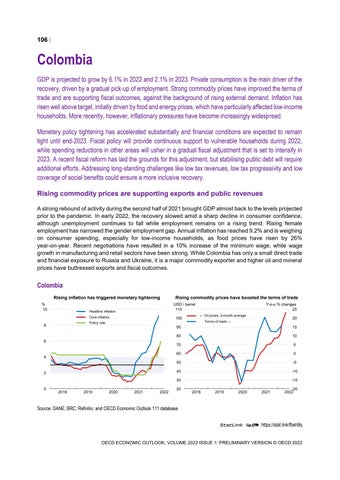
Colombia GDP is projected to grow by 6.1% in 2022 and 2.1% in 2023. Private consumption is the main driver of the recovery, driven by a gradual pick-up of employment. Strong commodity prices have improved the terms of trade and are supporting fiscal outcomes, against the background of rising external demand. Inflation has risen well above target, initially driven by food and energy prices, which have particularly affected low-income households. More recently, however, inflationary pressures have become increasingly widespread. Monetary policy tightening has accelerated substantially and financial conditions are expected to remain tight until end-2023. Fiscal policy will provide continuous support to vulnerable households during 2022, while spending reductions in other areas will usher in a gradual fiscal adjustment that is set to intensify in 2023. A recent fiscal reform has laid the grounds for this adjustment, but stabilising public debt will require additional efforts. Addressing long-standing challenges like low tax revenues, low tax progressivity and low coverage of social benefits could ensure a more inclusive recovery. Rising commodity prices are supporting exports and public revenues A strong rebound of activity during the second half of 2021 brought GDP almost back to the levels projected prior to the pandemic. In early 2022, the recovery slowed amid a sharp decline in consumer confidence, although unemployment continues to fall while employment remains on a rising trend. Rising female employment has narrowed the gender employment gap. Annual inflation has reached 9.2% and is weighing on consumer spending, especially for low-income households, as food prices have risen by 26% year-on-year. Recent negotiations have resulted in a 10% increase of the minimum wage, while wage growth in manufacturing and retail sectors have been strong. While Colombia has only a small direct trade and financial exposure to Russia and Ukraine, it is a major commodity exporter and higher oil and mineral prices have buttressed exports and fiscal outcomes.
Colombia Rising inflation has triggered monetary tightening % 10
Headline inflation Core inflation
100
Y-o-y % changes 25 ← Oil prices, 3-month average
6
4
2
2018
2019
2020
2021
2022
20
Terms of trade →
Policy rate
8
0
Rising commodity prices have boosted the terms of trade USD / barrel 110
90
15
80
10
70
5
60
0
50
-5
40
-10
30
-15
20
2018
2019
2020
2021
-20 2022
Source: DANE; BRC; Refinitiv; and OECD Economic Outlook 111 database. StatLink 2 https://stat.link/fbeh9q OECD ECONOMIC OUTLOOK, VOLUME 2022 ISSUE 1: PRELIMINARY VERSION © OECD 2022
107
Colombia: Demand, output and prices 2018
Colombia
2019
2021
2022
2023
Percentage changes, volume (2015 prices)
Current prices COP trillion
GDP at market prices Private consumption Government consumption Gross fixed capital formation
2020
987.8 672.9 152.3 209.7
3.2 4.1 5.3 2.2
-7.0 -5.0 -0.6 -23.3
10.7 14.8 10.3 11.2
6.1 8.3 4.1 8.6
2.1 3.1 -0.9 2.9
Final domestic demand Stockbuilding¹
1 034.9 - 0.3
3.9 0.2
-8.1 0.6
13.4 0.3
7.7 1.5
2.5 0.0
Total domestic demand Exports of goods and services Imports of goods and services Net exports¹
1 034.6 157.1 203.8 - 46.8
4.0 3.1 7.3 -1.0
-7.5 -22.7 -20.5 0.8
13.6 14.8 28.7 -3.9
9.3 12.5 25.1 -4.1
2.3 7.1 5.9 -0.2
4.0 3.5 2.8 10.4
1.4 2.5 2.0 15.7
6.5 3.5 1.8 13.8
12.3 8.4 5.2 11.6
6.2 5.4 5.4 9.9
-4.6
-3.4
-5.7
-6.5
-6.0
Memorandum items GDP deflator Consumer price index Core inflation index² Unemployment rate (% of labour force) Current account balance (% of GDP)
_ _ _ _ _
1. Contributions to changes in real GDP, actual amount in the first column. 2. Consumer price index excluding primary food, utilities and fuels. Source: OECD Economic Outlook 111 database.
StatLink 2 https://stat.link/zr0p14
Monetary and fiscal policies are tightening over 2022 and 2023 The monetary policy rate has risen by 425 basis points since 2021, and tightening has accelerated this year. Broad-based inflationary pressures will likely require maintaining this accelerated pace to restrictive levels of 8%, and then keeping interest rates stable until late 2023. Fiscal policy has moved from unprecedented support to a gradual consolidation as the recovery gained pace. Exceptional income support to vulnerable households will be maintained until the end of 2022, while other spending areas are set for a significant consolidation, including public investment and general public services expenditures. Fiscal consolidation is meant to accelerate in 2023, if the incoming administration honours current fiscal plans. Improving fiscal outcomes will shore up confidence, after gross public debt has risen to 62% of GDP in 2021, up from 50% in 2019.
Despite a slowdown, growth will nonetheless remain solid Moderate growth will resume in 2022, with a slight acceleration through 2023. Private consumption will gather steam in 2023 as high inflation abates and unemployment recedes. Investment will be driven by a strong construction sector attenuated by tighter financial conditions. Primary exports from oil and mining will benefit from high global prices, at least temporarily, which will also support investment in these sectors. Potential risks surround the adherence to fiscal plans, given that a significant part of the planned fiscal adjustment will have to be implemented by the next administration. Sudden sentiment changes in global financial markets, possibly related to changes in global interest rates, could increase financing costs and affect portfolio capital flows. These have been volatile in the recent past, although the impact has been cushioned by sizeable reserves and continuous access to multilateral financing.
OECD ECONOMIC OUTLOOK, VOLUME 2022 ISSUE 1: PRELIMINARY VERSION © OECD 2022
108
Ambitious reform could address structural bottlenecks and improve equity The pandemic has exacerbated previous challenges in poverty, inequality and labour market informality, while interrupting many children’s education for up to 18 months. Healing these scars will require additional spending on social protection, health and education. This requires mobilising additional public revenues, as does maintaining adequate levels of public investment. It also provides an opportunity for a progressive reform of the tax system and its widespread exemptions and special rates, most of which favour the better off. Replacing social security charges on formal-sector wages with general tax revenues would reduce high non-wage labour costs and curb labour informality, which currently affects 60% of the workforce. A significant overhaul of the fragmented pension system could increase its currently narrow coverage and reduce old-age poverty, while fragmented cash benefit programmes could be merged into a universal social safety net, building on recent advances in social registries. Steps to reduce trade barriers and strengthen competition could facilitate necessary reallocation processes and bolster productivity. A majority of electricity is already generated from renewable, mostly hydroelectric, sources, ensuring energy security, but there is scope to expand the use of wind and solar energy to reduce the reliance on fossil fuels. Defining a timeline for raising and expanding the carbon tax could support these efforts.
OECD ECONOMIC OUTLOOK, VOLUME 2022 ISSUE 1: PRELIMINARY VERSION © OECD 2022