29
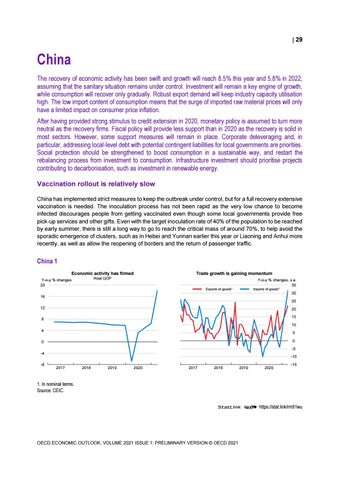
China The recovery of economic activity has been swift and growth will reach 8.5% this year and 5.8% in 2022, assuming that the sanitary situation remains under control. Investment will remain a key engine of growth, while consumption will recover only gradually. Robust export demand will keep industry capacity utilisation high. The low import content of consumption means that the surge of imported raw material prices will only have a limited impact on consumer price inflation. After having provided strong stimulus to credit extension in 2020, monetary policy is assumed to turn more neutral as the recovery firms. Fiscal policy will provide less support than in 2020 as the recovery is solid in most sectors. However, some support measures will remain in place. Corporate deleveraging and, in particular, addressing local-level debt with potential contingent liabilities for local governments are priorities. Social protection should be strengthened to boost consumption in a sustainable way, and restart the rebalancing process from investment to consumption. Infrastructure investment should prioritise projects contributing to decarbonisation, such as investment in renewable energy. Vaccination rollout is relatively slow China has implemented strict measures to keep the outbreak under control, but for a full recovery extensive vaccination is needed. The inoculation process has not been rapid as the very low chance to become infected discourages people from getting vaccinated even though some local governments provide free pick-up services and other gifts. Even with the target inoculation rate of 40% of the population to be reached by early summer, there is still a long way to go to reach the critical mass of around 70%, to help avoid the sporadic emergence of clusters, such as in Hebei and Yunnan earlier this year or Liaoning and Anhui more recently, as well as allow the reopening of borders and the return of passenger traffic.
China 1 Economic activity has firmed
Trade growth is gaining momentum
Real GDP
Y-o-y % changes 20
Y-o-y % changes, s.a. 35
Exports of goods¹
Imports of goods¹
30
16
25 12
20 15
8
10 4
5 0
0
-5 -4 -8
-10 2017
2018
2019
2020
0
0
2017
2018
2019
2020
-15
1. In nominal terms. Source: CEIC. StatLink 2 https://stat.link/rm91wu
OECD ECONOMIC OUTLOOK, VOLUME 2021 ISSUE 1: PRELIMINARY VERSION © OECD 2021
30
China: Demand, output and prices
StatLink 2 https://stat.link/klgq8n
China 2 Shadow banking remains under control amid robust formal credit growth
Private investment is rebounding Year-to-date data Y-o-y % changes 40
Y-o-y % changes 20 15
30
10
20
5
10
0
0
-5
-10
-10 -15
-20
Bank credit Core shadow banking items¹
2017
2018
2019
2020
0
0
2017
2018
2019
2020
-30
1. Core shadow banking items include entrusted loans, trusted loans and undiscounted bankers' acceptance. Source: CEIC. StatLink 2 https://stat.link/x8b0t1
OECD ECONOMIC OUTLOOK, VOLUME 2021 ISSUE 1: PRELIMINARY VERSION © OECD 2021
31
The recovery is gaining momentum Growth in the first quarter declined to 2.4% (quarter-on-quarter seasonally adjusted annualised rate) following double-digit rates in the preceding three quarters. The hardest hit industries, such as accommodation, catering and transportation, rebounded fast. Hubei Province, the epicentre of the pandemic, registered the highest growth, but even less affected provinces grew at double digit rates (in year-on-year terms). The recovery continues to be driven by investment: infrastructure investment is lifting the output of a number of midstream manufacturing industries and imports of raw materials such as iron or copper. Construction activity, which has been robust over the past year or so, is picking up further with the arrival of the peak season and the start of infrastructure projects. The recovery of consumption has been more gradual, but recent strong growth in online sales indicates that consumption is gradually rebounding. The pass-through of the surge of imported energy and raw material prices to consumer price inflation is limited due to the structure of consumption, with a large share of food and limited import content.
Monetary policy will turn more neutral and fiscal support will moderate Monetary policy is assumed to turn more neutral as the recovery firms. The benchmark interest rate has remained unchanged for roughly a year and other rates are also relatively stable. Tightening measures were introduced in the property market to avoid inflating bubbles, which were already emerging. Bond defaults are rising and the share of defaulting local-government-owned enterprises is increasing sharply. This will help to sharpen risk pricing and gradually remove implicit guarantees. Deficiencies in the creditrating market, including inflated ratings and weak warning systems hinder the healthy development of the bond market. The People’s Bank of China issued on 28 March 2021 a draft decision promoting high-quality and healthy development of credit ratings in the bond market, and proposed holding credit rating agencies accountable as independent third parties. Corporate debt has stabilised, but at a very high level. Deleveraging should thus continue. In late April, the securities exchanges published regulations seeking to restrict access of high-risk issuers to the corporate bond market. Local government investment vehicles, in particular those with low credit ratings, will find it difficult to issue corporate bonds other than to service existing debt. Fiscal policy will provide less support than in 2020 as the recovery is solid in most sectors. Still, some support measures will remain in place. For instance, debt moratoria are being extended on a case-by-case basis and firms hit by the crisis can continue to carry over losses for 8 years altogether. Lower-than-statutory social security contribution rates (for unemployment and work injury insurance) can be applied until end-April 2022 considering the slower recovery of some firms in hard-hit sectors and regions. As in the case of debt moratoria, the extension of reduced contribution rates is not automatic and is subject to an application process. With the coming extension of the retirement age, more funds need to be allocated to childcare facility support and to continuous learning.
Growth is to return to its gradually slowing pre-pandemic path Growth in 2021 will be strong and return to the gradually slowing pre-pandemic path thereafter. Investment and exports will remain robust as infrastructure projects restart and foreign demand recovers. The current account surplus is projected to rise further as a result and as the recovery of tourism imports is delayed. Further acceleration of corporate defaults will improve risk pricing, but may adversely affect banks and trust companies, as well as other private and institutional investors. More limited access for local government investment vehicles to the corporate bond market will reduce contingent liabilities at the local government level and help contain corporate debt (as debt by local government investment vehicles is classified as corporate debt). However, it may imply the foregoing of some needed infrastructure projects mainly at the district or county levels, such as toll roads, railways or sewage systems. Better regulation of credit rating agencies will result in a greater dispersion of ratings and provide improved guidance for OECD ECONOMIC OUTLOOK, VOLUME 2021 ISSUE 1: PRELIMINARY VERSION © OECD 2021
32 investors. Improved consumer confidence related to increasing inoculation rates will boost consumption, but for a sustainable pick-up in consumption, the social protection net needs to be strengthened. The sanitary situation remains a downside risk in the absence of mass inoculation, which prevents the reopening of borders as well as mutual recognition of vaccination certificates. A vaccine-resistant strain could also jeopardise the recovery. On the other hand, consumer confidence could rebound more sharply than projected if China succeeds at implementing an inoculation plan aiming at herd immunity in a shorter period of time than currently planned; this would lead to stronger consumption growth. While trade tensions continue to weigh on exports, stronger-than-expected foreign demand would cancel out that impact.
Turning crisis into an opportunity to initiate key reforms The COVID-19 crisis should be used as an opportunity to initiate fundamental reforms, in particular to strengthen social protection and therefore reduce precautionary savings and encourage consumer spending, which is picking up gradually. Accelerating the reform of the household registration system to grant access to public services to all would also work in that direction and could reverse the decline of migrant workers. The share of people planning to save more is decreasing, but it is still close to half of urban households. Once the recovery is fully established, new social spending could be financed with a more progressive income tax and a recurring tax on the ownership of real estate. In addition, a larger share of state-owned enterprise profits could be remitted to the government budget. The current growth target acknowledges that reforms may have a short-term negative impact on growth and this opportunity should be seized for a swift implementation of some needed measures, including the raising of the retirement age. This should be done simultaneously with providing affordable childcare services for all who need it. The rebalancing from investment to consumption will continue only if these structural reforms are implemented.
OECD ECONOMIC OUTLOOK, VOLUME 2021 ISSUE 1: PRELIMINARY VERSION © OECD 2021