96
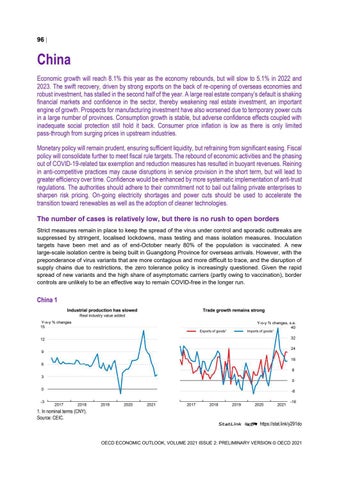
China Economic growth will reach 8.1% this year as the economy rebounds, but will slow to 5.1% in 2022 and 2023. The swift recovery, driven by strong exports on the back of re-opening of overseas economies and robust investment, has stalled in the second half of the year. A large real estate company’s default is shaking financial markets and confidence in the sector, thereby weakening real estate investment, an important engine of growth. Prospects for manufacturing investment have also worsened due to temporary power cuts in a large number of provinces. Consumption growth is stable, but adverse confidence effects coupled with inadequate social protection still hold it back. Consumer price inflation is low as there is only limited pass-through from surging prices in upstream industries. Monetary policy will remain prudent, ensuring sufficient liquidity, but refraining from significant easing. Fiscal policy will consolidate further to meet fiscal rule targets. The rebound of economic activities and the phasing out of COVID-19-related tax exemption and reduction measures has resulted in buoyant revenues. Reining in anti-competitive practices may cause disruptions in service provision in the short term, but will lead to greater efficiency over time. Confidence would be enhanced by more systematic implementation of anti-trust regulations. The authorities should adhere to their commitment not to bail out failing private enterprises to sharpen risk pricing. On-going electricity shortages and power cuts should be used to accelerate the transition toward renewables as well as the adoption of cleaner technologies. The number of cases is relatively low, but there is no rush to open borders Strict measures remain in place to keep the spread of the virus under control and sporadic outbreaks are suppressed by stringent, localised lockdowns, mass testing and mass isolation measures. Inoculation targets have been met and as of end-October nearly 80% of the population is vaccinated. A new large-scale isolation centre is being built in Guangdong Province for overseas arrivals. However, with the preponderance of virus variants that are more contagious and more difficult to trace, and the disruption of supply chains due to restrictions, the zero tolerance policy is increasingly questioned. Given the rapid spread of new variants and the high share of asymptomatic carriers (partly owing to vaccination), border controls are unlikely to be an effective way to remain COVID-free in the longer run.
China 1 Industrial production has slowed
Trade growth remains strong
Real industry value added Y-o-y % changes 15
Y-o-y % changes, s.a. 40
Exports of goods¹
Imports of goods¹
32
12
24
9
16 6 8 3
0
0 -3
-8 2017
2018
2019
2020
2021
0
0
2017
2018
2019
2020
2021
-16
1. In nominal terms (CNY). Source: CEIC. StatLink 2 https://stat.link/y291do
OECD ECONOMIC OUTLOOK, VOLUME 2021 ISSUE 2: PRELIMINARY VERSION © OECD 2021
97
China: Demand, output and prices 2018
2019
GDP at market prices Total domestic demand Exports of goods and services Imports of goods and services Net exports¹ Memorandum items GDP deflator Consumer price index General government financial balance² (% of GDP)
91.9 91.3 17.5 17.0 0.6 _ _ _ _ _
Headline government financial balance³ (% of GDP) Current account balance (% of GDP)
2021
2022
2023
Percentage changes, volume (2015 prices)
Current prices CNY trillion
China
2020
6.0 5.9 1.5 0.4 0.2
2.3 1.9 1.6 -0.8 0.4
8.1 6.3 16.7 7.8 2.0
5.1 4.8 2.4 0.4 0.4
5.1 5.1 5.5 5.3 0.3
1.2 2.9 -3.7 -2.8 0.7
0.7 2.5 -6.9 -3.7 1.9
3.8 0.8 -6.4 -3.1 1.7
1.9 1.7 -6.0 -3.0 1.5
1.4 2.4 -6.1 -3.2 1.5
1. Contributions to changes in real GDP, actual amount in the first column. 2. Encompasses the balances of all four budget accounts (general account, government managed funds, social security funds and the state-owned capital management account). 3. The headline fiscal balance is the official balance defined as the difference between revenues and outlays. Revenues include: general budget revenue, revenue from the central stabilisation fund and sub-national budget adjustment. Outlays include: general budget spending, replenishment of the central stabilisation fund and repayment of principal on sub-national debt. Source: OECD Economic Outlook 110 database.
StatLink 2 https://stat.link/wd1zq9
China 2 House price growth is moderating¹
Shadow banking is contracting rapidly
Y-o-y % changes 40 All
Y-o-y % changes 20
Beijing, Shanghai, Guangzhou and Shenzhen
35
15
Tier 1
30
Tier 2
10
Tier 3
25
Tier 4
20
5
15 0
10 5
-5
0
-10
-10
Bank credit
-5 2011
2013
2015
2017
2019
2021
0
0
Core shadow banking items²
2017
2018
2019
2020
2021
-15
1. Tier 1 comprises 17 cities, Tier 2 22, Tier 3 21 and Tier 4 10 cities. 2. Core shadow banking items include entrusted loans, trusted loans and undiscounted bankers' acceptance. Source: CEIC. StatLink 2 https://stat.link/ifpv6g
OECD ECONOMIC OUTLOOK, VOLUME 2021 ISSUE 2: PRELIMINARY VERSION © OECD 2021
98 Growth in the third quarter was 4.9% year-on-year (0.2% quarter-on-quarter) following very high rates in the preceding quarters. Industrial output slowed due to stringent implementation of environmental targets and power cuts spreading across over half of the provinces, but the services sector recovery continued to gain momentum. Export growth remained strong as overseas economies continued to rebound, although it was affected by COVID-19-related port closures. Investment growth is slowing as some of its key components such as real estate and infrastructure investment have weakened. The stringent regulations to rein in real estate investment (the so-called three red lines related to financial ratios as well as caps on real estate lending by bank type) and deflate the bubble that was forming tightened liquidity conditions for property companies and even pushed some large ones to default on their debt. The recovery of consumption has been more gradual, but recent strong growth in online sales indicates that consumption is gradually rebounding. The pass-through of the surge of imported energy and raw material prices to consumer price inflation is limited due to the structure of consumption, with a large share of food and limited import content.
Monetary policy will remain neutral and fiscal support will become more targeted Monetary policy is assumed to remain neutral, avoiding large-scale easing, but replenishing liquidity as needed. The benchmark interest rate has remained unchanged for over a year and other rates are also relatively stable. Credit events in the property market have tightened borrowing conditions not only for companies in the sector but also for other high-risk borrowers. This has led to a slight increase in informal interest rates, which reflect credit risk for smaller private companies. As the share of unsold properties reached the highest level in thirteen years, many cities adopted stimulus measures such as lump-sum or per-square-metre subsidies for first-time buyers, tax reductions, or broadening the definition of eligible home buyers. Orderly bond defaults will help to sharpen risk pricing and gradually remove implicit guarantees. Corporate debt has stabilised at a very high level of nearly 160% of GDP. Deleveraging should thus continue. Local government investment vehicles, in particular those with low credit ratings, will find it difficult to issue corporate bonds other than to service existing debt. Fiscal policy will provide less support in the coming couple of years as the recovery is solid in most sectors. Some support measures will remain in place, however. For instance, debt moratoria are being extended on a case-by-case basis and firms hit by the crisis can carry over losses for 8 years altogether. Lower-than-statutory social security contribution rates (for unemployment and work injury insurance) can be applied until end-April 2022 considering the slower recovery by firms in hard-hit sectors and regions. As in the case of debt moratoria, the extension of reduced contribution rates is not automatic and is subject to an application process.
Growth is returning to its pre-pandemic gradually slowing path Growth in 2021 will be strong, but will return to the gradually slowing pre-pandemic path thereafter. Infrastructure investment will pick up as the issuance of special bonds accelerates and as projects are frontloaded. This will make up for some of the lower investment in real estate. Further acceleration of corporate defaults will improve risk pricing, but may adversely affect banks, trust companies, and other private and institutional investors. Sporadic virus outbreaks will continue, constraining consumption. In any case, for a sustainable pick-up in consumption, the social protection net needs to be strengthened. CPI inflation will be somewhat higher due to the very low base and some pass-through from producer prices, but will remain under the target. The sanitary situation remains a downside risk as sporadic outbreaks continue even with very high rates of inoculation. The lack of mutual recognition of vaccination certificates prevents the reopening of borders. Continued credit events and disorderly deleveraging in the overstretched property sector may trigger failures of smaller banks and shadow banking institutions. In contrast, relaxing prudential measures and
OECD ECONOMIC OUTLOOK, VOLUME 2021 ISSUE 2: PRELIMINARY VERSION © OECD 2021
99 encouraging investment in real estate may fuel the bubble and subsequently cause greater disruptions. Relaxing environmental regulations to address electricity shortages would boost production in the short run, but would make it more difficult to meet longer-term environmental objectives. Trade disputes with multiple countries imply risks to trade and supply chains, though new tariff exclusions on bilateral tariffs imposed earlier by the United States could boost exports.
Turning crisis into an opportunity to initiate key reforms The COVID-19 crisis should be used as an opportunity to initiate fundamental reforms to enhance competition. This includes easing restrictions on the entry and conduct of private and foreign enterprises as well as phasing out the privileges of state-owned firms and public entities, in particular implicit government guarantees. Administrative monopolies, which are mostly manifest in exclusive rights to provide certain goods and services, should be dismantled to allow for competition. Stronger consumer protection could also boost competitive pressures. The creation of a level playing field and adherence to competitive neutrality should be done in a coherent and systematic way to avoid uncertainty and adverse confidence effects stemming from campaign-style implementation of regulations. The current growth target acknowledges that reforms may have a short-term negative impact on growth and this opportunity should be seized for a swift implementation of some needed measures, including spending on new technologies to decarbonise industrial processes, which would work towards achieving climate goals. Furthermore, on-going power shortages should accelerate the transition to renewables. As renewables production has become sustainable and subsidies are being phased out, more funds should be channelled to support the transition to zero net emissions.
OECD ECONOMIC OUTLOOK, VOLUME 2021 ISSUE 2: PRELIMINARY VERSION © OECD 2021