102
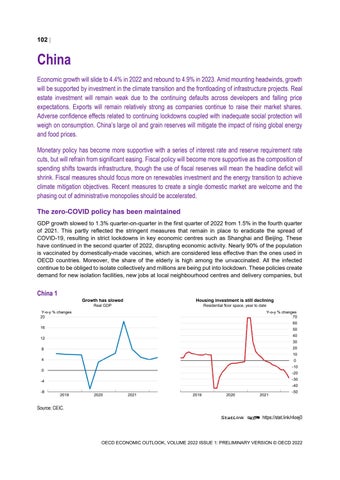
China Economic growth will slide to 4.4% in 2022 and rebound to 4.9% in 2023. Amid mounting headwinds, growth will be supported by investment in the climate transition and the frontloading of infrastructure projects. Real estate investment will remain weak due to the continuing defaults across developers and falling price expectations. Exports will remain relatively strong as companies continue to raise their market shares. Adverse confidence effects related to continuing lockdowns coupled with inadequate social protection will weigh on consumption. China’s large oil and grain reserves will mitigate the impact of rising global energy and food prices. Monetary policy has become more supportive with a series of interest rate and reserve requirement rate cuts, but will refrain from significant easing. Fiscal policy will become more supportive as the composition of spending shifts towards infrastructure, though the use of fiscal reserves will mean the headline deficit will shrink. Fiscal measures should focus more on renewables investment and the energy transition to achieve climate mitigation objectives. Recent measures to create a single domestic market are welcome and the phasing out of administrative monopolies should be accelerated. The zero-COVID policy has been maintained GDP growth slowed to 1.3% quarter-on-quarter in the first quarter of 2022 from 1.5% in the fourth quarter of 2021. This partly reflected the stringent measures that remain in place to eradicate the spread of COVID-19, resulting in strict lockdowns in key economic centres such as Shanghai and Beijing. These have continued in the second quarter of 2022, disrupting economic activity. Nearly 90% of the population is vaccinated by domestically-made vaccines, which are considered less effective than the ones used in OECD countries. Moreover, the share of the elderly is high among the unvaccinated. All the infected continue to be obliged to isolate collectively and millions are being put into lockdown. These policies create demand for new isolation facilities, new jobs at local neighbourhood centres and delivery companies, but
China 1 Growth has slowed
Housing investment is still declining
Real GDP
Residential floor space, year to date
Y-o-y % changes 20
Y-o-y % changes 70 60
16
50 40
12
30 20
8
10 4
0 -10
0
-20 -30
-4
-40 -8
2019
2020
2021
0
0
2019
2020
2021
-50
Source: CEIC. StatLink 2 https://stat.link/r4oej0
OECD ECONOMIC OUTLOOK, VOLUME 2022 ISSUE 1: PRELIMINARY VERSION © OECD 2022
103
China: Demand, output and prices 2018
2019
GDP at market prices Total domestic demand Exports of goods and services Imports of goods and services
2021
2022
2023
Percentage changes, volume (2015 prices)
Current prices CNY trillion
China
2020
91.9 91.3 17.5 17.0
6.0 5.9 1.3 0.4
2.2 1.6 3.0 -0.3
8.1 6.3 16.2 7.7
4.4 2.9 7.3 -0.3
4.9 4.9 5.5 5.3
0.6
0.2
0.6
2.0
1.6
0.4
_ _ _ _ _
1.3 2.9 -3.7 -2.8 0.7
0.5 2.5 -6.9 -3.7 1.7
4.4 0.8 -6.6 -3.1 1.8
3.1 2.0 -6.5 -2.8 3.0
1.4 3.0 -6.6 -3.0 3.1
Net exports¹ Memorandum items GDP deflator Consumer price index General government financial balance² (% of GDP) Headline government financial balance³ (% of GDP) Current account balance (% of GDP)
1. Contributions to changes in real GDP, actual amount in the first column. 2. Encompasses the balances of all four budget accounts (general account, government managed funds, social security funds and the state-owned capital management account). 3. The headline fiscal balance is the official balance defined as the difference between revenues and outlays. Revenues include: general budget revenue, revenue from the central stabilisation fund and sub-national budget adjustment. Outlays include: general budget spending, replenishment of the central stabilisation fund and repayment of principal on sub-national debt. Source: OECD Economic Outlook 111 database.
StatLink 2 https://stat.link/codpmb
China 2 Retail sales growth is weak
Shadow banking continues to contract
Y-o-y % changes 40 Retail sales (goods) 30
Y-o-y % changes 20
Online retail sales¹ (goods and services)
15 10
20
5 10 0 0
-5
-10 -20
-10
Bank credit
2019
2020
2021
0
0
Core shadow banking items²
2017
2018
2019
2020
2021
-15
1. Year-to-date data. 2. Core shadow banking items include entrusted loans, trusted loans and undiscounted bankers' acceptance. Source: CEIC. StatLink 2 https://stat.link/dbzlie
OECD ECONOMIC OUTLOOK, VOLUME 2022 ISSUE 1: PRELIMINARY VERSION © OECD 2022
104 such investments are less productive than those, for instance, in much needed infrastructure. The services sector and consumption have been particularly impacted. Automobile supply chains have experienced disruptions, contributing to weaker export growth. Investment growth is slowing as some components such as real estate investment have weakened. Stringent regulations to rein in real estate investment (the so-called three red lines related to financial ratios as well as caps on real estate lending by bank type) and prices have tightened liquidity conditions for property companies and even pushed some large ones to default. The impacts of the war in Ukraine have mostly been felt through the impact on global markets as neither Ukraine nor Russia is an important economic partner for China (unlike vice versa). Imported energy and raw material prices have surged, but the pass-through to consumer price inflation is limited due to the structure of consumption, with a large share of food that has limited import content. The release of edible oils reserves has helped keep food inflation under control, despite price rises in international markets due to the war in Ukraine. China’s large grain reserves and export restrictions in the form of quotas will mitigate the impact of rising global grain prices on domestic inflation and reduce the risk of shortages. However, lockdown-induced supply-side constraints on fresh food have started to push CPI inflation higher, with headline inflation reaching 2.1% year-on-year in April (though core inflation remained low at 0.9%). Replacing part of crude oil imports by discounted Urals from Russia also helps contain inflationary pressure.
Monetary policy will be more supportive and fiscal policy more expansionary Monetary policy is assumed to become more supportive. The required reserves ratio and the benchmark interest rate have been cut twice since November 2021, and further moderate cuts are assumed to follow, though the room is quite limited. Financial risks have declined, though vulnerabilities remain. Credit events in the property market have tightened borrowing conditions for companies in the sector and other high-risk borrowers, and shadow banking has been further reined in. This led to a slight increase in informal interest rates, reflecting credit risk for smaller private companies. As the share of unsold properties reached the highest level in thirteen years, many cities adopted stimulus measures such as lump sum or per square-metre subsidies for first-time buyers, tax reductions, or broadening the definition of eligible home buyers. In May, the floor of mortgage rates for first-time buyers was cut nationwide. Recent guidelines foreshadow some relaxation of financing restrictions for property developers and local government investment vehicles. Orderly bond defaults will help sharpen risk pricing and gradually remove implicit guarantees. Corporate debt has stabilised at a very high level of around 155% of GDP. Deleveraging should thus continue. Fiscal policy will provide support in the form of cuts in taxes and charges and spending of reserve funds. There is also a sizeable carry-over effect stemming from unspent proceeds from specialised local bond issues in 2021. Furthermore, ad hoc submission of dividends by the state-owned financial sector to the government as its owner equivalent to 0.8% of GDP will partly be spent on infrastructure investment. The recent requirement for local government investment vehicles to secure the budget prior to carrying out infrastructure projects helps contain contingent liabilities, though it has constrained their activities. To better mobilise them in the infrastructure drive, they will have easier access to funding.
Growth is returning to its pre-pandemic path GDP growth will moderate significantly in 2022, reflecting a slowdown from the strong rebound in 2021 and the impact of pandemic-related shutdowns, before returning to its gradually slowing pre-pandemic path in 2023. Infrastructure investment will pick up, financed by bonds issued last year and as the authorities frontload projects. This will partly offset weaker real estate investment. An expected further rise in corporate defaults will improve risk pricing, but may adversely affect banks, trust companies, as well as OECD ECONOMIC OUTLOOK, VOLUME 2022 ISSUE 1: PRELIMINARY VERSION © OECD 2022
105 other private and institutional investors. Further virus outbreaks are likely, constraining consumption, though to a lesser extent than in early 2022 assuming case numbers further decline. CPI inflation will be somewhat higher due to lockdown-related supply-side constraints lifting fresh food prices and some passthrough from higher energy and food prices, but will remain moderate. A stable supply of energy and grains will play a key role in containing price increases. The sanitary situation remains a key downside risk as outbreaks continue and are addressed by stringent isolation measures. The lack of mutual recognition of vaccination certificates prevents the reopening of borders. Continued credit events and disorderly deleveraging in the overstretched property sector may trigger failures of smaller banks and shadow banking institutions. In contrast, relaxing prudential measures and encouraging investment in real estate may fuel the bubble and subsequently cause greater disruptions. Relaxing environmental regulations to address electricity shortages would boost production in the short run, but would make it more difficult to meet longer-term environmental objectives.
Turning crisis into an opportunity to initiate key reforms Fundamental reforms to enhance competition would sustain the economic recovery from the pandemic. This includes easing restrictions on the entry and conduct of private and foreign enterprises as well as phasing out privileges of state-owned firms and public entities, in particular implicit government guarantees. Administrative monopolies, often with exclusive rights to provide certain goods and services, should be dismantled. Recent measures aiming at creating a single domestic market are a welcome step. Stronger consumer protection could also boost competitive pressures. The creation of a level playing field and adherence to competitive neutrality should be done in a coherent and systematic way to avoid uncertainty and adverse confidence effects stemming from ad hoc implementation of regulations. Better preparation for future outbreaks, which will likely happen, including vaccinating the unvaccinated and increasing the effectiveness of boosters would cause fewer disruptions to economic activity. The current growth target of around 5.5% is rather ambitious and available funding should target new technologies to decarbonise industrial processes, which would work towards also achieving climate goals. Furthermore, occasional power shortages should prompt an acceleration of the transition to renewables. As renewables production has become sustainable and subsidies are being phased out, more funds should be channelled to support the transition to zero net emissions.
OECD ECONOMIC OUTLOOK, VOLUME 2022 ISSUE 1: PRELIMINARY VERSION © OECD 2022