26
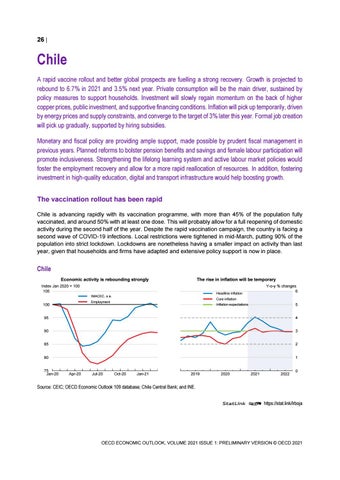
Chile A rapid vaccine rollout and better global prospects are fuelling a strong recovery. Growth is projected to rebound to 6.7% in 2021 and 3.5% next year. Private consumption will be the main driver, sustained by policy measures to support households. Investment will slowly regain momentum on the back of higher copper prices, public investment, and supportive financing conditions. Inflation will pick up temporarily, driven by energy prices and supply constraints, and converge to the target of 3% later this year. Formal job creation will pick up gradually, supported by hiring subsidies. Monetary and fiscal policy are providing ample support, made possible by prudent fiscal management in previous years. Planned reforms to bolster pension benefits and savings and female labour participation will promote inclusiveness. Strengthening the lifelong learning system and active labour market policies would foster the employment recovery and allow for a more rapid reallocation of resources. In addition, fostering investment in high-quality education, digital and transport infrastructure would help boosting growth. The vaccination rollout has been rapid Chile is advancing rapidly with its vaccination programme, with more than 45% of the population fully vaccinated, and around 50% with at least one dose. This will probably allow for a full reopening of domestic activity during the second half of the year. Despite the rapid vaccination campaign, the country is facing a second wave of COVID-19 infections. Local restrictions were tightened in mid-March, putting 90% of the population into strict lockdown. Lockdowns are nonetheless having a smaller impact on activity than last year, given that households and firms have adapted and extensive policy support is now in place.
Chile Economic activity is rebounding strongly
The rise in inflation will be temporary
Index Jan 2020 = 100 105 IMACEC, s.a.
Core inflation
Employment
100
Y-o-y % changes 6
Headline inflation
5
Inflation expectations
95
4
90
3
85
2
80
1
75 Jan-20
Apr-20
Jul-20
Oct-20
Jan-21
0
0
2019
2020
2021
2022
0
Source: CEIC; OECD Economic Outlook 109 database; Chile Central Bank; and INE. StatLink 2 https://stat.link/lrboja
OECD ECONOMIC OUTLOOK, VOLUME 2021 ISSUE 1: PRELIMINARY VERSION © OECD 2021
27
Chile: Demand, output and prices 2017
Chile GDP at market prices* Private consumption Government consumption Gross fixed capital formation Final domestic demand Stockbuilding1 Total domestic demand Exports of goods and services Imports of goods and services Net exports1 Memorandum items GDP deflator Consumer price index Private consumption deflator Unemployment rate (% of labour force) Central government financial balance (% of GDP) Current account balance (% of GDP)
2018
_ _ _ _ _ _
2020
2021
2022
Percentage changes, volume (2013 prices)
Current prices CLP billion
179 849.6 113 983.7 25 363.3 37 768.6 177 115.7 650.2 177 765.9 51 006.4 48 922.7 2 083.7
2019
3.8 3.8 3.3 5.0 4.0 0.5 4.4 5.4 8.1 -0.7
0.9 1.1 0.0 4.5 1.7 -0.7 0.9 -2.5 -2.4 0.0
-6.0 -7.8 -3.7 -11.8 -8.1 -1.6 -9.8 -0.7 -13.6 3.7
6.7 10.8 4.4 9.3 9.4 3.6 13.1 -1.4 21.9 -6.2
3.5 4.4 0.8 3.1 3.5 0.0 3.5 3.9 3.7 0.1
2.4 2.4 2.8 7.4 -1.7 -3.9
1.9 2.6 1.0 7.2 -2.9 -3.7
8.3 3.0 3.3 10.7 -7.2 1.7
5.7 3.6 3.7 9.8 -4.2 -1.5
3.2 3.1 3.1 8.2 -3.5 -1.2
* Based on seasonal and working-day adjusted quarterly data; may differ from official non-working-day adjusted annual data. 1. Contributions to changes in real GDP, actual amount in the first column. Source: OECD Economic Outlook 109 database.
StatLink 2 https://stat.link/145x3r
The recovery is gathering pace The recovery has gradually gained momentum since the third quarter of 2020. Strong retail trade has been supported by fiscal measures and exceptional withdrawals of pension funds. Other activities, such as accommodation, food services and recreation, continue to lag behind. Investment remains weak due to high uncertainty about the evolution of the pandemic. Employment has started to recover, but lags behind economic activity. Business and consumer sentiment have improved driven by the rapid vaccination process and higher copper prices.
A solid policy response is cushioning the negative COVID-19 effects The authorities responded to the crisis with unprecedented fiscal, monetary and financial measures. The multi-year fiscal response amounts to 13% of GDP during 2020 and 2021, supporting health, workers, households and firms. The government has recently strengthened pandemic relief measures, such as cash transfers for vulnerable households, the job retention scheme, hiring subsidies and public guarantee measures to help SMEs. Higher copper prices are improving the fiscal accounts and pandemic-related fiscal stimulus is expected to be withdrawn gradually as the recovery firms. Further fiscal support than currently planned for jobs and viable firms, particularly in the most affected sectors, might be needed. The monetary policy stance has been highly expansionary, with record low policy rates and a broad range of unconventional measures ensuring both financial stability and credit expansion. These policies should be maintained, as planned, until the recovery is firmly underway.
OECD ECONOMIC OUTLOOK, VOLUME 2021 ISSUE 1: PRELIMINARY VERSION © OECD 2021
28
GDP will bounce back to its pre-pandemic level by early 2022 The economic recovery will gain traction in the second part of 2021. Economic growth this year will be driven by buoyant private consumption, and strong global demand. Higher copper prices and measures to streamline private investment projects will boost fixed investment. The labour market will recover gradually, supported by hiring subsidies, but high informality remains a concern. The main risk to the outlook is the pandemic, though mitigated by fast vaccination. The outcome of the constitutional process and the presidential elections at end-2021 also remain sources of uncertainty. Sudden changes in global financial markets could weaken the currency and push up inflation. However, a strong macroeconomic and institutional framework, large foreign-exchange reserves and the still low level of public debt by international standards, make the economy resilient. Upside risks to growth are a faster-than-expected vaccine deployment, particularly in Latin America, excess savings and pent-up demand, and sustained higher copper prices.
Policies to support employment and productivity are needed Continuing the reform agenda is important to prevent a rise of inequality and to strengthen economic resilience and growth. Streamlining complex regulatory procedures and ensuring that firms are more exposed to competition, innovation and digital tools would support a swift recovery and boost productivity. Strengthening public employment services, unemployment benefits and the training system would help to face the challenges of digitalisation and ensure that all workers, particularly the most vulnerable, have adequate opportunities for finding good-quality jobs. A third wave of extraordinary withdrawals from pension funds has been approved, decreasing and, in many cases, depleting individual retirement savings, reducing already low old-age pensions and potentially reducing financial market depth and worsening future fiscal accounts. Moreover, the short-term demand boost will be smaller than with previous withdrawals given that more than 60% from the previous ones have been used to increase other types of savings rather than spending. If needed, extending the existing targeted support to vulnerable households would be more suitable to support demand in a more inclusive way.
OECD ECONOMIC OUTLOOK, VOLUME 2021 ISSUE 1: PRELIMINARY VERSION © OECD 2021