22
Canada The Canadian economy will rebound strongly and grow by 6.1% in 2021 and 3.8% in 2022, thanks to reduced COVID-19 restrictions in the second half of this year and buoyant external demand. These developments will be echoed in a recovery in the labour market. Nevertheless, output levels will remain below trend and underlying inflationary pressures will be contained. After increasing again in 2021, the public debt burden will stabilise in 2022. Government schemes supporting businesses and households experiencing revenue and income losses need to remain available until economic recovery is well underway. Monetary policy should remain accommodative, accompanied by a close watch on housing and corporate debt, with further tapering of quantitative easing contingent on signs of strengthening conditions. Reforms proposed in the National Budget 2021 suggest positive advances in social and environmental policy and for the business environment. The reduction in the fiscal deficit in 2022 is appropriate. However, once the economy is on a firm footing, a medium-term fiscal strategy to reduce public debt should be considered. Canada is hit by a third wave of the pandemic, but vaccination is accelerating A third wave of COVD-19 cases began in March and peaked mid-April. Containment measures have included a province-wide stay-at-home order in Ontario, localised lockdowns in Quebec and tighter restrictions in British Colombia and Alberta. Despite the latest surge, Canada remains less severely hit by the pandemic than the most affected countries. In addition, following a slow start, the rate of vaccination has increased substantially; as of mid-May, over 45% of the population had received at least one dose of a COVID-19 vaccine.
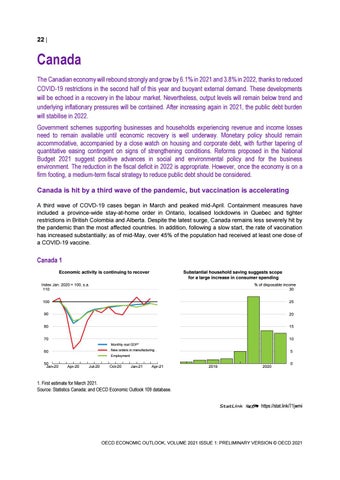
Canada 1 Economic activity is continuing to recover
Substantial household saving suggests scope for a large increase in consumer spending
Index Jan. 2020 = 100, s.a. 110
% of disposable income 30
100
25
90
20
80
15
70
10 Monthly real GDP¹ New orders in manufacturing
60
5
Employment
50 Jan-20
Apr-20
Jul-20
Oct-20
Jan-21
0 Apr-21
0
2019
2020
0
1. First estimate for March 2021. Source: Statistics Canada; and OECD Economic Outlook 109 database. StatLink 2 https://stat.link/71jwmi
OECD ECONOMIC OUTLOOK, VOLUME 2021 ISSUE 1: PRELIMINARY VERSION © OECD 2021
23
Canada: Demand, output and prices 2017
2018
Current prices CAD billion
Canada GDP at market prices Private consumption Government consumption Gross fixed capital formation Final domestic demand Stockbuilding1
2 140.6 1 241.1 443.2 485.8 2 170.1 17.5 2 187.6 673.3 720.3 - 46.9
Total domestic demand Exports of goods and services Imports of goods and services Net exports1 Memorandum items GDP deflator Consumer price index Core consumer price index2 Unemployment rate (% of labour force) Household saving ratio, net (% of disposable income) General government financial balance (% of GDP) General government gross debt (% of GDP) Current account balance (% of GDP)
2019
2020
2021
2022
Percentage changes, volume (2012 prices)
2.4 2.5 2.9 1.8 2.5 -0.2 2.3 3.7 3.4 0.0
1.9 1.7 2.0 0.3 1.4 0.2 1.6 1.3 0.4 0.3
-5.4 -6.1 -1.1 -3.6 -4.5 -1.6 -6.1 -9.8 -11.3 0.6
6.1 5.0 2.8 6.1 4.7 0.8 5.5 11.7 9.9 0.3
3.8 4.6 1.3 3.2 3.6 0.0 3.6 4.2 3.6 0.2
_ _
1.8 2.2
1.7 2.0
0.8 0.7
3.6 2.0
1.5 1.4
_ _ _ _ _ _
1.9 5.9 0.8 0.3 92.8 -2.3
2.1 1.1 1.1 1.3 5.7 9.5 7.9 6.8 1.4 14.7 11.4 6.5 0.5 -10.7 -6.0 -1.5 92.7 127.4 130.5 130.3 -2.1 -1.9 0.4 0.6
1. Contributions to changes in real GDP, actual amount in the first column. 2. Consumer price index excluding food and energy. Source: OECD Economic Outlook 109 database.
StatLink 2 https://stat.link/ip3mqw
Canada 2 Output is heading towards its pre-pandemic trend Index 2019Q4 = 100, s.a. 110
The unemployment rate will continue to fall
Real GDP
% of labour force 14
Pre-crisis growth path¹ Current growth path
105
12
100
10
95
8
90
6
85
2019
2020
2021
2022
0
0
2019
2020
2021
2022
4
1. The pre-crisis growth path is based on the November 2019 OECD Economic Outlook projection, with linear extrapolation for 2022 based on trend growth in 2021. Source: OECD Economic Outlook 106 and 109 databases. StatLink 2 https://stat.link/vr6i4s
OECD ECONOMIC OUTLOOK, VOLUME 2021 ISSUE 1: PRELIMINARY VERSION © OECD 2021
24
Economic activity has been more resilient than expected Output growth has been holding up well given the renewed virus outbreaks. Real GDP increased by 0.4% and 0.9% (month-on-month) in February and March, respectively. The faster pace of vaccination, significant fiscal stimulus, higher prices for oil and other commodity exports and the prospects of increased demand arising from the US fiscal package in March are boosting the recovery. The household saving rate is declining from the high level reached in the early months of the crisis, when middle and high-income households in particular accumulated saving well in excess of levels implied by pre-crisis behaviour. The saving rate decline is consistent with gathering confidence and adaptation to restrictions. Business sentiment has also become more positive according to the Bank of Canada’s Business Outlook Survey. The energy price recovery has driven increases in headline consumer price inflation in recent months. Headline inflation increased by 3.4% in April (year-on-year), while excluding energy, the consumer price index increased by 1.6%. House price growth continues apace; the Teranet-National Bank National Composite house-price index for March was up 10.8% year-on-year.
The federal government has committed to further support for households and businesses Monetary and fiscal policy support remains substantial. The monetary policy stance remains accommodative notwithstanding the reduction in the scale of the quantitative easing programme announced in April. The Bank of Canada’s policy rate remains at 0.25%. Similar to elsewhere, bond yields on long-term government securities have increased in recent months. The federal government’s National Budget for 2021, published in April, commits to keep support for households and businesses on tap. There are prolongations to a number of support schemes, including the Canada Emergency Wage Subsidy and the Canada Recovery Benefit. New supports include an additional wage-bill subsidy, the Canada Recovery Hiring Program. The Budget estimates the federal fiscal deficit at 6.4% of GDP for the fiscal year 2021-22, a level consistent with keeping pandemic support on tap. With only modest reductions in the public-debt burden projected over the four years to 2025-26, a medium-term fiscal strategy should aim to restore fiscal headroom after the pandemic subsides.
Economic growth will accelerate in the second half of this year The projections envisage a slowing of growth in the second quarter of this year. This will be followed by a pick-up as vaccination progresses and containment measures are lifted when the latest wave of the pandemic subsides. Consumer spending will increase further as restrictions are lifted and labour market conditions continue to improve. Exports will be boosted by additional demand arising from the US fiscal package. Headline consumer price inflation is expected to diminish in the near term as the impact of energy-price increases wears off. It will then rise gradually as the economy grows and spare capacity diminishes. Echoing the federal government’s budget, the general government fiscal deficit will decline substantially in 2021 and 2022 as tax revenues recover and need for household and business support declines. A rise in the monetary policy interest rate is assumed in the final quarter of 2022. Despite the improving economic outlook, risks remain elevated. As elsewhere, the emergence of highly contagious virus variants requiring renewed restrictions is a risk factor for the pace of economic recovery. On the other hand, faster reduction of case numbers, and brighter labour market prospects, could bring stronger-than-expected growth in household consumption and more rapid reduction in the saving rate. While the US fiscal package will undoubtedly boost demand for Canadian exports, the scale of the effect is uncertain. Vulnerabilities in the corporate bond market remain a concern. Recent housing price growth will make homeownership still less attainable for many households, while increased mortgage borrowing could compound financial market vulnerabilities in the event of future shocks.
OECD ECONOMIC OUTLOOK, VOLUME 2021 ISSUE 1: PRELIMINARY VERSION © OECD 2021
25
Policy needs to nurture business recovery and strengthen well-being The federal government’s budget indicates a welcome commitment to keep some of the pandemic support measures for households and businesses on tap for the duration of the crisis. It also aims to make progress on longer-term socio-economic issues that have been flagged in OECD Economic Surveys. Areas of policy requiring particular improvement include access to childcare, programmes for indigenous peoples and access to prescription drugs. In environmental policy, it remains important to follow through with the plan to accelerate the increases in carbon pricing and taxation through to 2030. The budget makes welcome commitments to improve the environment for business, including efforts to further lower Canada’s domestic trade barriers. In addition, there is scope to improve insolvency processes; attention to this could help business sector recovery.
OECD ECONOMIC OUTLOOK, VOLUME 2021 ISSUE 1: PRELIMINARY VERSION © OECD 2021