131
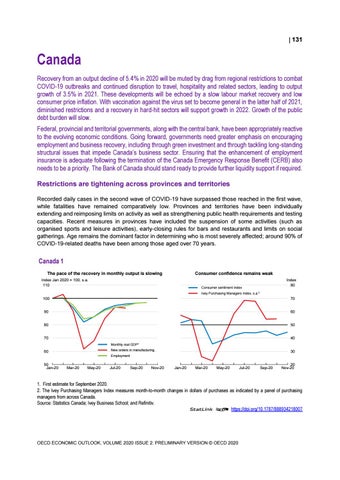
Canada Recovery from an output decline of 5.4% in 2020 will be muted by drag from regional restrictions to combat COVID-19 outbreaks and continued disruption to travel, hospitality and related sectors, leading to output growth of 3.5% in 2021. These developments will be echoed by a slow labour market recovery and low consumer price inflation. With vaccination against the virus set to become general in the latter half of 2021, diminished restrictions and a recovery in hard-hit sectors will support growth in 2022. Growth of the public debt burden will slow. Federal, provincial and territorial governments, along with the central bank, have been appropriately reactive to the evolving economic conditions. Going forward, governments need greater emphasis on encouraging employment and business recovery, including through green investment and through tackling long-standing structural issues that impede Canada’s business sector. Ensuring that the enhancement of employment insurance is adequate following the termination of the Canada Emergency Response Benefit (CERB) also needs to be a priority. The Bank of Canada should stand ready to provide further liquidity support if required. Restrictions are tightening across provinces and territories Recorded daily cases in the second wave of COVID-19 have surpassed those reached in the first wave, while fatalities have remained comparatively low. Provinces and territories have been individually extending and reimposing limits on activity as well as strengthening public health requirements and testing capacities. Recent measures in provinces have included the suspension of some activities (such as organised sports and leisure activities), early-closing rules for bars and restaurants and limits on social gatherings. Age remains the dominant factor in determining who is most severely affected; around 90% of COVID-19-related deaths have been among those aged over 70 years.
Canada 1 The pace of the recovery in monthly output is slowing
Consumer confidence remains weak
Index Jan 2020 = 100, s.a. 110
Index 80
Consumer sentiment index Ivey Purchasing Managers Index, s.a.²
100
70
90
60
80
50
70
40 Monthly real GDP¹ New orders in manufacturing
60
30
Employment
50 Jan-20
Mar-20
May-20
Jul-20
Sep-20
0 Nov-20
0 Jan-20
Mar-20
May-20
Jul-20
Sep-20
20 Nov-20
1. First estimate for September 2020. 2. The Ivey Purchasing Managers Index measures month-to-month changes in dollars of purchases as indicated by a panel of purchasing managers from across Canada. Source: Statistics Canada; Ivey Business School; and Refinitiv. StatLink 2 https://doi.org/10.1787/888934218007
OECD ECONOMIC OUTLOOK, VOLUME 2020 ISSUE 2: PRELIMINARY VERSION © OECD 2020
132
Canada: Demand, output and prices 2017
2018
Current prices CAD billion
Canada GDP at market prices Private consumption Government consumption Gross fixed capital formation Final domestic demand Stockbuilding1
2 141.1 1 240.4 444.1 486.8 2 171.3 17.2 2 188.5 672.5 719.9 - 47.4
Total domestic demand Exports of goods and services Imports of goods and services Net exports1 Memorandum items GDP deflator Consumer price index Core consumer price index2 Unemployment rate (% of labour force) Household saving ratio, net (% of disposable income) General government financial balance (% of GDP) General government gross debt (% of GDP) Current account balance (% of GDP)
2019
2020
2021
2022
Percentage changes, volume (2012 prices)
2.0 2.1 3.0 1.2 2.1 -0.2 1.9 3.1 2.6 0.1
1.7 1.6 2.1 -0.4 1.3 0.1 1.4 1.3 0.6 0.2
-5.4 -6.1 -0.1 -6.4 -4.9 -2.0 -6.8 -8.5 -12.8 1.6
3.5 4.4 2.0 2.1 3.4 -0.5 2.9 5.1 3.1 0.5
2.0 2.1 1.3 2.2 1.9 0.0 2.0 2.0 2.0 0.0
_ _
1.8 2.2
1.9 2.0
-0.1 0.6
0.4 0.7
1.0 1.2
_ _ _ _ _ _
1.9 5.8 1.7 -0.4 93.8 -2.5
2.1 0.9 0.3 1.2 5.7 9.6 8.7 7.7 2.9 15.0 8.5 5.4 -0.3 -15.6 -11.3 -5.8 94.3 121.5 131.2 135.4 -2.0 -1.9 -1.7 -1.7
1. Contributions to changes in real GDP, actual amount in the first column. 2. Consumer price index excluding food and energy. Source: OECD Economic Outlook 108 database.
StatLink 2 https://doi.org/10.1787/888934218026
Canada 2 Output will remain below the pre-crisis trend
Unemployment will decline slowly
Real GDP
Unemployment rate
Index 2019Q4 = 100, s.a. 110
Pre-crisis growth path¹
% of labour force 14
Current growth path
105
12
100
10
95
8
90
6
85
2019
2020
2021
2022
0
0
2019
2020
2021
2022
4
1. The pre-crisis growth path is based on the November 2019 OECD Economic Outlook projection, with linear extrapolation for 2022 based on trend growth in 2021. Source: OECD Economic Outlook 106 and 108 databases. StatLink 2 https://doi.org/10.1787/888934218045
OECD ECONOMIC OUTLOOK, VOLUME 2020 ISSUE 2: PRELIMINARY VERSION © OECD 2020
133
Recovery has initially been rapid Economic activity picked up sharply following the start of de-confinement in May. Monthly GDP troughed at 18% below pre-crisis levels in April; by July, the gap was only around 6%. Activity in some sectors, including retail and wholesale trade, is already back to pre-crisis levels. The large injection of support to household incomes has played a substantial role; indeed, the income increase outstripped consumption and the household saving rate has risen substantially. A partial rebound of global oil prices helped the resource sector. However, the pace of the recovery in output and employment is slowing, demand is weak in some sectors and there are signs of a fall in consumer confidence. National accounts data show that activity in the arts, entertainment and recreation sector and in the accommodation and food services sector are still well below pre-crisis levels. In addition, structural shifts prompted by the pandemic, such as the accelerated shift to online retailing (e-commerce sales approximately doubled during lockdown), are bringing adjustment costs. The Bank of Canada’s Business Outlook Survey shows business sentiment to have improved in the third quarter but remain negative. Consumer price inflation continues to be subdued. Meanwhile house price growth has been strong with housing purchases boosted, in part, by lower interest rates. Also, government support for households and banks’ provisions for mortgage-payment deferrals will have limited downward pressure on prices from forced sales.
Monetary and fiscal support is evolving Fewer monetary and financial market measures are being used, but the degree of monetary policy support remains substantial. The Bank of Canada has been able to withdraw support partially as some specific risks have receded, for instance support for the financing of provincial governments has been terminated. However, interest rates remain ultra-low (the Bank’s policy rate is 0.25%) and the Bank’s purchases of federal government securities continue. Government support is also evolving. Provisions allowing tax payment deferral have ended, and the Canada Emergency Response Benefit (CERB), the major income support programme introduced for households, was retired at the end of September. However, CERB’s termination is not bringing an abrupt halt to support. Many recipients are eligible to switch to unemployment insurance and substitute programmes have been introduced for certain groups. The other major programme, CEWS, which provides a wage subsidy of up to 75% to employers for up to three months, has been extended to mid-2021 with an estimated outlay of CAN 80 billon (around 3% of GDP). Employers must demonstrate a drop in revenue to access the subsidy, and the amount of subsidy is linked to the revenue drop. Rental support for business, credit support and loan guarantees are also being extended into 2021. Total federal government outlays on measures for the 2020-21 budget year are estimated at 11% of GDP. Provincial governments are retaining special provisions in safety nets and additional support for business, though the dollar value of support is expected to remain small compared with that from federal government.
The economic recovery is expected to slow considerably The projections envisage that localised containment measures will weigh on growth until vaccination against the virus becomes general. Activity in the travel, leisure and hospitality sectors will remain significantly below pre-crisis levels. Uncertainty about economic prospects will damp household consumption and business investment. Consumer price inflation is expected to remain below the 2% target. The fiscal deficit will decline in 2021 and 2022 as tax revenues recover and need for household and business support declines. Nevertheless, there will be a further increase in the ratio of public debt to GDP.
OECD ECONOMIC OUTLOOK, VOLUME 2020 ISSUE 2: PRELIMINARY VERSION © OECD 2020
134 Risks will remain elevated. As elsewhere, there are uncertainties on the scale and economic impact of future containment measures and the timing of a vaccine rollout. These issues will particularly affect the pace of recovery in the hard-hit sectors, such as travel and hospitality. Another key uncertainty is the extent to which households will unwind the elevated saving ratio through consumption or hold back due to caution about future prospects. For Canada, the future path of oil price and demand is also a key source of uncertainty and risk. Canada’s economic recovery from the COVID-19 crisis will depend as well on developments in the United States given the close economic ties between the two countries. In financial markets, while a liquidity crisis has been averted so far, risks remain. The economic crisis arising from the pandemic has heightened vulnerabilities in the corporate bond market and risks from high levels of household debt through mortgage borrowing.
Economic policy now needs to nurture business opportunities, job creation and well-being Nurturing recovery in the business sector should be a key priority. Support should focus on viable segments of those sectors heavily scarred by the crisis, but also on reallocation by encouraging positive shifts in the structure of economic activity, including through employment-intensive green investment projects and retraining programmes. Structural issues that have long held back the productivity and competitiveness of Canada’s business sector, such as non-tariff barriers to trade across provinces and territories, should be addressed. In addition, the coverage, responsiveness and effectiveness of social welfare programmes should be improved. The CERB scheme was, in part, introduced because of gaps in the coverage of federal employment insurance and modest safety net welfare benefit provisions in many provinces and territories. The follow-up measures to the withdrawal of CERB address some gaps, including support for the self-employed, but the broad issue of modest support remains. Further progress in improving access to affordable childcare and housing should also be made and there should be a push to include prescription drugs in the public healthcare basket (“Pharmacare”). Preparations should begin for tackling the public debt burden when the economic recovery is well underway. A more tightly defined medium-term federal fiscal target should be considered to help guide budgeting and strengthen the credibility of fiscal management. There is headroom in the goods and services tax should additional revenues be needed.
OECD ECONOMIC OUTLOOK, VOLUME 2020 ISSUE 2: PRELIMINARY VERSION © OECD 2020