89
Canada Supply-chain disruptions have slowed but not arrested Canada’s economic recovery. With a fourth wave of infections receding, output is projected to surpass pre-pandemic levels by the end of 2021 and grow faster than trend at 3.9% in 2022 and 2.8% in 2023. Inflation is projected to moderate as production bottlenecks clear, before strengthening again as unemployment falls. More persistent supply constraints could, however, mean that inflation stays higher for longer and delay a projected acceleration in trade and consumer spending. Monetary support should start to be withdrawn as remaining spare capacity in the economy is absorbed. Underlying price pressures and financial imbalances need to be closely monitored. Budget deficits will decrease over the next two years as improved business conditions enable a gradual withdrawal of pandemic support. The public debt burden should be reduced in the medium term to rebuild fiscal space for future shocks. Measures to improve housing affordability and childcare support are appropriately on the social policy agenda. Improvements to insolvency processes would support a strong business sector recovery. The recovery is back on track despite supply constraints A fourth wave of infections peaked in September, delaying economic re-opening plans in some provinces. But case numbers have since fallen, enabling further lifting of containment measures. The United States has also reopened its northern border to vaccinated Canadians. Data on trade and household consumption have revealed the significant effect of larger-than-anticipated disruptions to the manufacture and supply of durable goods, including motor vehicles. Cooling housing market activity has also been tempering growth in domestic expenditure. Residential construction remains at high levels, but has declined from a peak registered during lockdown conditions in April. With these drags on growth, industry output data suggest the recovery resumed in the third quarter, but at a modest pace. Firms surveyed in the Bank of Canada’s Business Outlook Survey continue to anticipate strengthening sales notwithstanding supply-side constraints. Disruption due to recent flooding in British Columbia risks exacerbating bottlenecks in some sectors.
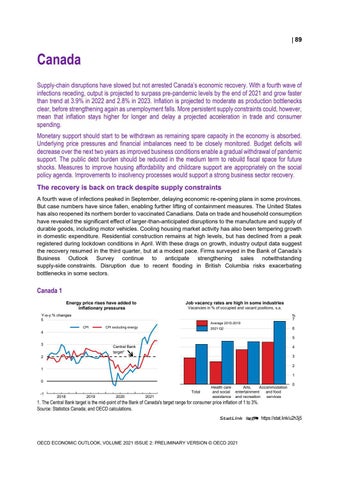
Canada 1 Energy price rises have added to inflationary pressures
Job vacancy rates are high in some industries Vacancies in % of occupied and vacant positions, s.a.
Y-o-y % changes 5
Average 2015-2019 CPI
CPI excluding energy
6
2021 Q2
4
% 7
5 3
Central Bank target¹
4 3
2
2
1
1 0 -1
0 2018
2019
2020
2021
0
Total
Health care and social assistance
Arts, Accommodation entertainment and food and recreation services
0
1. The Central Bank target is the mid-point of the Bank of Canada's target range for consumer price inflation of 1 to 3%. Source: Statistics Canada; and OECD calculations. StatLink 2 https://stat.link/u2h3j5
OECD ECONOMIC OUTLOOK, VOLUME 2021 ISSUE 2: PRELIMINARY VERSION © OECD 2021
90
Canada: Demand, output and prices 2018
2019
GDP at market prices Private consumption Government consumption Gross fixed capital formation Final domestic demand Stockbuilding¹ Total domestic demand Exports of goods and services Imports of goods and services Net exports¹ Memorandum items GDP deflator Consumer price index Core consumer price index² Unemployment rate (% of labour force) Household saving ratio, net (% of disposable income) General government financial balance (% of GDP)
2 231.2 1 292.8 462.4 503.4 2 258.5 14.8 2 273.4 721.7 763.9 - 42.2 _ _ _ _ _ _ _ _
General government gross debt (% of GDP) Current account balance (% of GDP)
2021
2022
2023
Percentage changes, volume (2012 prices)
Current prices CAD billion
Canada
2020
1.9 1.7 2.0 0.3 1.4 0.2 1.6 1.3 0.4 0.3
-5.3 -5.9 -0.3 -3.7 -4.3 -1.6 -5.9 -10.0 -11.2 0.5
4.8 4.3 5.7 7.5 5.3 1.1 6.4 1.3 6.9 -1.8
3.9 6.3 1.7 0.3 3.9 0.3 4.2 3.5 5.0 -0.4
2.8 4.4 1.1 1.3 3.0 0.0 3.0 2.6 3.7 -0.3
1.7 0.8 7.4 2.8 1.9 2.0 0.7 3.3 3.3 2.1 2.1 1.1 2.4 3.0 2.1 5.7 9.5 7.6 6.3 5.8 1.4 14.5 11.9 6.0 3.2 0.5 -10.9 -5.4 -1.6 -0.5 92.7 126.6 118.4 118.1 117.4 -2.1 -1.8 0.3 0.0 -0.4
1. Contributions to changes in real GDP, actual amount in the first column. 2. Consumer price index excluding food and energy. Source: OECD Economic Outlook 110 database.
StatLink 2 https://stat.link/qalek4
Canada 2 Output is heading towards its pre-pandemic trend Index 2019Q4 = 100, s.a. 110
The unemployment rate will continue to fall
Real GDP
% of labour force 14
Pre-crisis output path¹ Current output path
105
12
100
10
95
8
90
6
85
2019
2020
2021
2022
2023
0
0
2019
2020
2021
2022
2023
4
1. The pre-crisis output path is based on the November 2019 OECD Economic Outlook projection, with linear extrapolation for 2022 and 2023 based on trend growth in 2021. Source: OECD Economic Outlook 106 and 110 databases. StatLink 2 https://stat.link/duxm5o
OECD ECONOMIC OUTLOOK, VOLUME 2021 ISSUE 2: PRELIMINARY VERSION © OECD 2021
91 Hiring has picked up, consistent with expectations of strengthening demand. Employment is above pre-pandemic levels and labour force participation has increased. However, many of those employed are still working reduced hours – total hours worked are below levels in February 2020. Moreover, the unemployment rate remains elevated and over a quarter of those unemployed have been out of work for half a year or more (up from 16% before the pandemic). Meanwhile, labour shortages have emerged in some industries, partly ascribed to reluctance of workers to return to some service-sector jobs. Job vacancy rates are particularly high in household services, with reports of employers increasing pay offers to entice new hires. Energy price increases, while boosting income from commodity exports, are adding to price pressures elsewhere. Supply-chain bottlenecks have coincided with strong demand for durable goods, disruption due to extreme weather in British Columbia, as well as increased housing and food prices. The consumer price index rose by 4.7% year-on-year in October. However, long-term inflation expectations remain anchored and economy-wide wage pressures are moderate.
Federal support to households and businesses has been extended Demand remains supported by considerable monetary and fiscal policy stimulus. The Bank of Canada is holding-off on raising the policy rate from its current level of 0.25% until spare capacity in the economy has been absorbed, which it now expects to occur in mid-2022. The bank has, however, already ended its asset-purchase programme, ceasing to add further monetary stimulus since October; yields on long-term government securities remain above the levels at the start of the year. The projections envisage four policy rate rises by the end of 2023, totalling 100 basis points. Pandemic support measures are being re-targeted. Major wage and rent support schemes for businesses have been replaced with programmes aimed at the tourism and hospitality sectors and firms hardest hit by the pandemic. The timeframe for individuals submitting new claims for the Canada Recovery Benefit expired in October. However, a new programme (the Canada Worker Lockdown Benefit) will support individuals unable to work due to future lockdowns. Projected declines in the fiscal deficit in 2022 and 2023 are premised on further withdrawal of pandemic support through to May next year. A medium-term strategy will need to be set for rebuilding fiscal space for future shocks. Scheduled increases in the national minimum price on carbon of CAD 10 per tonne in 2022 and CAD 15 per tonne in 2023 are expected to have a small positive effect on consumer price inflation. Proceeds from the federal carbon pricing system are returned to households and businesses to compensate for cost increases.
Easing supply constraints will unlock pent-up demand After faltering over the summer, the economic recovery is projected to gather pace going into 2022. International supply-chain disruptions have been more pervasive and persistent than previously anticipated. A gradual clearing of bottlenecks will enable a further release of pent-up domestic demand, in particular from households with significant savings accumulated during the pandemic. Strong household consumption and increased business investment will more than offset a moderation in housing investment from the high levels seen earlier in the year. Goods exports will expand as manufacturers of automobiles and parts ramp up production, with strengthening world demand further supporting growth. The reopening of the border with the United States will spur the recovery in tourism and related services. Strong output growth will support increased labour demand and help pull unemployment down towards pre-pandemic levels. Inflation should ease as energy price pressures abate and supply bottlenecks are resolved through 2022.
OECD ECONOMIC OUTLOOK, VOLUME 2021 ISSUE 2: PRELIMINARY VERSION © OECD 2021
92 The potential for future outbreaks and more contagious variants of COVID-19 remains a risk to the economic outlook. However, with a high vaccination rate, Canada is better prepared than many other countries to withstand such pressures without re-imposition of strict lockdowns. Improving confidence and labour market conditions could see households spend more than expected, digging into stores of wealth built up earlier in the pandemic. In contrast, significant risks are posed by disruptions to international goods trade. Longer plant shutdowns and shipping delays could bring stronger price increases and impede a recovery in household consumption and trade volumes.
Reforms could facilitate resource reallocation and business sector recovery Economic re-opening, and reduced pressure on hard-hit sectors, will enable the federal government to further taper emergency support to businesses and households. This will be important for reallocating resources to growing firms and to ease worker shortages. Funding should, however, be maintained for skills training and re-employment assistance for individuals losing jobs, to reduce time spent unemployed. The government is committed to expanding childcare support, which will encourage employment, and measures to alleviate housing costs for low-income households. Work remains to be done to improve outcomes for indigenous people, including through enhancing self-determination. Progress on lowering inter-provincial trade barriers and improving insolvency processes should be prioritised to improve the business environment. Following through with planned increases in federal carbon pricing and taxation will be essential to reduce greenhouse gas emissions, backed with continued support for investment in green technologies.
OECD ECONOMIC OUTLOOK, VOLUME 2021 ISSUE 2: PRELIMINARY VERSION © OECD 2021