95
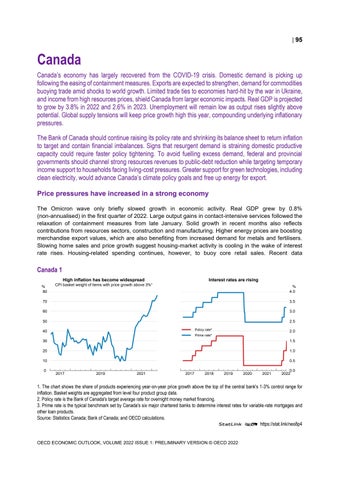
Canada Canada’s economy has largely recovered from the COVID-19 crisis. Domestic demand is picking up following the easing of containment measures. Exports are expected to strengthen, demand for commodities buoying trade amid shocks to world growth. Limited trade ties to economies hard-hit by the war in Ukraine, and income from high resources prices, shield Canada from larger economic impacts. Real GDP is projected to grow by 3.8% in 2022 and 2.6% in 2023. Unemployment will remain low as output rises slightly above potential. Global supply tensions will keep price growth high this year, compounding underlying inflationary pressures. The Bank of Canada should continue raising its policy rate and shrinking its balance sheet to return inflation to target and contain financial imbalances. Signs that resurgent demand is straining domestic productive capacity could require faster policy tightening. To avoid fuelling excess demand, federal and provincial governments should channel strong resources revenues to public-debt reduction while targeting temporary income support to households facing living-cost pressures. Greater support for green technologies, including clean electricity, would advance Canada’s climate policy goals and free up energy for export. Price pressures have increased in a strong economy The Omicron wave only briefly slowed growth in economic activity. Real GDP grew by 0.8% (non-annualised) in the first quarter of 2022. Large output gains in contact-intensive services followed the relaxation of containment measures from late January. Solid growth in recent months also reflects contributions from resources sectors, construction and manufacturing. Higher energy prices are boosting merchandise export values, which are also benefiting from increased demand for metals and fertilisers. Slowing home sales and price growth suggest housing-market activity is cooling in the wake of interest rate rises. Housing-related spending continues, however, to buoy core retail sales. Recent data
Canada 1 High inflation has become widespread % 80
Interest rates are rising
CPI basket weight of items with price growth above 3%¹
% 4.0
70
3.5
60
3.0
50
2.5 Policy rate²
40
2.0
Prime rate³
30
1.5
20
1.0
10
0.5
0
2017
2019
2021
0
0
2017
2018
2019
2020
2021
0.0 2022
1. The chart shows the share of products experiencing year-on-year price growth above the top of the central bank's 1-3% control range for inflation. Basket weights are aggregated from level four product group data. 2. Policy rate is the Bank of Canada's target average rate for overnight money market financing. 3. Prime rate is the typical benchmark set by Canada's six major chartered banks to determine interest rates for variable-rate mortgages and other loan products. Source: Statistics Canada; Bank of Canada; and OECD calculations. StatLink 2 https://stat.link/neo8p4
OECD ECONOMIC OUTLOOK, VOLUME 2022 ISSUE 1: PRELIMINARY VERSION © OECD 2022
96
Canada: Demand, output and prices 2018
2019
GDP at market prices Private consumption Government consumption Gross fixed capital formation Final domestic demand Stockbuilding¹ Total domestic demand Exports of goods and services Imports of goods and services Net exports¹ Memorandum items GDP deflator Consumer price index Core consumer price index² Unemployment rate (% of labour force)
2021
2022
2023
Percentage changes, volume (2012 prices)
Current prices CAD billion
Canada
2020
2 235.7 1 294.2 462.4 507.0
1.9 1.4 1.7 0.0
-5.2 -6.1 0.0 -2.8
4.5 4.9 5.8 7.1
3.8 4.7 1.8 2.9
2.6 3.0 1.3 1.7
2 263.5 15.8
1.2 0.1
-4.2 -1.7
5.6 0.9
3.7 0.5
2.3 0.0
2 279.3 722.7 766.3 - 43.6
1.2 2.3 0.4 0.6
-5.8 -9.7 -10.8 0.5
6.5 1.4 7.7 -2.0
4.3 2.5 4.0 -0.5
2.3 4.1 3.3 0.3
_ _ _ _ _ _ _ _
1.5 2.0 2.1 5.7
0.7 0.7 1.1 9.5
8.1 3.4 2.3 7.4
8.3 6.0 4.3 5.6
4.3 3.9 3.5 5.4
Household saving ratio, net (% of disposable income) General government financial balance (% of GDP) General government gross debt (% of GDP) Current account balance (% of GDP)
2.0 14.4 10.8 5.6 2.9 0.0 -11.4 -5.0 -2.4 -1.3 92.9 126.9 117.3 117.0 116.8 -2.0 -1.8 0.0 1.7 2.9
1. Contributions to changes in real GDP, actual amount in the first column. 2. Consumer price index excluding food and energy. Source: OECD Economic Outlook 111 database.
StatLink 2 https://stat.link/hsoq20
Canada 2 Output is heading towards its pre-pandemic trend Index 2019Q4 = 100, s.a. 110
The unemployment rate will remain low
Real GDP
% of labour force 14
Pre-crisis output path¹ Current output path
105
12
100
10
95
8
90
6
85
2019
2020
2021
2022
2023
0
0
2019
2020
2021
2022
2023
4
1. The pre-crisis output path is based on the November 2019 OECD Economic Outlook projection, with linear extrapolation for 2022 and 2023 based on trend growth in 2021. Source: OECD Economic Outlook 106 and 111 databases. StatLink 2 https://stat.link/zqp1yf
OECD ECONOMIC OUTLOOK, VOLUME 2022 ISSUE 1: PRELIMINARY VERSION © OECD 2022
97 show households spending more of their disposable incomes and saving less than in 2021. This is allowing many to maintain consumption in the face of rising prices. Firms’ investment plans are strong, in line with sales growth and capacity pressures. Supply challenges have been exacerbated by labour shortages. Increased competition for workers and rising wage growth point to an economy operating near full employment. Firms facing strong demand are passing on higher input costs to customers. Large price increases are now widespread and threaten to become self-sustaining. Food and energy price rises following Russia’s invasion of Ukraine are contributing to high inflation. Despite terms of trade gains, the value of the Canadian dollar is little changed against the US dollar, leaving import price pressures strong. Higher resource revenues are, however, boosting incomes and helping offset foreign demand shocks. Domestic production of wheat, energy and metals protects Canada from acute supply shortages.
Macroeconomic policy support is being withdrawn The Bank of Canada has stepped up monetary policy tightening. A 50 basis point increase in June brought the benchmark interest rate to 1.5%. The Bank has also announced that it will stop replacing maturing government bonds on its balance sheet. The resulting quantitative tightening will further increase long-term borrowing costs. More rate rises will be needed to tame price pressures and bring monetary policy to neutral settings, where it neither stimulates nor weighs on the economy. The projections assume the policy rate will increase to 2.5% by early-2023. Additional increases may be required if high inflation expectations become entrenched at a time when spare capacity is limited. The federal government sensibly allowed pandemic support to businesses and households to expire in May. Reduced expenditure on wage and rent-bill subsidies and strong tax revenues, due partly to high commodity prices, will contribute to declining fiscal deficits in 2022 and 2023, even after accounting for new spending. To reduce the burden of rising consumer prices this year, provincial governments have deployed measures ranging from fuel-tax cuts to one-off transfers to lower-income households. The federal government is focusing on alleviating housing costs, using supply-side interventions and support to first-time buyers. On top of higher skilled-migration targets, a fee-exempt immigration stream has been set up for people fleeing Ukraine. Over 240 000 applications had been received as of late May (equivalent to 0.6% of Canada’s population). The federal budget proposes additional funding for military and financial aid to Ukraine. Despite the new funding for these and other measures such as climate action, the public debt burden is projected to decline over the projections, tighter fiscal policy complementing withdrawal of monetary stimulus.
Strong growth will continue amid external shocks Real GDP is projected to grow by 3.8% in 2022. As a commodity exporter with limited trade links to hardhit economies, Canada is well placed to withstand economic shocks from the war in Ukraine. The major impact will come from higher price growth. Food and energy price rises will squeeze household purchasing power, with quarterly consumer price inflation peaking at an annualised rate of 7.2% in mid-2022. This will weigh on private spending, even as saving rates return to more normal levels. Weaker foreign demand, due in part to withdrawal of stimulus in the United States, will temper recovery in exports of non-resource goods. Demand for home-buying will soften with higher borrowing costs, causing price rises and construction to moderate. These growth drags will be offset in 2022 by strong investment in the public and private sectors and higher commodity exports. Oil and gas producers are expected to increase production this year and expand capacity in response to high prices. Trade surpluses will widen in the near term and then narrow from mid next year amid export price moderation and ongoing recovery in travel services, in which Canada is usually a net importer. Real GDP is projected to grow by 2.6% in 2023. Output will rise OECD ECONOMIC OUTLOOK, VOLUME 2022 ISSUE 1: PRELIMINARY VERSION © OECD 2022
98 above potential, with the unemployment rate remaining at historically low levels. Tight labour-market conditions are projected to drive up wage growth. This will keep core inflation above target next year even as energy price adjustments reduce headline inflation. A prolonged conflict in Ukraine would weaken foreign demand and bring stronger price rises, but also larger commodity revenues. Elevated uncertainty could damp businesses’ investment plans and encourage more precautionary saving among households. Large housing market corrections could weigh on credit markets and consumer finances, particularly if labour market conditions also deteriorate. This would further dent consumption. Economic activity has proved resilient to recent waves of COVID-19. Yet new variants and virus outbreaks remain a risk. In contrast, higher immigration could alleviate labour shortages and wage pressures in supply-constrained industries.
Current challenges must not derail long-term priorities Living-cost support should be temporary and targeted at lower-income households. Fuel-tax cuts – as introduced in some provinces – in contrast assist well-off households as well as those in need. Such measures also distort carbon-pricing signals. Support for clean electricity will help cut greenhouse gas emissions while freeing up energy for export. Rising interest rates should temper housing price growth in the near term. Other measures are needed to durably improve housing affordability, including relaxing local land-use rules to expand housing supply. Progress continues in social policy. Access to affordable childcare will support workforce participation. Such efforts should be matched with action to boost productivity. Lowering barriers to trade between provinces would remove an important obstacle to growth.
OECD ECONOMIC OUTLOOK, VOLUME 2022 ISSUE 1: PRELIMINARY VERSION © OECD 2022