86
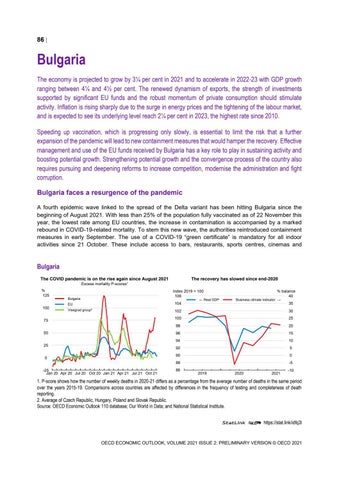
Bulgaria The economy is projected to grow by 3¼ per cent in 2021 and to accelerate in 2022-23 with GDP growth ranging between 4¼ and 4½ per cent. The renewed dynamism of exports, the strength of investments supported by significant EU funds and the robust momentum of private consumption should stimulate activity. Inflation is rising sharply due to the surge in energy prices and the tightening of the labour market, and is expected to see its underlying level reach 2¼ per cent in 2023, the highest rate since 2010. Speeding up vaccination, which is progressing only slowly, is essential to limit the risk that a further expansion of the pandemic will lead to new containment measures that would hamper the recovery. Effective management and use of the EU funds received by Bulgaria has a key role to play in sustaining activity and boosting potential growth. Strengthening potential growth and the convergence process of the country also requires pursuing and deepening reforms to increase competition, modernise the administration and fight corruption. Bulgaria faces a resurgence of the pandemic A fourth epidemic wave linked to the spread of the Delta variant has been hitting Bulgaria since the beginning of August 2021. With less than 25% of the population fully vaccinated as of 22 November this year, the lowest rate among EU countries, the increase in contamination is accompanied by a marked rebound in COVID-19-related mortality. To stem this new wave, the authorities reintroduced containment measures in early September. The use of a COVID-19 “green certificate” is mandatory for all indoor activities since 21 October. These include access to bars, restaurants, sports centres, cinemas and
Bulgaria The COVID pandemic is on the rise again since August 2021
The recovery has slowed since end-2020
Excess mortality P-scores¹ % 125 100
Index 2019 = 100 106
Bulgaria
← Real GDP
% balance 40
Business climate indicator →
EU
104
Visegrad group²
102
30
100
25
98
20
96
15
94
10
92
5
75 50 25 0 -25 0 Jan 20 Apr 20 Jul 20 Oct 20 Jan 21 Apr 21 Jul 21 Oct 21
35
90
0
88
-5
86
2019
2020
2021
-10
1. P-score shows how the number of weekly deaths in 2020-21 differs as a percentage from the average number of deaths in the same period over the years 2015-19. Comparisons across countries are affected by differences in the frequency of testing and completeness of death reporting. 2. Average of Czech Republic, Hungary, Poland and Slovak Republic. Source: OECD Economic Outlook 110 database; Our World in Data; and National Statistical Institute. StatLink 2 https://stat.link/idfq3l
OECD ECONOMIC OUTLOOK, VOLUME 2021 ISSUE 2: PRELIMINARY VERSION © OECD 2021
87
Bulgaria: Demand, output and prices 2018
Bulgaria GDP at market prices Private consumption Government consumption Gross fixed capital formation Final domestic demand Stockbuilding¹ Total domestic demand Exports of goods and services Imports of goods and services Net exports¹ Memorandum items GDP deflator Consumer price index Core consumer price index² Unemployment rate (% of labour force) Household saving ratio, net (% of disposable income) General government financial balance (% of GDP) General government gross debt (% of GDP) General government debt, Maastricht definition³ (% of GDP) Current account balance (% of GDP)
2019
2020
2021
2022
2023
Percentage changes, volume (2015 prices)
Current prices BGN billion
110.0 65.8 18.0 20.6
4.0 6.0 2.0 4.5
-4.4 -0.4 8.3 0.6
3.2 7.0 3.0 -5.5
4.2 4.0 3.0 11.7
4.5 3.9 1.4 13.0
104.5 2.7
5.0 0.0
1.3 -1.2
3.3 -0.3
5.2 -0.3
5.1 0.0
107.2 72.2 69.4 2.8
4.9 4.0 5.2 -0.7
0.0 -12.1 -5.4 -4.4
2.7 10.6 10.8 0.0
4.8 5.5 6.2 -0.4
5.1 5.4 6.4 -0.7
5.2 3.1 1.8 4.2
4.2 1.7 1.2 5.1
4.7 3.0 1.0 5.5
3.6 4.8 1.6 5.1
3.5 2.3 2.2 4.7
2.0 2.1 30.3 20.0 1.9
7.1 -4.1 36.2 24.7 -0.3
2.9 -5.7 41.7 30.2 -0.2
1.1 -5.0 46.0 34.5 -1.1
0.9 -3.9 49.0 37.4 -1.1
_ _ _ _ _ _ _ _ _
1. Contributions to changes in real GDP, actual amount in the first column. 2. Consumer price index excluding food and energy. 3. The Maastricht definition of general government debt includes only loans, debt securities, and currency and deposits, with debt at face value rather than market value. Source: OECD Economic Outlook 110 database.
StatLink 2 https://stat.link/87zp1h
theatres. This pass is also compulsory for hospital and nursing home staff. The persistence of uncertainties on the health situation but also on political prospects, with three legislative elections having taken place this year, has weighed on business confidence and investment. Consumption, on the other hand, recovered with the improvement of the labour market and consumer confidence, which however has weakened at the end of 2021. Following the sharp rise in energy prices and the tight labour market, inflation reached 6% year-on-year in October 2021.
Fiscal support to the economy will not jeopardise the health of public finances Given the evolution of the pandemic, the authorities have expanded fiscal measures to support the economy and the public deficit is expected to widen to around 5¾ per cent of GDP in 2021. Most notably, in September, the wage subsidy scheme to protect jobs and help businesses was extended. The budgetary expenditures required to deal with the pandemic should gradually moderate in 2022 and especially 2023 on the assumption of a marked improvement in vaccination coverage. In contrast, public investments will increase substantially in 2022 and 2023 due to the support of Next Generation EU grants, which should total around 10% of GDP during the period 2021-26. These grants being budget balance neutral, the fiscal deficit should gradually shrink, which will limit the rise in government debt to below 40% of GDP by 2023 (according to the Maastricht definition).
OECD ECONOMIC OUTLOOK, VOLUME 2021 ISSUE 2: PRELIMINARY VERSION © OECD 2021
88
Economic recovery is set to strengthen Supported initially by a rebound in exports in a more favourable external context, output growth should gradually benefit from more dynamic domestic demand from spring 2022 to reach 4¼ per cent in 2022 and 4½ per cent in 2023. Private consumption and investment are expected to gain strength as political and health uncertainties dissipate. The decline in unemployment is expected to continue, with wage increases leading to a gradual rise in underlying inflation to 2¼ per cent in 2023, while headline inflation will accelerate in late 2021 and early 2022 due to the surge in energy prices. However, the risks surrounding these projections are substantial. On the downside, they relate to a decline in confidence if it proves again not possible to reach a government agreement between political parties following the November elections. The vaccination rate, which is assumed to result in a lasting improvement in the health situation from the first quarter of 2022 in the projections, could also remain low. On the other hand, economic prospects could be brighter if the EU funds made available to Bulgaria are used more quickly than expected to build infrastructure, with a positive effect on investment.
Accelerating vaccination should be the priority Stronger incentives appear necessary to rapidly expand the coverage of immunisation given the high vaccine hesitancy in the population. From this perspective, the introduction of the COVID-19 “green certificate” will probably have beneficial effects, as in other EU countries. Following the November elections, cooperation between the elected political parties will also be important to ensure effective planning of EU funds’ use, boost productivity and accelerate the country's convergence process through an ambitious reform programme to increase competition, reduce administrative bureaucracy and fight corruption. Anti-corruption institutions should in particular be provided with the necessary responsibilities, co-ordination mechanisms and resources to fulfil their role. The authorities should also progressively remove public support for fossil fuels and redirect these funds to invest in renewables and to compensate poorer households for temporarily higher electricity prices during the transition.
OECD ECONOMIC OUTLOOK, VOLUME 2021 ISSUE 2: PRELIMINARY VERSION © OECD 2021