92
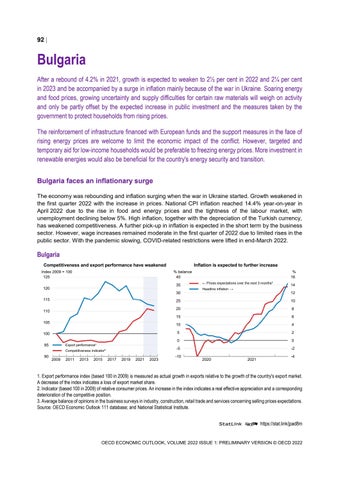
Bulgaria After a rebound of 4.2% in 2021, growth is expected to weaken to 2½ per cent in 2022 and 2¼ per cent in 2023 and be accompanied by a surge in inflation mainly because of the war in Ukraine. Soaring energy and food prices, growing uncertainty and supply difficulties for certain raw materials will weigh on activity and only be partly offset by the expected increase in public investment and the measures taken by the government to protect households from rising prices. The reinforcement of infrastructure financed with European funds and the support measures in the face of rising energy prices are welcome to limit the economic impact of the conflict. However, targeted and temporary aid for low-income households would be preferable to freezing energy prices. More investment in renewable energies would also be beneficial for the country's energy security and transition. Bulgaria faces an inflationary surge The economy was rebounding and inflation surging when the war in Ukraine started. Growth weakened in the first quarter 2022 with the increase in prices. National CPI inflation reached 14.4% year-on-year in April 2022 due to the rise in food and energy prices and the tightness of the labour market, with unemployment declining below 5%. High inflation, together with the depreciation of the Turkish currency, has weakened competitiveness. A further pick-up in inflation is expected in the short term by the business sector. However, wage increases remained moderate in the first quarter of 2022 due to limited rises in the public sector. With the pandemic slowing, COVID-related restrictions were lifted in end-March 2022.
Bulgaria Competitiveness and export performance have weakened Index 2009 = 100 125
Inflation is expected to further increase % balance 40 35
120
30 115 110 105 100 95
Export performance¹ Competitiveness indicator²
90
2009
2011
2013
2015
2017
2019
2021
2023
0
% 16 ← Prices expectations over the next 3 months³ Headline inflation →
14 12
25
10
20
8
15
6
10
4
5
2
0
0
-5
-2
-10
2020
2021
-4
1. Export performance index (based 100 in 2009) is measured as actual growth in exports relative to the growth of the country's export market. A decrease of the index indicates a loss of export market share. 2. Indicator (based 100 in 2009) of relative consumer prices. An increase in the index indicates a real effective appreciation and a corresponding deterioration of the competitive position. 3. Average balance of opinions in the business surveys in industry, construction, retail trade and services concerning selling prices expectations. Source: OECD Economic Outlook 111 database; and National Statistical Institute. StatLink 2 https://stat.link/jpad8m
OECD ECONOMIC OUTLOOK, VOLUME 2022 ISSUE 1: PRELIMINARY VERSION © OECD 2022
93
Bulgaria: Demand, output and prices 2018
Bulgaria GDP at market prices Private consumption Government consumption Gross fixed capital formation
2019
2020
2021
2022
2023
Percentage changes, volume (2015 prices)
Current prices BGN billion
110.0 65.8 18.0 20.6
4.0 6.0 2.0 4.5
-4.4 -0.4 8.3 0.6
4.2 8.0 4.0 -11.0
2.5 2.0 5.2 1.1
2.3 1.8 1.7 9.8
Final domestic demand Stockbuilding¹
104.5 2.7
5.0 0.0
1.4 -1.2
3.1 1.9
2.5 0.5
3.1 0.0
Total domestic demand Exports of goods and services Imports of goods and services Net exports¹
107.2 72.2 69.4 2.8
4.8 4.0 5.2 -0.7
0.0 -12.1 -5.4 -4.4
4.7 9.9 12.2 -1.1
2.9 3.5 4.3 -0.4
3.0 3.1 4.2 -0.7
5.2 3.1 1.8 4.2
4.2 1.7 1.2 5.1
6.2 3.3 1.4 5.3
10.8 14.1 8.0 4.7
7.8 8.5 7.3 5.1
2.7 2.1 30.3 20.0 1.9
9.2 -4.1 36.2 24.7 -0.1
8.3 -4.1 36.6 25.1 -0.4
3.9 -5.6 41.5 30.0 -2.2
3.1 -3.2 43.8 32.2 -2.6
Memorandum items GDP deflator Consumer price index Core consumer price index² Unemployment rate (% of labour force) Household saving ratio, net (% of disposable income) General government financial balance (% of GDP) General government gross debt (% of GDP) General government debt, Maastricht definition³ (% of GDP) Current account balance (% of GDP)
_ _ _ _ _ _ _ _ _
1. Contributions to changes in real GDP, actual amount in the first column. 2. Consumer price index excluding food and energy. 3. The Maastricht definition of general government debt includes only loans, debt securities, and currency and deposits, with debt at face value rather than market value. Source: OECD Economic Outlook 111 database.
StatLink 2 https://stat.link/5np6jm
Since the outbreak of the war, Bulgaria has taken in more than 100 000 refugees, inflation pressures have intensified, and uncertainty has increased. This uncertainty affects several sectors including construction, which is facing supply difficulties; tourism, where fewer Ukrainian and Russian visitors are expected; and the energy sector given the country's dependence on Russia, which has suspended its gas supplies to Bulgaria since April 27, 2022. Although a gas shortage will likely be avoided due to the supply of liquefied natural gas by the United States and EU partners and a new pipeline allowing greater gas imports from Azerbaijan and possibly other producers in the future, this situation will likely exacerbate inflationary tensions. The European oil embargo on Russian oil will also add to these price pressures, even if Bulgaria is exempt from this embargo until 2024. Faced with these tensions, companies were granted a partial compensation for their electricity bills. Household electricity, heating and water tariffs have also been frozen since December 2021.
Fiscal policy will moderate the economic consequences of the war The budget deficit remained stable at 4.1% of GDP in 2021 and the 2022 budget, which foresees a deficit increase by 1 point of GDP, will be reviewed during the summer. This strongly expansionary policy involves a sharp increase in public investment due to EU subsidies of the Recovery and Resilience plan, which will total around 10% of GDP between 2022 and 2026. The deficit is expected to decline in 2023 due to lower
OECD ECONOMIC OUTLOOK, VOLUME 2022 ISSUE 1: PRELIMINARY VERSION © OECD 2022
94 COVID-related expenditure and the expiry of measures to offset rising energy prices. Although rising to around 32% of GDP (Maastricht definition) in 2023, public debt will remain moderate by international comparison. Despite the strong acceleration of inflation in recent months, short-term interest rates remain low, reflecting the hard peg of the lev to the euro and euro area monetary conditions. Market rates are expected to increase gradually alongside those in the euro area.
The recovery is expected to weaken and inflation to rise The negative impact of inflation on household income, heightened uncertainty and the weaker external environment and competitiveness will hamper the recovery. The slowdown in growth to around 2½ per cent in 2022 and 2¼ per cent in 2023 should however be moderated by the measures taken to protect households from the surge in energy prices and the increase in public investment. Private consumption will also be supported by a decline in the savings rate as the pandemic wanes. Inflation, which could average nearly 14% in 2022, is expected to decline in 2023, and unemployment to remain relatively low. With fiscal policy tightening next year, energy price increase expected to moderate and lower pressures on other commodities, inflation could slow to around 6% by the end of 2023 if wage outcomes are moderate. However, risks are significant and tilted to the downside. Higher-than-expected inflation in the event of a wage-price spiral or a sharper increase in energy or food prices would weaken exports and/or private consumption. The increase in public investment could also be weaker than expected due to the late adoption, in April 2022, of Bulgaria's Recovery and Resilience plan.
Promoting the energy transition will help energy security Protecting low-income households against rising energy and food prices with targeted aid, such as cash transfers, would be more effective than freezing tariffs, generalised subsidies or a VAT reduction, and also avoid distorting price signals. A tightening of the fiscal stance in 2022, stemming from the summer budget review, could help ease inflationary pressures. Promoting the energy transition and renewable energies through effective use of EU aid is also important to improve the country's energy security.
OECD ECONOMIC OUTLOOK, VOLUME 2022 ISSUE 1: PRELIMINARY VERSION © OECD 2022