Surveys of willingness-to-pay
avoid negative chemicals-related health effects (SWACHE)
IMPROVING THE KNOWLEDGE BASE FOR THE COST OF INACTION ON CHEMICALS

Chemicals are part of our daily life and must be soundly managed to limit risks to human health and the environment. While countries around the world are setting up legal frameworks to address these risks, the cost of policy inaction is still poorly understood. Assessment of chemicals management options and environmental policies can be considerably improved by better estimating their costs and benefits. Financing national chemicals management programmes also often requires economic justification of the benefits of such an investments. However, data to support such analyses are lacking.
The OECD project Surveys on Willingness-to-Pay to Avoid Negative Chemicals-Related Health Impacts (SWACHE) project brings together expertise on chemical safety and economic analysis to fill this gap. The project aims to establish internationally comparable values for the willingness-to-pay (WTP) to avoid negative health effects due to exposure to chemicals. Such values can be used to demonstrate and measure the economic benefits of minimising the impacts of chemicals on human health.
To derive WTP values, surveys of a large number of citizens of countries have been conducted. These surveys apply state-of-the-art approaches that can be used by economists to determine the full monetary value that survey respondents place on reducing their risk of a particular health effect.
5 Health effects
Kidney disease, asthma, infertility, very low birth weight, IQ loss
1-5 surveys implemented in
22 Countries
46 Surveys in total
1 200 respondents per country, per health effect
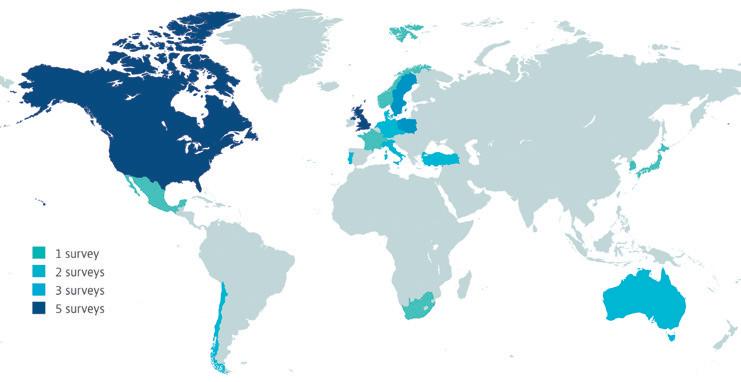 Figure 1: Countries in which the first round of SWACHE surveys was implemented
1 survey 2 surveys 3 surveys 5 surveys
to
The SWACHE project is organised in two rounds focusing on five health effects each. The health effects included in the first round are:
n asthma
n infertility
n IQ loss
n chronic kidney disease
n very low birth weight
The first round of surveys was implemented in 2022. Each survey, specific to one health effect, was implemented in at least five countries. For each group of country and health effect, a representative sample of at least 1 200 respondents was collected. Overall, one to five of the surveys were implemented in 22 countries, totalling 46 surveys conducted.
The second round of health effects will include thyroid dysfunction, miscarriage, hypertension, non-fatal cancer and skin sensitisation and will be carried out in 2023. Survey responses are empirically analysed to estimate mean WTP for a given reduction in health risk. Values of a statistical case are derived by dividing mean WTP by the average risk reduction.
THE MONETISED BENEFITS OF REDUCING CHEMICALS RELATED NEGATIVE HEALTH EFFECTS ARE CONSIDERABLE
COST-BENEFIT ANALYSIS
The first round of surveys clearly indicates that people are willing to pay a significant amount to reduce their risk of developing various negative health effects. The value of a statistical case is estimated in USD Purchasing Power Parity (PPP) from USD 91 000 for infertility to USD 1 194 000 for very low birth weight, on average, across the countries surveyed. The second highest value is found for chronic kidney disease (USD 805 000) followed by childhood asthma (USD 430 000) and adult asthma (USD 280 000).
The mean WTP for reducing asthma severity equals USD 529 per year for adults and USD 948 per year for children. People living in surveyed countries are also willing to pay USD 3 050 on average to avoid the loss of one IQ point in children.
These values can be used in benefit-cost analysis of chemicals management options. Typically, benefits of a given policy is measured by multiplying value of a statistical case by the number of statistical cases prevented every year by the policy. Annual benefits are then summed across health effects and years. The net present value of a policy option is equal to the difference between the total discounted benefit and the total discounted cost. Overall, the WTP values estimated by the SWACHE project provide significant evidence that chemicals management systems are worth implementing.
Value of a statistical case (thousand USD PPP) Infertility Adult asthma Childhood asthma Chronic kidney disease Very low birth weight 91 280 430 805 1 194
Figure 2: Value of a statistical case by health effect, average across countries
MONETISED BENEFITS BY HEALTH RISK AND BY COUNTRY
The health effects examined in the first round of the SWACHE project have all been associated with exposure to certain chemicals. The survey results can inform cost benefit analysis regardless of the specific chemical or the nature and pathway of the chemical exposure.

Chronic kidney disease
Chronic kidney disease has important negative impacts on the quality of life and can lead to severe health complications such as cardiovascular diseases, bone fragility, weakened immune systems, etc.
Valuation studies to date have focused on the final stage of chronic kidney disease that is permanent kidney failure that requires dialysis or kidney transplant. In the SWACHE chronic kidney disease survey, a range of severity (stage 3 and 4) that captures symptomatic kidney disease, including specific impacts from disease progression was valued. This novel approach provides a more useful estimate for benefit-cost analysis and makes the results more representative of the full impact of chemical exposure causing kidney disease on peoples’ lives.
The SWACHE chronic kidney disease survey was fielded in nine countries. In each country, a sample of at least 1 200 respondents representative of the general population was collected and empirically analysed. The value of a statistical case of chronic kidney disease varies from USD 556 000 in the United Kingdom to USD 1 203 000 in Türkiye.
Türkiye Italy Chile Pooled across countries Norway Germany Denmark Canada United States United Kingdom Value of a statistical case (thousand USD PPP) 1 203 1 000 994 805 759 725 710 697 655 556
Figure 3: Value of a statistical case of chronic kidney disease
Figure 4:
Mean WTP value for reduced asthma severity
United States Poland
Czech Republic
Pooled across countries
Asthma severity and risk in adults and children
Asthma is a non-curable long-term condition affecting children and adults. Asthmatics experience symptoms such as coughing, wheezing, shortness of breath and chest tightness. Depending on its severity, asthma can prevent normal outdoor activities, require routine medication and sometimes oxygen intake. Severe asthma can require emergency room visits and hospitalisation.
Previous valuation work does not provide internationally comparable WTP values for asthma risk and severity. To fill this gap, the SWACHE asthma survey asks what asthmatics are willing to pay to reduce their asthma severity e.g. from severe to moderate plus. Further, it asks people who do not have asthma what they are willing to pay to reduce their risk of getting it. Finally, the survey asks parents what they are willing to pay to reduce: i) the severity of the asthma of their youngest asthmatic child, and ii) the risk that their youngest non-asthmatic child get it.
United Kingdom
Mean willingness to pay (USD PPP per year)
Childhood asthma
Adult asthma
The survey was implemented in seven countries. In each of these countries, a sample of at least 1 600 respondents (1 200 non-asthmatic adults, 300 asthmatic adults and 190 parents of asthmatic children) representative of the general population was collected and analysed.
The mean WTP for reducing adult asthma severity varies from USD 429 per year in Canada to USD 685 per year in Czech Republic. The mean WTP for reducing asthma severity in children is higher and varies from USD 743 per year in the United Kingdom to USD 1 317 per year in the United States. The value of a statistical case of adult asthma varies from USD 200 000 in the United Kingdom to USD 370 000 in Poland. The value of a statistical case of child asthma varies from USD 350 000 in Canada to USD 610 000 in the United States.
Figure 5:
Value of a statistical case of asthma
Childhood asthma
Adult asthma
Value of a statistical case (thousand USD PPP)
United States Poland
Pooled across countries Sweden United Kingdom France Canada
France
Canada
Sweden
1 317 587 1 130 632 1 080 685 948 529 840 775 429 756 438 471 743 445 610 330 470 370 430 280 420 270 370 200 360 260 350 270
Infertility risk
Infertility is the inability of a couple to get pregnant after an extended period of trying. Declining fertility rates are a concern for many people in OECD countries.
Previous studies estimated the WTP for improved fertility, but many focused on assisted reproduction technologies. These previous studies estimated a value per statistical pregnancy. Overall, the existing metrics are difficult to apply in regulatory impact analysis. The SWACHE infertility survey was designed to elicit WTP for a reduced risk of infertility that can be easily used in benefit-cost analysis.
The survey was fielded in ten countries. In each country, a sample of 1 200 adult respondents planning and in capacity to have a child within the next five years was collected and analysed. The value of a statistical case of infertility varies from USD 66 000 in Japan to USD 109 000 in Portugal.
Very low birth weight
Very low birth weight can lead to serious health complications such as neurosensory problems, behavioural and social competency issues as well as learning disabilities.
Internationally comparable estimates of the economic benefits of reducing exposure to chemicals and consequent health risks associated with very low birth weight are rare. The SWACHE very low birth weight survey fills this gap by asking adults planning to have a child how much they are willing to pay over a period of eight months to reduce the risk of very low birth weight.
The survey was implemented in nine countries. In each country, a sample of 1 200 adult respondents planning and in capacity to have a child within the next five years was collected and analysed. The value of a statistical case of very low birth weight varies from USD 805 000 in the United Kingdom to USD 1 744 000 in Italy.
Portugal Chile United States Canada Australia Pooled across countries Sweden Poland Germany United Kingdom Japan Figure
Value of
of infertility 109 105 101 101 95 91 88 87 80 75 66
Value of a statistical case (thousand USD PPP)
6:
a
statistical case
Figure 7: Value of a statistical case of very low birth weight
Italy Mexico United States Türkiye Pooled across countries Switzerland Czech Republic Netherlands Canada United Kingdom 1 744 1 528 1 389 1 274 1 194 1 120 1 107 1 013 872 805
Value of a statistical case (thousand USD PPP)
Pooled across countries
IQ loss in children
IQ loss is associated with lower education achievement, lower lifetime income and higher probability to engage in criminal behaviour. Yet, there is no internationally comparable value of the WTP to avoid the loss of one point of IQ that can be used in socioeconomic analysis of chemicals management options. The SWACHE IQ loss survey asks adults to value a certain reduction in IQ loss for their own hypothetical child.
The SWACHE IQ loss survey was implemented in eleven countries. In each country, a sample of at least 1 200 respondents representative of the general population was collected and empirically analysed. The main WTP to avoid one IQ point loss in children varies from USD 1 640 in the United Kingdom to USD 4 670 in Poland.
CONTACTS:
Shardul Agrawala
Head of the Environment and Economy Integration Division
OECD Environment Directorate
Shardul.AGRAWALA@oecd.org
Damien Dussaux
Economist
Environment and Economy Integration Division
Damien.DUSSAUX@oecd.org
Olof Bystrom
Principal Administrator
Environment, Health and Safety Division
Olof.BYSTROM@oecd.org
Eeva Leinala
Principal Administrator
Environment, Health and Safety Division
OECD Environment Directorate: Eeva.LEINALA@oecd.org
For more information:
Mean willingness to pay (USD PPP per IQ point)
The OECD SWACHE project has received the financial assistance of the European Union. The views expressed herein can in no way be taken to reflect the official opinion of the European Union.
Environment © OECD, 2023. Graphic design: Maro Haas. Photos & illustrations: shutterstock/Song about summer shutterstock/biDaala studio shutterstock/limeart
Netherlands
States
https://oe.cd/SWACHE @OECD_ENV OECD
Poland Canada Korea
United
Denmark Portugal
Africa Australia
Kingdom
Sweden
South
United
4 670 4 590 3 860 3 310 3 300 3 050 2 840 2 730 2 570 2 060 1 890 1 640
Figure 8: WTP value for avoiding the loss of one IQ point in children
