15
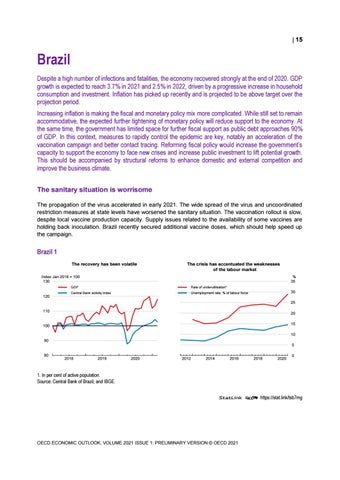
Brazil Despite a high number of infections and fatalities, the economy recovered strongly at the end of 2020. GDP growth is expected to reach 3.7% in 2021 and 2.5% in 2022, driven by a progressive increase in household consumption and investment. Inflation has picked up recently and is projected to be above target over the projection period. Increasing inflation is making the fiscal and monetary policy mix more complicated. While still set to remain accommodative, the expected further tightening of monetary policy will reduce support to the economy. At the same time, the government has limited space for further fiscal support as public debt approaches 90% of GDP. In this context, measures to rapidly control the epidemic are key, notably an acceleration of the vaccination campaign and better contact tracing. Reforming fiscal policy would increase the government’s capacity to support the economy to face new crises and increase public investment to lift potential growth. This should be accompanied by structural reforms to enhance domestic and external competition and improve the business climate. The sanitary situation is worrisome The propagation of the virus accelerated in early 2021. The wide spread of the virus and uncoordinated restriction measures at state levels have worsened the sanitary situation. The vaccination rollout is slow, despite local vaccine production capacity. Supply issues related to the availability of some vaccines are holding back inoculation. Brazil recently secured additional vaccine doses, which should help speed up the campaign.
Brazil 1 The recovery has been volatile
The crisis has accentuated the weaknesses of the labour market
Index Jan 2018 = 100 130
120
% 35
GDP
Rate of underutilisation¹
Central Bank activity index
Unemployment rate, % of labour force
30 25
110
20 15
100
10 90 5 80
2018
2019
2020
0
0
2012
2014
2016
2018
2020
0
1. In per cent of active population. Source: Central Bank of Brazil; and IBGE. StatLink 2 https://stat.link/tsb7mg
OECD ECONOMIC OUTLOOK, VOLUME 2021 ISSUE 1: PRELIMINARY VERSION © OECD 2021
16
Brazil: Demand, output and prices 2017
2018
Current prices BRL billion
Brazil GDP at market prices Private consumption Government consumption Gross fixed capital formation Final domestic demand Stockbuilding1 Total domestic demand Exports of goods and services Imports of goods and services Net exports1
2019
2020
2021
2022
Percentage changes, volume (2000 prices)
6 583.8 4 243.7 1 329.1 958.4 6 531.2 4.5 6 535.7 825.7 777.6 48.1
1.8 2.4 0.8 5.2 2.5 -0.4 2.2 3.3 7.0 -0.4
1.4 2.2 -0.4 3.4 1.9 0.0 1.9 -2.3 1.1 -0.5
-4.1 -5.5 -4.7 -0.6 -4.6 -0.7 -5.2 -2.2 -10.2 1.2
3.7 2.7 0.7 8.6 3.2 0.2 3.8 2.0 2.0 0.0
2.5 2.3 0.8 3.4 2.2 0.0 2.2 6.6 5.4 0.3
_ _ _ _ _
4.5 3.7 4.1 -7.0 -2.2
4.3 3.7 3.7 -5.7 -2.7
4.8 3.2 3.0 -14.9 -0.7
4.9 6.2 6.0 -7.4 0.9
4.0 4.0 4.0 -6.4 0.5
Memorandum items GDP deflator Consumer price index Private consumption deflator General government financial balance (% of GDP) Current account balance (% of GDP)
1. Contributions to changes in real GDP, actual amount in the first column. Source: OECD Economic Outlook 109 database.
StatLink 2 https://stat.link/pxfdyj
Brazil 2 Rising debt is constraining fiscal policy % of GDP 0
Inflation has picked up % of GDP 120
Y-o-y % changes 12
% 18 ← Headline inflation
-3
110
-6
100
-9
90
-12
80
-15
70
12
6
9
4
6
2
3
50
0
0
40
-2
60
Gross public debt → ← Primary fiscal balance
-21
15
8
← Headline fiscal balance
-18
Selic target rate →
10
← Interest balance
-24
2015
2016
2017
2018
2019
2020
2015
2016
2017
2018
2019
2020
-3
Source: Central Bank of Brazil. StatLink 2 https://stat.link/s6wr1n
OECD ECONOMIC OUTLOOK, VOLUME 2021 ISSUE 1: PRELIMINARY VERSION © OECD 2021
17
The recovery has been shaky Economic activity rebounded strongly in the fourth quarter of 2020. The main monthly activity indicators point to sustained activity in January and February, with some variation across sectors. However, in March a net decline in economic activity was registered due to the degradation of the sanitary situation. More recent data point to a weaker effect of the pandemic on economic activity compared to a year ago. Business confidence has fallen since January. The unemployment rate declined to 13.9% at the end of 2020, from 14.6% in the third quarter.
Policy support is being reduced The fiscal package to protect vulnerable people, including informal workers, amounted to 11.4% of GDP in 2020. Initially, a temporary emergency benefit (USD 120 per month) was paid to over 67 million informal, self-employed or unemployed workers from April to September. The aid was prolonged until December, but halved. This year, Congress has approved an extension of the benefits for another four months, but further reduced the amount to around $45 on average, for a total of around $7.9 billion. Given the deteriorating sanitary situation, the fiscal support will be insufficient to maintain private consumption. Thanks to social emergency transfers and the expansion of the Bolsa Familia programme, the poverty rate fell to 21% in 2020, from 29% in 2019. However, if social transfers are not prolonged while economic activity continues to be affected by the virus outbreak, poverty rates will likely rise again this year. Inflation remained subdued during most of 2020, but rebounded sharply at the end of the year and reached a quarter-on-quarter annualised rate of 9.7% in the first quarter of 2021. Given inflation expectations, the central bank has increased the Selic rate by 0.75 percentage point to 3.5% since March. The central bank also decided to start the partial normalisation of monetary policy and announced that this policy will continue over 2021. Moreover, the macroprudential authorities decided that the countercyclical capital buffer for credit exposures in Brazil will be 0% until at least the end of 2021. They also recommended that banks should be conservative in the allocation of profits and announced the start of the replenishment of the capital conservation buffer in April.
The recovery will depend on the evolution of the pandemic Despite solid growth in the first two months of the year, driven by retail and other services sectors, activity in the first semester will be subdued, constrained by the high level of propagation of the virus and mobility restrictions. A strong economic rebound in the second half of the year is projected, led by household consumption and exports on the back of a more effective vaccination rollout and improvements in controlling the spread of the virus. Although higher unemployment will weigh on household income, higher saving in 2020 is projected to recede, helping to sustain consumption levels. Exports will continue to benefit from recovering global demand for food and minerals. Import demand will pick up progressively in line with domestic demand. Unemployment will decline slowly amid a return of previously discouraged workers to the labour market. Overall, the activity rate will remain significantly below pre-crisis levels, keeping millions of workers outside the labour market. Policy uncertainty around the fiscal strategy has become a major risk. Gross public debt will reach 90% of GDP by end-2022, limiting fiscal space. The chosen strategy of excluding additional spending related to the COVID-19 from the spending cap risks breaking the fiscal rule. While understandable in the current exceptional context, it should be exercised with caution as it may add to the volatility of financial markets and policy uncertainty. The government should therefore clearly make it time-limited and ensure that only spending related to the COVID-19 crisis is excluded. The credibility of public policies will be important to keep attracting foreign investment and limit the depreciation of the exchange rate. On the other hand, the social situation is fragile as many families struggle to make their living with the deterioration of the sanitary OECD ECONOMIC OUTLOOK, VOLUME 2021 ISSUE 1: PRELIMINARY VERSION © OECD 2021
18 situation. On the upside, a quick implementation of the infrastructure and fiscal stimulus package in the United States will boost exports and accelerate the recovery.
Creating fiscal space will allow financing policies that lift potential growth Striking the right balance between protecting the poor and ensuring sustainable public finances will be a key policy challenge in 2021. The social emergency benefits should be prolonged until economic activity resumes and the pandemic is under control. There is scope to finance the extension of social spending by redirecting current expenditures, such as subsidies to credit and payroll exemptions for specific sectors, and by better managing public payroll expenses. Furthermore, changes in mandatory spending items and indexation rules (93% of spending) are necessary to create fiscal space to finance policies that strengthen long-term growth. Improving domestic regulation and fostering a further integration into global value chains could boost competition and reduce the cost of intermediate and capital goods. Expanding access to early-childhood education, improving the quality of schooling and increasing resources for professional training courses would improve labour market performance. Regarding support to firms, bank credit has been increasing on the back of low interest rate levels and emergency measures that mitigated the effects of the COVID-19 crisis. Some credit segments, such as real estate credit, are particularly boosted by record-low interest rates. Overall, household and firm indebtedness remains moderate and banks’ capitalisation, buffers and provisions for losses seem adequate. However, given the likely protracted crisis, it may be necessary to prolong financial support measures for firms and increase or maintain the softening of prudential measures to allow financial institutions to exit progressively from the crisis.
OECD ECONOMIC OUTLOOK, VOLUME 2021 ISSUE 1: PRELIMINARY VERSION © OECD 2021