82
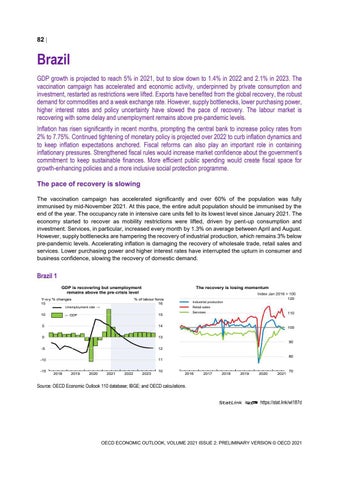
Brazil GDP growth is projected to reach 5% in 2021, but to slow down to 1.4% in 2022 and 2.1% in 2023. The vaccination campaign has accelerated and economic activity, underpinned by private consumption and investment, restarted as restrictions were lifted. Exports have benefited from the global recovery, the robust demand for commodities and a weak exchange rate. However, supply bottlenecks, lower purchasing power, higher interest rates and policy uncertainty have slowed the pace of recovery. The labour market is recovering with some delay and unemployment remains above pre-pandemic levels. Inflation has risen significantly in recent months, prompting the central bank to increase policy rates from 2% to 7.75%. Continued tightening of monetary policy is projected over 2022 to curb inflation dynamics and to keep inflation expectations anchored. Fiscal reforms can also play an important role in containing inflationary pressures. Strengthened fiscal rules would increase market confidence about the government’s commitment to keep sustainable finances. More efficient public spending would create fiscal space for growth-enhancing policies and a more inclusive social protection programme. The pace of recovery is slowing The vaccination campaign has accelerated significantly and over 60% of the population was fully immunised by mid-November 2021. At this pace, the entire adult population should be immunised by the end of the year. The occupancy rate in intensive care units fell to its lowest level since January 2021. The economy started to recover as mobility restrictions were lifted, driven by pent-up consumption and investment. Services, in particular, increased every month by 1.3% on average between April and August. However, supply bottlenecks are hampering the recovery of industrial production, which remains 3% below pre-pandemic levels. Accelerating inflation is damaging the recovery of wholesale trade, retail sales and services. Lower purchasing power and higher interest rates have interrupted the upturn in consumer and business confidence, slowing the recovery of domestic demand.
Brazil 1 GDP is recovering but unemployment remains above the pre-crisis level Y-o-y % changes 15
The recovery is losing momentum
% of labour force 16
Retail sales
Unemployment rate →
10
Index Jan 2016 = 100 120
Industrial production Services
15
← GDP
5
14
0
13
-5
12
-10
11
110
100
90
-15
2018
2019
2020
2021
2022
2023
10
80
0
2016
2017
2018
2019
2020
2021
70
Source: OECD Economic Outlook 110 database; IBGE; and OECD calculations. StatLink 2 https://stat.link/wl187d
OECD ECONOMIC OUTLOOK, VOLUME 2021 ISSUE 2: PRELIMINARY VERSION © OECD 2021
83
Brazil: Demand, output and prices 2018
2019
GDP at market prices Private consumption Government consumption Gross fixed capital formation Final domestic demand Stockbuilding¹ Total domestic demand Exports of goods and services Imports of goods and services Net exports¹ Memorandum items GDP deflator Consumer price index Private consumption deflator General government financial balance (% of GDP)
2021
2022
2023
Percentage changes, volume (2000 prices)
Current prices BRL billion
Brazil
2020
6 999.8 4 520.9 1 393.3 1 056.2
1.4 2.2 -0.4 3.4
-4.4 -5.5 -4.7 -0.7
5.0 3.0 -0.1 16.5
1.4 1.0 0.9 -0.1
2.1 1.7 0.4 2.7
6 970.4 4.7
1.9 -0.1
-4.6 -0.9
4.5 1.1
0.8 -0.3
1.6 0.0
6 975.1 1 022.2 997.5 24.8
1.7 -2.3 1.1 -0.5
-5.5 -2.3 -10.4 1.2
5.7 12.2 16.9 -0.6
0.4 5.8 1.1 1.0
1.7 3.4 1.6 0.5
_ _ _ _ _
4.3 3.7 3.7 -5.8
5.2 3.2 3.0 -13.6
11.6 7.8 9.1 -7.8
5.4 5.1 5.5 -7.0
3.6 3.5 3.8 -6.5
-3.5
-1.7
-0.5
-0.8
-0.7
Current account balance (% of GDP) 1. Contributions to changes in real GDP, actual amount in the first column. Source: OECD Economic Outlook 110 database.
StatLink 2 https://stat.link/1hkeb0
Several factors are contributing to rising inflation. International commodity prices, and logistical and transportation costs have increased. Global demand is picking up, underpinned by fiscal stimulus in Brazil’s main trade partners, while global value chain bottlenecks are holding up adjustments in supply and raising inflationary pressures in industrial goods. The hydric crisis is reducing water levels and contributing to higher domestic electricity prices, as two-thirds of the electricity supply relies on hydropower, and to food price inflation. Pent-up consumption, supported by generous government income transfers to the lowest-income households during the crisis, is pushing services inflation up. Policy uncertainty and increasing fiscal risk are also weighing on the exchange rate, raising imported inflation.
Brazil 2 Inflation has increased above target, prompting higher interest rates Y-o-y % changes 12
The primary balance has improved, but debt servicing costs are increasing % 18
← Inflation (IPCA)
% of GDP 0
← Core inflation¹ Policy rate (SELIC) →
10
15
-4
← Target
8
12
6
9
4
6
2
3
-8
-12
0
2016
2017
2018
2019
2020
2021
0
Headline fiscal balance Primary fiscal balance
-16
Interest balance
0
2016
2017
2018
2019
2020
2021
-20
1. Core inflation excludes energy and food products. The shaded area corresponds to the target band. Source: OECD Economic Outlook 110 database; Central Bank of Brazil; and OECD calculations. StatLink 2 https://stat.link/2c0vbz OECD ECONOMIC OUTLOOK, VOLUME 2021 ISSUE 2: PRELIMINARY VERSION © OECD 2021
84
Fiscal risks have increased and the tightening of monetary policy has accelerated In March 2021, Congress approved a new round of COVID-19 emergency support, not subject to the spending cap rule, worth 1.4% of GDP, consisting of cash transfers to poor households, employment support, credit incentives and health spending. The job preservation scheme ended in August and the emergency income support programme was withdrawn in October 2021. Fiscal consolidation has started at the end of 2021 and is assumed to continue during the projection period. Primary fiscal revenues have started to increase again as the economy recovers, also supported by higher inflation. The government has proposed a new, more generous, welfare programme, pending approval in Congress. To finance the new programme, the government suggested a tax reform that, among other changes, introduces a dividend tax. However, the tax reform is expected to, at least temporarily, lower fiscal revenues in 2022. Furthermore, judicial payment orders arising from debt owed by government entities to private individuals and non-financial companies, to pay damages, contractual differences or compensate for expropriations, have reached more than 1% of GDP. The government is planning to repay only part of that debt in 2022 and to postpone the remaining payments, raising uncertainty about its ability to respect the spending rule in the coming years. The central bank has accelerated the pace of monetary policy tightening to contain rising inflation. The key interest rate stood at 2% in March 2021 and reached 7.75% in October. The central bank is expected to increase policy rates significantly in the near future. Monetary policy tightening and increased fiscal risks are pushing longer-term interest rates up and increasing debt servicing costs.
Growth will regain momentum as inflation falls and labour markets recover The pace of recovery will regain momentum in 2022 as labour market outcomes continue to improve. Employment growth and slowly falling inflation, on the back of higher interest rates, will support households’ disposable income and sustain private consumption growth. Private investment is also expected to recover towards the end of 2022 as global supply-chain bottlenecks vanish and business sentiment improves. Non-financial corporations’ indebtedness is at record lows, suggesting that there is scope for credit expansion and further investment, despite tighter financial conditions. Exports will continue to benefit from the global recovery. There are important downside risks to the forecast. The hydric crisis could last longer than expected and require electricity rationing, leading to persistent inflation and lower growth prospects. Prolonged political uncertainty and increasing fiscal risk could undermine the credibility of fiscal rules, de-anchoring inflation expectations and reducing investment growth. Weaker than expected growth in China could damage the performance of exports. On the upside, if the hydric crisis ends soon, global supply bottlenecks vanish sooner than expected and high commodity prices are sustained for longer, the pace of recovery could accelerate more than projected.
OECD ECONOMIC OUTLOOK, VOLUME 2021 ISSUE 2: PRELIMINARY VERSION © OECD 2021
85
Reforming the public finances would support the recovery and increase resilience To finance policies that will increase potential growth while maintaining a sustainable fiscal position, the government needs to improve public spending efficiency. Mandatory spending items and indexation rules limit the government’s ability to respond to shocks. Strengthening the medium-term fiscal framework, including subnational finances, would boost market confidence and private investment, while keeping debt servicing costs down. Fiscal reforms should be accompanied by labour and product market reforms. Social protection programmes should be redesigned to increase incentives for formal employment and make growth more inclusive. More competition-friendly regulation would boost productivity, export competitiveness and living standards. Policies that promote environmentally sustainable activities would increase resilience to climate-related shocks. Environmental considerations should be more systematically integrated into public policies, including land-use planning. Subsidies for polluting activities, such as fossil fuel and pesticides production, should be progressively scaled down. The capacity of agencies in charge of monitoring and enforcing environmental laws should be strengthened.
OECD ECONOMIC OUTLOOK, VOLUME 2021 ISSUE 2: PRELIMINARY VERSION © OECD 2021