88
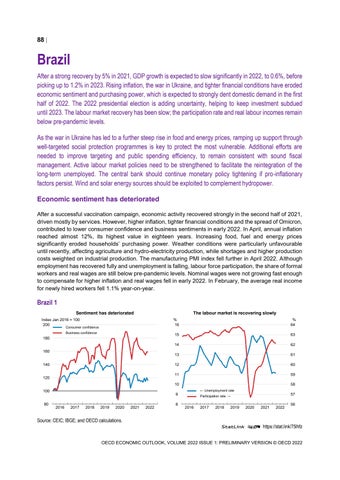
Brazil After a strong recovery by 5% in 2021, GDP growth is expected to slow significantly in 2022, to 0.6%, before picking up to 1.2% in 2023. Rising inflation, the war in Ukraine, and tighter financial conditions have eroded economic sentiment and purchasing power, which is expected to strongly dent domestic demand in the first half of 2022. The 2022 presidential election is adding uncertainty, helping to keep investment subdued until 2023. The labour market recovery has been slow; the participation rate and real labour incomes remain below pre-pandemic levels. As the war in Ukraine has led to a further steep rise in food and energy prices, ramping up support through well-targeted social protection programmes is key to protect the most vulnerable. Additional efforts are needed to improve targeting and public spending efficiency, to remain consistent with sound fiscal management. Active labour market policies need to be strengthened to facilitate the reintegration of the long-term unemployed. The central bank should continue monetary policy tightening if pro-inflationary factors persist. Wind and solar energy sources should be exploited to complement hydropower. Economic sentiment has deteriorated After a successful vaccination campaign, economic activity recovered strongly in the second half of 2021, driven mostly by services. However, higher inflation, tighter financial conditions and the spread of Omicron, contributed to lower consumer confidence and business sentiments in early 2022. In April, annual inflation reached almost 12%, its highest value in eighteen years. Increasing food, fuel and energy prices significantly eroded households’ purchasing power. Weather conditions were particularly unfavourable until recently, affecting agriculture and hydro-electricity production, while shortages and higher production costs weighted on industrial production. The manufacturing PMI index fell further in April 2022. Although employment has recovered fully and unemployment is falling, labour force participation, the share of formal workers and real wages are still below pre-pandemic levels. Nominal wages were not growing fast enough to compensate for higher inflation and real wages fell in early 2022. In February, the average real income for newly hired workers fell 1.1% year-on-year.
Brazil 1 Sentiment has deteriorated
The labour market is recovering slowly
Index Jan 2016 = 100 200
Consumer confidence Business confidence
180 160 140 120
% 16
% 64
15
63
14
62
13
61
12
60
11
59
10 100 80
58 ← Unemployment rate
9 2016
2017
2018
2019
2020
2021
2022
0
8
57
Participation rate →
2016
2017
2018
2019
2020
2021
2022
56
Source: CEIC; IBGE; and OECD calculations. StatLink 2 https://stat.link/75lhfz OECD ECONOMIC OUTLOOK, VOLUME 2022 ISSUE 1: PRELIMINARY VERSION © OECD 2022
89
Brazil: Demand, output and prices 2018
2019
GDP at market prices Private consumption Government consumption Gross fixed capital formation
2021
2022
2023
Percentage changes, volume (2000 prices)
Current prices BRL billion
Brazil
2020
7 004.1 4 525.8 1 393.5 1 057.4
1.2 2.6 -0.5 4.0
-4.2 -5.7 -4.5 -0.5
5.0 3.9 2.0 17.3
0.6 0.8 2.2 -0.8
1.2 0.8 1.5 1.4
Final domestic demand Stockbuilding¹
6 976.7 - 0.1
2.2 -0.5
-4.7 -0.6
5.7 0.5
0.8 0.0
1.1 0.0
Total domestic demand Exports of goods and services Imports of goods and services Net exports¹
6 976.6 1 025.1 997.5 27.6
1.6 -2.5 1.4 -0.6
-5.4 -2.2 -10.2 1.2
6.1 6.3 12.9 -1.0
0.7 -1.9 -1.6 -0.1
1.1 2.6 1.7 0.2
_ _ _ _ _
4.2 3.7 3.7 -5.8
5.5 3.2 3.5 -13.6
10.7 8.3 8.4 -4.0
7.2 9.7 9.4 -6.4
5.0 5.3 5.3 -5.9
-3.5
-1.6
-1.8
-1.0
-0.9
Memorandum items GDP deflator Consumer price index Private consumption deflator General government financial balance (% of GDP) Current account balance (% of GDP) 1. Contributions to changes in real GDP, actual amount in the first column. Source: OECD Economic Outlook 111 database.
StatLink 2 https://stat.link/7jrge3
Brazil 2 Inflation has not peaked yet, despite monetary policy tightening % 14
Higher commodity prices improved the primary balance, but debt servicing costs continue to increase % 21
← Inflation (IPCA)
% of GDP 2
← Core inflation¹
12
0
18
Policy rate (SELIC) →
-2
← Target
10
15
8
12
-6
6
9
-8
4
6
Headline fiscal balance
2
3
Primary fiscal balance
-4
-10 -12 -14
Interest balance
0
2016
2017
2018
2019
2020
2021
2022
0
0
2016
2017
2018
2019
2020
2021
-16
1. Core inflation excludes energy and food products. The shaded area corresponds to the inflation tolerance band. Source: OECD Economic Outlook 111 database; Central Bank of Brazil; and OECD calculations. StatLink 2 https://stat.link/9d5oql
OECD ECONOMIC OUTLOOK, VOLUME 2022 ISSUE 1: PRELIMINARY VERSION © OECD 2022
90 The war in Ukraine has raised international commodity prices, further escalating inflation. To cushion the impact of higher international energy prices on households and firms, the exceptional tariff on electricity, introduced in September 2021 during the hydric crisis, has been withdrawn earlier than expected. Brazil is particularly dependent on fertilisers imported from Russia. Trade disruptions and economic sanctions are pushing farming input and output prices up, feeding food inflation. As a response, the government has eliminated the import tax rate for some food products and chemicals used in the production of fertilisers.
Monetary policy continues to tighten, while fiscal policy expands In early May, the Brazilian central bank increased the reference rate by another 100 basis points, making monetary policy more restrictive. The Selic rate has reached 12.75% and is expected to rise to 13.25% in the next central bank meeting, since market inflation expectations continue to increase. The Selic rate is projected to remain at 13.25% until early 2023 and then decrease slowly during the year, as the lagged effects from recent increases are finally felt. Strong commodity prices are supporting fiscal outcomes in the short term. Oil revenues, coming from royalties and dividends, are benefiting both the central government and regional governments, which posted robust budget results in 2021 and early 2022. Inflation is also boosting Federal and regional tax collection. However, public expenditure is expected to increase in 2022, driven by higher social transfers with the new Auxílio Brasil programme, adjustments in civil servant wages, and higher discretionary expenses, resulting in an expansionary fiscal stance in 2022. Permanent increases in public expenditures pose a threat to the fiscal outlook in the longer term, especially given the weaker spending cap rule. In addition, debt-servicing costs continue to increase given tighter monetary policy.
Growth is slowing amid significant downside risks Due to deteriorating economic sentiment and the challenging domestic and global environment, growth prospects are limited in 2022 and 2023. GDP growth is expected to slow considerably this year, to 0.6%, before picking up to 1.2% in 2023. Inflation, tight financial conditions and uncertainty are restricting domestic and external demand. In addition, labour incomes are not recovering fast enough to compensate for the withdrawal of pandemic-related emergency support and rising inflation. Inflation should start easing in the second quarter of 2022, with tighter monetary policy and reduced uncertainty after the presidential elections, but rise again in early 2023 as the European oil embargo on Russia takes effect. Inflation will remain high in 2023, and is not expected to reach the inflation target in the projection horizon. The 2022 presidential election adds considerable uncertainty, which could dampen private consumption and investment even further. Prolonged conflict in Europe could continue to raise the cost of farming inputs, such as fertilisers, severely constraining agriculture production and exports. An abrupt tightening of monetary policy in advanced economies could lead to capital outflows and currency depreciation, adding pressure to imported inflation. Mounting pressure on the spending cap rule in the coming years poses a threat to fiscal and financial stability. On the upside, if commodity prices remained high for longer than expected fiscal pressures would ease in the short term and the terms of trade would improve.
Ambitious reforms are needed to enhance growth and preserve public finances To safeguard fiscal sustainability and prevent poverty rates from increasing, Brazil needs to continue the ambitious reforms it has started to simultaneously boost productivity and employment. Improving public spending efficiency and strengthening the medium-term fiscal framework would create fiscal space for productive public investment and well-targeted social support, and strengthen investors’ confidence.
OECD ECONOMIC OUTLOOK, VOLUME 2022 ISSUE 1: PRELIMINARY VERSION © OECD 2022
91 Conditional cash transfers that fade out only as workers regain employment, would strengthen incentives for job search in the formal sector. Boosting professional training opportunities would facilitate the reintegration of long-term unemployed and discouraged workers into the labour market. Finally, laws that prevent illegal deforestation need to be properly enforced, to protect natural resources, such as the Amazon rain forest, that can provide sustainable livelihood to vulnerable segments of the populations and is associated with higher levels of rainfall. The strong reliance on hydroelectric energy has shown its limits and, as demand for electricity continues to increase, alternative renewable sources will need to be exploited. Wind and solar sources present significant untapped potential in Brazil. Scaling up investments in urban public transport systems would benefit low-income workers, while also reducing car dependency and air pollution.
OECD ECONOMIC OUTLOOK, VOLUME 2022 ISSUE 1: PRELIMINARY VERSION © OECD 2022