79
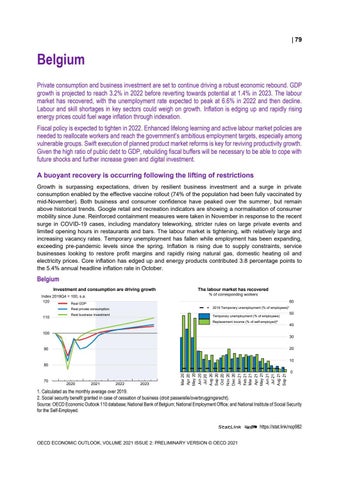
Belgium Private consumption and business investment are set to continue driving a robust economic rebound. GDP growth is projected to reach 3.2% in 2022 before reverting towards potential at 1.4% in 2023. The labour market has recovered, with the unemployment rate expected to peak at 6.6% in 2022 and then decline. Labour and skill shortages in key sectors could weigh on growth. Inflation is edging up and rapidly rising energy prices could fuel wage inflation through indexation. Fiscal policy is expected to tighten in 2022. Enhanced lifelong learning and active labour market policies are needed to reallocate workers and reach the government’s ambitious employment targets, especially among vulnerable groups. Swift execution of planned product market reforms is key for reviving productivity growth. Given the high ratio of public debt to GDP, rebuilding fiscal buffers will be necessary to be able to cope with future shocks and further increase green and digital investment. A buoyant recovery is occurring following the lifting of restrictions Growth is surpassing expectations, driven by resilient business investment and a surge in private consumption enabled by the effective vaccine rollout (74% of the population had been fully vaccinated by mid-November). Both business and consumer confidence have peaked over the summer, but remain above historical trends. Google retail and recreation indicators are showing a normalisation of consumer mobility since June. Reinforced containment measures were taken in November in response to the recent surge in COVID-19 cases, including mandatory teleworking, stricter rules on large private events and limited opening hours in restaurants and bars. The labour market is tightening, with relatively large and increasing vacancy rates. Temporary unemployment has fallen while employment has been expanding, exceeding pre-pandemic levels since the spring. Inflation is rising due to supply constraints, service businesses looking to restore profit margins and rapidly rising natural gas, domestic heating oil and electricity prices. Core inflation has edged up and energy products contributed 3.8 percentage points to the 5.4% annual headline inflation rate in October.
Belgium Investment and consumption are driving growth
The labour market has recovered % of corresponding workers
Index 2019Q4 = 100, s.a. 120 Real GDP 110
60
Real private consumption
2019 Temporary unemployment (% of employees)¹
Real business investment
Temporary unemployment (% of employees) Replacement income (% of self-employed)²
100
50 40 30 20
90
10 0 70
2020
2021
2022
2023
0
Mar 20 Apr 20 May 20 Jun 20 Jul 20 Aug 20 Sep 20 Oct 20 Nov 20 Dec 20 Jan 21 Feb 21 Mar 21 Apr 21 May 21 Jun 21 Jul 21 Aug 21 Sep 21
80 0
1. Calculated as the monthly average over 2019. 2. Social security benefit granted in case of cessation of business (droit passerelle/overbruggingsrecht). Source: OECD Economic Outlook 110 database; National Bank of Belgium; National Employment Office; and National Institute of Social Security for the Self-Employed. StatLink 2 https://stat.link/nop982 OECD ECONOMIC OUTLOOK, VOLUME 2021 ISSUE 2: PRELIMINARY VERSION © OECD 2021
80
Belgium: Demand, output and prices 2018
2019
GDP at market prices Private consumption Government consumption Gross fixed capital formation Final domestic demand Stockbuilding¹ Total domestic demand Exports of goods and services Imports of goods and services Net exports¹ Memorandum items GDP deflator Harmonised index of consumer prices Harmonised index of core inflation² Unemployment rate (% of labour force) Household saving ratio, net (% of disposable income) General government financial balance (% of GDP) General government gross debt (% of GDP) General government debt, Maastricht definition³ (% of GDP) Current account balance (% of GDP)
460.0 238.2 106.2 108.5 453.0 8.2 461.1 382.0 383.1 - 1.1 _ _ _ _ _ _ _ _ _
2021
2022
2023
Percentage changes, volume (2015 prices)
Current prices EUR billion
Belgium
2020
2.1 1.8 1.7 4.5 2.4 -0.5 1.9 2.0 1.6 0.3
-5.7 -8.2 0.2 -6.2 -5.8 -0.3 -6.1 -5.5 -5.9 0.4
6.1 5.7 2.0 10.8 6.0 -0.3 5.6 10.5 10.0 0.5
3.2 6.6 -0.5 3.4 4.1 0.0 4.0 5.1 6.0 -0.7
1.4 2.2 -0.3 2.9 1.8 0.0 1.8 3.2 3.5 -0.4
1.8 1.3 3.3 2.3 1.8 1.2 0.4 2.9 3.3 2.1 1.5 1.4 1.1 1.8 2.1 5.4 5.6 6.3 6.6 6.4 6.1 15.5 11.2 5.6 4.3 -1.9 -9.1 -8.1 -4.8 -5.0 120.4 141.5 140.5 140.0 141.9 97.7 112.8 111.7 111.3 113.1 0.2 0.8 0.4 -0.6 0.1
1. Contributions to changes in real GDP, actual amount in the first column. 2. Harmonised index of consumer prices excluding food, energy, alcohol and tobacco. 3. The Maastricht definition of general government debt includes only loans, debt securities, and currency and deposits, with debt at face value rather than market value. Source: OECD Economic Outlook 110 database.
StatLink 2 https://stat.link/cvdl7p
Support measures are unwinding The extension of temporary unemployment for employees and replacement income for the self-employed is set to expire at the end of 2021. Moratoria on both loans and government claims (social security contributions and value added tax) ended in June, while the suspension of bankruptcy proceedings was lifted in January. Large pandemic-related spending has increased Maastricht public debt from 97.7% of GDP in 2019 to 112.8% of GDP in 2020, with around EUR 14 billion of support measures in 2021 (2.8% of GDP) and EUR 2 billion budgeted for 2022, down from around EUR 21 billion in 2020. Subordinated debt and guarantees amount to around 2.5% of GDP in 2021. The national recovery and resilience plan includes EUR 5.9 billion (1.2% of GDP) of Next Generation EU grants, overwhelmingly earmarked for green (building renovation and transport infrastructure) and digital investment, with two thirds of the total planned to be absorbed over the period 2021-23. The supplementary investment allowance is also planned to be restricted to green and digital assets beyond 2022.
Domestic demand is set to drive growth GDP surpassed its pre-pandemic level in the third quarter of 2021 and is projected to expand by 3.2% in 2022 before growth stabilises at 1.4% in 2023. Private consumption is expected to drive growth in 2022, with the household saving ratio normalising and the economy fully open, but will moderate in 2023. Business investment is also projected to grow robustly given high demand prospects, rising capacity
OECD ECONOMIC OUTLOOK, VOLUME 2021 ISSUE 2: PRELIMINARY VERSION © OECD 2021
81 utilisation and low interest rates. While public consumption is expected to recede due to lower COVIDrelated spending on support measures and healthcare, public investment is set to increase as the national recovery plan is rolled out. Net exports are projected to damp GDP growth. Unemployment is expected to peak at 6.6% in 2022 as hours worked rise and job retention measures are unwound, before falling in 2023. The high inflation rate in late 2021 is projected to carry over through 2022 before receding in 2023, as the contributions of supply chain bottlenecks and energy prices subside. An export boost from higherthan-expected growth in Belgium’s main trading partners is an upside risk, but risks are generally on the downside. A worsening of the sanitary situation would necessitate partial restrictions on non-essential economic activities. Limited cross-border migration, and increasing labour demand related to recovery plans and the reconstruction of flood-affected areas, could worsen labour and skill shortages in key sectors such as construction and IT services. Energy price pressures are building up and are expected to trigger a further 2% automatic wage indexation in early 2022, adding to the 2% automatic indexation in the last quarter of 2021 and creating the risk of labour cost inflation over the projection period.
Facilitating reallocation will be key More effective lifelong learning, such as the planned personalisation of training allowances, is necessary to support workers as job retention policies are unwound. While planned reforms to boost labour market transitions and facilitate activation across regional borders are welcome, further action and enhanced active labour market policies targeted on vulnerable groups are needed to reach the authorities’ ambitious employment targets by 2030. The execution of reforms to streamline regulations and support digitalisation as outlined in the national recovery plan will be key to increase productivity and potential growth. Expenditure-led adjustments, outlined in a medium-term fiscal adjustment strategy at each level of government, will be required once the recovery is firmly based in order to rebuild fiscal space to address future shocks and create room for supporting the low-carbon transition. Effective co-ordination of climaterelated efforts across different levels of government and a credible long-term carbon pricing framework will be needed to achieve net-zero targets.
OECD ECONOMIC OUTLOOK, VOLUME 2021 ISSUE 2: PRELIMINARY VERSION © OECD 2021