9
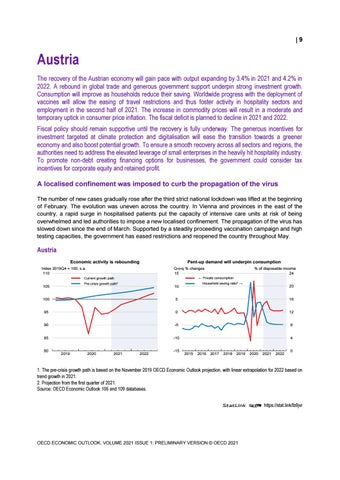
Austria The recovery of the Austrian economy will gain pace with output expanding by 3.4% in 2021 and 4.2% in 2022. A rebound in global trade and generous government support underpin strong investment growth. Consumption will improve as households reduce their saving. Worldwide progress with the deployment of vaccines will allow the easing of travel restrictions and thus foster activity in hospitality sectors and employment in the second half of 2021. The increase in commodity prices will result in a moderate and temporary uptick in consumer price inflation. The fiscal deficit is planned to decline in 2021 and 2022. Fiscal policy should remain supportive until the recovery is fully underway. The generous incentives for investment targeted at climate protection and digitalisation will ease the transition towards a greener economy and also boost potential growth. To ensure a smooth recovery across all sectors and regions, the authorities need to address the elevated leverage of small enterprises in the heavily hit hospitality industry. To promote non-debt creating financing options for businesses, the government could consider tax incentives for corporate equity and retained profit. A localised confinement was imposed to curb the propagation of the virus The number of new cases gradually rose after the third strict national lockdown was lifted at the beginning of February. The evolution was uneven across the country. In Vienna and provinces in the east of the country, a rapid surge in hospitalised patients put the capacity of intensive care units at risk of being overwhelmed and led authorities to impose a new localised confinement. The propagation of the virus has slowed down since the end of March. Supported by a steadily proceeding vaccination campaign and high testing capacities, the government has eased restrictions and reopened the country throughout May.
Austria Economic activity is rebounding
Pent-up demand will underpin consumption
Index 2019Q4 = 100, s.a. 110
Q-o-q % changes 15 ← Private consumption
Current growth path Pre-crisis growth path¹
105
% of disposable income 24
Household saving ratio² →
10
20
100
5
16
95
0
12
90
-5
8
85
-10
4
80
2019
2020
2021
2022
0
-15
2015
2016
2017
2018
2019
2020
2021
2022
0
1. The pre-crisis growth path is based on the November 2019 OECD Economic Outlook projection, with linear extrapolation for 2022 based on trend growth in 2021. 2. Projection from the first quarter of 2021. Source: OECD Economic Outlook 106 and 109 databases. StatLink 2 https://stat.link/lb9jvr
OECD ECONOMIC OUTLOOK, VOLUME 2021 ISSUE 1: PRELIMINARY VERSION © OECD 2021
10
Austria: Demand, output and prices 2017
2018
Current prices EUR billion
Austria GDP at market prices* Private consumption Government consumption Gross fixed capital formation Final domestic demand Stockbuilding1 Total domestic demand Exports of goods and services Imports of goods and services Net exports1 Memorandum items GDP deflator Harmonised index of consumer prices Harmonised index of core inflation2 Unemployment rate (% of labour force) Household saving ratio, net (% of disposable income) General government financial balance (% of GDP) General government gross debt (% of GDP) General government debt, Maastricht definition (% of GDP) Current account balance (% of GDP)
2019
2020
2021
2022
Percentage changes, volume (2015 prices)
369.5 193.9 72.0 87.1 353.0 4.1 357.0 201.2 188.7 12.5
2.5 1.1 1.2 4.0 1.8 0.4 2.2 4.9 4.6 0.3
_ _ _ _ _ _ _ _ _
1.7 2.1 1.8 4.8 7.8 0.2 95.5 74.1 1.3
1.4 0.8 1.4 3.9 1.7 -0.7 0.9 2.9 2.5 0.3
-6.7 -9.4 1.7 -4.8 -6.0 -0.4 -6.3 -10.9 -10.0 -0.9
3.4 3.0 1.3 4.6 3.0 0.7 3.8 7.2 7.9 -0.1
4.2 4.9 1.1 4.1 3.8 0.0 3.8 7.8 7.3 0.5
1.7 1.1 1.1 1.5 1.5 1.4 2.0 1.9 1.7 2.0 1.8 1.8 4.5 5.4 5.1 4.8 8.2 14.5 11.1 8.2 0.6 -8.9 -7.3 -3.1 93.4 114.6 119.1 118.5 70.5 84.1 88.6 88.0 2.8 2.5 1.6 2.3
* Based on seasonal and working-day adjusted quarterly data; may differ from official non-working-day adjusted annual data. 1. Contributions to changes in real GDP, actual amount in the first column. 2. Harmonised index of consumer prices excluding food, energy, alcohol and tobacco. Source: OECD Economic Outlook 109 database.
StatLink 2 https://stat.link/euhysr
Travel restrictions have severely impeded tourism Economic activity in manufacturing sectors has benefited from the worldwide recovery in industrial production and a subsequent rebound in global trade. Business confidence has returned to the level observed at the onset of the crisis. With the exception of hospitality sectors and other contact-intensive service sectors, the situation on labour markets improved over the winter. Employment increased by roughly 2.4% over the period from December 2020 to March 2021. Moreover, registered vacancies increased by 45% over the same period. Due to a strict lockdown and international travel restrictions, hospitality sectors had to forego most of the winter tourist season. Overnight stays in January and February dropped by more than 90% compared to the previous year. Even so, real GDP edged up in the first quarter of 2021.
Massive fiscal stimulus is supporting jobs and businesses The authorities have taken measures amounting to around EUR 50 billion (13% of GDP), including credit guarantees, since the onset of the pandemic. Available support includes subsidies for firms’ fixed costs, short-time work schemes, temporary generalised and sector-specific tax reliefs and additional funds for small businesses and sole proprietorships. A planned reduction of income taxes was brought forward. Expenditure measures comprise public investment in climate protection, digital teaching and medical equipment. A priority has been the retention of existing jobs. The short-time work scheme was extended for the fourth time in March and is currently expected to be phased out by the end of June. The support
OECD ECONOMIC OUTLOOK, VOLUME 2021 ISSUE 1: PRELIMINARY VERSION © OECD 2021
11 scheme also encompasses incentives to business investment in climate protection and digitalisation in the form of accelerated depreciation rules and direct subsidies. These incentives allow firms to get reimbursed for up to 14% of the amount invested. The envelope reserved for the investment incentives amounts to EUR 6½ billion.
Progress with vaccinations will boost the recovery A broad-based recovery is projected to gain pace in the second half of 2021. The easing of lockdown measures and international travel restrictions combined with progress with the vaccination campaign should allow hospitality sectors to resume activity over the summer period. The strong rebound in key partners underpins exports and business investment. The unemployment rate is projected to fall gradually but not return to pre-crisis levels by end-2022. The labour market improvement is driven by an increase in private consumption. GDP will reach its pre-crisis level at the end of 2022. With the gradual phasing out of government support measures, the fiscal deficit could decline to below 4% of GDP at the end of the projection horizon. Government debt is set to decrease moderately in 2022 but remains well above precrisis levels. The downside risks to the projection remain elevated. Activity in hospitality sectors, which account for 7-8% of total value added and around 10% of total employment, crucially depends on the virus retreating. Continued travel restrictions would jeopardise the upcoming summer and winter tourist season, put many tourism businesses severely at risk and adversely affect regional cohesion. A slower unwinding of household excess saving would weigh on private consumption.
The government should increase public spending on infrastructure and skills The authorities should be ready to deploy additional stimulus if downside risks materialise. Maintaining a structurally neutral fiscal position, for example through well-targeted increases in public spending on digital infrastructure and climate protection, would help boost sustainable long-term growth. Additional public spending could boost skills, by improving the digital teaching equipment at schools and universities and by increasing the number of teachers across all layers of education. This would benefit social cohesion and promote reallocation towards new jobs and the most productive firms. A more targeted investment incentive scheme would support firms with viable projects but impaired balance sheets.
OECD ECONOMIC OUTLOOK, VOLUME 2021 ISSUE 1: PRELIMINARY VERSION © OECD 2021