118
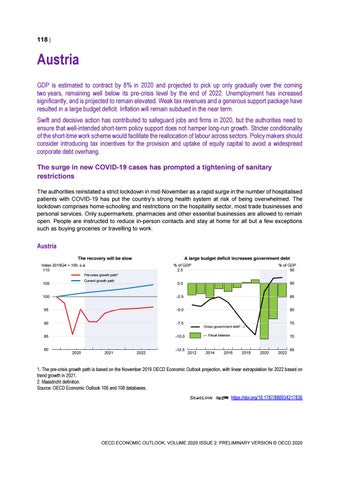
Austria GDP is estimated to contract by 8% in 2020 and projected to pick up only gradually over the coming two years, remaining well below its pre-crisis level by the end of 2022. Unemployment has increased significantly, and is projected to remain elevated. Weak tax revenues and a generous support package have resulted in a large budget deficit. Inflation will remain subdued in the near term. Swift and decisive action has contributed to safeguard jobs and firms in 2020, but the authorities need to ensure that well-intended short-term policy support does not hamper long-run growth. Stricter conditionality of the short-time work scheme would facilitate the reallocation of labour across sectors. Policy makers should consider introducing tax incentives for the provision and uptake of equity capital to avoid a widespread corporate debt overhang. The surge in new COVID-19 cases has prompted a tightening of sanitary restrictions The authorities reinstated a strict lockdown in mid-November as a rapid surge in the number of hospitalised patients with COVID-19 has put the country’s strong health system at risk of being overwhelmed. The lockdown comprises home-schooling and restrictions on the hospitality sector, most trade businesses and personal services. Only supermarkets, pharmacies and other essential businesses are allowed to remain open. People are instructed to reduce in-person contacts and stay at home for all but a few exceptions such as buying groceries or travelling to work.
Austria The recovery will be slow
A large budget deficit increases government debt
Index 2019Q4 = 100, s.a. 110
% of GDP 2.5
% of GDP 95
Pre-crisis growth path¹ Current growth path
0.0
90
100
-2.5
85
95
-5.0
80
90
-7.5
85
-10.0
105
80
2020
2021
2022
0
-12.5
75
Gross government debt² → ← Fiscal balance
2012
2014
2016
70
2018
2020
2022
65
1. The pre-crisis growth path is based on the November 2019 OECD Economic Outlook projection, with linear extrapolation for 2022 based on trend growth in 2021. 2. Maastricht definition. Source: OECD Economic Outlook 106 and 108 databases. StatLink 2 https://doi.org/10.1787/888934217836
OECD ECONOMIC OUTLOOK, VOLUME 2020 ISSUE 2: PRELIMINARY VERSION © OECD 2020
ď ź 119
Austria: Demand, output and prices 2017
Austria GDP at market prices* Private consumption Government consumption Gross fixed capital formation Final domestic demand Stockbuilding1 Total domestic demand Exports of goods and services Imports of goods and services Net exports1 Memorandum items GDP deflator Harmonised index of consumer prices Harmonised index of core inflation2 Unemployment rate (% of labour force) Household saving ratio, net (% of disposable income) General government financial balance (% of GDP) General government gross debt (% of GDP) General government debt, Maastricht definition (% of GDP) Current account balance (% of GDP)
2018
Current prices EUR billion
2019
2020
2021
2022
Percentage changes, volume (2015 prices)
369.5 193.9 72.0 87.1 353.0 4.1 357.0 201.2 188.7 12.5
2.5 1.1 1.2 4.0 1.8 0.4 2.2 4.9 4.6 0.3
_ _ _ _ _ _ _ _ _
1.7 2.1 1.8 4.8 7.8 0.2 96.8 74.1 1.3
1.4 0.8 1.4 3.9 1.7 -0.7 0.9 2.9 2.5 0.3
-8.0 -7.9 1.2 -7.0 -5.8 -0.8 -6.6 -13.3 -12.7 -0.8
1.4 2.9 1.2 1.9 2.2 -0.3 2.0 4.0 3.9 0.1
2.3 2.3 1.2 3.2 2.3 0.0 2.4 4.3 4.5 0.0
1.7 0.7 1.1 1.1 1.5 1.3 1.3 1.6 1.7 1.7 1.2 1.6 4.5 5.6 5.6 5.1 8.2 17.0 15.4 12.6 0.7 -10.5 -6.7 -2.6 95.0 111.2 116.3 116.6 70.6 86.8 91.9 92.2 2.8 2.9 3.1 3.2
* Based on seasonal and working-day adjusted quarterly data; may differ from official non-working-day adjusted annual data. 1. Contributions to changes in real GDP, actual amount in the first column. 2. Harmonised index of consumer prices excluding food, energy, alcohol and tobacco. Source: OECD Economic Outlook 108 database.
StatLink 2 https://doi.org/10.1787/888934217855
The labour market improved over the summer but the outlook is now uncertain After a historic output decline in the first half of 2020, economic activity rebounded over the summer. The increase in activity came alongside an improved situation on the labour market. A bit more than 400 000 persons were registered for short-time work in September, compared with over 1.3 million in mid-April, though the actual uptake will only be known later. The number of unemployed workers decreased by around 156 000 from the peak in April. Nevertheless, employment has declined in most sectors since March. The number of tourist overnight stays in summer was more than 30% lower than last year. The hospitality sector and other services sectors requiring close personal contact have been most affected by the pandemic. The renewed lockdown will continue to put a strain on the labour market.
A generous support package has helped to avoid a more severe downturn A support package amounting to around EUR 38 billion (around 10% of GDP) has been gradually implemented since March. In June, the authorities announced further measures to stimulate the economy. With the June measures, the total support package amounts to around EUR 50 billion (around 13% of GDP), including credit guarantees. The new measures include an extension of the short-time work scheme until March 2021, new expenditure measures on climate protection and digital teaching, additional funds for hardship cases across micro and small firms and for caretaking, research and medical equipment, and tax reliefs and VAT reductions in selected sectors. The June support programme also includes tax incentives for corporate investment, in particular in green and digital technologies, and a retroactive
OECD ECONOMIC OUTLOOK, VOLUME 2020 ISSUE 2: PRELIMINARY VERSION Š OECD 2020
120 ď ź reduction of the income tax rate in the first tax bracket from 25% to 20% should help to accelerate the recovery. Furthermore, the government has announced that it will spend an estimated EUR 3 billion to refund businesses for up to 80% of foregone revenues in November 2020 subject to a ceiling of EUR 800 000.
GDP is projected to recover only gradually Output is set to decline in the near term as containment measures and voluntary restraints due to health concerns take a toll on private consumption. Disruptions in global value chains and moderate growth in key trading partners are putting downward pressure on exports and investment. As an effective vaccine is implemented, activity will recover over 2021-22, but will still be well below its pre-crisis trend level by the end of 2022. The unemployment rate will remain high through 2021 and only start to edge down in 2022. The generous support package has resulted in a large budget deficit, but it will decrease steadily over the projection period. To the extent that the phasing-out of the fiscal stimulus is not compensated by a decline in the household saving rate, it will weigh on growth in 2021 and 2022. Downside risks to the projection remain high. Many businesses in the tourism sector are family-owned and tend to be highly leveraged. If travel restrictions and recurring lower demand prevail over an extended period, a wave of insolvencies may follow with negative consequences for employment in remote areas and regional cohesion.
Policy makers should take the opportunity to promote the development of markets for equity capital Options to support businesses while avoiding large increases in corporate debt are limited since markets for equity capital are less developed than elsewhere. The authorities should incentivise the provision and uptake of equity capital, for example by granting a tax allowance on corporate equity or by providing tax incentives for venture capital and private equity investment in small and medium-sized enterprises. They should also continue to strengthen qualifying conditions for the short-time work scheme, for instance regarding training measures related to advanced digital tools and activities, to promote a healthy reallocation of jobs towards more promising sectors and productive firms.
OECD ECONOMIC OUTLOOK, VOLUME 2020 ISSUE 2: PRELIMINARY VERSION Š OECD 2020