82
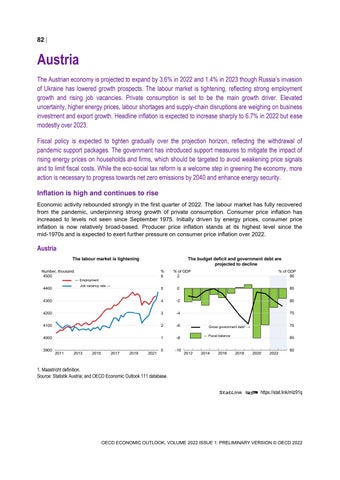
Austria The Austrian economy is projected to expand by 3.6% in 2022 and 1.4% in 2023 though Russia’s invasion of Ukraine has lowered growth prospects. The labour market is tightening, reflecting strong employment growth and rising job vacancies. Private consumption is set to be the main growth driver. Elevated uncertainty, higher energy prices, labour shortages and supply-chain disruptions are weighing on business investment and export growth. Headline inflation is expected to increase sharply to 6.7% in 2022 but ease modestly over 2023. Fiscal policy is expected to tighten gradually over the projection horizon, reflecting the withdrawal of pandemic support packages. The government has introduced support measures to mitigate the impact of rising energy prices on households and firms, which should be targeted to avoid weakening price signals and to limit fiscal costs. While the eco-social tax reform is a welcome step in greening the economy, more action is necessary to progress towards net zero emissions by 2040 and enhance energy security. Inflation is high and continues to rise Economic activity rebounded strongly in the first quarter of 2022. The labour market has fully recovered from the pandemic, underpinning strong growth of private consumption. Consumer price inflation has increased to levels not seen since September 1975. Initially driven by energy prices, consumer price inflation is now relatively broad-based. Producer price inflation stands at its highest level since the mid-1970s and is expected to exert further pressure on consumer price inflation over 2022.
Austria The labour market is tightening
The budget deficit and government debt are projected to decline
Number, thousand 4500
% 6
% of GDP 2
% of GDP 90
← Employment Job vacancy rate →
4400
5
0
85
4300
4
-2
80
4200
3
-4
75
4100
2
-6
4000
1
-8
0
-10
3900
2011
2013
2015
2017
2019
2021
70
Gross government debt¹ → ← Fiscal balance
2012
2014
2016
65
2018
2020
2022
60
1. Maastricht definition. Source: Statistik Austria; and OECD Economic Outlook 111 database. StatLink 2 https://stat.link/mlz91q
OECD ECONOMIC OUTLOOK, VOLUME 2022 ISSUE 1: PRELIMINARY VERSION © OECD 2022
83
Austria: Demand, output and prices 2018
Austria GDP at market prices* Private consumption Government consumption Gross fixed capital formation Final domestic demand Stockbuilding¹ Total domestic demand Exports of goods and services Imports of goods and services Net exports¹ Memorandum items GDP deflator Harmonised index of consumer prices Harmonised index of core inflation² Unemployment rate (% of labour force) Household saving ratio, net (% of disposable income) General government financial balance (% of GDP) General government gross debt (% of GDP) General government debt, Maastricht definition³ (% of GDP) Current account balance (% of GDP)
2019
2020
2021
2022
2023
Percentage changes, volume (2015 prices)
Current prices EUR billion
385.4 200.1 74.5 92.7
1.5 0.7 1.5 4.8
-6.8 -8.4 -0.4 -4.9
4.6 3.2 6.8 4.0
3.6 4.0 -1.2 4.2
1.4 1.1 0.6 2.0
367.3 6.0
1.9 -1.2
-5.9 0.1
4.2 0.5
3.0 0.0
1.2 0.0
373.3 214.3 202.2 12.1
0.6 3.3 1.8 0.9
-5.8 -11.5 -9.4 -1.5
4.5 13.3 13.8 0.1
2.9 8.5 7.4 0.7
1.2 4.4 4.1 0.2
1.6 1.5 1.7 4.5
2.3 1.4 2.0 5.4
1.7 2.8 2.3 6.2
3.5 6.7 3.6 5.2
3.4 4.7 3.9 5.0
_ _ _ _ _ _ _ _ _
8.5 14.4 11.8 7.4 6.5 0.6 -8.1 -5.9 -3.1 -1.6 93.5 112.3 106.4 103.5 101.2 70.6 83.5 82.9 80.0 77.7 2.1 1.9 -0.5 -0.3 -0.9
* Based on seasonal and working-day adjusted quarterly data; may differ from official non-working-day adjusted annual data. 1. Contributions to changes in real GDP, actual amount in the first column. 2. Harmonised index of consumer prices excluding food, energy, alcohol and tobacco. 3. The Maastricht definition of general government debt includes only loans, debt securities, and currency and deposits, with debt at face value rather than market value. Source: OECD Economic Outlook 111 database.
StatLink 2 https://stat.link/golc9b
Austria is highly dependent on gas imports from Russia. Prior to the invasion of Ukraine, Austria imported 80% of its gas consumption from Russia. Imports of crude oil from Russia were only around 8% of total crude oil imports and, to a large extent, have already been substituted with imports from other sources. Other trade links with Russia, including tourism, are relatively modest. The amount of outstanding loans of Austrian banks to Russia is one of the highest across the European Union. However, the risk to the Austrian banking sector is manageable given that these loans only account for around 4% of the total stock of outstanding credit to foreigners. Ukrainian refugees continue to move to Austria and numbered around 70 000 in May. Refugees have equal access to the labour market. The authorities have rolled out a refugee support package worth around 0.12% of GDP.
Fiscal policy will tighten The primary budget deficit is expected to close in 2022 and turn positive in 2024, mainly due to the withdrawal of pandemic support. While the overall stance of fiscal policy is tightening, grants from the Recovery and Resilience Facility will support public investments with an aggregate amount of around 0.8% of GDP until 2026. The authorities have also rolled out new discretionary measures to cushion some of the impact of energy price inflation with a total amount of 0.8% of GDP in 2022 and 0.2% of GDP in 2023. The package also includes the acquisition of a national strategic gas reserve. Moreover, the eco-social tax
OECD ECONOMIC OUTLOOK, VOLUME 2022 ISSUE 1: PRELIMINARY VERSION © OECD 2022
84 reform - a combination of several measures including gradual increases in carbon prices and personal and corporate income tax cuts - will apply from July 2022.
Downside risks to the projection are high Economic activity continues to expand due to significant private consumption growth. High energy prices and supply bottlenecks due to Russia’s invasion of Ukraine and the subsequent sanctions will weigh on business investment and exports. Shortages of skilled labour are constraining growth in many sectors. Headline inflation is set to increase to 6.7% in 2022 and ease only modestly over 2023, as the EU embargo of Russian oil will keep oil prices at elevated levels. Wage negotiations, usually guided by inflation rates over the last 12 months, may add pressure on prices in 2022 and 2023. Real wages will decline in 2022 but strong wage growth in 2023 will help to keep real disposable incomes flat. The growth projections are subject to considerable downside risks. A new pandemic outbreak with renewed sanitary measures that impede activity in service sectors would jeopardise growth in 2022. Potential disruptions in the supply of gas would have severe consequences on economic activity as gas imports from Russia cannot be substituted from other sources in the short-term.
Expanding renewables to raise energy security and a better activation of labour reserves are key priorities Policy action should aim at a better diversification of the supply of gas and fully leverage the domestic energy potential of renewables. This would complement recent efforts to build a gas storage facility and help to outweigh at least some of the adverse effects of a potential sudden stop of gas imports. Labour and skill shortages are holding back growth. Austria needs to better activate its labour reserves to counteract these shortages. Stepping up efforts to promote female employment, for example by bolstering the availability and quality of early childcare services throughout the entire country, should be a priority. Enhancing incentives to continue in the labour force at an older age while ensuring good working conditions for elderly workers would help to boost the supply of skilled labour.
OECD ECONOMIC OUTLOOK, VOLUME 2022 ISSUE 1: PRELIMINARY VERSION © OECD 2022