115
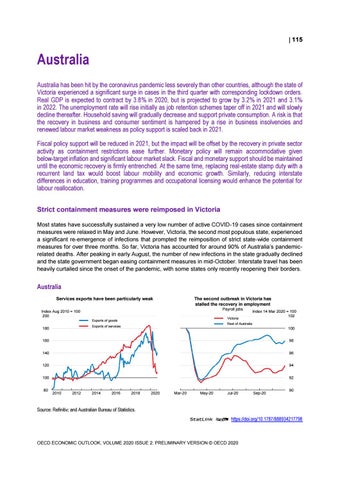
Australia Australia has been hit by the coronavirus pandemic less severely than other countries, although the state of Victoria experienced a significant surge in cases in the third quarter with corresponding lockdown orders. Real GDP is expected to contract by 3.8% in 2020, but is projected to grow by 3.2% in 2021 and 3.1% in 2022. The unemployment rate will rise initially as job retention schemes taper off in 2021 and will slowly decline thereafter. Household saving will gradually decrease and support private consumption. A risk is that the recovery in business and consumer sentiment is hampered by a rise in business insolvencies and renewed labour market weakness as policy support is scaled back in 2021. Fiscal policy support will be reduced in 2021, but the impact will be offset by the recovery in private sector activity as containment restrictions ease further. Monetary policy will remain accommodative given below-target inflation and significant labour market slack. Fiscal and monetary support should be maintained until the economic recovery is firmly entrenched. At the same time, replacing real-estate stamp duty with a recurrent land tax would boost labour mobility and economic growth. Similarly, reducing interstate differences in education, training programmes and occupational licensing would enhance the potential for labour reallocation. Strict containment measures were reimposed in Victoria Most states have successfully sustained a very low number of active COVID-19 cases since containment measures were relaxed in May and June. However, Victoria, the second most populous state, experienced a significant re-emergence of infections that prompted the reimposition of strict state-wide containment measures for over three months. So far, Victoria has accounted for around 90% of Australia’s pandemicrelated deaths. After peaking in early August, the number of new infections in the state gradually declined and the state government began easing containment measures in mid-October. Interstate travel has been heavily curtailed since the onset of the pandemic, with some states only recently reopening their borders.
Australia Services exports have been particularly weak
The second outbreak in Victoria has stalled the recovery in employment Payroll jobs
Index Aug 2010 = 100 200
Victoria
Exports of goods
Rest of Australia
Exports of services
180
Index 14 Mar 2020 = 100 102 100
160
98
140
96
120
94
100
92
80
2010
2012
2014
2016
2018
2020
0
0 Mar-20
May-20
Jul-20
Sep-20
90
Source: Refinitiv; and Australian Bureau of Statistics. StatLink 2 https://doi.org/10.1787/888934217798
OECD ECONOMIC OUTLOOK, VOLUME 2020 ISSUE 2: PRELIMINARY VERSION © OECD 2020
116
Australia: Demand, output and prices 2017
2018
Current prices AUD billion
Australia GDP at market prices Private consumption Government consumption Gross fixed capital formation Final domestic demand Stockbuilding1 Total domestic demand Exports of goods and services Imports of goods and services Net exports1
1 808.3 1 020.8 336.3 437.2 1 794.3 4.4 1 798.7 387.0 377.5 9.5
Memorandum items GDP deflator Consumer price index Core inflation index2 Unemployment rate (% of labour force) Household saving ratio, net (% of disposable income) General government financial balance (% of GDP) General government gross debt (% of GDP) Current account balance (% of GDP)
_ _ _ _ _ _ _ _
2019
2020
2021
2022
Percentage changes, volume (2017/2018 prices)
2.8 2.6 4.0 2.5 2.9 0.1 2.9 5.0 4.2 0.2
1.8 1.4 5.4 -2.0 1.4 -0.2 1.1 3.2 -1.3 1.0
-3.8 -7.5 7.8 -9.7 -5.0 0.9 -4.1 -9.3 -12.7 0.4
3.2 4.7 4.7 2.1 4.1 0.4 4.5 1.0 6.6 -1.0
3.1 4.2 0.9 3.8 3.4 0.0 3.4 3.8 5.7 -0.3
2.3 1.9 1.7 5.3 3.5 0.2 43.5 -2.1
3.1 1.6 1.6 5.2 3.7 -0.2 45.8 0.6
0.3 0.7 1.1 6.8 14.4 -12.7 57.7 2.3
1.3 1.6 1.3 7.9 11.7 -6.5 64.1 1.6
1.3 1.6 1.6 7.4 8.9 -5.1 68.8 1.4
1. Contributions to changes in real GDP, actual amount in the first column. 2. Consumer price index excluding food and energy. Source: OECD Economic Outlook 108 database.
StatLink 2 https://doi.org/10.1787/888934217817
The recovery has been uneven The economic recovery has been uneven due to differences in the impact of voluntary and imposed confinement across regions, industries and firms. Continued international border restrictions have hampered the recovery in education and tourism exports. Mobility indicators suggest that retail, recreation, workplace and transit station activity remain below pre-pandemic levels. The second virus outbreak in Victoria led to an interstate divergence in consumer sentiment and labour market outcomes: while employment in Victoria is still 6% below the level in March 2020, the number of employed persons in the Northern Territory, South Australia and Western Australia is back to around pre-pandemic levels. Mining, manufacturing and retail trade payroll jobs have rebounded strongly, but accumulated job losses in vulnerable services industries such as arts, recreation, accommodation and food remain high, at between 13% and 16%. Smaller firms have also experienced larger job losses and declines in sales. The government’s temporary wage subsidy, “JobKeeper”, has covered nearly one million employers and one-third of all employment, containing the rise in the measured unemployment rate so far.
Macroeconomic policies are shielding incomes and easing borrowing terms In October, the federal budget included new measures that increased direct fiscal support during the pandemic to 11.2% of GDP. Additional fiscal easing is concentrated in the fourth quarter of 2020 and the first half of 2021. New fiscal support plans include tax relief for households and firms, hiring subsidies, support payments, essential services spending, infrastructure investment and business tax deductions. Public spending will be scaled back during the second half of 2021, as the private sector recovery becomes OECD ECONOMIC OUTLOOK, VOLUME 2020 ISSUE 2: PRELIMINARY VERSION © OECD 2020
117 more firmly entrenched. The government also announced a debtor-friendly and simplified liquidation model for small businesses to come into effect in 2021. Its implementation will be key given the expiry of the moratorium on directors’ personal liability for trading while insolvent at end-2020. The central bank has reduced its policy rate and three-year Australian government bond yield target to 0.1%, reoriented its forward guidance from forecast to actual inflation and extended its long-term, low-cost funding to banks to boost business loans. In addition to directly reducing interest rates as part of the yield curve control policy, the central bank has introduced an asset purchase programme targeted at long-term bonds issued by the Commonwealth, as well as states and territories, to ease further financial conditions.
The unwinding of support measures will slow down the recovery The easing of Victoria’s lockdown and strong fiscal support will boost GDP growth in the near term. The infrastructure-led economic recovery in China will help sustain commodity exports and mining investment. In contrast, services exports will recover only slowly due to persistent border restrictions, and higher domestic demand will increase imports, reducing net exports. The unwinding of the strong fiscal support will be a headwind to higher GDP growth in the second half of 2021. Gradual phasing out of job retention programmes and increased labour force participation will cause the unemployment rate to rise further. However, consumption will continue to be supported by households gradually drawing down their increased savings and the further easing of containment measures. Headline inflation will initially decline following the attenuation of the carryover effects from the rise in commodity prices and the removal of the childcare fee waiver in the third quarter of 2020 and will slowly increase thereafter. Underlying inflation will remain subdued as economic slack is only reduced gradually. A key risk to the outlook is a fall in business and consumer confidence, as reduced government support is accompanied by a rise in business liquidations and unemployment. Furthermore, any additional escalation in geopolitical tensions with China may undermine export growth. On the upside, a faster-than-expected phasing out of border restrictions would boost the recovery in services exports.
Sustaining the recovery and enabling labour reallocation are key priorities Further policy measures should focus on sustaining the economic recovery from the pandemic as well as reducing barriers to labour reallocation. Fiscal and monetary policy support should not be withdrawn before the recovery is well entrenched. At the same time, replacing taxes and fees on property transactions, such as stamp duty, with a recurrent land tax as is being contemplated by the government of several states would achieve a more growth-friendly tax mix and promote labour mobility. Introducing well-designed skills programmes would enable rehiring in sectors such as hospitality and recreation services and may facilitate reallocation of labour from these sectors to manufacturing or digital services, sustaining the economy’s growth capacity. Paring back occupational licensing and implementing the government’s plans to recognise licenses across jurisdictions automatically would also boost labour mobility. In addition, to mitigate partly rising inequalities caused by the pandemic, the authorities should permanently strengthen the social safety net and support increased investment in social housing.
OECD ECONOMIC OUTLOOK, VOLUME 2020 ISSUE 2: PRELIMINARY VERSION © OECD 2020