73
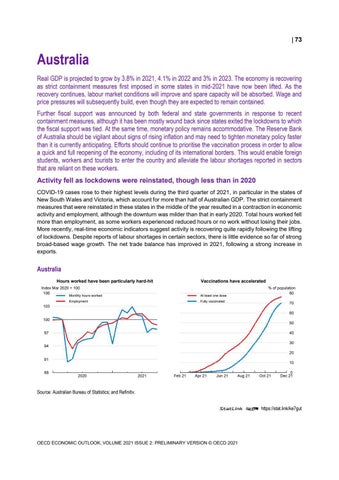
Australia Real GDP is projected to grow by 3.8% in 2021, 4.1% in 2022 and 3% in 2023. The economy is recovering as strict containment measures first imposed in some states in mid-2021 have now been lifted. As the recovery continues, labour market conditions will improve and spare capacity will be absorbed. Wage and price pressures will subsequently build, even though they are expected to remain contained. Further fiscal support was announced by both federal and state governments in response to recent containment measures, although it has been mostly wound back since states exited the lockdowns to which the fiscal support was tied. At the same time, monetary policy remains accommodative. The Reserve Bank of Australia should be vigilant about signs of rising inflation and may need to tighten monetary policy faster than it is currently anticipating. Efforts should continue to prioritise the vaccination process in order to allow a quick and full reopening of the economy, including of its international borders. This would enable foreign students, workers and tourists to enter the country and alleviate the labour shortages reported in sectors that are reliant on these workers. Activity fell as lockdowns were reinstated, though less than in 2020 COVID-19 cases rose to their highest levels during the third quarter of 2021, in particular in the states of New South Wales and Victoria, which account for more than half of Australian GDP. The strict containment measures that were reinstated in these states in the middle of the year resulted in a contraction in economic activity and employment, although the downturn was milder than that in early 2020. Total hours worked fell more than employment, as some workers experienced reduced hours or no work without losing their jobs. More recently, real-time economic indicators suggest activity is recovering quite rapidly following the lifting of lockdowns. Despite reports of labour shortages in certain sectors, there is little evidence so far of strong broad-based wage growth. The net trade balance has improved in 2021, following a strong increase in exports.
Australia Hours worked have been particularly hard-hit
Vaccinations have accelerated
Index Mar 2020 = 100 106
Monthly hours worked
At least one dose
Employment
Fully vaccinated
% of population 80 70
103
60 100
50
97
40 30
94
20 91 88
10 2020
2021
0
0 Feb 21
Apr 21
Jun 21
Aug 21
Oct 21
0 Dec 21
Source: Australian Bureau of Statistics; and Refinitiv. StatLink 2 https://stat.link/ke7gut
OECD ECONOMIC OUTLOOK, VOLUME 2021 ISSUE 2: PRELIMINARY VERSION © OECD 2021
74
Australia: Demand, output and prices 2018
2019
GDP at market prices Private consumption Government consumption Gross fixed capital formation Final domestic demand Stockbuilding¹ Total domestic demand Exports of goods and services Imports of goods and services Net exports¹ Memorandum items GDP deflator Consumer price index Core inflation index² Unemployment rate (% of labour force) Household saving ratio, net (% of disposable income) General government financial balance (% of GDP) General government gross debt (% of GDP) Current account balance (% of GDP)
2021
2022
2023
Percentage changes, volume (2018/2019 prices)
Current prices AUD billion
Australia
2020
1 901.1 1 063.2 357.6 455.4
1.9 1.2 5.7 -2.6
-2.5 -5.8 7.0 -3.1
3.8 3.7 4.7 7.6
4.1 4.4 6.8 4.2
3.0 3.5 2.3 3.0
1 876.2 2.4
1.1 -0.3
-2.6 -0.2
4.8 1.1
4.9 -0.1
3.1 0.0
1 878.6 438.4 416.0 22.5
0.8 3.1 -1.3 1.0
-2.8 -9.9 -13.2 0.4
5.9 -2.4 8.5 -2.1
4.7 3.5 7.0 -0.4
3.1 4.4 5.2 0.1
_ _ _ _ _ _ _ _
3.3 1.6 1.6 5.2
1.0 0.9 1.3 6.5
5.3 2.7 2.3 5.1
2.4 2.7 2.4 4.7
1.9 2.1 2.1 4.3
5.0 -0.5 47.1 0.6
15.5 -12.3 66.8 2.7
12.0 -6.7 73.0 4.1
8.6 -5.0 77.2 3.4
6.8 -3.6 79.9 3.1
1. Contributions to changes in real GDP, actual amount in the first column. 2. Consumer price index excluding food and energy. Source: OECD Economic Outlook 110 database.
StatLink 2 https://stat.link/sz062o
Fiscal policy support was reintroduced in response to the lockdowns The Commonwealth government expanded economic support to households and firms as Victoria and New South Wales experienced a return to severe lockdowns. The COVID-19 Disaster Payment for workers experiencing reduced hours was increased and made recurring as long as lockdown restrictions remained in place. Small and medium-sized businesses received new support payments of up to 40% of their state payroll, as well as increased tax relief. Childcare providers also received additional targeted support. Most of these support measures have now been wound back. A number of measures announced in the latest Budget, however, are set to support the recovery over the next few years: businesses and households were provided with extended tax relief, and funding for aged care and childcare was increased. As the economy recovers and support measures tied to the lockdowns fade, the government deficit is projected to gradually fall from 6.7% in 2021 to 3.6% in 2023. High vaccination rates have allowed states to lift almost all restrictions for the fully vaccinated. The outbound travel ban has been lifted since 1 November, while inbound travel by foreigners is still restricted. However, the government has indicated that skilled migrants and students will be able to return to Australia in December. While there is no date for a full reopening of the Australian borders, the government has indicated that it hopes that some inbound travel by fully vaccinated foreign travellers will be possible before the end of the year. Monetary policy has remained accommodative, although the Reserve Bank of Australia has started to adjust its policies in the face of improvements in the economic outlook and higher than expected inflation outturns. In September, the central bank started slightly reducing its government bond purchases from AUD 5 billion to AUD 4 billion a week until at least mid-February 2022. In November 2021, OECD ECONOMIC OUTLOOK, VOLUME 2021 ISSUE 2: PRELIMINARY VERSION © OECD 2021
75 it announced that it would no longer maintain the target on the April 2024 government bond yield. The Reserve Bank of Australia is projected to conclude the asset purchase programme in the first half of 2022 and raise its policy interest rate at the end of 2023 following a sustained increase in underlying inflation into the target band. However, there is a risk of an earlier rise in interest rates if inflation surprises to the upside.
Growth will continue to recover as the economy reopens Economic activity is projected to rebound with the gradual relaxation of the recent lockdowns, with GDP growth reaching 3.8% in 2021 and 4.1% in 2022. As the vaccinated population returns to work, the labour market recovery will drive household consumption, aided by the recent temporary increase in government support and the gradual decline of the household saving ratio. The full reopening of international borders will eventually boost exports and support the labour market recovery as tourism resumes and more foreign workers are allowed to enter the country. Core inflation is projected to rise, as spare capacity is eroded and global supply-chain issues feed through further to prices. Wage pressures are projected to build as labour market conditions improve, though they are expected to remain contained. Reports of labour shortages have been concentrated in sectors particularly reliant on international students and foreigners on Working Holiday visas, such as tourism and hospitality, and therefore the full reopening of Australian borders should alleviate some of the resulting price pressures. Trade relations with China, which have already deteriorated, represent a downside risk. China has already placed tariffs and restrictions on major Australian exports, and these could be expanded if the trade dispute worsens. The large amount of savings accumulated by households during the pandemic could pose an upside risk to the projections. Given that most employment relationships were preserved during the most recent lockdowns, a rapid unwinding of accumulated savings could drive a stronger rebound in activity in the coming months.
Policies should focus on enabling resource reallocation Given some of the structural changes that have occurred during the pandemic, resource reallocation should be promoted, including through occupational licensing reforms and changes to land use regulations that more easily allow land to be repurposed. Further fiscal support may be needed if the recovery falters. However, a clear medium-term fiscal strategy should be laid out with well-defined targets and timeframes. This could make medium-term fiscal adjustment conditional on measurable economic outcomes. Now is also an appropriate time for a review of Australia’s monetary policy framework, given the prolonged recent episode of inflation undershooting the central bank target, the new monetary policy tools that were deployed during the pandemic and the changed environment for macroeconomic management with interest rates near their lower bound. Australia’s recent commitment to achieve net zero emissions by 2050 is welcome, and efforts must be made to continue to ensure that the national climate strategy is comprehensive, effective and inclusive.
OECD ECONOMIC OUTLOOK, VOLUME 2021 ISSUE 2: PRELIMINARY VERSION © OECD 2021