76
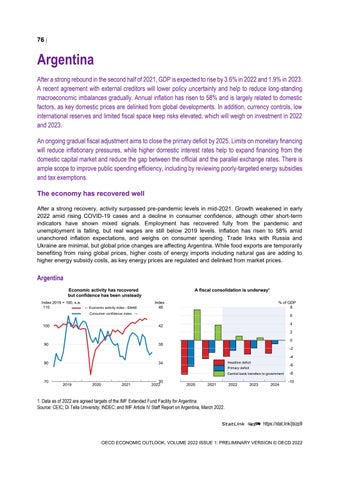
Argentina After a strong rebound in the second half of 2021, GDP is expected to rise by 3.6% in 2022 and 1.9% in 2023. A recent agreement with external creditors will lower policy uncertainty and help to reduce long-standing macroeconomic imbalances gradually. Annual inflation has risen to 58% and is largely related to domestic factors, as key domestic prices are delinked from global developments. In addition, currency controls, low international reserves and limited fiscal space keep risks elevated, which will weigh on investment in 2022 and 2023. An ongoing gradual fiscal adjustment aims to close the primary deficit by 2025. Limits on monetary financing will reduce inflationary pressures, while higher domestic interest rates help to expand financing from the domestic capital market and reduce the gap between the official and the parallel exchange rates. There is ample scope to improve public spending efficiency, including by reviewing poorly-targeted energy subsidies and tax exemptions. The economy has recovered well After a strong recovery, activity surpassed pre-pandemic levels in mid-2021. Growth weakened in early 2022 amid rising COVID-19 cases and a decline in consumer confidence, although other short-term indicators have shown mixed signals. Employment has recovered fully from the pandemic and unemployment is falling, but real wages are still below 2019 levels. Inflation has risen to 58% amid unanchored inflation expectations, and weighs on consumer spending. Trade links with Russia and Ukraine are minimal, but global price changes are affecting Argentina. While food exports are temporarily benefiting from rising global prices, higher costs of energy imports including natural gas are adding to higher energy subsidy costs, as key energy prices are regulated and delinked from market prices.
Argentina Economic activity has recovered but confidence has been unsteady Index 2019 = 100, s.a. 110
← Economic activity index - EMAE
A fiscal consolidation is underway¹ Index 46
% of GDP 8
Consumer confidence index →
100
6 4
42
2 90
38
80
34
0 -2 -4 Headline deficit
-6
Primary deficit Central bank transfers to government
70
2019
2020
2021
30 2022
0
2020
2021
2022
2023
2024
-8 -10
1. Data as of 2022 are agreed targets of the IMF Extended Fund Facility for Argentina. Source: CEIC; Di Tella University; INDEC; and IMF Article IV Staff Report on Argentina, March 2022. StatLink 2 https://stat.link/jbizp9
OECD ECONOMIC OUTLOOK, VOLUME 2022 ISSUE 1: PRELIMINARY VERSION © OECD 2022
77
Argentina: Demand, output and prices 2018
Argentina GDP at market prices Private consumption Government consumption Gross fixed capital formation Final domestic demand Stockbuilding¹ Total domestic demand Exports of goods and services Imports of goods and services Net exports¹
2019
2020
2021
2022
2023
Percentage changes, volume (2004 prices)
Current prices ARS billion
14 744.8 10 243.2 2 330.4 2 248.7
-2.0 -7.3 -1.2 -15.9
-9.9 -13.8 -3.3 -12.9
10.3 10.2 7.8 32.9
3.6 4.1 3.6 4.5
1.9 2.1 -0.4 1.8
14 822.4 200.9 15 023.4 2 128.7 2 407.2 - 278.6
-7.7 -0.7 -8.7 9.1 -19.0 4.4
-12.2 1.8 -10.1 -17.3 -17.9 -0.5
12.9 0.4 13.0 9.0 21.5 -1.4
4.1 0.3 4.2 7.4 9.8 -0.1
1.6 0.0 1.7 4.1 2.9 0.2
_ _ _
50.9 54.4 -0.6
39.9 40.4 0.7
54.1 48.8 1.4
51.4 60.1 1.0
43.1 50.6 1.0
Memorandum items GDP deflator Consumer price index Current account balance (% of GDP) 1. Contributions to changes in real GDP, actual amount in the first column. Source: OECD Economic Outlook 111 database.
StatLink 2 https://stat.link/uvf7e5
Gradual policy tightening will ease macroeconomic imbalances The recent agreement with the International Monetary Fund has reduced uncertainty about near-term macroeconomic policies. The headline fiscal deficit is set to decline by 0.5% of GDP in 2022, as part of an overall consolidation of 2.1% of GDP during 2022-24. Transfers from the central bank to the Treasury are set to decline by 2.7% of GDP in 2022, reducing one key source of inflationary pressures. Compliance with fiscal targets hinges on scaling back the 2.3% of GDP spent on energy subsidies in the Greater Buenos Aires area, where regulated retail prices paid by many households and small enterprises cover less than half of costs. As adjustments of most regulated prices have fallen short of inflation, rising import prices for natural gas are adding to subsidy expenditures. The monetary policy rate was raised five times in early 2022 and is set to rise further to ensure positive real interest rates, as shallow domestic financial markets will play an increasing role for financing the fiscal deficit. In the short run, ensuring continuous roll-over of domestic-currency debt will require the maintenance of strict currency controls, implying collateral damage for growth. Implementing the crawling peg exchange rate regime faces a difficult trade-off between preserving export competitiveness to ensure continuous trade surpluses and support reserve accumulation, and limiting inflationary pressures.
Growth is slowing in the near term amid significant risks The challenging domestic macroeconomic scenario will limit growth prospects in the short term without more ambitious reforms. High inflation weighs heavily on consumption and investment, and an escalation of inflation is a key risk as expectations lack a nominal anchor. Likely forthcoming adjustments of administered prices will add to inflationary pressures during 2022. Wage negotiations in key sectors are currently ongoing, but point to rising wage pressures and more-frequent adjustments in the future. Private consumption will remain subdued during 2022, before accelerating in 2023 as confidence in the macroeconomic stabilisation programme improves. Investment is likely to remain weak throughout both years as the macroeconomic backdrop remains fragile. Exports will remain solid amid high commodity
OECD ECONOMIC OUTLOOK, VOLUME 2022 ISSUE 1: PRELIMINARY VERSION © OECD 2022
78 prices, while currency restrictions continue to place severe limits on imports. Potential external shocks, including ones related to higher global prices and interest rates, could trigger a disorderly adjustment process involving stronger currency depreciation, spiralling inflation and a failure to comply with current fiscal targets. On the upside, stronger demand for Argentina’s exports could lead to stronger growth and currency inflows, reducing pressure on the exchange rate.
More ambitious reforms could reduce risks and strengthen growth A more front-loaded fiscal adjustment, mostly through improvements in public spending efficiency, would ease macroeconomic tensions and imbalances and reduce risks. By contrast, well-targeted social expenditures, in particular cash transfers to poor and vulnerable households, should be safeguarded or even expanded. Broadening tax bases, including in personal income taxes, and reviewing special tax and pension regimes could also improve fiscal outcomes and enhance fairness. Strengthening domestic and external competition and entrepreneurship through lower regulatory and trade barriers holds the key for raising productivity and innovation. Ongoing investments in oil and gas production will enhance energy security. Moreover, the dependence on fossil fuels could be reduced through more investment in hydroelectric sources, where only 20% of the generation potential is used, while wind and solar energy also hold strong potential in Argentina.
OECD ECONOMIC OUTLOOK, VOLUME 2022 ISSUE 1: PRELIMINARY VERSION © OECD 2022