





Due to social media and the desire to fit in, microtrends have become increasingly prevalent, their unsustainability causing irreparable damage to the environment.
BY SARA STUART
CCHS Arthropod Club President Copper Callahan’s fascination with insects has been a part of his identity ever since he was a toddler, a passion he hopes to pursue for the rest of his life.
BY PETER ATCHLEY, OLIVE FORRESTER, SARA STUART AND DAVID WANG
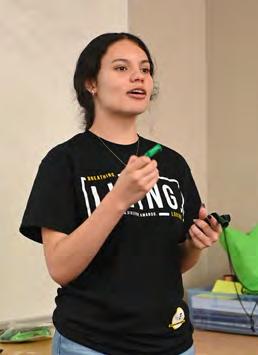
CCHS’ Hispanic organization Promoting education focuses on supporting Hispanic students with an inclusive environment and access to information on educational and service-related opportunities.
BY SASHA BARKAN
The world is continuously grappling with devastating tragedies surrounding violence, but taking real action requires actual change and uncomfortable conversations... a social media post should cover it.
BY EDIE ASH
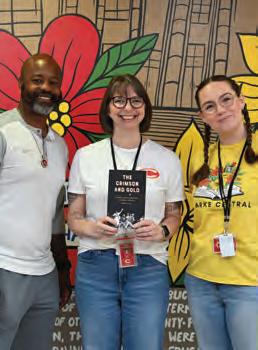
The CCHS media specialists are introducing a summer book club for student-athletes, who will read “The Crimson and Gold: Football and Integration in Athens, Georgia,” to celebrate the history of school integration in Athens.
BY KYE STREETMAN

Menu Editor Lydia Rowell reflects on the outlet reading has provided to her since childhood and how her relationship with books has fluctuated over time.
BY LYDIA ROWELL

British singer-songwriter RAYE released her second studio album “THIS MUSIC MAY CONTAIN HOPE.” on March 27, and presents a theatrical tone while delivering meaningful messages.
BY MERREN HINES
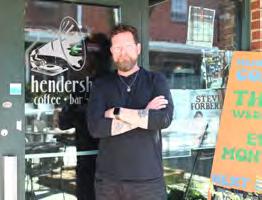
Hendershot’s owner and founder Seth Hendershot discusses his business’s impact on the Athens community and his decision to sell it after 15 years.
BY ADAH HAMMAN
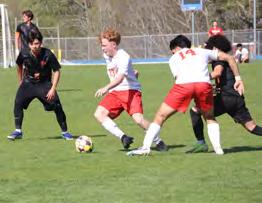
The CCHS boys and girls varsity soccer teams beat the Cedar Shoals High School boys and girls soccer teams with scores of 3-0 and 4-1, respectively, on March 21.
BY COOPER JONES AND MAYPOP WREN
The ODYSSEY is a studentproduced news publication, published with the intent to inform, entertain and give voice to the Clarke Central High School community, as well as to educate student journalists.
Established in 2003, the ODYSSEY is published four times a year, and each issue is an open public forum for student expression under the guidance of a faculty adviser.
Student journalists are provided with opportunities to investigate, inform, interpret and to evaluate: all traditionally accepted functions of the press in America. Published opinions do not necessarily reflect the views of anyone other than the staff.
The ODYSSEY staff is committed to reflect the mission statement set forth by Clarke Central High School. The goals of the staff are to provide fair, accurate news and commentaries, as well as to serve the interests of the school and Athens’ community.
Advertising must conform to the guidelines set forth for editorials. Publication of advertisements does not indicate an endorsement by CCHS or the ODYSSEY staff.
Students pictured in advertisements are not given monetary compensation. All advertising rates are available upon request from any ODYSSEY staff member.
The ODYSSEY is a member of the Columbia Scholastic Press Association, Georgia Scholastic Press Association, National Scholastic Press Association, Quill and Scroll Honor Society and Southern Interscholastic Press Association.
Corrections of errors and omissions will appear in the next issue.
Print Editor-in-Chief: Liza Larson
Digital Editor-in-Chief: Lea D’Angelo
Managing Editor: Peter Atchley
Senior Copy Editor: Cooper Jones
Viewpoints Editor: Isabella Gresham
News Editor: Emlyn McKinney
Variety Editor: Adah Hamman
Sports Editor: Liya Taylor
Photography Editor: Illiana Tejada
Business Manager: Merren Hines
Social Media Coordinator: Edie Ash
Beat Editor: Izzy Hammock
Menu Editor: Lydia Rowell
Outreach and Alumni Coordinator: Gillian Williams
Diversity and Representation Editor: Samaya Ellis
Staff Members: Abigail Holloway
Cesia Martinez
David Wang
Dream Freeman
Eloise Luken
Kye Streetman
Lucca Fleenor
Maypop Wren
Miriam Silk
Mzée Pavlić
Sara Stuart
Sasha Barkan
Adviser: David A. Ragsdale, CJE
ODYSSEY Newsmagazine
Clarke Central High School 350 S. Milledge Ave. Athens, Georgia 30605 (706)-357-5200 EXT. 17370
Our March 2026 issue featured a news story about the five candidates running in the Athens mayoral election.
Corrections/Omissions March 2026
Page 15, in “History down the street,” there should be a comma after “Oct. 25, 2016”
Page 26, in the “In Focus” caption, “‘you belong here’” should be “You belong here’”
Page 27, in “Authentically Adah,” in the caption, “Southeast” should be “U.S.”
Page 28, in “Athens sound,” there should be a space between “the” and “‘90s”
Page 29, in “Athens sound,” all instances of “REM” should be “R.E.M.”
Page 29, in “Athens sound,” in all instances of R.E.M. album and song titles, every word should be capitalized
Page 29, in “Athens sound,” “do it, if you hip-hop artists come up there and do it,” should be “do it. If you hip-hop, artists come up there and do it,”
Page 29, in “Athens sound,” “The 40 Watt, Flickr” should be “the 40 Watt Club, Flicker Theatre and Bar” Page 29, in “Athens sound,” all instances of “Nuci space” should be “Nuçi’s Space”
Page 30, in “Quest for Athens’ Best: Southern Scramble” in the deck, “White Tiger Deluxe” should be “The Farm Cart”
Page 30, in “Quest for Athens’ Best: Southern Scramble,” all instances of “The Farmcart” should be “The Farm Cart”
Pages 34 and 35, in “Roots to writing,” all first instances of “Memphis” should be “Memphis, Tenn.”
Page 36, in “Roots to writing,” “hat’s” should be “That’s”
Page 37, in “Roots to writing,” “‘World’s Largest Man’” should be “‘The World’s Largest Man’”
Page 39, in “Cultural buzz,” in blurb for “The Future Saints,” “deeep” should be “deep”
Page 40, in the “In Focus,” “Oconee County” should be “Oconee County High School”
Page 43, in “Leaping into Southern charm,” “. those” should be “. Those”
Page 44, in “Running past records,” the period in “football together. like brothers” should be omitted
Contact the ODYSSEY
T”his article is a wholesome and insightful look into Athens music and its history. I enjoyed the emphasis on how many different kinds of music and performance there are in Athens, and the mention of venues like Hendershots. Learning the history was interesting and articles like these are especially nice to read as an Athens local.
”– Anthony Gresham, CCHS Class of 2023 alumnus On “Athens sound” by Eloise Luken
Letters: Email us at editors@odysseynewsmagazine.net, or drop off in the Main Office, in care of the ODYSSEY. We ask that all letters be under 250 words and signed. We reserve the right to omit or edit any letters received. Insulting, unsigned or libelous statements will not be considered for publication. All letters may be edited for clarity and space.
Advertising: For ad rates email us at business@odysseynewsmagazine.net.
Online: Message us on Instagram at @odysseynewsmag.
FRESH VOICE // Singer Brinson
I think this volume’s “Fresh Voice” by Singer (Brinson) is so important and very relevant to things going on today. Many members of the LGBTQ+ community face so much discrimination, and while it shouldn’t be happening at all, it definitely shouldn’t be happening in a learning environment. I think this article brings attention to a serious problem and was a great feature!
AGAINST DISCRIMINATION // Lea D’Angelo
“Against Discrimination” brings light to an important issue and tells a real story of discrimination. I thought that Fannie Smith’s story was really impactful and was a great topic. The article is written well and displays a heartfelt story. With descriptive details and narrative writing, the article draws you in well and leaves you glad with the outcome. Utilizing only one quote makes it really impactful, making the article overall very well written.
– Easton Snipes, CCHS junior
AUTHENTICALLY ADAH // Adah Hamman
I enjoyed how the author of this article explained how detrimental AI can be to the environment. This story really opened my eyes to how AI is extremely dependent on data centers and the water and energy used by those data centers. I also liked the evidence the author used because it really showed me how extreme AI usage is.
– Adriana Ozuna, CCHS sophomore
LIYA’S LINEUP // Liya Taylor
I thought the article took a unique direction in understanding a phenomenon questioned by many in our community, and that the author made well-articulated and interesting points that allowed the audience to consider the topic in a positive way. The sources used were chosen and incorporated very well, as I believe they successfully contributed to the purpose of the article. Overall, I really enjoyed this read and learning about the ins and outs of how football contributes to our school and community.
– Basil Mattox CCHS senior
Lea D’Angelo discusses the current political climate in the U.S. and how events like the Holocaust must be learned from rather than replicated.

BY LEA D’ANGELO Digital Editor-in-Chief
People talk about history, the good, the bad and the ugly, so they can learn from it and so they don’t repeat it.
For decades, the horrors of the Holocaust and the Nazi Party’s rule in Germany during the 1930s and ‘40s have been retold, both for remembrance of people whose lives were wronged and deserve to be honored, and as a lesson. Every plaque, memorial and testimonial carries a reminder of what must not be repeated.
However, the lessons learned from the Holocaust and other genocides don’t quite seem to have sunk in.
The warnings of the millions of “unGerman” people, or those considered “undesirable” who were forced to leave Germany, the propaganda disparaging Jewish people and the torture the millions thrown in concentration camps, such as Auschwitz and Dachau went through.
unbiased portrayal of current events to taxpaying citizens.”
ICE does not equal Gestapo, the authoritarian police force in Germany during the Holocaust, and NPR losing funding does not equal Nazi-level propaganda, but the similarities point to a question of how far these actions can go before it becomes clear history hasn’t been internalized?
There are these faint similarities that suggest our government hasn’t learned from what seems like a glaringly obvious lesson. And then there are the stark resemblances that make it seem as though people are intentionally trying to apply the same hallmarks that defined the Holocaust.
During a rally celebrating Trump’s inauguration on Jan. 20, 2025, then-head of Department of Government Efficiency Elon Musk made a gesture that was widely interpreted as a Nazi salute.
Our government hasn’t learned from what seems like a glaringly obvious lesson.
All of that, and it still doesn’t quite seem like society has learned.
To say the political climate of the United States in recent years is equivalent to a mass genocide would be a dismissal of the horrors those impacted faced that many people can’t even begin to fathom. However, to claim resemblance between two points in time wouldn’t be too far off.
Mass deportations and government control on media outlets were both prominent issues of the Holocaust. Both warning signs, and in recent years, the U.S. has seen a rise in them.
Since U.S. President Donald Trump took office in January 2025, U.S. Immigration and Customs Enforcement has deported over 600,000 people.
In May 2025, Trump issued an executive order that cut funding to public news outlets NPR and PBS, claiming their coverage was not a “fair, accurate or
While the similarity could easily be written off as an act done in ignorance, the question remains the same: Has society not learned enough from a mass genocide to know not to make distinct references to the anti-semitic mottos and signs that defined it?
“We need to have a sharper eye and a sharper ear for (extremist) language, (and it) really boils down to the use of the language, and then those become actions,” Clarke Central High School English department teacher Meghan McNeeley, who teaches Holocaust and Genocide Studies, said. “There is a certain amount of hope, because (CCHS has) a class where I can help young minds understand the parallels and become more more critical consumers,”
So, as people living through what will one day become history, students need to look at their country’s current political climate, not to draw comparisons but to draw conclusions about what’s happening in the world. Students need to truly take in what they’re being taught, not simply as facts to memorize, but lessons to apply and truly learn from.
Rather than repeating what has already proven to not work, Americans need to form their own history.

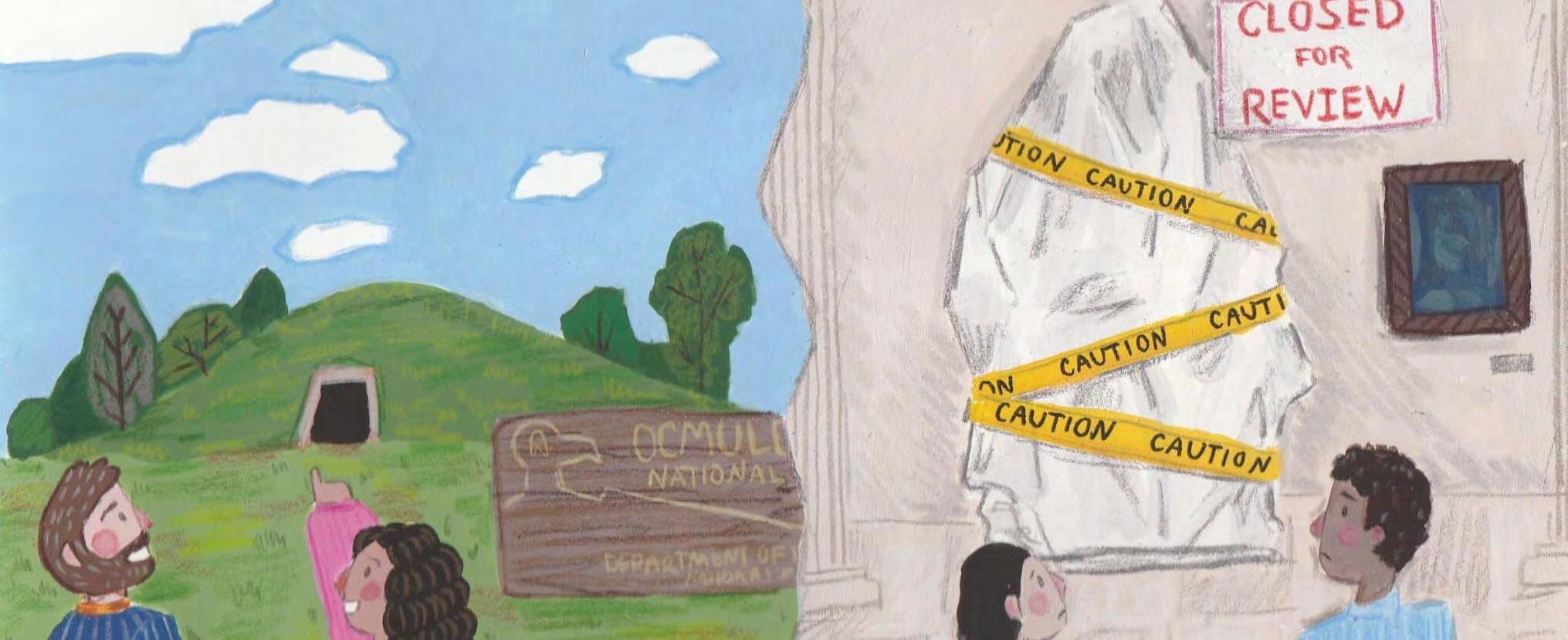
History is under attack as U.S. national parks lack legislative support and museums fight to keep themselves, and appreciative viewership, in good graces with the country.

BY PETER ATCHLEY Managing Editor
“He who controls the past controls the future. He who controls the present controls the past.”
This quote is from English author George Orwell’s dystopian novel “1984,” a story about a man fighting a government that controls history and truth, which mirrors real-life efforts to censor, obscure and revoke history in the United States’ national parks.
If history is sanitized or altered in textbooks and national parks, U.S. residents lose the full picture of the past that they deserve.
Such sanitization has already begun.
In February 2025, the U.S. National Park Service erased the word “transgender” and the name of LGBTQ+ activist Marsha P. Johnson from the Stonewall National Monument website to restrict the idea of “gender identity.”
years ago. Now, Tracie Revis, a Muscogee Nation citizen, and U.S. Sen. John Ossoff, D-Ga, are leading the charge to recognize this historical site as Georgia’s first National Park.
Legislation to name it as such has been stalled in the U.S. House of Representatives since 2024. A similar outcome has occurred to other pieces of protective legislation like the Protect Our Parks Act of 2025, which has been stalled in the House since December of 2025. This pattern begs the question, why is history going underappreciated?
To warp history for the sake of naive enjoyment enables ignorance.
In July 2025, signage dictating that land, such as the Yellowstone National Park, was originally inhabited by Native Americans was removed because they “disparaged Americans’ past.” On Jan. 13, the Smithsonian Institute was asked by the White House, under the Trump Administration, to review exhibits for “divisive narratives” that may create hostility within the country prior to display.
This “cleansing” of what can sometimes be a complex past is to make the past more palatable for the everyday tourist, who is strictly consuming history from the “patriotic” or “fun day-trip” view. But to warp history for the sake of naive enjoyment enables ignorance.
These parks are time capsules, but, without preservation or proper appreciation, places that honor history, especially indigenous history, will be forgotten to time.
Nearly 70 miles from Clarke Central High School is the Ocmulgee Mounds, a site featuring earthen mounds where Native American chiefs lived about 1,000
“We talk about queer histories, we talk about women’s histories, we talk about Native (American) histories, we talk about the history of reconstruction. We talk about things that are not only often absent (from textbooks), but often widely misunderstood,” University of Georgia Assistant Professor in the Department of Mathematics, Science and Social Studies Education Dr. Rebecca Geller said. “(Those topics) do require us to figure out where our own gaps in knowledge are. It’s an opportunity for us to learn something new.”
Ocmulgee is home to over 2.5 million recovered artifacts including jewelry and pottery as well as hundreds of unmapped and unprotected cultural sites.
These fragments of history will be erased if no one appreciates how valuable they are to understanding the world now. If someone doesn’t, or can’t because it’s been censored, learn from history, they are doomed to repeat it.
History like this can elevate one’s understanding of the community as a living classroom dedicated to the past. National parks should be protected above anything, because the historical value they hold is priceless.
To control the past, one has to first understand it. And to understand anything, its history must be recognized and analyzed.
Despite being written over 75 years ago, Orwell’s words were true then, and they’re true now.
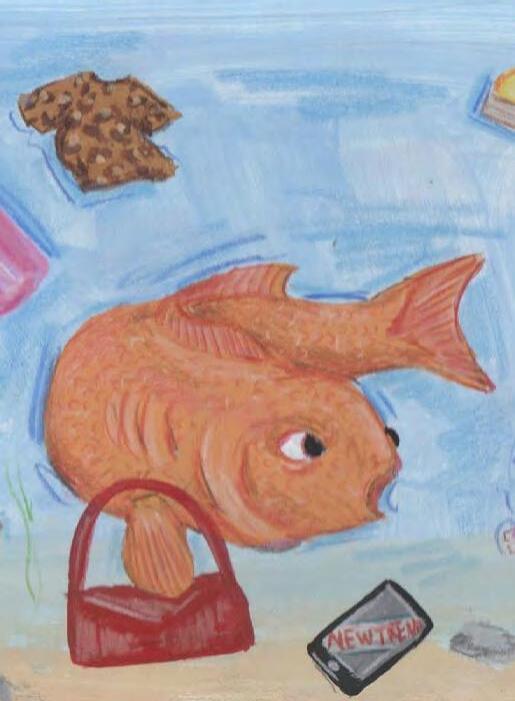
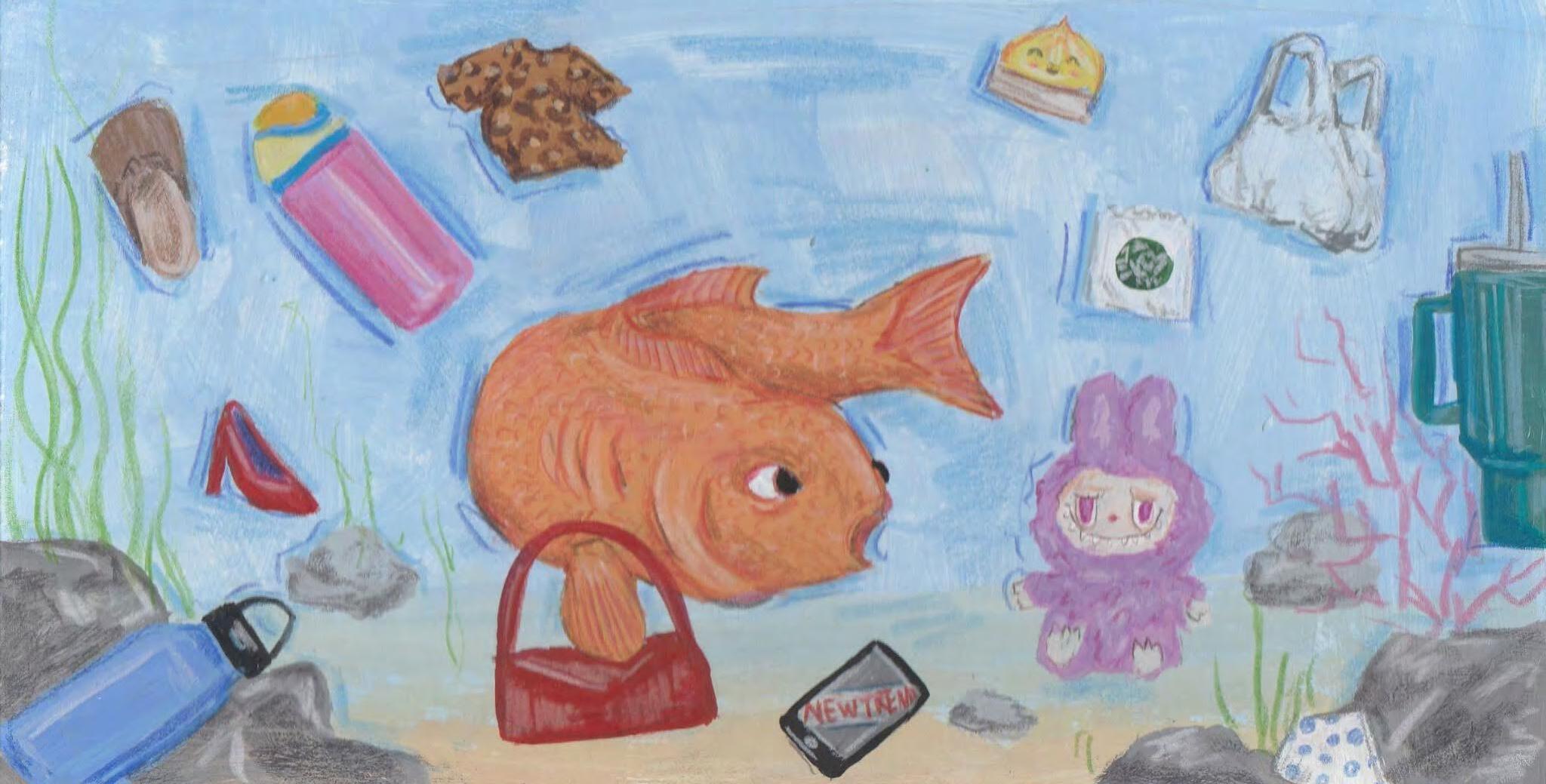
Due to social media and the desire to fit in, microtrends have become increasingly prevalent, their unsustainability causing irreparable damage to the environment.

BY SARA STUART Viewpoints Staffer
Practically every day, there’s a new trend that blows up all over social media.
Consumers will spend hundreds of dollars just to fit into the latest trends and collect each item that corresponds with them, just to throw the goods away in a few months and begin collecting something new.
For example, different water bottles have trended over the years, from Hydro Flasks to Stanleys to Owalas, quickly turning into a neverending cycle of what water bottle is the most “trendy.”
According to the Elton Bryson Stephens Company, which provides research databases, overconsumption is defined as the excessive use of materials to meet supply and demand of a certain trending item. Overconsumption has become more normalized due to social media platforms including Instagram and TikTok.
resources by burning more than the Earth can produce.
“Putting aside social responsibility (and) fiscal responsibility, you don’t need another Stanley water bottle if they’re built to last. Why are we getting one for every holiday? It’s contrary to its own marketing,” University of Georgia Associate Professor of Fashion Merchandising Monica Sklar said.
The rush of wanting a multitude of unnecessary toys has caused factories to make more trending items, like Labubus, to support the amount of demand. While this may be positive for corporations in terms of business success, overproduction causes even more damage by contributing to causing pollution.
According to a 2024 study from the nonprofit United Nations Environmental Program, if action against the rapid increase of overconsumption isn’t taken, natural resource usage could increase by 60% by 2060. This will then cause the Earth to be unable to replenish enough natural resources to catch up to the amount of materials consumed.
Rapid increase of natural resource usage results in speeding up climate change.
Social media influences overusage by creating “Fear Of Missing Out” when consumers don’t have the currently trending item. Due to social media’s influence, many stores like CVS and Target have sold out of popular squishy toys called “Nee Dohs.” The overconsumption of various toys makes it nearly impossible for others to get just one while other people get multiple, leading to a higher sense of urgency.
Shortly after a trend goes viral, it dies down. This overconsumption and trendhopping leads to the “trendy” items being thrown away in most cases, which can be extremely detrimental for the environment due to wasting natural
This rapid increase of natural resource usage results in speeding up climate change, pollution and long term water and energy loss.
Although overconsumption is something that won’t easily come to an end, more sustainable habits can be picked up. For example, instead of collecting reusable water bottles, consumers should use the same one until it’s no longer usable, and then recycle it. Additionally, instead of buying brand new unnecessary items from companies, second hand or local stores should be supported.
Following unsustainable trends should never become more important than protecting the environment.
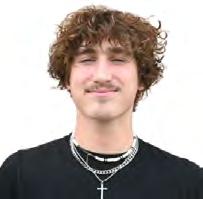
“Walkouts (are) good, because that’s the time where (students) could share our minds and (advocate for) freedom and rights. I think (walkouts are) a good thing to do.”
– ELENA HERNANDEZ, CCHS freshman
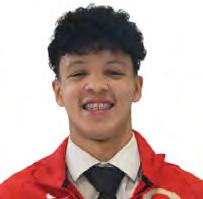
“I feel like a lot of people, at least at (Clarke Central High School), like to use (walkouts) as an excuse to get out of class. But, (walkouts) just show that the younger generation supports a movement or an action.”
– ASHER SHEPPARD, CCHS sophomore
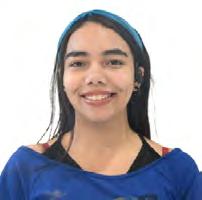
“Even though (students) try to (participate in walkouts) every time we (can to) show what (we’ve) got to say and show our opinion, I don’t think it has been effective because we haven’t seen any changes.”
– XAVIER REYES, CCHS junior
“Some walkouts are effective, like outside of the (CCHS) campus, but (CCHS’) walkouts are nonsense because who’s gonna see (students) protesting? Unless (the walkout’s posted) on social media, no one knows what we’re protesting about.”
– VYCKTORJA DAVIS, CCHS senior
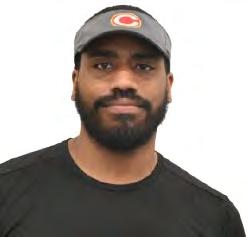
“I think (walkouts) are effective, but I also think they can be edited and changed to be more productive. (However), as students do (walkouts) more, they’re gonna get more comfortable and productive at it (and) get their message across.”
– JOSHUA DAWSON, CCHS physical education department teacher
Society has centralized academics to a point that is becoming dangerous to students’ wellbeing.
Did you know that being a teenager comes with great power? It’s not the ability to be responsible, to laze in bed all day or even to be able to drive. It’s the sudden ability that teenagers gain to be a kid and an adult all at once.
Maybe not literally. But the whiplash I feel when I’m signing up for summer camp one second and thinking about college opportunities the next is definitely real.
Growing up has gone from something that just happens to something we need to accomplish.
I can understand treating us like kids. All the “don’t-go-to-that-concertby-yourself” and the “make-sure-you-eat-your-vegetables.” But I don’t get the adult stuff, where we decide what we want to do for the rest of our lives when we’re 18 and stay up working until 1 a.m. because we’ve been taught that school assignments are more important than sleep. That stuff.
For a lot of teenagers, myself included, it feels like the ground is rushing up to meet us. That feeling may be expected for anyone growing up, but it definitely isn’t helped by school fast-tracking us into the “real world.”
Like when we get flyers for dual enrollment and Work-Based Learning and invitations for college tours before we’re even old enough to drive.
It seems like growing up has gone from something that just happens to something we need to accomplish, but it’s not and shouldn’t be. It wouldn’t hurt anyone, parents, teachers or kids, to remember that we’re still going to be young for a while.
Maybe we can just sit back and enjoy it.

Above: GREAT RESPONSIBILITY: An illustration shows a baby surrounded by papers and a computer, representing the stress that schools often put on students from an early age. Journalism I student Olivia Trimble reflected on how, in a world of rising academic pressure and falling college acceptance rates, students often face more challenges than they are ready for. “It seems like growing up has gone from something that just happens to something we need to accomplish, but it’s not and shouldn’t be. It wouldn’t hurt anyone, parents, teachers or kids, to remember that we’re still going to be young for a while,” Trimble wrote. Illustration by Tess van Wagtendonk

In January 2024, I became a German citizen even though I’ve never been to Germany.
After adjusting its Nationality Act in 2019 and in 2021, Germany began offering citizenship to descendants of individuals who lost their German citizenship between 1933 and 1945, particularly those forced to flee Nazi persecution.
Almost 90 years after my great-grandfather left the country in 1936, gaining a United States citizenship, and in doing so, “voluntarily” giving up his German one, my mom applied for citizenship for herself, my brother and me.
She described it as both an act of defiance and an act of forgiveness. Defiance against the history that pushed families like mine out and forgiveness toward a country attempting to make amends.
Legally, it was a simple collection of papers, documents and signatures. My mom had to show my great-grandfather’s German address, the date he left Germany and arrived in the U.S., birth certificates for the three of us, proof she had no criminal record and more. But the concept of identity has never felt that straightforward.
I never met my great-grandfather. I don’t speak German. I don’t know what German foods taste like or what the house he left behind looked like. When I first looked at my new passport, I didn’t suddenly feel European. Instead, I felt curious and unsure, and I realized a sense of belonging doesn’t come through something legal, like citizenship.
This summer, I will be visiting Germany for the first time. I don’t expect to feel at home in a place I’ve never been, but rather to feel like a visitor, since that’s what I am. Nonetheless, I also hope to feel something else: a connection to a history of mine that has always felt distant.
Being a German citizen doesn’t mean I have to claim a culture I don’t yet understand. Instead, maybe it just means that I have the opportunity to learn. My mom might see this passport as defiance and forgiveness, but for me, it’s a question mark that I can now begin to explore.

The ODYSSEY staff’s opinions on this month’s issues.

CCHS Arthropod Club
President and senior Copper Callahan’s fascination with insects transcends the classroom. It is apparent in every aspect of his life.
CCHS student athletes will participate in a required summer book club to educate them on CCHS’ history and integration story, a powerful and heartfelt sentiment.
University of Georgia track and field pole vaulter Alon Rogow has used his sport not only to find his strengths in pole vaulting but also in leadership by making his voice heard.
Relay for Life has allowed CCHS Multi-Classroom Leader and School Coordinator for Relay for Life Lawanna Knight to find a community to grieve and hope with, prompting her to aid the organization.

With a rise in microtrends, like Stanley Tumblers and Nee Dohs, due to social media, the environment is seeing a rapid increase in pollution from overconsumption.
Effective at the start of the 2026-27 school year, CCHS students will have to be a United States citizen or an eligible non-citizen to receive dual enrollment funding, a detriment to education equality.
The welfare of animals has been severely questioned in zoo exhibits in recent years, prompting public outcry and the need for more regulations to ensure the safety of animals.
The United States’ current political climate suggests that the U.S. government hasn’t learned from the history of the Holocaust and Nazi Germany, which must be checked.
The welfare of zoo animals should be prioritized over treating them like an exhibit or money-making opportunity, which the public must hold zoos accountable for.

BY ISABELLA GRESHAM Viewpoints Editor
Numerous people tune into their social media platforms to view Punch the Monkey, a baby Japanese macaque living at Ichikawa City Zoo in Japan, cuddling with a stuffed IKEA orangutan for comfort after being abandoned by his mother.
While this situation may be seemingly harmless, after Punch struggled to integrate into the surrounding group of monkeys, widespread calls for better care and safety of animals were all over the media, drawing attention to animal welfare in captivity.
Although zoos have been longstanding institutions and can provide opportunities for education and conservation, the animal cruelty exhibited in past cases proves that holding animals in captivity can rapidly become unethical because of the confined spaces they’re forced into, unnecessary exposure to humans and an inability to engage in natural behaviors.
cracks and doing more harm than good.
While in some cases, AZA-accredited zoos can provide necessary conservation efforts for endangered species, it becomes all too easy for welfare to be questioned in those that aren’t.
“If (an) animal is being treated within the high standards that (animal caretakers) set ourselves (to), and there’s some research that we’re getting information from that animal, or it’s a part of a conservation effort, I think (captivity is) justified,” University of Georgia Assistant Professor of Wildlife Habitat Management Dr. Marcelo Jorge said. “If the welfare degrades to too far of a point where that individual’s life is no longer better in captivity than in the wild, then that’s when you need to draw (the) line.”
Even with AZA guidelines set, captive animals are commonly forced into human interaction, in spite of them regularly showing signs of distress.
Human entertainment should never be prioritized over animal welfare.
This was seen at the Cincinnati Zoo on May 28, 2016, when Harambe, a silverback gorilla, was shot and killed rather than tranquilized after dragging a child who fell into his enclosure through water. Earlier, on Feb. 9, 2014, Marius, a giraffe housed in Copenhagen Zoo in Denmark, though healthy, was euthanized because his genes were unsuitable for captive breeding. These are just a few cases in a long pattern of cruelty.
In an attempt to limit cases like these, the Association of Zoos and Aquariums outlines ethical guidelines for exhibits, such as providing natural habitats, behavioral enrichment and high-quality veterinary care for animals. AZA-accredited zoos have to follow these rules, which are enforced by requiring institutions to reapply for accreditation every five years, but the process to do so is expensive, leading to many underfunded displays slipping through the
Despite efforts by the animal rights organization People for the Ethical Treatment of Animals, according to its website, at Oswald’s Bear Ranch in Luce County, Michigan, visitors can pay $10 to take a picture with a bear cub, exploiting the animals and forcing them into unnatural interactions. An article by PETA published on Aug. 29, 2018, describes these bear cubs as being severely distressed, pacing and crying after being separated from their mothers for these photos. Nonetheless, the exhibit is still open today.
Instead of using zoos to capitalize on animals’ lives, such attractions should be shut down. Additionally, attention should be brought to enclosures that display poor animal welfare. It is crucial for zoos to follow ethical guidelines, and if the public notices they are not, that should be highlighted.
Human entertainment should never be prioritized over animal welfare. Proper care and welfare should be at the forefront, and it is up to the public to ensure that.
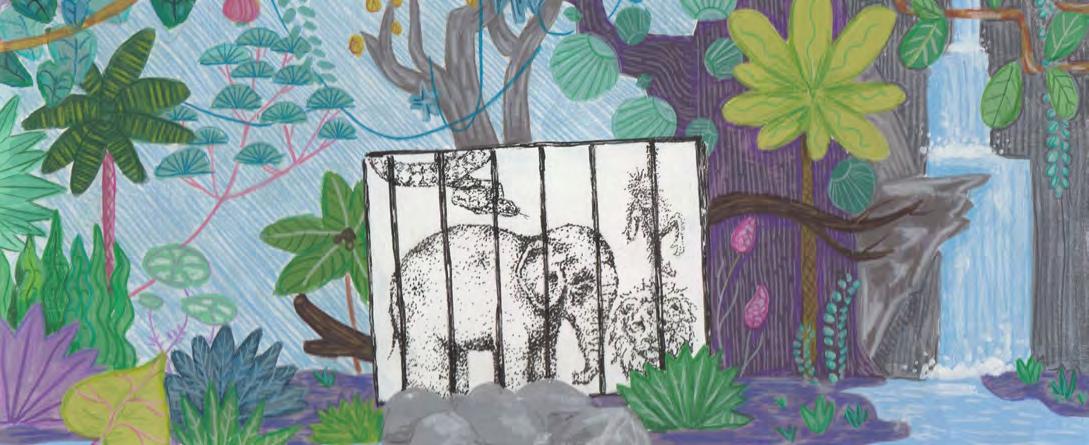
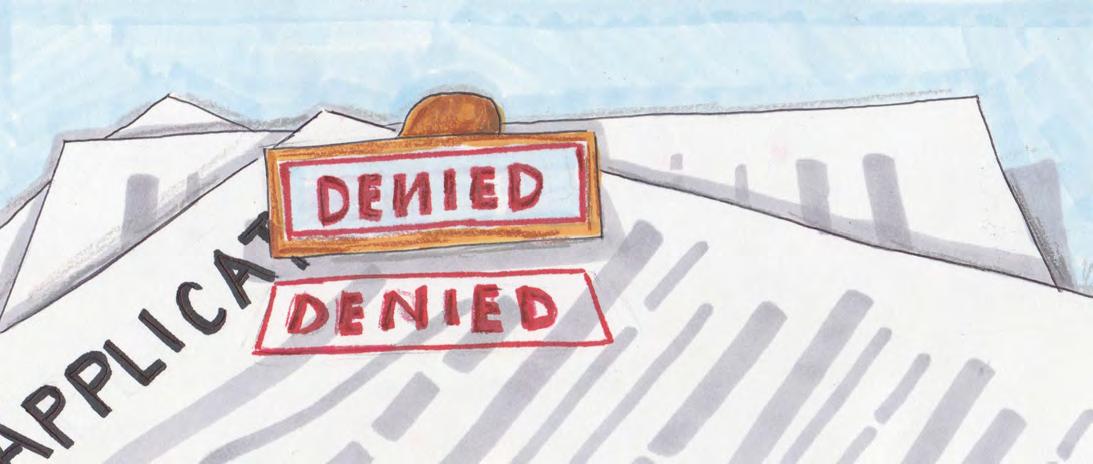
To participate in dual enrollment for the 2026-27 school year, a new law requires students to meet U.S. citizenship or eligible non-citizenship requirements, a discriminatory policy that diminishes opportunities for many students.
Everyone deserves equal access to education. This is a statement that shouldn’t prompt disagreement, but a new law: GA House Bill 18, or the Dual Enrollment Act. Effective fiscal year 2027, has managed to do just that. The law requires dual enrollment students to meet the United States citizenship or eligible non-citizenship requirements in order to be eligible for the Dual Enrollment Funding Program, according to Georgia Futures.
Isolating students from both collegiate opportunities and from their peers does more harm than any good the policy may create.
The U.S. Department of Education states students must either be a U.S. citizen, a lawful permanent resident or hold official “eligible noncitizen” status according to Federal Title IV Regulations, which govern student aid.
Clarke Central High School currently offers dual enrollment through five colleges and universities: Athens Technical College, Piedmont University, University of North Georgia, University of Georgia and Georgia Institute of Technology Distance Math and Distance Computer Science programs. But these opportunities are insignificant if they are not accessible to all CCHS students.
Dual enrollment previously allowed equitable opportunities for high school students to earn college credit at no cost, something vital for Title I schools like CCHS, where funding is an obstacle for many students. Diminishing these opportunities will likely lower postsecondary education enrollment, undoing earlier progress.
According to the Georgia Student Finance Commission, 70% of dual enrollment students who graduated between 2019 to 2024 enrolled in a HOPEeligible postsecondary institution within a year of high school graduation, in comparison to 45% of non-dual enrollment students.
Dual enrollment proves to be an essential component to furthering education and workforce preparation, but despite this, an ample number of students will be cut from accessing these programs. Implementing GA HB18 will harm affected students in their future endeavors and alienate them from a sense of belonging within the public school system.
These opportunities are insignificant if they are not accessible to all CCHS students.
“I think (the law) is a detriment to our students. I think that all of our students should have the opportunity to further their education if that’s what they choose to do,” CCHS Assistant Principal Alexis Scott said.
Increasing limitations for students to reach higher education during high school does nothing but disadvantage undocumented students and potentially those who are lawfully present, including asylum seekers, individuals with Temporary Protected Status and Deferred Action for Childhood Arrivals, which protects undocumented minors who came to the U.S. as children from deportation.
“(GA HB18) directly hits the core values of American society by depriving (students) of one part of public education.This law does not fit into the framework of what public education is supposed to be,” Athens immigration attorney Sujata Gupta Winfield said. “(This policy) sends a very negative (message to students). It says that they’re good enough for high school, but not good enough for anything further. We don’t want to build a society of people who are excluded from (opportunities).”
Diminishing the important educational programs already in place in an attempt to reduce funding and align with consistently strict and unfair immigration policies is unprincipled. Equitable access to higher education should be prioritized, not pushed to the side.
No student deserves to be unable to participate in dual enrollment because of their residency status.

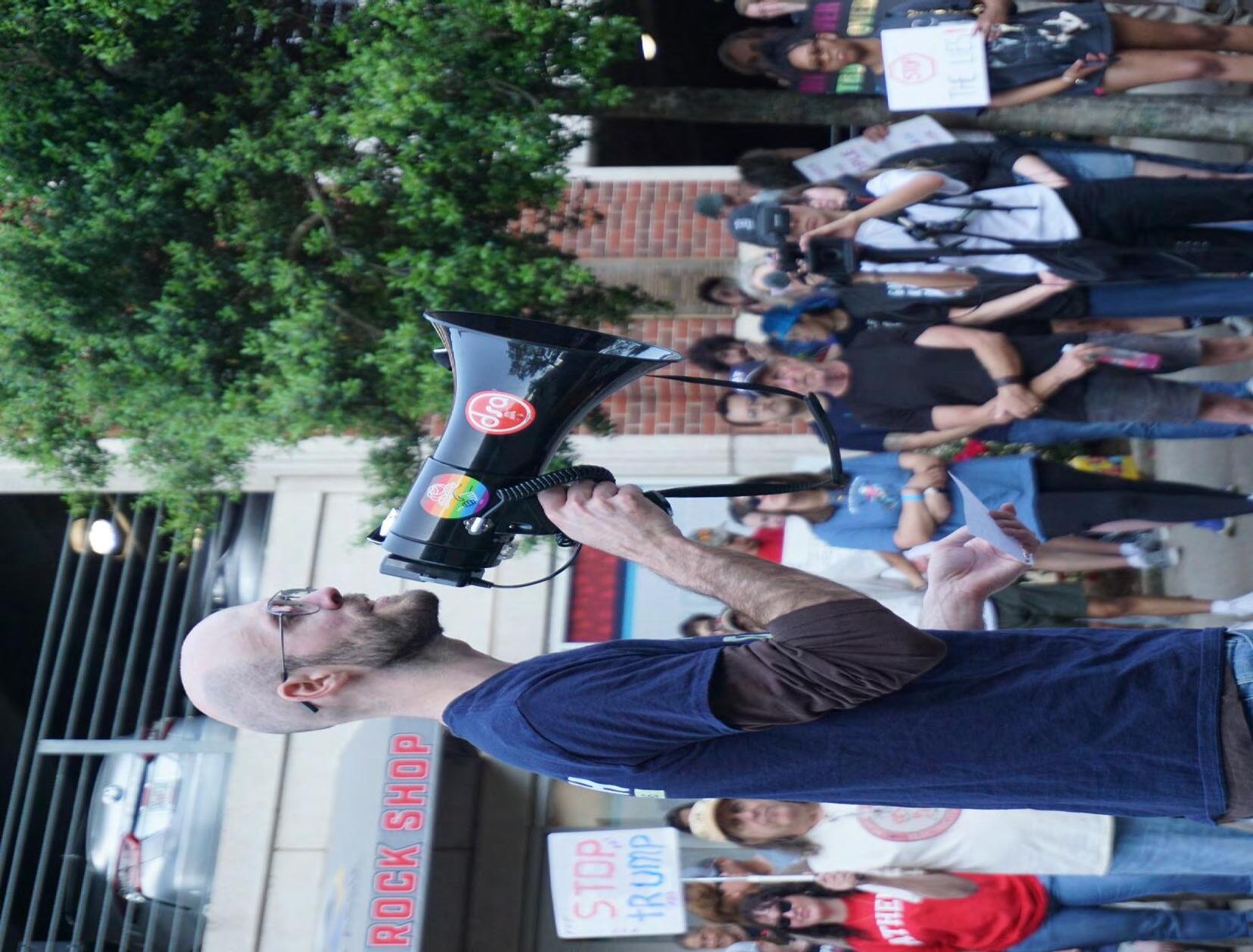
Featured: SPEAKING UP: Second Chair of the Oconee County Democrats Society Ray Smith, who is running for Georgia Senate in District 46, speaks at a protest against the Turning Point U.S.A. campus tour at Akins Ford Arena at the Classic Center featuring United States Vice President J.D. Vance on April 14. The protest, planned by University of Georgia sophomore Aspen David, was attended by both UGA students and Athens community members. “The current administration has gone too far. It’s so important that (community members) show up and we make our voices heard. That’s what the First Amendment is all about,” Smith said. Photo by
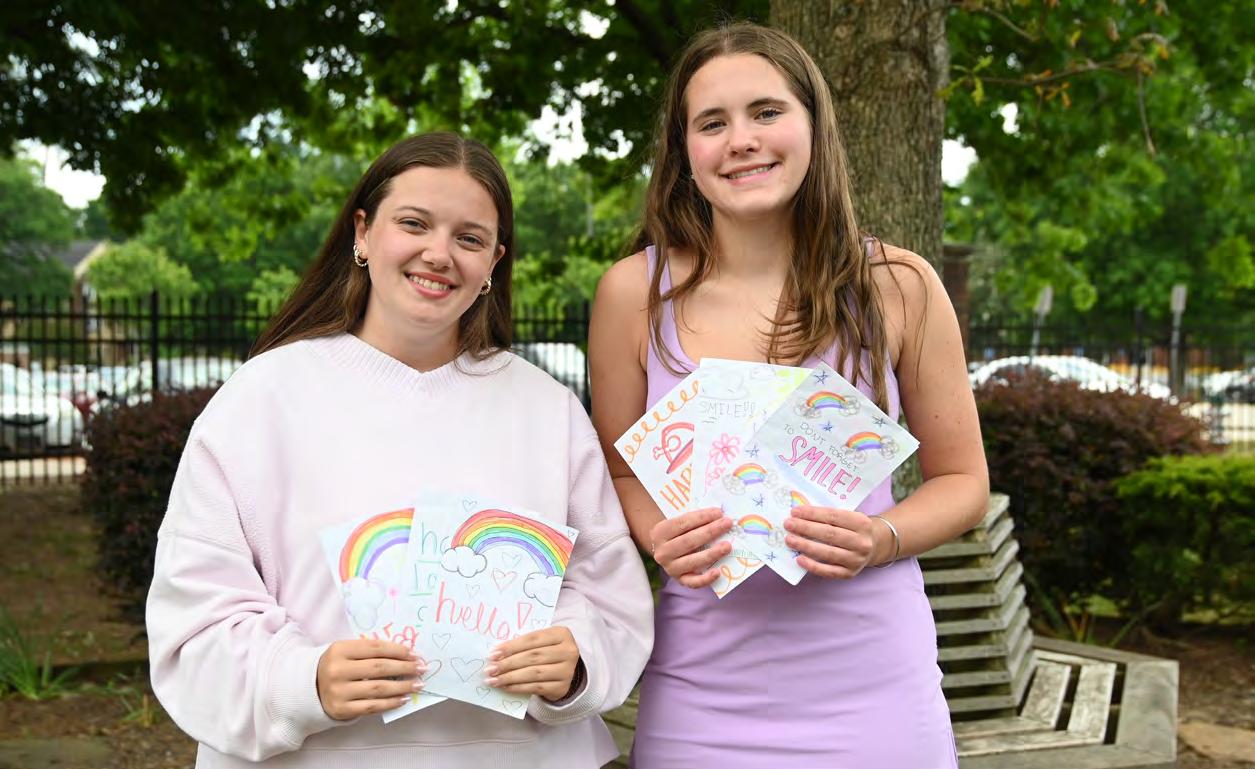
Since the start of the 2025-26 school year, CCHS’ Supporting Senior Citizens Club has aided Athens-Clarke County elders through fundraisers and volunteer work.
Raising money for and volunteering in support of Athens-Clarke County elders are just a couple of the activities that the Clarke Central High School Supporting Senior Citizens Club engages in.
SSCC founder and President Mary Wicker, a junior, launched the club at the beginning of the 2025-26 school year out of a desire to support ACC’s elderly community, beginning with those close to her.
“I was named after my great-grandma, Mary Wicker, and I adored her. I would spend time with her all the time,” Wicker said. “I love hearing (the elderly’s) stories and their life experiences, (but) also (because) they can be lonely if they don’t live by their family or if their spouse died, so I like spending time with them.”
After asking CCHS English department co-chair Meghan McNeeley to sponsor the club, Wicker began holding club meetings on Thursdays before school in McNeeley’s room. The meetings regularly involve brainstorming ideas for volunteering and holding various workshops.
Wicker also conducted research on organizations and senior citizen homes SSCC could connect with, such as the Athens Community Council on Aging
(ACCA) and Lanier Gardens, an apartment community located at 801 Riverhill Drive, respectively.
“I love hearing (the elderly’s) stories and their life experiences,so I like spending time with them.”
– Mary Wicker,
CCHS Supporting Senior Citizens Club President and founder
“I know (Wicker is) a doer, and she has a big heart, so whatever she wanted (when starting the club), I (said), ‘Yeah, let’s go,’ and that was it,” McNeeley said. “This is her brainchild. (SSCC) is everything (to) her.”
In the early stages of the club, Wicker decided on having an Executive Board of six members to run it. The board consisted of those who were most active within SSCC, including SSCC Vice President and Event Planner Izzy Grogan, a junior, who works with organizations and prioritizes community outreach.
So far, Grogan has set up a percentage night with Chick-fil-A’s Beechwood location on Nov. 11, 2025, where the restaurant donated 10% of its sales to SSCC, and helped with Trunk or Treat in the CCHS Bus Loop on Oct. 28, 2025 as a way to connect with the Athens community.
“My favorite part (of SSCC) is being able to (work) with everybody in the club. (I enjoy bouncing) ideas off of each other and (being) able to put (the ideas) into action,” Grogan said. “We’re trying to raise money for different senior homes. My grandma’s in (Lanier Gardens), and we’re working on volunteering there. (SSCC is) a good cause (and) a great thing to be a part of.”
senior citizens.
“The letters were (a) great way to tell (ACCA’s) Meals on Wheels clients that someone’s thinking of them. Somebody really devoted (took the) time to (write) this letter and (is) improving their social connection (so they can) feel better about their network in their community,” Schley said. “(The clients) were so happy to see (the letters). It just brightens their day in a really neat way.”
As a larger project, SSCC is working on organizing a yard sale fundraiser that would be held in the CCHS Bus Loop, but it is currently awaiting approval as of April 22. Athens community members would buy a slot from SSCC to sell their chosen goods, with the total revenue they make being donated to ACCA.
“I just know (Wicker’s) a doer, and she has a big heart, so whatever she wanted, I (said), ‘Yeah, let’s go,’ and that was it.”
– Meghan McNeeley, CCHS Supporting Senior Citizens Club sponsor
SSCC has been able to assist senior citizens while still operating within the walls of CCHS. For example, the club asked CCHS students to submit letters addressed to ACC senior citizens from Oct. 7-18, 2025, which Wicker brought to the ACCA to distribute to Meals on Wheels clients.
“I was inspired by Letters Against Isolation, which is a (United Statesbased) nonprofit. I wanted to do something like that, where (SSCC makes) letters and (sends) them to different places, letting the people at (senior) homes know that people are thinking of them,” Wicker said. “Some (students) put their favorite quotes, told them about their day and asked questions, just letting (the senior citizens) know that we’re thinking of them and they’re loved.”
To set up the distribution of the letters, Wicker reached out to ACCA Volunteer Coordinator Ezra Schley and brought the letter-writing idea to him. Schley then brought meals, along with the letters, to homebound
Additionally, SSCC Executive Board members held two clay workshops using the funds they earned from the percentage night for materials, with one on Jan. 29 and a second on Feb. 6. The clay trinkets they made will also be sold at the yard sale.
“(The yard sale) could be like Trunk or Treat, a sustained (event), (where) you have it every year (and) the community comes out,” McNeeley said. “(It’s) important (for SSCC) to incorporate (Clarke) Central as well as the (Athens) community. A lot of times with seniors, they are on very limited incomes, (so SSCC) could let them come shop at the yard sale and get a discount.”
The club is hoping to extend its community outreach with posters around CCHS and on Instagram as a way to gain traction for the yard sale and for the club to continue after the current Executive Board members graduate at the end of the 2026-27 school year.
“I’m hoping I can go through with a lot of different events (because) it feels good to follow through with them,” Grogan said. “I am hoping that this club stays in Clarke Central and shows people that (it is) a good cause, and it’s something that we should all work towards: supporting the seniors in our community because a lot of them don’t have family who come to visit them all the time.”
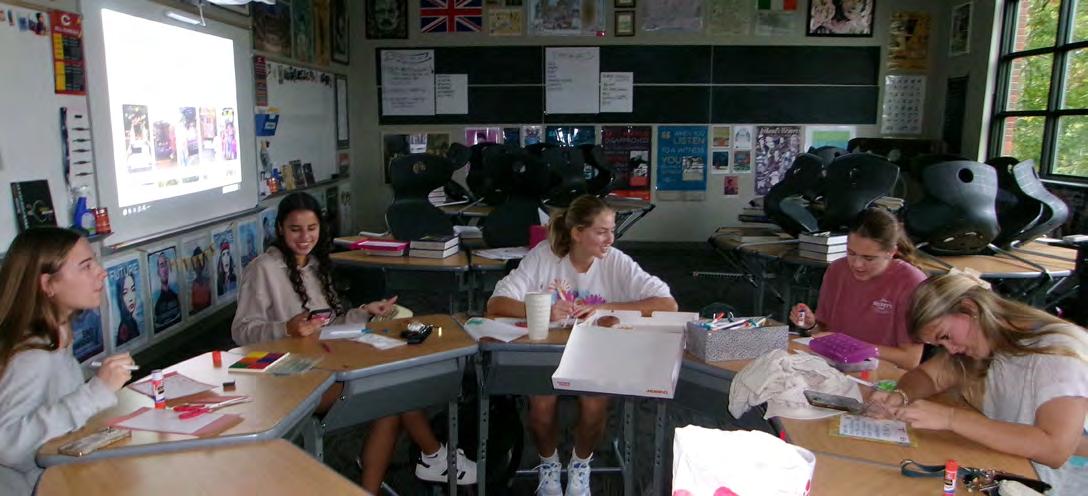

CCHS students involve themselves in politics through studentorganized walkouts, protests and advocacy.

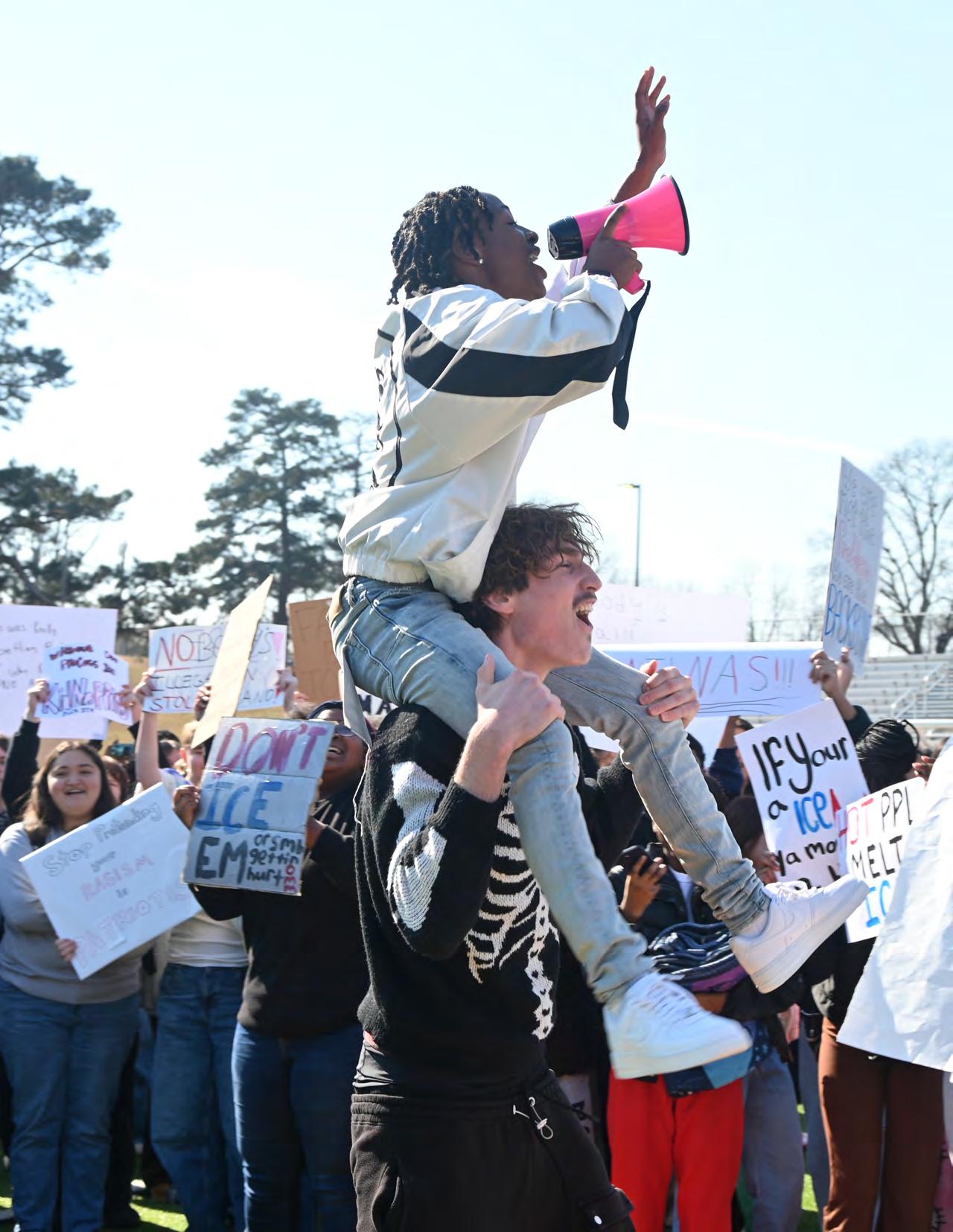
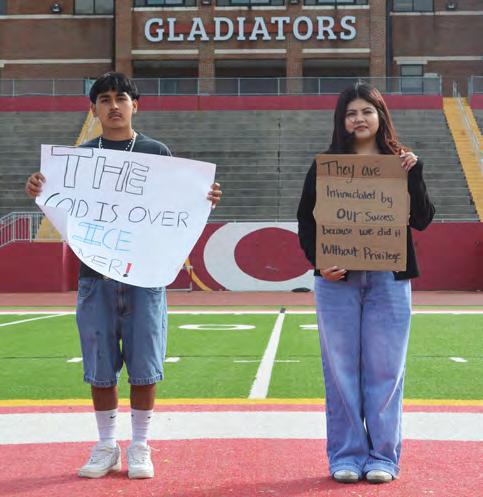
Featured: CREATING CHANGE: Clarke Central High School students protest at a walkout against United States Immigration and Customs Enforcement on Jan. 30 in
Stadium. CCHS freshman Luis Jimenez participated in and spoke at the Jan. 30 walkout, and believed that the students’ voices were heard. “I think (protesting) does change a lot of people’s minds, because before that walkout, people weren’t talking much about it, and then after, we had a lot of people speaking about it (and) people posting about it,” Jimenez said. Photo by
It’s no new concept for young people to be politically active.
From the Civil Rights Movement and protests against the Vietnam War in the 1950s and ‘60s to 21st-century Black Lives Matter and anti-gun violence walkouts, high school and college-aged citizens have a history of voicing their opinions, and those voices are only growing.
According to a 2024 survey by the United Way of the National Capital Area, a nonprofit research organization based in Washington, D.C., youth participation in demonstrations, such as protests and demonstrations, rose from 5% in 2016 to 27% in 2020, and engagement has continued since.
ICE walkout at CCHS, held Jan. 30.
“Seeing everything going on around the world and then having family members going through the same thing (inspired me to become an activist),” Jimenez said. “Seeing that really made a big change in my life, and then I started speaking about (issues I care about) and making it known to people that aren’t as informed.”
“It’s vitally important for students, when they see injustice, to make sure that (their) voice is heard.”
“I sense that (increased youth activism) has to do with overlapping, intense crises that are unfolding as children grow into adolescence and early adulthood,” University of Georgia Professor of Social Studies Education Jim Garrett said. “It’s concurrent with a media landscape where everybody has way more access to various kinds of news and information than we ever had before. Young people (who are) growing up now are much more exposed to what’s happening around them.”
Clarke Central High School students have become one such example of this rise in student activism. CCHS freshman Luis Jimenez has taken a stand on topics that affect him and his family’s security, like issues relating to the United States Immigration and Customs Enforcement. For some young people who are ineligible to vote, like Jimenez, these issues are impossible to ignore, which led him to speak out at a recent
Students have organized two walkouts during the 2025-26 school year: one against gun violence on Sept. 5, 2025 and one against ICE on Jan. 30. But, those aren’t the only forms of activism that have been shown at CCHS.

– Dr. SWADE HUFF, CCHS Principal
“One thing that I like (at CCHS, during) the Black Lives Matter protest right after (the COVID-19 pandemic) and the one (CCHS) had (about) ICE, (was) how passionate the kids were,” CCHS Assistant Principal Everett Nealy said. “They didn’t have to be Black. They didn’t have to be threatened by ICE, but they were still passionately vocalizing their support of those groups.”
Although several student-organized walkouts at CCHS have been used by students to miss class and socialize, the ICE walkout, according to CCHS Principal Dr. Swade Huff, was taken more seriously by students than previous student-led walkouts. For each walkout, the CCHS Administrative Team has set guidelines, including a designated time frame and location for students to protest peacefully.
“School pride was definitely on display in support of those who are being mistreated in (the U.S.),” Huff said. “It’s vitally important for students, when they see injustice, to make sure that (their) voice is heard. I was proud, not just as a (CCHS Class of 1991 alumnus), but as an administrator and parent.”
Despite Huff’s support of First Amendment rights, there was some online backlash against students walking out of class. On the ODYSSEY Media Group’s Jan. 31 Facebook post covering the walkout, community members left comments like, “End federal funding of this school,” and, “The school needs to be teaching the classes the children are there for, not pushing liberal ideology.”
However, for students like CCHS junior Kate Hinger, who has participated in multiple walkouts at CCHS, it’s important to emphasize advocating for topics that not only currently apply to students currently, but also those that will in the future.
“If (students) are putting something above our education, then that is showing the importance (of the topic),” Hinger said. “If you’re arguing that the reason we shouldn’t have walkouts is because we’re missing class, (you’re) missing the point. The point is that we are learning
has seen many walkouts during his tenure as principal and views
activism as a benefit to the CCHS community. “In order for a change to really take place, then you have to use your voice to speak out against what’s going on in this country,” Huff said. “I do appreciate the fact that there is a student voice here at Clarke Central High School. There’s a level of bravery, there’s some lack of respect (towards adults), but I think that’s a good thing. Living in the past does not allow us to move forward.”



and we are aware, and that’s why we’re walking out.”
According to a January 2026 article from the Harvard University John F. Kennedy School of Government, protests with extensive youth involvement are over twice as likely to succeed as protests without. For Jimenez, this serves as encouragement to speak out against issues.
“(Youth activism) can make it more known to people that have authority and power to see that (social issues are) not just a thing around grown-ups, but it also affects younger people,” Jimenez said.
Though the majority of CCHS students are ineligible to vote, they can participate in politics by expressing their opinions and organizing demonstrations.
“Don’t be scared. Don’t hesitate. If you even have the slightest thought of doing a protest (or) speaking out, do it,” CCHS senior
Hernandez, who helped organize the ICE walkout, said. “There’s going to be people standing by you, and there’s going to be many people who are against you. But, if you even have one person behind you, you know that you are seen (and) you know that you are heard.”
“Don’t be scared. Don’t hesitate. If you even have the slightest thought of doing a protest (or) speaking out, do it.”
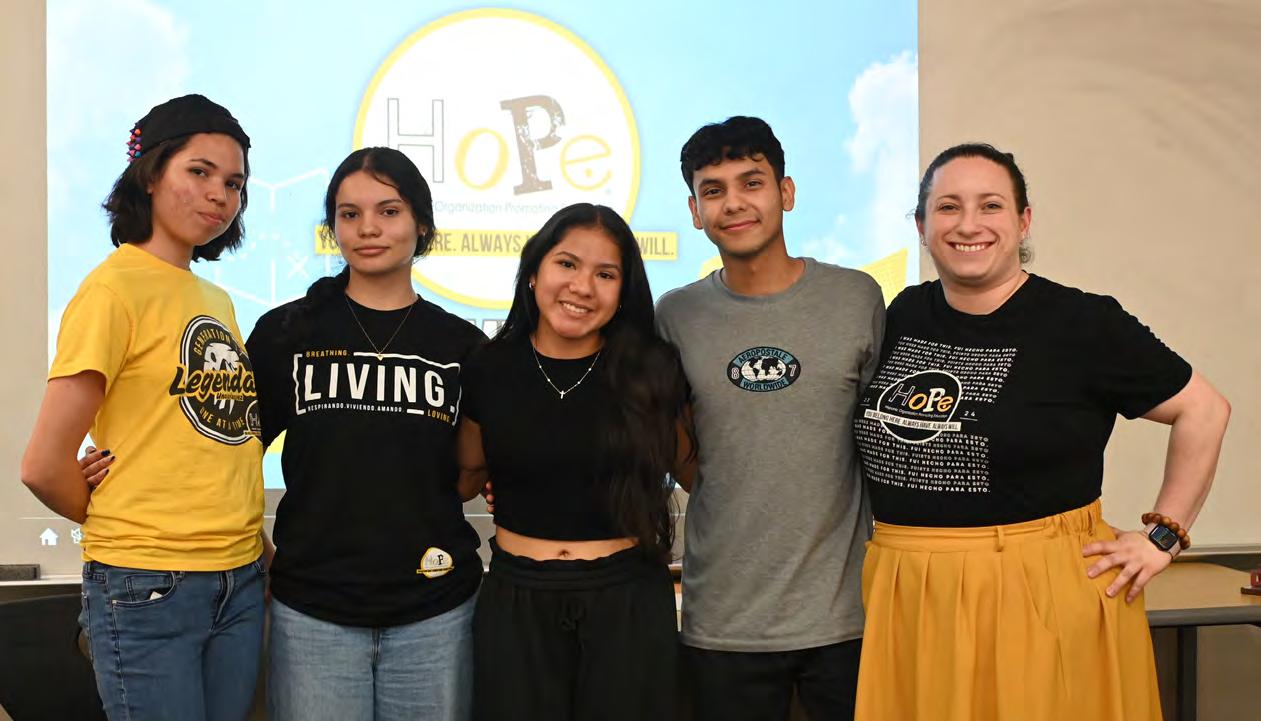
CCHS’ Hispanic organization Promoting education supports Hispanic students with inclusivity and access to information on educational and service-related opportunities.
AClarke Central High School student walks into a Hispanic organization Promoting education meeting in Room 242. They are greeted with smiles, pupusas and the blasting tones of “SONRIELE” by Daddy Yankee before settling into the variety of activities that HoPe facilitates.
HoPe is a national organization seeking to empower Hispanic students with leadership and academic skillsets as well as educational and service opportunities. At CCHS, the club is led by a president and three vice presidents, all of whom are known as Legacy Leaders. At meetings, these Legacy Leaders deliver a slideshow presentation showcasing upcoming service or academic scholarship opportunities to the approximately 30 club members in attendance.
for Speakers of Other Languages department teacher, said. “(Legacy Leaders) provide a lot of information and support when it comes to scholarships. (HoPe) serves as a way for like-minded Latino students to support each other and build community.”
“I wanted to create a place (with HoPe) where members could forget about anything else that they’re worried about.”
“(HoPe’s) goal is to support Hispanic and Latino students in high school and beyond, especially when it comes to finding leadership opportunities (and) doing community service,” HoPe sponsor Carrie Emerson, a CCHS English
To build such a community, HoPe club members engage in a variety of moralbuilding activities and ice-breaker games, such as scavenger hunts and timed challenges, at meetings. HoPe President Kamila Duran, a senior, incorporated these activities at the beginnijng of the 2025-26 school year to promote inclusivity.
– Kamila Duran, CCHS HoPe President and senior
“I used to go (to HoPe) as a member and the Legacy Leaders at the time were not very involved with the members. I was like, ‘When it’s my turn to be president, I want to make sure I connect with every single person and make sure that everyone feels included,’” Duran said. “I wanted to create a place where members could forget about anything else that they’re worried about.”
While HoPe’s primary focus is on student support, the club also facilitates
“La Noche de HoPe,” each fall semester, where students’ families can learn about subjects like Georgia graduation requirements, the Federal Application for Student Aid and post-secondary education in Spanish.
“When I came (CCHS as a freshman), I had to do everything by myself, (like) figure out scholarships (or) how to get leadership roles,”
CCHS HoPe Vice President of Education Lilith Zerpa, a senior, said. “Your (Spanish-speaking) parents cannot do your homework (if it) is in English. (HoPe tries) to connect not just with the students, but with the parents (so) that they know that their children have something they can rely on.”
“(HoPe tries) to connect not just with the students, but with the parents (so) that they know that their children have something they can rely on.”
HoPe), and they don’t have to speak English to connect with nobody. They can easily talk with us (with) no barriers,” Zerpa said. “When I was trying to learn English my freshman year, I didn’t have that kind of club, but I imagine myself feeling safe in HoPe if the club was around by that time.”
– Lilith Zerpa, CCHS senior and HoPe Vice President of Education
This language-based inclusivity is implemented in club meetings, as well, in which Legacy Leaders translate the presentation into Spanish for any club members who may need it.
“It’s easier to connect with people in your language. (Members) can go (to
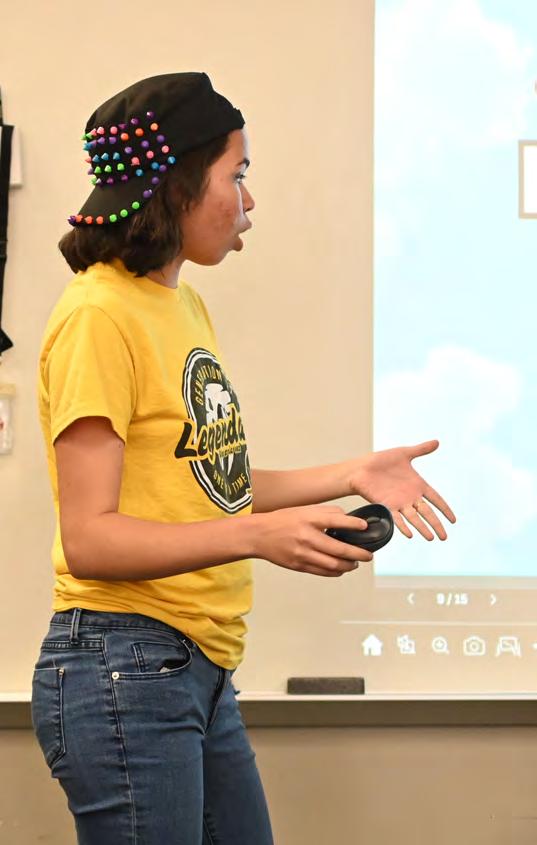
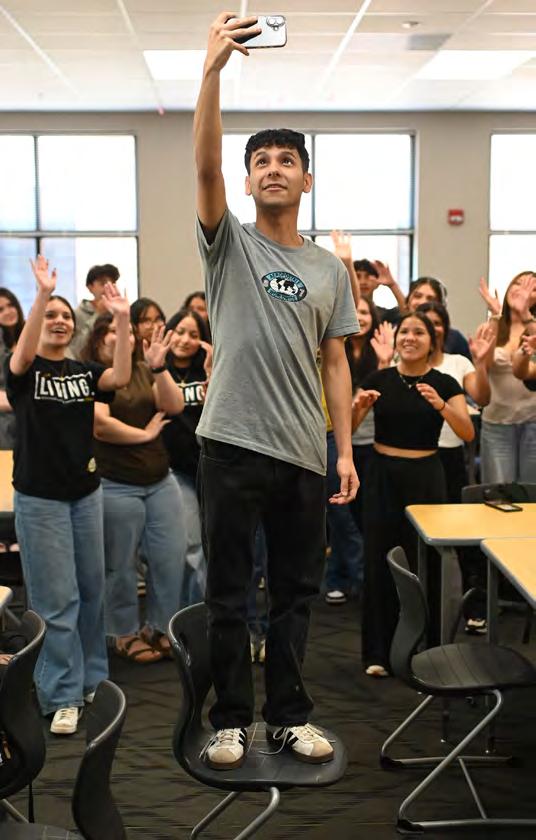
With three of its four Legacy Leaders graduating in May, HoPe will be under the helm of new leadership. Regardless, the club aspires to continue to fulfill its mission of supporting the next generation of Hispanic youth serve, lead and thrive in their communities.
“(HoPe) wants to help the Hispanic community become leaders and be whatever they want to be,” CCHS HoPe Vice President of Marketing Gabriel
Davila, a senior, said. “(HoPe wants to) help (members) grow that leadership spirit, inspire them to do something great in their community and provide them with the resources they need so they can be someone out (in the world).”
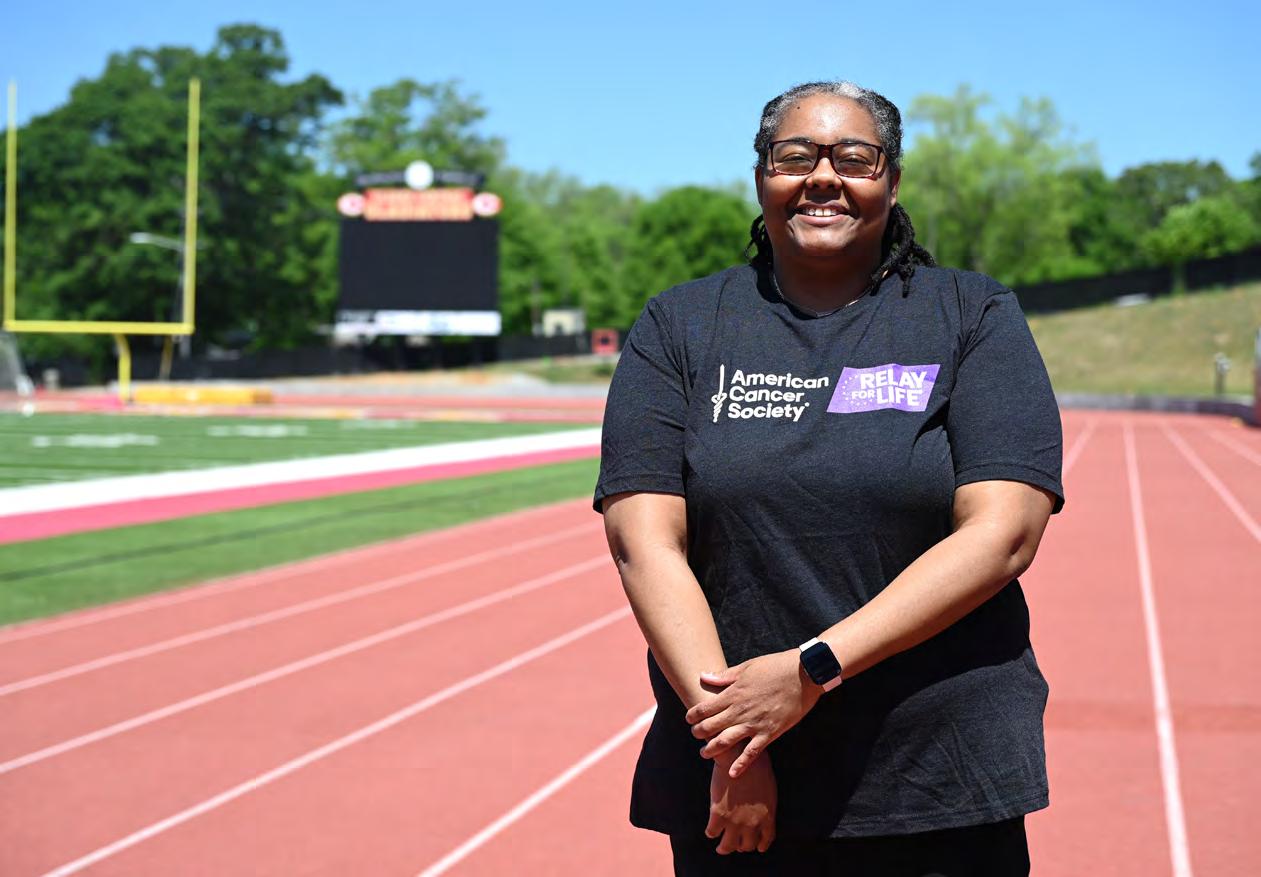
CCHS Multi-Classroom Leader and School Coordinator for Relay for Life Lawanna Knight discusses the Relay For Life fundraiser and how it has impacted her.
STORY
Staffer Lucca Fleenor: Can you tell me what Relay For Life is and its purpose?
Clarke Central High School Multi-Classroom Leader and School Coordinator for Relay For Life Lawanna Knight: The Relay For Life (organization) raises awareness for all types of cancer. It’s also going to try to raise money for research, but (it mainly aims to) make improvements and advancements to get people into remission and prolong lives, but ultimately look for the cure. It’s been going on (since 1985), but that’s what the program aims to do, and they do it by relaying. (The relay is) an event where everybody gets together, (and) that’s the beauty in it, because everybody (has) either been affected by, knows someone who’s been affected, or sadly, probably will know someone (affected) by cancer.
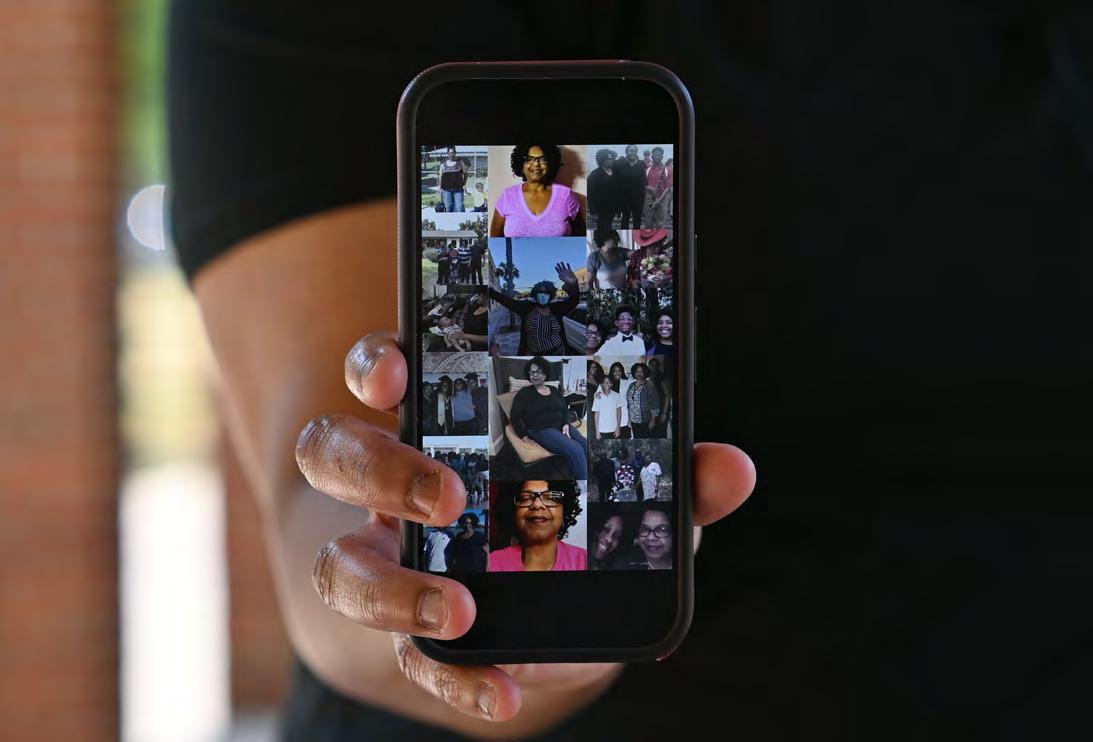
Above: PAY IT BACK: Clarke Central High School Multi-Classroom Leader and School Coordinator for Relay For Life Lawanna Knight stands in the Billy Henderson Stadium track on April 16. Apart from Relay For Life, Knight has also supported cancer research by donating to other cancer foundations. “I also donate to (St. Jude Children’s Research Hospital) and Breast Cancer foundations, (which) I donate for because I’ve had three of my paternal aunts who had breast cancer,” Knight said. “There are a plethora of things, (like the) American Cancer Society, you can donate to anytime you want, but you (should) find one that speaks to you or applies to you.”
LF: How did you first get involved with the Relay For Life fundraiser?
LK: My starting point was fairly simple. It’s actually a restart, because I did Relay For Life when I was in high school. I participated (through) the basketball team to volunteer and subsequently, I figured out what it was about. Since then, I’ve donated money, but my restart was when my mom got cancer, and passed fairly quickly (in 2022. I was) trying to get through that, so (Relay for Life) was part of my grieving process, to honor her and to bring my siblings together. We’re not very open and emotional people, (but) if we’re doing this together, we’re all honoring my mom and my family members who’ve had cancer without (having to) say (it). We’re all here together in this pain, but together in this hope as well.
Right: CHANGING TUNE: Clarke Central High School Multi-Classroom Leader and School Coordinator for Relay For Life Lawanna Knight holds a collage of photos of her mother in the CCHS Breezeway on April 22. Over time, the Relay For Life fundraiser, which raises money for the American Cancer Society and further cancer research, has changed Knight’s goals and ambitions since she began attending. “When I started out (in Relay For Life), my simple goal was to honor my mom (who passed away from lung cancer). I still do that, but it’s going beyond that, and I have to change my thoughts (that) it’s not just my mom,” Knight said. “The core is still there, but now I’m able to apply feelings in that empathy and sympathy towards other people.” Photo by Miriam Silk
LF: From your perspective, why is it so important for the Athens community to have this event?
LK: (Relay For Life) is fellowship. It’s connection. It’s bringing individual hope together, (and) the more brains and thoughts you have, the better hope. But for me, it’s just that collective being able to grieve (and) heal collectively without having to speak about it. Everyone’s there for a specific reason, and the more people, the more knowledge, the more awareness we have, the quicker we can put forth (ending cancer). The closer (any issue) hits to home, the more you want to do about it.
LK: Every team gets a little area (to) set up your tent, and then you can decide if you want to do games (to) raise money for your team while you’re there. (There’s) camaraderie (and) no negativity, it’s all positive (and) uplifting. I have random people come put their arm around me, and you don’t feel a certain way, it’s just encouraging. I think that spirit, that’s what you leave with. You walk, (but) there are different activities throughout the night, and I try to keep my team walking the whole time. But at the end of the night, the culminating event is (the) luminary walk where people have the chance to write the names of family members or friends they’ve lost, or people who survived on a bag, and illuminate (them). All the lights are cut off, and it’s complete silence. Everybody walks around, taking in the moment and honoring who we need to honor. Everybody who’s surviving, struggling (and) everybody who’s on the other side.
LF: What is the most rewarding part of
LK: It was unexpected, but I think it’s just that connection with other people and the encouragement (that), “You can do this, you can get over this (and) we can do this together.” But, I also think there’s satisfaction in knowing you’re actively trying to do something. You’re donating money (and) your muscle strength trying to raise (funds) for this cause that so desperately needs as much money as it can get, so we can find more advancements and research to get to (a) cure. But, I think (it’s) also to honor people and think about their memories and everything they’ve done.
LK: I think Relay For Life is in good hands. I (not) only see it expanding here (in Athens), but nationally (as well). People know it’s not a party, but it’s (being) with other people, so we can talk, you can laugh (and) you can cry if you need to, and it’s a no judgment zone. It’s one of those places where the humanity of everyone comes out and everybody brings their best version of themselves there. I would love to see Relay For Life do other, smaller events, (like) start a student only Relay For Life, have a movie night, (or) other events that are for the American Cancer Society. Those are the type of things I’m thinking about trying to implement next year.
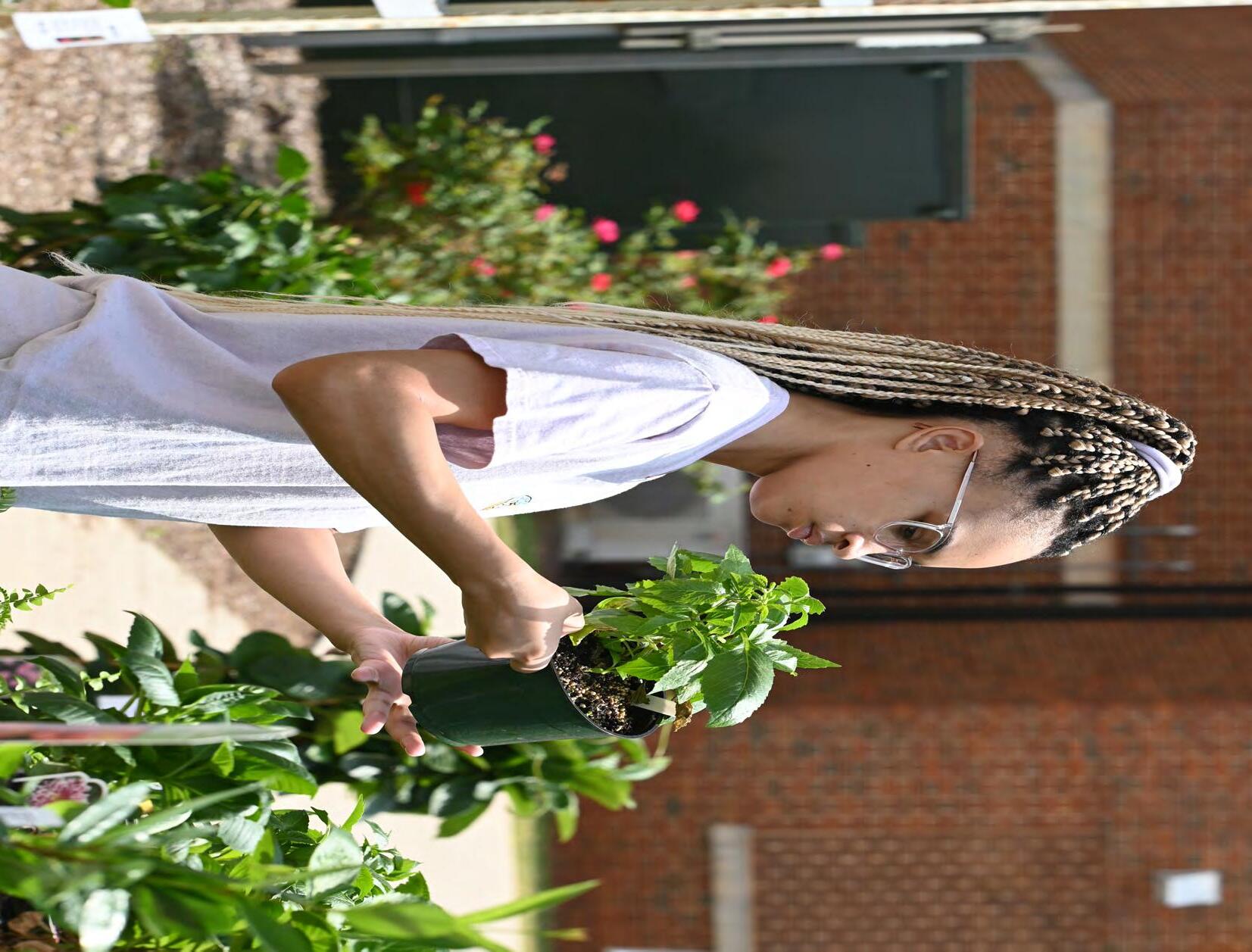
Sentinel Juliana Hardman, a senior, said.
“Some (customers) that we get from this plant sale, they’ve been coming every year. It’s great to see that they keep coming back,” CCHS FFA
Featured: SPRING HAS SPRUNG: A customer shops at the Clarke Central High School National FFA Organizations’ Spring Plant Sale on April 2. The sale, which took place from April 1-3 from 10 a.m.6 p.m. at the CCHS Greenhouse, was advertised by CCHS’ FFA through flyers around the school, yard signs, Instagram and Facebook.


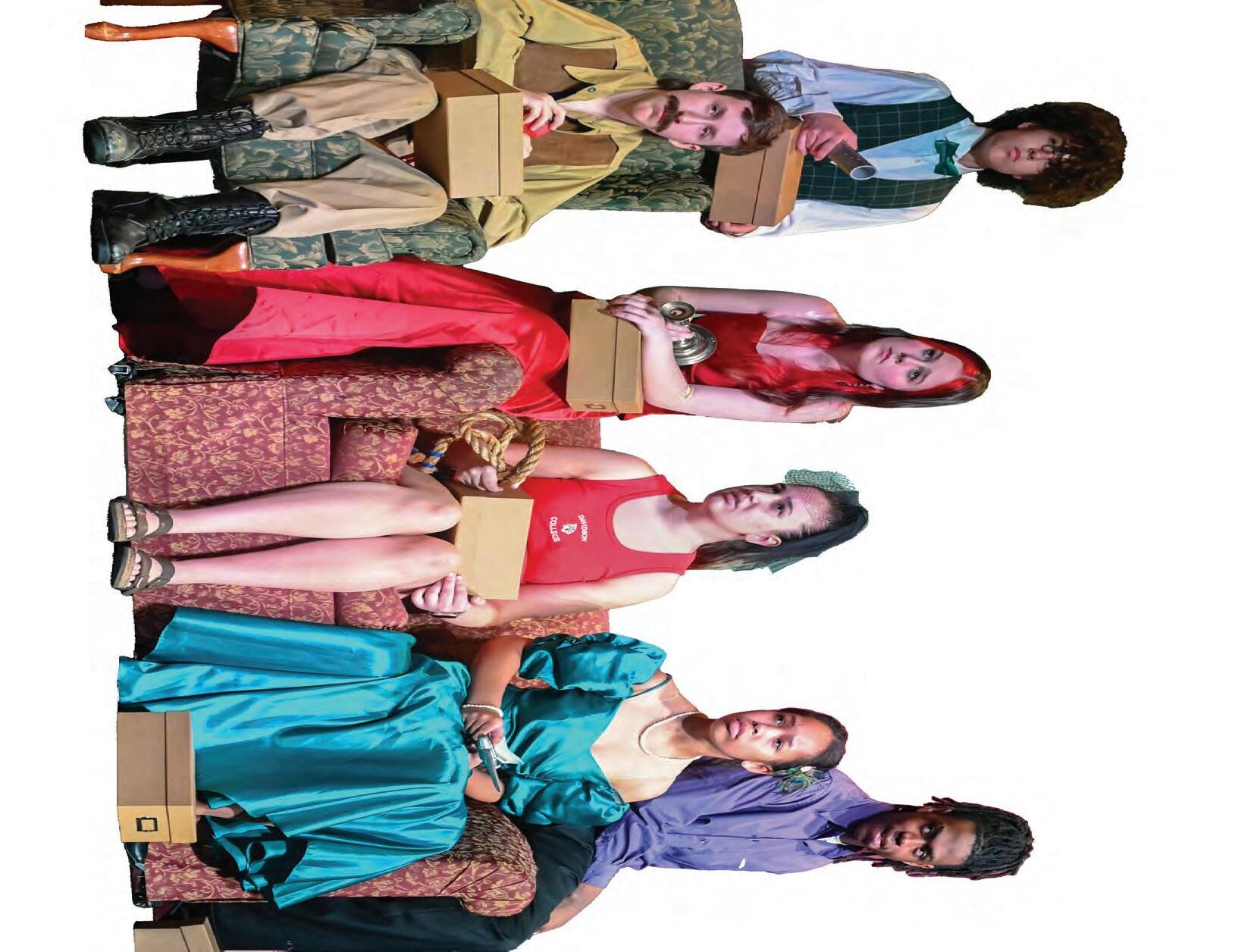
“Clue” in the CCHS E.B. Mell Auditorium on April 18. The play was performed April 16-18 by two different Drama Club casts. “I think the play went well, the audience seemed to enjoy it,” Actor of Colonel Mustard Davis Lewis, a CCHS sophomore, said. “My favorite part about the play was on show day when we actually got to hear the audience laughing at the jokes on script.”
Featured: CLUE: Clarke Central High School drama students perform in the play
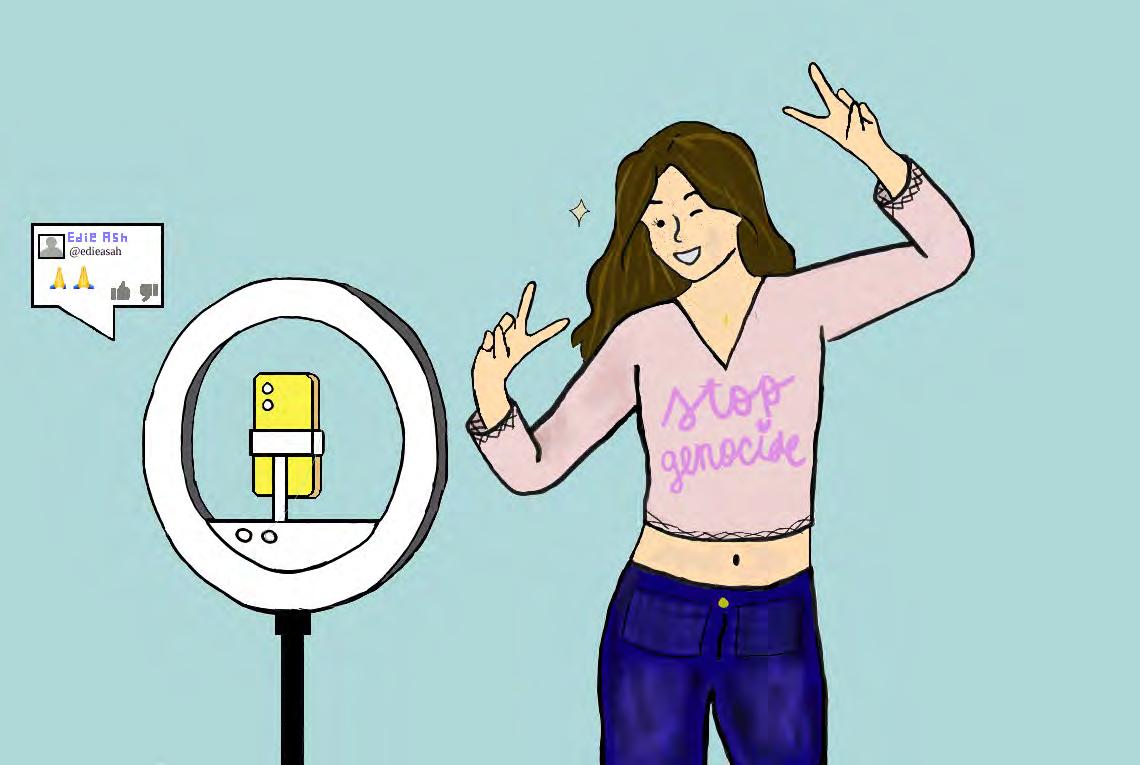
The world is continuously grappling with devastating tragedies surrounding violence, but taking real action requires actual change and uncomfortable conversations… a social media post should cover it.

BY EDIE ASH Social Media Coordinator
In the era of social media, the natural response to tragedy, be it gun violence, warfare or any loss of life, has changed entirely. Nowadays, anyone can post heartfelt messages regarding an incident, quickly turning social media engagement into what feels like a civic duty.
As a member of society, I am responsible for sending thoughts and prayers. The decision-making should be left up to committees and experts, all the people who have yet to let us down. Right?
I instead focus on dedicating my time to thoughts, prayers and Instagram. I take the time to post my compassion, making it visible and shareable. I carefully chose a meaningful Bible verse with 10 hashtags followed by three praying-hands emojis. Sometimes, I even take the time to add a song. Coming together through tweets of prayer, that’s what community really looks like.
Coming together through tweets of prayer, that’s what community really looks like.
Critics like to argue that faith without action is incomplete, but I prefer to think of it as streamlined, maximum belief with minimum action. Why would I focus on harsh reality when I can blindly trust an already-existing higher authority? Why would I focus on policy change if it might force me to rethink my voting history and lifelong ideas?
I do what any respectable, contributing citizen does when they learn tragic news. I stop, set up my camera, bow my head and send thoughts and prayers to everyone affected. Oftentimes, being this good of a person is inconvenient to my day-to-day life, but if you know me, you know I’m huge on empathy.
I can’t let those advocating for policy change, for the protection of future generations, get in the way of what’s really important in the time following a tragedy: Sending thoughts and prayers in full glam, reading off a script in 150 words or less.
Now, that’s what caring really looks like.
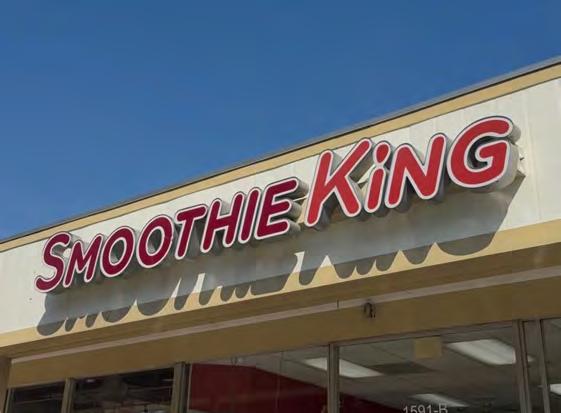
The ODYSSEY Media Group Variety Staff visited smoothie chains around Athens and concluded that Smoothie King offers the best strawberry and banana smoothie. 8.5

BY MZÉE PAVLIĆ Variety Staffer
Less than a mile from Clarke Central High School, located at 1591 S. Lumpkin St., Smoothie King provides customers with refreshing and healthy smoothies.
With Smoothie King’s upbeat music playing and walls covered in bright colors, customers entering the somewhat small store are greeted by a lively atmosphere. The store offers a wide variety of smoothies and smoothie bowls, such as the Angel Food smoothie.
The smoothie, made with strawberry and banana, comes in three sizes: 20, 32 and 44 oz. At $6.29, the sweet smoothie is not only affordable, but also strikes a tasty balance between the strawberry and banana flavors.
On the other hand, while Smoothie King does have indoor and outdoor seating, both areas are very small, seating only a few customers.
While customers looking for a place to sit and relax may be disappointed, for those looking for a tasty way to stave off Georgia’s summer heat, Smoothie King is a great choice.
8 9 9 8 8

BY ELOISE LUKEN Variety Staffer
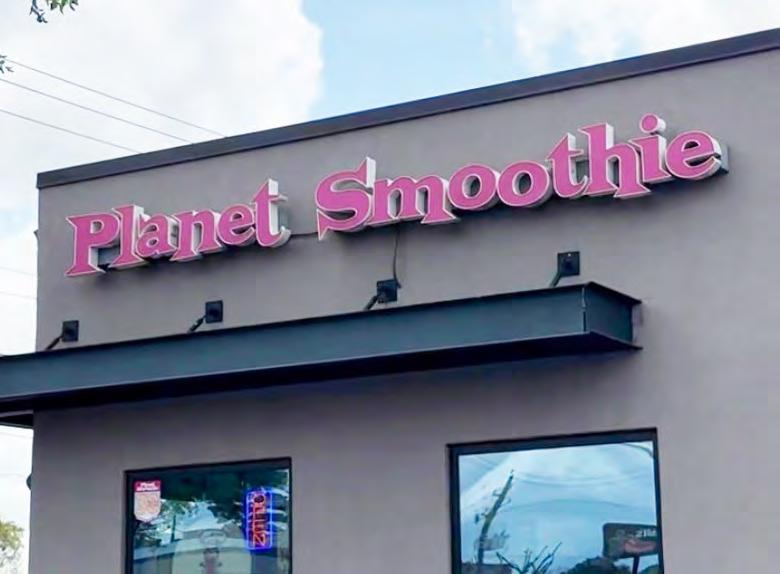
Planet Smoothie, located less than two miles from Clarke Central High School at 196 Alps Road, offers a variety of refreshing smoothies at an affordable price.
The chain offers several types of smoothies depending on the mood a customer is in, including caffeinated, protein-concentrated or composed entirely of whole food ingredients. They also have a Planet Favorites menu, which includes the Twig & Berries flavor.
Made with strawberries, bananas and frozen yogurt, the smoothie comes in several sizes, including 20 oz, which costs $6.89.
The combination of the two fruits is delicious, and although bananas often have a distinct flavor, they don’t overpower the strawberries. The smoothie’s consistency is creamy, but not watery, which customers should appreciate.
Additionally, Planet Smoothie is located fairly close to CCHS, making it easily accessible to students. It also has a small outdoor seating area where customers can enjoy a cold treat in the sun. However, there aren’t any chairs available inside, a feature that could deter some visitors if they’d rather avoid the heat.
Overall, Planet Smoothie is a great place to stop by and enjoy a delicious smoothie this summer.

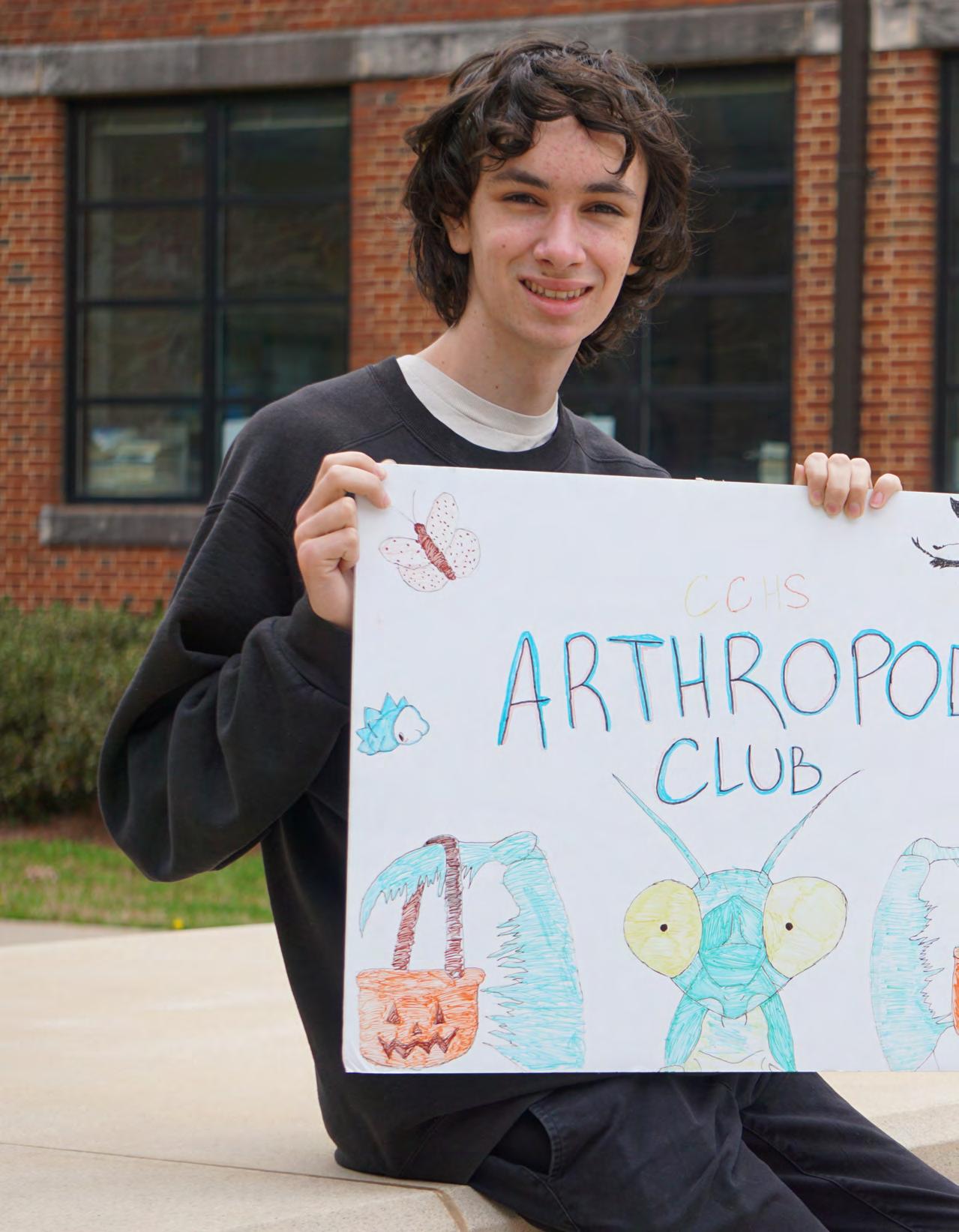
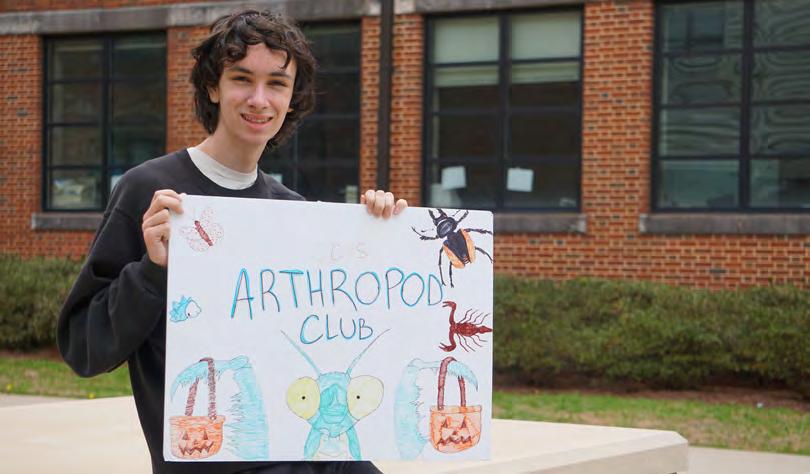
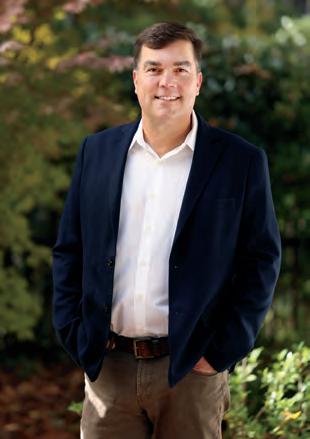
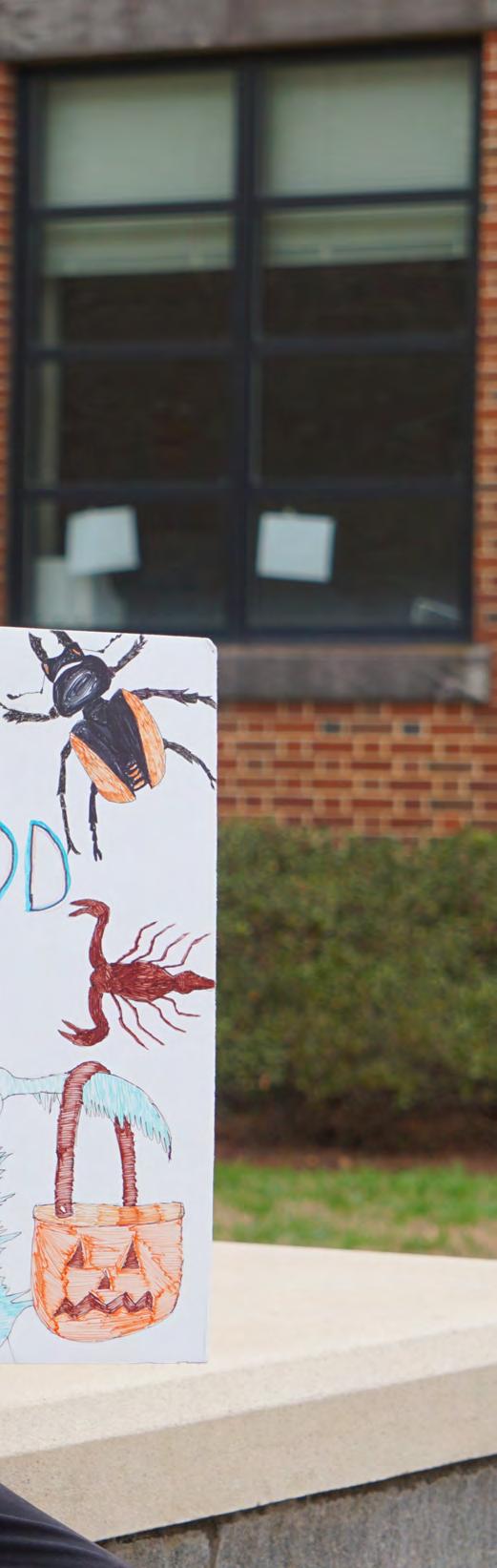
Featured: COLEOPTERAS AND COPPER: Clarke Central High School Arthropod Club
President Copper Callahan, a senior, poses in the CCHS Media Center Courtyard on March 2. Callahan became the club’s president during his sophomore year and has since helped the club grow in membership and activity. “Posters and (other Arthropod Club signs) are part of the club’s outreach efforts,” Callahan said. “We started (with) eight members (during the 2023-24 school year). Now, we consistently (have about) 20 people showing up to a meeting. It’s been exciting to see how the club has grown, and I think I’ve contributed to that by encouraging everybody I know to join.”
Photo by Peter Atchley
CCHS
Arthropod Club President Copper Callahan’s fascination with insects
has been a part of his identity ever since he was a toddler, a passion he hopes to pursue for the rest of his life.
STORY BY PETER ATCHLEY, SARA STUART, DAVID WANG, OLIVE FORRESTER ODYSSEY staffers
LAYOUT BY ISABELLA GRESHAM Viewpoints Editor
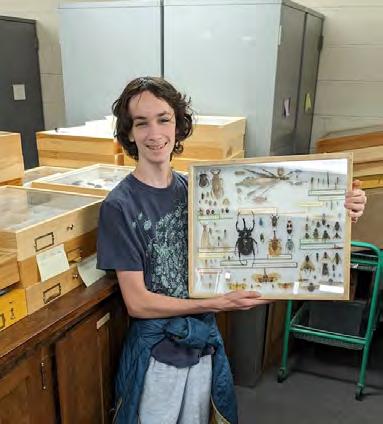
Clarke Central High School Arthropod Club President Copper Callahan, a senior and self-identified “weird kid always looking for bugs,” can’t remember a time when he wasn’t interested in insects.
However, to just call it an interest would be the same as comparing an ant to a termite, or a crane fly to a mosquito, a mistake that Copper would never make. For Copper, his fascination in entomology has been a part of his life since the beginning.
“(Copper’s passion for bugs) is contagious. I don’t think the club would have grown to where it is if it weren’t for Copper.”
–
ROBERT PULLIAM, CCHS science department teacher
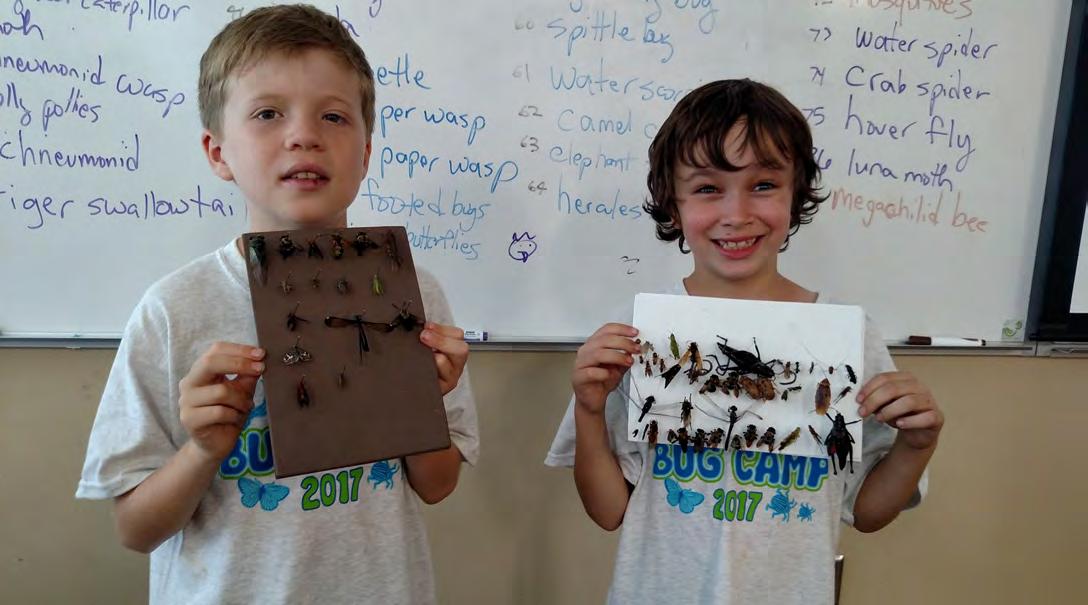
“I went to Insectival at the (State) Botanical Gardens (of Georgia) when I was really little. I was around the (University of Georgia) entomologists a lot. I did the (Invertebrates Summer) Camp (during) elementary school at UGA, and all the entomologists have been very nice to me. I’ve always been the kid who (is) interested in bugs,” Copper said. “(When people are scared of bugs), I can usually find (some insect fact) they will be interested in.”
For Copper, bugs and insects are more than just creepy-crawly critters. He strives to inform everyone on the importance of arthropods in nature and how they further help environmental efforts, a passion that started with his family.
as he can
“People should eat more bugs because they’ve got a lot of protein, and people all over the world do it. It’s a lot more sustainable than eating beef or (other meat),” Callahan said.
“(Copper’s) eyes are gigantic (when) looking in the drawers of specimens. He was absolutely fascinated, and asked (me) a lot of questions. I remember thinking, ‘This little guy, he’s got the entomological gene.’”
– JOSEPH MCHUGH, UGA’s department of Entomology professor
“(Our family is) all patient with Copper around the house because he takes up a lot of space, because he always has a lot of projects going on. He’ll have his (insect) jewelry on one table and the next table, and then he’ll have his bug stuff on the (other) table and (bugs) in the freezer,” Ashley Callahan, Copper’s mom, said. “We just accept that that’s how it is, and enjoy his enthusiasm.”
CCHS science department teacher Robert Pulliam first met Copper at Freshman Orientation when he was an incoming student, and later taught him when he was enrolled in Pulliam’s Entomology class as a sophomore. In Pulliam’s eyes, after his first interactions with Copper, he immediately recognized his student’s passion for entomology and how it separated Copper from other students in the class.
“(On) day one (of class), a lot of the time students are (generally) more apprehensive, a little softer-spoken (and) not quite as outgoing, but I do not recall that being the case for Copper,” Pulliam said. “I remember immediate enthusiasm, particularly for insects and entomology, (and) for school and learning as a whole. That stood out to me, (and) I knew it was gonna be a fun semester.”
During the 2022-23 school year, former Arthropod Club President Oliver
Domingo, a CCHS Class of 2024 alumnus, started the club. The following school year, Copper became the club’s president as a sophomore.
“(Copper’s passion for bugs) is contagious. I don’t think the club would have grown to where it is if it weren’t for Copper, ” Pulliam said. “There’s some students that are there more for the social side of it, and some students are there because they really like bugs. That intersection is Copper.”
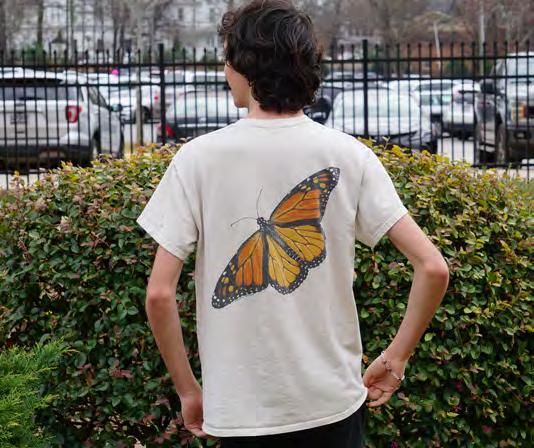
Copper has tried various tactics to grow the Arthropod Club, such as creating insect jewelry, making custom T-shirts and face-to-face conversations to get others interested in the club. Under his leadership, the club has dissected insect-filled pitcher plants from the Botanical Garden and hosted several guest speakers, which, for Copper, are the most educationally beneficial meetings for club members.
“It’s a lot of fun to invite guest speakers, because they’re just as interested (in entomology) as I am, and they’re happy to talk about it,” Copper said. “There’s so much to learn about entomology, and I think the best way is to find someone who’s passionate (and) will (share their passion).”
“People need to know that insects are important. If we don’t protect them, the food system and the environment will collapse.”
–
COPPER CALLAHAN,
CCHS Anthropod
Club
President and senior
Copper now works as an intern for UGA Department of Entomology Professor Joseph McHugh through the UGA Young Dawgs Program, which collaborates with CCHS to connect students to internships. One of the first times Copper and McHugh met was at the 2012 Insectival when Copper was
4-years-old, where they bonded over a mutual passion for bugs.
“(Copper’s) eyes got gigantic (when) looking in the drawers of (arthropod) specimens (at UGA). He was absolutely fascinated by the specimens, and asked (me) a lot of questions about them,” McHugh said. “I remember thinking, ‘This little guy, he’s got the entomological gene. I can see it in his eyes.’”
For Copper’s internship, he studies and surveys ciidae beetles, otherwise known as minute tree fungus beetles, which are found on rotting wood in the North Georgia region. His peer editor is fellow CCHS senior Alexa Carcamo, who gives him feedback on his research assignments.
“Because (Copper’s) passion is so strong for entomology, he has no issues completing work or reading articles, even (mine), because my (study) is on fruit flies,” Carcamo said. “It’s super cool to see how far his passion has taken him, and with his love for entomology, (it’s) going to (get him) very far.”
Even those who only met him when he was showing off his Madagascar
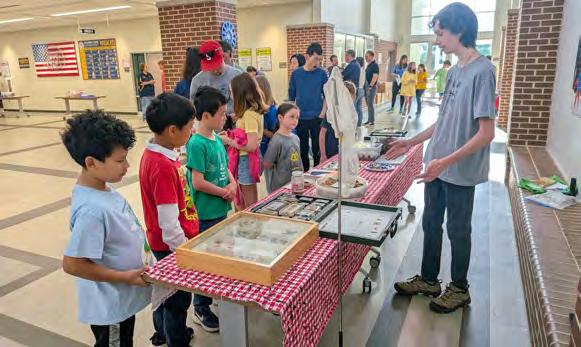
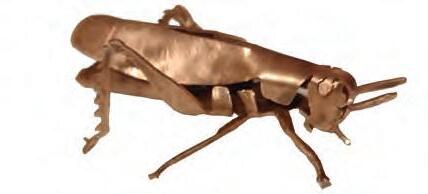
hissing cockroaches at a CCHS Open House or dressing up like a lightning bug for Trunk or Treat know him for his dedication and depth of knowledge.
“Copper is a natural collaborator. He’s bright, he’s interested,” Pulliam said. “He’s accumulated this massive knowledge over his years of studying insects, whether in (the) Entomology (class) or on his own time, and he’s not stingy with it, just happy to share it with others and spread what he knows.”
When Copper was still knee-high to a grasshopper, he was fascinated by seeing all four wings and the sharp tail of scorpionflies, or hearing the buzz of periodical cicadas. What made these insects even better was when he got to tell others about them.
“I enjoy learning things and telling people about (bugs). People need to know that insects are important,” Copper said. “If we don’t protect them, the food system and the environment will collapse. (Insects are) just really interesting (and) there’s so many of them.”
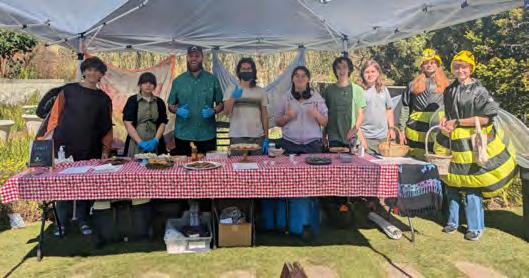

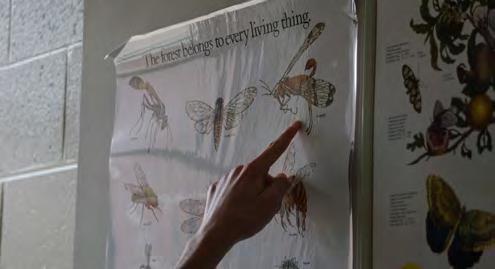

Icelandic singer-songwriter Laufey’s deluxe album “A Matter of Time: The Final Hour” is truly the final crescendo of the artist’s third Grammy Award winning album.
Released on April 10, the deluxe edition added four fantastic new tracks to the original 14-track album, each with time-stopping vocals that elevated the thought-provoking emotions of the initial album. The leading single of the deluxe album was “Madwoman,” which explores the complexity of a relationship and how chaotic it can be, a theme many listeners can relate to.
“A Matter of Time: The Final Hour” further carries the artist’s pattern of creating albums that blend genres like jazz with more classic genres like piano ballads and powerful string quartet sections.
The final song on the album, “I’ll Forget About You (In Time),” is hypnotizingly moody, concluding when her lyrics, “I’ll forget about him, won’t I,” ring out as the piano and quiet strings slowly lead listeners out of the album.
Laufey’s latest release is a fantastic addition to her discography, cementing her sound as sweepingly romantic.
– Peter Atchley, Managing Editor
BY VIOLET DOCKERY Journalism I student

AFast food chain Wingstop released its new Citrus Mojo Flavor on April 7 to participating locations nationwide. Described as a dry rub seasoning, the flavor is a subtle but enjoyable limited-time addition to the restaurant’s menu.
Available on chicken wings, tenders and sandwiches, the Citrus Mojo flavor contains citrus, garlic and herb notes. Additionally, it includes a hint of lime, which adds a unique, tangy element to the coating.
This sweetness present in the wings is polarizing for consumers, while it does add a new tropical flavor choice to the menu, the orange citrus taste does not pair well with most of Wingstop’s dipping sauces.
The Citrus Mojo flavor is also labeled as a one out of five on Wingstop’s heat scale, meaning that it’s a great option for those who don’t love spice.
Overall, Wingstop’s new Citrus Mojo flavor is a refreshing choice for customers who prefer an understated version of the typical wing sauce.
student

American cosmetic brand e.l.f. Cosmetics launched three new shades of its Glow Reviver Melting Lip Balm in select stores on April 5. A sheer pink, the pink lemonade shade costs $9 and is perfect for those who prefer a more subtle makeup look.
The balm smells exactly like pink lemonade: sweet, tart and perfect for a sunny day. When applied, it melts seamlessly onto the lips, offering customers a glossy and moisturized finish. The formula contains a 10% butter blend, which includes shea butter, mango, cocoa and hyaluronic acid for intense lip hydration.
However, the lip balm isn’t as long-lasting as advertisements make it seem, only lasting around an hour or so before it needs to be reapplied.
Despite this, e.l.f.’s Glow Reviver Melting Lip Balm in pink lemonade is a sweet and refreshing way to kick off the summer season.
24’s film “The Drama” was released to theatres on April 3 and was written and directed by Kristoffer Borgli. The romantic comedy deals with themes of forgiveness and redemption with humor mixed in to create a sense of uneasiness for the audience.
The story follows characters Emma (Zendaya) and Charlie (Robert Pattinson), an engaged couple whose relationship is jeopardized the week before their wedding. Focusing on the emotional challenges of romantic relationships, the film dives into how secrets and confrontation can create strain and judgment in a partnership.
From the start, viewers see glimpses of the early relationship of the seemingly happy couple days before their wedding. One night with their friends Mike (Mamoudou Athie) and Rachel (Alana Haim), Rachel asks them the worst thing they’ve ever done and once their answers are revealed, the dynamic of the group completely shifts. In the hectic moments after the plot twist reveal, viewers experience the perfect mix of shock and anticipation.
Both Zendaya and Pattinson’s performances after the reveal show intense emotion, especially regret, guilt and anxiety. As Charlie deals with his crumbling relationship, the viewer experiences his thoughts and the eeriness of his dramatic imagined outcomes of their future as a couple.
Zendaya tastefully portrays Emma’s attempts to conceal parts of her past she hoped to keep private as the viewer is shown her childhood memories.
The comedy mixed with growing anxiety caused awkward and borderline uncomfortable moments for the audience that made the film a surprising and challenging watch. Despite these heavy emotions and themes, the movie does a good job of blending drama, humor and emotional depth. Overall, the suspenseful storyline and dramatic emotion of “The Drama” will keep viewers on the edge of their seat, waiting for the next twist to be thrown their way.


A story of unexpected drama and romance all set in charming France, “The Paris Match” by Kate Clayborn, released on April 7, is an ambitious novel with an overly-convoluted plot but authentic and realistic characters.
When Layla Bailey shows up to her former sister-in-law’s wedding in Paris with the knowledge she’s going to see her ex-husband with his new partner, the last thing she expects is to compromise the imminent marriage, or fall for the grumpy best man, Griffin. In a conversation with the bride-to-be, Layla’s words plunge the marriage into uncertainty and Griffin pressures Layla to salvage the wedding.
Clayborn’s writing style is vivid, although difficult to follow for long periods of time, and the focus grapples between intense relationship dynamics and a hectic, fleeting plotline. But the novel’s characters experience meaningful emotional growth by the end of their stay in the enchanting City of Light.
A messy but entertaining narrative, The Paris Match excels in character detail, but its tangled plot and unbalanced pacing may lack appeal beyond romance readers.
– Lydia Rowell, Menu Editor

Coffeehouse chain Starbucks released the Mango Strawberry Lemonade Refresher on April 7, along with the introduction of Energy Refreshers. Priced at $5.25 for a grande, or 16 oz., the drink is a sweet, tangy, new addition to Starbucks’ refreshers menu.
A vibrant orange, the Mango Strawberry Lemonade Refresher includes two pumps of mango syrup, lemonade and a scoop of freeze-dried strawberries. When customers take their first sip of the beverage, they will immediately notice its juicy, tropical mango flavor and a sweet undertone of strawberry.
However, although the drink contains a unique flavor, there aren’t many features that differentiate its appearance from other Starbucks refreshers.
Overall, the Mango Strawberry Lemonade Refresher is a tasty, refreshing new drink for customers to enjoy on a sunny day.
– Adah Hamman, Variety Editor

“BULLY” was released on March 28 by rapper Kanye West, also known as Ye. This is West’s 12th studio album and is available on all music platforms except TIDAL. The album is a turnaround compared to recent works, but also compliments West’s other 2000’s projects well.
The album mixes genres of alternative hiphop, industrial rap and neo-soul, all of which are displayed in the song “FATHER.” The album provides an overall theme of reflection through concepts of growing up and family, adding a personal and cultural connection to the music.
The album’s inconsistency of changing from slow to high tempo songs may be unappealing to some. On the contrary, the layering, echo effect and interchanging voices in several songs, specifically “SISTERS AND BROTHERS,” provide an upbeat and rhythmic melody.
Overall, the album is diverse in genre, culturally and rhythmically, providing listeners with a wellrounded album to jam out to.
“The Night We Met”
BY LEA D’ANGELO Digital Editor-in-Chief
Contemporary romance author Abby Jimenez released her newest book, “The Night We Met,” to all major booksellers on March 24, the second book in the “Say You’ll Remember Me” series. While not presenting anything groundbreaking in the character development department, Jimenez adds an interesting storyline to the traditionally overdone romance plots.
The book follows Larissa, a waitress, who has a seemingly easy relationship with her boyfriend, Mike. However, when Mike begins to struggle with alcoholism, Larissa finds solace in a relationship with his friend Chris, which ultimately forces her to question her loyalty.
Jimenez’s ability to handle delicate topics such as alcoholism and anxiety shines in her exploration of different characters’ struggles, which adds a layer of complexity not commonly found within the genre. Additionally, although the novel is set in the same world as the series’s first installment, it follows an independent storyline and can be read as a standalone.
However, for some readers, the romance aspect of the book appears like more of a side plot. A majority of the storyline is dedicated to the history behind Larissa and Mike’s relationship, and Mike’s subsequent mental health challenges, rather than the development of Chris and Larissa’s relationship.
Chris and Larissa also come across as somewhat flat in their individual characterization. Jimenez establishes Larissa’s strength and sense of independence early on in the book, and rarely strays from the description, ultimately causing her to seem one-dimensional. Similarly, Chris’ flaws go largely undiscussed, making him feel like more of an archetype than a real person.
Overall, while “The Night We Met” adds an interesting layer to a romantic story, readers looking for a character and relationship-driven plot will likely be disappointed.
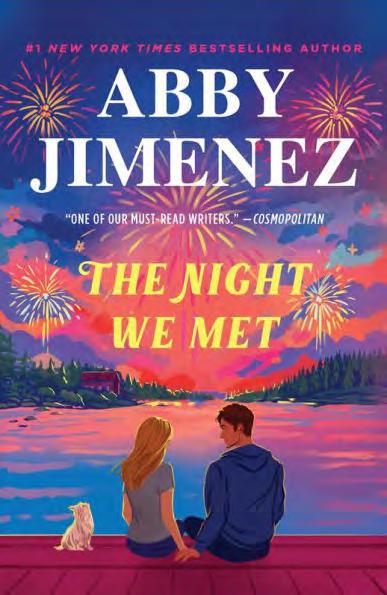
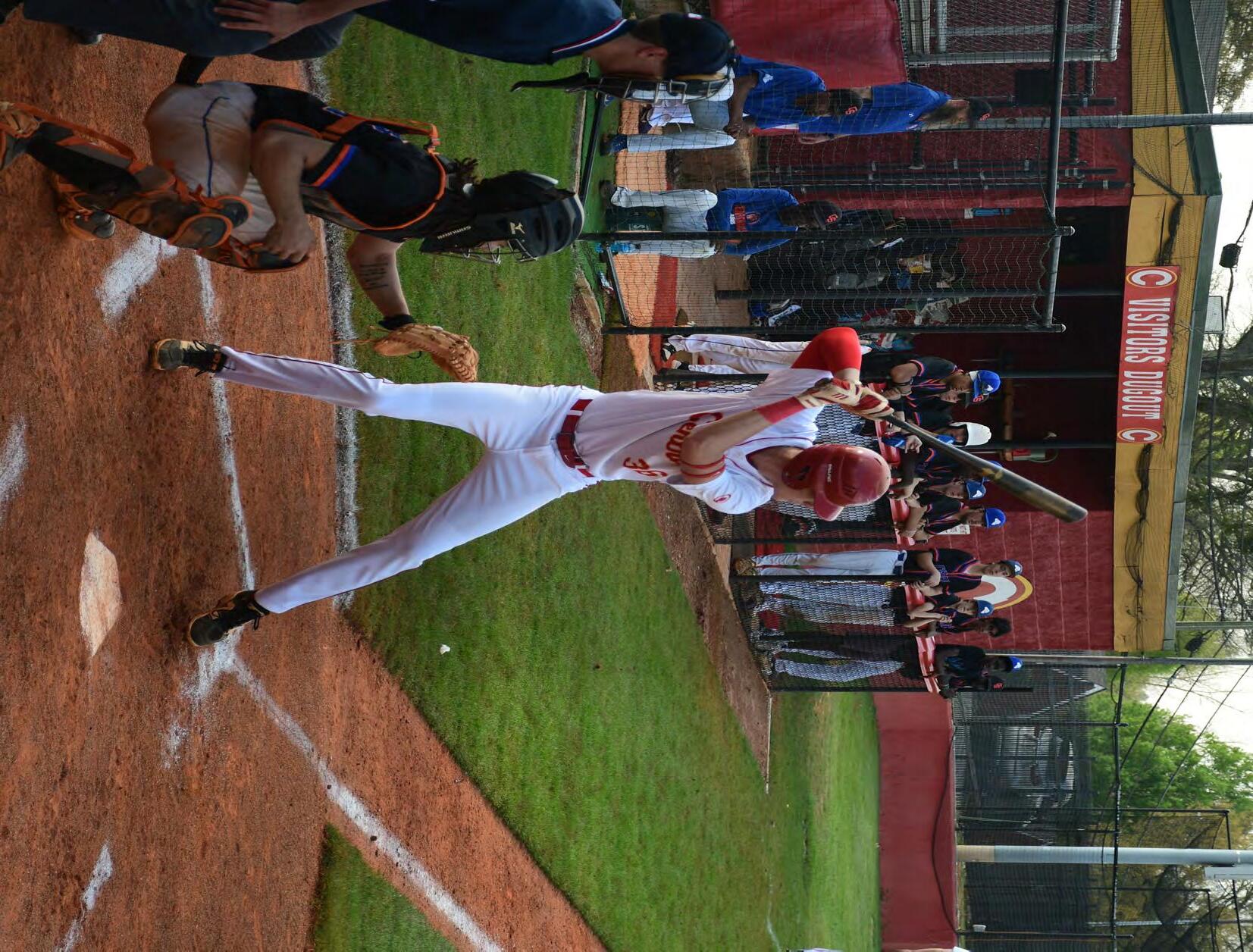
Featured: RUN-RULED: The Clarke Central High School varsity baseball team plays against Cedar Shoals High School on March 26 in CCHS’ A.B. Weathersby Field. The Gladiators ended the game early at 13-0 in the fifth inning of their second game against CSHS this season. “(The Classic City Championship is) always a lot of friendly competition between the two schools,” CCHS junior varsity baseball head coach Matt Bishop said. “(CCHS) pitched well, and we hit well, so when you do that in a baseball game, you’re bound to come out victorious.”
As Sports Editor Liya Taylor looks ahead to her senior volleyball and golf seasons, she reflects on the lessons and opportunities for growth that sports have given her, even without pursuing college athletics.

BY LIYA TAYLOR Sports Editor
The gym is loud: volleyballs hit the floor, teammates call out “mine” and everyone is moving.
The golf course is the opposite: quiet, still and the only sound heard is a club swinging.
Throughout high school, I’ve moved between these two worlds, and now, going into my senior season, I know they won’t last forever.
According to a 2025 article from The University of Olivet, only around 6% of high school athletes go on to play a sport on a collegiate team. This number puts things into perspective as I look towards my senior year.
something bigger than myself.
Golf, which I picked up during my sophomore year, has impacted me in a completely different way. There is no one to rely on, and every good or bad shot is on you. It has forced me to be patient and stay composed, teaching me to be accountable, to quickly shake things off and not to get in my head. While volleyball taught me how to lean on others, golf taught me to trust myself.
Those lessons might not result in playing collegiate athletics, but they will stick with me.
While volleyball taught me how to lean on others, golf taught me to trust myself.
I have never wanted to be part of that 6%, and I’ve felt that way for a while. But that has not made my years of playing sports feel any less meaningful.
Although I danced and played soccer as an elementary school student at Johnnie Lay Burks Elementary School, the first sport that stuck with me was volleyball. I started playing in sixth grade, and it quickly became more than just something to do after school. Volleyball is a team sport in every sense of the term.
When playing, I rely on the people around me throughout the whole game, whether that’s trusting my setter to put the ball in the right spot or knowing my teammate will cover if the opposing team blocks my attack. Over time, the sport has taught me how to communicate, how to lead and how to be a part of
It’s easy to measure sports by what comes next, like scholarships or Name, Image and Likeness deals. But most high school athletes won’t play at the next level, and that doesn’t make the hours they spent practicing, the long bus rides and the early mornings and late nights any less valuable.
Because when the game ends, what they’re left with isn’t a record or a title. It’s the discipline to keep showing up, the ability to work with people who are different and the mindset to push through challenges even when no one is watching.
That’s what I’ll take with me when my senior year ends.
I don’t know exactly what role these sports will play in my life a year from now, but I know they won’t disappear completely. Maybe it’s playing beach volleyball on a trip or playing a round of golf on a random Saturday. It won’t be the same as my high school playing days, but it doesn’t have to be.
For me, sports were never about playing at the next level. They were about the process, the people and the personal growth that came with it, and as my senior seasons start, that feels like more than enough.
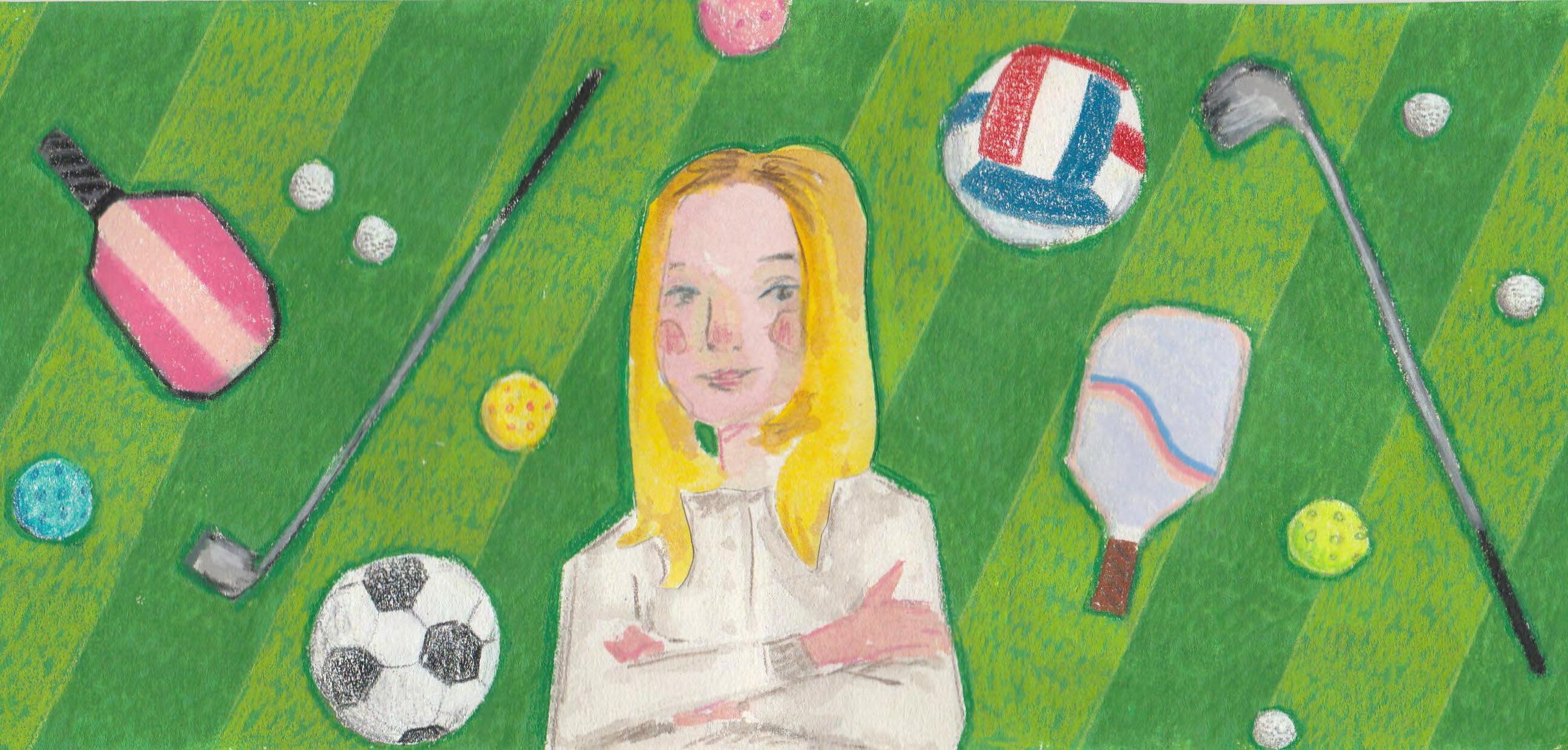
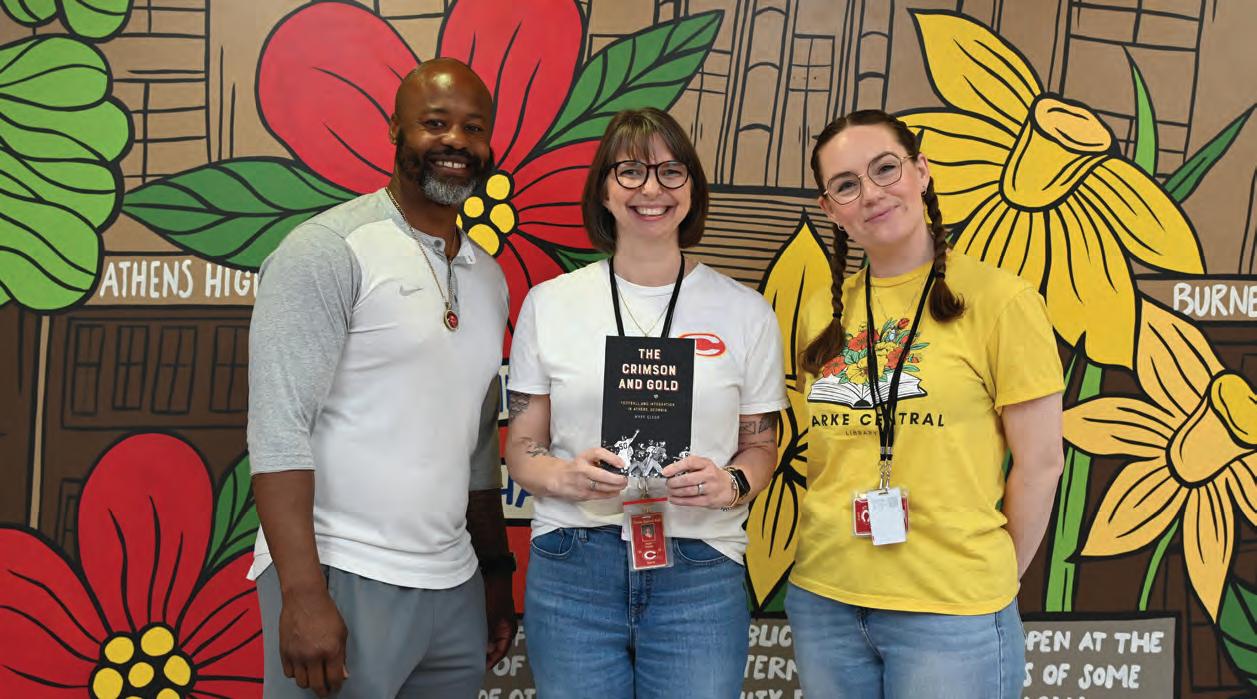
CCHS media specialists and coaches are introducing a summer book club for studentathletes, who will read “The Crimson and Gold: Football and Integration in Athens, Georgia,” to celebrate the history of school integration in Athens.
STORY BY KYE STREETMAN Sports Staffer
LIYA TAYLOR Sports Editor
What once unfolded on the football fields of Athens will now be revisited by a new generation of student-athletes during the summer of 2026 through a book club designed to teach students about the city’s history of integration in the 1970s.
CCHS Media Specialist Angela Pendley spearheaded the creation of the book club, working alongside CCHS Media Specialist Naomi Craver. The club is centered on the comprehensive narrative: “The Crimson and Gold: Football and Integration in Athens, Georgia” by author Mark Clegg, which was published on Sept. 1, 2024, and explores the history of racial integration in Athens through the lens of high school football.
The idea first arose during the summer of 2025, when Pendley introduced the book to CCHS varsity football assistant coach Damien Gary, whose grandfather, former Burney-Harris High School football player Leonard Champion, is featured in the book, and pitched the idea of reading it with the football team.
“Coach Gary took (the book) home and came back, and he was like, ‘This book is amazing. I couldn’t put it down. It’s a go, let’s read this as a book club.’ Then we started talking about diving into it and (organizing) something over
the summer where it wouldn’t be competing with academics for the students,” Pendley said.
“(CCHS varsity football assistant coach Damien) Gary took (the book) home and came back, and he was like, ‘This book is amazing.’”
– Angela Pendley, CCHS Media Specialist
After the book resonated with Gary, Pendley began raising the approximately $7,000 needed to fund the project through fundraisers and community support. Each student who participates in the book club will receive a free copy
Center holding the book “The Crimson and Gold: Football and Integration in Athens, Georgia,” on April 17. The three CCHS staff members collaborated to launch a summer book club for student-athletes during 2026 with the hopes of teaching the history and significance behind the book. “When I (was) in the process of reading it, Ms. Pendley was also reading it, so every day we’d be like, ‘Did you read this,’ or ‘Did you hear about that?’ We were both just glued into the book,” Gary said. “Then Ms. Pendley took it a step further, and (said), ‘Well, what if we did a book club with the athletes talking about the history of Clarke Central, how it came into existence, and the people that paved the way?’ I was like, ‘Man, that’d be a great idea.’”” Photo by Kye Streetman
of the book, which has a $26 retail price, along with an annotation kit. To help defray expenses, University Press, the book’s publisher, offered a 50% discount on book copies in support of the initiative.
The book club was originally planned to be for members of the CCHS football team, but after discussions with head varsity flag football coach Cherelle Pass, the club expanded to the varsity flag football team and quickly grew to include athletes from all sports practicing during the summer of 2026.
“We’ve had a great ton of success with former athletes. I know some of the people that I looked up to are in the book. My granddaddy’s name is in the book, so having those experiences was really key for me,” Gary said. “Our generation now, even though a lot of the names that are in the book (are) obviously way older than them, I hope that (athletes will) see that (there’s) a rich history of successful athletes to have (been) born and raised and come from Clarke Central.”
South, they always took the name of the legacy white school. (They) didn’t do that here, Clarke Central High (School) emerged.”
The club is designed to educate students about their school’s integration and broader community history while building connections through shared experiences. To Pass, whose grandfather, former CCHS football player Clarence Pope, is also featured in the book, CCHS athletes must understand its history.
“I hope that (the book) sparks an interest in the history of the school and the local community.”
“As a flag football coach, we typically play schools that are either predominantly white with white coaches or predominantly Black with Black coaches. (CCHS is) one of the few schools that is very diverse,” Pass said. “Reading this book will enlighten our girls to understand (that) even then, they were facing certain obstacles because they chose to diversify and change the narrative in (the Clarke County School District), and we may still be subconsciously dealing with some of those issues.”
– Mark Clegg,
Author of “The Crimson and Gold: Football and Integration in Athens, Georgia”
The book club will be structured differently for each sport to accommodate different teams’ needs and practice schedules. The CCHS media specialists have also secured copyright permission to create an audiobook option, which will be narrated by various CCHS faculty and staff.
“I hope that (the book) sparks an interest in the history of the school and the local community. I suspect that people will start reading the book and realize (they’ve) got a family connection here. Plus, it’s important for students to realize that the history of the school is so unique,” Clegg said. “If you look at the history of schools that merged during integration in the ‘60s and ‘70s in the
An event will be held during the 2026 Homecoming week for all athletes participating in the book club, featuring an author’s visit with Clegg and a panel of community members who were a part of the integration of Burney-Harris High School and Athens High School, to celebrate the club’s completion of the book.
“(CCHS) had a really rough start with the school in general, but also with our football team, so for Billy Henderson to come in and rebuild this team to bring us into what we have today, we need to know what our beginnings were,” Pendley said. “Because this book is specifically about Athens, I think that will be really powerful for our students to be able to empathize with and to see what we have rebuilt here. (That’s) important.”
Below: GOLDEN HISTORY: Author Mark Clegg sits in the Clarke Central High School media center reading his book, “The Crimson and Gold: Football and Integration in Athens, Georgia,” on April 2. During the summer of 2026, all student-athletes on teams holding summer practices will read the book as a part of a book club aimed at teaching them the history of their school. “It was my hope that Clarke Central would adopt the book as its origin story, which it really is. It describes how we got there, in terms of the steps that were taken before Athens High and Burney-Harris merged (into) Clarke Central in 1970, (and) the steps involved on how we got there,” Clegg said. “(It’s) perhaps (the) most interesting part of the story, it was anything but easy.” Photo by Kye Streetman
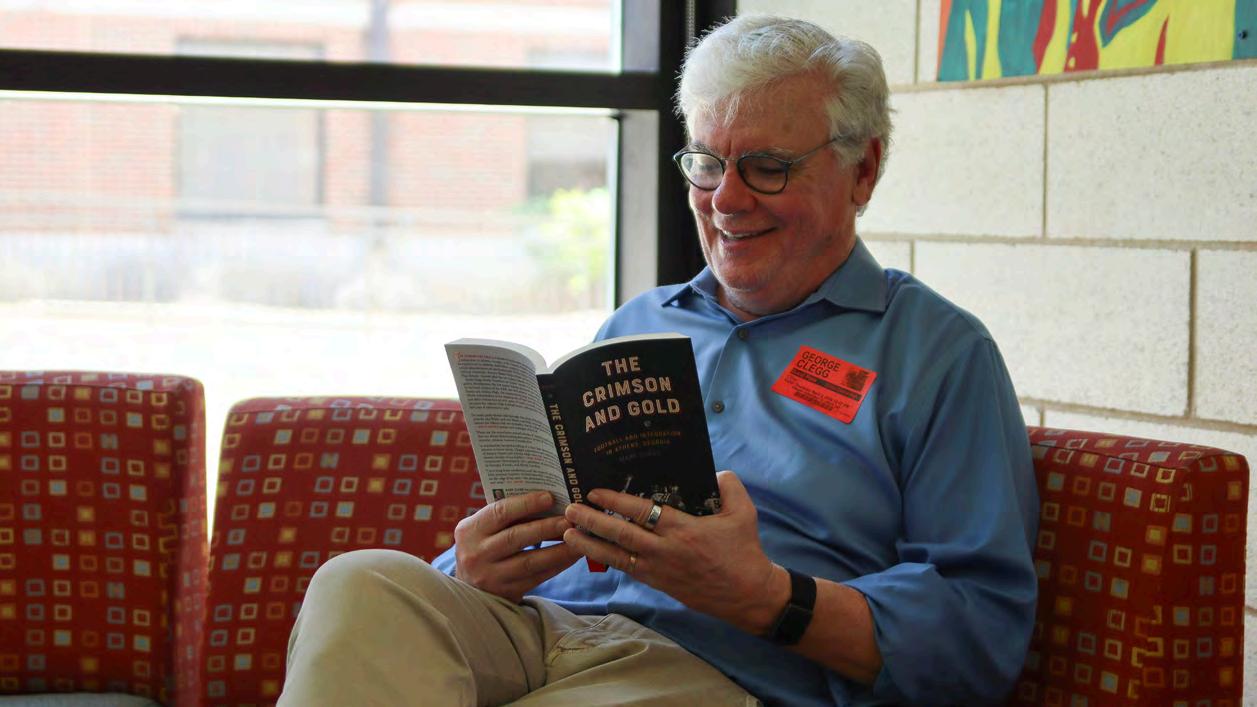

University of Georgia track and field team pole vaulter Alon Rogow discusses his passion for pole vaulting and serving the Athens and UGA community.
Samaya
University of Georgia track and field team pole vaulter Alon Rogow: Long story short, I thought (pole vaulting) looked cool and I wanted to try it, so I did. (I talked to) my eighth-grade social studies teacher (Matt Barry at the Davis Academy), as well as the coach at (Pole Vault Atlanta). There were a couple kids in grades above me that were nationally ranked, and (pole vaulting) looked really cool. So, I asked him to coach me. (We) didn’t really get around to (working together) until the summer, where I went to a couple camps at Pole Vault Atlanta, and then I improved, quickly fell in love with the sport, and the rest is history.
SE: Pole vaulting is a blend of mental and physical toughness. What goes through your head as you’re performing this sport?
AR: The main thought that goes through my head when I’m running down the runway is, “Just go for it,” and (I) try to simplify (the sport) as much as (I) can (and) try not to think. There’s a saying in pole vaulting that, “90% of pole vaults are mental.” It’s a very physical sport, but once you get to a certain level, it’s almost completely (a) mental (game). You have to have full confidence, (and) you have to go into every jump knowing that it’s going to be successful. Even if there is a little bit of fear, you have to do it scared.
SE: What does a typical pole vaulting training session look like during the off-season and regular season?
AR: In (the off-season), it’s a lot more conditioning: heavy lifting in the weight room, a lot of running, a lot of bounding sand circuits, just trying to get as athletic as you possibly can. Once (the pole vaulters) get into (the) season, we’ll (pull) back in the approach. We’ll have a couple full practices (where) the conditioning is still there, but it’s a little lighter so we can be fresh for competitions. (The) weight lifting turns over from heavy lifting to a little bit of lighter weight, so you can work on your explosiveness and feel that pop on the runway.
SE: You were the 2025-26 Joel Eaves Scholar Athlete award winner, an award presented to seniors with the highest GPAs. How have you maintained your academic drive while also pole vaulting?
AR: Growing up, I was taught to be very academically focused, so that’s where my headspace has been (for) forever. I am very driven in athletics, (and) I want to be the best pole vaulter in the world. That is the goal. However, academics are also very important. I’m not going to be a pole vaulter forever, so I will need to have a career lined up afterwards. Academics have always been a very important piece of that to me, so I work just as hard in the classroom as I do on the track.
SE: You earned a Bachelor of Sports Management at UGA, and you’re currently working to get a Master of Science in Kinesiology. What are your post-graduation plans?
AR: Ideally, I want to pole vault as long as I can. If I (could) have a professional career, post-collegiate, that would be ideal. Realistically speaking, (I’ll) most likely have to have a job while I train, (but) I’m not entirely sure what that job is. I had an internship at the Atlanta Track Club this past summer, and I loved it. I’ve considered going back (and) asking them for a position.
SE: On a personal level, how have you evaluated your growth during your career?
AR: My collegiate career has been underwhelming. I have very high expectations of myself, and I expect to do better than I have. I feel like I’ve fallen short in many areas, but it’s taught me a lot. There’s been a lot of lessons (I have) learned. It’s made me tougher, mentally (and) physically. This year feels different than previous years, where I feel more prepared. Everything feels like it’s starting to fall into place. My coaches always say, “It’s not on your time, it’ll happen when it’s meant to happen,” and I think it’s starting to fall (into place this) time.
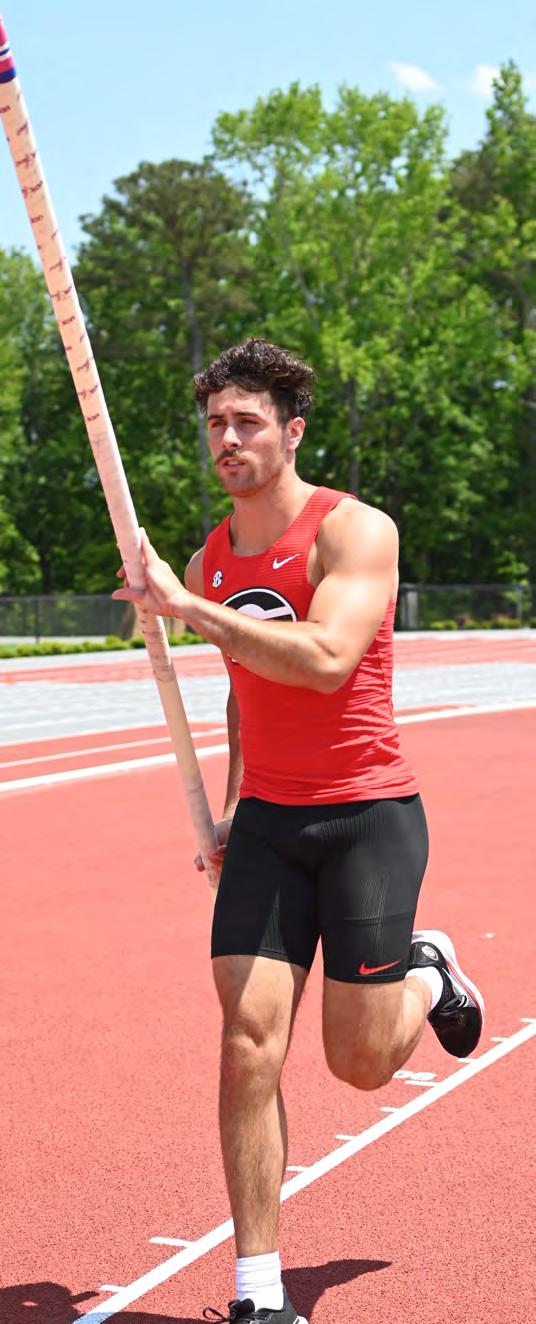
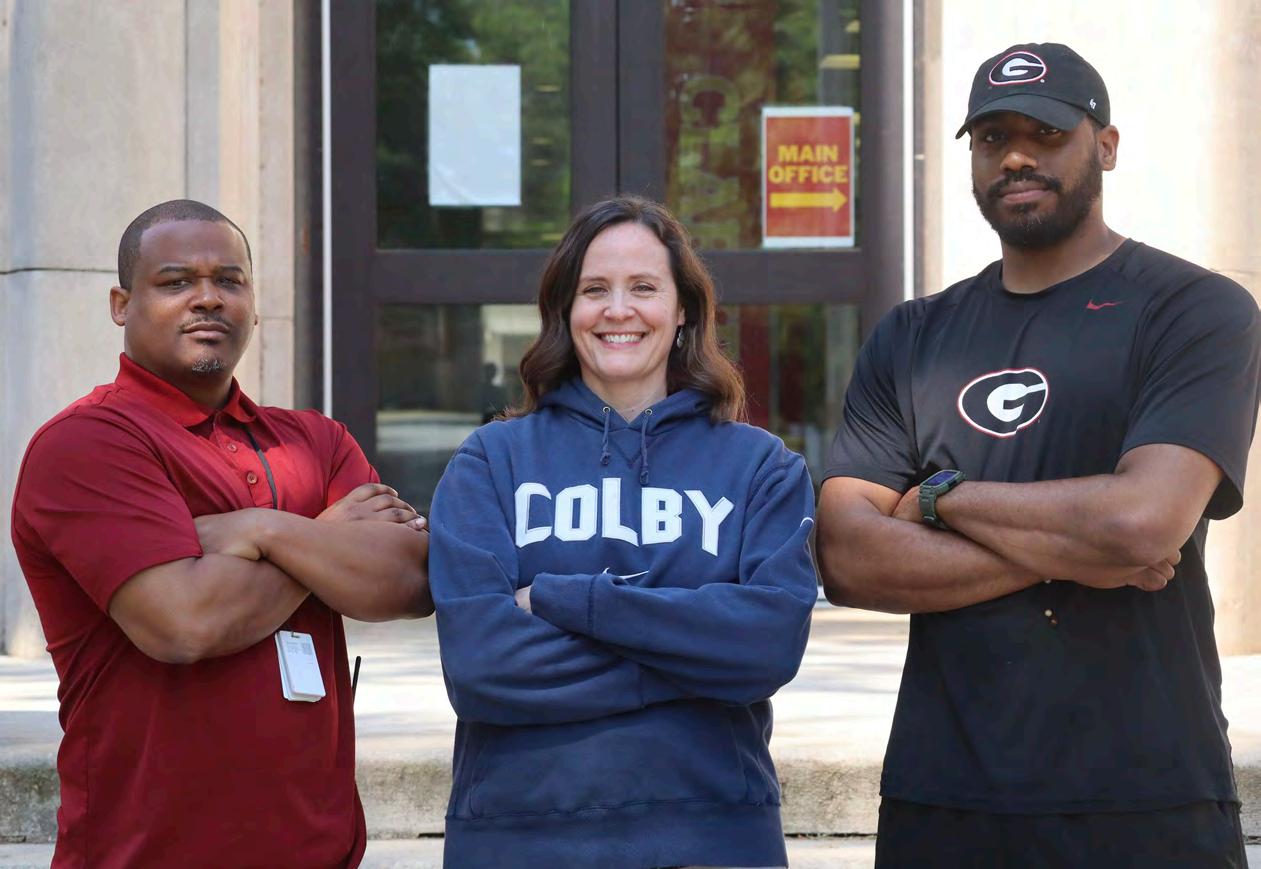
College
STORY AND LAYOUT BY LIYA TAYLOR Sports Editor
SDivision I, II and III universities compete in the same sports, but
ports don’t always fade after high school. For some athletes, they become even more important. But being a collegiate athlete looks very different depending on the level.
While other organizations provide opportunities for athletes to continue playing, according to U.S. Sports Scholarship, the National Collegiate Athletic Association is the largest and most well-known governing body for college sports in the U.S. With 24 sports and over 1,100 schools, college athletes within the NCAA are divided into three main levels: Division I, Division II and Division III. These divisions are separated by factors such as school size, funding, scholarships and level of competition, making their differences substantial.
The recruitment process reflects one of the biggest differences between the three divisions: scholarships. At the DI level, schools can offer full-ride scholarships covering tuition, housing, meals and other costs.
“Being able to get your education for free, halfway (or) three-fourths paid for, and still playing a sport that you love, that’s a win-win.”
– JOSHUA DAWSON, Former DI University of Georgia football player
“(The) amount of money that you can get from a DI school is through the roof,” Clarke Central High School varsity football defensive coordinator Joshua Dawson, a former DI University of Georgia football player, said. “Being able to get your education for free, halfway (or) three-fourths paid for, and still playing a sport that you love, that’s a win-win.”
On average, DI athletic scholarships range from around $14,000 to $18,000 or more per school year. In top DI programs such as Stanford University or the University of Texas at Austin, numerous athletes receive full-ride scholarships, especially in revenue sports like football or basketball.
“Many times, the desire to play at the next level leads a young person down a path of taking on some debt in order to play. But non-athletes who go to (that same) college, a high percentage of those take on debt too,” CCHS Athletic Director Dr. Jon Ward said. “(But with) DI, you’re not only not taking on debt, you’re now earning money.”
“(Imagine) I’m a DII kid, then go (to an in-state school), go walk on for free. That first year may be a little bit of a struggle. It makes no sense, in my opinion, to advise a kid to go to a DII school out of state, and end up paying to play.”
At the DII level, athletic scholarships are much smaller and often split among multiple athletes, averaging around $5,000 to $8,000 per year. This means most DII athletes, especially out-of-state, still pay a portion of their tuition, often more than DI athletes do, although they can still lower their college costs through academic scholarships or in-state tuition.
“(Imagine) I’m a DII kid, then go (to an in-state school), go walk on for free. That first year may be a little bit of a struggle,” CCHS Assistant Principal Terry Liggin, a former DI Eastern Kentucky University football player, said. “It makes no sense, in my opinion, to advise a kid to go to a DII school out of state, and end up paying to play when I can go (to an in-state smaller school) for free when I add all my money.”
While the DII level typically offers partial scholarships covering a portion of those costs, DIII schools do not offer any athletic scholarships. However, according to CCHS world language department co-chair Emily Hulse, a former DIII Colby College swimmer, DIII coaches have an informal influence over who receives academic scholarships.
“(Recruitment) is not something (DIII schools) have scholarship money (for). Although no one’s ever told me this for sure, the rumor is that coaches influence who gets a little extra money academically,” Hulse said. “Anybody can join (DIII teams. My team) had people with various degrees of ability, but (although) it didn’t consume my life, it was still a big-time commitment.”
Because of this, figuring out where to continue an athlete’s athletic career is not just about skill but also about finding a program that fits them financially, not only at the time of their decision, but also with their future in mind.
“The average car payment, give or take, is probably $250, but if I wanted a nice car (now it’s) $400-600. Well, if you don’t have student loan debt, you can get that nice car,” Liggin said. “It’s your decision in the end. But, kids need to understand what this is gonna do to (them) when they leave.”

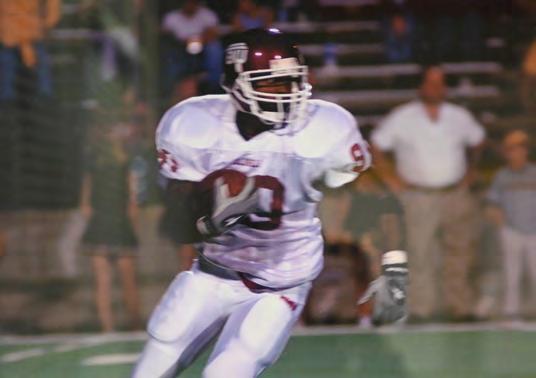
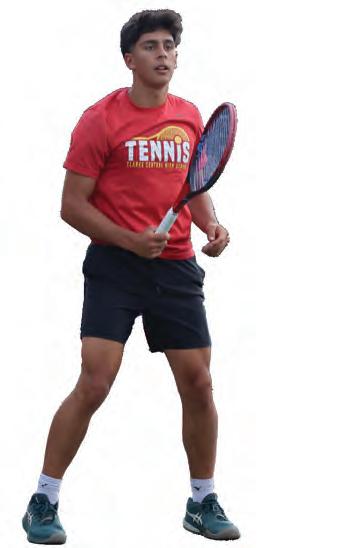
Grade: 9
GPA: 3.6
Years of experience: 2
Gameday rituatal: I listen to Lil Baby. Anything by him really gets me lit and allows me to lock in.
Favorite memory: (My favorite memory was) when I changed my event to 300-meter hurdles and went on to get first place in the next meet.
Role model: My mom, because I’m a multi-athlete (in volleyball and track), so she has to do a lot just for me to get places, and that’s a good role model.
What teammates say: “Taylor has the opportunity to be exceptional on the track as a freshman. If she decides to put hard work in and makes sure that she is proactive with getting (time) on the track, she will do well. This year she’s been able to drop her times in both 110-meter and 300-meter hurdles fairly fast with her form improving, as well.”
– Head girls varsity track and field coach Alexis Hunter-Lonon
ODYSSEY Star Players are selected based on their academic standing and commitment to teammates, their sports program and Clarke Central High School. Star Players are written for each issue by the Sports Staff based on interviews with players and coaches.
Grade: 12
GPA: 4.1
Years of experience: 12
Gameday rituatal: I listen to specific music artists, mainly Drake and Lil Baby. We also have a team huddle before each match. Another thing is we eat cookies from (varsity tennis assistant) coach (Evan) Adams’ mom.
Favorite memory: My favorite memory was when we won the Region 8-AAAAA championship for the first time (in) my sophomore year. It was the first region championship in 40 years, so we were all super excited when our singles won, so we rushed the court.
Role model: My tennis role model is (Serbian professional tennis player) Novak Djokovic because he’s the most complete player, and he’s also the best in practically every field regarding tennis.
What teammates say: “Despite (Noah) already being an incredible player, in my mind, he’s also the most improved player we had from last year to this year. That took so much pressure off of the rest of us, knowing that we just go out there, trust him, and no matter what, he can fight.”
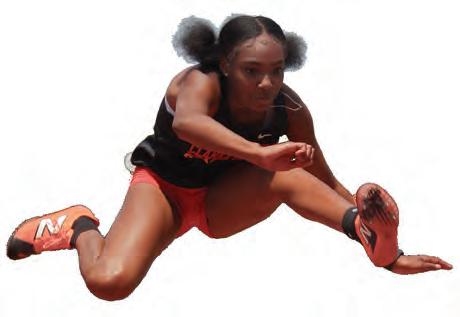
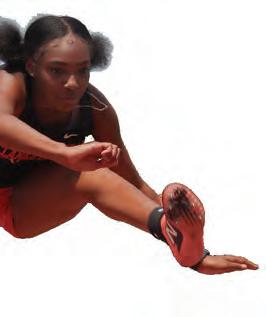
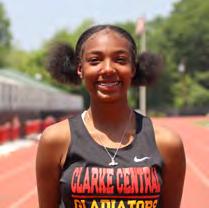
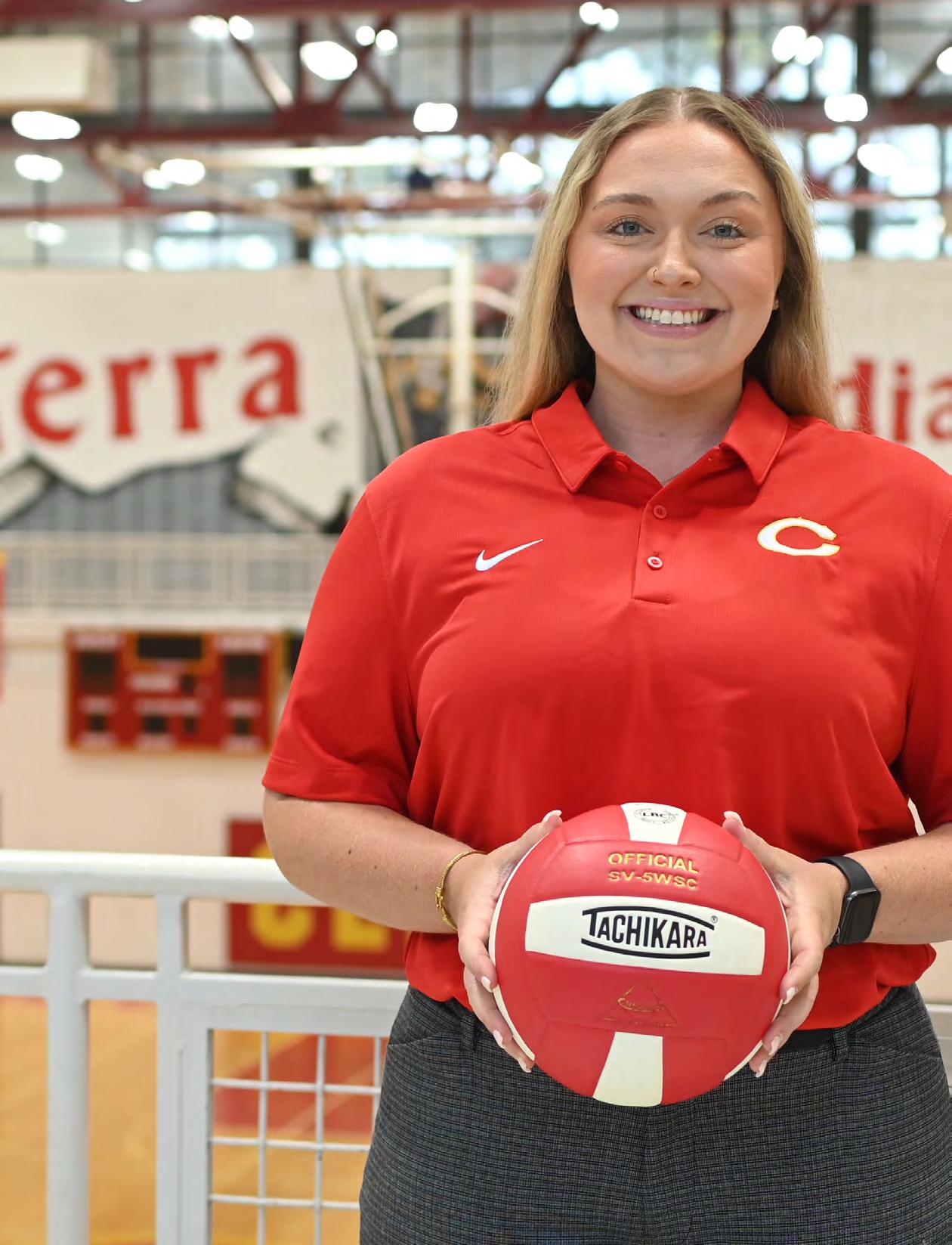
I’m not originally from Georgia. I was born in Dothan, Ala., and my family is in full-time ministry. We moved to Montgomery, Alabama, when I was 4 years old to help with a previous church we were a part of. I spent a lot of my life there, until December 2025. I went through elementary, middle and high school, all in Montgomery, Ala., and then eventually into college, as well.
I graduated from Alabama State University in December 2025. I played there for four years. It’s a Division I Historically Black College and University in Montgomery, Alabama. I graduated high school in 2020, and because of the COVID-19 pandemic, I had an extra year of college, so I played for four years. (In) the fifth year, because of a lot of injuries I had, I did some student coaching instead of playing.
I would say one thing (about coaching) that many people don’t tell you is, in all transparency, that coaching and playing the sport is completely different. It is 100% different. I think that’s what a lot of coaches struggle with when they start.
I’m really looking forward to establishing culture. I think that’s something that I bring (to the team). I come from a very strong, structured background, and (in) my collegiate experience, my previous coach was really big on establishing culture, and I fully understand that culture takes time to establish, but it needs to start.
(Sports are) exciting if you love what you’re doing and (are excited) about the family and the culture. I love that because I think that’s very important, because sports teach you about life. If you’re not teaching your athletes about life, you’re really not setting them up for success.
Local, trusted, and deeply invested in building relationships for the long haul.