









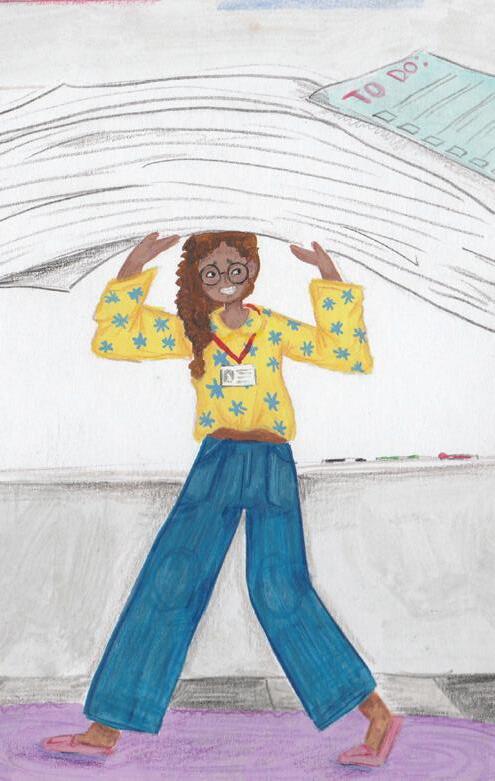
High workloads and policy failures are driving a special education teacher shortage as teachers still try to give their students everything they need.
BY PETER ATCHLEY
Cover
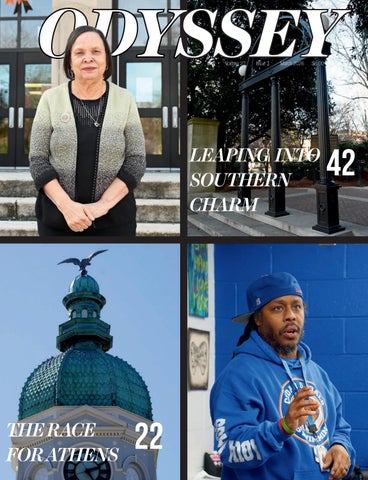
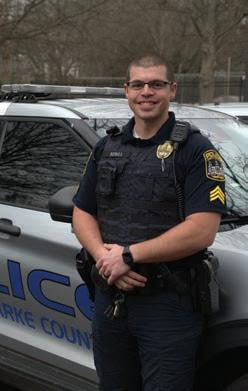
The Moon-Killian building, where the Athens-Clarke County police substation is located, has served the Athens community for over 20 years and retains the important history of the ACC Police Department.
BY LUCCA FLEENOR
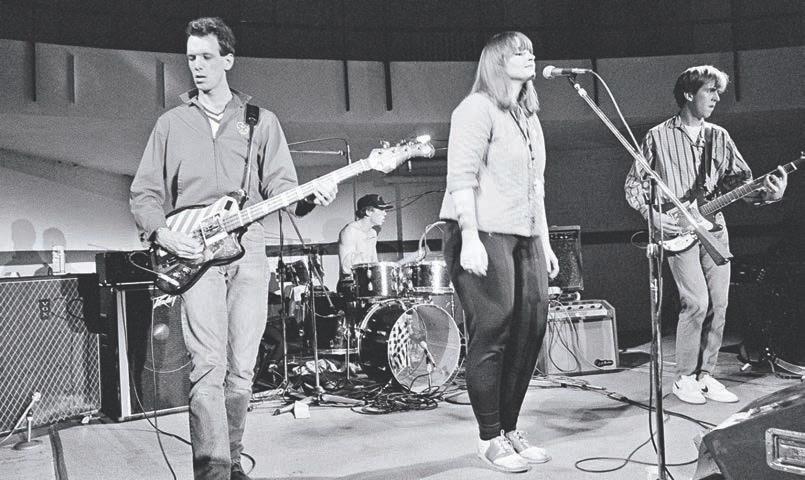
The Athens music scene is ever-changing with focuses spanning across genres, from hip-hop to jazz to indie rock.
BY ELOISE LUKEN
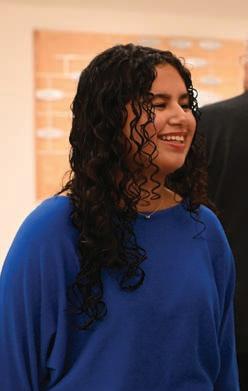
Variety Staffer Cesia Martinez, a Christian, writes about her experience going to a Shabbat service at the Congregation Children of Israel.
BY CESIA MARTINEZ
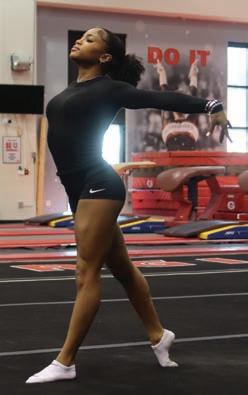
University of Georgia gymnast Nyla Aquino shares her experience with the cultural differences of the South after moving from Boston.

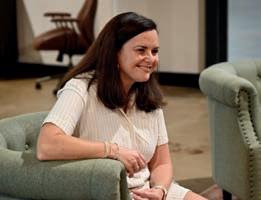
News Staffer Sasha Barkan reflects on how her experiences in Girl Scouts have shaped her life.
BY SASHA BARKAN
The ODYSSEY is a studentproduced news publication, published with the intent to inform, entertain and give voice to the Clarke Central High School community, as well as to educate student journalists.
Established in 2003, the ODYSSEY is published four times a year, and each issue is an open public forum for student expression under the guidance of a faculty adviser.
Print Editor-in-Chief: Liza Larson
Digital Editor-in-Chief: Lea D’Angelo
Managing Editor: Peter Atchley
Senior Copy Editor: Cooper Jones
Viewpoints Editor: Isabella Gresham
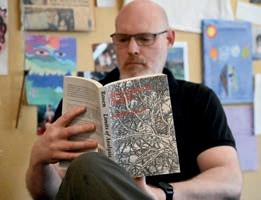
CCHS English department teacher Ian Altman’s curiosity shines through in his teaching, influenced by a lifetime of education and philosophy.
BY IZZY HAMMOCK
Since nonprofit organization Lydia’s Place was founded by motivational speaker April Farlow in 2017, it has grown into a program fully committed to meeting the needs of those aging out of the foster care system.
BY LEA D’ANGELO

Athens Youth Development
Initiative Director Chris Hulse discusses the organization’s purpose and its goals moving forward.
AS TOLD TO ADAH HAMMAN
Student journalists are provided with opportunities to investigate, inform, interpret and to evaluate: all traditionally accepted functions of the press in America. Published opinions do not necessarily reflect the views of anyone other than the staff.
The ODYSSEY staff is committed to reflect the mission statement set forth by Clarke Central High School. The goals of the staff are to provide fair, accurate news and commentaries, as well as to serve the interests of the school and Athens’ community.
Advertising must conform to the guidelines set forth for editorials. Publication of advertisements does not indicate an endorsement by CCHS or the ODYSSEY staff.
Students pictured in advertisements are not given monetary compensation. All advertising rates are available upon request from any ODYSSEY staff member.
The ODYSSEY is a member of the Columbia Scholastic Press Association, Georgia Scholastic Press Association, National Scholastic Press Association, Quill and Scroll Honor Society and Southern Interscholastic Press Association.
Corrections of errors and omissions will appear in the next issue.
News Editor: Emlyn McKinney
Variety Editor: Adah Hamman
Sports Editor: Liya Taylor
Photography Editor: Illiana Tejada
Business Manager: Merren Hines
Social Media Coordinator: Edie Ash
Beat Editor: Izzy Hammock
Menu Editor: Lydia Rowell
Outreach and Alumni Coordinator: Gillian Williams
Diversity and Representation Editor: Samaya Ellis
Staff Members: Abigail Holloway
Cesia Martinez
David Wang
Dream Freeman
Eloise Luken
Kye Streetman
Lucca Fleenor
Maypop Wren
Miriam Silk
Mzée Pavlić
Sara Stuart
Sasha Barkan
Adviser: David A. Ragsdale, CJE
ODYSSEY Newsmagazine
Clarke Central High School
350 S. Milledge Ave. Athens, Georgia 30605
(706)-357-5200 EXT. 17370
Our Jan./Feb. 2026 issue featured an in-depth story about the boys varsity basketball team and it’s growth.
Corrections/Omissions Jan./Feb. 2026
All dates should be followed by “2025”
Page 6, in Letter From the Editor, comma after Ashley Larson in caption
Page 6, in Letter From the Editor, should say “Liza” instead of “Larson” in second sentence of caption
Page 7, in Boiling Point, in second quote (Robbie) should be omitted
Page 9, in Isa’s Ideals, after first reference, Chickfil-A should be CFA
Page 10, in Question of the Month, Za’shun’s answer should say “Grinch” instead of “Gring” Page 10, in Question of the Month, Nightmare should be capitalized in “Nightmare before Christmas”
Page 10, in Thumbs, CCSD should be spelled out first reference
Page 11, in Digital Footprint, News Staffer should be capitalized in caption
Page 12, in Paws and Lessons, “Eventual -ly” should be “eventually”
Page 16, in ESOL Expansion, in the caption box “in fron of” should be “in front of”
Page 24, in Who is Dr. Jennifer Scott?, “Our views compliment” should be “our views complement” Page 25, in Who is Dr. Jennifer Scott?, in the caption, “appreciate Scott’s kindness” should be “appreciates Scott’s kindness”
Page 40, in In her DNA, in the Featured caption box, it should say “despite it being HER first time ever playing” instead of “despite it being THE first time ever playing”
Page 40, in In her DNA, there should be a period after “Peel said”
Page 47, in 5 Things to Know, caption should say “Clarke Central High School varsity swim and dive swimmer Patrick Coverdill, a CCHS sophomore, swims at the University of Georgia Ramsey center. Coverdill has swam with the CCHS varsity swim and dive squad since he…”
Contact the ODYSSEY
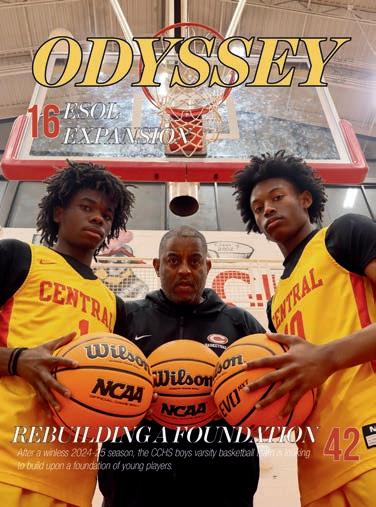
I”really enjoyed reading this article because it showed me how the spirit of the Clarke Central High School basketball team has not faded away. Even though going 0-25 last season we still have hope and this hope is what drives the team. I also really liked how it got both the viewpoints of the coach, and some of the players that are on the team. I think the story overall is very good.
”-- Ergi Pirra, CCHS junior on “Rebilding a foundation” by Cooper Jones
Letters: Email us at editors@odysseynewsmagazine.net, or drop off in the Main Office, in care of the ODYSSEY. We ask that all letters be under 250 words and signed. We reserve the right to omit or edit any letters received. Insulting, unsigned or libelous statements will not be considered for publication. All letters may be edited for clarity and space.
Advertising: For ad rates email us at business@odysseynewsmagazine.net.
Online: Message us on Instagram at @odysseynewsmag.
ISA’S IDEALS // Isabella Gresham,
“Isa’s Ideals” showed how important it is for students to take on responsibility, both in school and in working. Hearing both the positive and negative aspects can help you feel validated and be optimistic as you join the workforce. Through the use of personal stories and everyday details, the article really draws you in and makes you feel connected to her experience.
-- Lydia Haag, CCHS sophomore
GETTING COMFORTABLE // Liza Larson
I agree with the author especially because this is an important cause and it is something important to write about. I like how the author included lots of statistics and data, that always makes the point more clear. Also, the way that this entire article was worded and the way it explained the topic really helped me understand. Overall, this was a very well written article and it really helps you understand the importance of this cause.
--
Evey Freeman, CCHS freshman
QUEST FOR ATHENS' BEST // Eloise Luken and Cesia Martinez
“Cocoa Clash” gives honest and specific insight into two local coffee shops hot chocolate. I like how the location and ambience of both locations are accounted for in the ratings, as that is very important to me personally, as well as the seating availability. I also felt the detailed descriptions of the drinks themselves like the richness and foam were very helpful in explaining the given ratings. The authors effectively summarized the highs and lows of each hot cocoa and helped me decide where I might try going next.
--Guy Smolik, CCHS senior
SWIMMING TOWARDS SUCCESS // Liya Taylor
I thought “Swimming Towards Success” was a great introduction to Clarke Central’s new swim coach. I think readers really got a good sense of who Coach Simonds is, his connection with Clarke County Schools, and his experience with the sport of swimming and diving.
-- Emily Hulse CCHS world languages department teacher
Print Editor-in-Chief Liza Larson contemplates her experiences growing up as a Southerner and what they mean for her identity now.

BY LIZA LARSON
Editor-in-Chief
Igrew up in a Southern family where everything seemed to come with an expectation. Stories, jokes, even the way we said, “Yes, ma’am” and “No, sir” carried a meaning I didn’t always understand.
There were unspoken rules about respect, about how to greet people, about how long to hold eye contact and when to look away. Hospitality wasn’t optional, it was instinct. You stood when an adult entered the room. You brought a dish to a neighbor in need. You never embarrassed your family in public.
I just thought it was life, ordinary, unquestioned, universal.
Now, I realize those patterns shape how I think, act and approach the world, even when I try not to let them. They surface in small, almost invisible ways. I instinctively apologize when someone bumps into me. I soften criticism so it doesn’t sound harsh. I worry about how my tone might be perceived.
creeps in without warning. I hold doors open. I say, “Bless your heart” and know exactly how layered that phrase can be. Sometimes it’s comforting, like a part of me I didn’t know I needed. Other times, it frustrates me, a reminder me that no matter how far I go, the habits and values of my Southern upbringing are still stitched into me.
That stitching shows up in moments of conflict. When a conversation grows tense, my instinct is to ignore, to preserve harmony at all costs. I was raised to believe that politeness could fix almost anything, that raised voices signaled failure.
But as I’ve grown older, I’ve learned that honesty sometimes requires discomfort. Balancing those lessons, civility and candor, can feel like walking a tightrope.
It’s a strange push-and-pull. I value the emphasis on community, the way gatherings stretch for hours because no one wants to leave. I appreciate the discipline of showing respect, even when it’s inconvenient. At the same time, I question the expectations that feel limiting, the pressure to conform, to avoid controversy, to prioritize appearance over authenticity.
I’m learning that identity is not a clean break from the past. It’s a negotiation.
These habits aren’t random, they are learned responses, polished over years of watching and listening. What once felt like simple manners now feels like a blueprint I carry with me.
As I’ve gotten older, I’ve wanted to step away and make my own choices without the weight of family traditions. I’ve wanted to test the edges of who I am without hearing an echo of who I was raised to be. I wanted to speak my mind with no regard for manners, to make decisions that were mine alone, without imagining how they would be received at the dinner table or discussed after church. I thought I could leave it all behind, like a place I had outgrown.
But I can’t.
The South, for me, isn’t just a region on a map. It’s muscle memory. I slip into more often than I expect.
A phrase, a way of saying something politely, a reflex to smooth over tension
I’ve learned that resisting doesn’t mean erasing. I don’t have to escape my roots to be myself. Instead, I can notice when I slip back in, decide what I keep, and let the rest fall away. Independence doesn’t require rejection, it requires discernment. It means choosing which traditions align with who I am becoming and which ones no longer serve me.
I’m learning that identity is not a clean break from the past. It’s a negotiation. I don’t have to choose between the person I’m becoming and the family I came from. Both parts can exist at the same time. The traditions that once felt restrictive can also be resources, reminders of resilience, loyalty and care.
Being Southern isn’t something I can fully walk away from. It’s in my vocabulary, my instincts, my sense of responsibility to others. But I’m figuring out how to carry it without letting it define me. And maybe that balance, between inheritance and independence, isn’t a contradiction at all, but a sign that I’m growing into something that is entirely my own.
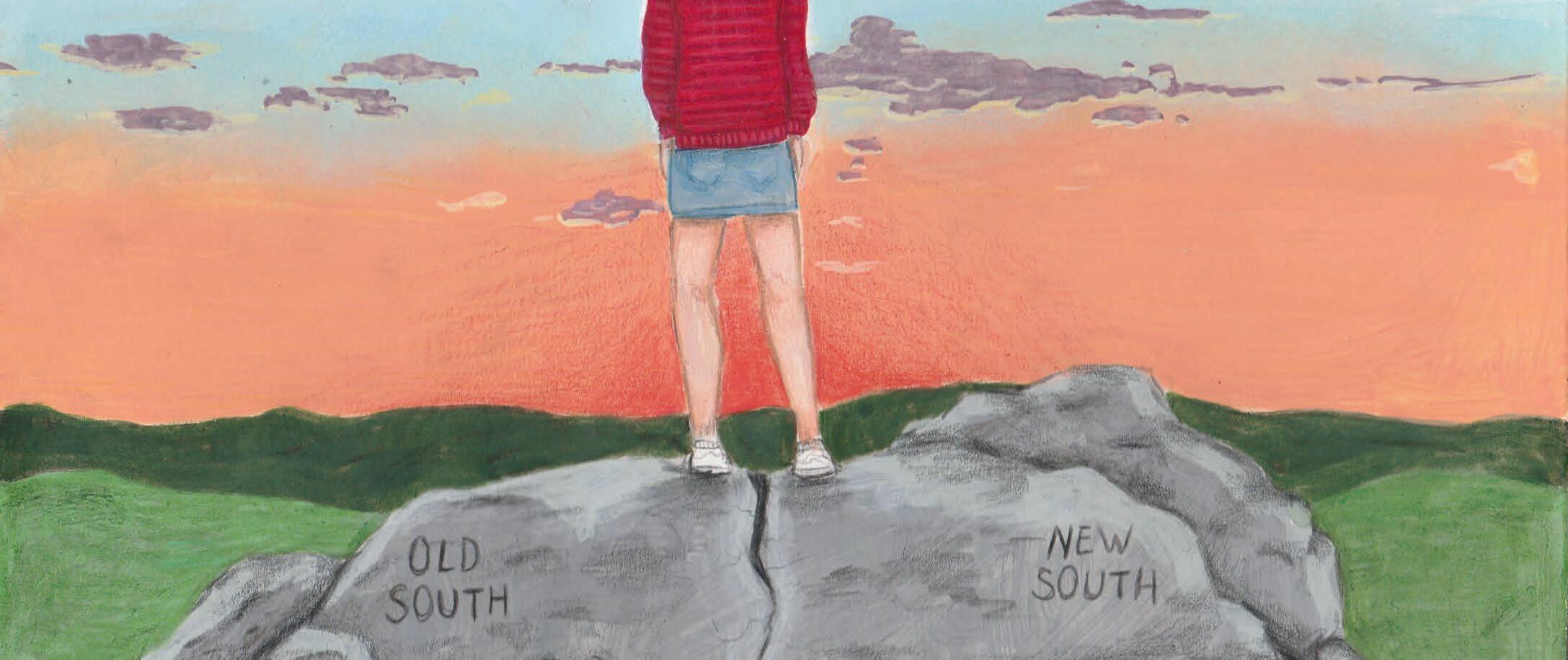
Digital Editor-in-Chief Lea D’Angelo discusses her experiences moving to the South at 7-years-old and how it contrasted her Northern uprbringing.

BY LEA D’ANGELO Digital Editor-in-Chief
I‘ve spent more time living in the South than I have out of it, and yet I can’t seem to call myself “Southern.”
Maybe it’s my inability to casually use the word “y’all” without instantaneously feeling awkward. Or maybe it’s my characteristically Northern distaste for grits and confusion about the seemingly absurd number of chicken restaurants within the 125 square miles of Athens.
I was born in Allentown, Pa., about an hour outside of Philadelphia, and moved to Mankato, Minn. when I was almost 4-years-old. Then, halfway through second grade, my family moved to Georgia.
I don’t know what I expected when we moved to the South. All I remember is my parents’ explanation of the importance of using “ma’am” and “sir” when addressing adults, a practice I quickly adapted, and can’t seem to shake, despite my struggles with the aforementioned “y’all.”
But, beyond that, the differences were things I hadn’t known to expect. The first, and probably largest, was Southern hospitality.
The slights were subtle: a tilted head at the mention of the LGBTQ+ community. A casually thrown “bless her heart” that carried more judgement than concern. As I grew up, I also became more aware of the beliefs that contradicted my own, and of the polite manners that masked them.
I was exposed to other, more positive, beliefs, as well. Upon moving to Georgia, I quickly learned that invites to Youth Group and Vacation Bible School were common, activities that had been few and far between in the North. I had grown up going to Catholic church with my family and was even in the process of receiving my First Communion at St. Joseph Catholic Church, but sitting through Bible studies seemingly so different from the studies I went to every Wednesday night taught me how to understand traditions different from the ones I had known.
Another tradition I hadn’t expected? Football. Saturday nights were now reserved for college football.
That “yes ma’am” and “no sir” came out in full force in the extended periods I spent at my neighbors’ and friends’ houses. But what my parents and I quickly learned was that the manners were often reciprocated but not always real. In the nine years I’ve spent here, I’ve encountered kindness and honesty more times than I can count. However, there’s also the harsh truth: the large right-leaning conservative populations of the South and acceptance don’t always mix well.
Another tradition I hadn’t expected? Football.
I had grown up near Minnesota State University and would watch football with my parents on TV occasionally, but nothing could prepare me for the college football scene of the South, especially Athens. It was more than a hobby, it was a lifestyle, a cornerstone of Southern culture. During my family’s first week here, we had gone to one of my dad’s coworker’s houses for a welcome dinner and walked out with a documentary about the history of the University of Georgia. Saturday nights were now reserved for college football.
In my time in the South, I’ve developed both an awareness of the less-than accepting sides of Southern culture, but also the ones that have brought me in with open arms, shaping parts of my identity that cannot be undone. Maybe one day I’ll think of myself as “Southern.”

High workloads and policy failures are driving a special education teacher shortage, as teachers still try to give their students everything they need.

BY PETER ATCHLEY Managing Editor
In 1975, the Individuals with Disabilities Education Act (IDEA) was passed in the United States, guaranteeing every student with a disability free and accessible public school education.
But over five decades later, school leaders across the nation are reporting difficulty in staffing their special education departments. Roughly three-quarters of public schools reported in a survey that hiring certified special education teachers was a struggle during the 2024-25 school year, according to the Institute of Education Sciences, the statistics center of the U.S. Department of Education.
The result of this struggle?
Students with disabilities are not getting the instruction and services they were guaranteed due to high teacher turnover rates. When the properly certified teachers are stretched so thin that they can’t help all their students, educational needs are not met.
Additionally, the district has set up a system to provide monetary retention incentives depending on the amount of support needed by students in the class, current position and certification. This effort has paid off for the CCSD, with no vacancies in special education for the last two school years, according to Henry.
The weight of the workload is felt especially by those new to the field of special education, since it can be difficult to grasp all that is asked without the proper support from in-school faculty and government officials.
Amidst the U.S. government shutdown in October of 2025, the Trump Administration announced the firing of dozens of employees working in the U.S. Department of Education’s Office of Special Education. These employees oversee roughly $15 billion in funding and services for 7.5 million students with disabilities.
Students with disabilities are not getting the instruction and services they were guaranteed due to high teacher turnover rates.
While the student-to-teacher ratios may be better at Clarke Central High School, with 275 students of varying levels of required support being supported by 25 dedicated special education teachers and 10 paraprofessionals, not every district is so lucky.
The leading causes of this turnover includes heavy workloads, long meetings and the writing of Individualized Education Plans (IEPs), a legally binding document of a student’s educational needs, goals and accommodations for them to succeed.
“There’s paperwork for the job of writing IEPs and staying compliant with (government regulations), that’s the part that can run people off, especially for people that have never been in education,” Clarke County School District Executive Director of Exceptional Programs Jacinta Henry said.
To improve teacher retention and training, before the first semester of the 202526 school year began, Henry hosted a guided two-day onboarding workshop to ensure all special education teachers have the right skills.
While the exact impact of these firings is unknown at this time, the impact of special education teachers not receiving support is felt daily. The proper support includes tailored professional development on effective instructional strategies and assistive technology like augmentative and alternate communication devices, as well as available resources, such as classroom aides and IEP-writing resources or mentorship.
“(Special education teachers) have all the same requirements as every other teacher and (more),” CCHS Assistant Principal Everett Nealy said. “(The CCHS Administrative Team) is pushing for things that hopefully we can implement over the next couple of years that will help reduce that workload of our teachers and make it a more welcoming environment.”
If retention incentives were paid by the government, not only would local districts like CCSD be able to allocate funds to other programs while still paying teachers what they deserve, they would retain teachers just the same.
These teachers need resources and support from their districts and government so they can continue to go above and beyond to teach their students. It was guaranteed 50 years ago for every student, but teachers still fight for it now.
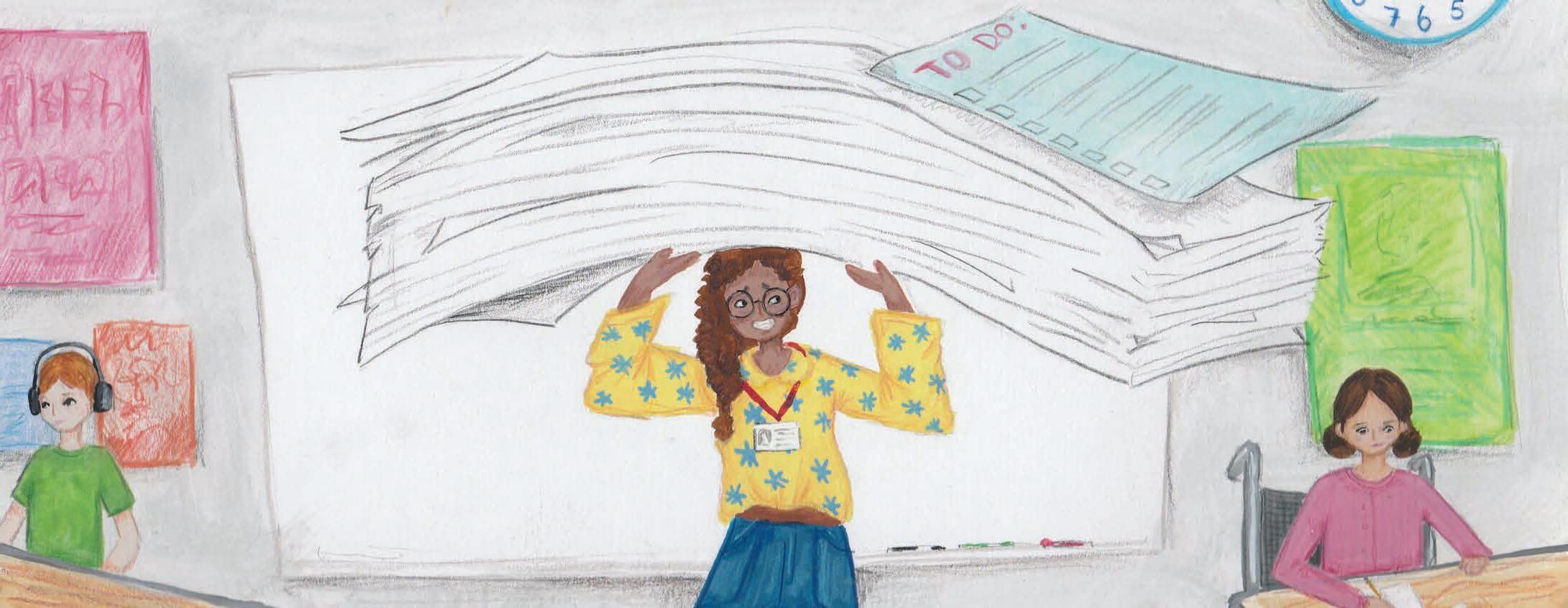
While the South’s history is forever tainted, Southern education and authors continue to work beyond the negative stereotypes and attitudes towards the South.

BY ISABELLA GRESHAM Viewpoints Editor
“You have a distinctive Southern drawl. You must be stupid.”
That stereotype, and many worse, are consistent in the world’s mind when they discover someone from the American South.
Being credited with Southern hospitality, renowned authors, iconic music genres and infinitely more, being from the South is made out to be a curse rather than a blessing. The second someone from another region hears that sweet Southern accent or notices someone’s kind Southern manners, their mind fills with baseless stereotypes forever rooted in a complicated history.
Stemming from before the Civil War, the South was infused with hatred, slavery and racism, leading to a forever tarnished reputation. Even after progressive movements, like the fight for women’s suffrage and the Civil Rights Movement, and the countless efforts of Americans to reverse the horrid past, the media has clung to this outdated narrative and made it near impossible to counter.
According to a report conducted by the nonprofit organization Economic Policy Institute, in 2023, the poverty rate across the South was 12.4%, whereas it was 11% in the West and 9.8% in the Northeast and Midwest. Still, despite being poorer than other regions, great contributions to the world have been made within the South.
With the first state-chartered public university in the United States, the University of Georgia, being in the South, influential American author and Civil Rights Activist Maya Angelou, widely-loved blues music and more all originating in the deep South, its poor history is acknowledged, but overridden.
Perpetuating the stereotype that everyone in the South is unintelligent, despite its multitude of talented people will forever do more harm than good. Judging someone based on their accent rather than their accomplishments simply uncovers prejudice rather than providing an accurate assessment.
Judging based on accents rather than accomplishments is never an accurate assessment.
While it is necessary to acknowledge the shortcomings of Southern history, dwelling on them and only regarding the South as a place of negativity diminishes the value of the work those have put in to progress.
“Southerners have done amazing things and in some ways, the poverty, the racism (and) the struggle creates people. We know the name Martin Luther King Jr., because of what he accomplished. The brutality of the South has created exceptional people, and those things go hand in hand,” Dr. R.J. Morgan, University of Mississippi Instructional Associate Professor and Director of the Mississippi Scholastic Press Association, said.
Beyond the intolerances that plagued the South, poverty runs deep in its roots. Education by default has struggled because of this, leading to a large number of poorer school districts.
Usree Bhattacharya, Associate Professor in the language and literacy department at the University of Georgia Mary Frances Early College of Education, has endured this with her daughter, Kalika Bhattacharya, who has Rett Syndrome, a neurological disorder causing regression in motor and language skills.
“I’ve learned firsthand how society confuses different ways of communicating with lack of intelligence. Kalika communicates through a sophisticated repertoire that includes eye gaze, vocalizations, body language and assistive technology. She’s brilliant, but people who expect verbal speech often fail to see her intelligence,” Bhattacharya said.
The place a person is born in or their tone of voice should never be a defining factor of their intelligence. While the South’s past is filled with ugliness, the hurt stereotyping causes is irreversible.
Acknowledging Southern history and clinging to it are entirely different. Southerners are constantly working to prove themselves beyond these stereotypes but can only do so without the constant reminder of a treacherous Southern past.

Left: SOUTHERN SHORTCOMINGS:
An illustration depicts common characteristically Southern features in Southern states. Defined by unintelligence, poverty and poor history, the South’s reputation is forever tainted despite the work of various educational institutes, authors and professors.
“While it is necessary to acknowledge the shortcomings of Southern history, dwelling on them and only regarding the South as a place of negativity diminishes the value of the work those have put in to progress,” Viewpoints Editor Isabella Gresham wrote. Illustration by Sylvia Robinson

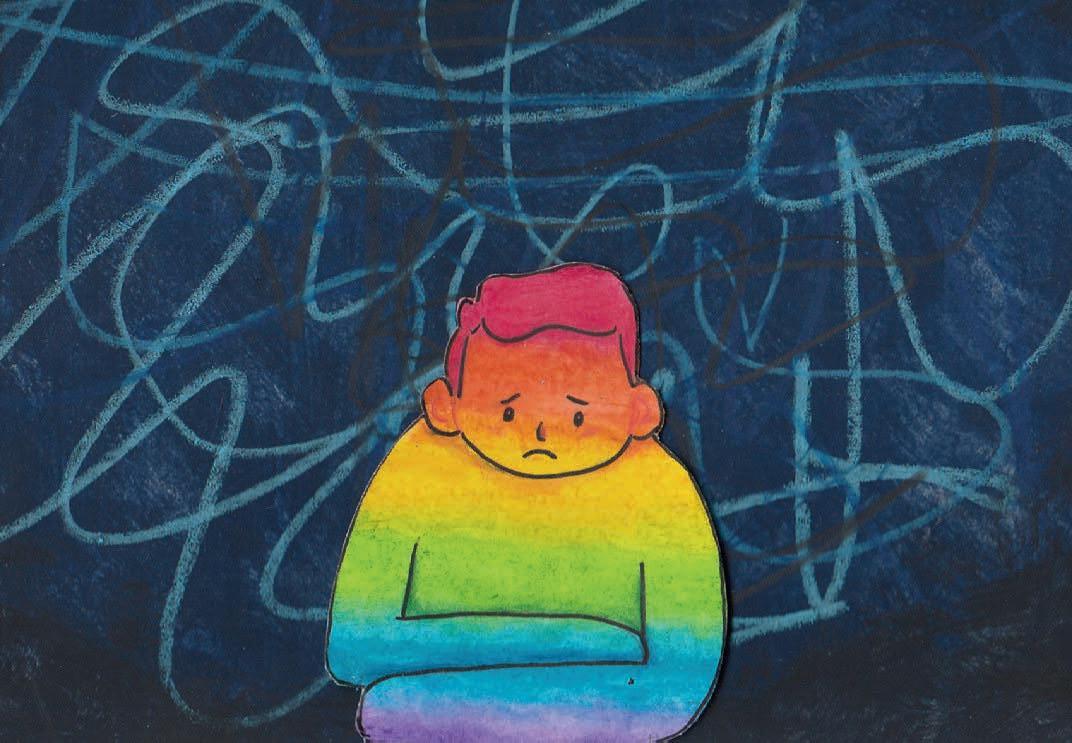
Lack of education and inconsistent allyship contribute to ongoing discrimination against LGBTQIA+ students in schools.
Homophobic language and attitudes are often brushed off as “normal,” but normalization doesn’t make them harmless and ignoring them won’t make them disappear. In school environments especially, this kind of discrimination can take root quickly, shaping how students treat one another and how safe they feel.
Schools themselves are not entirely to blame. Bringing together students from different backgrounds, beliefs, and upbringings is inherently complex. However, that complexity makes education even more important.
For Clarke Central High School mental health counselor Zadie JamesDriskell, the root of discrimination is clear, fear and a lack of understanding.
“A lot of your types of bigotry come from fear and lack of knowledge about that thing,” James-Driskell said.
Students in the LGBTQIA+ community often face that harm daily. While some individuals are willing to speak up, support is inconsistent. Advocacy tends to depend on personal relationships rather than principle.
““We do a great job (standing up for) people that we love, but I don’t think we do a great job if harm has been done to somebody that we don’t love,” Assistant Principal Terry Liggin said.
That gap leaves many students vulnerable. No one’s safety or dignity should depend on whether they have someone willing to defend them.
This issue extends beyond school walls. In March 2025, the University of Georgia removed “gender identity” and “sexual orientation” from its non-discrimination policy, raising concerns about increased vulnerability for LGBTQIA+ individuals in the Athens community.
Creating a more inclusive environment requires more than passive acceptance. It demands education, accountability and the willingness to stand up, not just for friends, but for anyone facing discrimination. Only then, can Athens-Clarke County become a place where all students feel safe and respected. O
If you could bring back any trend, what would it be?



“I’d bring, back the Mannequin Challenge because it takes me back to when I was five. It was (always) fun to do as a group.”
-- JACKSON RUSHING, CCHS freshman
“I think that we should bring back dabbing, like dabbing on the haters, because it’s such a fun thing to do. You just dab, and it’s a way to express your feelings through swag.”
-- ZAREMA DOURIS, CCHS sophomore
“I would bring back Musical.ly because I think it’s a lot more fun than TikTok. It’s a lot more dancing, and it was just less toxic, and I like it a lot more (because) I love music.
-- CLAIRE MURTHY, CCHS junior
“I’ll probably, bring back the 2016 Moonwalking trend (where) we would jaywalk across the school. I would bring it back because all the people in school will line up in a pair of Jordans, and they would (Moonwalk).”
-- KEWON BROWN, CCHS senior
“I would bring back the Analog trend, (which is) going back to not being on the phone so much. Instead of texting your friends, calling them, instead of sending texts, sending them a letter. Just unplugging a little bit.”
-- ENYA GRANADOS, CCHS science department teacher
Football serves as more than a game to watch on the weekends, it works to provide large sums of money to athletic programs and allows them to thrive.
The renaming of the Baxter Street police substation to the Moon-Killian Building, named after the first two African American police officers in Athens, both made history and left a lasting legacy.
The Southern music scene constantly changes from a variety of stories told through lyrics, allowing for a melting pot of sounds and the chance for a variety of musicians to flourish.
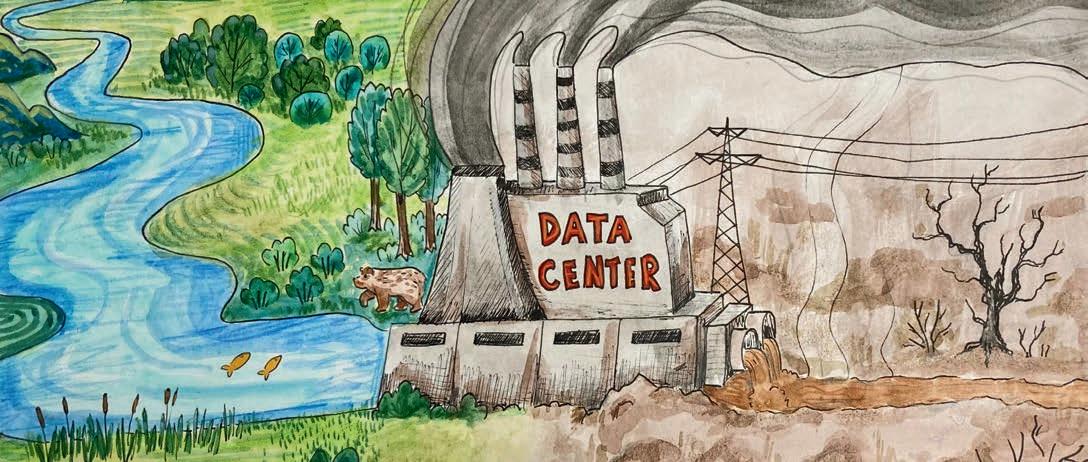
Though Artificial Intelligence is readily available, unregulated use leads to mass water consumption and environmental damage.
Homophobia in classrooms is prevalent and leaves students that are part of the LGBTQ+ community unprotected from discrimination.
With a complicated and painful history, the South has been regarded as lesser than, which diminishes the efforts of various Southern institutions and individuals.

Journalism I student Violet Dockery reflects on how she overcame her internal comparison with her younger brother.
When my brother was in kindergarten, he was advanced a grade. At only four years old, he could read whole books to his pre-K class. After his teachers started picking up on his advanced academics, I felt like all we talked about at home was how smart he was for his age.
I remember our parents coming home from the meeting where his teachers decided on his advancement, and I didn’t know how to feel. In my second grade brain all I could think of was that I was somehow inferior or less intelligent than him.
From that moment on, I felt the need to prove to others that I was just as smart or smarter than him. Beyond that, I felt the need to prove it to myself. My parents didn’t intend for us to be compared to each other, but as the older sibling, our academic comparison was something I did naturally.
Once I entered middle school, no one knew my brother had advanced a grade, and I didn’t feel like I was constantly being compared to him. I wasn’t worried about our differences, because I realized that the competition I had built in my head was far from what was really happening.
My brother had developed his love for sports, and I had focused on academics and music, and it became clear to me that after years of thinking we were being compared, every sibling isn’t going to be the same person. Between our hobbies and strengths, we began to grow into our differences.
As I got older, I came to realize the beauty of having siblings growing up is being able to have contrasting interests and strengths, while also having a relationship despite our differences. Although It took me years to realize, the challenges between siblings are not about comparison, but seeing the good in our differences.

On Feb. 14, couples find ways, some more cliche than others, to show their affection for each other, leaving the halls dazzled in balloons, candies and other gifts. While sure there are mixed opinions, there really is nothing to dislike.
Some say that Valentine’s Day is just an excuse to show off your significant other, but it’s actually a holiday people have spent showing affection for each other since elementary school. Valentine’s Day isn’t just for cliche couples and Instagram stories, but also a time to show affection to anyone you love.

BY GRADY DUNSTON Journalism I Facilitator
Love isn’t just reserved for your significant other, but also your closest friends, important family members and even yourself. It’s not the same kind of love, but Valentine’s Day is a great way to show appreciation to those who make your day better.
On top of the affection and value of gift giving, Valentine’s Day is a great excuse to spend time with your community. Places like Kilwins and Condor Chocolates often have limited time items and discounts throughout February and there are plenty of events that are Valentine’s themed in Downtown Athens.
Even those without a partner can enjoy the value of a Valentine’s gift from a loved one. Some families will even have their own gift exchange, typically gifting Valentine’s-themed candy and small trinkets.
Some people would argue that it just creates an obligation to be romantic with your significant other. In reality, it does not promote fake romance, instead it just puts aside a time to bond. Any other time, people are often swarmed with work, school, and other day-to-day chores, but Valentine’s Day gives time to center your attention on those who you share affection for.
Valentine’s Day brings friends, families, couples and any other loved ones together. Clearly, it is much more than just another consumerist holiday.


BY SARA STUART Viewpoints Staffer
Imagine walking into school on Feb. 14 and there’s balloons and candies and loud couples clogging up the halls everywhere while people are just trying to get to class.
Although it’s supposed to be a “special day” for spreading love, it’s really not. It isolates those without someone to spend Valentine’s Day with, and it rushes people into relationships with the “need” of finding a valentine.
Although single people can spend Valentine’s Day with their family or friends, it still creates a sense of feeling unwanted.
While it may be enjoyable for those with a partner, the holiday is a cruel reminder of loneliness and bad memories to those without one.
Even though Valentine’s Day was created to be a happy day filled with love and a time to be around those you care for, it adds salt to the wound for people without a partner to celebrate with.
Additionally, Valentine’s Day is outdated with continuous traditions and cliches. From the way that the movies frame this holiday, to how people celebrate it with loads of pink and red gifts, it’s just repetitive. Also, Valentine’s Day can turn into a way to peer pressure people with a partner.
If a couple doesn’t fit into these movie-perfect clichés like asking their partner to be their valentine or getting extravagant gifts for each other, the day can create jealousy and cause comparisons between their relationship and others around them.
After Christmas, for people with a partner, they’re most likely already drained and broke from gift giving, and Valentine’s Day coming up only adds stress. Valentine’s Day just gives an excuse to buy useless trinkets that typically won’t last or will be outdated by the time next Valentine’s Day comes around.

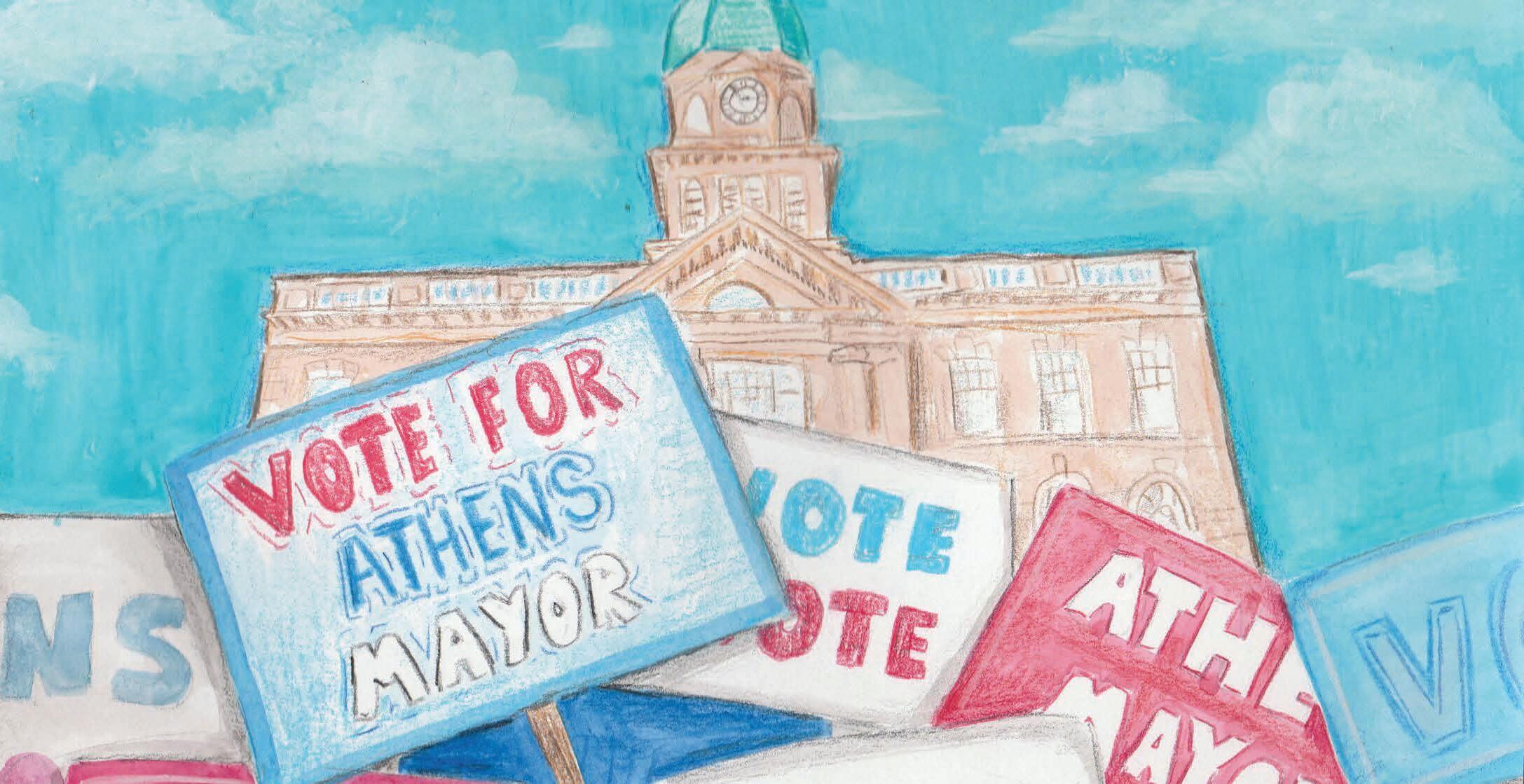
Low turnout in local elections shows the need for stronger civic engagement in
Local elections rarely generate the same excitement as presidential races, but their impact is often far more immediate.
In communities like Athens-Clarke County, the decisions made by local leaders shape everything from housing availability to public safety to the preservation of cultural identity. That’s why participation in these elections isn’t just important, it’s essential.
“The success of the community depends on local decision-making,”Current ACC Mayor Kelly Girtz said.
Unlike national politics, which can feel distant, local leadership determines the day-to-day realities residents experience. Whether it’s access to affordable housing, safe transportation, or economic opportunity, these are not abstract issues, they are lived ones.
Yet, despite this proximity, voter turnout in local elections tends to be significantly lower and ACC is no exception. Data from the county’s elections reports shows turnout can fluctuate dramatically, with some local or off-year elections seeing participation as low as around 27–28%, compared to over 75% during major general elections. Even recent local election cycles have struggled to engage voters early, in one 2024 primary, only about 6.6% of registered voters had cast ballots during early voting.
than just showing up, it means being informed about candidates, policies and realistic outcomes.
Another key issue is the complexity of change. Many of the challenges facing Athens, such as homelessness or housing affordability, cannot be solved overnight.
This long-term nature of policy can make it easy for voters to feel disconnected or impatient, but it also underscores why consistent civic engagement matters. Elections are not one-time events, they are part of an ongoing process that requires attention and participation.
Athens itself is a reflection of this complexity. Known for its arts scene, diverse communities and vibrant culture, the city is constantly evolving. Preserving what makes Athens unique while addressing growth-related challenges requires leadership with goals aligigned with their community.
Voting in local elections is one of the most direct ways individuals can influence their community’s future.
“The mayor must focus on casting a vision and using policy and collaboration to achieve it,” Girtz said.
But ultimately, that vision is shaped by the voices of the people who vote.
This gap highlights a clear pattern: the elections that most directly affect daily life often receive the least attention.
“Leaders must be honest about what is and is not in our wheelhouse,” Girtz said.
That honesty goes both ways, voters also have a responsibility to understand the role and limitations of local offices. Engaging in local elections requires more
Participating in local elections is one of the most direct ways individuals can influence their community’s future. It determines who sets priorities, allocates resources and represents the public’s interests. When turnout is low, decisions are made by a smaller, less representative group, limiting the diversity of perspectives that shape policy.
Engagement doesn’t end at the ballot box, but it begins there. If residents want a say in the direction of their city, they have to take that first step. Local elections may not always feel high-profile, but their impact is undeniable and their importance shouldn’t be overlooked.
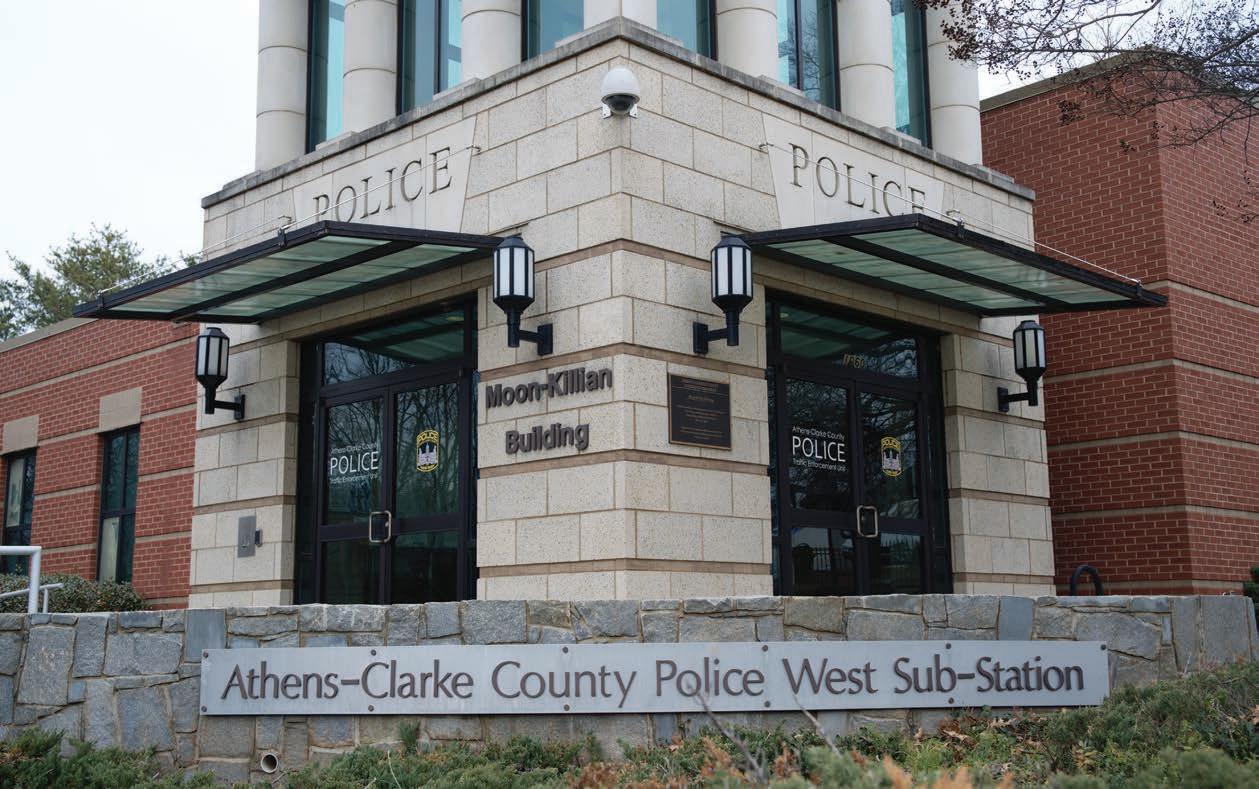
The Moon-Killian building, where the Athens-Clarke County Police West Substation is located, has served the Athens community for over 20 years and retains the important history of the ACC
Police Department.
History was made when the now Moon-Killian Building, which houses the Athens-Clarke County Police West Substation on 1065 Baxter St. was renamed after the first two African American police officers in Athens.
Following its construction in 2005, the police substation building was renamed after Athens-Clarke County Police Department officers Donald Moon and Archibald Killian in 2013 for their service and historical contributions to the Athens community. The original request for renaming the building was brought to the attention of the Clarke County Board of Education by a Commemoration Committee, led by Committee Chairperson Aurelia Scott, in April of 2013.
“Everybody I’ve come in contact with over my life talked about the difference my dad made,” James Killian, son of Archibald Killian, said. “He could go into domestic situations and diffuse them without even taking anybody to jail. So that, along with being (one of) the first (two African American ACC police officers), is what got that memorial, being such an incredible figure in the
“Being in the traffic unit, it’s not just giving tickets, (but) keeping the roadway safe.”
-- Vincent Schill, an ACCPD Sergeant stationed at
the Baxter Street
substation
police force.”
Originally, former ACCPD Chief of Police Joseph H. Lumpkin wanted the substation built on Baxter Street due to the uptick of crime in the surrounding area and the proximity to educational facilities such as Clarke Central High School and the University of Georgia. According to the ACCPD’s website, “Since
Above: STAND STRONG: The Athens-Clarke County Police Substation, located on 1065 Baxter St., is shown above on Jan. 5. Solicitor General’s Office Investigator Brad Collinsworth, a former officer at the substation, worked to increase community policing and connect with residents surrounding the area. “We would coordinate with the (community members), and have license check points just to let people know that we were in the area, and (people) appreciated us,” Collinsworth said. “We were able to meet a lot of different people, and we were available to the community (as officers but), also just to talk to and tell what’s kind of going on in their neighborhood.” Photo by Maypop Wren
extra enforcement commenced, statistics show a 30% reduction in overall citations within school zones in 2014.”
“Crime started going down just because there were (police officers around).” Solicitor General’s Office Investigator Brad Collinsworth, a former officer at the substation, said. “There were a lot of places where wrecks (and accidents) went down, and a lot of the speeding problems went away, just because everybody knew there was a police station, so I feel (the substation) was positive for that area around Baxter Street.”
The substation works with traffic accidents surrounding the substation, and for Sergeant Vincent Schill, a traffic officer stationed at the substation, the proximity the Moon-Killian Building has to Athens residents has influenced the
“Having (the) substation (means Athens can) have more police officer presence around the community, and more importantly, honor and recognize Donald Moon and Reverend Killian”
former Solicitor General and District Attorney
work and people the police substation engages with.
“Being in the traffic unit, it’s not just giving tickets, (but) keeping the roadway safe,” Schill said. “Some of the government housing areas and the new drivers at (CCHS) end up having to meet traffic officers, (so) when we run into (drivers), we give out car seats to people who can’t afford them, do driving education, interact with students (new to driving), and show them that we just want (them) to be safe on the road.”
While the substation has previously housed multiple units before, which are specialized teams in the ACCPD, it currently houses the K-9 Unit with five officers and five dogs stationed, and the ACCPD Traffic Unit, with 12 officers stationed. Community members, such as former Solicitor General and District Attorney Ken Mauldin, appreciate the station’s presence and what it stands for.
“Having (the) substation (means Athens can) have more police officer presence around the community, and more importantly, honor and recognize Donald Moon and Reverend Killian,” Mauldin said. “In those early days, it was tough what (Killian and Moon) went through. They could only patrol areas and make arrests on African Americans, (so) it’s a remembrance of what they did and had to go through.”
Donald Moon passed away on Nov. 3, 1963, at the age of 30, and Killian on Oct. 25, 2016 at the age of 83. Both officers served the ACCPD and have continued to play a role in the community through the legacy of their commitment to Athens.
“My dad was a very special person, full of integrity, and one of the things that hurt him toward the end of his life is that police officers have become a negative connotation attached to (communities),” Killian said. “I hope that the police officers (at the substation) realize what the names on that building stood for. For everybody, no matter what the color of your skin, (to) be treated with respect, and I (hope) they can take that with them every day.”
Below: HISTORIC ROOTS: The late former Athens-Clarke County Police Officer Archibald Killian speaks at the renaming of the Athens Police Substation at the Moon-Killian Building on March 7, 2013. The substation was officially renamed on the 51-year anniversary of former ACC officers Killian and Donald Moon taking their oath to become Athens’s first Black police officers. “I think my father was very touched and moved by (the renaming) while he was still here, and for me as a family member, to drive by and see that, it gives you a good sense of knowing the sacrifices (my father) made on the police force,” James Killian, Archibald Killian’s son, said. “(Athens Clarke County) didn’t have to do it, but I’m glad they made the move in good fortune, and now (the) entire city (can) remember my dad forever.” Photo Courtesy of James Killian

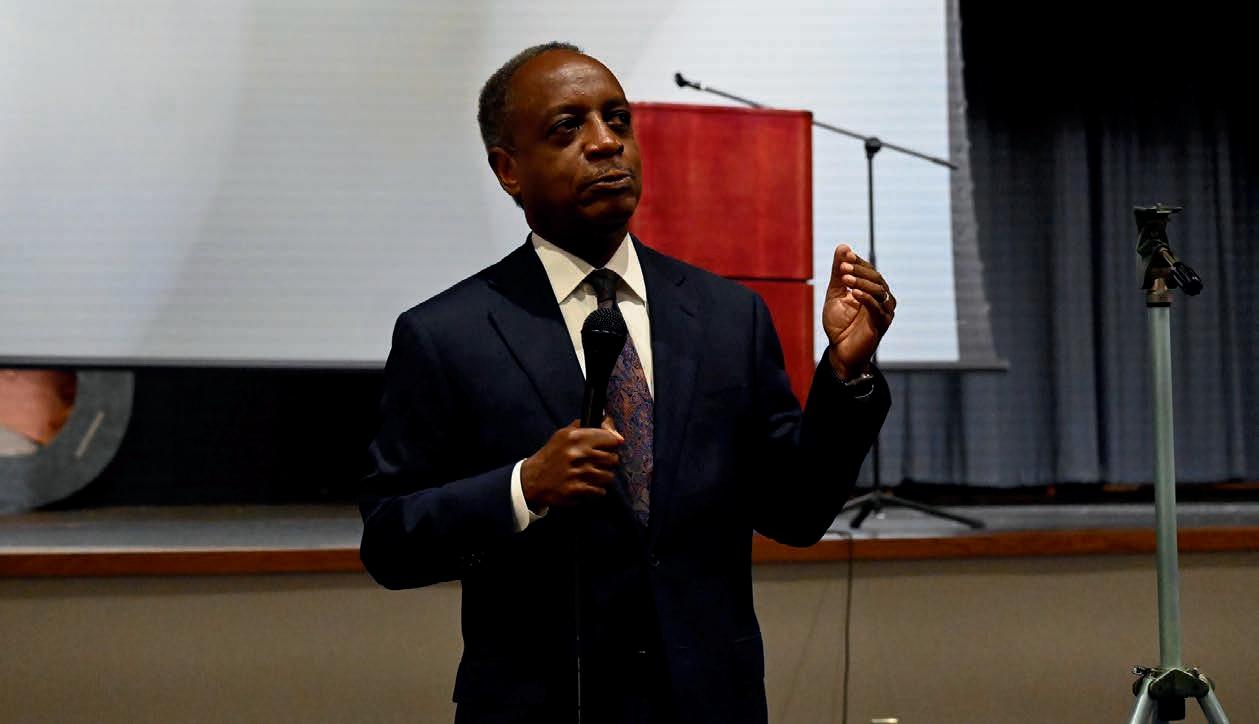
CCHS Class of 1971 alumnus and 2026 Georgia gubernatorial candidate Michael Thurmond speaks about his time at CCHS and in Georgia’s government.
AS TOLD TO MZÉE PAVLI
Variety Staffer MZÉE PAVLIĊ: What was it like attending Clarke Central High School in 1971, the year it was founded?
CCHS Class of 1971 alumnus and 2026 Georgia gubernatorial candidate Michael Thurmond: It was a year of tremendous change, high anticipation, excitement, fear (and) trepidation, all wrapped up into one. We knew that it was a historic moment. We knew that we had been called upon to literally change the course of history of Clarke County, Georgia. But, it was a tremendous amount of stress, and frankly, there were many things we did not understand, and they’ve only (become) clear to me over the years that have followed.
MP: How did Burney-Harris High School and CCHS differ in regards to its atmosphere, location, community and the resources available to students?
MT: Well, Clarke Central was much larger because we had a combined student body and the resources were actually better in many ways. Coming from (an) all Black, segregated environment into an integrated environment was very different. We were the first. The schools (had) been segregated in Athens for 84 years. So, changing 84 years of history was a momentous experience, and it was different having an integrated faculty and staff and administration, an integrated student body-playing football. I was on the Gladiator (varsity) football team, but playing with white guys on the football team was different. It was an opportunity to learn. There were so many unique moments during that year that (have) shaped my life and how I perceive the world throughout the remainder of my life, up until this day.
Above: AUTHOR AND ALUM: Clarke Central High School Class of 1971 alumnus and 2026 Georgia gubernatorial candidate Michael Thurmond speaks in the CCHS’ E.B.
on
23, 2022. Over five decades after his graduation, Thurmond returned to CCHS to speak about his first published book “A Story Untold: Black Men and Women in Athens History,” which is about the
of
in Athens. “(The) idea (of this book) was born at Clarke Central,” Thurmond said. “And some years later to actually publish the book and then nearly half a century later, to return to Clarke Central and (see) students actually studying and utilizing the book in class was just such a rewarding moment for me, something I’ll never forget.” Photo by Aza Khan
MP: You’ve written three books on the history of Georgia and Athens. What inspired you to write these books?
MT: The (idea for my) first book, “A Story Untold: Black Men and Women in Athens History,” was born in a class at Clarke Central High School during my senior year. As a senior, one of the classes I signed up for was Black History, but Black History was the only class that did not have a textbook. We would complain, and a major part of our complaint was that it was discrimination that the only class that we were taking without a textbook was the Black History class, and one day, I was sharing my thoughts with (the teacher of the class), and she said, “Well, Mike Thurmond, if you want a textbook, why don’t you go write it?” I walked out of class that day totally dedicated and committed to one day writing a history book that students at Clarke Central and any school in (the) Clarke County (School District) could use.
MP: You were the Co-President of CCHS’ student council during your senior year at CCHS, had you always had aspirations of working in government?
MT: Yes, I had been a student leader at Burney-Harris High School, Class President, and I remember the first speech I gave to an integrated audience was at Clarke Central. And I was very nervous. We were in the E.B. Mell Auditorium, and we assembled the seniors, and it was the first time that I had ever spoken publicly to an integrated audience. I don’t remember what I said, but I remember afterwards the audience, the students, applauded, and that was the first time I ever received any positive affirmation. I walked away knowing that I could be a leader of all people, not just people of my own color.
MP: As the first African American Georgia General Assembly member from AthensClarke County since the Reconstruction era, and the first African American Georgia State Labor Commissioner, what’s it like to have made history in this way?
MT: It’s humbling and there’s a sense of fulfillment, but it’s also a burden, because you carry the hopes and dreams of people, and you think about all of those who may have been qualified to hold these positions, but because of laws and bias and prejudice, they were denied the opportunity, so it’s been great. When I was elected to the legislature from Athens, I was the first Black (legislator) since Reconstruction, but I was also the only African American elected from a majority white district. When I was elected statewide as labor commissioner, obviously, Georgia is a state (where) there are (a) greater number (of) white voters than Black voters. So, what those elections said to me was that, I think it said more good things about Georgia and about AthensClarke County than it really said about me. And what it said was that, given (the) opportunity, a majority of the people can and will judge a candidate based on his or her qualifications and platform and ideas, (rather) than just look at their race.
MT: I want to bridge the divide. I want to bring people together to solve some of what has appeared to be the most intractable problems that (have) plagued our state. I want to build a winning coalition of Georgians, North, South, urban, rural, suburban, all races, colors and creeds. First and foremost, we must have a public education system that creates multiple pathways to success for our students. Go to college if you have the desire and the skillset and ability, but we must also celebrate those students who choose technical careers, celebrate those students who choose to go into the military, celebrate those students who may end up in an internship program, or even entrepreneurs who go straight into business. We have to create multiple pathways to success. We must have an education system that celebrates not just achievement, but also growth, and acknowledges that they are educators and students who may come from challenged backgrounds. Those teachers that can encourage and inspire growth should be celebrated equally as those who are able to document the achievement of the students that they teach.

From the experiences she witnessed during the Civil Rights Movement to her time as a student and teacher, Fannie Smith has combatted discrimination with determination.
A17-year-old Fannie Smith sits on a patch of grass in Downtown Athens next to her younger sister and brother. It’s 1963 and the siblings have just been arrested after taking part in a protest against the recent Birmingham, Ala. Children’s Crusade. But, as Smith was carted off to jail, it wasn’t fear she felt. It was determination to fight against the injustices being committed against Black people for as long as she’d been alive.
Smith was born in Oglethorpe County, Ga., but moved to Athens when her father, Rev. James Sims, a farmer, became determined to give his children a better education than he had received.
That determination is what caused him to ask Smith to be part of the group of five Black students who would be the first to attend the all-white Athens High School in 1963, now Clarke Central High School.
At school, Smith faced more isolation than discrimination from fellow students, but found joy in
books gaining the education her father had wanted for her.
Smith’s determination was fueled by information. Smith watched the news daily, seeing Black people throughout the South protesting and facing acts of violence that she had never seen in Athens, a city seemingly sheltered from violence.
Until she was walking home one day and saw a police officer beating a Black man. She stopped, the words “Why are you doing that to him?” leaping out of her mouth. The officer told her to move along, and she did, but with the sense that she wanted to do more.
That determination to help is what came to define Smith as a business teacher, a career she began in 1993 at CCHS and continued throughout the Clarke County School District until she retired in 2015.

“When I taught my students, I defended them. I said, ‘Nobody messes with my students. I don’t care what race you are, I want our kids to get treated right,’” Smith said.
O as Smith was carted off to jail, it wasn’t fear she felt.
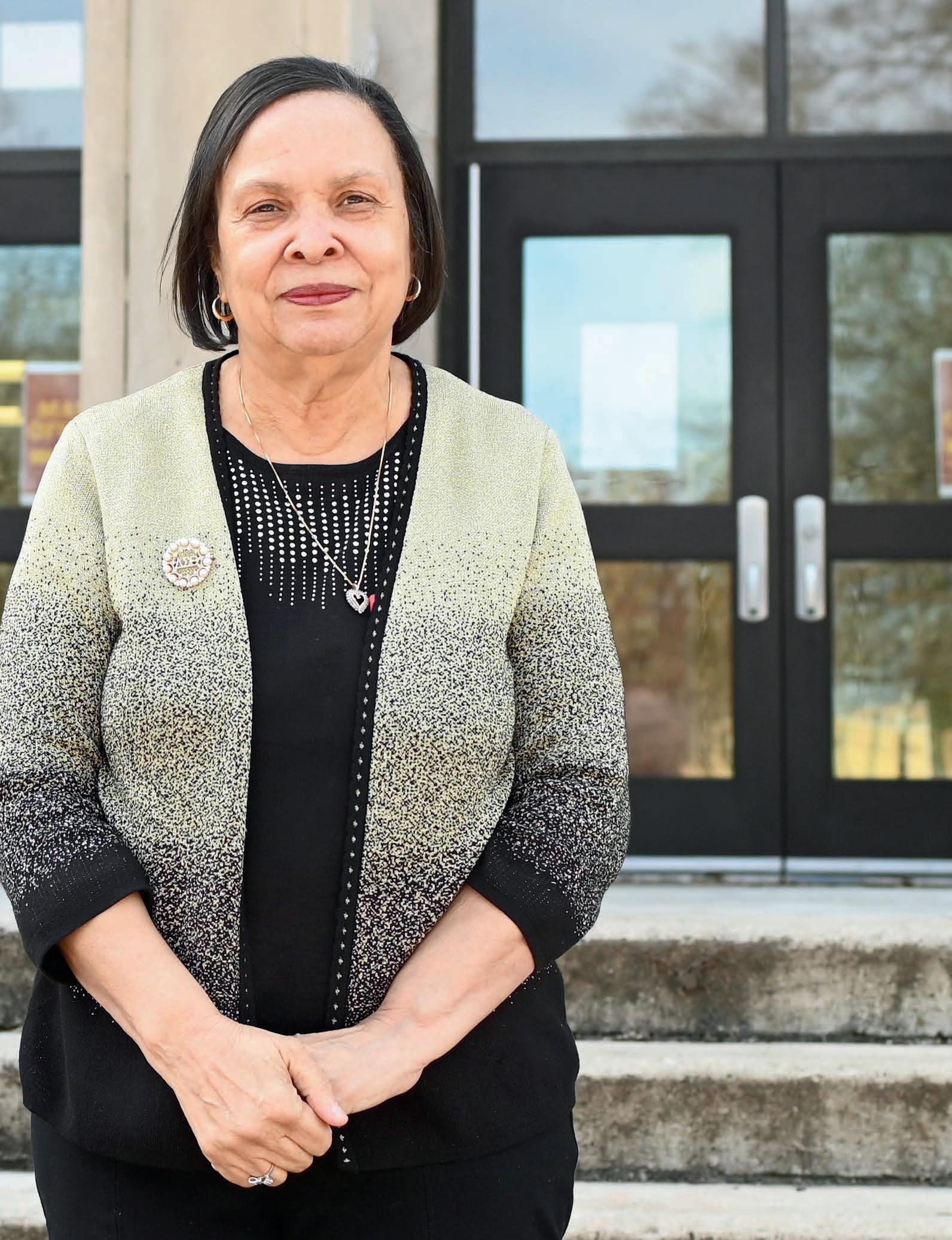

Featured: EDUCATION EXPERIENCES: Athens community member Fannie Smith stands in front of the Clarke Central High School Ceremonial Entrance on Jan. 12. Smith was one of the first Black students to attend CCHS, then Athens High School, in 1963, one of her many experiences with the Civil Rights Movement as a child, including her family’s involvement with the National Association for the Advancement of Colored People. “As a little girl, I attended our (NAACP) meetings at our church, and our church had hosted the meetings. My brother, at age seventeen, became the vice president of the Athens chapter (of the NAACP),” Smith said. “All of my interests were different from what a regular teenager’s were. And thought it was the norm, that you went to (NAACP) meetings, and that you listened (to and) watched (the) news every day.”
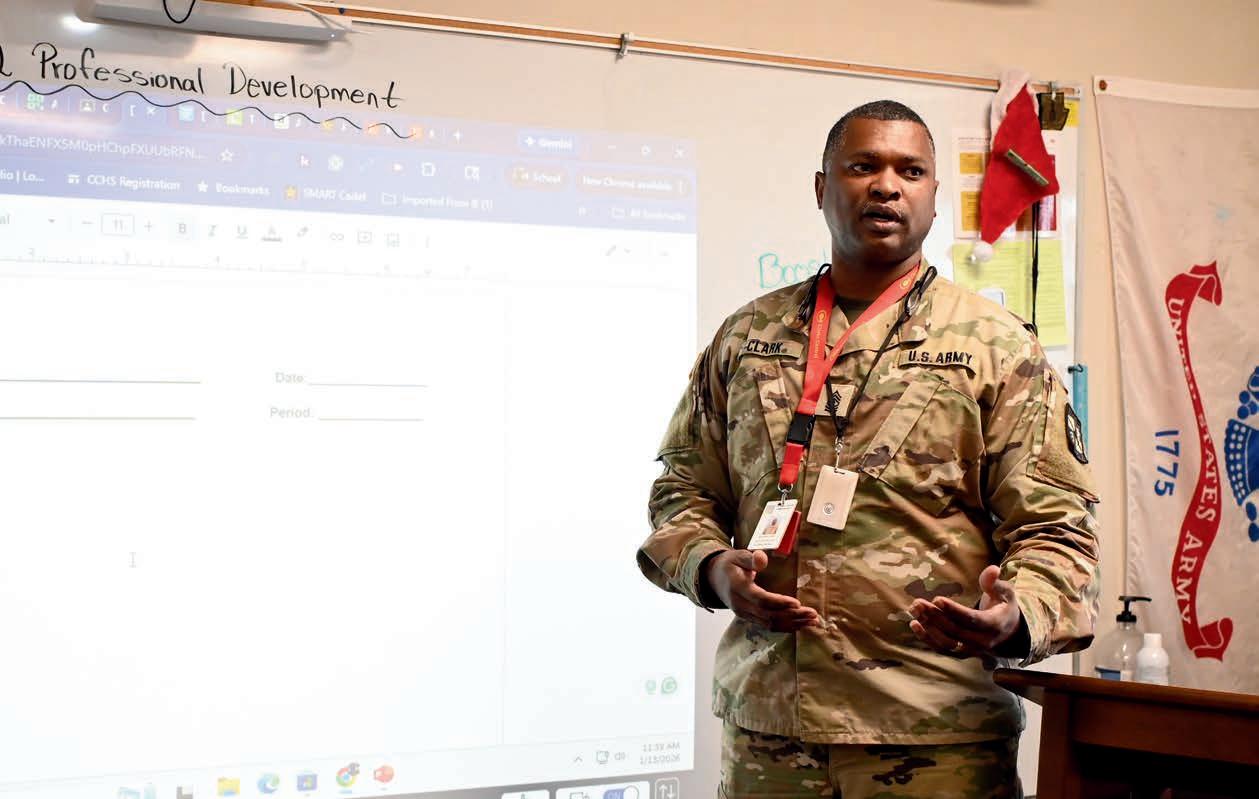
Army Instructor First Sergeant Antione Clark discusses the CCHS JROTC program and what it teaches students.
Staffer David Wang: how would you describe the JROTC program at Clarke Central High School?
CCHS JROTC Army Instructor First Sergeant Antione Clark: JROTC is a program that’s open to any student that’s a part of our high school. It’s not a program where, if you’re planning on going into the military, (you say), “Hey, let’s join JROTC.” If you have (an) interest in joining the military, (the JROTC instructors) can point you to the information that you need to go into the military. However, (JROTC’s) main goal is to motivate young people to be better citizens by teaching them (about) things (such) as community service, service learning, first aid, American history, (the United States) government (and) financial literacy. We’re here to support Clarke Central High School in any capacity that they need us. Every day in JROTC, cadets recite (our) Cadet Creed, and it’s emphasizing (being a) part of something that’s bigger than just you as an individual. You represent not only you, (but) your family, your school, your community (and) your country. That’s what JROTC entails.
DW: How do students move through levels of leadership from their freshman to senior year?
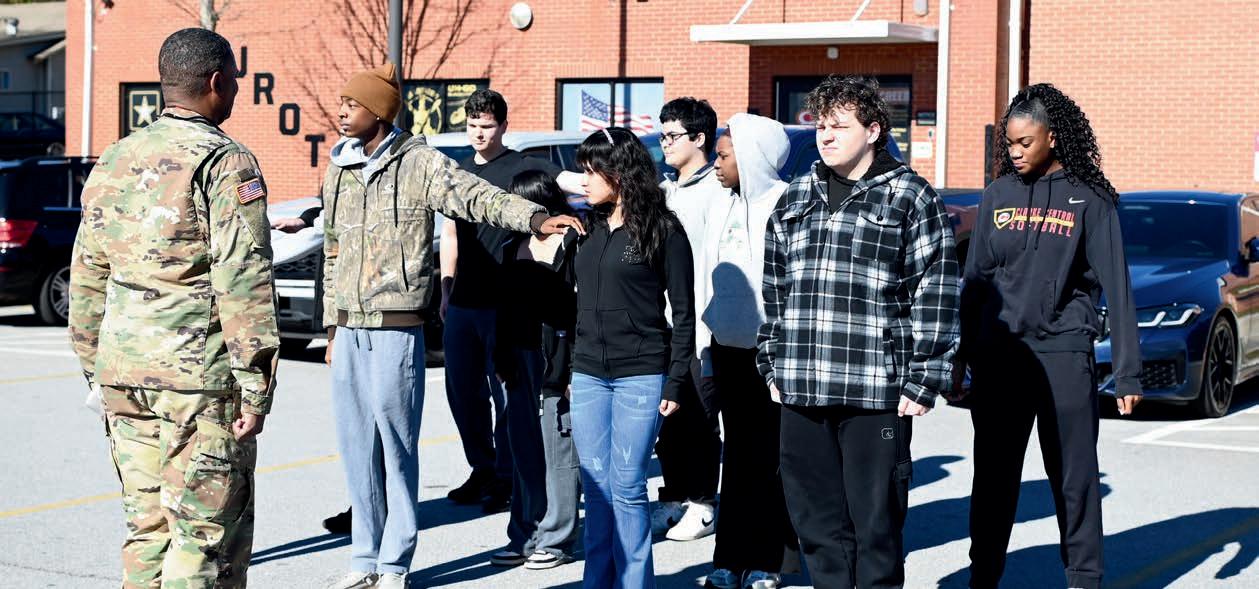
AC: Each JROTC unit is considered a battalion, (which) consists of several companies. Companies are comprised of platoons, platoons are comprised of squads and squads are comprised of first-year cadets. JROTC is structured like the (U.S.) Army, (where) you have officers (and) enlisted personnel. (Those cadets) have to master one level in order to get promoted or advance up to the next level as they (progress) from their freshman to their senior year. JROTC is a program where you can, after three semesters, receive your physical education credit. However, most of our cadets stay in (JROTC) longer than that, and that’s how they end up moving into the senior, higher-level positions.
AC: Their maturity level, confidence (and) ability to communicate in front of a large group (improves). They’re more outgoing (and) involved. Once (a cadet commits) to something, they see it through. (Cadets have) to take on that increased responsibility. (JROTC is) set up automatically where cadets are going to improve. I see that with all cadets, and we receive feedback from their parents, where their parents tell us, “Hey, if it wasn’t for JROTC, my kid would still be this quiet, introverted kid. Now, they’re outspoken. (Now), they take initiative (and) take charge.” The parents see it before (the instructors) see it.
AC: When we start the semester out, the cadets plan events (using) the school calendar (and) observances. School starts in August, and some of our first events (are held after football season starts) in September, where (JROTC) could be assisting with parking for (CCHS) football games (or) with neighborhood cleanups. Come October, we take part in (events) with the school, with the Trunk or Treat, food drives (and) clothing collections. (On) Veterans Day, we (partnered) with the (Veterans of Foreign Wars), along with the Daughters of the American Revolution, where we went to the (AthensClarke County) Library and planted poppy flowers, which represented soldiers (in) World War II. We also went to St. Mary’s Hospital and planted (U.S.) flags to represent veterans.
AC: (One misconception is) it forces students to join the military. JROTC does not require military service, (and) most cadets do not join the military (after high school). Another misconception is (that) JROTC is all about marching in uniforms, (but) that’s just a small part of our program. We focus on teaching discipline, teamwork (and) attention to detail. (JROTC is) not a program (that) you send students who you may deem trouble (to). It’s an academic elective. We don’t teach any combat skills. We don’t treat cadets like soldiers. Another misconception is (that) JROTC promotes violence or war. We emphasize conflict resolution, peace, responsibility (and) respect.
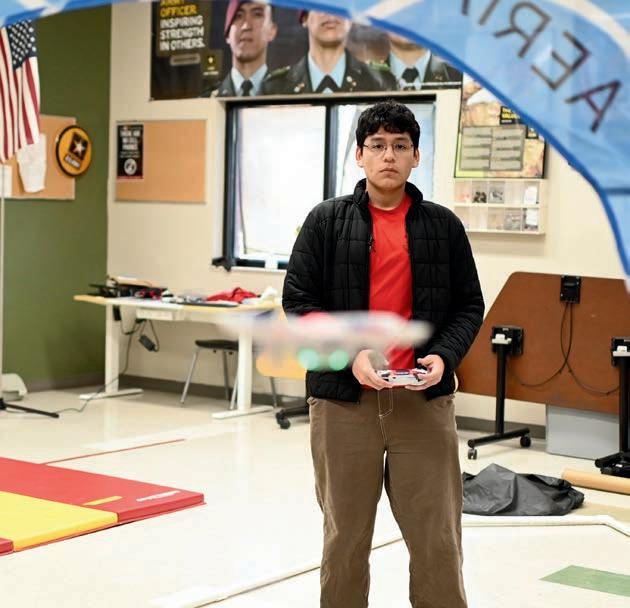
Above: DRONES AND DRILLS: A Clarke Central High School JROTC cadet flies a drone in the JROTC Building on Jan. 14. Along with classroom lessons and drilling instruction, JROTC has expanded the number of co-curricular activities it offers, such as the riflery and drone teams, over the years. “The (United States) Army Cadet Command sent (CCHS) drones, (and) the cadets jumped on (the drone team), took charge of it, figured it out and excelled,” CCHS JROTC Army Instructor First Sergeant Antione Clark said. “(The team has) to code to program these drones, maintain (them and) figure out how to maneuver (them).”
AC: (JROTC’s) expectations (are) for that cadet to have community awareness (and awareness of) how the (U.S.) government operates. (Additionally, to know) how they could be a help and service to their community (and) other students. We teach (cadets about) anti-bullying, cyberbullying (and) substance abuse, so, to me, (JROTC teaches) them enough things to put in their “tool kit,” to make them a better citizen for their community.
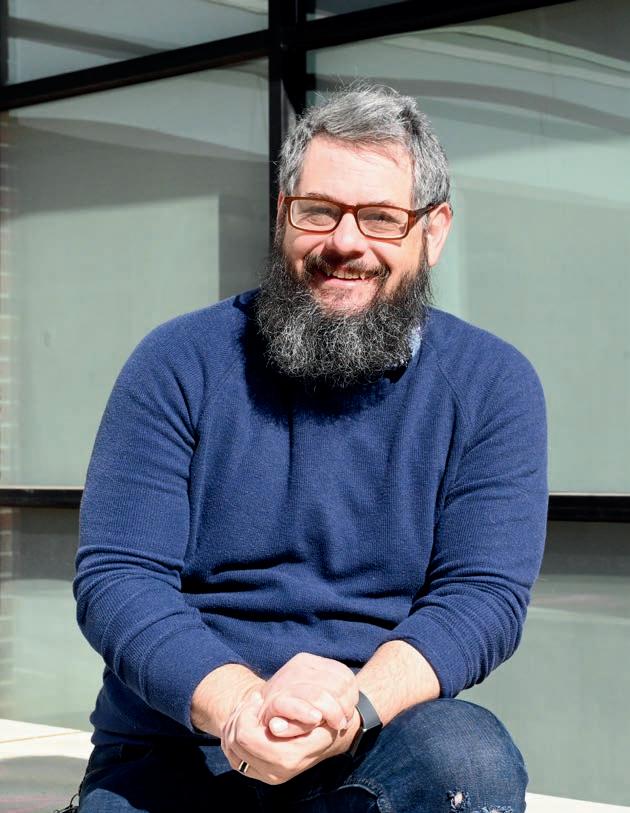
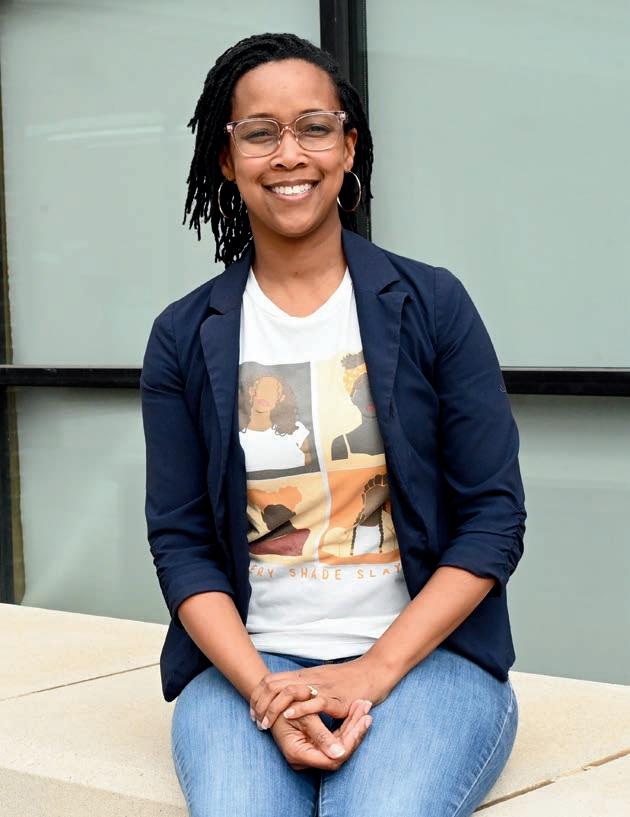
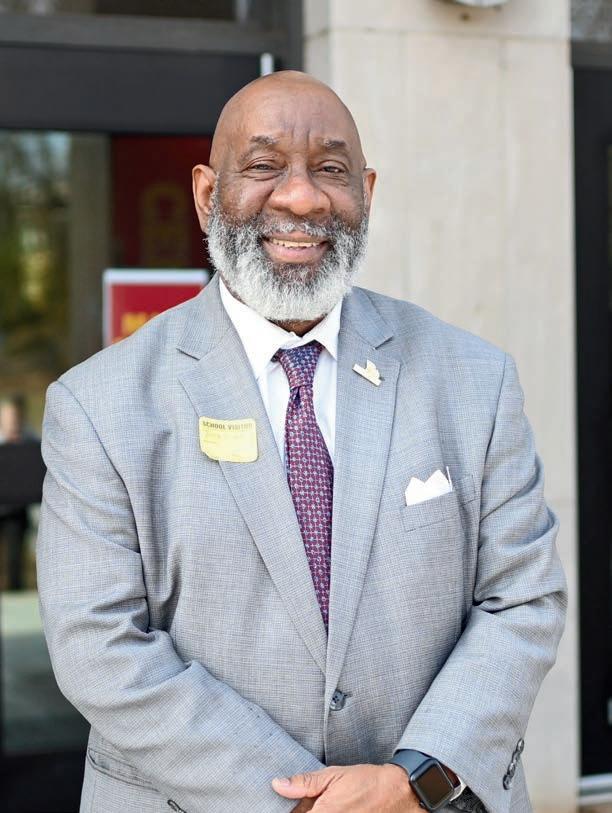
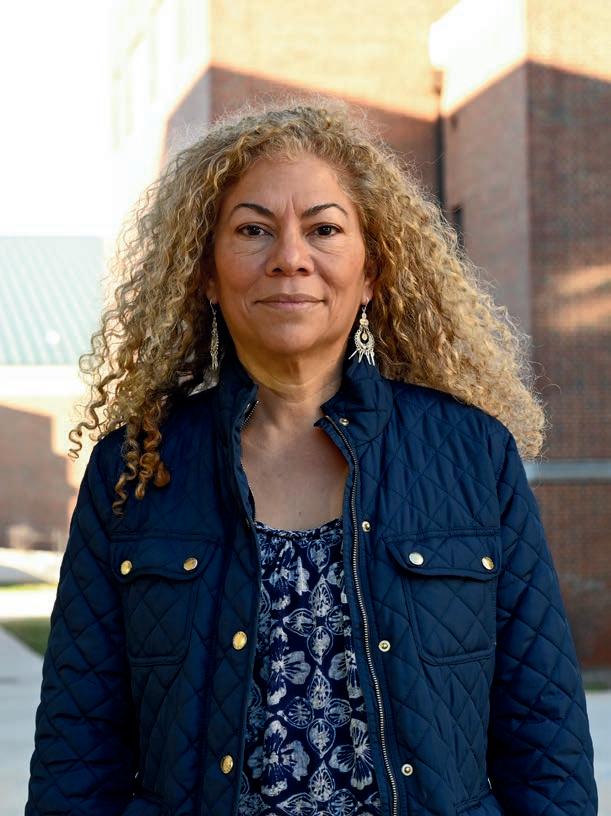
Five candidates go head-to-head in preparation for the Athens-Clarke County mayoral election, which will commence on May 19.
STORY BY SASHA BARKAN News Staffer
LAYOUT BY LIZA LARSON
Print Editor-in-Chief
Athenians will cast their vote for the seventh mayor of Athens-Clarke County in a nonpartisan election on May 19, determining which of the five* candidates will lead the city until 2030. The mayor of ACC is responsible for agenda setting, presenting the budget, internal auditing and recommending candidates for government positions, giving them significant influence over key issues such as affordability, education and commerce.
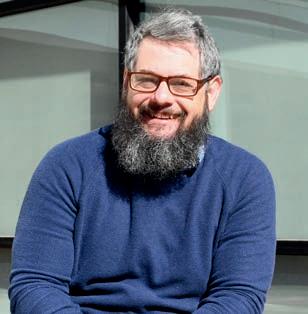
District five representative
Clarke County School District Board of Education District five representative Tim Denson, who first ran for mayor in 2014, will be returning to the ballot in 2026.
Denson’s Why: “Athens has a lot of pretty huge challenges. We have a lot of people who aren’t getting the services and resources that they need here, (and) we have a very large economic disparity that’s happening. The gap between those who are well off and those who are left out has gotten larger than it ever has before. I wanted to step up, because I believe that the government has a role to serve.”
criminal justice: Denson hopes to expand co-responder programs, in which a trained social worker accompanies law enforcement officials when responding to mental health crises. He also seeks to sever Athens’s ties with for-profit prisons, which are owned by private corporations.
housing: Denson hopes to recreate a task force and develop policies that expand residential housing. He also wants to build more subsidized housing, using the Affordable Housing budget.
commerce: Denson is interested in creating an Economic Development Department to assist prospective business owners with the beginning steps of entrepreneurship. He seeks to create an entertainment district in Downtown Athens with an open container zone for alcohol.
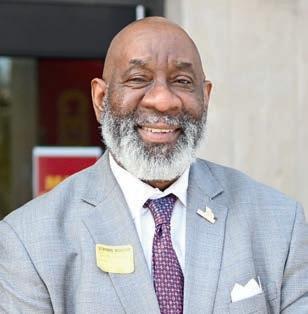
Dexter Fisher, currently serving as ACC District Five Commissioner and Mayor Pro Tempore, is running for mayor in 2026.
fisher’s Why: “I’ve always had the feeling that I was going to eventually run for public office. I was a civil rights baby, so (growing up), when my mom was going around registering people to vote, I was with her. I knew then that, from a civic perspective, I (wanted) to do something to help folks.”
criminal justice: Fisher is a supporter of “community policing,” in which law enforcement is encouraged to form connections with those they serve. He also believes in the value of deploying officers from similar backgrounds to those living in their precinct.
housing: Fisher wants to partner with local developers to build housing units that middleclass Athenians can afford. Fisher also supports existing housing initiatives that have arisen from Athens’s partnership with Advantage Behavioral Health Systems.
commerce: Fisher spotlighted the importance of strong education within the city, praising the Athens Community Career Academy for creating job readiness. He wants to “brand” Athens’s education and economic opportunities to bring more people to the city.
Athens-Clarke County mayoral candidates Tim
Dexter Fisher and Mara Zuniga. The four Athenians, who represent the entirety of ACC mayoral candidates alongside Sharon Miller, all announced their run for mayor at some point in 2025 and hope to make a positive change in the Athens community. “The mayor leads the legislative arm of the local government. That means both some kind of near term and long term work. Near term, the mayor is the primary agenda setter, month in, month out, for the things that the commission is going to be working on and ultimately voting on and then really takes that same role long term, the mayor helps set the stage for policy crafting in areas that are going to require many months and many years of work, if you think about the critical issues that have been in the atmosphere in recent years, whether it’s affordable housing or public safety or mobility or access to good jobs,” current Mayor Kelly Girtz said. Photos by Illiana Tejada and Maypop Wren, Graphic by Liza Larson
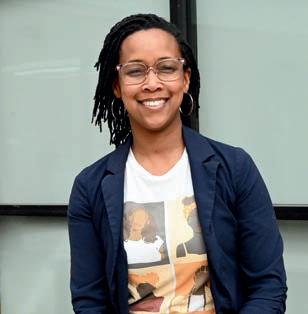
CCSD BOE District seven representative Dr. LaKeisha Gantt is a first-time candidate for the 2026 Mayoral Race.
gantt’s Why: “We need bold leadership in this position right now. My work in schools (as a behavioral specialist) has really allowed me to see (that). Schools exist within a context of a community, and if that community is not whole or healthy and we’re not working to alleviate issues, then they show up in schools. That work has helped me realize just how systemic (reform) is and how we have to solve these issues from an ecological perspective.”
criminal justice: Gantt sees importance in the police acknowledging law enforcement-related trauma in minority communities. She believes that ACC law enforcement should work to build relationships with constituents, particularly unhoused and “vulnerable” communities.
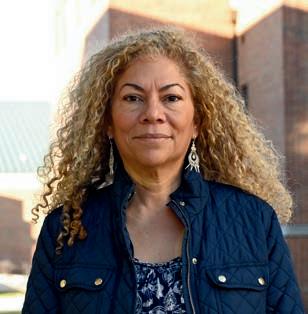
local businessperson
housing: Gantt hopes to request that the University of Georgia contribute payment in lieu of taxes to fund housing initiatives, such as expanding Athens’s homeless shelters. She emphasized having individuals from the Neighborhood Leaders Program, an ACC program, to connect residents to government resources.
commerce: Gantt hopes to create a liaison service to assist potential business owners with their enterprises. She also expressed interest in creating a collaborative workspace for women and minorityowned businesses to share resources and ideas.
Local businessperson Mara Zuniga, who first ran for mayor in 2022, will be returning to the ballot in 2026.
zuniga’s Why: “The mayor listens to the community and has the power to bring people together. I felt that we needed to bring (Athens) commissioners together (to be) a table for communication. I wanted dialogue, and since I have always been a person that communicates and listens, I would be appropriate for the mayor’s position.”
housing: Zuniga is interested in partnering with the Georgia state government to find solutions to Athens’s affordability crisis. She also emphasized the importance of maintaining the current housing infrastructure to decrease the city’s upkeep deficit.
commerce: Zuniga wants to create a small business district. She also hopes to streamline the bureaucratic processes associated with entrepreneurship. criminal justice: In an interview with The Red and Black, a news publication run by Univeristy of Georgia students, Zuniga emphasized crime as a key concern of hers. Zuniga opposed the creation of Athens’s Public Safety Oversight Board and proposals to defund local law enforcement.


Photo by Maypop Wren

Featured: BHM HISTORY: JROTC cadet Brandon Frazier, a junior, speaks at the Clarke Central High School Black History Month Program in the E.B. Mell Auditorium on Feb. 25. With this year’s BHM program theme being “you belong here,” Frazier, alongside other JROTC cadets, highlighted multiple Black historical figures such as Lloyd Austin, the first African American Secretary of Defense in United States history. “His journey proves that barriers can be broken and that representation in positions of power matters,” Frazier said. “Sharing his story was important because it motivates young people, especially young Black men and women, to believe that they can lead at the highest levels and make a difference in the world.”

The infrastructure that artificial intelligence technology relies on must be regulated, or it could pose a severe threat to the environment.

BY ADAH HAMMAN Variety Editor
In years past, when people thought of the term “artificial intelligence,” several things may have come to mind: self-driving cars, talking virtual assistants and maybe even evil robots hellbent on destroying the world.
But now, AI is used merely out of convenience, powering the tools people use every day for work, school and entertainment.
However, this convenience comes at a cost.
The development of AI technology largely depends on data centers, which, if not regulated properly, can have grave consequences, particularly for the environment.
According to Dictionary. com, a data center is “a facility equipped with or connected to one or more computers, used for processing or transmitting data.” There are several types of data centers, including hyperscale data centers, which have become increasingly popular in recent years for their ability to house advanced computer servers capable of handling large processing workloads.
Sound familiar?
University of Georgia Odum School of Ecology PhD student Bryson Hilburn, who studies fisheries and wildlife, said.
According to a study by the Pew Research Center, data centers in the United States used about 17 billion gallons of water in 2023, with hyperscale facilities accounting for 84% of that amount. By 2028, that number is expected to have skyrocketed, with estimates ranging from 16 to 33 billion gallons for hyperscale data centers alone.
Although these numbers may seem insignificant to some, after all, data centers only accounted for around 0.04% of U.S. water consumption in 2024, their impacts are felt by local communities and ecosystems.
Nowhere is this more evident than in the U.S., where data centers have begun popping up like weeds. One such project was planned for Bessemer, a town located less than 15 miles from Birmingham, a major metropolitan area in Alabama.
The development of AI technology largely depends on data centers, which, if not regulated properly, can have grave consequences.
However, there was a problem: the Birmingham darter, a rare species of fish only found in and around the land allocated for the data center. Environmental activists argued the fish wouldn’t be able to survive if the center was built, as they require very specific conditions to carry out their life cycle.
Well, these “large processing workloads” often include training and running AI-powered applications, such as language models, facial recognition software and programs like ChatGPT that can generate text and images, which now receives around 2.5 billion prompts every day, according to its developer, AI research and deployment company OpenAI.
“These data centers take a ton of water. Either they’re pulling it from surface water, or they’re pulling it from some aquifer underground to cool all the heat that’s generated from all those queries, which is really energy-intensive,”
Fortunately, after efforts from local environmental agencies, the data center was moved to another location. Other places, though, aren’t as lucky.
A more sustainable path forward is possible, but it requires stronger oversight for data centers. Both state and local governments can prevent further harm to the environment by enforcing stricter water-usage guidelines, requiring environmental impact studies and encouraging them to use more eco-friendly methods of powering and cooling their servers. Without these measures, data centers threaten to inflict irreversible damage on local communities and ecosystems.

The Athens music scene is ever-changing with focuses spanning across genres, from hip-hop to jazz to indie rock.
STORY BY ELOISE LUKEN Variety Staffer
LAYOUT BY ISABELLA GRESHAM
Viewpoints Editor
The Southern music scene is ever-changing, taking on new trends as decades pass, but it will always go back to its roots.
While Southern music may be harder to define now, as music and sounds keep evolving, there is an identity within the music, which can be heard through folk, blues and country. These familiar sounds come from people telling their stories through lyrics, hearing instruments like the fiddle or the acoustic guitar and imagery in verses of the songs.
Many of these traits are heard in music all around Athens. Adam Knight, a professor at Clemson University, went to school in Athens during the‘90s, and has lived in the South the majority of his life. From growing up with music, to being in multiple bands, and to now teaching about music, Knight has always been immersed in Southern music.
“There’s a lot of similarities to other (music) scenes, in terms of people wanting to write good songs, people wanting to tell a story with their lyrics (and) people wanting to make people dance. But sometimes songs get their Southernness through specific lyrics that may mention specific places or specific towns in the South,” Knight said. “(Bands) use a lot of imagery in their music. So, people hear lyrics like that, and that’s one of the things that can connect them to the Southern feeling.”
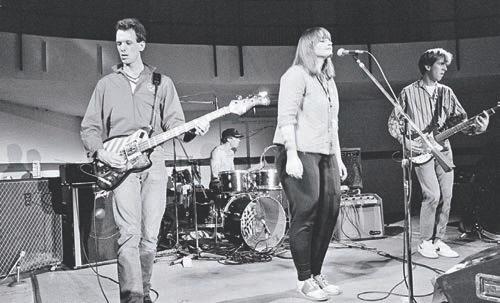
Former Pylon singer Vanessa Briscoe Hay started in art school in 1973 at the University of Georgia, alongside Randy Bewley and Michael Lachowski, who decided to start a post-punk band. They auditioned people for vocals, and through connections, they went to Hay. While she thought the band would be short-term, people still remember Pylon to this day.
“When I got to Athens (in 1973), something started happening, as far as the music scene. There was a local record store called Chapter Three Records, and they got a lot of records from New York, Europe, Germany and England.
We were able to just go in there and (say), ‘Wow, this looks like an interesting cover.’ ‘Let’s get this,’” Hay said. “At that point in time, about 1977, a lot of new music was coming out, bands like Elvis Costello, the Talking Heads, Blondie, and so on.”
Pylon officially broke up in 2009. However, Hay has fronted the Pylon Reenactment Society, a band that writes new music, but also performs Pylon’s music to uphold their legacy.
“We got to tour with some great bands, like the Gang of Four, the B-52s, (and) REM. And what I’m finding out is we’re really an all-ages band. We have people there who (are) in their teens all the way up to people in their ‘70s and ‘80s,” Hay said. “I’ve had fan mail from a 9-year-old and fan mail from an 80-year-old. It’s really pretty amazing, right here in 2026, to still be doing this and people still enjoying what we did before.”
Shortly after Pylon was formed, R.E.M., an American rock band, was formed, which would change the Athens music scene. Bertis Downs, general counsel and manager for R.E.M. since the early ‘80s, knew Peter Buck and Bill Berry
“The
nature of the (music) scene was competitive, but it was collaborative when people enjoyed showing up (to) other shows.”
--
Bertis downs, General Counsel and Manager for R.E.M.
before they started the band. Through these connections, he saw how the band grew from the ‘80s to the ‘90s, and the legacy they left.
“(The music scene in the ‘80s) was informal. It was friendly. A lot of bands supported each other,” Downs said. “The nature of the scene, to the extent, was competitive. It was friendly rivalries, but it was really almost (a) collaborative time when people enjoyed showing up (to) other shows.”
When Downs toured with R.E.M., he attended many concerts with the band,
“People get on stage because they just want to vent. It is like a free speech stage.”
such as the Bridge School Concerts and the Live 8 Concert in 2005. During the Vote for Change tour of 2004, REM got to play alongside Bruce Springsteen, doing shows in many different states, a once-in-a-lifetime opportunity.
“(REM) became popular gradually. They were kind of the opposite of overnight success. It took them a while. (Then) they had a huge hit called ‘Losing my Religion.’ It became one of the biggest songs in the world that particular year, (and) that was 11 years into their career. Once ‘Losing my Religion’ became a big hit, the very next year, this album “Automatic for the People” (came out) and it had ‘Everybody Hurts’ on it, and it had ‘Man on the Moon’. It had a lot of really great songs too, that they kind of built strength on.”
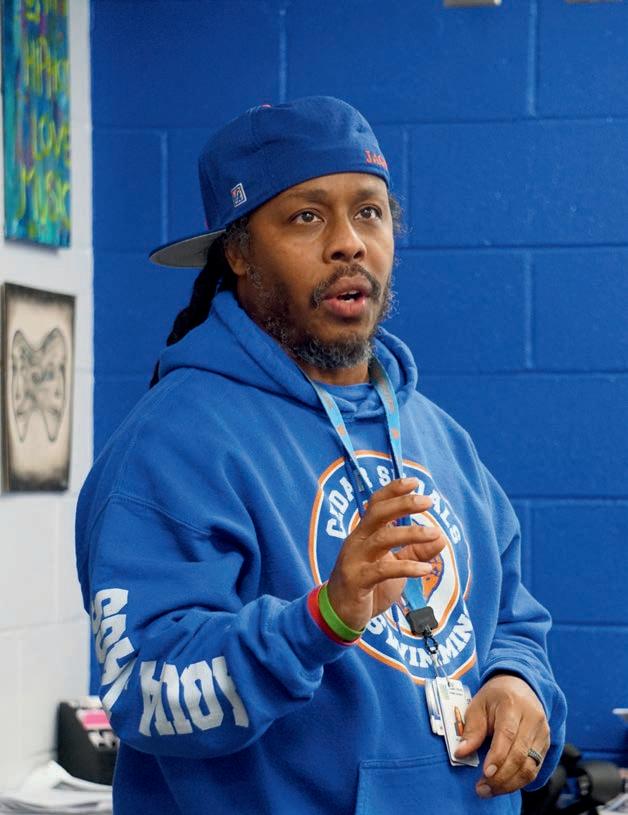
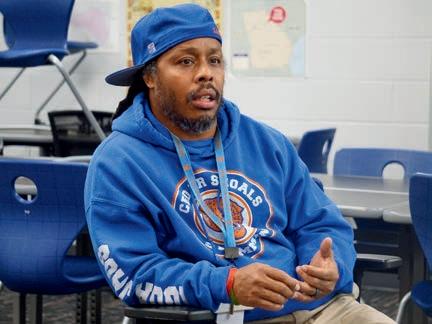
While there is a long-established indie rock scene in Athens, other artists who focus on other genres, like Montu Miller, have a harder time finding their voice in town. Miller, a staple in the hip-hop community, as well as a Cedar Shoals High School teacher in the social studies department moved to Athens in 1999 because he loved the vibe of the city.
“There’s pockets of diversity. When you look at this overarching look or vibe or genre of (Athens), it almost feels the same. There’s pockets of hip-hop, hardcore heavy metal, jazz, but overall it’s so anchored in indie rock. I feel like
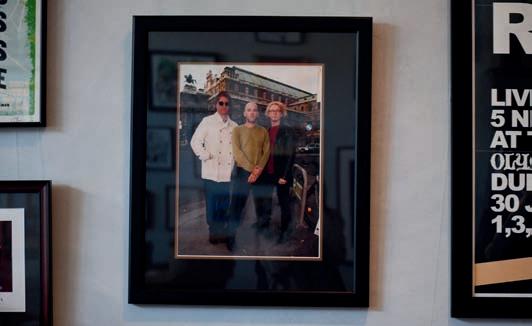
Upper left: MUSICAL VARIETY: A collage of photos displaying various Athens artists is shown. Montu Miller, an Athens hip hop staple and Cedar Shoals High School teacher, moved to Athens because of the culture and has discovered the structure of the music scene since then. “There’s pockets of diversity. When you look at this overarching look or vibe or genre of (Athens), it almost feels the same,” Miller said. “There’s pockets of hip hop, hardcore heavy metal, jazz, but overall it’s so anchored in indie rock and I feel like a lot of other genres just don’t get the respect that they deserve.” Photos by Peter Atchley, Miriam Silk and courtesy of Bertis Downs
Lower right: YOUNG ARTISTS: A group of photos showcasing aspects of the Athens music scene is shown. With various spaces for young artists to play, Athens has served as a place for new artists and styles to flourish. “The youth is where the future of Athens music lies. We have programs (in) Nuci space, like Camp Amped, (and) they do a great job of indoctrinating the younger folks into the music scene,” singer and guitar player for Athens band Shehehe Noelle Shuck said. “I think if we allowed more young people into shows, if there were more safe spaces for those kinds of folks, that we would get an even more amazing influx of new music for Athens.” Photos by Peter Atchley and Miriam Silk
a lot of other genres just don’t get the respect that they deserve,” Miller said.
As a way to give a voice to those who don’t always have a way to express themselves, Miller hosts Beats, Rhymes, and Life, an open mic event where a variety of artists attend, from cartoonists to poets to hip-hop artists.
“People get on stage because they just want to vent. So, it is like a free speech stage. It is a stage where anybody can get up there and do their thing. Even if you’re a singer-songwriter, come up there and do it, if you hip-hop artists come up there and do it, and I feel like that element sometimes is missing in Athens” Miller said. “But (by) coming to Beats, Rhyme, and Life, they feel like they’ve got a home now, whereas before, they were just kind of lost out here.”
Beats, Rhymes, and Life was hosted at Hendershots, a coffee shop, bar and music venue, located off of Prince Avenue, owned by Jennifer and Seth Hendershot. Seth moved to Athens in 1998 and opened the original Hendershots in 2010 off of Oglethorpe Avenue. Over the past 16 years owning a music venue, Seth hosted many open mic events, metal nights, rock nights, bluegrass nights and more.
“I hope that our role in this music scene has been to bring these people together, these people from different walks of life and different musical backgrounds. (Hendershots has) just always been open to everything. We’re not the punk rock club, we’re not the jazz club, we’re not the country club or the classical club. We showcase all of it.” Seth said.
Noelle Shuck, is a singer and guitar player, as well as a founding member for Shehehe, an Athens punk rock band. Shehehe was formed in 2011 and has played in many places around Athens including The 40 Watt, Flickr and Nowhere Bar.
“What I love to see change is all of the younger people (form) bands,” Shuck said. “The youth is where the future of Athens music lies. We have programs (in) Nuci space, like Camp Amped, (and) they do a great job of indoctrinating the younger folks into the music scene. I think if we allowed more young people into shows, if there were more safe spaces for those kinds of folks, that we would get an even more amazing influx of new music for Athens.”
Athens has always had a broad range of music and has been open to new bands. Pylon became a band through mutual connections, Downs became a lawyer and general manager for R.E.M. by knowing the band members before they were a band.
“Over the decades, (the music scene has) really become more just more symbiotic. The genres have mingled more so that you’re seeing hip hop and classical music going together, and there’s indie rock and sort of yacht rock, jam stuff, and jazz, all these things are coming together kind of beautifully. And people are more interested in helping than in staying away from” Seth said.
So, as Knight looks back at the time he spent in Athens, he reflects on the distinct culture surrounding the city’s music scene and the impact it has.
“There’s this unique Southern (vibe) mixed with (an) artistic, intellectual vibe (in Athens) that you don’t necessarily get in any other town. It’s got its own distinct identity. I think that’s a cool thing (that makes) an impression on the world,” Knight said. “A lot of people have been affected by (the vibe).”


BY ELOISE LUKEN
The Farm Cart, located at 1074 Baxter St. in Athens, is both an accessible and tasty breakfast option.
Open from 8 a.m. to 2 p.m. Tuesday through Friday, The Farm Cart is less than a mile from CCHS and has a covered dining space as well as an indoor seating area.
As customers walk inside, they will immediately notice the variety of options available on their menu, including the breakfast plate, which costs $15 and comes with a buttermilk biscuit, and three sides, such as bacon, fried eggs and a bowl of cheesy grits.
The biscuit is warm and fluffy, and the eggs are sprinkled with a dash of salt and pepper. Additionally, the grits are thick and creamy, with a smooth consistency that customers should find satisfying. Overall, the meal highlighted quality ingredients and well-made dishes, all served in a omfortable envrionemnt for any diner.
The Farm Cart’s freshly-made food, in addition to its convenient location, makes it an enjoyable experience for all who choose to visit.
8.5
8 7 9 8.5 8
8.1/10

White Tiger Deluxe, located on 64 N. Main St., in Watkinsville, Ga., provides customers with an inviting atmosphere paired with delicious Southern-style cuisine.
On weekends, White Tiger Deluxe’s brunch menu is offered from 10 a.m. to 3 p.m. and contains a large selection of different items. With its brunch plate, priced at $13.50, customers get a buttermilk biscuit and their choice of three sides, such as bacon, fried eggs and a small bowl of grits.
The biscuit is very fluffy, and the bacon is cooked perfectly, with crisp edges and a chewy texture. Additionally, the grits are satisfyingly creamy, but to some customers might be too salty.
White Tiger Deluxe has an indoor seating area, which is welcoming and upbeat, with colorful walls and unique decorations. However, since the restaurant is over 15 minutes away from Clarke Central High School, students who don’t have reliable transportation may find it hard to visit.
White Tiger Deluxe’s pleasant ambiance, combined with its relatively affordable food, makes it a great brunch option for those with a means of transportation.

7.9/10 7.5 8.5 9 6.5 8.5 7.5

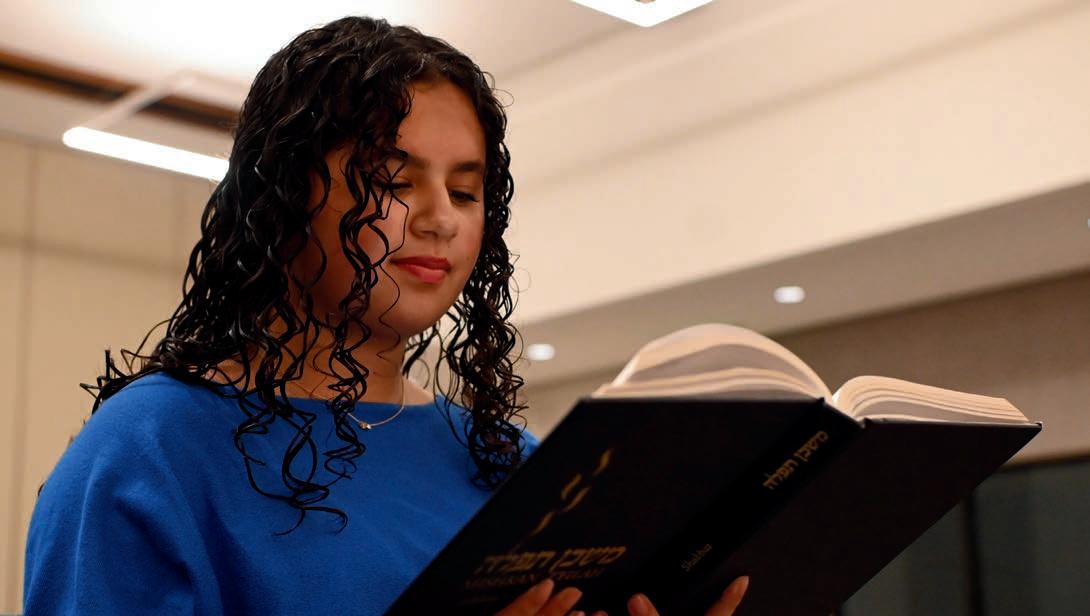
Variety Staffer Cesia Martinez, a Christian, writes about her experience going to a Shabbat service at the Congregation Children of Israel.
STORY BY CESIA MARTINEZ Variety Staffer
BY LIYA TAYLOR Sports Editor
Like many other people in the South, I was raised in the Christian church. For as long as I can remember, it’s always been part of my family’s routine to be ready by 10:30 a.m. on Sundays to attend morning service at Iglesia Fuente De Vida. Because of that, I never really had the opportunity to experience other religions. Until now.
As I walked into the Congregation Children of Israel on Friday night, I was immediately greeted by smiling faces. “Shabbat Shalom,” they said as I entered, which I later learned meant “peaceful Shabbat.” This reminded me of, “Dios les Bendiga,” the greeting we receive at my church, meaning, “God bless you.”
was followed by some more songs. What stood out to me most was when the rabbi pulled out the Torah, the most sacred text in Judaism, meaning “instruction” or “teaching.” It contains the first books of the Hebrew Bible, the Old Testament.
I realized that Judaism is not only focused on practice and prayer, but also focused on community.
Walking further into the synagogue, I expected to feel nervous since I didn’t know anybody. However, after introducing myself to a few members, I began to feel less like a stranger and more like a friend. I felt relieved at the fact that everyone seemed to welcome my presence, despite never having been there or going to a service before. Everyone was smiling and laughing, and even the rabbi made a point to introduce himself to me.
When I entered the sanctuary, I immediately noticed a few shelves of books to my right. I was given one and learned it was a Siddur, a traditional Jewish prayer book, containing different songs and prayers for daily, Shabbat and holiday services. Then, I took my seat and waited for the service to officially start.
The service took place from 6:15 to 7:15 p.m. and was full of different songs and prayers. We began by singing a song to welcome Shabbat, which
As the Torah was passed around, I sensed a change in the atmosphere. This moment felt different than the rest of the service, in that it felt sacred. I sensed how every person’s demeanor had changed, and watched as members either touched it with their Siddur or Tallit, a type of shawl primarily worn by Jewish men.
After the Torah was returned, the rest of the service went by fast, ending with a Mourners’ Kaddish, “Kiddush Yatom,” which is a prayer meant to honor people who have passed in the Athens community.
Once the service was over, we made our way into the back where we participated in an Oneg. This is a time for people to catch up with one another and enjoy refreshments. Something similar to what we call at my church Santa Cena.
During the Oneg, I realized how close-knit the congregation was, and I realized that Judaism is not only focused on practice and prayer, but also focused on community. Although my church has also always focused on community, I was more impacted at the synagogue.
Although I have always been Christian, in that moment, I felt grateful for the opportunity to explore Judaism. This experience allowed me to grow and learn about other people’s culture and history. Although it may seem scary at first, it’s a good opportunity to try new things and get out of your comfort zone.

Above: EXPERIENCING JUDAISM: A lit menorah at the Congregation Children of Israel is shown on Jan. 9. Prior to Martinez attending a Shabbat service at CCI, she did not know what to expect coming from a Christian household. “Although I have always been Christian, I felt grateful for the opportunity to explore Judaism. This experience allowed me to grow and learn about other people’s culture and history,” Martinez wrote. Photo by
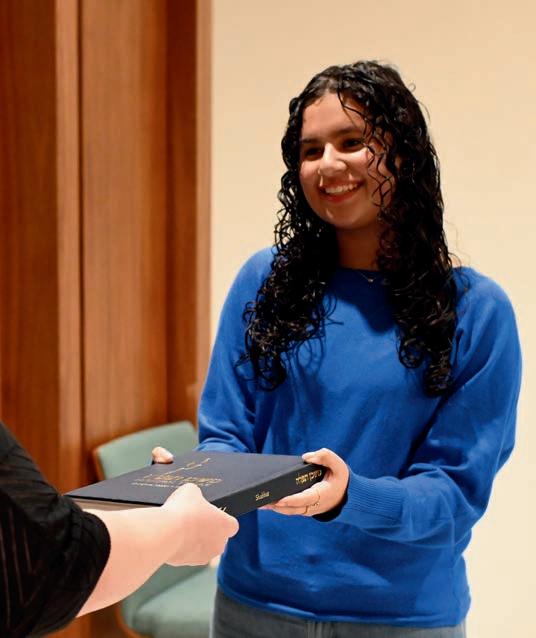
Above: SOMETHING NEW: Variety Staffer Cesia Martinez receives a Siddur from one of the members of the Congregation Children of Israel on Jan. 9. Throughout the service Martinez was able to follow along with the songs and prayers through the Siddur which helped her understand better. “When I entered the sanctuary, I immediately noticed a few shelves of books to my right. I was given one and learned it was a Siddur, a traditional Jewish prayer book,” Martinez wrote.
Below: MEETING MEMBERS: Variety Staffer Cesia Martinez sits inside the Congregation Children of Israel on Jan. 9. Martinez got the opportunity to meet members of CCCI and learn more about the religion. “Walking further into the synagogue, I expected to feel nervous since I didn’t know anybody. However, after introducing myself to a few members, I began to feel less like a stranger and more like a friend,” Martinez wrote.

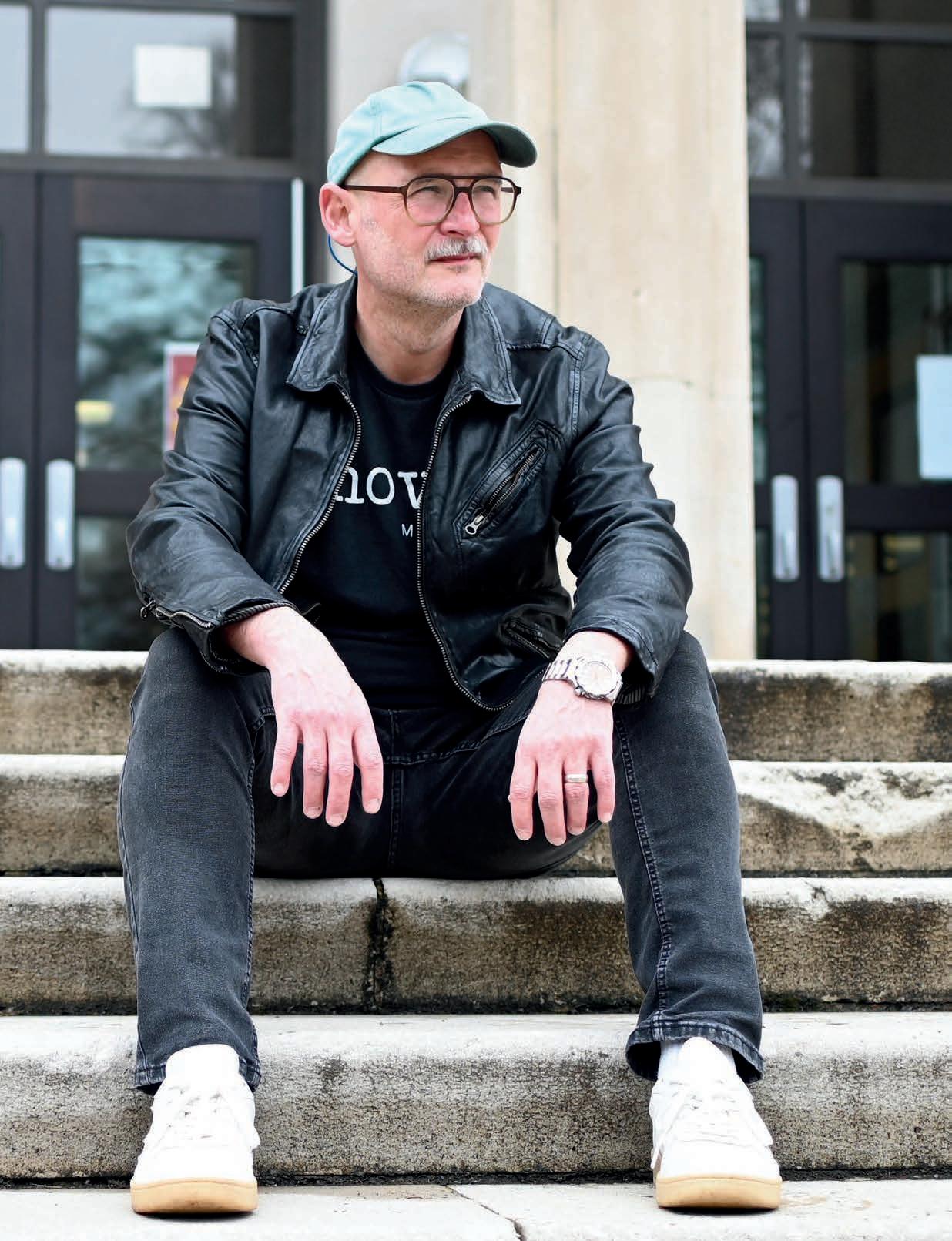

Featured: SOUTHERN SHOCK: Author Dr. Harrison Scott Key, Savannah College of Art and Design Executive Dean, sits outside the Clarke Central High School Ceremonial Entrance on Feb. 27. Key experienced culture shock when he moved from his birthplace of Memphis, to rural Rankin County, Miss., when he was 9-years-old. “I went from a place where it was cool if you could play Atari and could do tricks on your bike, to a place where most kids had killed something that weighed more than them by the time they were 10 years old,” Key said.
Photo by Iliana Tejada
Right: REGIONAL IDENTITY: A photo shows author Dr. Harrison Scott Key as a child. Though the South, by definition, is a region, it historically carried more meaning. “It seems to have a stronger identity than any other region of America. So, the question becomes, why?” Key said. “You can’t get away from history when you’re defining it. You have to talk about the history that all of America is living inside, the legacy of enslavement, civil war, poverty. You can’t not talk about those things (because) that’s why people look down on the South. Because we have this terrible history of voting rights and civil rights, it’s hard.” Photo courtesy of Dr. Harrison Scott Key
Dr. Harrison Scott Key discusses his experiences as a Southerner and their impact on his career as a published author.
Author Dr. Harrison Scott Key: I grew up in Rankin County, which is pretty close to (Jackson, Miss.), but I grew up at the far end, which was very rural, out in the middle of nowhere. It took 20 minutes just to get to the nearest gas station, whereas on the other side of the county, there were movie theaters and shopping malls, and it was a whole other world. I was born in (Memphis), but when I was nine we moved down to Mississippi. That was such a culture shock for me, and probably was one of the top three or four defining moments of my life. (In Memphis) I could ride my bike to school, we had a mall and cable TV, and then when we moved to the country, it was just such a shock, because nobody rode bikes. There were no sidewalks. Everybody worked on a farm. It was like going back in time 100 years, and that experience really shaped who I am now.
HSK: I was already a funny kid. I liked to cut up in class and make the girls laugh, so I was always kind of silly and funny and really into reading and things. But, when we moved to Mississippi, I was such a fish out of water. In Memphis, I was one of the cool kids. I wore checkered Vans when I was six, and I had girlfriends and I was talented at all the things little boys were supposed to be good at. When I moved to Mississippi, it was football, hunting, fishing and violence. I went from a place where it was cool if you could play Atari and could do tricks on your bike, to a place where most kids had killed something that weighed more than them by the time they were 10-years-old. So, that fish-outof-water feeling stayed with me all through my youth and adolescence, and I think that is what helped me become a funny writer.
HSK: Comedy is born out of awkward moments and sadness and grief and weirdness and uncomfortability and all those things. I felt really weird when I was a kid. The fact that I liked to read was very strange in rural Mississippi, where guys wouldn’t even admit to having ever read a book. I think that helped me. I relied on my sense of humor to survive in that world. If you could make the girls laugh, they would like you. If you could make the guys laugh, they would think you were cool. I couldn’t make them think I was cool by scoring 1000 touchdowns or by killing 15 wild game a weekend or anything, but I could make them laugh. That really had a lot to do with what I ended up doing with my life. So now, everywhere I go, that’s my natural disposition. To feel like a fish out of water, like I don’t quite fit in.
HSK: I do think it’s different for every generation. Racism was just a little more obvious and sort of in your face (when I was a child). The idea of being either white or Black was just such a defining category of growing up in the South, and religion is such a big part of Southern life. Even if you don’t go to church, it’s just a part of the whole culture. For me, it was always about race and religion. There was also something about masculinity that was a real part of being in the South, of traditional gender roles. Men play football, and they hunt and they fish and they break things with their hands, and they’re big and tough, and women are all very beautiful and pretty, and they’re amazing cooks, there were so many stereotypes.
HSK: I took a Mississippi writers class my senior year (of high school), and that was the first time I really, actually thought about it. We’re reading all these people who were from where I was from, (like) William Faulkner, Eudora Welty, Tennessee Williams. (I was) like, “These are the greatest writers in the history of American literature, and they’re all from where I’m from.” That was cool. I realized everything amazing and everything terrible about America, we perfected in Mississippi: food, music, literature and storytelling, but also racism, misogyny and poverty. hat’s the first time I started thinking about it. (The South) is a weird place.
HSK: (People would say,) “(Being Southern is) weird. They’re all racist down there.” I found myself sometimes having to defend the South (or) sometimes being like, “It’s actually worse than you think.” I learned in graduate school (at the University of Southern Illinois that) some of the ways that I was raised had not been ideal, at the least. A lot of really progressive classmates would tell me, “Oh, you’re from the South and you’re white and you’re a man and you’re a Christian? You’re really not a good dude.” That made me think about being about the South a lot, as well. My whole career has been unpacking that to some degree, especially my first book “(The World’s Largest Man)” that really tackles that question, “What does it mean to be yourself? Can you love it and hate it at the same time?” Just because there are some bad things about it, do you have to throw all of it out? I really explore that through my relationship with my dad, because there’s a lot about him that I didn’t love, but I loved him.
HSK: (It’s) in some very concrete ways. I grew up an (University of Missippi) fan, and we would always wave the Confederate flag at games. For me, that flag was the Ole Miss flag. The only time I ever saw it was at games. You really didn’t see it on bumper stickers and stuff that you do now. And so, in the ‘90s, the Confederate flag was banned from football games, and the band no longer played “Dixie,” which was the Ole Miss fight song, and they still don’t to this day. There’s very practical things like that. There are things my wife can do that my mom couldn’t do. My mom graduated from college in ‘68. Even back then, really smart women typically only became nurses or teachers. If my mom had come of age now, she’d have the option of law school. Culturally, that was not a thing that was encouraged. It was also similar for guys, too. I found it very weird to be sensitive and creative, and I do love sports, but it wasn’t the end-all be-all of my life. I told my parents that I wanted to become an actor, and then I wanted to become a playwright, (a) very hard conversation. I think that’d be less hard today.
HSK: Places outside the South definitely look down on it, and I experienced that when I left the South. If you had a Southern accent, you were obviously dumb. People now realize it’s definitely a weird place, but it doesn’t mean you’re dumb if you’re from there. The population of America is moving south, and the South is cool. College football makes the South cool, and our food makes the South cool, and our culture and the fact that it’s warm all year long. It’s cool to be from here now. I think people realize that so many things that make America so amazing are done in the South, from sports and entertainment to music.

three books tell real, honest stories in ways that balance humor

Football, hunting and fatherhood. These three themes come together to form American author Dr. Harrison Scott Key’s “World’s Largest Man.”
Released on May 12, 2015, the memoir details Key’s relationship with his father and the longstanding impact it had on his life, from his early childhood growing up in rural Mississippi to his marriage and experiences as a father in Savannah, Ga..
The novel is made up of anecdotes, each a story of its own that feeds seamlessly back into the main storyline.
The book closely resembles a hall of doors, full of rooms of secrets and stories to explore while simultaneously connecting back to the main hallway and the point of the story: Key’s father.
Key’s ability to balance lighthearted humor with blistering sarcasm makes “The World’s Largest Man” an engaging read as he touches on topics of racism and misogyny that speak not only to the growth of the South but the growth of generations represented in his family in a way that mirrors the complexities of both.
However, the abrupt transition from lighthearted anecdotes about topics like three-wheeler racing to deep reflections on fatherhood and the meaning of life might be confusing for some readers.
A melting pot of Southern stories and the multiple facets of his Southern identity, Key’s “The World’s Largest Man” is an engaging series of anecdotes, all channeling down into the deeper meaning.
“Oh, okay.”
Have you ever had a dream, something you desperately wanted to accomplish and this was the extent of the response you got?
That feeling of chasing after a dream no one but you believe in is what American author Dr. Harrison Scott Key explores in his second book “Congratulations, Who Are You Again?,” which was published on Nov. 6, 2018.
The memoir is Key’s second and follows his journey to becoming the humorous, polished writer he is now. Key recounts everything, from early morning writing sessions to the months spent on the road for a tour he wasn’t sure anyone would even show up for, in a way that is both witty and honest.
What truly stands out is Key’s ability to weave metaphors that would be considered nonsensical in almost any other author’s book but in a manner that doesn’t seem overdone. For example, he describes having a dream as “You give birth to a dream and nurse the baby until it is big and strong and monstrous, and you can share your dream-baby monster with the world.”
He also manages to balance his seemingly endless sarcastic quips with insightful anecdotes containing themes about family and various obstacles.
Key is a master of almost literally putting the reader inside the author’s head and giving a satirical impersonation of a “How to…” guide for writers. Despite the humor, some might find the nonfiction elements of the text a bit dry, even with the pile of sarcasm they come with, such as Key’s long-winded descriptions of the publishing industry.
While on the surface, “Congratulations, Who are You Again?” seems to be just a book for aspiring authors or fans of Key’s previous works, it’s actually an inspiring read for anyone who dares to dream.

American author Dr. Harrison Scott Key’s third and most recent memoir “How To Stay Married,” released on June 13, 2023, gives readers a complex look into Christianity and the role it plays in marriage.
The book describes Key’s experiences within his marriage, particularly the years after he discovers his wife has been having an affair, making this book best suited for a mature audience.
Like his other works, Key manages to make even dark situations funny, but some readers might find this an instance where he takes it too far. For example, at one point he states, “You’d sooner get Vladimir Putin to ride a unicycle in the Pride Parade than hear my wife apologize.”
While statements like this have truth to them, there’s also the glaring fact that he’s talking about a real person, sharing a thought many would not think to put on paper for the world to read.
Although blunt, Key’s use of anecdotes paint an engaging picture, employing a unique level of honesty. He jumps between stories with ease, each one filled with complexities and realness, but in a way that flows well.
Beyond the scope of his marriage, Key’s internal grappling with Christianity and his experiences with religion tell a story relatable to many audiences with the usual sarcasm and wit to go with it.
Overall, “How to Stay Married,” is a mixture of relatability and unwarranted truths with a variety of mature topics and discussions. O

On Jan. 16, the sixth season of popular playerversus-player hero shooter “Marvel Rivals” was released, entitled “Night at the Museum.” Starring everyone’s favorite assassin, Deadpool, the update introduced several new and exciting features.
Additions include exclusive disco-themed skins for Thor and Luna Snow, as well as a special event called “Times Square: Disco Night.” The highlight of this season, however, is definitely the introduction of Deadpool, the first character in the series who can switch between different roles.
The update also adds a new in-game collectible, based on Deadpool’s theft from Marvel Cinematic Universe villain The Collector. For the game’s casual players, this feature may not mean much, but fans of the MCU will surely appreciate this nod to a less popular villain.
Overall, season six of “Marvel Rivals” adds a lot of fun content to play and collect for Marvel fans and casual enjoyers alike.
-- Peter Atchley, Managing Editor
By ADAH HAMMAN Variety Editor

ATaco Bell’s Avocado Ranch Chicken Stacker was introduced on Jan. 22 as a part of their Luxe Value Menu.
At an affordable $2.99, it contains grilled chicken, a blend of mozzarella, cheddar, and Monterey jack cheese, chopped lettuce, diced tomatoes, in addition to its key ingredients: avocado ranch and chipotle sauce.
Although the stacker is advertised as bursting with flavor, customers are instead met with what appears to be a mostly-empty tortilla. While its texture is satisfyingly crunchy, the ingredients inside are lukewarm and don’t offer much in terms of taste. The lettuce, which is advertised as crunchy and fresh, is frail and wet, making the stacker seem like it was just taken out of a microwave.
Despite being affordable, the Avocado Ranch Chicken Stacker is hardly what Taco Bell advertises it as and will likely leave customers disappointed.
-- Singer Brinson, Journalism I student

Searows’ second album, “Death in the Business of Whaling,” released Jan. 23, is the artist’s best album to date, with a mature sound and raw, vulnerable lyrics.
The singer’s melancholy vocals paired with the album’s instrumental production make for ethereal, haunting and introspective tracks. All together, they paint a vivid story, full of themes like self-discovery and acceptance. The tracks “Dearly Missed” and “In Violet,” in particular, are elevated by an array of distorted guitars, syncopated rhythms and clean backup vocals.
However, some listeners may feel that the album is too similar to Searows’ previous release, “Guard Dog,” as the production does contain many of the same elements.
Overall, if someone is a fan of artists like Phoebe Bridgers, Ethel Cain or Lizzy McAlpine, “Death in the Business of Whaling” should be right up their alley.
-- Finn Sleppy, iliad Managing Editor
merican singer-songwriter Madison Beer’s 11th studio album, “locket,” was released to all streaming platforms on Jan. 16. A blend of pop and R&B, the album explores themes of heartbreak and resilience during its 11-track duration, featuring vocals and exceptional production.
“locket” opens with a title track, where Beer croons about a past lover, singing “If you don’t hear from me, it don’t mean I loved you less.” She then launches into the synth-pop “yes baby,” a high-energy song in which the singer repeatedly propositions listeners with lyrics like “I promise if you ask, you will receive.”
Standout songs in “locket” include “angel wings,” where Beer seemingly alludes to her last relationship, joking that it’s easier for her to tell people her ex is dead when they ask about him. In it, her vocals blend perfectly with the background instrumentals, which include elements from ‘90s R&B and contemporary pop production styles. “bad enough” will also catch listeners’ attention, as Beer details the emotional turmoil experienced during a toxic relationship. “He’s not making it easy / I know he’ll never leave me,” she cries, her voice dripping with emotion.
However, after a while, listeners might begin to feel like the album is repetitive and lacking in any real identity or purpose. Beer’s vocals are fantastic, but at times, may too closely resemble those of American singer-songwriter Ariana Grande’s in her 2019 album, “thank u, next.” This is especially evident in songs like “bittersweet,” in which Beer reflects on an old relationship.
While “locket” can be repetitive at times, it also demonstrates Beer’s ability as an artist, and one listeners should be sure to keep an eye out for in the future.
released to all streaming heartbreak and don’t mean be


Released on Jan. 28 to Paramount+, the first installment of “School Spirits” season three includes three episodes that will largely disappoint viewers.
The show follows high schooler Maddie Nears after she finds herself stuck in her school as a ghost, and her journey to discovering the mysterious truth behind her supposed death. In this season, Maddy is tasked with solving the disappearances of her fellow spirits after being reunited with her body towards the end of season two.
While the first two seasons of “School Spirits” were praised for their thrilling twists and touching character development, the third season’s plot feels disconnected from the original story and makes it hard for viewers to stay engaged.
In summary, while “School Spirits” season three part one may appear interesting to dedicated fans of the show, others will be disappointed by the lack of creativity exhibited.


Starbucks’ new Cannon Ball Drink came out on Jan. 14, 2026, offering customers a pleasant but altogether unoriginal experience.
Priced at $5.25 for 16 ounces, the limited-edition drink was released in collaboration with popular YouTube personality Mr. Beast to promote his reality television show “Beast Games,” released on Jan. 7. A mix of the popular Strawberry Açaí Lemonade and Mango Dragonfruit Lemonade Refreshers, the drink is a vibrant shade of magenta at the top and a pale pink at the bottom.
When customers take their first sip of the Cannon Ball Drink, they will be met with a tart flavor paired with refreshing bits of strawberry and dragonfruit. However, to some customers, it may resemble the Strawberry Açaí Lemonade Refresher too closely, with a nearly identical taste.
Overall, the new Cannon Ball Drink from Starbucks is refreshing, but not anything special.

On Jan. 29, part one of season four of “Bridgerton” was released, focused on the long-anticipated romantic journey of Benedict Bridgerton (Luke Thompson).
The first four episodes of the season follow Benedict on his search for a wife, and while he struggles at first, he then meets Sophie Bleak, or “The Lady in Silver,” played by Yerin Ha.
A Cinderella-esque story, this installment of “Bridgerton” brings several exciting new dynamics to the table, particularly the one between Benedict and Bleak. Their interactions are very entertaining to watch, and as the series progresses, viewers will become more and more invested in their relationship.
However, since there are so many different characters within the “Bridgerton” universe, sometimes the plot can be confusing, since all of them have their own storylines that often intertwine.
All in all, the first part of “Bridgerton” season four will keep audiences well-engaged.
By LYDIA ROWELL Menu Editor
American author Ashley Winstead’s novel “The Future Saints,” released on Jan. 20, is an emotionally charged novel full of well-written, heart-wrenchingly realistic characters.
Set in the flashy yet volatile world of indie rock, the book follows Hannah, the lead singer of a band called the Future Saints, and Theo, a record executive. Hannah is in a downward spiral after the death of her sister, and is threatening to take the band down with her when Theo intervenes in an attempt to save his declining career. Their fragile partnership is rocked when, suddenly, a video posted by Hannah goes viral, and she is immediately thrust into the spotlight. Hannah’s grief isn’t romanticized or overlooked, and it shapes her decisions and behavior in realistic ways. Theo’s character is nuanced as well, particularly in his internal conflict between his care for the band and the drive to save himself.
Throughout the story, Theo’s character is thrust into various difficult situations as he falls deeper and deeper in love with Hannah. However, readers can’t help but empathize with him, as Winstead does a masterful job of making his character feel three-dimensional.
Theo’s deeep emotions as he becomes attached to both the band and Hannah. But this story isn’t just about these character’s depth of emotion, but how this cutthroat business that thrives on gossip and rumors. Asking reader, is he really helping them, or is he taking advantage of their vulnerability?
The story is a whirlwind of perfect chaos, and Winstead writes complex analyses of emotion masterfully, handling each subject with sensitivity and grace. Additionally, every character feels authentic, from the way they interact with one another to their various flaws and motivations.
A messy yet compelling portrayal of drama in the music industry, “The Future Saints” delivers a gut-punch feeling that will resonate with readers long after they turn the final page.


Photo by Cooper Jones
“When we played (OCHS) last year, they were on the way to the state championship, and every year is different, but they are a high quality team,” CCHS varsity girls soccer interim head coach Chris Hulse said. “My message to the girls right after (the game) was, ‘So are we. It does not matter who we play this year. We deserve to be on this field with everybody, and we can beat everybody.’”
Featured: COMPETITION: Clarke Central High School varsity girls soccer winger Joanne Fischetti, a junior, kicks a ball during warmups before the Gladiators’ game against Oconee County on Feb. 24 in Billy Henderson Stadium. After holding the score at 0-0 for the majority of the game, defending Georgia High School Association AAA state champions, OCHS, scored in the last 15 minutes of the second half, defeating CCHS 0-1.
Football is often viewed as a drain to other sports, but its revenue is what allows athletic programs to not just function but thrive.

BY LIYA TAYLOR
Sports Editor
Every year, the same argument echoes through athletics: football takes too much. Too much money, too much attention, too much power.
But financially, the numbers tell a different story, especially in the South where football isn’t just a game, but the engine keeping athletic departments running.
Nowhere is this more clear than in the Southeastern Conference. Which, has built a national reputation on football dominance and with that dominance comes high revenue. At the University of Georgia, football success hasn’t just filled Sanford Stadium, it has fueled the growth of the entire athletic department. According to a July 2025 New York Times: The Athletic article, UGA generates an average of $147 million in revenue from the schools football program alone a year.
This same pattern exists closer to home. At Clarke Central High School, during the 2023-24 school year, football brought in $47,518 in ticket sales, a number that far exceeds any other sport. And that money doesn’t sit untouched. It helps fund equipment, officials and transportation for athletes across different sports.
To argue that football takes away is to misunderstand scale. Football requires more resources because it needs more. According to CCHS Athletic Director Dr. Jon Ward, each football player’s uniform costs around $800, while uniforms for other sports, like cross country, cost closer to $85 per player.
To argue that football takes away is to misunderstand scale.
“UGA is (a) university that consistently makes more money than it spends on college sports and the overwhelming majority of that is because of football,” Dr. Welch Suggs, an Associate Professor at the UGA Grady College of Journalism and Mass Communication, said. “Having a football team that (brings in) a ton of money is why (UGA is) able to have softball, soccer, equestrian and why we’re able to compete in all of those sports at a very high level.”
Those non-revenue sports are essential. They provide opportunities of their own, but pretending football takes away resources from those programs ignores how athletic finances actually work. Football doesn’t take, it provides.
“(Around 2005), I moved away from giving everybody the same amount of money because everybody has different needs. You can’t do the cookie cutter
‘All sports are gonna get the same,’” Ward said. “Coaching supplements, the stadium, the gym, those are provided by the district, but everything else is provided based on funds coming in. Here at (CCHS), all that goes into what we call the general fund and from that we cover all sports’ needs.”
This doesn’t mean other sports are less valuable. It means we need to stop framing the conversation as competition between programs when the reality is cooperative. Football’s success in the South allows athletic departments, from UGA to CCHS, to offer more opportunities, not fewer.
In a region where Friday nights and Saturdays are an integral part of community identity, football is more than just a tradition, it’s also a financial backbone. Until another sport proves it can generate the same impact, football should not be seen as a drain but rather a lifeline.

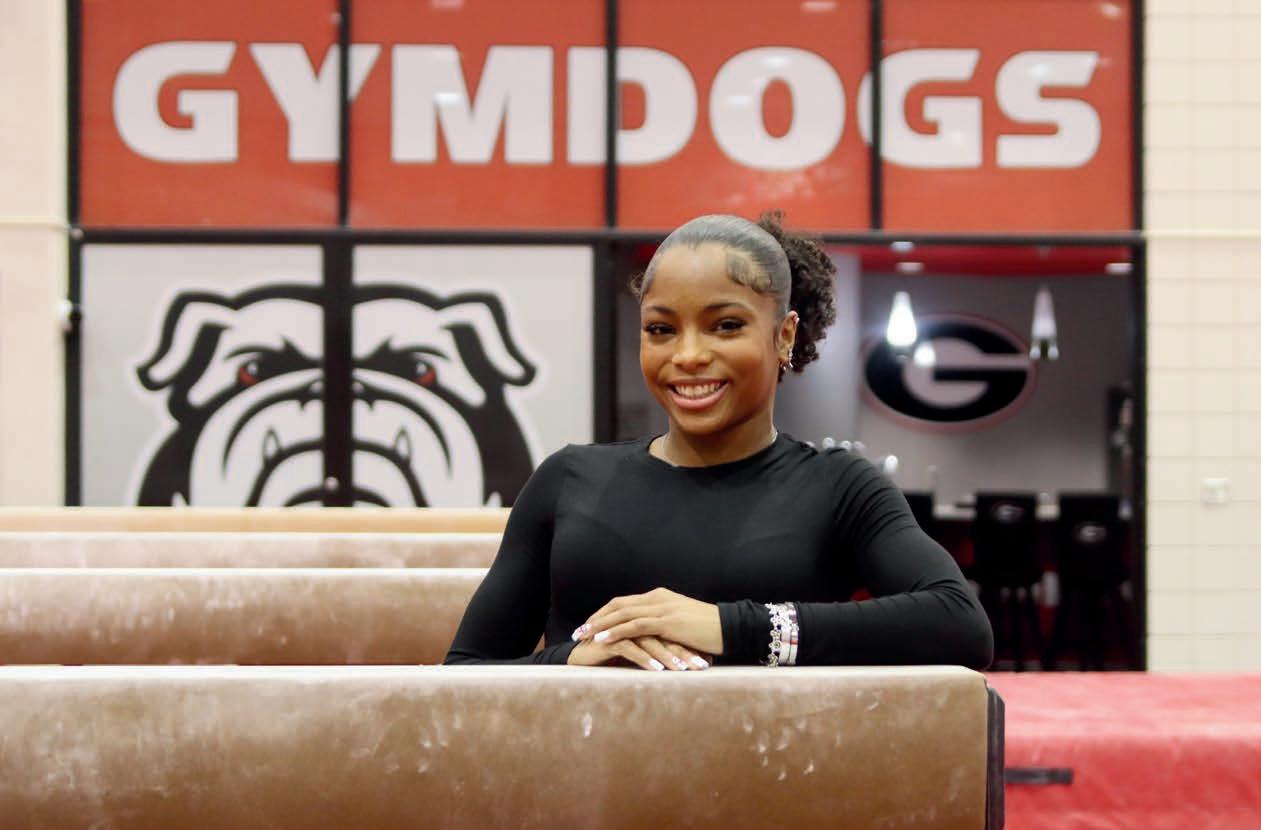
University of Georgia gymnast Nyla Aquino, a sophomore, shares her experience with the cultural differences after moving to the South from Boston.
AS
TOLD TO
VOLET DOCKERY LAYOUT BY LIYA TAYLOR Journalism I Student Sports Editor
University of Georgia gymnast Nyla Aquino: My mom’s side of the family, they’re all University of Alabama fans. They’re all from Deep South Alabama, so that attracted me to the Southeastern Conference and college sports in particular. College sports in the North are not super huge (and) the more that I got into gymnastics, the more I got into being interested in the (SEC). I looked into University of Alabama gymnastics, but something about watching Georgia and seeing how they compete, and watching their floor teams, there was so much personality and so much grit. It was somewhere that I immediately saw myself. Once I got attracted to Georgia gymnastics, I started getting attracted to everything (about) Georgia.
NA: Everything is different about moving from the North to the South. (In Boston), they were really big on academics (and) coming to the South, the culture is so different. UGA specifically does such a good job of integrating school and sports into so much of who they are. Having a great balance of the two was something that I didn’t have (growing) up in the middle of a big city. It’s quieter (in Athens) but everybody’s closer. The whole university feels like one big family. Everybody’s a diehard Dawg, everyone bleeds red and black and I just love how serious everybody is about where they come from and the school that they go to, which you (don’t) see in the North at all.
NA: As an Afro-Latina there’s a very typical (type of) Latina growing up in (Boston) versus growing up in the South. The Southern accents versus Northern accents, the different food options and the weather. Small daily things (like) in the city, you see bodegas, (small neighborhood convenience stores), on the corner, there’s public transportation all the time and everything is going and going. There’s some sort of calm here that doesn’t exist in Boston but also a rush here that doesn’t exist in Boston. While Athens is loud, Athens is vibrant, you get vibrancy that with closer relationships, just because you know that they’re UGA fans.
NA: There’s this video of (former UGA gymnastics head coach) Suzanne Yoculan, and she’s the one the (Suzanne Yoculan Gymnastics Center) is named after. She’s probably the most inspiring person that I’ve ever listened to. All she has to say is a couple words, and it feels like I’m fired up and I’m ready to go. It’s stuff like that, (that) builds the culture. I don’t know that I would say they’re more intense, but they’re more driven. There’s more of a drive to prove who you are in the SEC because it’s such a competitive conference. There’s more to give, and there’s more to prove in the SEC. those things, like riding a bike, (that) once you get into it, it comes back to you.
NA: Thinking about Georgia, there’s so (many parts), like football, basketball, volleyball, nothing about Georgia is small, but that was not what drew me to the school. It was always (about) what I was building and what I could build from gymnastics. Obviously, the cherry on top was everything else. When I got here, me and my roommates were talking about (how) we go to Georgia. UGA, this big SEC football school with all of this money and facilities, and we have to go do everything. I can’t have tunnel vision on gymnastics. I can’t let that be my whole identity, my whole life. I root for every other sport like it’s my own sport. I feel like I had never been so in love with Georgia until I was actually a part of it.
NA: I think being in the South, you can always tell right when you see people that they are from Georgia and go to UGA. These people are rooting for me, through everything that I do, not just my gymnastics. They’re rooting for all of these other people, for all of these other sports. There’s so much pride, and there’s so many friendly people, and that Southern hospitality runs deep in everything. I really appreciate that about the South because, in a busy city like Boston, you don’t feel the same pride, you don’t feel the same excitement and die hard fan energy that you get here. It surprised me, but I wouldn’t want it any other way.
Below: EXPRESSIVE JOURNEY: University of Georgia sophomore and GymDog Nyla Aquino strikes a pose at the Suzanne Yoculan Gymnastics Center on Jan. 13. Aquino had always loved the self expression and friendship aspects in gymnastics, but found greater opportunities for expression and connections as she grew as a gymnast. “I love that college gymnastics emphasizes that team aspect, and you get more freedom in your floor routines,” Aquino said, “I love using music that I grew up with in my floor routines, and being able to show who I am as a person.”
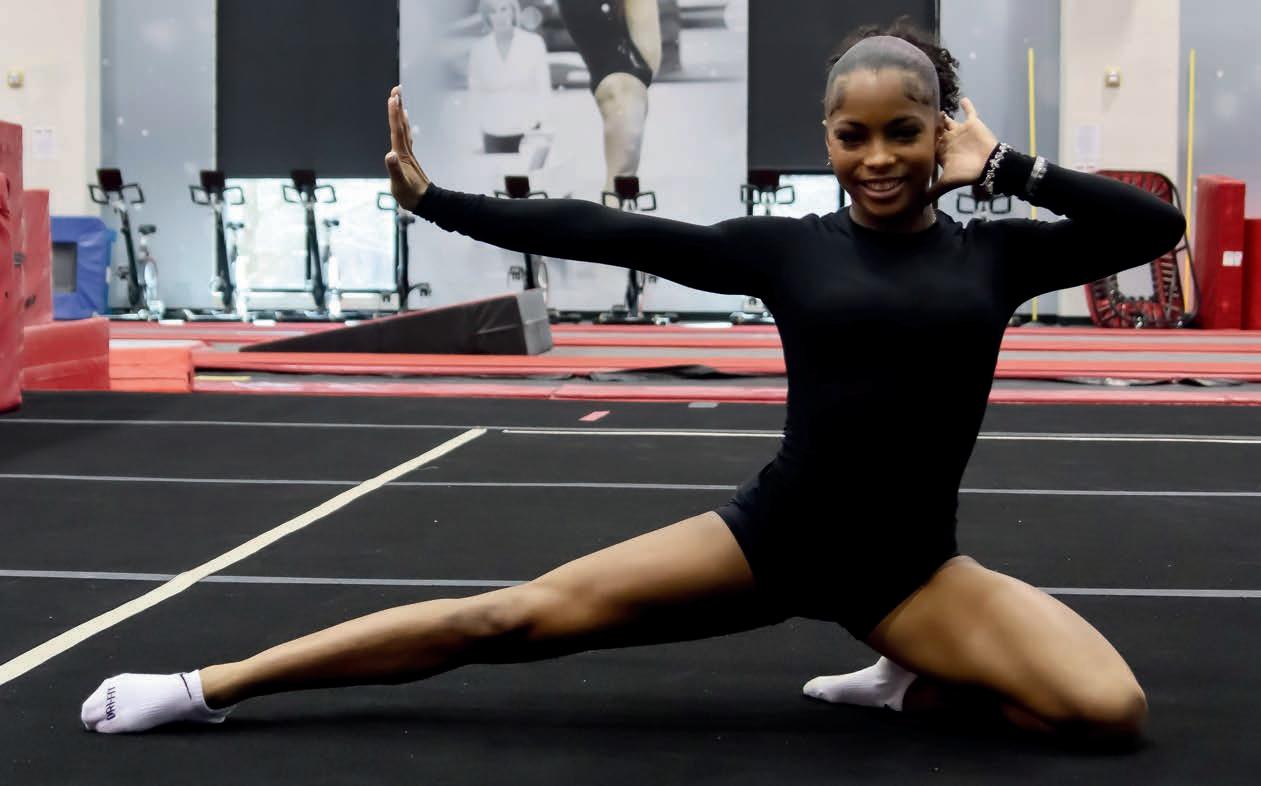

Members of the CCHS boys varsity track and field team broke a total of five CCHS records at the Third Annual Berkmar Patriot Preview on Feb. 11.

STORY BY LEA D’ANGELO Digital Editor-in-Chief
LAYOUT BY LIZA LARSON Print Editor-in-Chief
I“Records are meant to be broken.”
-Zay Brown, CCHS boys varsity track and field assistant coach
t’s the afternoon of Feb. 11 and the Clarke Central High School boys varsity track and field team has just participated in their first meet of the season: the Third Annual Berkmar Patriot Preview at Berkmar High School in Lilburn, Ga..
During the past several hours, four members of the team have broken a total of five CCHS records.
In the 60-meter race, both running a time of 7.24 seconds, CCHS varsity boys track and field athletes La’Gracion Little and Gyasi Miller, both juniors, broke the record previously set in 2016. The previous record holder was CCHS boys varsity track and field assistant coach Zay Brown, with a time of 7.33 seconds.
“Records are meant to be broken. I think being broken by your athletes is (saying) something about what you’re coaching, because, I told (Miller and Little), ‘Hey, y’all are faster than me, so that means I’m coaching y’all to be faster than I ever was. So, take that on the shoulder and keep it moving. Don’t settle. Just keep moving,’” Brown said For Miller and Little, the race represented
not only individual work but the pinnacle of a longstanding relationship and competition since the two played football together as middle schoolers.
“Coming into the meet, the plan was to break the record. That’s what the goal was. So, I just tried to work on my start as much as I could and just keep that going well,” Miller said. “(Little and I) have been neck and neck since middle school. We run, (and) we play football together. like brothers, and it feels great to see him breaking the record and doing good things, too.”
CCHS head varsity track coach Zachary Howard took over the team during the 2024-25 school year and has seen the energy Brown has poured into the team.
“Zay Brown, he will do anything for anybody, (and) for the kids. He’s not in it for himself, and he works really hard at what he does. He’s a Clarke Central legend. He played football here, went to (the University of South Carolina and) played football at the University of Tennessee at Chattanooga,” Howard said. “(It) was really neat to watch somebody like Zay get to coach these kids

Featured: RECORD-BREAKING: Clarke Central High School varsity track and field assistant coach Zay Brown, athletes Gyasi Miller, Jackson Brooks, La’Gracion Little, Torin Trotter and head coach Zachary Brown (left to right) pose on the CCHS track on March 2. Little and Miller broke the 60 meter record, both with a time of 7.24 seconds, which was set by Brown in 2016. “(Little and Miller) got God-given talent right there. We’re adding the mechanics in there now, so they’re gonna be, and they can be, way faster. They can break their own record,” Brown said. “(They’re) just learning how to run. They’re fast. But once you add the mechanics to it, you get way faster.” Photo by Dream Freeman

and break his own record. Coach Brown, he’s a phenomenal person.”
In addition to Little and Miller’s break of the 60-meter record, CCHS boys varsity track and field athletes Jackson Brooks, a sophomore, and Torin Trotter, a senior, also broke a total of four additional records.
Brooks broke the record for the 300-meter with a time of 36.79 seconds and the one for the 600-meter, which was previously set by CCHS senior James Daniel, who committed to running track with the University of Georgia in the fall, with a time of 1:25.79 seconds.
“I try not to get in my head because I have a lot of room for improvement, and I’m not near where I want to be, but I’m extremely happy to be in the school record book,” Brooks said. “It’s been a dream of mine growing up, getting ready to go to Clarke Central, and dreaming (about) here, and now holding school records, no matter what weight they hold, it’s still a huge deal.”
Trotter, who has been on the team for all four years of high school, broke the records for the 1200-meter and the 1500-meter with times
of 3:26.29 and 4:17.31 seconds, respectively. Although not his main goal of the season, Trotter still expressed pride in the wins.
“I was happy with (the record), but I didn’t get too high because those are just two events that we don’t run very often,” Trotter said. “My mindset (for the meet) was just getting a really good double, win both of my events,have fun out there,get a good (training session) and run in.”
Although the team made strides at the first meet, Brown emphasized the importance of continuing momentum rather than settling. In doing so, he’s worked to embody the philosophy of former CCHS head varsity track and field coach Bode Osagiobare, under whom Brown broke the previous 60-meter record.
“(Under Osagiobare), I didn’t have a choice, I just had to do what he told me to do. That’s what (current runners) are gonna have to do. You gotta want to do it. Nobody can’t want it more than you. You got to want to do the things you do in life,” Brown said. “Trying to keep in mind, (not to) settle on that record, break another one and another one.”
“...the plan was to break the record.”
-gyasi miller, CCHS varsity boys track and field athlete
ODYSSEY Star Players are selected based on their academic standing and commitment to teammates, their sports program and Clarke Central High School. Star Players are written for each issue by the Sports Staff based on interviews with players and coaches.

Grade: 12
GPA: 3.60
Years of experience: 4
Grade: 10
GPA: 4.18
Years of experience: 4


Gameday rituatal: We’re a team based sport, even though it’s one-onone wrestling. You talk to your team, you find out, what you’re gonna do beforehand. Your coaches, (will) basically ask you, What’s your game plan? (I) just walk in (and) go out there ready.
Favorite memory: My freshman year, we went to state, even though it was only one person that went to state, we all went. We went out to get Waffle House at 12 o’clock at night, we walked around Downtown Macon, it set my standards of what our team could be.

Gameday ritual: I’ll listen to a little music, but stretching is a big part of my pre game ritual. Get warmed up, ready for the game. (I) listen to a little bit of (NBA)Youngboy. That’s mostly it.
Favorite memory: (My favorite memory was) right before Christmas break this year when we played Oconee County at home, and I had a three pointer in that game, and the locker room after the game was lots of fun, lots of energy. It was fun to be part of the team.
Role model: I look up to freshman basketball coach Markis Callahan and Head junior varsity boys coach Omar Reid, but also basketball player Dylan Cardwell, he played for Auburn University a couple years ago. He’s in the NBA now, and he just brings a lot of energy to the court, gets the crowd in the game.
What coaches say: “Cooper is a hard worker on the court. He gives us all his effort which is a good ability to have out of a player when he competes it brings a different level of energy.”
Role model: My teammate), Moon. She’s way better than me. She pushes me. She’s way more disciplined than I am. She makes me show up every day, overall (making me) a better person.
What teammates say: “She brings a lot of positivity to the room, lots of giggles and laughter. I like wrestling with her, because it makes me better. Her mindset, even if she wins or loses, it’s always the same (and it) makes me want to have the same mentality going into a match.





By augie koons, As told to olive forrester

I’m their coach, and (they need to) respect me, but I’m also joking around with them, trying to be their friend. So, they want to come to practice every day. I’ve had some old coaches and they’re stuck in their old ways, (but) I listen to what (my players) want.
I (use) constructive feedback. I don’t (want) kids (on the field) yelling at people about how bad they are, it doesn’t help anybody. You (should) have something (to) actually say to them that can help them. I just try to emphasize that. I’m not gonna chew somebody out. I’m gonna let them know what they did wrong and how they can fix that.
We don’t really work on fundamentals that much. You can come out to the fields whenever (and) work on your fundamentals. I don’t need to be here telling you what to do. You know what to do. You know you can juggle, you know you can dribble through ladders. The time we have here is more structured towards learning our system, and getting better in that system.
When I was playing JV, all I wanted to do was get with varsity. I’m trying to instill that into them, that that’s something that they can do. If you work hard up here, you will play. I was never that good of a soccer player, but I worked hard, and I worked hard in the games and they saw that. So, I’m trying to show them that they can do (it). JV is just an opportunity to get better and eventually make it to varsity, (and) I would love to see all the kids that are on my team play on varsity.

If the JV program is good, in a year or two the varsity program is going to be good. When you have a good JV program and you’re missing kids on the varsity team through injury or something, then kids from the JV team can just slot into the varsity practice and things can run smoothly, and it just makes everything go so much better.

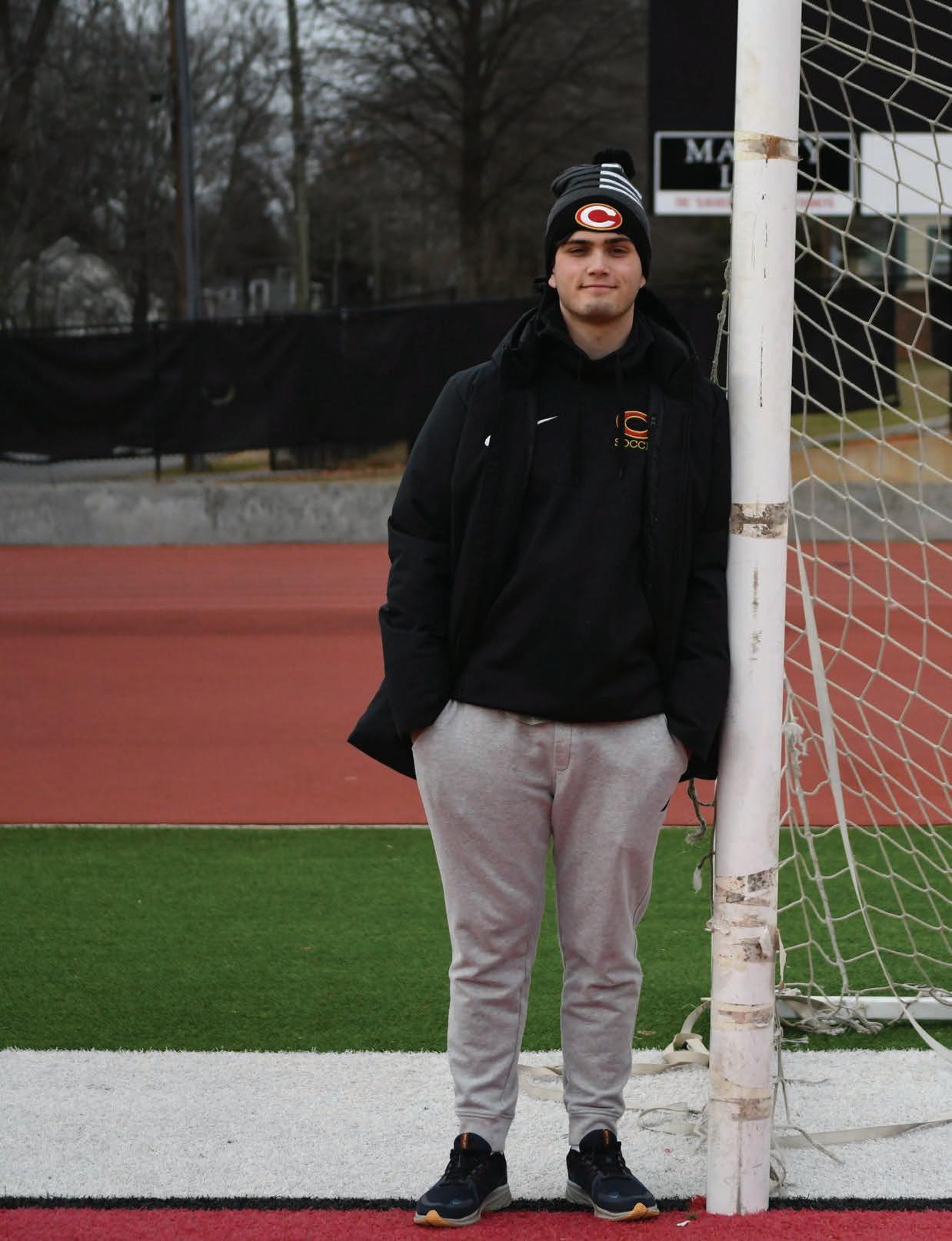
“My goal would be to show them how to be successful.” Koons said. “Sports (will do) that. It shows you how to show up on time, work hard, (be) consistent (and) be respectful to people. So, that’s what I’m trying to instill in all of them.”