16 ESOL EXPANSION
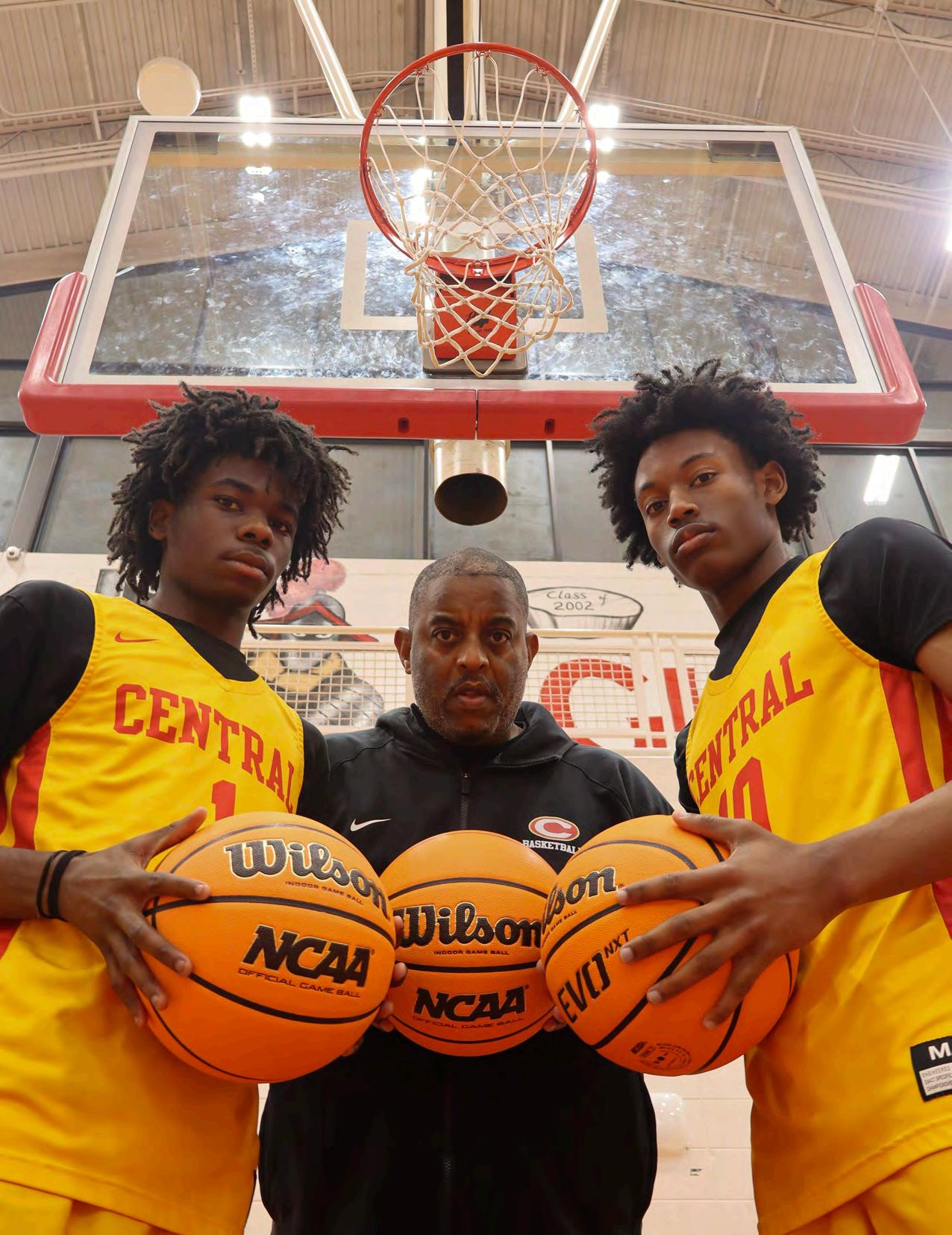
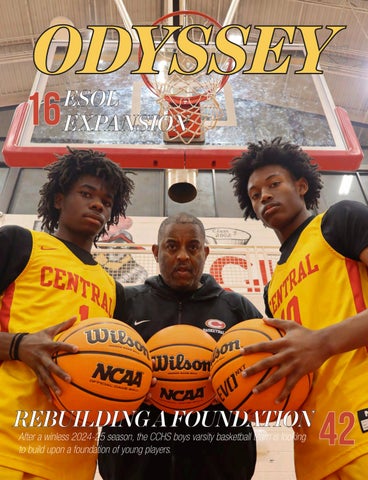
REBUILDING A FOUNDATION
After a winless 2024-25 season, the CCHS boys varsity basketball team is looking to build upon a foundation of young players.


TABLE OF CONTENTS Features

ESOL EXPANSION
Over the past 20 years, CCHS’ ESOL program has expanded to meet the growing needs of Athens’ emergent bilingual population.
BY SASHA BARKAN AND COOPER JONES
Viewpoints
ISA’S IDEALS
Viewpoints Editor Isabella Gresham discusses her job at Chick-fil-A and the impact it has had on her.
BY ISABELLA GRESHAM
The CCSD has four School-Based Health Centers that offer a variety of low-cost healthcare services to CCSD community members.
BY LUCCA FLEENOR AND COOPER JONES
Variety
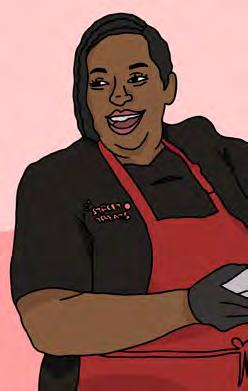
COOKING UP A STORM
CCHS Class of 2007 alumna Faneshea Browner has grown her business from making croissants for her husband at home to a full commercial kitchen.
BY ELOISE LUKEN
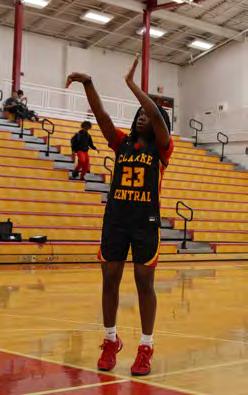
IN HER DNA
CCHS girls varsity basketball point guard De’Anah Oliney, a sophomore and multi-sport athlete, is emerging as a figure of success in CCHS athletics.
BY KYE STREETMAN
Illustration by Sylvia Robinson
photo by Iliana Tejada
design by Liza Larson
Photo by Cooper Jones
Illustration by Sylvia Robinson
Photo by Kye Streetman
REDEFINING BEING THE YOUNGEST
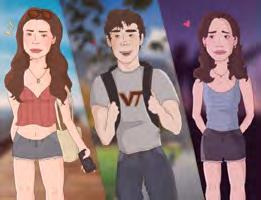
Business Manager Merren Hines reflects on how being the youngest child has impacted her life in ways that she couldn’t have imagined.
BY MERREN HINES
GALLERY: THERESA THA SONGBIRD VISITS CCHS

CCHS hosted Georgia Author's award-winning spoken word poet and singer Theresa Wilson, or "Theresa Tha Songbird," in the E.B. Mell Auditorium.
BY GRADY DUNSTON
INKSPIRED: TATOOING IN ATHENS

THE GLORY OF '85
Since the '90s, the tattoo industry in Athens has been a robust ecosystem of shops and artists who work to balance the legacies from past shops with their own artistic and business ventures.
BY ABIGAIL HOLLOWAY
ODYSSEY
The ODYSSEY is a studentproduced news publication, published with the intent to inform, entertain and give voice to the Clarke Central High School community, as well as to educate student journalists.
Established in 2003, the ODYSSEY is published four times a year, and each issue is an open public forum for student expression under the guidance of a faculty adviser.
Student journalists are provided with opportunities to investigate, inform, interpret and to evaluate: all traditionally accepted functions of the press in America. Published opinions do not necessarily reflect the views of anyone other than the staff.
The ODYSSEY staff is committed to reflect the mission statement set forth by Clarke Central High School. The goals of the staff are to provide fair, accurate news and commentaries, as well as to serve the interests of the school and Athens’ community.
Advertising must conform to the guidelines set forth for editorials. Publication of advertisements does not indicate an endorsement by CCHS or the ODYSSEY staff.
Students pictured in advertisements are not given monetary compensation. All advertising rates are available upon request from any ODYSSEY staff member.
Print Editor-in-Chief: Liza Larson
Digital Editor-in-Chief: Lea D’Angelo
Managing Editor: Peter Atchley
Senior Copy Editor: Cooper Jones
Viewpoints Editor: Isabella Gresham
News Editor: Emlyn McKinney
Variety Editor: Adah Hamman
Sports Editor: Liya Taylor
Photography Editor: Illiana Tejada
Business Manager: Merren Hines
Social Media Coordinator:
Edie Ash
Beat Editor: Izzy Hammock
Menu Editor: Lydia Rowell
Outreach and Alumni Coordinator: Gillian Williams
Staff Members: Abigail Holloway
David Wang
Dream Freeman
Eloise Luken
After falling short in the 1984 state championship, the 1985 varsity football Gladiators turned their heartbreak into history, bringing CCHS its third football state title.
BY LIYA TAYLOR AND DAVID WANG
The ODYSSEY is a member of the Columbia Scholastic Press Association, Georgia Scholastic Press Association, National Scholastic Press Association, Quill and Scroll Honor Society and Southern Interscholastic Press Association.
Corrections of errors and omissions will appear in the next issue.
Kye Streetman
Lucca Fleenor
Maypop Wren
Miriam Silk
Mzée Pavlić
Sara Stuart
Sasha Barkan
Sylvia Robinson
Adviser:
David A. Ragsdale, CJE
ODYSSEY Newsmagazine
Clarke Central High School
350 S. Milledge Ave.
Athens, Georgia 30605
(706)-357-5200
EXT. 17370
LETTERS TO THE EDITOR
Lighting Up
Death Valley
Our Sept./Oct. 2025 issue featured an in-depth story about the new scoreboard at CCHS.
Corrections/Omissions Sept./Oct. 2025
Page 6, in Letter From the Editor, in the caption, “Larson said” should be “Print Editor-in-Chief Liza Larson wrote”
Page 8, in Fresh Voice, “7 hour drive” should be “seven-hour drive”
Page 9, in Nifty Nails, “Dad” should be lowercase Page 10, in My Word vs. Yours, in Lea D’Angelo’s column, “Clarke Central High School U.S.” should be “CCHS United States”
Page 10, in My Word vs. Yours, in Lea D’Angelo’s column, “actor’s” should be “actress’s”
Page 10, in My Word vs. Yours, in Lea D’Angelo’s column, “the” should be omitted in “the Riordan”
Page 10, in My Word vs. Yours, in the caption, the directionals should be swapped
Page 13, in In Focus, “CCHS jujnior” should be “Clarke Central High School junior”
Page 20, in Quest for Athens’ Best, “J Buffalo” should be “J. Buffalo”
Page 20, in Quest for Athens’ Best, “their Honey” should be “its Honey”
Page 31, in Lighting Up Death Valley, in the caption, “athletic director Jon Ward” should be “Athletic Director Dr. Jon Ward”
Page 33, in Lighting Up Death Valley, in the second caption, there should be a “Dr.” in front of “Jon Ward”
Page 35, in Leaving a Legacy, “coach (Billy) Henderson” should be “(former CCHS head varsity football coach Billy) Henderson”
Page 38, in Star Players, in the first blurb, “Lashonda” should be “Lashanda”
Page 39, in 5 Things to Know About Being a Softball Catcher, in the caption, “Bonilla” should be “Dipietro-Bonilla” on all references

It was great to see the new scoreboard as the cover story. I'm not sure how many people realized that the upgraded scoreboard goes hand-in-hand with a new course connected to sports media. Based on (Kye) Streetman's coverage, I understand better understand how the scoreboard represents an investment in the self-esteem of our athletes, as well as an expansion of our students' media skills.
-- Grace Ayer, CCHS English department teacher on “Lighting up death valley” by Kye Streetman
>> VIEWPOINTS
NIFTY NAILS // Sara Stuart
I really liked reading this article because it felt very relatable. For example, how the author talked about her struggles in the beginning and finding a hobby she actually enjoyed. I think it inspires people to explore different activities and to not be discouraged when something doesn't work out.
-- Anna Kim, CCHS sophomore
>> NEWS
SCOTT'S SUPPORT // Emlyn McKinney
I enjoyed this article. I think that talking about the administrators and how they want to help change our school and help students is really important. Administrators sometimes feel like the people that are just there watching over us while we go about our days, so an article like this helps humanize them. I think that have quotes from a student was really helpful to get the full perspective of how the school views Ms. (Alexis) Scott.
-- Shelby McDaniel, CCHS senior
>> VARIETY
QUEST FOR ATHENS' BEST // Mzée Pavlić and Cesia Martinez
I liked how both stories were very informative because they didn’t just focus on the food, but also described the atmosphere and interior of each restaurant. It helped me imagine what it would be like to actually eat in both places. Even though both reviews mentioned some downsides, they also balanced them with positive details that made the restaurants sound appealing overall. I haven’t been to Buffalo Wild Wings yet, but after reading this, it sounds very tempting to try it for myself.
-- Naomi Benavides, CCHS junior
>> SPORTS
LEAVING A LEGACY // Liya Taylor
Contact the ODYSSEY
Letters: Email us at editors@odysseynewsmagazine.net, or drop off in the Main Office, in care of the ODYSSEY. We ask that all letters be under 250 words and signed. We reserve the right to omit or edit any letters received. Insulting, unsigned or libelous statements will not be considered for publication. All letters may be edited for clarity and space.
Advertising: For ad rates email us at business@odysseynewsmagazine.net. Online: Message us on Instagram at @odysseynewsmag.
I read "Leaving a legacy" by Liya Taylor. I really enjoyed how it showed CCHS's historic prominence in the area. The old pictures were a really nice touch to give the reader a perspective on how the school has changed visually. The only thing I would maybe shed a little more light on is asking him personal questions about how he is connected to CCHS football and how he would motivate students and teachers. Other than that, I thought it was very well put together and really enjoyed the article.
-- Tiger Tabb, CCHS freshman
LETTER FROM THE EDITOR
Print Editor-in-Chief Liza
Larson
explains
her relationship to the women in her family and what they have taught her.

BY LIZA LARSON Print Editor-in-Chief
When I try to trace where my sense of purpose comes from, I always end up in the same place: the women in my family.
My mom and Gigi, my maternal grandmother, didn’t set out to be "inspirational figures," but their lives have shaped mine in ways that go far
beyond family ties. Their influence isn’t wrapped in grand speeches or dramatic gestures, it’s in the way they’ve moved through the world.
My Gigi grew up in an era that didn’t offer many choices to women. She learned that if she wanted something, she’d have to find her own way to get it. I’ve always been struck by how matter-of-fact she is about the obstacles she faced. She never romanticizes them, and she doesn’t see herself as a hero.
principles and morals. Growing up, I watched her hold my world together through financial stress, career changes and moments when everything felt unstable.
She never pretended things were perfect, which might be the most valuable lesson she has given me, that strength isn’t about pretending not to struggle, but about choosing to keep showing up.
What I admire most about the both of them is that they don’t easily fit into the narratives we usually assign to “influential women.” They’re neither public figures nor polished success stories. They taught me that you don’t wait for permission to make a life you want.
When I try to trace where my sense of purpose comes from, I always end up in the same place, the women in my family.
As I’ve gotten older, I’ve started to recognize the ways I carry them with me. Outside of looking like them, I see them in how I do work, in how I respond to pressure, and even smaller things like how I approach situations. Their influence on me isn’t about legacy in the traditional sense. It’s about continuity.
But in the details of her stories, you catch a glimpse of her resolve.
My mother’s version of strength looks different. She is unwavering in her
The idea that what they built, even in small unseen ways, allows me to stand a little more firmly in the world.
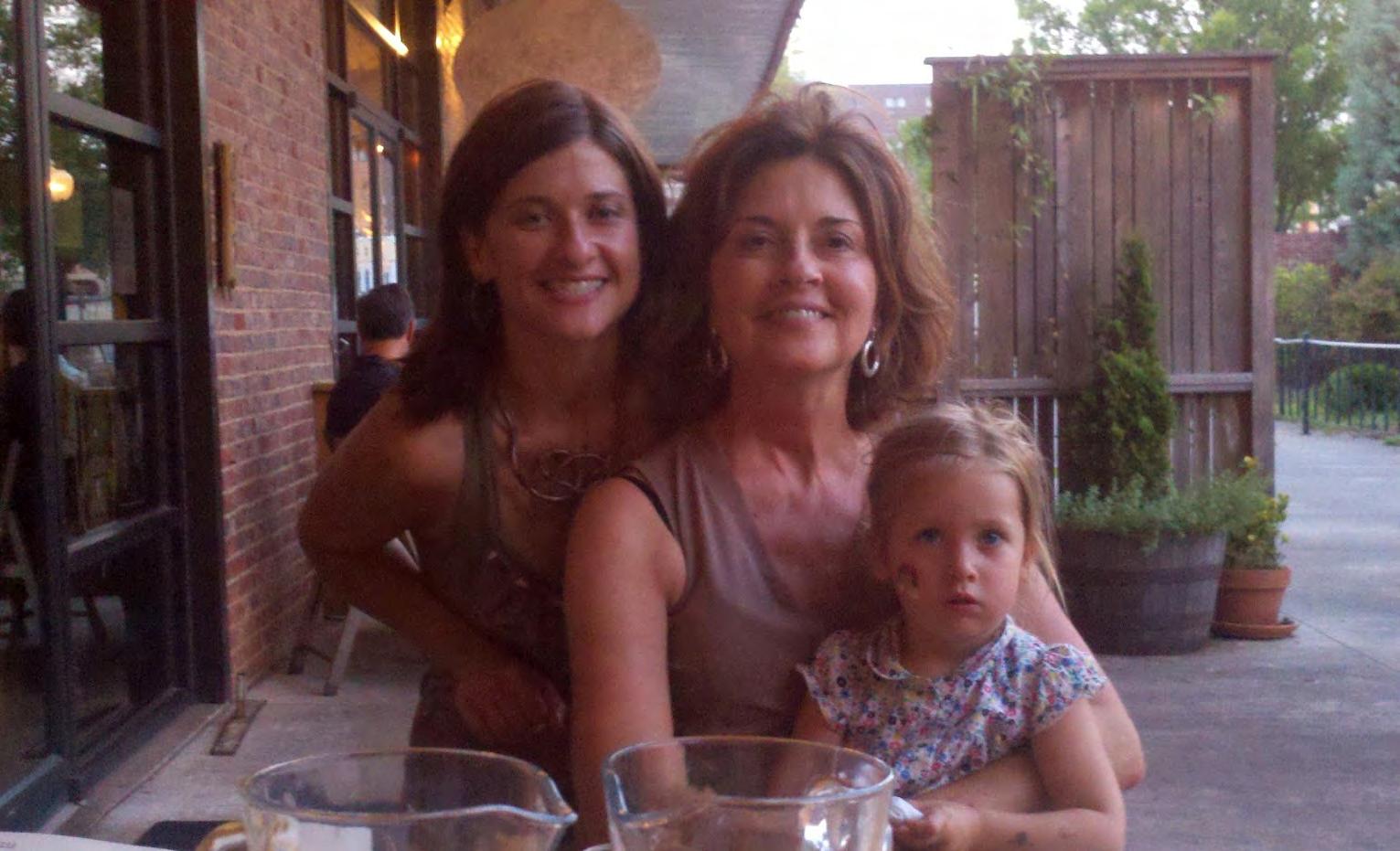
Above: FAMILY CONNECTION: A photo shows Print Editor-in-Chief Liza Larson with her mother, Ashley Larson and grandmother, Patricia Larson. Through observing the women in her family, Larson has learned valuable lessons. "What I admire most about the both of them is that they don’t easily fit into the narratives we usually assign to 'influential women.' They’re neither public figures nor polished success stories. They taught me that you don’t wait for permission to make a life you want," Larson wrote. Photo courtesy of Ashley Larson
LETTER FROM THE EDITOR
The CCSD Board of Education must remain committed to making decisions as a united front rather than backsliding into the fractured group they once were.

BY LEA D'ANGELO Digital Editor-in-Chief
The Clarke County School District Board of Education is currently responsible for representing 12,482 students.
The BOE has nine members who are required to act as a united front, rather than individually.
That unity wasn’t always there, but is something the BOE has made strides in and must continue to commit to in the interest of each of those students and employees they serve.
This discord was exemplified during the COVID-19 pandemic, where the BOE faced severe backlash over the various decisions it made, from putting schools in lockdown to mandating that teachers get vaccinated. That separation continued as the BOE and community faced issues with then-superintendent Dr. Demond Means, culminating in an ethical complaint accusing him of plagiarism and lying on his application for the role.
Conflict persisted until a separation agreement, a termination of Means’ contract, was reached with a 5-4 vote on July 23, 2020. Since that era, however, it’s clear the BOE has come a long way.
“I don't think that anyone can see from the outside how hard we worked to get to a place where we are communicative, where we are responsive to each other, where there's no hostility,” BOE president Dr. Mumbi Anderson, who has been on the board since 2020, said.
However, in that time, the district has also gone through three subsequent superintendents, four in the last six years.
So, as the BOE faces the choice of their next leader following the retirement of three-year superintendent Dr. Robbie P. Hooker in May, that longevity is something they must consider right alongside the issues of those they represent for their respective districts.
The decision has included a multitude of others, most notably what the process would look like, something the BOE spent a great deal of time debating in its August work session.
“There was no process before we decided on Dr. (Robbie) Hooker, we were doing it ourselves and it was chaos,” District four representative Dr. Patricia Yager said during the meeting. “If (current Interim Superintendent Dr. Jennifer) Scott applies and we decide to hire Dr. Scott, that would be awesome, but let’s have a process, that’s what’s gonna keep the community from being split.”
The August discussion showed the BOE’s commitment to learning from the mistakes of the past, but that growth must continue beyond the superintendent selection process and into the transition, which has been proven to be a rocky area, even going as far back as the 2000s.
That unity wasn’t always there, but is something the BOE has made strides in.
“You have to lay the foundation of trust between board members and between the board and the superintendent,” University of Georgia Mary Frances College of Education Dean Dr. Denise Spangler, who served on the BOE from 2002 to 2012, said. “We were super intentional from the beginning with the search committee of setting up professional development, community building and trust building between the (then-superintendent) and the Board from the get-go, because we had not had great experiences with a prior superintendent.”
The conflicts the BOE faced during Spangler’s era and five years ago are no longer as predominant as they once were. It’s clear the BOE has put in the work. But, as half of the BOE goes up for reelection in June of 2026, that work must not be undone.

Above: BOE GROWTH: Audience members question Clarke County School District Board of Education members during a BOE meeting. The BOE has shown growth in keeping conversations at meetings and work sessions productive, particularly in a discussion about choosing the next superintendent at its August work session, in which members expressed the desire to not repeat past mistakes. “The discussion showed the BOE’s commitment to learning from the mistakes of the past,” Digital Editor-in-Chief Lea D’Angelo wrote. “But that growth must continue beyond the selection process and into the transition, which has been proven to be a rocky area.” Illustration by Sylvia Robinson
BOILING POINT
Even amid political divides and frustration, Athens residents like Kirrena Gallagher and Dr. Marilyn Vickers show that impactful change starts with involvement, not complaints.
BY PETER ATCHLEY Managing Editor
If a community wants change, it must contribute to solutions rather than complain from the safety of its couches.
Armchair advocacy only encourages political distrust when involved activists are needed most.
One such local activist is Kirrena Gallagher, former Athens Land Trust Vice President, former Clarke County School Board of Education member and current Athens-Clarke County Commission candidate. Gallagher began her activism with the Athens Teen Pregnancy Prevention Task Force in 2005, learning the importance of promoting change whether elected or not.
“It's one thing to complain about a problem, it's another to address it,” Gallagher said.
over 45 years. Community member Dr. Marilyn Vickers started a petition against the closure that gathered 1,842 signatures in days.
“The whole community center around Five Points has been very important to me for decades,” Vickers said. “We have good communities in Athens, they’re worth supporting… we have to try whatever we can.”
As of Dec. 16, no resolution has been reached, but Vickers continues contacting State Representative for Georgia House District Rick W. Allen in support of the bipartisan Contact Postal Unit Transparency Act, which would hold parties accountable for CPU closures nationwide. Despite her efforts, she faces government policy that feels untouchable.
At the end of the day, armchair advocacy only encourages more political distrust.
She joined the BOE in 2020 to influence needed change, motivated by negative experiences she faced as a parent and student. Gallagher continued pushing into local politics, resigning from the BOE in 2022 to run for County Commission. Though she lost, she ran again for the BOE in 2024.
Another example of engaged community action comes from Athens' Five Points, where the United States Contract Post Office in ADD Drug closed after
Given America’s unstable political climate and government gridlock— illustrated by the federal shutdown from Oct. 1 to Nov. 12—it's understandable that people feel powerless. Yet Athenians like Vickers and Gallagher prove anyone can change their community and yield meaningful results, even when politics feel divided.
For anyone looking to spark change, the first step is knowing community needs and collaboratively identifying action steps. Voicing negative opinions may seem easier, but creating solutions is simpler than it appears—it only requires getting involved.
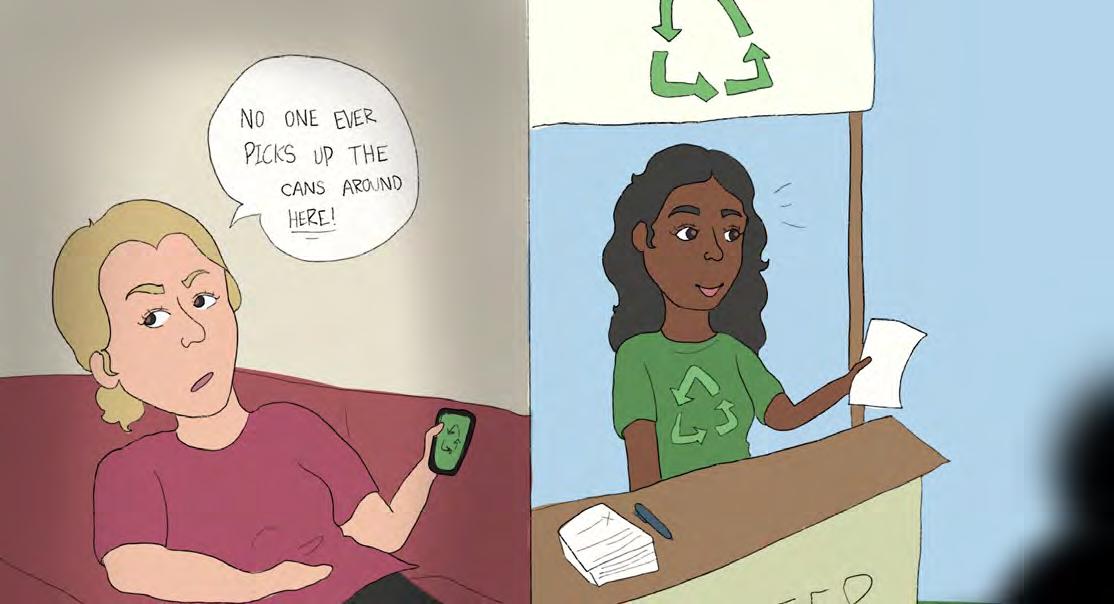
Above: CHANGING COMMUNITIES: An illustration shows the clash between government policies and community activists. Community activist and former Clarke County School Board of Education member Kirenna Gallagher has committed her life to being an involved member of the community. “Show up to a (BOE) meeting, and take your three minutes. I would love for more people to take
standing there and staring, making people uncomfortable,” Gallagher said. “Because those are your three minutes, you can do
present.” Illustration by Sylvia Robinson
ISA’S IDEALS
Viewpoints Editor Isabella Gresham discusses her job at Chick-fil-A and
the impact it's
had on her.

BY ISABELLA GRESHAM Viewpoints Editor
"To have a positive impact on all who come in contact with Chick-fil-A.”
Stated above is Chick-fil-A’s Corporate Purpose, outlining how each Front of House team member should respond to guests. Following that statement, the five core values are listed as continuous improvement, hustle, positive attitude, stewardship and to have fun.
As a member of the CFA team since the beginning of the 2025-26 school year, I have been pushed and encouraged to follow the restaurant purpose and values as closely as possible.
Beyond the learning, I’ve had many humorous moments, including, but not limited to, my friend spilling nearly an entire container of sticky, runny milkshake base on herself, my coworker dropping a full stack of clean trays with countless sauces piled on top and multiple bags of thick strawberry sauce leaking all over myself and the floor, which fill me with amusement each day.
responsibility, respect and balance more than I ever had.
In an environment based on efficient and nearly-perfect customer service, working under pressure is the everyday norm. In just one month, I learned how to serve customers both inside and outside, be on drinks and desserts for the drive thru, bag dine-in and carry-out orders and close the entire store so we can attempt to get out at closing time.
From this fast-paced atmosphere, I’ve learned to not be so focused on tiny mistakes, and instead to complete each task efficiently and well. Additionally, I have become much better about communication and asking for help when needed rather than struggling on my own.
I have become better about asking for help rather than struggling on my own.
Nonetheless, no matter how unnerving it may be to tell people, “I work at Chick-fil-A,” queue “my pleasure” jokes, my position has granted me the most amazing coworkers and a newfound respect for all service industry workers and the difficult roles they endure each day.
Throughout my employment, I have come to understand the importance of
Though my job is generally enjoyable, the more hours I take on and the three-four day work week makes the mounds of homework seem impossible. But, since I have begun working, knowing that I may not be able to get everything done all the time has opened up more doors than it closes.
It allows me to better prioritize and identify necessary tasks. Because of the opportunities allotted to me through my job, I now know that I am set up for success later down the road.
In my fifth month working at Chick-fil-A, I’m now constantly trying to make a positive impact on everyone I encounter, even beyond the guests at work. While saying, “My pleasure,” about a 1,000 times a day isn’t always the most pleasurable, I’m endlessly grateful for my job and all the newfound skills I have because of it.

Left: BALANCING AT WORK: An illustration depicts Viewpoints Editor Isabella Gresham completing many tasks at once during her shift at Chick-fil-A. Gresham began working at CFA at the start of the 2025-26 school year and has since worked to balance her job alongside homework and activites. “Since I have begun working, knowing that I may not be able to get everything done all the time has opened up more doors than it closes,” Gresham said. “It allows me to better prioritize and identify necessary tasks. Because of the opportunities allotted to me through my job, I now know that I am set up for success later down the road.” Illustration by Sylvia Robinson
Singer Brinson VOICE FRESH
Journalism I student Singer
Brinson reflects on her passion for film.
Films and other forms of visual media have always played a significant role in my life.
In 2023, I watched the first film that made something click in my brain, and I began becoming more interested in film and its industry. This motion picture was “A Ghost Story,” directed by David Lowery. The film is mainly silent with hardly any dialogue.
While it lacked verbal storytelling, it still allowed for an emotional and visceral reaction from its raw and simplistic cinematography and sound work. I realized then how important and powerful cinema can be and how many attributes truly contribute to the effectiveness of it.
Whether it’s through a work’s cinematography, sound design or writing, I find visual media capable of illustrating perfectly imperfect moments. Film depicts what it means to be human through acting and capturing one’s own concepts and idealisms on what it means, allowing features of all genres to form a connection with their audiences.
The creativity that filmmakers display allows me to connect with a variety of films, no matter the style. I can enjoy and find relatability in motion pictures without them all being the same story or tone.
Visual media has allowed me to better understand myself and the world around me. When I watch, I strive to pick up on the smaller details and how they add to the visual or overall concept. By learning to spot the important features that might not seem so important, I find myself being able to appreciate the little things instead of taking them for granted.
I’ve always appreciated visual media, which has helped me explore my possible career paths. When I grow up, I want to pursue a career with sound editing or sound production. I hope that as I go into the field of filmmaking, I can achieve the same impact, and detail, that I admire when I watch films.

QUESTION OF THE MONTH
What’s your favorite movie to watch during the holidays?
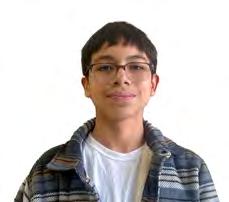
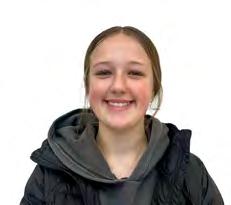
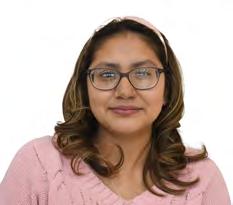
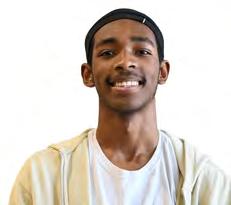
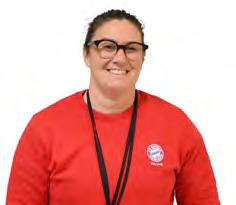
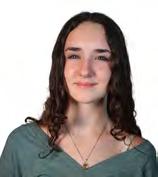
“My favorite movie is to watch is the first 'Alvin and the Chipmunks' movie, because it is very nostalgic because I used to watch it with my parents and brother and it's just super fun and festive."
-- ISAAC BERMUDEZ, CCHS freshman
“'Christmas Vacation' because I think it's funny and it reminds me of the Christmas season and spirit.”
-- FAYE SKELTON, CCHS sophomore
“My favorite holiday movie is 'The nightmare before Christmas' because I really like the animation style and the combination of Halloween and Christmas in one."
-- MIA GARCIA, CCHS junior
“I gotta say, 'How the Gring stole Christmas' because he's a relatable character. It's a really sweet story about not being selfish, not caring. Then, you know, his heart grew three times bigger.”
-- Za'shun Hardeman, CCHS
senior
“My favorite holiday movie to watch is 'Home Alone,' the original. Since my husband and I started dating 13 years ago, we have watched it every Christmas Day, and it's just our tradition,"
-- GILLEN
SCHECTER,
CCHS social studies department teacher
Above: FILM FANATIC: An illustration shows Journalism I student Singer Brinson is immersed in film. Brinson has been interested in film for multiple years and has developed a passion for the craft. "Visual media has allowed me to better understand myself and the world around me," Brinson wrote. Illustration by Sylvia Robinson
THUMBS
The ODYSSEY staff’s opinions on this month’s issues.
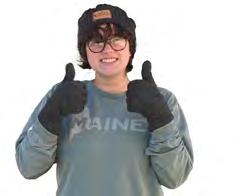
REBUILDING UNITY
After years of conflict and turnover, the CCSD Board of Education is finding its footing, but with another superintendent search ahead, the unity they’ve built will be tested.
INQUIRY INFECTION
Due to the Get Comfortable literacy program, the next epidemic will be critical thinking.
NEIGHBORHOOD NURSES
The CCSD has four School-based Health Centers that offer a variety of low-cost healthcare services.
BOUNCING BACK
Although they didn't win a single game last year, the CCHS boys varsity basketball team is on the rebound in 2025-26.

DIGITAL VIGILANCE
A single social media post can travel far beyond its intended audience, shaping opportunities and consequences long after it’s shared.
LANGUAGE LIFELINE
With 2,000 English Learners depending on support the district barely funds, the Clarke County School District risks leaving some of its most vulnerable students without a fair shot at graduation.
WARPED MASCULINITY
Behind the rise of the manosphere lies a dangerous cycle where online misogyny exploits male vulnerability and breeds hostility toward women.
PRESSURED PRAYER
When team prayer blurs the line between unity and exclusion, studentathletes are left to choose between belonging and their beliefs.
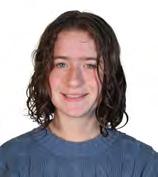
Being aware of what you post and share is vital in protecting your digital footprint.
How far does a social media post go after one hits “share”?
The answer, it turns out, can be very far indeed.
Posts can follow individuals throughout their lives, highlighting the importance of monitoring one’s active digital footprint in an increasingly online world.
Norton, a cybersecurity company, defines active digital footprint as “the information you choose to share online, including posts you make on social media,” meaning that every time someone shares a story, Instagram Reel or TikTok, their active digital footprint is expanding.
Active digital footprints have the potential to leave lasting effects that shape individuals’ futures. According to Kaplan, Inc., an education and admissions service company, 67% of college admissions officers believe it’s appropriate to examine applicants’ social media profiles, with 28% having done so in the past.
Social media posts containing illegal substances or activities can harm one’s chances of getting into their desired school, according to CollegeData, a higher education information center.
This demonstrates that, although a post might be shared with friends or family in mind, it can also be evaluated by those determining one’s future.
Some may argue that the use of private accounts negates the need for such precautions. However, the ability to screenshot private posts provides a gateway for such information to circulate on public accounts, completely outside of the original posters’ control.
While an Instagram story, TikTok repost or X post may seem temporary and insignificant, they wield substantial power in the effects on one’s future. In an increasingly digital world, it is vital for young people to protect their digital footprint by being conscientious about the things they post.
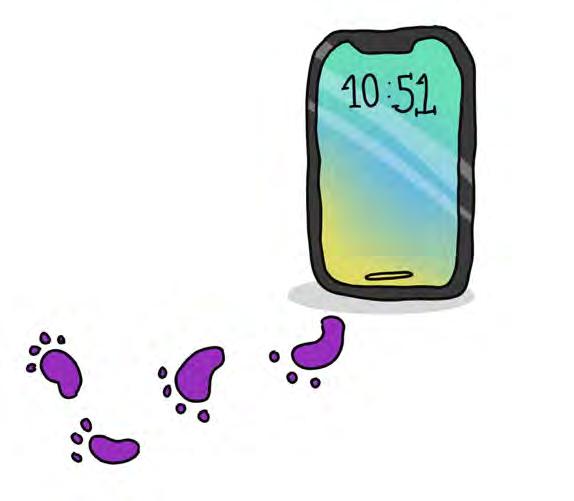
HARMFUL
TWO SISTERS, TWO CITIES
Viewpoints Staffer Sylvia Robinson
reflects on her struggles without her sister, who recently left for college, and coming to terms with them.
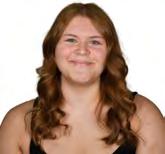
BY SYLVIA ROBINSON Viewpoints Staffer/Illustrator
Ilook out the window as I watch my sister, Eleanor, leave to attend the Savannah College of Art and Design one early morning in late August 2024.
With her gone, I’m left with almost nothing but our shared memories, from begging her to play with me to gossiping about drama on our old bunk bed or driving around Athens while blasting music. I understood that I was going to lose one of my best friends.
The first week she was gone was rough, and not being able to annoy or talk to her in person was difficult. I didn’t realize how much I’d miss her until we were no longer living under the same roof.
Similar to many siblings, we’d always bicker with one another. Though there were times when I didn’t want to deal with her, I forgot we have a bond and are meant to stick together. Although I don’t always show it, I’m grateful for the advice she’s given me.
Now, it's been a year and I've gotten better at being the only child in my home. I’ve realized this is what it will be like in the future, and I remind myself that she’s following her dream as an illustrator and animator.
Our relationship has only grown stronger. Even though we don’t speak as often as we used to, we try our best to call each other whenever we can.
Even after nights of catching up, I still find myself rushing to my sister’s room to tell her the news I heard from my friends, only to open a door to an empty bedroom.
Looking at the leftover tape on the walls from the posters she brought with her to college, the always-made bed that hasn’t been touched since she left and the built up dust on her window sill, I catch myself missing her all the same.
But nonetheless, I understand that although she’s far away, our bond could never be broken and never will be for as long as we live. O


PAWS AND LESSONS
Viewpoints Staffer Sara Stuart explains how having and losing pets has helped her gain responsibility and learn to cope.

Throughout my life, I've had many different pets: one dog, five cats, one lizard, two mice, many fish and multiple chickens. Owning pets comes with the learning curve of responsibility, as an animal's life is practically in my hands.
When my brother, Jack, wanted a pet bearded dragon in 2016, he had to promise to our parents that he would take great care of it. He even wrote an essay on how to take care of a bearded dragon. My parents eventual-ly bought him one because they thought they could trust him.
For me, my cats taught me the responsibility that the lizard taught Jack. From changing litter, to making sure they had clean water, to brushing out matted fur and making sure they had enough food, their care became an enjoyable daily routine.
However, as time goes on, pets get old and owners face the inevitable. From cats to dogs to fish, experiencing a pet’s death never falls short of devastating. No matter how their passing came about, I always struggled to get over it.
When I was nine, my first cat died. I was completely miserable. Nonetheless, his death taught me how to deal with that extreme sadness. The experiences of grief over departed pets helped guide me to healthy coping mechanisms, such as humor and relying on my friends and family.
The 11 different pets that I've had throughout my life all became a big part of the person I am now. I’ve learned responsibility, how to manage grief and the importance of companionship. I'm grateful for all they’ve taught me.
BY SARA STUART Viewpoints Staffer
Above: SISTERS FOR LIFE: Viewpoints Staffer Sylvia Robinson (left) poses next to her sister Eleanor (right) in front of a holiday background in their ballet class in Minneapolis in 2012. After Eleanor left for college in 2024, Sylvia reflected on their past time together. “Although don’t always show it I’ve always been grateful for the things she’s taught me, like advice or expressing better communication skills because of her," Sylvia wrote.
Photo courtesy of Chad Robinson
Above: PUPPY LOVE: An illustration shows Viewpoints Staffer Sara Stuart hugging a dog. Through losing pets over her lifetime, Stuart has learned how to healthily cope with loss. “When I was nine, my first cat died. I was completely miserable. Nonetheless, his death taught me how to deal with that extreme sadness," Stuart wrote. Illustration by Sylvia Robinson
OUR TAKE
As
district budgets rise but ESOL funding remains stagnant, hundreds of Athens-area English Learners face steep academic barriers and disproportionately low graduation rates.
English for Speakers of Other Languages is not a luxury in public education, it is a lifeline.
In Athens-Clarke County, nearly 16% of students in the Clarke County School District are English Learners (ELs), meaning 2,000 students rely on ESOL programs to access the same education as their peers. Despite these numbers, ESOL funding remains an afterthought, with only a fraction of high school ELs receiving the support they need to stay on track for graduation.
The district has made efforts to implement this support. In 2024-25, the CCSD launched the Center for Readiness in English and Career Education, a half-day program for newcomer students at Clarke Central and Cedar Shoals High Schools. The program provides targeted language and cultural support, helping students transition more smoothly into mainstream classrooms.
Meanwhile, the district’s budget continues to grow. For fiscal year 2024-25, CCSD approved a $240.6 million budget, an increase of $26.5 million over the previous year. Yet within this figure, there are no clear earmarks for expanding high school ESOL services beyond existing staffing and CRECE.
Without specific protections, ESOL funding risks being absorbed into broader budget priorities.
The consequences are measurable. According to the Migration Policy Institute, EL’s graduate rates are nearly 20 percentage points lower than their peers nationwide. In the CCSD, where the percentage of EL students is higher than the national average of 10.6%, underinvestment in high school ESOL is a direct threat to equity.
High school ESOL students are not asking for special treatment. They are asking for the same chance at success as their peers.
But CRECE’s reach underscores the scale of the challenge. Only about 50 students are enrolled each semester. Which is a fraction of the 2,000 ELs districtwide, and far short of the hundreds of high school students who could benefit from more aid.
Title III of the Every Student Succeeds Act provides federal money for EL programs and the CCSD participates. But when spread across all students, Title III supports only amount to a few hundred dollars per student. By comparison, overall per-pupil spending in CCSD exceeds $15,000 annually, according to U.S. News & World Report. The imbalance leaves ESOL programs dependent on piecemeal funding or pilot initiatives rather than stable, long-term investment.
“If we lost funding and we lost ESOL-endorsed teachers then that would affect our graduation rate. It would affect our students' comfort (at CCHS), just knowing that there's a hostile world out there waiting for them,” ESOL department chair Jodi Bolgla said.
High school ESOL students are not asking for special treatment. They are asking for the same chance at success as their peers. That chance requires more than determination, it requires real investment.O
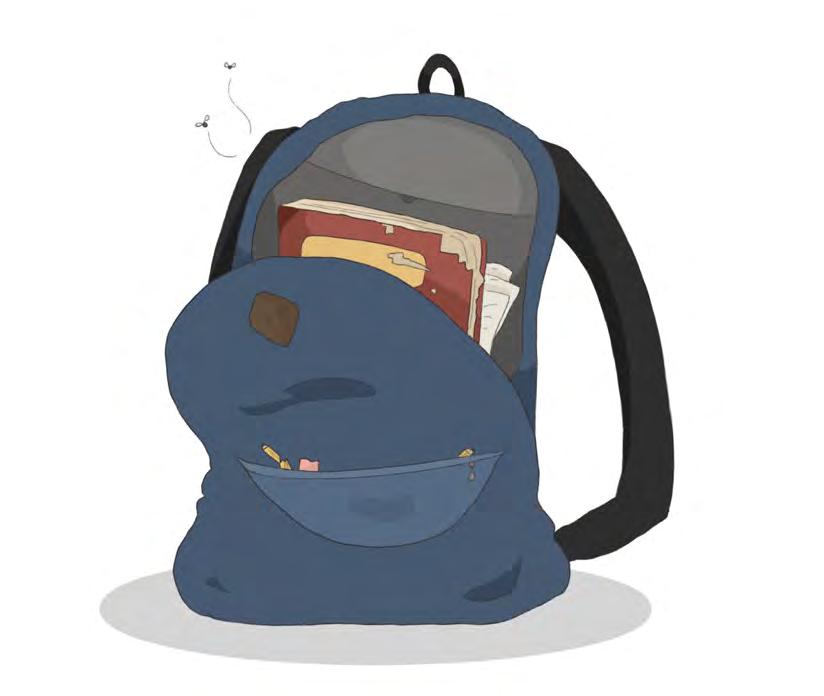
Left: LACKING RESOURCES: An illustration showing below par school resources is shown. English for Speakers of Other Languages programming is at risk of being incorporated into other priorities. “In the CCSD, where the percentage of EL students is higher than the national average of 10.6%, underinvestment in high school ESOL is a direct threat to equity,” Illustration by Sylvia Robinson
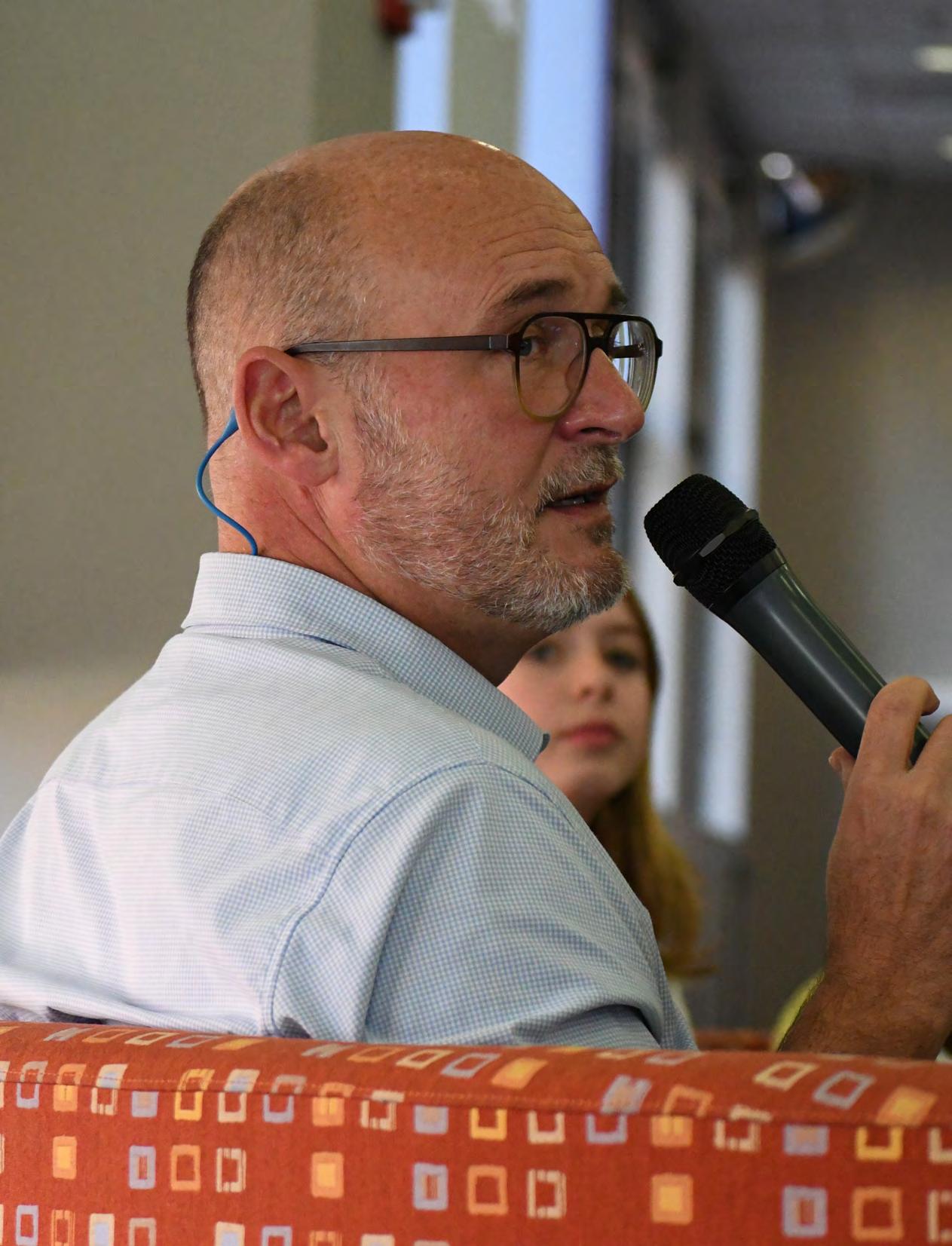
Featured: AUTHOR VISIT: Dr. Harrison Scott Key, Executive Dean of Savannah College of Art and Design, speaks during an author visit in the Clarke Central High School Media Center on Oct. 17. During the event, Key discussed his experiences with writing and his family, prominent topics in three of his memoirs. “It took me a decade or more of trying to write as an adult before I was like, ‘Oh, if I’m funny, then what I write kind of has to be funny, because that’s who I am,’” Key said. “Not everybody is. Some people are very romantic and poetic and (their) writing should also be like that.”
IN FOCUS
Photo by Maypop Wren
Getting comfortable Getting comfortable
The Get Comfortable literacy program shows success in the CCSD, with literacy rates growing at partnered schools.
STORY BY LIZA LARSON Print
Editor-in-Chief
EMLYN MCKINNEY News Editor
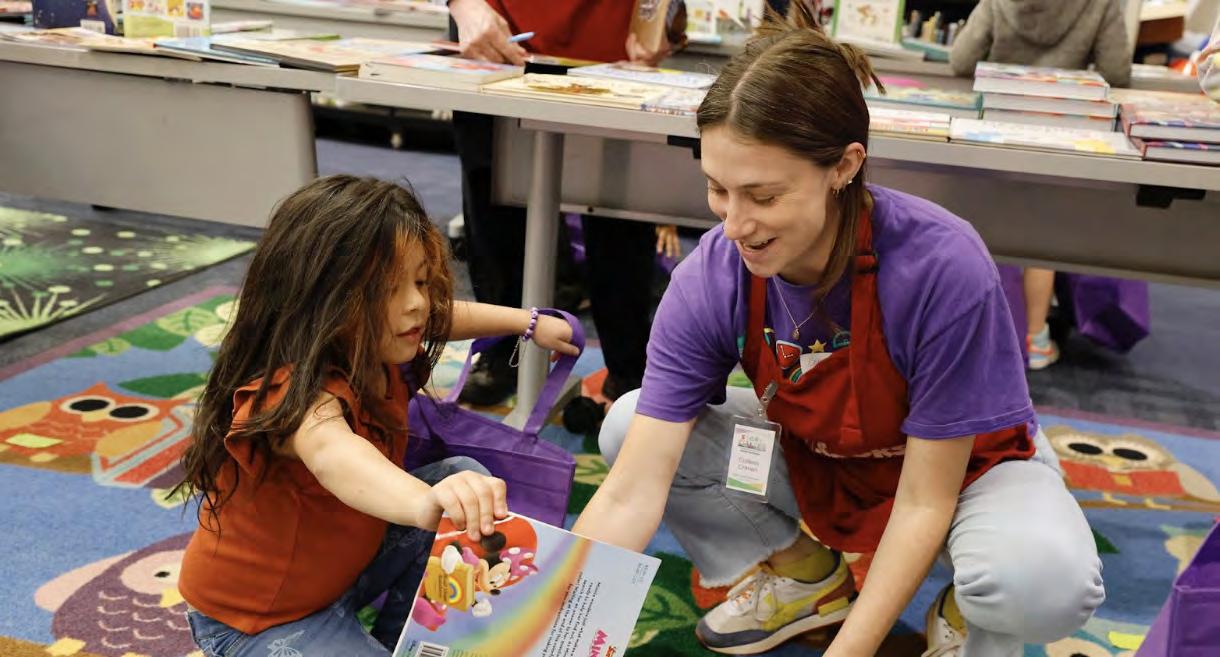
The Clarke County School District is entering its fourth year of the Storytellers Program, a partnership between Get Comfortable, a literacy initiative under Books for Keeps and Creature Comforts Brewing Co. With strong results at Howard B. Stroud and Fowler Drive Elementary Schools, the program is set for expansion.
Storytellers began in 2021 at HBSES and expanded to FDES in 2023. The program pairs volunteer mentors with first and second grade students who have been identified as needing literary support by annual i-Ready tests taken by all CCSD students. The data from i-Ready scores are split into three sub-sections: on-grade level, approaching grade level and below grade level. Students in the below-grade level sub-section receive twice-weekly, 30-minute, one-on-one reading sessions designed to improve their reading skills.
“To have the community in our schools is amazing because they see the great work that’s happening in our buildings.”
-- Stacie Carson, Fowler Drive Elementary School principal
“We saw students in second grade (who participated) growing at a rate three times that of the non-mentored students,” CCSD Executive Director of Innovation Strategy and Governance James Barlament said. “(It’s a) limited sample of students we’re talking about, about 100 students at (HBSES and
FDES), but the efforts have been working well.”
The partnership was created after a Creature Comforts community-needs assessment identified student literacy as a key concern. District data has shown that literacy proficiency dropped from 63% in 2019 to 43% in 2021 for grades K-5. Since then, rates have increased, resting at 60.5% in 2024. FDES principal Stacie Carson has seen the impact of this program firsthand.
“To have the community in our schools is amazing because they see the great work that’s happening in our buildings. Not only are we getting them to be in the building, but it also gives our children another adult that’s cheering them on and supporting them (and) wants them to be great,” Carson said. “To have somebody else come in and say, ‘I want to give up my time twice a week to hang out with you,’ that just adds in another bonus.”
This year, the CCSD plans to take on a greater coordinating role in the partnership. Books for Keeps will continue mentor training and oversight, and Creature Comforts will continue providing funding through the annual Get Comfortable campaign.
“What we’re looking to do over the course of (the 2025-26 school year) is to kind of flip that over to where CCSD becomes a more active partner and we become the convening partner,” Barlament said. “That doesn’t mean that Creature Comfort shoots out the door, never comes back. They’re still going to be out there working, raising money. Books for Keeps would remain the bootson-the-ground partner.”
Expansion of the program is dependent on recruiting additional volunteers and securing resources for sustainment, an endeavor Books For Keeps’ Storytellers Program Manager Colleen Craven feels is achievable.
“We are well-suited to get volunteers. We have a lot of folks that really enjoy the mission of Books for Keeps,” Craven said. “We are as well-positioned as we could be to get the volunteers for the school sites, (it’s) just a matter of when we’re ready (to expand).”
Featured: COMMUNITY CONNECTEDNESS: Colleen Craven, manager of the Storytellers program for Books for Keeps, works with a student at a Books for Keeps event. Craven has worked at Books for Keeps since 2022, the second year of the Storytellers program, which provides literacy mentorship opportunities to students who have been identified as below grade level in reading. “The idea (is) that students are feeling confident in connectedness to their community and in themselves,” Craven said. Photo courtesy of Scott Thompson
LAYOUT BY
ESOL EXPANSION
esol expansion
Since 2001, CCHS’ ESOL program has grown significantly along with the population of ELs in Athens.
the history
STORY BY SASHA BARKAN AND COOPER JONES News Staffer, Senior Copy Editor
LAYOUT BY LIZA LARSON AND EMLYN MCKINNEY
Print Editor-in-Chief, News Editor
Over the last 20 years, Clarke Central High School’s English for Speakers of Other Languages department, which focuses on preparing emergent bilinguals for CCHS’ English-based curriculums, has expanded to meet growing needs.
Enacted in 1985 under Title III, ESOL is a state-funded program in the United States defined by the Georgia Department of Education as “a language instruction educational program provided to help English Learners (ELs) overcome language barriers and participate meaningfully in schools’ educational programs.”
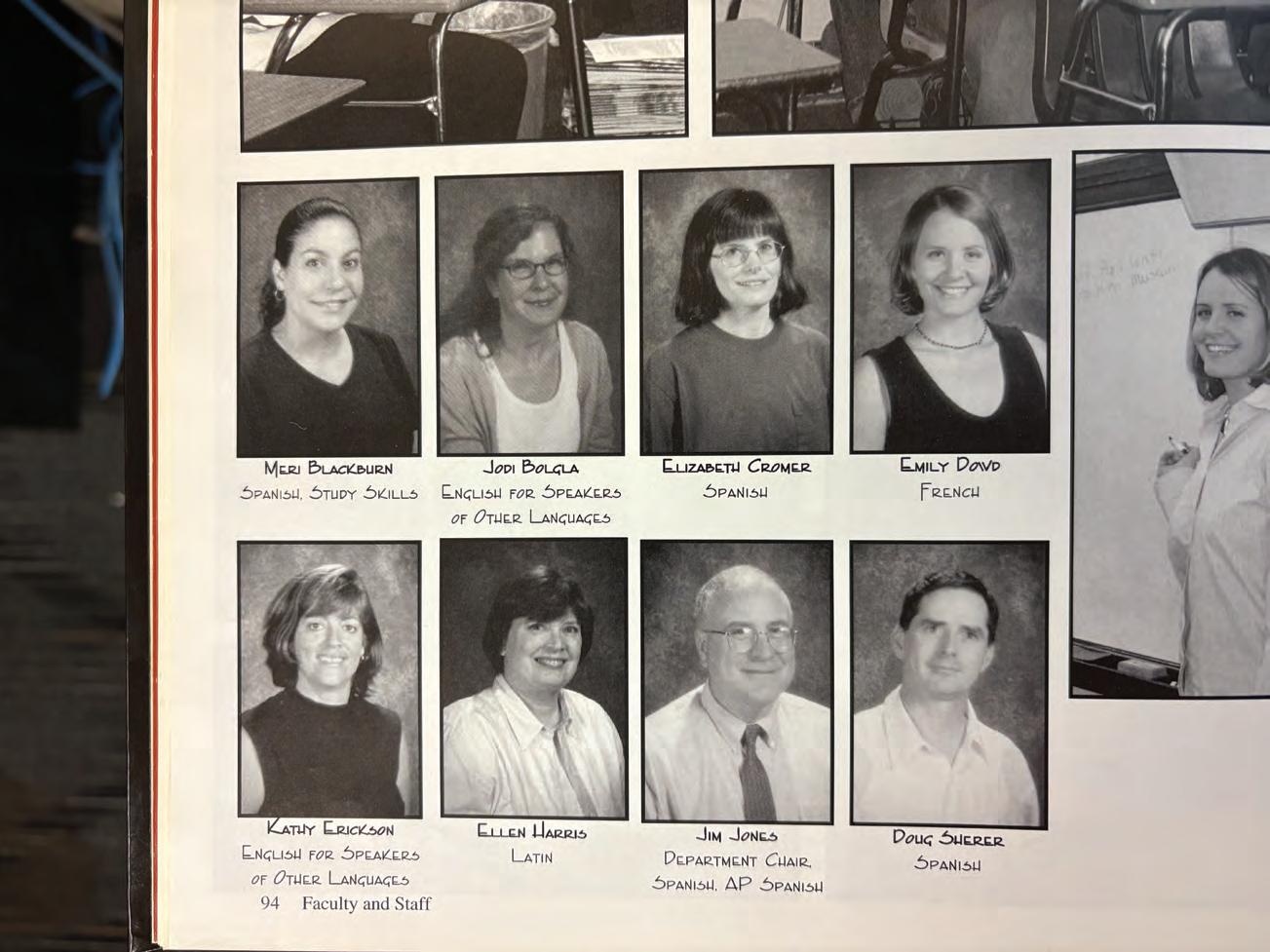
When ESOL department teachers Jodi Bolgla and Kathy Erickson took over CCHS ESOL in 2001, they represented the full faculty of the ESOL department.
“It was small. We just had our own classes. It was kind of nice that way to start off because we got to know our students very well,” Erickson said. “It wasn't difficult, because anything we were teaching them was helping them learn (English).”
the growth
The program has grown exponentially since its inception. Since 2001, the CCHS ESOL department has grown from 40 to 211 ELs. This parallels the Clarke County School District’s growth from 347 to 3,002 students in the last 20 years.
To account for more ESOL students, the program has grown from two to nine teachers, with six added in the past five years.
“The number of ESOL teachers is incredible to me,” Erickson said. “We kind of sprout out and go to our departments that we work with, but we also come back together and have our ESOL talks and see what's working (and what) could be improved upon. It's crazy, but we get it in somehow. (The program’s growth is) striking.”
However, this new growth has its fair share of challenges as well. As the ESOL department’s student enrollment and course offerings expanded, its faculty needs grew too, causing challenges on the district level.
“You're always trying to figure out how many (teachers) you need, how many kids you have, but the planning is always a year out when the kids aren't there yet,” CCSD Coordinator of English Language Learner Programs Dr. David Forker said. “We work really hard to have the right number of teachers to support students. (It’s) always a challenge to make sure that we're supporting students with sustainability.”
for them. (Graduation is) meaningful (because of) the opportunities they'll have because they graduated from high school, and that's not always easy to figure out. Knowing all the challenges they have to get to graduation, makes it really meaningful that they actually manage to do everything they needed to do to
At the school level, the influx of students has challenged the ESOL faculty’s capacity to form personal relationships with students, something Erickson believes is a vital part of her teaching success.
“(Knowing about students’ backgrounds) helps us because ELs are just like every student in the school,” Erickson said. “We're told to get to know the student because it's hard to teach a student that you don't know, but if you go the extra mile and figure out what's going on, that helps them feel comfortable.”
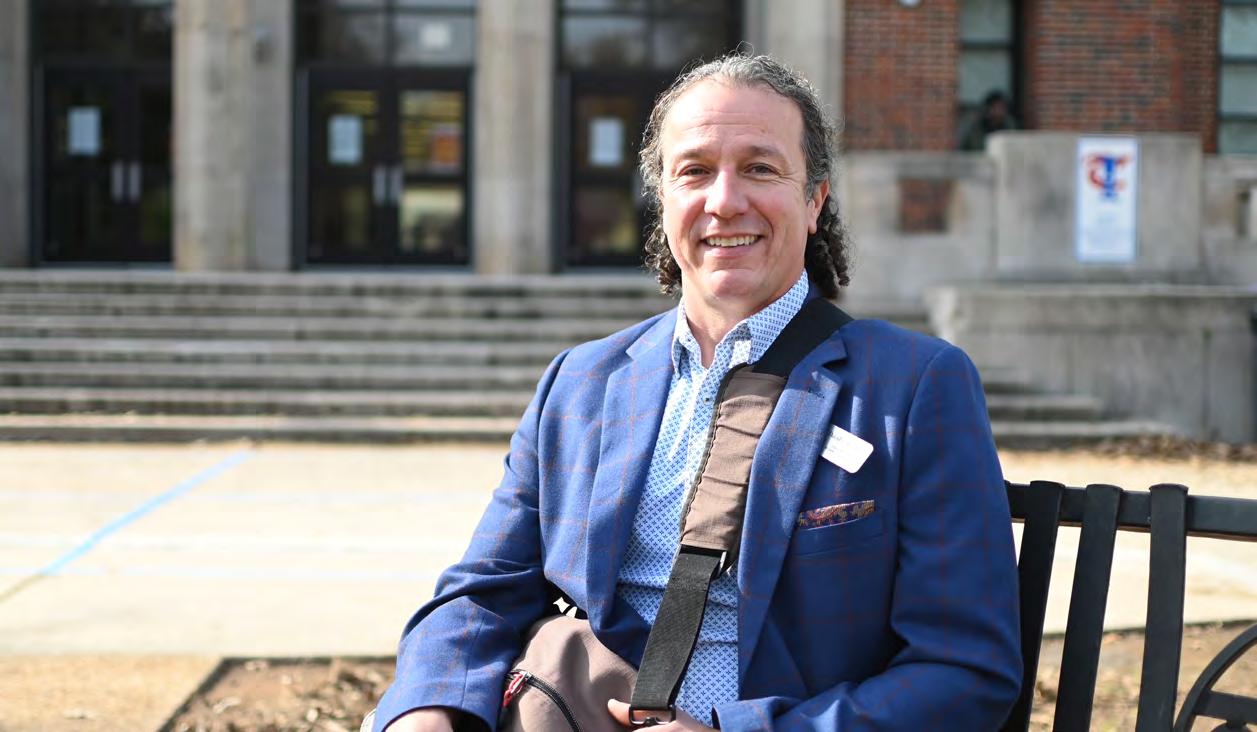
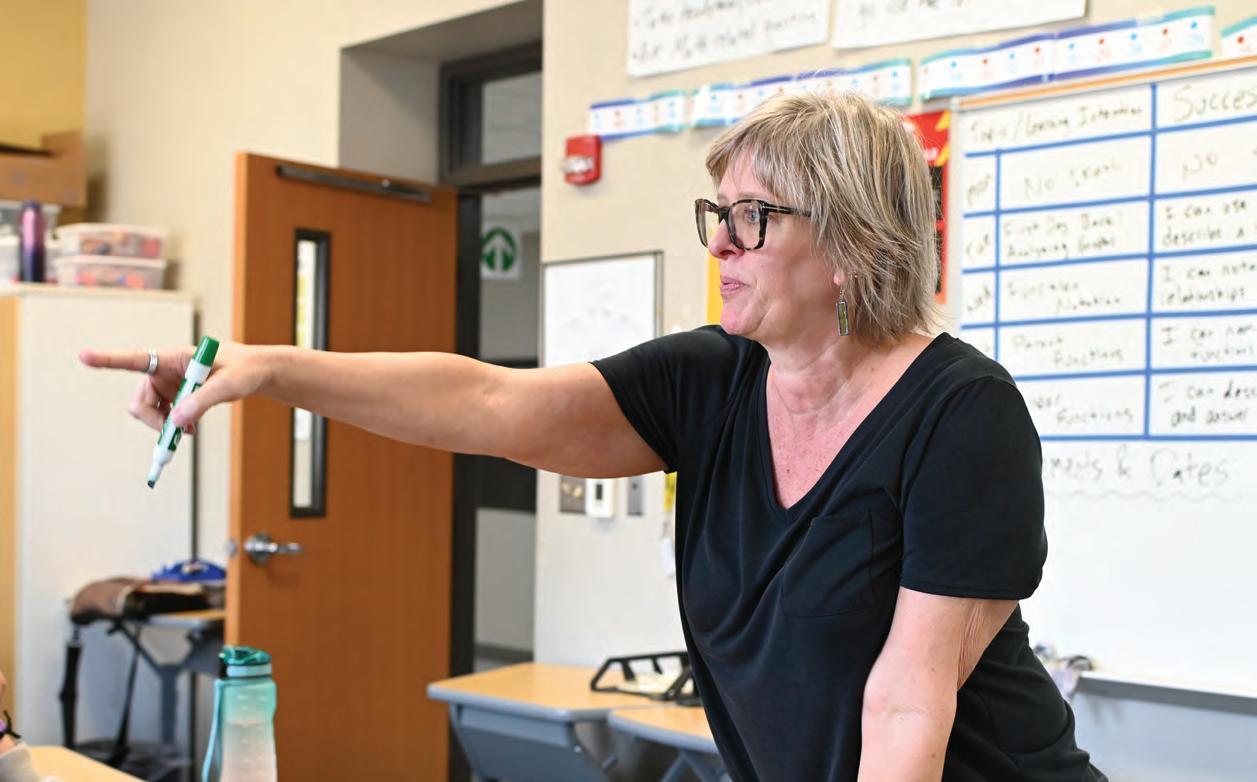
Above: ESOL CONNECTION: Clarke County School District Coordinator of English Language Learner Programs Dr. David Forker sits in fron of the Ceremonial Entrance of Clarke Central High School on Jan. 8. CCHS ESOL department teacher Carrie Emerson has found that witnessing her students graduate is a poignant moment as an ESOL teacher. "I (feel) that we made that possible
graduate," Emerson said. Photo by Iliana Tejada
English for Speakers of Other Languages Teachers
English for Speakers of Other Languages Department

the program
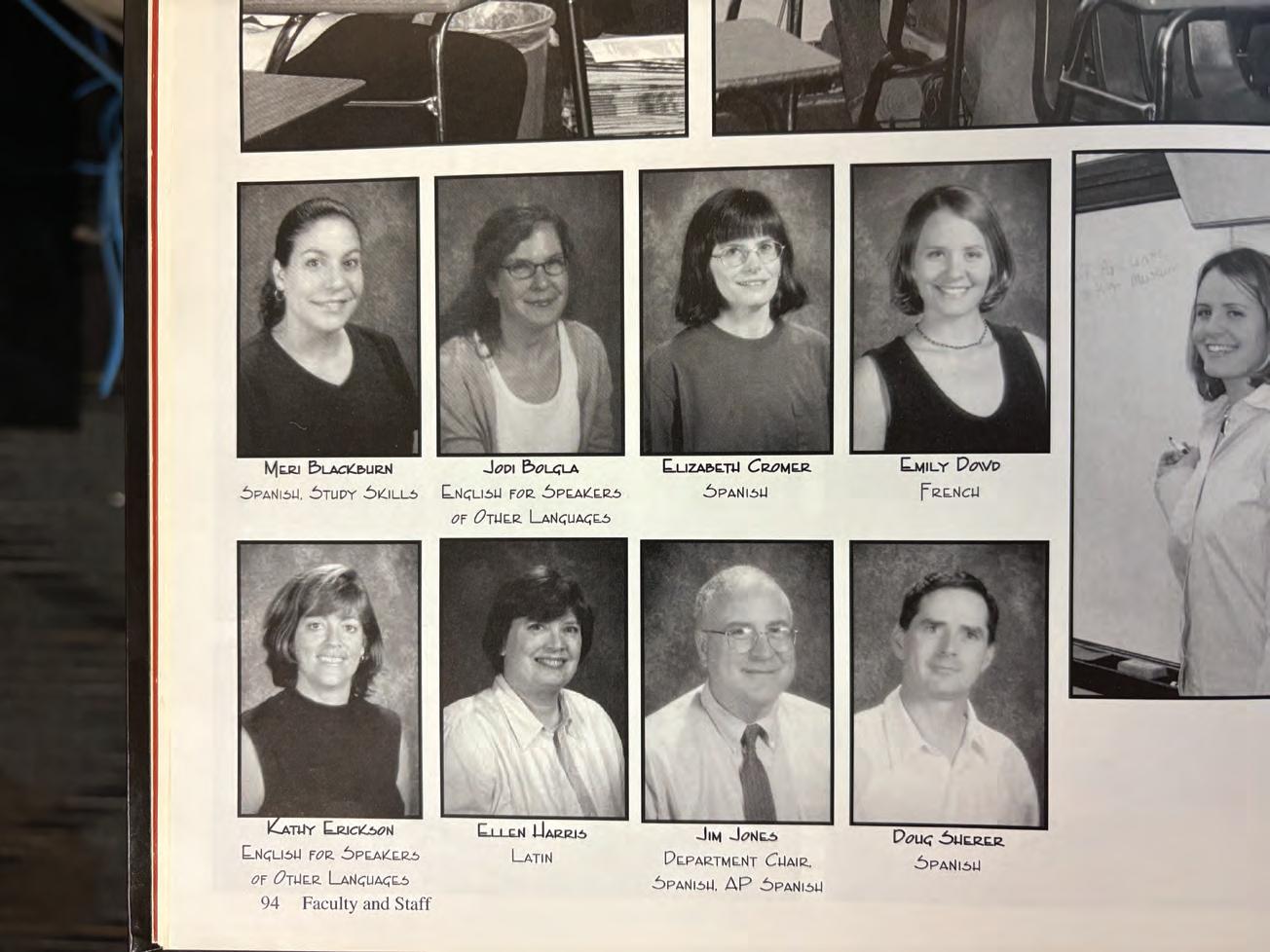
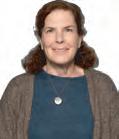
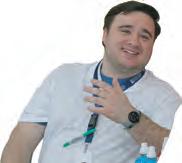

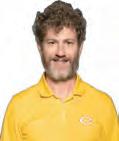
Language barriers can create dissonance between teachers and students, an issue that the ESOL department seeks to solve. ESOL department teacher Carrie Emerson views her role in the ESOL department as being a liaison between her students and the rest of CCHS and teaches with an emphasis on interpersonal connections.
“ESOL teachers are advocates for the students and make sure they get the support they need. There’s a lot of positive things that come from having the ESOL program, like community (and) good (teacher-student) relationships,” Emerson said.
The CCSD primarily employs two ESOL program delivery models at the high school level: push-in, when an ESOL department teacher co-teaches with a general education teacher, and sheltered content, when an ESOL department teacher delivers specific course content to an exclusive group of ELs. Currently, the CCHS program uses a majority of push-in or collaborative classes with the only sheltered class being taught by Bolgla. Students are placed in whichever class will best fit their accessibility needs.
“ESOL teachers are advocates for the students and make sure they get the support they need. There's a lot of positive things that come from having the ESOL program."
-- carrie emerson, ESOL department teacher
“(ESOL is) a way of supporting students who did not learn English as their first language (and) finding ways (for) them to be successful in their classes, because they have the same graduation requirements as everybody else,” Emerson said. “I view my role as making the curriculum accessible to (emergent bilinguals).”
In a state where immigrants comprise 11.6% of the total population, there were 1.7 million ELs in Georgia public schools as of May 2025. In Georgia, an EL’s eligibility for ESOL is determined by a series of intake questions from the World-Class Instructional Design and Assessment evaluation, which is given to students who indicate a primary language other than English on a the Home Language Survey that all district enrollees take. The WIDA judges the student’s English proficiency to determine the best language learning support for the student.
CCHS junior “Jane Doe” is an ESOL student who took the WIDA after enrolling in the Clarke County School District as an eighth grader. Doe, whose first language is Spanish, views her participation in ESOL as a significant factor in her language growth.
“In the beginning it’s difficult because you start in a new school, (with a) new language, but if you take ESOL classes, (you get) more comfortable, because the (other ELs) there have the same situation (as) you,” Doe said.
All nine ESOL teachers co-teach in push-in classes and Bolgla teaches the only sheltered content class. CCHS sophomore “Richard Roe," who is in ESOL, has experienced both sheltered and collaborative scenarios.
“On both sides there are benefits. When I am in a class of (ELs) I have more confidence, can express myself and my opinion,” Roe said. “I don’t feel nervous to ask a question because my classmates and I are all learning.”
Jodi Bolgla Kathy Erickson
Kathy Erickson
Jodi Bolgla
Shelby Alvord Brian Ash
Carrie Emerson
Cori Pringle
Sheryl Blazic
Zachary Crosby
the future
National trends may threaten the future of ESOL. On June 30, the Trump Administration announced that it withheld $6.8 billion in educational funding, including Title III funds, for the 2025-26 school year, according to Education Week, a news publication covering changes within schooling. Though the funds have since been released, this shows how potential legislation could affect ESOL programs.
“In a red state, legislators (are) not friendly to people who don't look like them. I think (Georgia legislators) are going to follow the national trend of defunding language programs,” Bolgla said. “Why would you take education away from children? I think our funding is (at risk for) the next four years.”
Whether or not these fears will be realized remains to be seen. However, despite these concerns, the ESOL program presses on, serving students, families and teachers. ESOL continues to foster ELs’ connections with their communities through language and more.
“ESOL helped me understand the language and communicate with the people I want to communicate with,” Roe said. “It helped me grow academically, (get) my grades up and (socialize) more with teachers, so that they could understand me and let them know what I wanted to tell them.”
“In the beginning it's difficult because you start in a new school, (with a) new language, but if you take ESOL classes, (you get) more comfortable, because the (other ELs) there have the same situation (as) you."
-- “Jane doe," CCHS junior
Below:
Photo by Peter Atchley
Wht is the Home Language Svey?
The HLS is a short questionnaire given to the parent or guardian of each school district student. The survey is one of the first steps in determining whether a student will be enrolled in the English for Speakers of Other Languages program.
E F
Questions include:
Which language does your child best understand and speak?
Which language does your child most frequently speak at home? Which language do adults in your home most frequently use when speaking with your child?
Source: Georgia Department of Education A ur
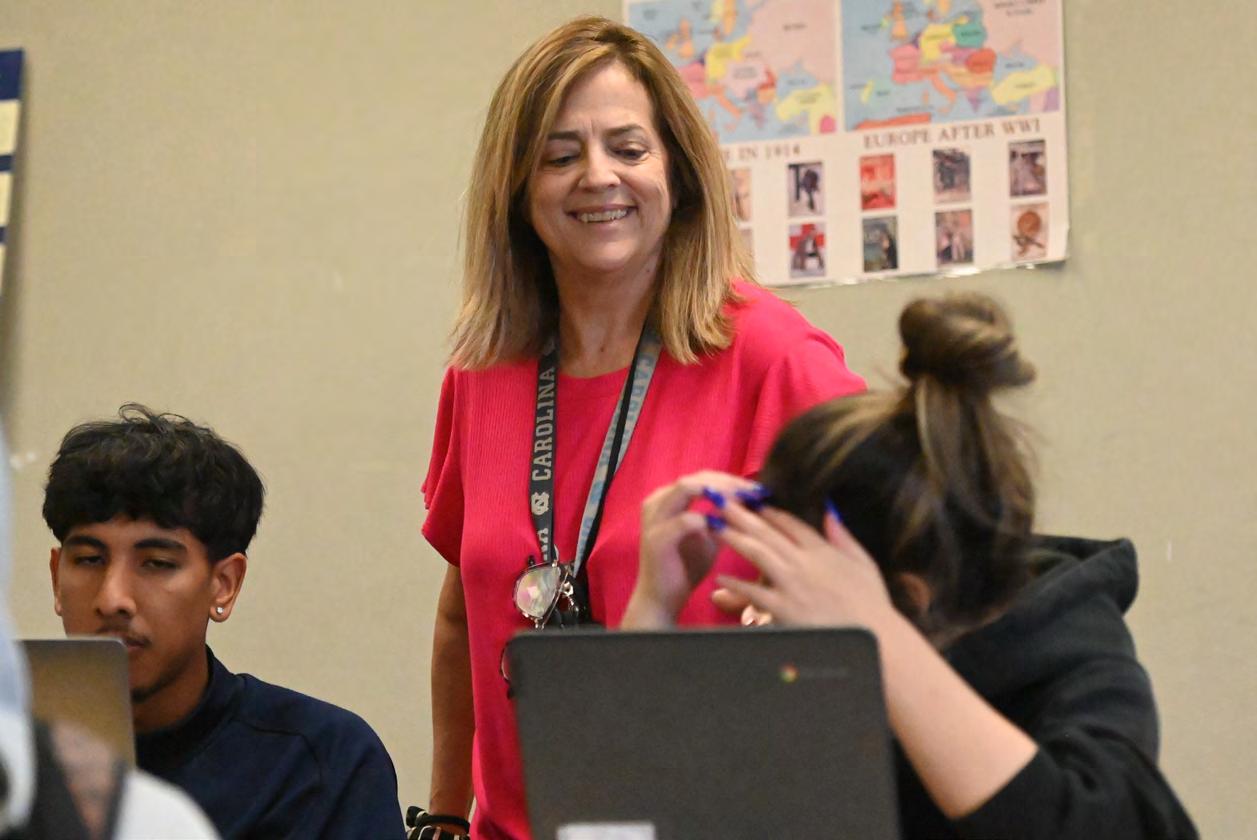
Above: GROWING IN ESOL: Clarke Central High School English for Speakers of Other Languages department teacher Cori Pringle teaches in Room 313 on Jan. 8. CCHS junior “Jane Doe” joined the ESOL program as a freshman and has attended both collaborative classes, which have ESOL and non-ESOL students, and sheltered classes, which only have ESOL students. "I grew with ESOL. (After) I was with Ms. Bogla (in the sheltered) class my freshman year, I came away knowing more English. In middle school, my mom told me about 'You need to learn English,' (so) now I speak more English than when I was in freshman (year)," Doe said. Photo by Peter Atchley
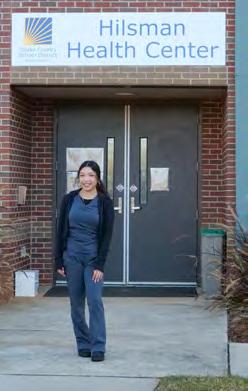
Above: WELCOME IN: Clarke Central High School
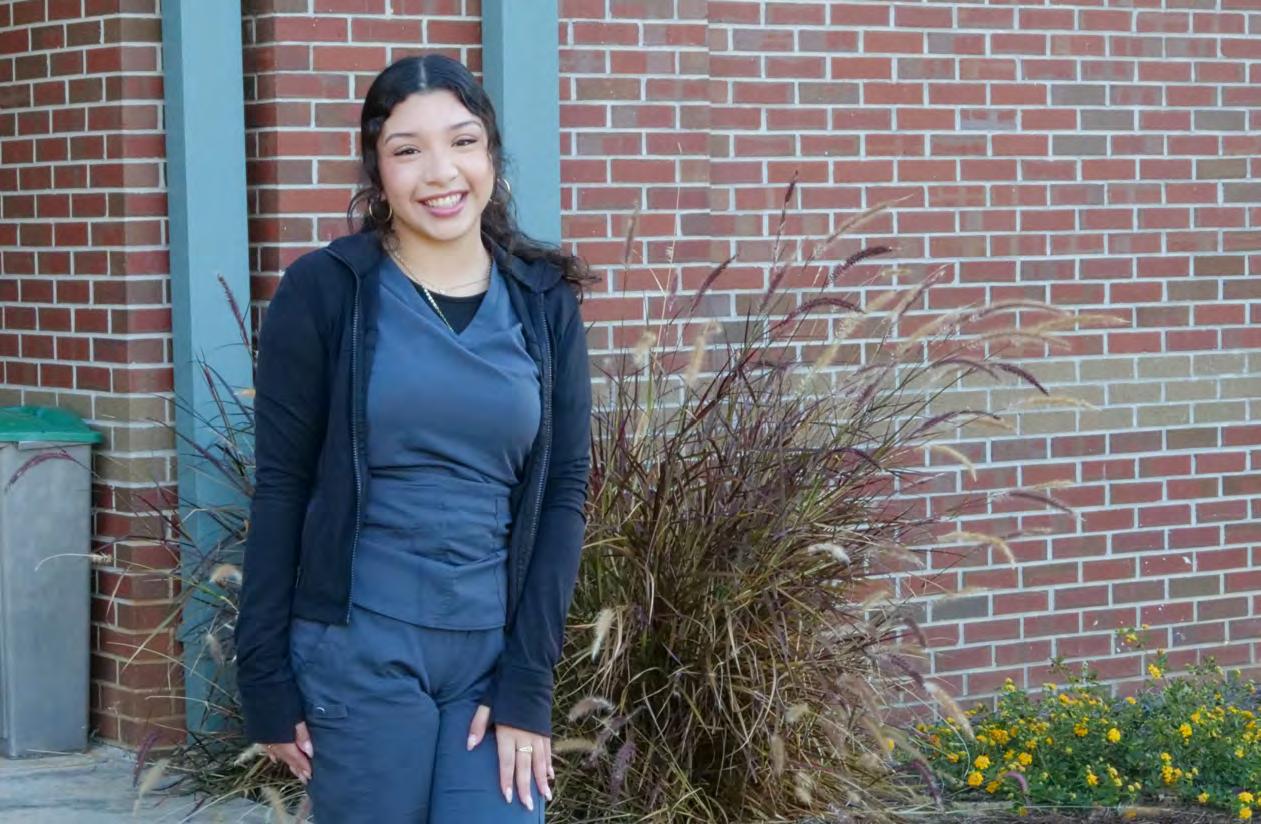
and
to the
on Nov. 4. Carranza has worked at the
through WBL and has seen how the staff maintains an upbeat attitude. “(The HHC) gets really stressful and busy, (but) I think the (staff) do a really good job staying positive (and are) able to still talk to the patients in the middle of chaos,” Carranza said. “I find that fascinating, how they can deal with everything.”
Healthcare close to homE
The CCSD has four School-based Health Centers that offer a variety of low-cost healthcare services to CCSD students, staff and immediate family members.
AClarke County School District student feels ill during class, excuses themselves and walks down the hall hoping to be picked up and taken to the doctor. Unfortunately, their parents are unable to pick them up while being stuck at work, and the student is forced to spend the rest of the day sick at school. Schoolbased Health Centers in the CCSD combat this problem.
The CCSD began working with local healthcare organizations like the Athens Neighborhood Health Center, MedLink and the Athens Free Clinic, in 2018 on the creation of four School-based Health Centers across the district. Located at Clarke Middle, Hilsman and W.R. Coile Middle Schools and Classic City High School, the centers are accessible to all CCSD students and faculty, along with their immediate family members.
“Before we had the four School-based Health Centers, (students) would have to either go to their primary care provider, urgent care or the (Emergency Room) for their medical needs,” CCSD School-based Health Center Coordinator Meredith Dykes said. “(Now), CCSD students, families and employees have health care right there on campus or very near them and pretty much have everything that they need there.”
Following a community needs assessment performed to justify the need for the HHC that identified student healthcare as a concern, the centers were created to improve accessibility to affordable healthcare for CCSD students and staff.
With the exception of the CMHC, whose services are completely free, the other health centers accept most major insurances, Medicaid and use a sliding fee scale that is available for families who qualify. To meet the requirements families must bring in pay stubs for two pay periods and proof of residency.
“Especially in the school setting, to be able to offer services where there’s no copay and no bill, the school nurses feel more comfortable sending people our way, and it makes care more accessible,” Athens Free Clinic and CMHC Medical Director Dr. Suzanne Lester said.
“The school nurses feel more comfortable sending people our way, and it makes care more accessible.”
-- Dr. Suzanne Lester, Athens Free Clinic and CMHC Medical Director
STORY BY LUCCA FLEENOR AND COOPER JONES News Staffer, Senior Copy Editor
LAYOUT BY LIYA TAYLOR Sports Editor
junior
Work-based Learning student Carmen Carranza stands by the entrance
Hilsman Health center located at 870 Gaines School Rd.
HHC
Photo by Cooper Jones
Each SBHC offers treatment for illness and injuries, wellness checks, preventative screenings, mental health support and sports physicals. Some individual locations provide additional specified services due to the different partnerships, like the HHC, which is partnered with the Athens Neighborhood Health Center and is the only center that offers comprehensive dental care.
“The (staff does) such a good job, (so) we don’t have any big issues. Our community trusts them a lot, so parents are using the service more frequently,” HMS principal Kenneth Vaughan said. “It’s a very powerful initiative. When I speak to all of the other principals regarding it, it’s been nothing but positive accolades.”
“It’s a very powerful initiative. When I speak to all of the other principals regarding it, it’s been nothing but positive accolades.”
-- Kenneth Vaughan, Hilsman Middle School principal
The CCHC and CHC operate under the same non-profit provider, Medlink, but the CMHC, an extension of the Athens Free Clinic, is unique in its partnership with the University of Georgia. This means that the services of the CMHC include legal, behavioral healthcare and counseling in addition to the other services.
“We are interdisciplinary, meaning we are trying to address whatever (big) needs come up for that patient because rarely does a patient or a family present
only medical problems,” Lester said. “Often they have other struggles, and those have a negative impact. We are able to address social determinants of health.”
The SBHC’s are located in close proximity to the school buildings so access is easier for students to reach during the school day, with consent needed from a parent or guardian to receive care.
“Because we have (the SBHC’s), our kids are not losing a lot of time outside (class) waiting to go to the doctor,” Vaughan said. “They get quick and timely service. If we had a traditional health center, you would have elongated periods wherein students may lose so much time in the classroom because of the nuances of a medical facility (with) an extended wait period.”
With the nearest SBHC 1.5 miles at CMS, for Clarke Central High School students there is no apparent SBHC. Despite the lack of location on campus, CCHS students are still able to connect with the SBHC’s through school programs, such as Work-Based Learning. CCHS junior Carmen Carranza works at the HHC to triage patients, which means taking their height, weight and the reason for the visit.
“The (SBHC’s are) really beneficial to the school district. If the kids have an appointment, or they’re sick, they just need the (parent’s) consent (to come). It’s not like their parents have to get off work and bring them, and they’re really flexible, so if they need to squeeze in someone, they will.”
Carranza said. “The (staff) looks through the patient’s history, and if they see they need a vaccine or something (overdue), they’ll call their parents and go get them out of school really quickly. Then financially, they’re also really affordable for families who need a little more support.”
While there are no immediate plans to include a fifth School-based Health Center in the CCSD, the centers are primarily focused on serving the community and improving services.
“The (SBHC’s) are here for our students and our students and families of CCSD and employees, and they do want to see you want y’all to use their services. And it’s easy to get appointments.” Dykes said. “You can call, or have your school nurse help you get an appointment for same day visits. And if (you need) a service they can’t provide then they will help refer you to someone else as well.”
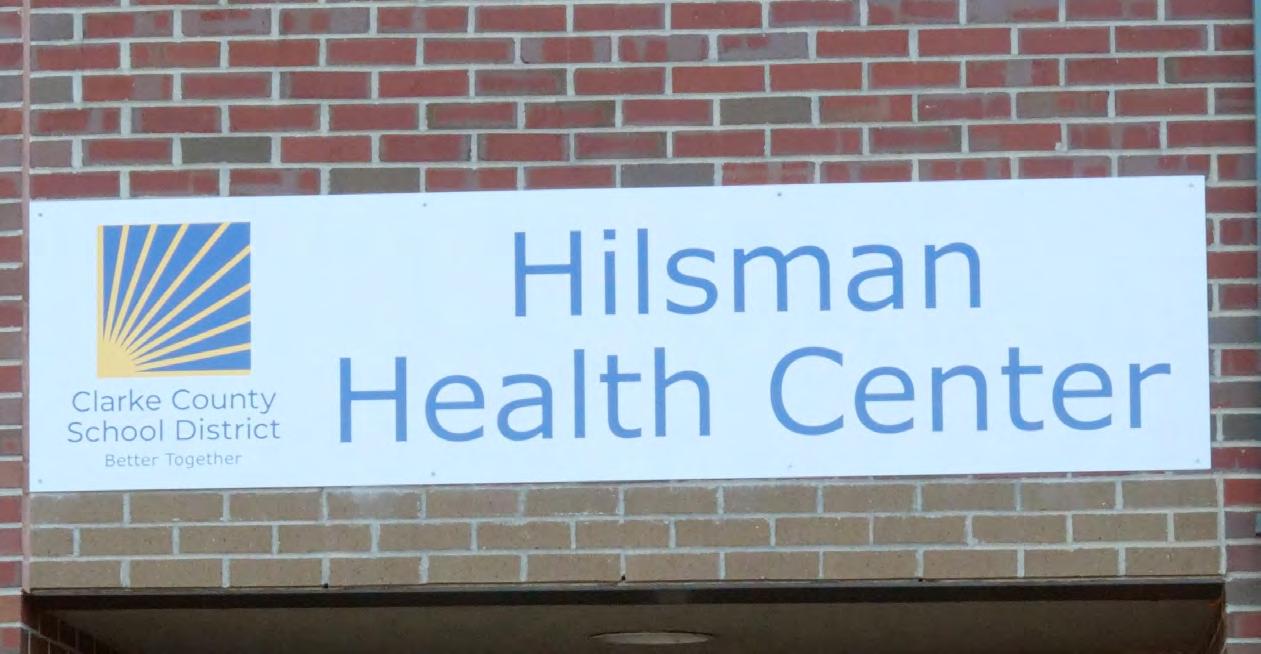
Below: TREATING SUCCESS: The Hilsman Health Center sign is shown on Nov. 4 at Hilsman Middle School. The Clarke Middle Health Center first opened to the public in 2022, and like the other three School-based Health Centers located in the Clarke County School District, it has offered affordable health care to families that doesn’t interfere with any original primary care providers. “If they already have a primary provider, they can keep (them) and give permission to the SBHC (to) send records of what they’ve done to the provider,” Clarke County School District SBHC Coordinator Meredith Dykes said. “We want to continue those relationships with primary care providers in town, and we want families to feel comfortable utilizing our four School-based Health Centers.” Photo by Cooper Jones
Who is Dr. Jennifer Scott?
Dr. Jennifer Scott has worked in the CCSD for nearly 27 years in several different positions, from teaching at Timothy Road Elementary School to working as a CCSD Executive Director of Leadership Development. After being appointed the Interim Superintendent, effective July 1, she aims to help the district's students, staff and schools thrive.
STORY BY EMLYN MCKINNEY News Editor LAYOUT BY LIZA LARSON Print Editor-in-Chief
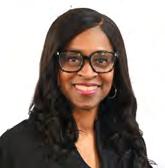
Dr. Jennifer Scott CCSD Interim Superintendent
How has working as an educator at Barnett Shoals and Timothy Road Elementary Schools affected your approach to the role of interim superintendent?
I think that if you cannot connect to the work that our (school administrators) do every day when you're sitting in a district leadership position, then you are disconnected from the heart and soul of our district. Our principals are the ones that really have that direct impact on students and student achievement because they are the direct supports for our teachers. It's really just a trickle-down effect. There was a lot of ways in which I was able to grow as a leader in the district by serving as an assistant principal (at TRES from 2007-11) and a principal (at BSES from 2011-19). (I learned) lessons that I take with me in any role, (such as) continuing to look for ways to grow and expand in my knowledge and how I'm able to support the building leaders with the work that they do every single day.
What caused you to pursue a career at the district level after working as an educator and school administrator positions?
My trajectory to the district office was not something that I necessarily had planned out. I didn't have a timeline because I never wanted to move into any leadership position for the sake of doing it. It was a tough decision because I loved being a building leader and having that connection with the school family. (However), I felt like the work that I could do at the district-level would contribute to the growth of our district as a whole, and that resonated with me at a great degree. That let me know that, “OK, this was the right time to make this move.” I feel like I'm walking in my purpose, and I've made very careful decisions and thought about it from the lens of, "How (are) we serving the students of our district?" That ultimately is what really pushed me to go ahead and say, "Yes, this is the right time and it's the right position for me."
Featured: NEXT STEPS: Clarke County School District Interim Superintendent Dr. Jennifer Scott speaks at the Teacher and Support Professional of the Year awards banquet on Oct. 23.
One thing that drove Scott to pursue the Interim Superintendent position was the opportunity to promote and sustain student excellence. “Ultimately, we are preparing students to become citizens and adults within our community,” Scott said. “You want to be able to feel confident that the individuals that are graduating from our school district are prepared to serve in various spaces within the community, whether it be workforce (or) community engagement.”
Photo by Maypop Wren
What are specific ways you want to contribute to the CCSD?
My messaging this year is all about raising the bar in pursuit of excellence. It is critical that, in doing so, we're thinking about what excellence (looks) like. It's not just us guessing at it, but us truly being able to identify (it), and then spotlighting that, celebrating that and making sure that that is what we are truly trying to replicate. We do that as district leadership, but I also push our building leaders to make sure that they're doing that at the building level. I want to make sure that people know that we see the work that they're doing and value them. That goes for our students, our parents (and) our staff, so that as a community, we are truly building a culture where we are proud of who we are as a school district.
How is the Georgia School Boards Association’s search for a permanent Superintendent going to affect your tenure as interim superintendent over the next year?
I signed a contract with the (CCSD) Board (of Education) to serve in the interim position from July (1), 2025 through June 30, 2026, so the only way (the Georgia School Boards Association) really impacts it is if they're able to identify someone to serve in the permanent position. If there's someone else that comes in (as Superintendent), then my interim contract would potentially end when that person starts. I would continue to support them during that transition, and then I would roll back to my previous position of Deputy Superintendent (of Academics and Student Supports). (The) GSBA is here to create the structure and the process to support the Board in selecting an individual that would be the best fit for what they're looking for in a Superintendent, and offer the space to ensure that that's done in a transparent manner, involves stakeholders and truly allows our school board members to make an informed decision.
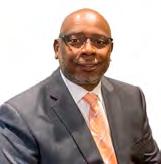
4Dr. robbie p. hooker Former CCSD Superintendent
What efforts did you make to help Dr. Scott transition into the role of interim superintendent?
Every table that I sat at in the community, I made sure (that) when I met with those individuals, Dr. Scott (had) been in the room with them before, was familiar with them and understood the process as to why the decision was being made. I ensured that she built (a) network of other superintendents and aspiring superintendents, (so) that she would have a network across the state. She attended the American Association of (School Administrators), so she could meet very bright and strong women leaders who are leading public schools across the United States. Once you make connections with them, it's like having a (database).
What was it like working with Dr. Scott when she was the deputy superintendent of academics and student support from 2022-25?
What I loved about Dr. Scott (is that) she's not afraid to ask the tough questions. She didn't run from problems. Some people, when they're presented (with) a problem, want to push it to the side and not deal with it. She will meet it head-on, and that's (how) I see her as a leader. Here's the thing: she's not impulsive in her decision-making. She wants to make sure that she has the right information before making that tough decision.
How does Dr. Scott build relationships with the people she meets or works with?
One of the key things is she wants to (know) what's going on with the students, and the best way to do that is (by) having relationships with students that are in (CCSD) schools. Even when I had my Student Advisory (Council), she was always there to give input or just listen and learn. She's a person to be reckoned with, (and) a (greater) leader than you will find even among the state for curriculum directors and other academic leaders. She has a name across the state (for) being a champion for students, (and someone) who cares about resources being provided for teachers so that they can carry out the act of teaching the standards in CCSD.
What do you want the Athens-Clarke County community to know about you?
The biggest thing that people need to know about me is that I am very passionate about (the) CCSD. I am committed to (seeing) our school district grow for many years to come, and making sure that what we’re providing for our students is truly in line to what they need to be prepared for in today’s workforce. Our society has changed tremendously through the years and through the generations, and (by) recognizing that, we are preparing our students for beyond their K-12 experiences. We cannot teach students based upon what we’re used to, how we learned or what we knew in our day and age. We have to teach and prepare them for what is to come in their generation. As (interim) superintendent, that is what I am truly focused on: “How are we evolving as a school district to make sure that we are prepared to meet the ever-changing needs of our students?”
What are some strengths you've noticed about Dr. Scott while working together?
She rose the ranks from being an Executive Director (of Leadership Development from 2019-22), to Chief (of Student and Family Support in 2022), to Deputy Superintendent (in 2023). I don't think those elevations came by happenstance. Each time she applied for those jobs, she was the right person for the job. When she's in a crowd, she's not one of the leaders who needs to stick with her group to feel comfortable. She's able to go out and speak to business people, as well as community leaders, and have that conversation about what is best for Clarke County School District, and how we (can) move forward.
"What I loved about Dr. (Jennifer) Scott (is that) she's not afraid to ask the tough questions. She didn't run from problems."
-- DR. ROBBIE HOOKER, Former CCSD Superintendent
3
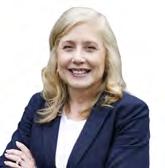
Dr. DONNA ELDER
CCSD Interim Deputy Superintendent of Academics and Student Supports
What has the transition into your position as interim deputy superintendent looked like for you and Dr. Scott?
I was honored that (Scott) asked me to (be the interim deputy superintendent of academics and student supports), but at the same time, really taken aback and going, “OK, am I ready for this? Can I do this well?" There is a lot of weight on my shoulders to help her shine, but she's right here with me. A lot of people will go and ask her things that they would be asking her (when she was Deputy Superintendent), and she points them right back to me and says, "Go speak with Donna about that, and then if you guys have questions, let me know." She's definitely given me confidence and the room to grow in this role, but she's also right there (to help).
"There's that dynamic that brings us together. We have unique experiences, but both aren't about underestimating you because of what somebody has decided that you are because of your label."
-- DR. DONNA ELDER,
CCSD Interim Deputy Superintendent of Academics and Student Supports
2
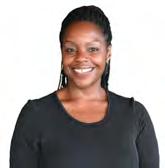
CCSD BOE President
As the CCSD BOE president, what has working with Dr. Scott been like so far?
She's so open. (She and I) meet every other week, and we have really candid conversations about what's happening in our community, not only (at) the school-district level, but just with our kids in Athens-Clarke County. She has a pulse, just like (former CCSD Superintendent) Dr. (Robbie) Hooker did, on what's happening with our (students) in both of those communities, and we have conversations about how we can potentially bridge some gaps, but make improvements at the community level. I appreciate the fact that she does her homework and she never approaches a meeting or a conversation without knowing all the details of what we're going to talk about. That's a trait that you don't see in a lot of people, and (that’s) something that lends to her being so trustworthy and ready to tackle whatever issue’s in front of us.
How have your experiences working in the CCSD since 2001 affected how you work with Dr. Scott?
(Dr. Scott) and I came from very different backgrounds, and our views compliment. I was a struggling learner, and I think that I was socially promoted. Once I got to college outside of Clarke County, it occurred to me that I had been labeled a special (education) kid in Clarke County, and my expectations for my success were lowered because of that. That's a point of view that she didn't live. She grew up in Atlanta Public Schools, (so) she has all the experiences in the world of being a Black student in an urban school district. There's that dynamic that brings us together. We have unique experiences, but both are about underestimating you because of what somebody has decided that you are because of your label.
What do you hope to see during Dr. Scott's tenure as interim superintendent?
(CCSD is) starting to see real progress in our reading scores in third grade, and Dr. Scott is very much responsible for implementing the new curriculum resources and the new (schooling) around the science of reading. Our third graders were (in) kindergarten when (the 2024-2029 Strategic Plan) work started and (Scott) was Deputy Superintendent. That's what I hope to see: that we continue to see growth.
What do you want the community to know about Dr. Scott and her approach to her work?
It takes a lot for someone to be an educator in Clarke County, not having been from here. As a Black woman, it takes a lot. It's hard to have people come from the outside and judge what's happening in the county for our children, our school district (and) our teachers, but she doesn't do that, and she never did that. She came in, and she was boots on the ground, and she was willing to do the work to turn this district around from day one, and she's always been that way. For (CCSD), we need to have a reckoning in this community that people coming from the outside don't always have bad intentions, and we can all work together towards this greater good if we're just willing to be open and communicative, and appreciate everybody's talents and values.
Dr. MUMBI ANDERSON
1
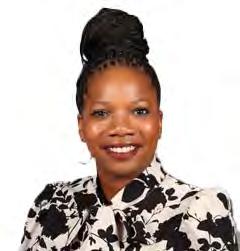
Dr. Aliceson Nobles
Gaines Elementary School Principal
What has it been like seeing Dr. Scott progress through her career over the years, going from principal at BSES to being interim superintendent?
Being someone who worked under her (as a BSES third-grade teacher and then assistant principal), I've been elated to see the progression, because I know that she is someone who truly cares about the CCSD (and) Athens as a whole. I think that we have, as a community, (longed) for someone who really knows Athens, our populations and subgroups, and (wants) what's best for them. I will also say that she is realistic in (what) can be achieved and in the time frames that they can be achieved. With that, her leadership through integrity shines through all the decisions that she makes.
"I've been elated to see the progression, because I know that she is someone who truly cares about the CCSD (and) Athens, as a whole."
-- DR. ALICESON NOBLES,
Gaines Elementary School Principal
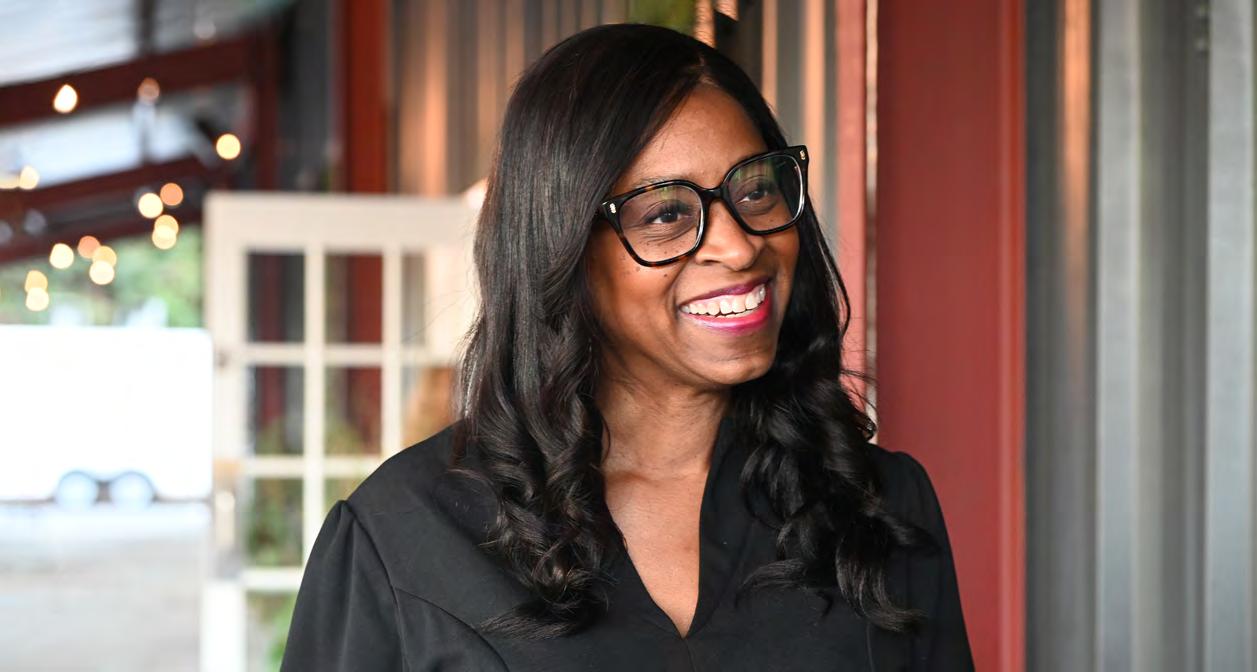
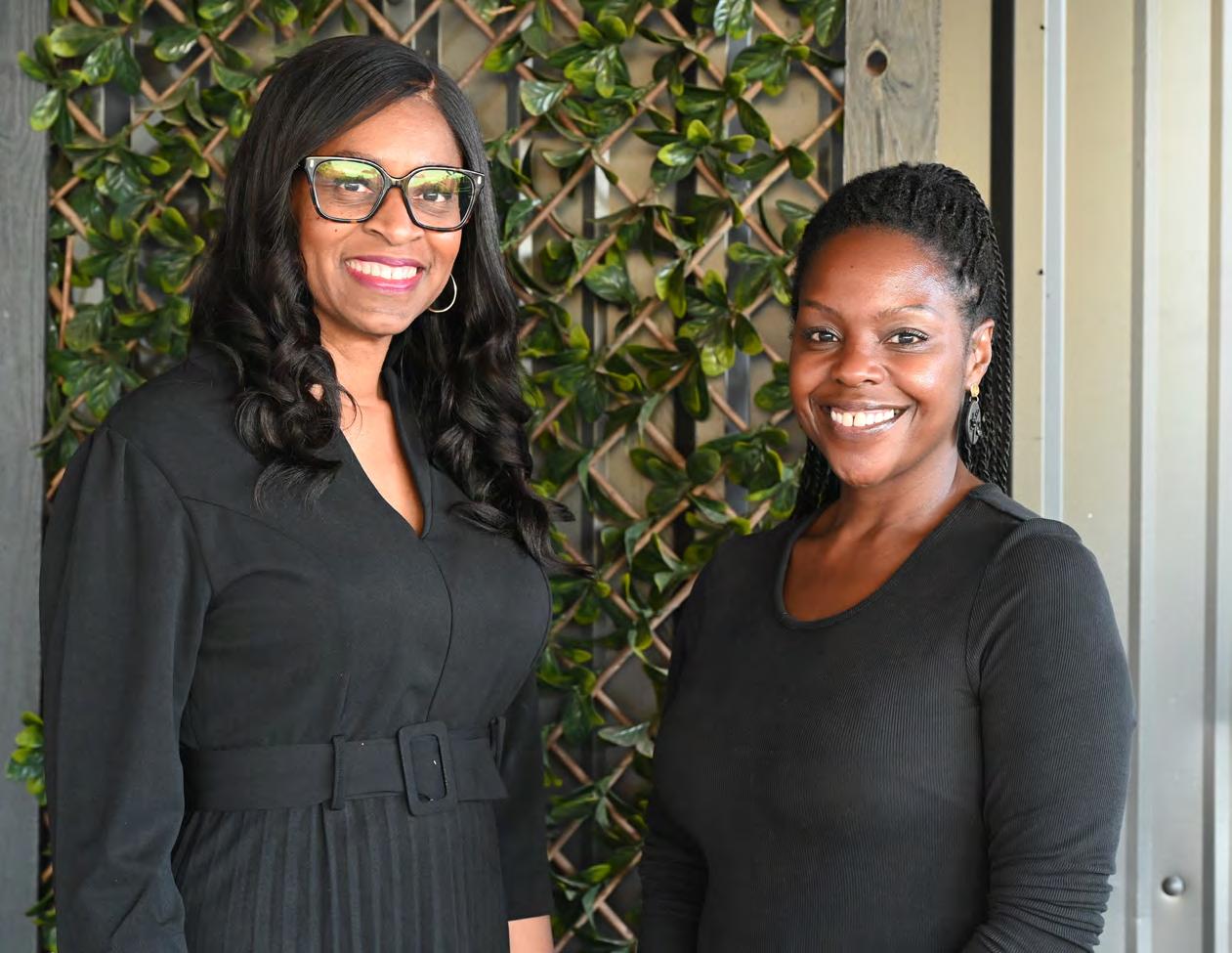
Below: LEADER’S LIGHT: Clarke County School District CCSD Interim Superintendent Dr. Jennifer Scott (left) and CCSD Board of Education President Dr. Mumbi Anderson (right) pose with each other at the 2025 Teacher and Support Professional of the Year awards banquet on Oct. 23. Anderson, who met Scott after Dr. Robbie Hooker was hired as the CCSD Superintendent in 2022, appreciate Scott’s kindness and empathy towards those she worked with. “(It’s) not really important from a leadership perspective, (but) when a leader has a vision and they're compassionate and they've worked with the people that they're going to serve, that has an added sentiment to me,” Anderson said. “Because (Scott) had been a teacher, a principal (and) deputy superintendent, she had this warmth to all of the people in the district.” Photo by Maypop Wren
IN FOCUS
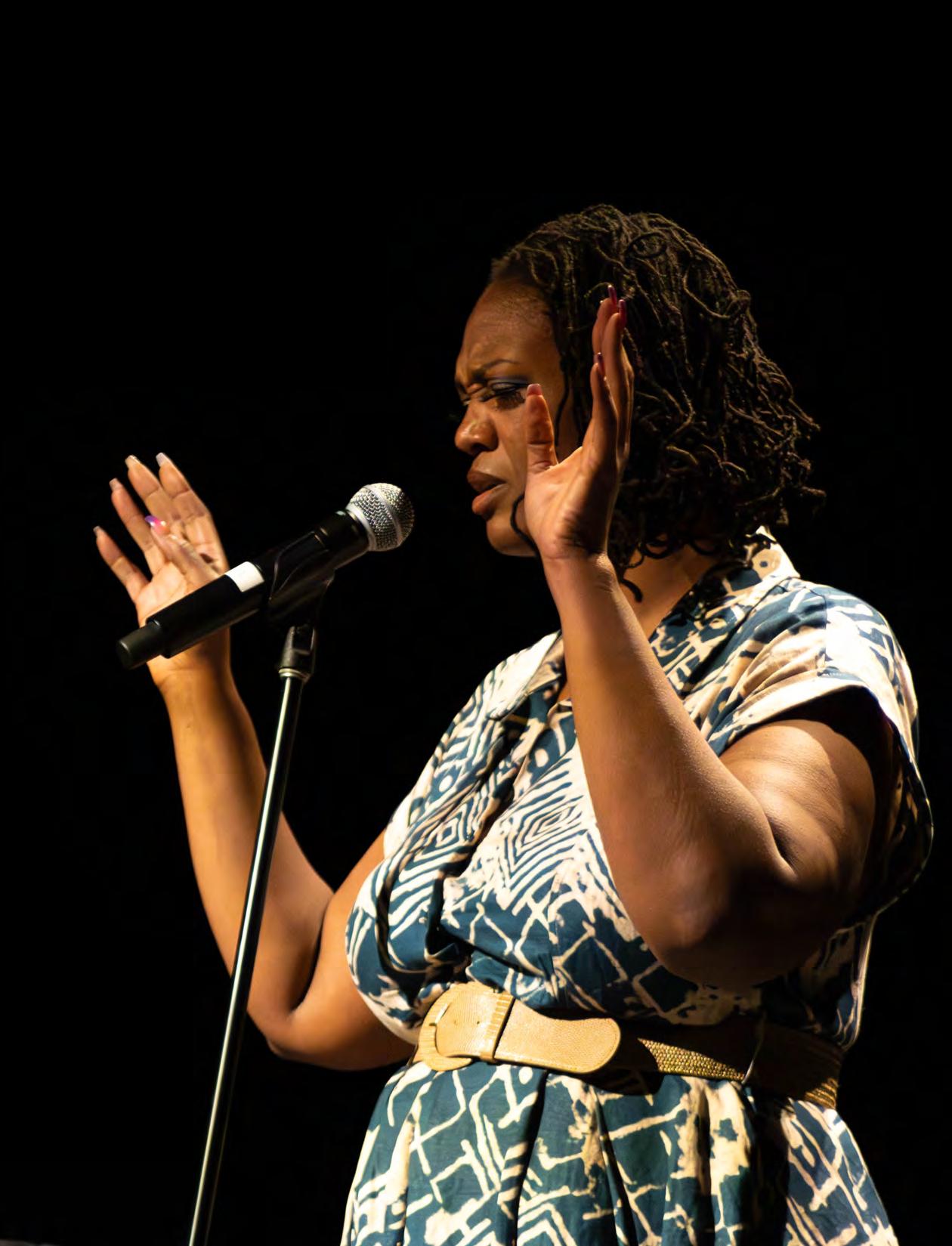
Featured: THERESA THA SONGBIRD: Georgia Authors Association award-winning poet, spoken word artist and singer Theresa Wilson, also known as “Theresa Tha SONGBIRD,” performs in the E.B. Mell Auditorium on Nov. 11. Wilson, who wrote the poetry book “Mass, Matter, and Magic,” in 2017, performed several of her original spoken word pieces, songs and poems to the CCHS students who attended the visit. “Her presence was commanding, like you couldn't look away. You didn't want to miss a single word that she said. I felt like I couldn't get enough of her. I was in awe of what she was able to do with just herself and a microphone,” CCHS Media Specialist Angela Pendley said. “I just felt like I left (the performance) feeling filled up. And I think the kids in the audience left there feeling like their cups were full.”
Photo by Grady Dunston
AUTHENTICALLY ADAH
Themanosphere,anetworkofinfluencersmakingcontentaboutcontemporarymasculinity, promotesharmfulstereotypesanddestructivebehaviors.
When the psychological crime drama miniseries “Adolescence” was released on March 13, it captivated audiences and critics alike. The show, which received eight Emmy awards, follows Jamie Miller, a teenage boy who murders his female classmate after she rejects him.
Although the series wasn’t based on a true story, it drew attention to the growing issue of toxic masculinity and the emergence of the “manosphere.”
The manosphere is a network of influencers who make content about subjects regarding contemporary masculinity, like gender roles and dynamics. While some argue that it serves as a safe space for men to voice their problems, in reality, it makes their problems worse by promoting harmful stereotypes and destructive behaviors.
The term “manosphere” originated in the early 2000s, but its roots trace back to the 1970s and '80s with the men’s rights movement. The campaign began in response to the rise of feminist ideas and politics, which advocates claimed were anti-men. This same argument has been popularized by figures like Andrew Tate, who has garnered billions of views across various platforms.
According to the Anxiety and Depression Association of America, “Nearly one in 10 men experience depression or anxiety, but less than half receive treatment.” There are several reasons for this, but one of the main ones is due
to the stigma surrounding men’s mental health.
“(There are) old patriarchal values that prescribe confining expectations for how men are supposed to behave and how they’re supposed to appear to others, and the same (goes) for (women. They) are allowed to express emotions, and men are not,” Clarke Central High School mental health counselor Dr. Meg Dion said. “When men say something is wrong emotionally, it is seen as a weakness rather than a strength.”
This stigma drives many young men online, where the manosphere exploits their vulnerabilities by perpetuating stereotypes. For example, one argument is that women are shallow and that they only value men for their money, social status or physical appearance. This narrative not only distorts young men’s view of relationships, but also fosters hostility towards their female peers.
In the most extreme cases, this kind of rhetoric can lead to outbreaks of violence. For instance, on Aug. 12, 2021, in Plymouth, England, Jake Davison, a 22-year-old apprentice crane operator, shot and killed six people, including himself. According to CNN, Davison had expressed strongly misogynistic views online for months before the attack, including calling women “very simple-minded” on his YouTube channel, which has since been taken down.
To counter the manosphere’s influence, a conversation must be held between parents, teachers and peers when they witness the men around them voice harmful beliefs. Challenging misogynistic rhetoric early on can prevent it from evolving into something dangerous. This approach can help promote a safer environment for all, where everyone feels heard.
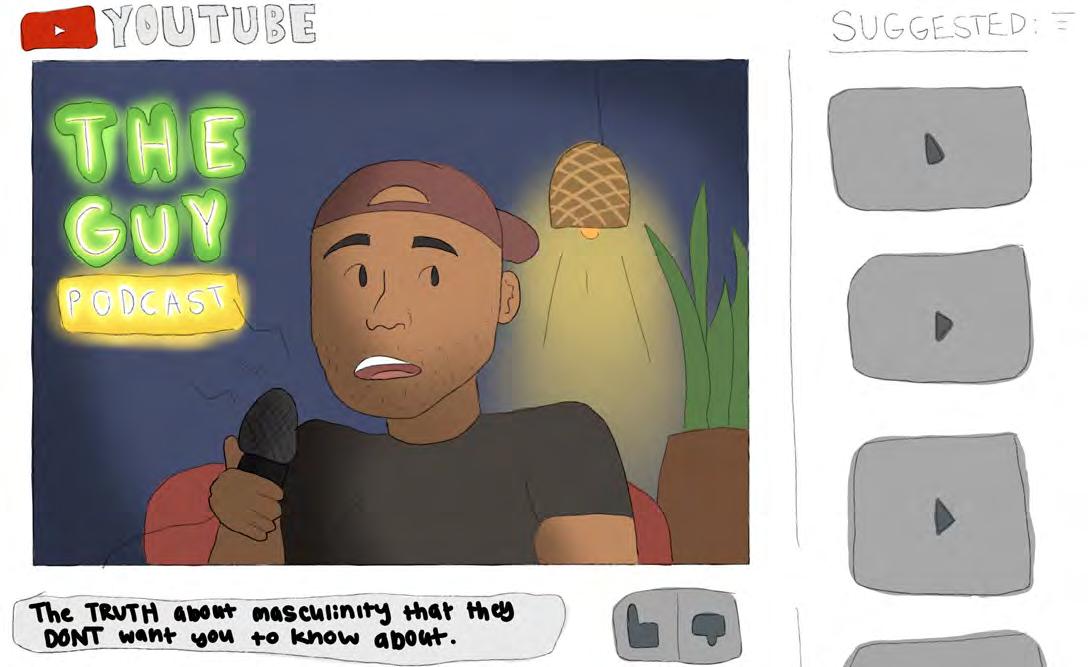
Above: TOXIC CULTURE: A YouTube video about masculinity is shown. The term “manosphere” originated in the early 2000s and refers to an online network of influencers who make content about contemporary masculinity. “While some argue that (the manosphere) serves as a safe space for men to voice their problems, in reality, it makes them worse by promoting harmful stereotypes and destructive behaviors,” Variety Editor Adah Hamman said.
Illustration by Sylvia Robinson
BY ADAH HAMMAN Variety Editor
Piggly Wiggly on 484 North Ave. An outsider may think they’re waiting for the food, but for some, it’s more than that. Street Treats didn’t start as a commercial kitchen, but as the act of making bacon, egg and cheese croissants for her husband to take to work every morning. Faneshea Browner’s food didn’t need any advertisingword of mouth from the Athens community is what got the business to where it is today. In the heart of the grocery store, you can find Browner cooking up a storm for her customers.
STORY BY ELOISE LUKEN Variety Staffer LAYOUT BY LIZA LARSON Print Editor-in-Chief
At 8 a.m. on a Friday, shoppers can expect a steady line outside of Street Treats in
Except these folks aren’t just customers to Browner, because most business owners don’t greet their customers by name, or joke around with them while taking orders. While serving wings and grits and her bacon, egg and cheese croissant that started it all, she also chats with each person, making them feel seen and heard. “I didn't quite grow up in the house with a lot of home cooking, and so for me to be able to make people feel like home is very special to me,” Browner said. What makes Street Treats different from other small businesses is the owner’s care. The construction worker, the nurse, the businessman, the CCHS administrator, she knows them all. By asking questions and noticing the little things, Browner gets to know each of their stories and makes known she is someone people can confide in. Browner puts just as much effort into building relationships and getting to know her customers as she does her food, and it pays off. “I think the community would still come where we (go), because (it’s) not just the food. They like us. They feel like (we’re) good people,” Browner said. With what started as a sandwich for her husband is now a line out the door.
CCHS class of 2007 alumna Faneshea Browner, co-founder of Street Treats, builds intentional and personal relationships with all her customers.
cooking up a storm

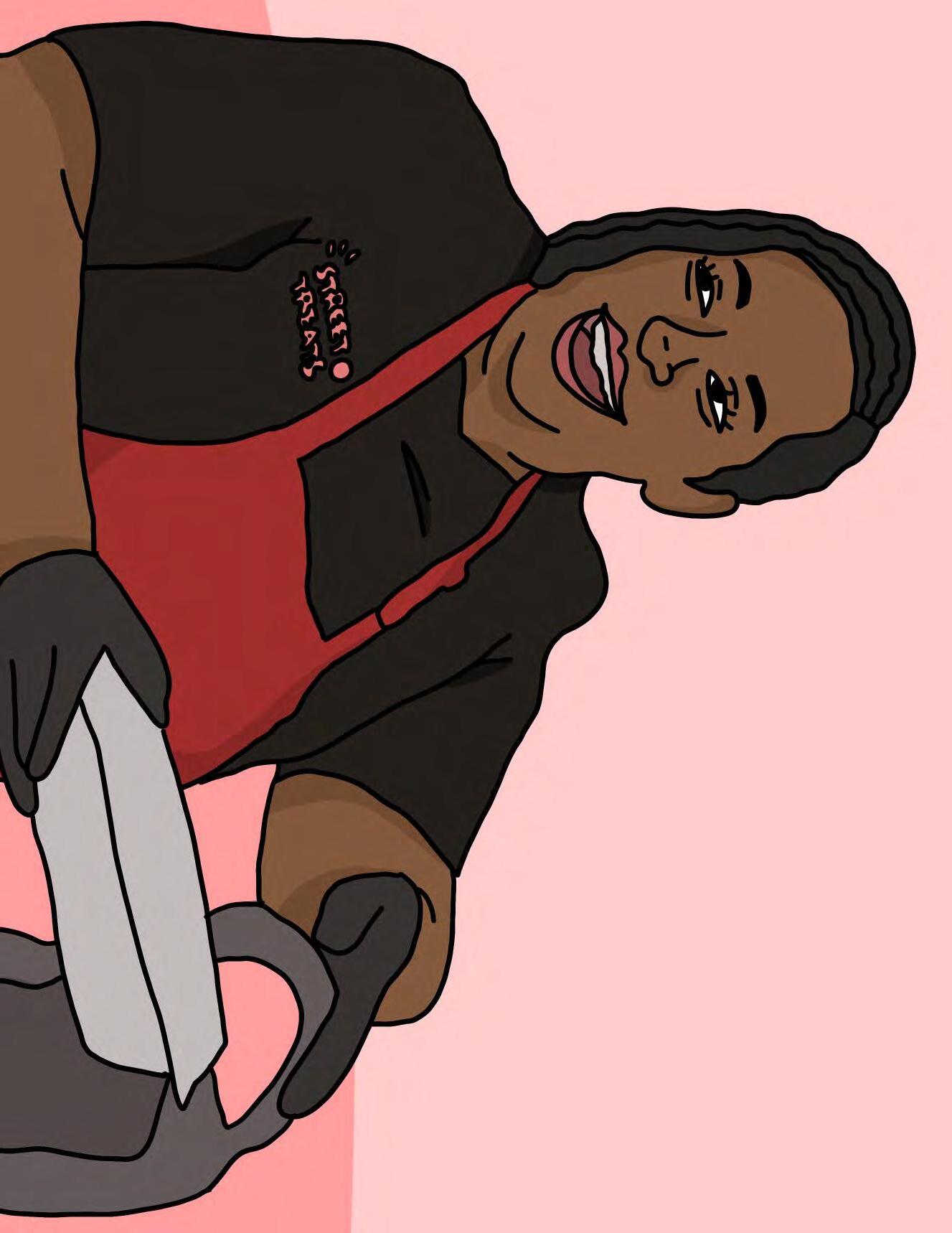
“It’s still surreal when we go out and people are hollering our slogan, and even our kids are like, ‘Everybody knows us,’” Browner said. Illustration by Sylvia Robinson
Featured: Featured: GROWING BUSINESS: An illustration displays CCHS Class of 2007 alumna and Street Treats co-owner Faneshea Bronwer. Street Treats evolved from Browner’s breakfast sandwiches made for her husband into a commercial kitchen serving the Athens community.
Quest for Athens' Best:
After trying hot chocolate at several cafes around Athens, ODYSSEY staffers determined that Choco Coffee Roasters offers the best hot chocolate.
LAYOUT BY LIYA TAYLOR Sports Editor GRAPHICS BY SYLVIA ROBINSON Viewpoints staffer/Illustrator


BY CESIA MARTINEZ Variety Staffer
Choco Coffee Roasters, located at 700 Baxter St., is a perfect spot for customers to enjoy a delicious cup of hot chocolate.
The establishment is less than a mile away from Clarke Central High School, and offers parking in both the front and back. When customers step inside, they are greeted with a cozy atmosphere decorated with various plants and natural lighting, but the space is small, meaning there aren’t a lot of seating options.
Choco Coffee Roasters’ hot chocolate is 12 ounces and costs $4. At first glance, the drink doesn’t look like anything special, served in a small brown cup with no added garnishes like marshmallows or foam. After taking the first sip, though, customers should be pleasantly surprised. The chocolate flavor is rich without being overpowering, and the drink’s consistency is creamy and provides a mouthwatering sensation.
Overall, although Choco Coffee Roasters has limited seating available, its hot chocolate is a tasty treat to enjoy this winter.
8.2
Above: COCOA FROM CHOCO: Choco Coffee Roasters, located at 700 Baxter St., is pictured. On Oct. 8, ODYSSEY Media Group staffers visited the cafe and tried its hot chocolate. “The chocolate flavor is rich without being overpowering, and the drink’s consistency is creamy and provides a mouthwatering sensation,” Variety Staffer Cesia Martinez wrote. Photo by Liza Larson
Above: FIRST PLACE: A cocoa from Choco Coffee Roasters is shown. ODYSSEY Media Group Variety Staffer Cesia Martinez visited the cafe, located near-by at 700 Baxter St., to try the hot chocolate on Oct. 8. “The establishment is less than a mile away from Clarke Central High School, and offers parking in both the front and back,” Martinez wrote. Photo by Adah Hamman

BY ELOISE LUKEN Variety Staffer
Sunroof Coffee, located at 175 Tracy St., provides customers with a welcoming atmosphere and delicious beverages, making it a great place to sit with a cup of hot chocolate this winter.
cocoa clash
The café’s hot chocolate comes in two sizes: eight and 12 ounces. Priced at $3.50, the eight-ounce option is reasonably priced and the perfect temperature. The presentation was excellent, with latte art of a leaf and a good foam-to-drink ratio.
Once the foam is gone, however, the hot chocolate’s taste and texture begin to deteriorate quickly. The thickness that one would generally prefer in a cup of cocoa isn’t present, and instead feels watered down.
Although its cocoa's consistency isn’t the best, Sunroof Coffee has a warm and inviting atmosphere. Located in the Mill District, surrounded by other shops and with plenty of outdoor seating, customers are sure to enjoy their visit.
Although Sunroof Coffee’s hot chocolate lacked some important qualities, its overall ambience should keep customers coming back for more.


Above: SPLENDID SUNROOF: Sunroof Coffee, located at 175 Tracy St., is shown on Nov. 20. ODYSSEY Media Group Variety Staffer Eloise Luken went to the cafe on Oct. 8 and tried the hot chocolate.
“Although its hot chocolate’s texture isn’t the best, Sunroof Coffee has a warm and inviting atmosphere,” Luken wrote. Photo by Liya Taylor
Above: SECOND PLACE: A photo of hot chocolate from Sunroof Coffee is pictured. ODYSSEY Media Group Variety Staffer Eloise Luken felt that the hot chocolate’s texture was lacking. “The thickness that one would generally prefer in a cup of cocoa isn’t present, and instead feels watered down,” Luken wrote. Photo by Adah Hamman
Crafting success
Love.Craft Athens, a disability-inclusive art studio, fosters community and independence through productive and meaningful creativity.
LLIYA TAYLOR Sports Editor
ove.Craft Athens is an adaptive non-profit art studio that provides developmentally disabled adults, also known as Crew Members, with meaningful artistic activities.
Founded in 2018 by Susan Fontaine, a former Clarke Middle School special education department teacher, Love.Craft offers experiences facilitated by volunteers and staff to encourage adults’ creativity in a variety of forms including pottery, music, dance and painting.
“What I love about Love.Craft is (that) they’re very helpful. They understand me (and) where I come from,” Crew Member Lyric Barnett, a Clarke Central High School Class of 2018 alumna, said.
“If something is wrong with me, I know they’ll be there to help. It’s a fun place to be at.”
To make sure every Crew member can participate, Love.Craft adapts its activities to each individual’s needs. While similar programs for adults with disabilities are often inaccessible due to high costs, Love.Craft operates as a non-profit, meaning adults can attend classes free of charge.
“We serve adults who have aged out of school. Opportunities for (adults with disabilities post-high school) are slim to none,” Love.Craft Community Coordinator Emma Brisendine said. “Keeping our doors open and making sure we stay accessible is important.”
CCHS special education department teacher and Love.Craft Board Member Jennifer Frost helps
guide CCHS special education graduates to Love. Craft. In doing so, Frost aims to provide graduates the opportunity to keep learning and connecting beyond high school.
“(When) we have students getting ready to graduate, (if) we think Love.Craft might be a good fit for them, we transition them,” Frost said. “(This gives) Love.Craft an opportunity to get to know (our graduates) and what (they) need. (CCHS and Love.Craft) have a very close partnership.”
"We treat every individual as an indvidual."
-- susan fontaine, Love.Craft Athens founder
Once these graduates become a part of the Love. Craft Crew, they will be among the 45 people that Fontaine works with to provide personalized care, based on their strengths and support needs.
“We treat every individual as an individual. I think a lot of people think that we’re just having class, and that’s not what we do at all,” Fontaine said. “We really get to know each individual and their needs, and we use the art process to (teach them) some jobs and other adult life skills. We serve 45 individuals, and we serve them off in 45 different ways, but it’s (also) a fun environment. We really just look for what they need and try to provide it.”
STORY BY SASHA BARKAN, EDIE ASH, KYE STREETMAN, SENYA KERO ODYSSEY staffers
LAYOUT BY
Right: LOOKING TO THE FUTURE: A collage of pictures taken at Love.Craft Athens on April 1 are shown. Love.Craft, through
wider Athens community. “My dream is for individuals to walk down
founder
executive director Susan Fontaine said. Photos by Kye Streetman






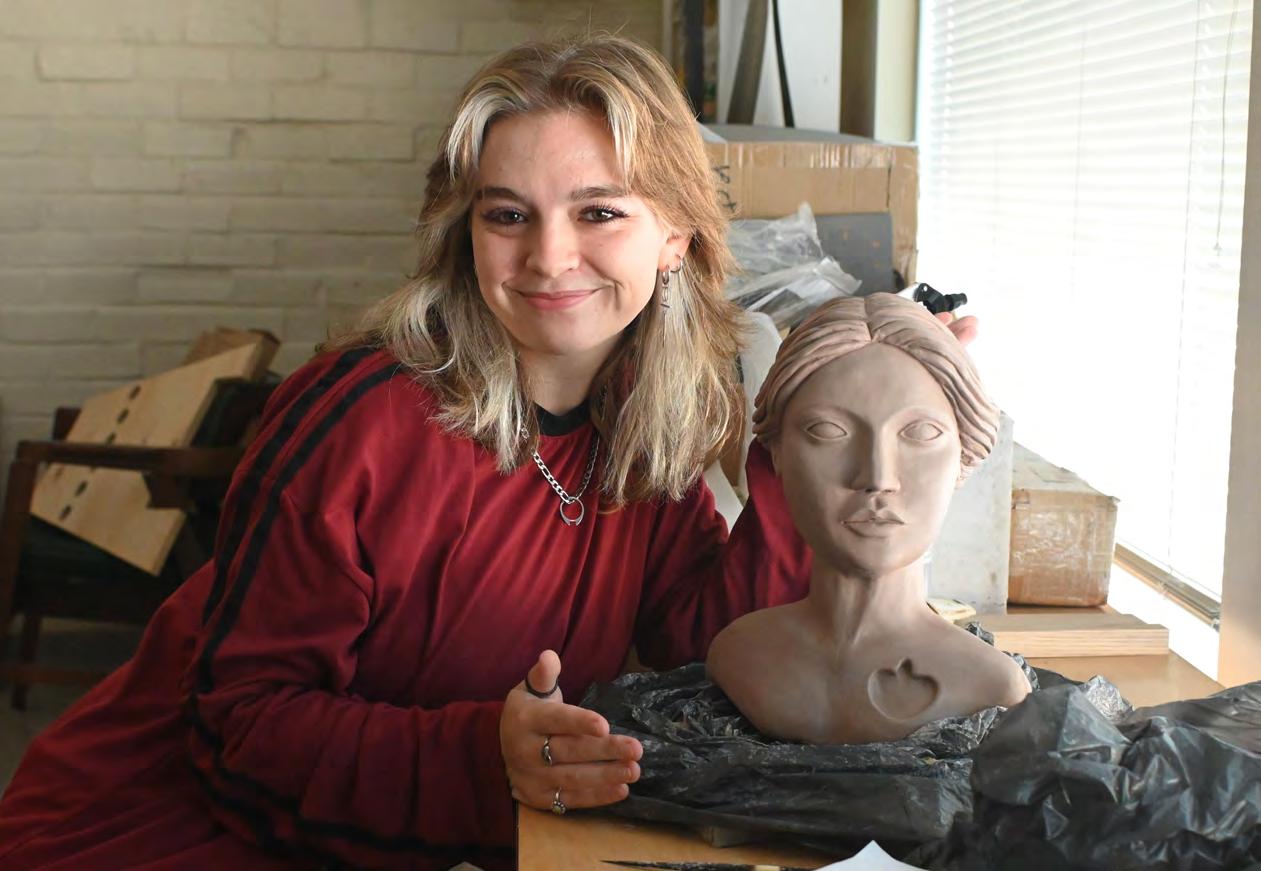
crafts of clay
CCHS senior Calum Cederbaum speaks about her experience sculpting and her fall internship at the University of Georgia.
AS TOLD TO MZÉE PAVLIĆ Variety Staffer
LAYOUT BY ISABELLA GRESHAM Viewpoints Editor
VARIETY STAFFER MZÉE PAVLIĆ: WHAT’S YOUR PROCESS WHEN CREATING SCULPTURES?
Clarke Central High School Senior Calum Cederbaum: Usually I take, it depends on how big the project is, about half a week to come up with the idea, figure out how logistically that’s going to work and then come up with a timeline. If there is already a set timeline, how (I’m) going to break up my time. ‘How am I going to separate? Oh, I need to have this feature done by this date.’ So I set (the schedule) all up within the first week, and then (I) really just work away till the deadlines. A lot of the time is actually spent drying, so you have to make sure that that time is added, especially if it’s a bigger piece.
MP: WHAT’S KEPT YOU CONTINUING SCULPTURE ALL THESE YEARS?
CC: It was highly encouraged when I was younger (to) find any sort of art form that you like and would like to continue doing. So I tried 2D, I tried music and everything, and this is the one that stuck. It’s always been very easy, shaping clay. With drawing, it’s very much like (if) you make one mistake, that might have ruined the piece. But with clay, you put something on and (if) you’re like, ‘Meh, I don’t like that,’ you can just scrape it back off. It’s very forgiving, and I like that.
Above: BUILDING A BUST: Clarke Central High School senior Calum Cederbaum presents a clay bust at Thomas Street Art Complex on Oct. 16. Cederbaum was homeschooled until fourth grade and began sculpting with ceramics during that time. “It’s just very easy to go in any direction with (clay),” Cederbaum said. “You can create functional pieces. You can create things for beauty alone. (There’s) such a wide open range of things.” Photo by Illiana Tejada
MP: YOU SAID IT’S EASIER TO MAKE MISTAKES AND FIX THOSE WITH CLAY. HOW DO YOU WORK THROUGH BIGGER MISTAKES OR THINGS TURNING OUT DIFFERENTLY THAN YOU EXPECTED?
CC: Especially working on face sculpture, I had so much trouble with actually shaping the lips. You’ll watch tutorials, that’s a (big) thing if you don’t know what you’re doing, I would watch a tutorial, but of course, sometimes they don’t cover actually doing it on a sculpture, so you have to figure out how to fit everything together (through) trial and error. Then, just not being afraid to start over completely and scrape off the entire bottom half of her face and just redo it. I think I had to do (that) like five different times.
MP: HOW HAS YOUR SKILL DEVELOPED DURING YOUR INTERNSHIP?
CC: I had never done a bust before. It was something completely new, and I started out and had to scrap it completely just because it wasn’t turning out how I wanted. I’ve grown (with) problem solving. (That) would be the main thing overall, because it’s very difficult to figure out how things actually fit together in a face, even though you see them every day. So it’s taking little portions of a bigger picture and focusing on it until it turns out how you want it, and then making sure that fits with the overall sculpture.
MP: WITH THE WIDE RANGE OF AREAS OF
SCULPTURE AT UGA, HOW ARE THE OPPORTUNITIES DIFFERENT FROM CCHS’?
CC: (UGA has) a lot more specifics. (CCHS students) have ceramics, which is just clay, and then we have sculpture, which is like every other medium, and then you can go over to (Athens Community) Career (Academy for welding), but I don’t think a lot of people know about that. Over at UGA, everything’s in one place. They have different kinds of jewelry making. They have enameling classes. They have woodworking, metal, pretty much anything you could think of. (I feel like) there’s a class for everything.
MP: ARE THERE ANY PROJECTS BEYOND THE BUST YOU’RE DOING?
CC: I think (the bust) might take most of our time, but any leftover time, we are going to use to really hone in on different features and getting practice. But the sculpting is only half of my internship, and the other half is working on machines and fixing them with my mentor, because she’s a studio tech. So anything that breaks in any of the studios, it’s her job to go in and fix them. So that should also take up some time.
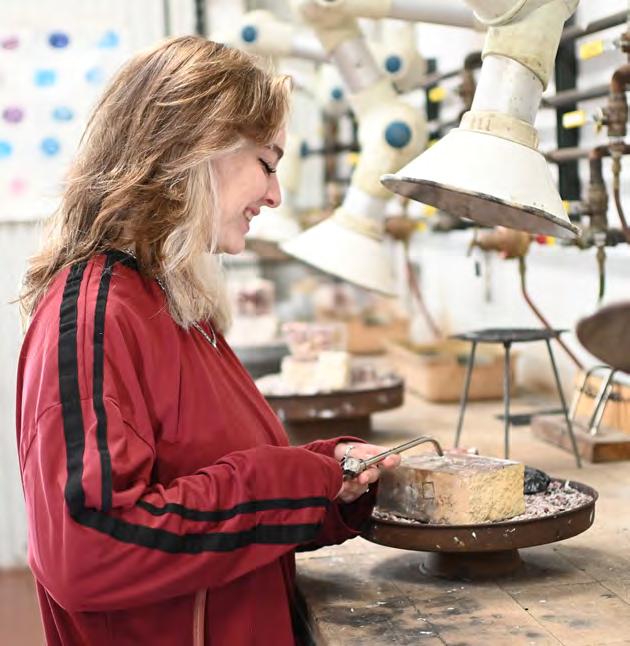
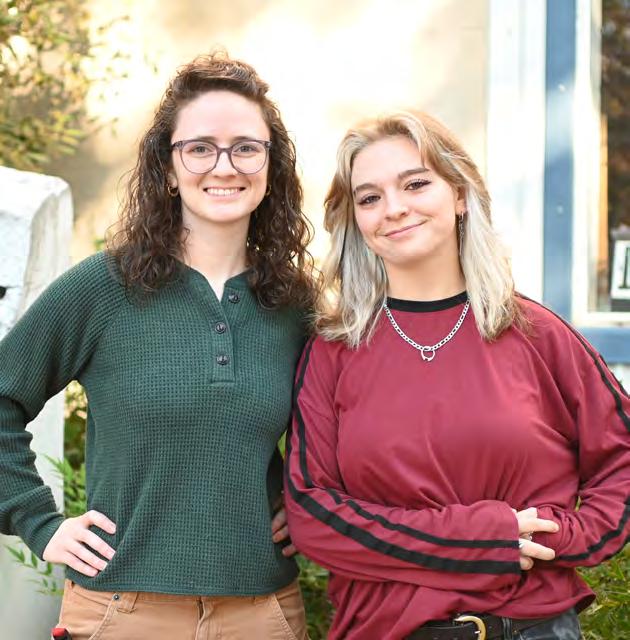
Above: SCULPTING SUPERVISOR: University of Georgia Art Studio Technician Haley Huebner (left) stands next to Clarke Central High School senior Calum Cederbaum (right) at Thomas Street Art Complex on Oct. 16. Cederbaum has interned with Huebner since the start of the 2025-26 school year. “(Huebner) has a (bachelor of arts) in ceramics, and so anytime I’m struggling with something, she’ll come over,” Cederbaum said. “She’s had experience actually creating a bust, so she’ll give me pointers and information that I should consider.”
Photo by Illiana Tejada
Above: BUILDING A BUST: Clarke Central High School senior Calum Cederbaum works on a jewelry piece at the Thomas Street Art Complex on Oct. 16. Cedarbaum, who also experimented with welding at Athens Community Career Academy, believed that clay is more forgiving than metalwork. “It’s just very easy to go in any direction with (clay),” Cederbaum said. “You can create functional pieces. You can create things for beauty alone. (There’s) such a wide open range of things.” Photo by Illiana Tejada
CULTURAL BUZZ

The latest installment of the “Predator” franchise, “Predator: Badlands” was released on Nov. 7 to introduce a stand-alone story for fans and newcomers alike.
Directed by Dan Trachtenberg, this rated R film provides viewers with excellently choreographed fights and otherworldly special effects.
But these fights would be a drop in the bucket of “Predator” movies without this film’s cast, with starring performances from our Yautja protagonist Dek (Dimitrius Schuster-Koloamatangi) and synthetichuman sidekick Thia (Elle Fanning).
This movie follows Dek, an outcast of his clan, as he meets an unlikely ally on his hunt for the ultimate adversary. With a runtime of 1 hour and 47 minutes, viewers will be stunned by this film’s setting and scenery: the intricately deadly planet of Genna.
Overall, “Predator: Badlands” is a must watch for lovers of the franchise or new fans looking to explore the Yautja’s world of creative weaponry.
-- Peter Atchley, Managing Editor
“Frankenstein”
BY ANGEL TEJADA Journalism Facilitator

“FReleased on Sept. 19, 2025, technology company Apple’s iPhone 17 contains several unique features that significantly elevate its performance compared to previous models.
Offered in five different colors: lavender, sage, mist blue, white and black, the iPhone 17 is equipped with a scratch-resistant screen, as well as a new maximum brightness capacity. It also introduces an updated camera system, which includes new framing options and higher resolution for close-up shots. Additionally, at 256 gigabytes, the iPhone 17 has double the storage capacity of its predecessor.
However, some may feel as though the iPhone 17 is too expensive, considering it doesn’t vary too much from its counterparts in terms of design. On top of that, its battery life doesn’t appear to have improved since the iPhone 16, which is disappointing.
Overall, the iPhone 17 hosts a variety of features that provide users with a relatively enjoyable experience.
-- Adah Hamman, Variety Editor

Similarly to the trending name of adult horror and fiction author Olivie Blake’s newest book “Girl Dinner,” its storyline and nuanced writing sets it apart from others in its genre.
The novel, released to all major booksellers on Oct. 21, follows dual points-of-view of college professor Dr. Sloane Hartley and student Nina Kuar, who is trying to get into the most prestigious sorority on campus, “The House.”
The alluring plot line and relatable characters are harnessed well in Blake’s writing, as she makes shockingly true statements about the patriarchy and toxic masculinity while simultaneously using horrific elements in a way that doesn’t make them seem fake and glorified.
However, despite the uniqueness of the book, some might find it repetitive of itself: the same conversations seemingly happening more than once, which drag on, rather than add, to the novel.
Overall, “Girl Dinner” is good for anyone looking for a horror novel that stays close to reality.
-- Lea D'Angelo, Digital Editor-in-Chief
rankenstein,” released on Netflix on Nov. 7, is an adaptation of Mary Shelley’s 1818 novel of the same name, creating a visually-stunning and heartbreaking tale.
Directed by Guillermo del Toro, the almost three-hour R-rated film contains gory horror and violence, which may be upsetting to some viewers.
The story is split into two main chapters: “Victor’s Tale” and “The Creature’s Tale.” The first chapter follows Victor Frankenstein (Oscar Issac), the son of renowned surgeon Leopold Frankenstein (Charles Dance). The chapter narrates Victor’s upbringing in an abusive relationship with his father to Captain Anderson, the head of a Danish naval ship, who rescues Victor from the Arctic, where the film starts.
This transitions into Victor’s reasoning for the creation of the Creature (Jacob Elordi), or Dr. Frankenstein’s iconic monster, who starts the second chapter by retelling his story after the events of the creation and how Victor and his creation ended up in the Arctic.
The movie beautifully depicts every scene with extreme precision, adding heavy gothic and steampunk elements in its architecture, technology and costuming that really bring viewers into the world. These visuals correspond perfectly with the haunting orchestral soundtrack by Alexandre Desplat that makes every scene more emotional.
The central themes Toro brings into the film also emphasize its complex nature. The failure of nurturing one’s child and the cycle of abusive parenthood is shown to be the true monstrosity of the film, not the creation of life.
This plays into question where the line between what is human and what is monstrous converges, making watchers empathize for the Creature and see that many of the humans display monster-like qualities, more so than the creature itself.
For this new iteration of Frankenstein, delving into multiple complex and intricate themes, “Frankenstein” highlights the sci-fi genre Shelley pioneered exceptionally well and encapsulates the atmosphere perfectly.
CULTURAL BUZZ

On Dec. 31, 2025, Netflix’s hit sci-fi horror series “Stranger Things” concluded with its season five finale, "The Rightside Up," ending the story that began nearly a decade ago. Created by the Duffer Brothers, the show follows a group of friends as they battle supernatural forces from the Upside Down and navigate adolescence.
While the episode delivers a dramatic showdown and successfully ties the characters' storylines with a hopeful ending, its pacing is uneven. Some scenes linger longer than necessary while others feel rushed making the two-hour-and-eight-minute episode feel inconsistent despite its movie-like runtime.
Additionally, in comparison to earlier seasons, the finale feels unrealistic. In all four previous seasons at least one main character dies, reinforcing the high stakes of the show’s universe. However, in the finale, despite the magnitude of the final battle, the episode spares every major character, diminishing the sense of danger that defines the series.
Overall, the “Stranger Things” finale provides emotional closure but lacks the realism that made the series so compelling to begin with.
-- Liya Taylor, Sports Editor
“Fallen City”
BY ADAH HAMMAN Variety Editor

ROn Nov. 21, Canadian singer-songwriter Tate McRae released her fourth studio album, “SO CLOSE TO WHAT??? (deluxe)” to all major streaming platforms. Featuring five more songs than the original, the deluxe version is strong overall but a bit repetitive.
Among these, “TIT FOR TAT,” an already popular single, and “NOBODY’S GIRL” stand out as highlights.
The album is electric and modern, setting itself apart from other pop releases. Its upbeat tunes make it easy to dance to and the album’s themes, focused around the complexity of love and relationships from a young woman’s perspective, will resonate with many listeners.
However, the upbeat music often overpowers McRae’s voice causing the lyrics to get lost and making it difficult to understand the meaning. Additionally, without powerful lyrics to differentiate the songs, the tunes get repetitive.
Despite this, the deluxe version is a compelling addition to McRae’s discography.
-- Olive Forrester, Journalism I student
eleased on Nov. 4, American author Adrienne Young’s “Fallen City” is full of immersive scenery and engaging characters. However, some readers may find the novel confusing, as it frequently jumps between past and present, occasionally disrupting the narrative’s momentum. “Fallen City” is dual-perspective and follows forbidden lovers Luca and Maris as they navigate their city’s corrupt political landscape and a subsequent rebellion. The 416-page book alternates between timelines, and readers witness the pair fall in love, only for them to be thrust onto opposite sides of the conflict after their plan to overhaul the government fails.
Young does an excellent job of worldbuilding, both the novel’s setting and its characters feel welldeveloped, especially Luca. He wants to be with Maris, but he also wants to do what is right by his people, and this internal struggle makes him a particularly compelling protagonist.
However, an aspect of the story that didn’t seem as refined was the romance between the two main characters. They only spend a brief period of time with each other before the war breaks out, but somehow, readers are expected to believe they would sacrifice everything for one another. Young tries to make up for this by implying that their relationship is destined, but it ultimately feels like a cheap way to make up for its lack of development.
Overall, “Fallen City” has an exciting and innovative premise, but its non-linear execution may take away from some readers’ overall experience, especially those who prefer a more straightforward ot characterdriven storyline.

The “Wizard of Oz” cinematic universe defied gravity again with “Wicked: For Good,” but some may feel it becomes redundant as the film progresses.
On Nov. 21, “Wicked: For Good” was released, offering fans a heartwarming conclusion to the duology. With powerful performances from Elphaba (Cynthia Erivo) and Glinda (Ariana Grande), the film ensured that every song in the soundtrack was highlighted, from the reprise of “I’m Not That Girl” to songs original to this movie like “The Girl In The Bubble.”
Where this musical adaptation may have disappointed fans was in its two hour and 18 minute runtime. While “Wicked” made use of every second, “Wicked: For Good” felt drawn-out, with several scenes that echoed similar sentiments. While it didn’t diminish overall appeal by that much, the high standard last year’s film set made for a let down in comparison.
Overall, with stunning visuals, expertly rendered songs and an emotional storyline, “Wicked: For Good” makes a great watch for this holiday season.
-- Peter Atchley, Managing Editor
PHOTO ILLUSTRATION BY LIYA TAYLOR Sports Editor
LIYA’S LINEUP
Prayer can be meaningful for many athletes, but it should remain a personal choice and not a team expectation.

BY LIYA TAYLOR Sports Editor
Minutes before a game begins, when the referee’s whistle hasn’t blown yet, squads gather around. Hands clasp, heads bow, teams pray. It looks like unity, but for some athletes, it’s the exact opposite.
Under the First Amendment's Establishment Clause, team-sponsored prayer is unconstitutional in Georgia public schools. Defined as instances when school officials or coaches organize, lead, encourage or endorse prayer, the practice continues at Clarke Central High School and elsewhere. However, without a formal complaint, the CCHS athletic department has not taken action.
“I know teams do it,” CCHS Athletic Director Dr. Jon Ward said. “I'm hopeful that we're not putting students in a situation where they're feeling uncomfortable or obligated.”
didn't have to do that,” CCHS varsity flag football kicker and senior Cameron Mojock, who is not religious, said. “(Team prayer) creates an ‘us-versus-them’ idea. When the entire team is doing it and you're the one person who's out, it doesn't feel good.”
The effects of those “it doesn’t feel good” moments can be dangerous. University of Georgia professor of Human Development and Family Science Assaf Oshri explained that, when adolescents feel the need to conform or silence themselves to be included, their stress response gets activated.
“If a key task for healthy development is to form (a) healthy identity, then if the social structures around you are not accepting you, you feel excluded. And social isolation has very (harmful) effects,” Oshri said. “It can cause (a) lack of emotion regulation, which undermines our ability to make decisions (and) can lead to anxiety and depression.”
While some might argue that prayer brings people together, it should remain a personal choice.
But as a Jewish volleyball athlete, I’ve felt that discomfort. The sting of standing in a huddle, wanting to belong, but staying silent when Christian prayers are said. That moment which should symbolize solidarity instead draws a line between those inside the prayer and those outside.
According to the Pew Research Center, 37% of United States adolescents ages 13 to 17 don’t identify under a part of the Christian umbrella.
“Personally, I go in the circle and I don't talk, but part of me wishes that I
While some might argue that prayer brings people together, it should remain a personal choice. Players who wish to pray should feel empowered to do so individually while allowing those who don’t to feel equally included and respected.
Athletics should bring out the best in every player, but when rituals pressure some to leave their beliefs at the door, a team isn’t stronger, it’s fractured. True unity comes when every player feels they belong, not because they pray together but because everyone feels respected for what they believe or don’t believe.

Above: PRESSURE TO PRAY: An illustration shows a Clarke Central High School sports team praying before a game. Sports Editor Liya Taylor discussed how team-led prayer alienates some athletes and instead, players and coaches who wish to pray should do so individually.“Athletics should bring out the best in every player, but when rituals pressure some to leave their beliefs at the door, a team isn’t stronger, it’s fractured,” Taylor wrote. Illustration
by Sylvia Robinson
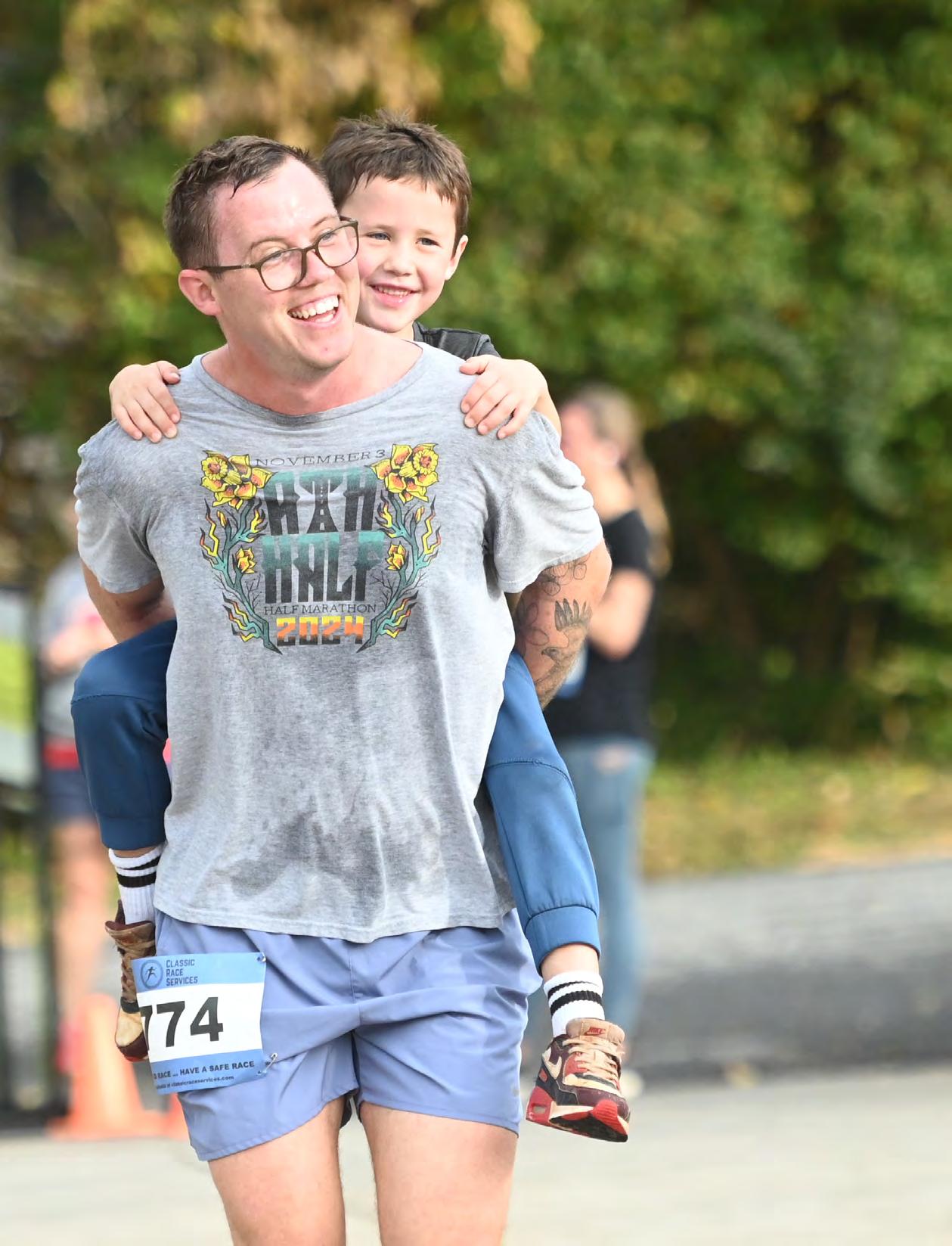
IN FOCUS
Featured: 5K FUN: Participants run to the finish line of the Glads Run Ath 5K hosted by Clarke Central High School in bIlly Henderson Stadium on Nov. 8. The 5K was organized by CCHS Associate Athletic Director Dr. Chris Aiken and open to all CCHS and Athens community members. “It was so much fun. The hills were rough, but it was a lot of fun. My little ones had a blast. (enjoyed) seeing everybody out running and having a great time and supporting the school,” Kelsey Wynn, a 5K participant, said. Photo by Iliana Tejada
Featured: DOUBLE-TROUBLE: Clarke Central High School girls varsity basketball point guard De’Anah Oliney, a sophomore, stands in the CCHS Competition Gym. Oliney played on the CCHS varsity girls basketball team in the 2024-25 season, despite it being the first time ever playing the sport. “In basketball, my proudest moment is the first time I hit a double-double. I had the most double-doubles on the team. That was as a freshman, and I had at least three or four double-doubles. I was proud of myself,” Oliney said. “At the beginning of the season, I didn't even know what a double-double was. They had to explain it to me, because never played basketball (before).”
Photo by Kye Streetman
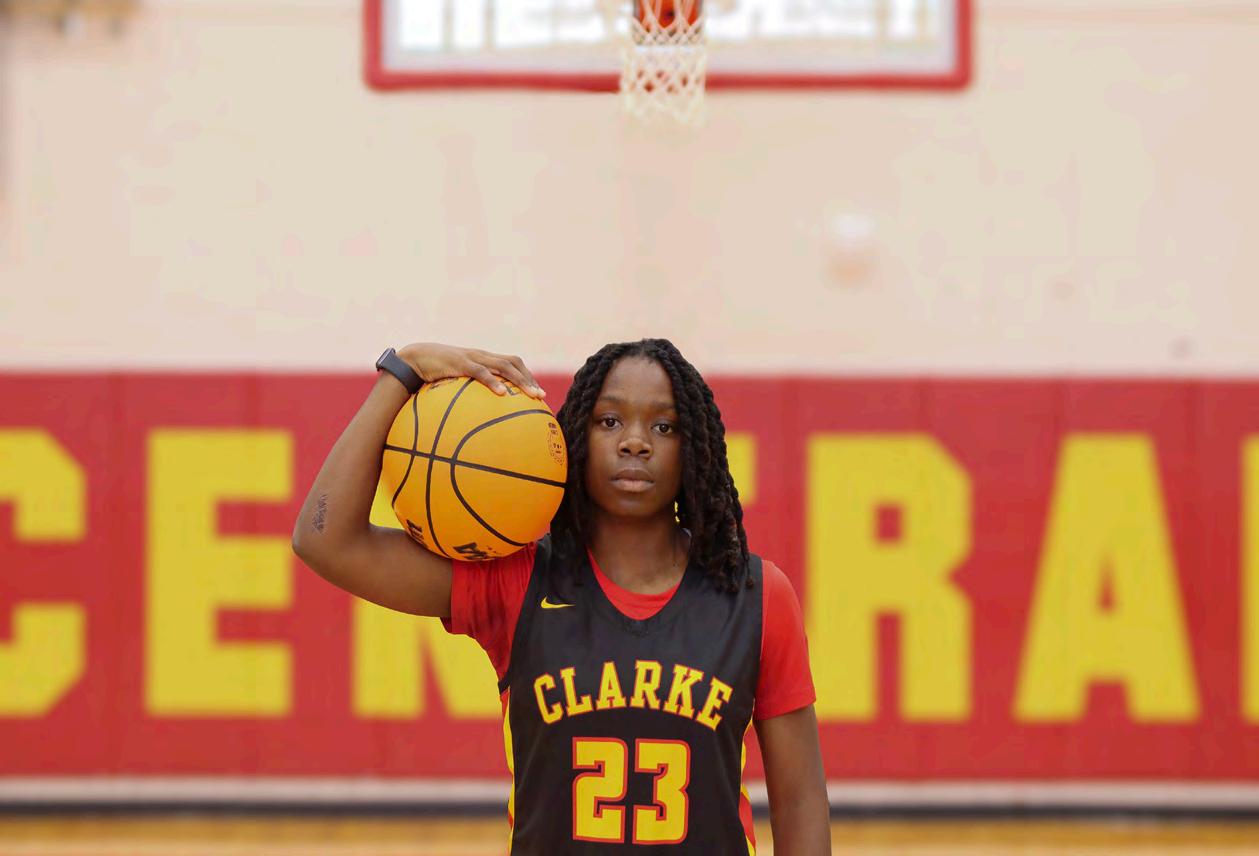
in her dna
CCHS varsity girls basketball point guard De’Anah Oliney, a sophomore and multi-sport athlete, is emerging as a figure of success in CCHS athletics.
STORY BY KYE STREETMAN Sports Staffer
LAYOUT BY LIZA LARSON
Print Editor-in-Chief
clarke Central High School varsity girls basketball point guard De’Anah Oliney doesn’t just compete, she changes the pace of the game every time the sophomore steps on the court.
Prior to being a part of any organized basketball team, Oliney’s only experience came from playing pickup basketball, primarily during her time at Clarke Middle School, where she was first noticed by CCHS head varsity girls basketball coach Carla Johnson.
“When I (first) saw her, it was (at) an after school program. I would go over to CMS, and we would do some drills with some kids,” Johnson said. “Her movement (when) she was playing with the guys (was) just effortless. That's the first time that I was like, ‘Okay, she's a baller.’”
At the beginning of her eighth grade year, she joined the CCHS junior varsity flag football team as its only middle school player, and CMS flag football and head basketball coach Marie Peel quickly noticed her energy and talent on the field.
“I noticed that De’Anah was naturally athletic when I first met her. I would
see her playing ‘snag’ football with all of the boys. She was just as aggressive, if not more, than most of the boys,” Peel said “Her explosive athleticism prompted others to rise up. She pushed other players to match her energy. (She was) always smiling and finding unique ways to get others smiling and in a good mood.”
After that season ended, she joined the CMS girls basketball team, also coached by Peel. Shortly after, she took a hard hit that ended up knocking out a tooth during a scrimmage before the season started, causing her to step away for the remainder of the season.
“After that incident, she didn’t seem to have the heart to play. I’m unsure if her injury was the main reason why she quit, but I’m sure it played a part in her decision,” Peel said. “We definitely felt her absence; it was like we lost our light for a little while. Though we bounced back as a team, we sure wished we had her on our side during the season.”
When her freshman year began, so did flag football season, and CCHS head varsity flag football coach Cherelle Pass said Oliney has been a dominant force on the team since joining, currently starting on both sides of the ball as both
quarterback and strong safety.
“De’Anah as an athlete has a God-given gift. She just has this craft about herself that you can't necessarily train. You can't work to do some of the things that she naturally knows how to do,” Pass said.
Her impact continued to grow on the field. During her freshman season, she helped the Gladiators’ offense deliver a 15-8 season record and make it to the Georgia High School Association Region 8-AAAAA state playoffs Sweet 16 round. No matter the sport, her natural ability translates.
“Having her as a ninth grader in gym class, she would play pickup basketball with the boys. She had this natural ability to make moves on the court,” Pass said.
When the flag football season ended, Oliney decided she wasn’t done with basketball and gave it another chance. She quickly earned a starting spot as point guard, the only freshman in the starting lineup for the CCHS girls varsity basketball team.
“I wasn't going to play basketball my freshman year because I was scared to get injured again, (but) then I had coaches and my family pushing me just to try it,” Oliney said. “Nobody wants to get hurt, but I couldn't just let that stop me from being great or being recognized.”
In addition to her success on the flag football team, she delivered a strong performance on the basketball team in the 2024-25 season. Despite being a freshman, she led the team in double-doubles, fueled by a relentless inner drive and passion for the game.
“She was a big boost in our offensive output. When she earned a starting role, it really played a positive part (for) us with some wins last season,” Johnson said. “She had a huge impact on the team. Her natural basketball instincts and the way she plays the game (make her) a very exciting player to watch.”
Oliney’s attitude extends beyond her athletic performance, often acting as a team motivator according to CCHS varsity flag football wide receiver and varsity girls basketball point guard Sadie Miller, a senior, who has played alongside Oliney for the past three years.
“She's a game changer. If she's on the bench and the game starts to slow down, we'll put her in and everything speeds up 10 times faster,” Miller said. “That's really helpful if we're in a close game, or even if we're behind and we're trying to play catch up. She's definitely an energy changer. Her energy is transferable, and everyone (feeds) off her energy.”
“When I (first) saw her, it was (at) an after school program. I would go over to CMS, and we would do some drills with some kids. Her movement (when) she was playing with the guys (was) just effortless. That's the first time that I was like, ‘Okay, she's a baller,”
--carla johnson, CCHS head varsity girls basketball coach
Despite her qualities of a natural athlete, Oliney carries it with humility, which coaches say make her not just a great athlete, but a respected teammate and leader.
“De’Anah is humble. Even though here I am talking about her, and other people talk about her, I don't think she carries that with arrogance or cockiness. She doesn't give this pridefulness, which sometimes great athletes have. And that doesn't mean anything about athletics, that's just who she is,” Pass said.
Though her natural-born talent has taken her far, Oliney’s work ethic, passion and drive continue to set her apart. Still early in her high school career, she’s already established herself as a key presence in both teams’ success.
“I feel like (my motivation comes from) me first. If you were to play a sport and not love the sport, you probably wouldn't be as good as you would want,” Oliney said. “Loving the sports that I play helps me push myself every day. Then, my teammates, my coaches and my mom push me, but I come first.”
Below: DOUBLE DOUBLE: Clarke Central High School girls varsity basketball point guard De’Anah Oliney, a sophomore, takes a shot in the CCHS Competition Gym. Oliney played on the CCHS varsity girls basketball team in the 2024-25 season, despite it being the first time ever playing the sport. “In basketball, my proudest moment is the first time I hit a double-double. I had the most double-doubles on the team. That was as a freshman, and I had at least three or four double-doubles. I was proud of myself,” Oliney said. “At the beginning of the season, I didn't even know what a double-double was. They had to explain it to me, because I never played basketball (before).”
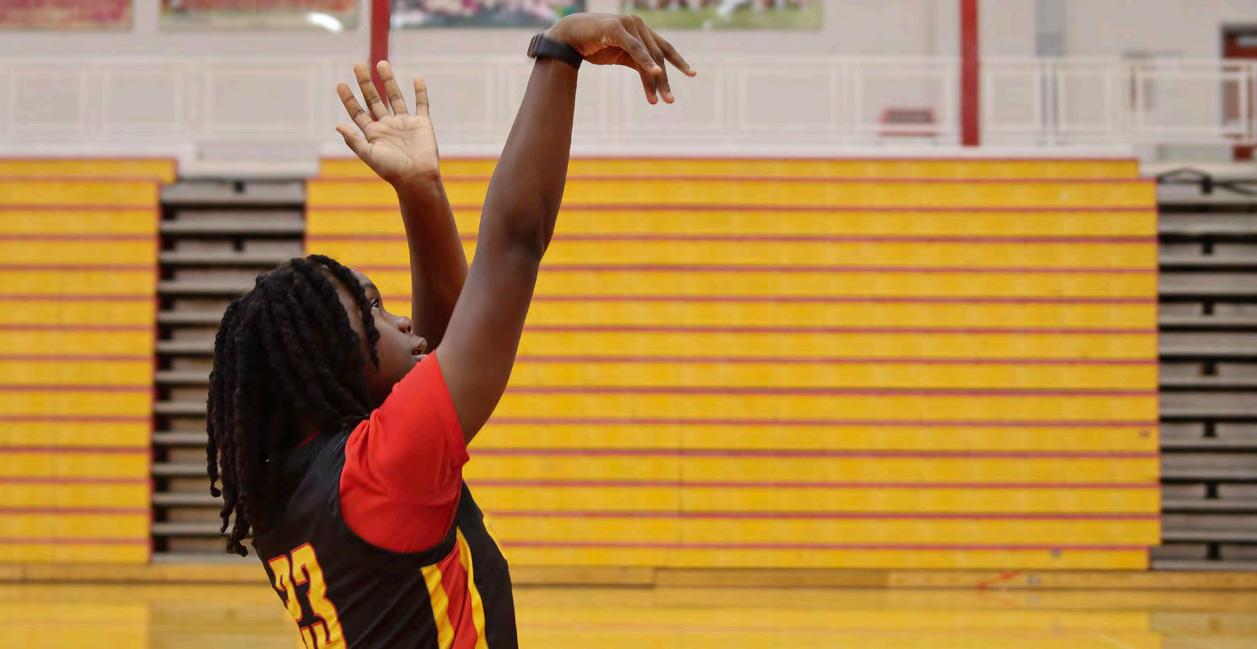
Photo by Kye Streetman
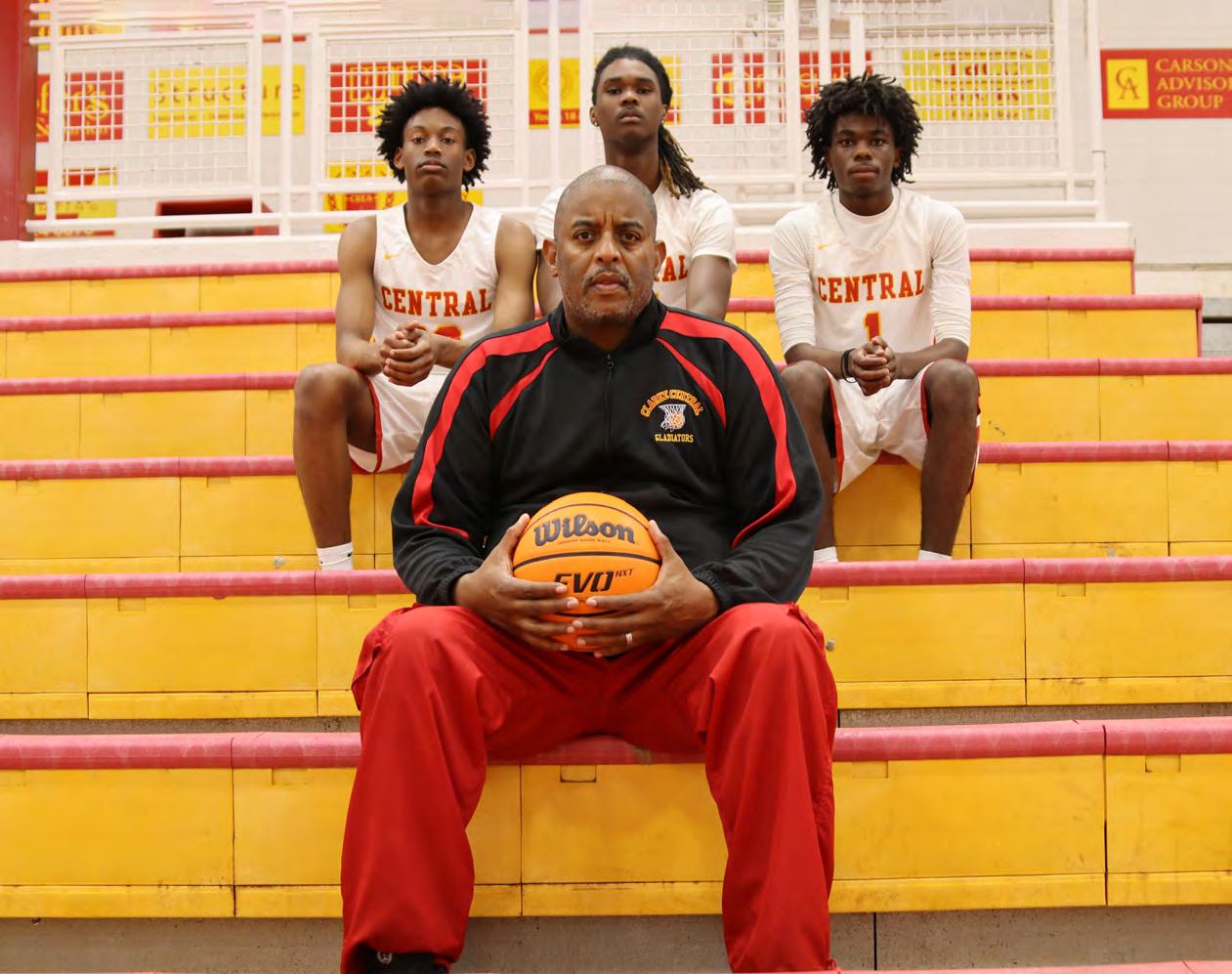
Gym
Oct. 28.
Smith, the 2025-26 varsity boys basketball team is looking to build talent by giving their all during practices. “We're going to hold ourselves to a higher standard, as far as making sure we give effort every time we get in the gym,” Smith said. "I tell (the team) all the time, ‘That ball might not go in the hoop, but effort, you always bring that with you.’ So I think if we just continue to stick to what we doing, good things will happen.”
rebuilding a foundation
After a winless 2024-25 season, the CCHS boys varsity basketball team is looking to build upon a foundation of young players.
STORY BY COOPER JONES
Senior Copy Editor
LAYOUT BY LIZA LARSON
Print Editor-in-Chief
it’s January 2025 and the Clarke Central High School boys varsity basketball team takes to the court for another game. Sneakers squeak, balls bounce and the scoreboard counts down the final seconds to the buzzer, marking yet another loss.
Heads hang low, with players and fans disappointed, but head boys varsity basketball coach Dr. Stefan Smith claps. Not to celebrate a win, there hasn’t been one all season. He’s applauding effort.
The Gladiators went 0-25 in the 2024-25 season and finished last in the Georgia High School Association Region 8-AAAAA with a region record of 0-12 after losing key players like former CCHS students Marcus Gillespie and Hezekiah Millender. Despite the adversity and left to start a squad of primarily underclassmen and first-time varsity players, the team and coaching staff remained optimistic about player growth and prospects for future seasons.
"it was hard to come to practice every day and give our best effort despite our record and everybody doubting us at school."
--matthew collins, CCHS varsity basketball shooting guard
Featured: INCREASING EFFORT: Clarke Central High School boys varsity basketball players Mathew Collins, a senior; Andre Cox, a junior; and TJ Gipson, a junior, sit behind varsity boys basetball coach Dr. Stefan Smith in the CCHS Competition
on
According to
Photo by Cooper Jones
“It was a developmental season. Guys had to step up and play, and it was a great experience for them. I got a chance to play a lot of freshmen, and in the long run, what we did last year was very, very important to what's gonna happen in the future,” Smith said.
According to CCHS varsity basketball shooting guard Matthew Collins, a senior, the team faced adversity beyond their record. In their own school halls, they heard constant criticism.
“It was hard to come to practice every day and give our best effort despite our record and everybody doubting us at school, calling us trash and saying we need players from last year to help us out,” Collins said.
Still, Smith saw a team that did its best to remain positive despite these doubts, who worked hard in practice and played through frustrations.
“(Our strength was) our resiliency, because (the players) probably had the best attitude that you would ever want to see from guys who weren't as successful in games as they thought they should be,” Smith said. “You couldn't ask for a better group of kids when it comes down to what we were going through and how we were going through it.”
Prior to last season, the Gladiators have seen region success in recent years. They won the GHSA Region 8-AAAAA boys varsity basketball championship in 2021, 2022 and 2024. This made them the region’s No. 1 seed in state playoffs each year and, according to Smith, made them a target to other teams.
“We're champions. I don't think (the 2024-25 team understood) that we were the team to beat in the region. Everybody's bringing their best to us, and we got to understand that. Last year they didn't have an understanding of that,” Smith said.
The 2024-25 team grew tired of losing towards the end of the season, creating rifts between teammates and contributing to dysfunction on the court, according to Collins. Because of this, the Gladiators have made a point to strengthen relationships early on this year.
“I feel great about this year's team, because we've all been playing in the summertime, and we all built chemistry with each other. Last year we didn't do anything for bonding, so we never got close with each other. And this year we started early (to) build bonding,” Collins said.
On and off the court, in the weight room and on the track, the 2025-26 boys varsity basketball team is working to avenge their losses last season and return to their former glory: region champs, a winning record and a state playoff run. Smith predicts a return to form for players and himself.
“We're going to do much harder things than we used to do. They’re going to get Coach Smith back. I got comfortable, too, (after) we won three out of five region championships,” Smith said. “Anything worth getting, you’re gonna have to work for, regardless of what it is. We don't want people to go lay down. They're not gonna be in this program.”
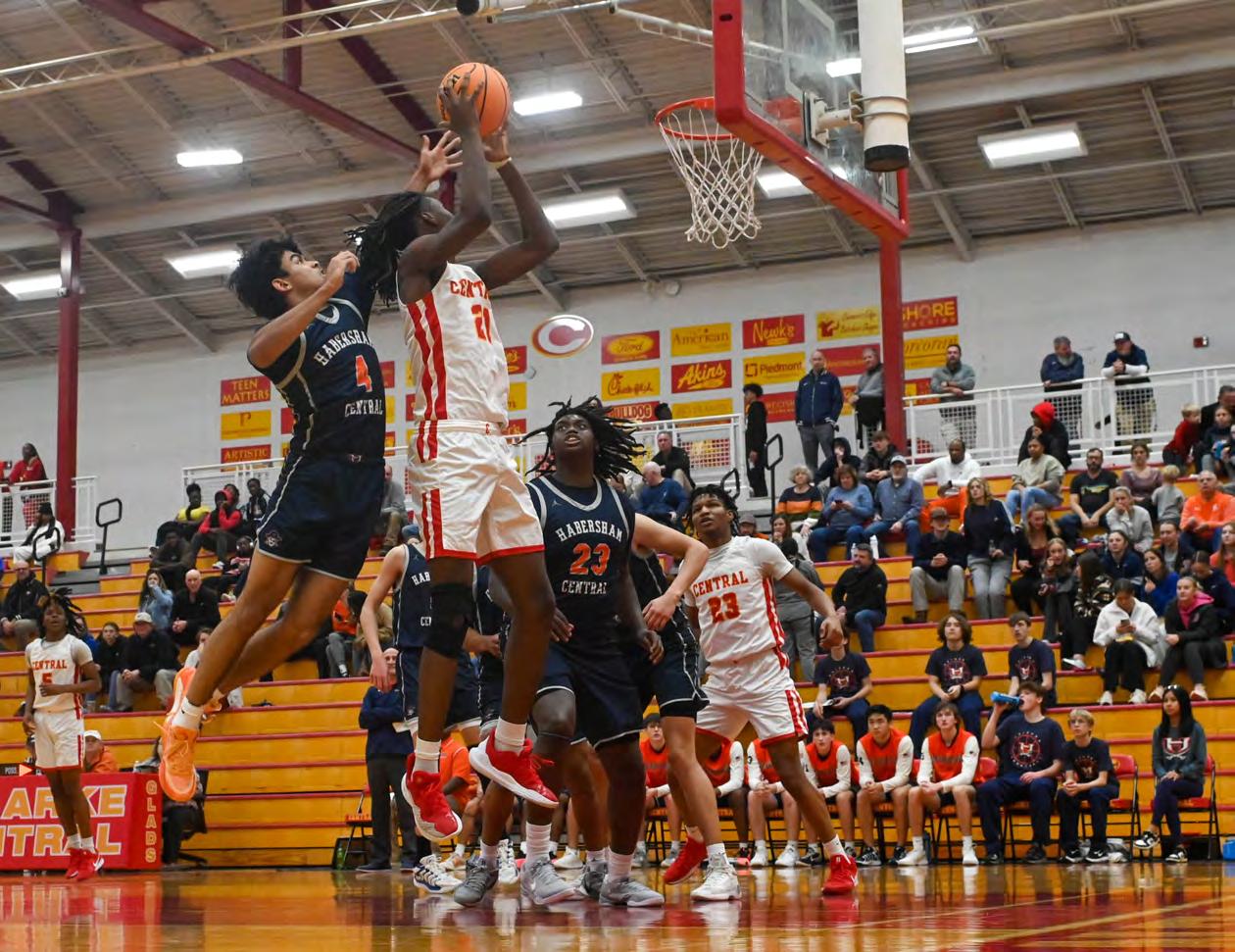
Below: LOOKING FORWARD: Clarke Central High School boys varsity basketball center Andrea Cox, a now junior, takes a shot during the 2024-25 varsity basketball team’s game on Feb. 14 against Habersham Central in the CCHS Competition Gym. Varsity boys basketball coach Stefan Smith attributes last year's record to a large graduating class and lack of varsity exposure.. “It was just inexperience, no varsity experience. They were with the sub varsity coach. Varsity is a lot more advanced than that. In the long run, what we did last year was very, very important to what's gonna happen in the future,” Smith said. Photo by Grady Dunston
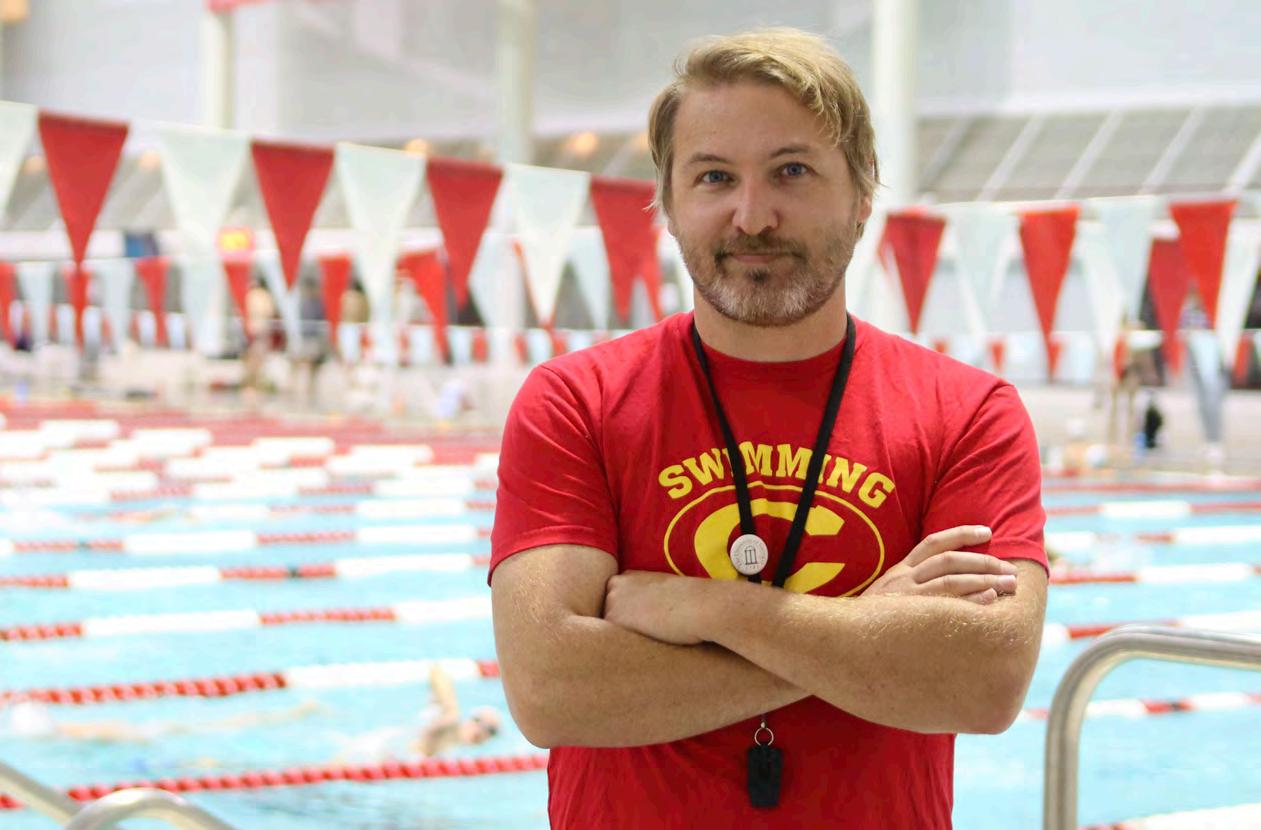
Swimming towards success
CCHS head varsity swim and dive coach Rick Simonds discusses his career as a swimmer and expectations for his first year as CCHS’ head coach.
STORY AND LAYOUT BY LIYA TAYLOR Sports Editor
Sports Editor Liya Taylor: What is your past experience with swimming and diving?
LT: What do you bring to the CCHS swim and dive program?
Clarke Central High School head varsity swim and dive coach Rick Simonds: I am from Athens, and I learned to swim at the Athens YMCA when I was about 4-years-old. Then, when I was in high school (at Clarke Central High School), I needed a job. I got certified and became a lifeguard. (Then, my old coach) convinced me to become a swim instructor, (so) I was (teaching) swim lessons. When I graduated college, I just enjoyed being a part of the Y, being a part of the nonprofit (and) helping kids out (so I) became an Aquatics Director over in Beaufort, S.C. (There, I) had a swim team that I took over as coach and (I) sort of worked my way up throughout the YMCA nonprofit, and now we’re here.
RS: My background (and) my knowledge being around aquatics (from) my previous experience, we had a team (in) the YMCA league (with a) little bit over 100 kids on the team, (with) a substantial 15-20 kids on the high school side. So, being around those kids (and) having that experience, from coaching (and) interacting with high school-aged students (will) help me out at Clarke Central.
Above: A NEW START: Clarke Central High School head varsity swim and dive coach Rick Simonds poses at the University of Georgia Ramsey Student Center on Oct. 15. Simonds, a CCHS Class of 2003 alumnus, has returned to the Clarke County School District for the 2025-26 school year to teach eighth-grade Georgia Studies at Burney-Harris-Lyons Middle School and coach at CCHS. “I miss being around the water. I miss being around the pool, the kids, teaching them (and) coaching,” Simonds said. “I was very fortunate that when I got the job at BHL, (I) happened to see that there was a position and sort of right time, right place. (I) couldn’t be happier that I’m back (in the) Clarke County and helping out with my old high school.” Photo by Kye Streetman
LT: How do you plan to grow the CCHS swim and dive program?
RS: One thing that I’ve been really excited about being here at (Burney-Harris-Lyons Middle School) is that I’ve got kids that are interested (in swimming). I’ve talked about being the swim coach and I’ve got kids that haven’t really thought about it (before), but you can technically swim with the team (and) compete (as an) eighth grader. So, I think being at the middle school and having a classroom with kids will actually help with some recruitment. I’m not sure if there’s participation at the middle school level (yet), but being a middle school teacher (will help build up that feeder system.
LT: What are some challenges you anticipate?
RS: Challenges are just (going to be) getting my bearings. I’ve been a coach before, but it’s a little bit different getting used to the environment. The different locations (and) venues, many of them I’ve never been to. So, just learning on the job, getting my bearings, relearning some stuff that’s probably a little bit rusty and absorbing as much as (former head swim and dive) coach Emily (Hulse) will help me out (with). It’s one of those things, like riding a bike, (that) once you get into it, it comes back to you.
LT: How do you approach athletes at different levels?
RS: My personal thing is it’s a high school swim (team) and I will take anybody and everybody that wants to come out that can swim. Hopefully, they’ve got some experience in the past, but we really want to meet the swimmer where they are and build up on that, because you never know. I’ve had swimmers that think they can’t swim all that well, and then very quickly get the hang of it and get to be really strong swimmers. So, I never want to discourage anyone. It’s always whoever wants to come try out, whether you’re new to the pool or you’ve been swimming since you (were) 3-years-old. There’s a spot for you and there’s an opportunity to help the team and represent the school.
LT: Overall, how do you feel about taking on this position?
RS: I’m excited about the opportunity and the challenges. I am hopeful. I’ve missed having that aspect of being around the pool, so I’m really looking forward to get back into it. It’s been about 10 years since I’ve been the official head coach. Athens is my home. I am a Clarke Central graduate, moved away for a while, had a different career, moved back and really want to put down roots. I’m here for the long haul.
Below: COMING BACK: Clarke Central High School head varsity swim and dive coach Rick Simonds helps his swimmers at the University of Georgia Ramsey Student Center on Oct. 15. After taking a break from coaching for nearly 10 years, Simonds expressed excitement about getting back in the pool. “I want kids to be successful at their personal goals. I want my swimmers to let us know what their personal goals are, whether that’s personal times, trying to build up for the next level, or trying to get into a certain college,” Simonds said. “Whatever their personal goals are, we want to make sure we’re helping them to attain (them).” Photo by Kye Streetman
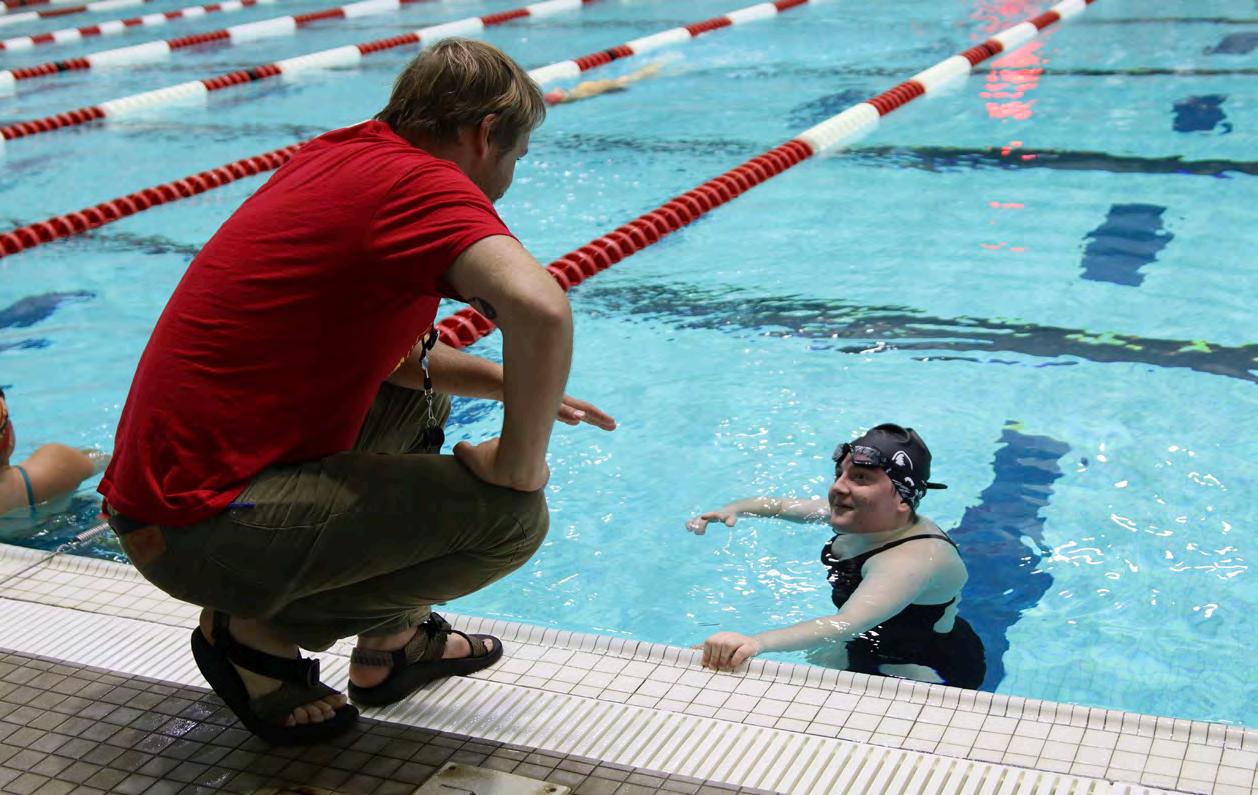
STAR PLAYERS
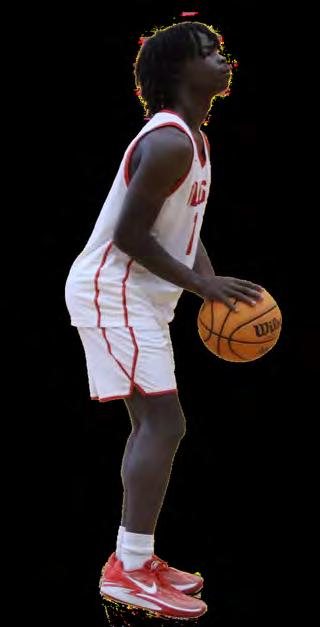
devin osoh
Grade: 10
GPA: 4.10
Years of experience: 8
Gameday rituatal: (For) my game day ritual, I like to listen to music that gets me excited and makes me happy because I like being happy during the games. It gets my energy up. My go-to song is "Members Only" by Drake.
Favorite memory: My favorite memory was the basketball game when we went to go play Cedar Shoals (High School) at the Akins Ford (Arena) and we were cheering there. That was fun.
Role model: My mom inspires me every day with her strength, kindness and determination. She never gives up, no matter how hard things get, and always finds a way to make others smile. Watching how she handles challenges with grace motivates me to work harder and be a better person.
What coaches say: “I call her a social butterfly or a bright light, because she brings great energy and her friendliness helps create a positive atmosphere. She has a very outgoing personality and her outgoing personality fits with cheer because it helps build connections with her teammates.”
-- Head junior varsity basketball cheer coach Tonia Jones
ODYSSEY Star Players are selected based on their academic standing and commitment to teammates, their sports program and Clarke Central High School. Star Players are written for each issue by the Sports Staff based on interviews with players and coaches.
Grade: 12
GPA: 3.70
Years of experience: 12
Gameday rituatal: (I) wake up, get ready and eat oatmeal, a PB&J and lemon water. (Right before the game) I listen to music from Babystaydown, Pradabagshawty or Drake. I have to eat an Airhead Extreme and drink a purple Powerade before the game, then it’s go time.
Favorite memory: (My favorite memory was) when the team practiced the day before we played Cedar (Shoals High School at the Atkins Ford Arena) where our team was doing layout lines. Everybody was dunking, even people who couldn’t dunk were dunking. It just felt great.
Role model: My mom (is my role model) because she’s always persevering and has instilled a great work ethic in me. I (always) try to go out there and make her proud. My favorite quote from her is, “It’s not who you know, it’s what you know.”
What coaches say: “Devin works hard both on and off the court. He gives us a good defensive guard presence and the ability to hit open shots. When he relishes his role he will have a great impact on this team.”

Laila nobles
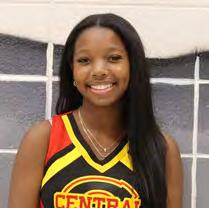
JV basketball cheer
-- Head varsity boys basketball coach Stefan Smith
boys varsity basketball
Photos by Kye Streetman

5things to know about CCHS swim and dive
By Patrick Coverdill, As told to dream freeman
1. Ramsey Routine
(At practice) we start with a warm up, and then move to swimming with a specific focus for the day, (which could) be a stroke or a certain part of a stroke. Then we cool down at the end. Practice is four days a week at the (University of Georgia Ramsey Student Center) from 7 to 8:30 (p.m.). It’s a bit of a drive to get there every day. I’m sure that discourages a lot of people, because it is a lot of time, but it’s manageable.
2. Solo But Supported
(Swimming) being an individual sport creates more pressure on yourself to perform, since you are solely responsible for the outcome of your performance as opposed to traditional team sports. This can be overwhelming at times but (as a team) we still talk to each other and support each other before and after races and at practice.
3. Pick Your stroke
There are five main types of events in swimming. There’s fly, backstroke, breaststroke and freestyle, which are the four main strokes, and then there’s an IM, which is an individual medley of all four. The distances range from 50, 100, 200 and 500 yard swims (and) we get to pick for ourselves (what we race) because we know our strengths.
4. Discipline In Motion
(Swimming has) made me more hard-working and I’ve learned that I can do or learn to do anything that I really stick with. It builds discipline and helps you learn to work harder and persevere more. Things might not be the easiest at first, but with time and practice, you can become a lot better.
5. Weekend in the Water
School meets typically take place on Fridays and weekends, and they last around four to five hours. (However), prelims or final meets (have) a standard four hour session in the morning (and) then a shorter session in the evening for the top qualifiers. (Meets) are typically pretty competitive.
Featured: SWIMMING SUCCESS: Clarke Central High School varsity swim and dive swimmer Patrick Coverdill, a sophomore, swims at the University of Georgia Ramsey aswimming with the CCHS varsity swim and dive squad since he was an eighth grader at Clarke Middle School. “As opposed to traditional team sports, the focus (with swimming) is more on yourself instead of the relationships with and performance of your teammates,” Coverdill said. Photo by Kye Streetman