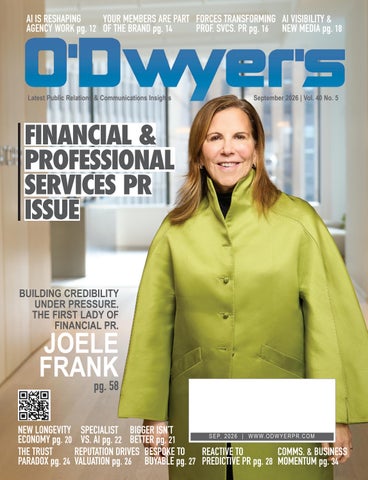
AI IS RESHAPING YOUR MEMBERS ARE PART FORCES TRANSFORMING AI VISIBILITY & AGENCY WORK pg. 12 OF THE BRAND pg. 14 PROF. SVCS. PR pg. 16 NEW MEDIA pg. 18
Latest Public Relations & Communications Insights
September 2026 | Vol. 40 No. 5
FINANCIAL & PROFESSIONAL SERVICES PR ISSUE BUILDING CREDIBILITY UNDER PRESSURE. THE FIRST LADY OF FINANCIAL PR.
JOELE FRANK pg. 58
NEW LONGEVITY SPECIALIST BIGGER ISN’T S E P. 2 0 2 6 | W W W. O D W Y E R P R . C O M ECONOMY pg. 20 VS. AI pg. 22 BETTER pg. 21 THE TRUST REPUTATION DRIVES BESPOKE TO REACTIVE TO COMMS. & BUSINESS PARADOX pg. 24 VALUATION pg. 26 BUYABLE pg. 27 PREDICTIVE PR pg. 28 MOMENTUM pg. 34
CONTENTS September 2026 | Vol. 40 No. 5 LAUNCHES POLANSKY LEADERS FUND 8 PAGE ONE’S PLAYBOOK FOR PR SUCCESS 9 TIER OF ‘NUCLEAR’ VERDICTS RISES 10 NUMBER THE PUZZLE PIECES OF DATA FIT TOGETHER 11 MAKING IS RESHAPING WORK 12 AIAGENCY MEMBERS AREN’T AN AUDIENCE. THEY’RE PART OF THE BRAND 14 YOUR FORCES TRANSFORMING PROFESSIONAL SERVICES PR, AND HOW TO STAY AHEAD 16 FIVE AI VISIBILITY AUDITS REVEAL ABOUT MEDIA AUTHORITY 18 WHAT NEW LONGEVITY ECONOMY: A STRATEGIC LENS FOR COMMUNICATORS 20 THE ISN’T BETTER. BETTER IS BETTER 21 BIGGER KNOW-HOW MATTERS MORE THAN EVER IN AGE OF AI 22 INDUSTRY TRUST PARADOX: WHY FINANCIAL SERVICES SPEND MORE BUT EARN LESS 24 THE DRIVES VALUATION: CEO, CFO & BOARD HAVE TO OWN THAT STORY 26 REPUTATION BESPOKE TO BUYABLE: THE PRODUCT SHIFT IN PROFESSIONAL SERVICES 27 FROM AND DATA SCIENCE IN COMMUNICATIONS REACTIVE TO PREDICTIVE PR 28 AIFROM LEADERS MUST BECOME ARCHITECTS OF BUSINESS MOMENTUM 34 COMMUNICATIONS OF FINANCIAL PR & INVESTOR RELATIONS PR FIRMS 36 PROFILES OF THE TOP FINANCIAL PR & INVESTOR RELATIONS PR FIRMS 45 RANKING
58 On the cover: Joele Frank OF PROFESSIONAL 46 PROFILES SERVICES PR FIRMS OF THE TOP PROFESSIONAL 51 RANKING SERVICES PR FIRMS STAFF RETENTION IS CRITICAL IN 52 KEY BUILDING PR FIRM VALUATION BLUM IS PART PR PERSON, 53 ANDY PART PSYCHOLOGIST FIRM ON 55 PEOPLE 54 PR NEWS THE MOVE 57 INTERNATIONAL 56 WASHINGTON REPORT PR NEWS FRANK AND HER PARTNERS 58 JOELE SELL CREDIBILITY 2026 EDITORIAL CALENDAR
• Jan., Crisis Comms. & PR Buyer's Guide • Mar., Food & Beverage PR • May, PR Firm Rankings • Jul./Aug., Travel PR
• Sep., Financial PR/IR & Professional Svcs. PR • Oct., Healthcare PR • Nov., Technology PR & AI
WWW.ODWYERPR.COM
ADVERTISERS
Collected Strategies ..................................... Inside Front Cover Davis+Gilbert ......................................................................... 15 Edelman ......................................................................... 30 & 31 FINN Partners .......................................................................... 5 G&S Integrated Marketing Comms. Group ............... Back Cover Gould+Partners ................................................................... 33 Gregory .................................................................................. 19
Highwire ................................................................................. 17 ICR .......................................................................................... 25 Infinite ...................................................................................... 7 Joele Frank, Wilkinson Brimmer Katcher ............................ 29 Kekst CNC ............................................................................ 23 Longacre Square Partners .................................................... 13 Padilla ....................................................................................... 3
O’Dwyer’s is published bi-monthly for $60.00 a year ($7.00 for a single issue) by the J.R. O’Dwyer Co., Inc., 271 Madison Ave., #1500 New York, NY 10016. (212) 679-2471; Fax: (212) 683-2750. Periodical postage paid at New York, N.Y., and additional mailing offices. Postmaster: Send address changes to O’Dwyer’s, 271 Madison Ave., #1500, New York, NY 10016. O’Dwyer’s ISSN: 1931-8316. Published bi-monthly.
LETTER FROM THE PUBLISHER
A
s I write this introduction to our September issue, the world is transfixed by AI researchers that say the technology has the potential to wipe out civilization. I think my use of AI is minimal, although maybe I’m just oblivious to how much of that technology has infiltrated my daily activities. I caught up with Joele Frank on a Microsoft Teams call to put together the interview that appears on page 58. It’s amazing how everything discussed in a web meeting like that is magically spit out into a neatly organized summary with subheads. What you gather pretty quickly talking with Frank is that she’s on another level. How many people do you know who started out as biochemists and switched gears to become financial analysts? Frank’s rise in the world of investor relations has taken some interesting twists and turns, including representing Walter Hewlett during the contentious Hewlett-Packard merger with Compaq. She earned a memorable moniker as a result of that work that lives on the web. The genesis of it is easily summoned through a Gen AI search. You’ll have to read the article to find out what I’m talking about. Frank stressed in our talk that her team’s work in the mergers and acquisitions space is tough, but she relishes it. In fact, Frank believes strong competition is essential for the PR industry to exist. Many of Frank’s competitors are featured in this issue’s ads, profiles and articles. There are twelve pieces from experts in financial and professional services PR. This thought leadership serves as an educational tool for those in search of outside counsel and also as a resource for PR pros to compare notes with peers. Following the articles are 39 agency profiles as well as O’Dwyer’s exclusive rankings for each specialty. As with all our themed issues in the past year or so, there’s an AI angle to whatever PR specialty is in the spotlight. While there is no shortage of important tactics to consider and pitfalls to avoid when it comes to AI, the overriding consensus of experts writing for O’Dwyer’s continues to paint a picture where the PR industry is needed more than ever. Gen AI feeds on fact-based, original content that informs and educates and who better to provide that than PR pros? By the way, while I worked off the transcript generated by Microsoft Teams of my interview with Frank, I didn’t rely on an AI summary to put the piece together! Coming up in October is our coverage of the latest developments in healthcare and medical PR. Here’s to hoping that the AI bots haven’t taken over the world by then.
- John O’Dwyer 6
SEPTEMBER 2026
EDITOR-IN-CHIEF Kevin McCauley kevin@odwyerpr.com PUBLISHER John O’Dwyer john@odwyerpr.com SENIOR EDITOR Steve Barnes steve@odwyerpr.com CONTRIBUTING EDITORS Fraser Seitel EDITORIAL ASSISTANTS & RESEARCH Jane Landers Christine O’Dwyer Melissa Werbell ADVERTISING: John O’Dwyer john@odwyerpr.com O’Dwyer’s is published seven times a year for $60.00 ($7.00 a single issue) by the: J.R. O’Dwyer Co., Inc. 271 Madison Ave., #1500 New York, NY 10016. (212) 679-2471 © Copyright 2026 J.R. O’Dwyer Co., Inc. OTHER PUBLICATIONS: O’Dwyer’s website - www.odwyerpr.com Breaking news, commentary, useful databases and more. Online since 1998. O’Dwyer’s Newsletter Jack O’Dwyer’s groundbreaking weekly newsletter started in 1968 continues today giving readers the inside news of public relations and marketing communications. O’Dwyer’s Directory of PR Firms Clients find it easy to shop for PR firms in this directory, published annually since 1970. The 2026 edition contains listings of firms in the U.S. and abroad. The directory's exclusive cross-client index is the only place where you can look up a company and determine its outside PR counsel. O’Dwyer’s PR Buyer’s Guide Products and services for the PR industry in 50 categories printed as part of O’Dwyer’s magazine each January.
REPORT
Page Launches Polansky Future Leaders Fund The fund is meant to serve as a catalyst for empowering future senior communications leaders as well as increasing the diversity in the chief communications officer pipeline. By John O’Dwyer
P
age has launched the Polansky Future Leaders Fund, a permanent fund established through a founding gift from 2025 Page Hall of Fame inductee and former Weber Shandwick Global CEO Andy Polansky. The Fund is focused on supporting, inspiring and empowering emerging talent and increasing diversity among senior leaders in the communications profession. O’Dwyer’s caught up with Polansky to talk about what the fund means to him. Polansky is retired now after spending years traversing the globe for Weber Shandwick. He’s still advising senior executives and boards and spends additional time with those early in their careers as well as students on college campuses. Polansky believes public relations and communications is a promising career track for young people even with the threat of AI eliminating positions. “There will continue to be demand for communicators who can help organizations navigate the changing environment as well as the transformative impact AI is having across the enterprise,” Polansky said. “Our point of view and judgment is highly valued in the C-Suite.” Polansky stressed the need to understand the technology as it continues to evolve, but also underscored the communicator's broad role. “It's never been more important to earn engagement and trust from all of a company's stakeholders,” he added. The Fund will begin supporting Page’s Future Leaders Experience, a two-year executive education program that prepares high-potential communications professionals for senior leadership roles. The curriculum is built around six areas key to the evolving C-suite: Societal Value: Focuses on the value created through either a product or service and how to determine goals to build a commitment to delivering on that value. Corporate Brand: Explores how to deliver a brand experience with every touchpoint with every stakeholder that is aligned with the brand promise. Corporate Culture: Learn how to strategically build and align organizational culture to energize employee engagement and support. Commtech: Discover how to use technology to engage with stakeholders and earn their support. 8
Leadership: Master the skills to work effectively as a strategic advisor to an organization’s leadership. Corporate Advocacy: Takes aim at building public support for an organization’s priorities. Classes are led by Page members, building access to a lifelong network
one-time gift but a permanent fixture for the Page community, giving others an opportunity to contribute in the years ahead. “More on-ramps need to be created to widen the opportunity for individuals whose organizations don’t have the budget or funding for this type of
Andy Polansky
of senior communications leaders. Polansky emphasized how indebted he is to the leaders who invested in him as he was rising through the ranks. “It’s key to have a network of peers in addition to good judgment and technical skills,” Polansky emphasized. Polansky acknowledged the inherent challenge to increasing the eligible pool of candidates and explained that plans are in the works to expand the program outside the U.S. Also, the training is now open to non-Page member companies for the program year 2027 - 2028. Deadline to sign up is Oct. 30. Polansky stressed that the Fund is not a
professional development. In-person sessions in different U.S. cities plus virtual engagement through online platforms make up the class schedule. Full tuition for Page members is $19,500. Non-member is $20,000. The fee includes all course materials and meals. While the program began in 2009 with a cohort of 20, today two cohorts engage concurrently bringing the total number of participants to between 50 and 60. “It is important to continue investing in the future of the communications function,” Polansky said. “Creating this fund is my way of paying that forward.” O
PRSA-NY Hosts Big Apple Awards Sep. 17
T
he PRSA-NY Big Apple Awards Gala on Sept. 17 will have Gio Benitez, co-anchor of the weekend edition of “Good Morning America” and ABC News transportation correspondent, serving as emcee. The award ceremony, to be held at Sony Hall in New York City, will celebrate outstanding campaigns and organizations, honor accomplished communications leaders through the PRSA-NY Individual Awards, and recognize the 2026 PRSA-
SEPTEMBER 2026
NY 15 Under 35 Class. This year’s theme, “Where Stories Move Hearts, Minds and Markets,” reflects the power of communications and storytelling to inspire action, build trust and drive meaningful impact. Sponsors of the Big Apple Awards: Edelman, HUNTER, Burson, MikeWorldWide, 360PR+, Truescope, Davis + Gilbert LLP, Baker Tilly x Anchin, The Museum of Public Relations, D S Simon Media, Coyne PR, Bospar and Notified. O
REPORT
Tier One’s Playbook for PR Success
Starting out with the goal of creating a “different model” for communications, Tier One’s leaders discuss creating value for firms in financial/fintech, professional services and other high-tech industries. By Christine O’Dwyer
W
hen Tier One Partners co-founders Kathy Wilson and Marian Hughes launched their agency in 2003, they were looking to expand their communications offerings to firms in financial and professional services. “We started our agency to really create a different model that delivered very hands on, very senior-level experience and service to our clients—all senior, all the time,” said Hughes. Since then, the firm has continually moved forward to put that different model together. “We started as a traditional PR agency,” Hughes told us, “but we have evolved into being a fully integrated agency over the years.” Before they got Tier One off the ground, Wilson and Hughes had worked together at Weber Group (now Weber Shandwick). With co-headquarters in Boston (led by Wilson) and Chicago (led by Hughes), their agency has now grown to 20 employees. It also has a hub in New York City. In addition to working with clients in financial services/fintech and professional services, Tier One serves B2B and B2C companies in AI and other disruptive technologies, digital healthcare, manufacturing and energy tech. We recently had a conversation with Wilson and Hughes, focusing on news about their firm in the areas of financial/fintech and professional services public relations, along with commentary on the state of the public relations industry, AI, earned media, trends and their outlook on the business as we approach 2027. Hughes told us that Tier One’s sweet spots are “high stakes industries includ-
Practicing and simulating a crisis communications response before an actual crisis can benefit financial/fintech firms according to a new e-book by Tier One Partners.
Marian Hughes (left) and Kathy Wilson, Founders and Managing Partners, Tier One Partners. ing financial services/fintech, and professional services.” The firm’s financial services/fintech clients have included Ally Financial, Apex Fintech Solutions, Invest Green, Prophix, Nephila Capital and Velocity Risk. Wilson discussed the complexity of working with financial services clients. Noting that financial services is “a highly regulated industry,” she said that “it’s changing incredibly rapidly with all sorts of new products, new kinds of digital financial products coming on the scene.” The agency’s professional services roster has included Deloitte, Oliver Wight, 3Pillar, and JetSweep. Content Division and Analytics Practice Tier One’s content division, led by Ashley Tate, senior VP of content, is a central part of the agency’s operations. Tate, a seasoned financial editor, worked at Real Simple magazine for 10 years and was the founding editor of its Money section and regularly covered personal finance. “Because our content studio was created by someone from the publishing industry, we help our clients develop unique, creative, powerful, differentiated thought leadership voices,” said Hughes. The firm’s Agile Insights and Analytics practice is designed to identify and predict macro trends in real time. “It helps us identify and spot potential trends and business issues right when they happen,” Hughes told us. Earned media is one area Hughes says is becoming increasingly important. “In the age of AI where so many people are turning to AI for service and discovery, we believe that earned media and our original thought leadership programs are more important than ever to help increase our clients’ digital authority,” she explained.
Crisis E-book Just Released The firm is providing additional value to financial services/fintech companies with “Effective Crisis Communications for Fintech and Financial Services,” its new e-book that can be downloaded at no charge from the Tier One website. The e-book can help financial/fintech firms create an action plan before a crisis potentially occurs. The guide details action communicators need to take in advance of a real crisis. Developing the Tier One Team Tier One keeps on growing, with new additions to the agency’s team. Christine Lewis joined the company in September as senior VP, managing director in the Boston office. Lewis has more than 20 years of experience and a background in B2B technology and financial services. Team members are at the heart of Tier One Partners and collaboration, continued learning, meetings and gatherings are encouraged regularly among the group. “We do a lot of professional development,” Wilson said. “It’s all about really building a strong culture. We have a set of agency values that everybody is really familiar with. It guides the way we treat each other and our clients and the way we work,” she said. Team Member and Recent Awards The firm is also active with many PR and communications groups. For instance, Hughes was recently elected as a trustee for The Institute for Public Relations and Wilson received the John J. Molloy Crystal Bell Lifetime Achievement Award in June from the PR Club of New England. Tier One Partners has also received numerous industry awards over the years, including SABRE awards, Bulldog PR Awards, and, at press time, was a finalist for PRNEWS’ Platinum Award for Small Agency of the Year. In addition, Wilson said listing with O’Dwyer’s has helped promote the firm to potential clients. Stated Wilson, “It’s been a great 24 years and we’re ready to head into 2027 in a real position of strength.” For more information on Tier One Partners, visit wearetierone.com. The link to download the complimentary Financial/Fintech Crisis E-book can be found on the site’s Blog section. Also, see Tier One Partners’ financial/fintech and professional services profiles in this issue. O
SEPTEMBER 2026
9
REPORT
Number of 'Nuclear' Verdicts Rises
Marathon Strategies releases a new study that says a recent spike in “nuclear” (at least $10M) and “thermonuclear” (greater than $100M) decisions in lawsuits against corporate clients is at least partly due to generational shifts and governmental policy. By Steve Barnes senior editor
M
illennial and Gen Z jurors are considerably less likely to take the side of corporations in lawsuits, according to a new report from Marathon Strategies. “Corporate Verdicts Go Thermonuclear,” finds that a recent spike in “nuclear” (at least $10M) and “thermonuclear” (greater than $100M) decisions in lawsuits against corporate clients is at least partly due to generational shifts and governmental policy. That trend may reflect “the greater apathy toward and distrust of American institutions” that the study finds in younger jurors. “The attitudes and experiences of jurors play crucial roles in predicting verdict outcomes,” the study notes, “and studies have shown that Millennials are generally more pro-plaintiff than the prior generation.” There is also an overall shift in opinion when it comes to the validity of “juror activism” (i.e., the use of courtroom verdicts to punish what are seen as badly behaving corporations). Marathon cites a 2025 report from Swiss Re in which only 56 percent of respondents said that there is too much litigation in the U.S. That’s a far cry from the 90 percent who
10
expressed that opinion in 2016. The price that corporations are paying when they are found guilty of bad behavior is rapidly rising. While the $3.8B that Las Vegas-based Affinity Lifestyles had to pay out when it was determined that its Real Water was contaminated with hydrazine, a toxic chemical often used in rocket fuel, dwarfs the amount paid by most of the other defendants, every firm in the list of the top 10 biggest corporate verdicts had to fork over at least $639M. Another factor behind the rising price tag corporations are paying for guilty verdicts is an increased hesitancy on the part of the government to wield its regulatory powers. The study cites law firm
SEPTEMBER 2026
Norton Rose Fulbright’s annual litigation trend survey of more than 400 U.S. general counsel and in-house litigation leaders, which found that the share of organizations involved in at least one regulatory proceeding declined overall to 56 percent in 2025 from 70 percent in 2024. “This has instigated a kind of redistribution of enforcement as private attorneys file more class action lawsuits, widening the window of cases in which private companies may face increasingly highstakes jury trials,” Marathon notes. In addition, “class action lawsuits are costly to defend, consume time, and divert resources from core business practices.” While some states are feeling the pinch more than others, the upward trend is affecting corporations nationwide. While Georgia was the source of 10 verdicts that totaled $4.8B in payouts, and the 29 verdicts in Texas resulted in an overall tab of $3.3B, these verdicts occurred in 97 courts across 28 states. And the upward trend does not look likely to stop. The study says surveys of corporate counsels indicate that reaching pre-trial settlements has become more difficult due to increasing legal costs, regulatory changes, and high settlement demands. Also, the younger generation that is spurring changes will become a bigger part of the jury pool as time goes on. Also, “forever chemicals,” generative AI liability, deepfake and synthetic media, extreme weather and climate attribution and algorithmic liability will likely form a growing portion of nuclear verdicts in the years to come. The findings presented in Marathon’s report included data from LexisNexis’ Jury Verdicts & Settlements database, The National Law Review, legal journals, and media reports. O
REPORT
Making the Puzzle Pieces of Data Fit Together
A majority of business leaders say they are tracking a wider range of business-impact signals than they did previously. However, far less than half (35 percent) say they have fully integrated reporting across earned, paid, social, content and digital channels. By Steve Barnes senior editor
A
n ever-growing tidal wave of information has given communications pros more data than ever to work with, but their ability to connect the dots provided by that data is in short supply. That’s the conclusion of 10Fold’s “The Communications ROI Reset: What B2B Leaders Measure, Trust and Act On,” a study conducted by Sapio Research that surveyed 400 B2B technology marketing and communications leaders. More than half the leaders responding say they are tracking a wider range of business-impact signals than they did previously. Those signals include website traffic, AI visibility, AI referral traffic and downstream actions. But only about a third (38 percent) measure how pipeline or revenue influence correlated to those metrics. Fewer (35 percent) say they have fully integrated reporting across earned, paid, social, content and digital channels. The shifts in data measurement are being felt in the amount of money invested in communications. More than 80 percent of respondents said that measurement is changing strategy and budget decisions for paid social, paid media, digital,
owned content, earned media, earned content and organic social. One of the main sources of the growing amount of data is, expectedly, AI. AI visibility has rapidly moved to the top of the communications measurement heap. AI referral traffic is measured by 54 percent of respondents, and the same number look at AI search visibility or brand citations in AI-generated content. When communications pros try to make the puzzle pieces of gathered data fit together, they encounter a major hurdle. Not all metrics of communications performance carry
the same weight with executives. More than a third of respondents (34 percent) cite the revenue impact of communications as the most reliable metric, followed by website traffic (27 percent) and social engagement (25 percent). The big takeaway: Almost nine out of 10 (87 percent) marketing leaders said that CEOs or corporate boards are more likely to trust metrics when they are closely aligned with business outcomes. Also, while AI often appears to be in the driver’s seat, traditional communications metrics still matter. Even so, they are usually not enough to build trust on their own. Coverage volume, social engagement and share of voice become more powerful when they are connected to buyer behavior, AI discoverability, lead generation, pipeline influence and revenue impact. Based on the study’s findings, 10Fold recommends a connected, communications scorecard, which includes visibility (earned media, social audience growth, AI search visibility and share of voice); engagement (content engagement, downloads, social amplification, website behavior and time on page); authority (analyst or influencer inclusion, message pull-through, AI-generated answer citations and summaries); and action (clickthroughs, form fills, demo requests, event registrations and newsletter signups). “Marketing leaders are not short on metrics. They are short on connected metrics,” said Susan Thomas, CEO of 10Fold. “The C-suite does not need a longer dashboard. It needs a credible story that shows how visibility creates trust, how trust creates action and how action contributes to business growth. And, ideally, the communications metrics are aligned with other marketing programs, to support a fair attribution model. That is the communications ROI reset.” O
SEPTEMBER 2026
11
FEATURE
AI Is Reshaping Agency Work: Are Your Contracts Keeping Up? Agencies are playing catch-up when it comes to drawing up the ground rules for AI. Getting up to speed starts with clearly defining how AI should be used. By Michael Lasky & Andrew Richman
T
oday, AI touches nearly every part of agency operations, from research and media monitoring to content development, analytics, brainstorming and workflow automation. Yet while agency practices have evolved rapidly, many firms have not updated their client and vendor agreements. This gap creates risk. Some clients Michael Lasky want strict limitations on AI usage. Others expect agencies to leverage AI to deliver greater speed and value. The answer is not to ban AI or blindly embrace it. The answer is for a public relations firm to be intentional in its contracting practices and to update agreements to clearly define how AI can be used by the agency. PR firms should also clearly establish in AI riders or amendments to client contracts, who Andrew Richman is responsible for what, and who bears the risks and for what. Transparency, Not Prohibition One of the biggest mistakes agencies make is treating AI as something to hide from clients. Most agency master service agreements were drafted years before tools like ChatGPT or Claude existed. They typically require deliverables to be produced as work-for-hire, with all intellectual property assigned to the client. Confidentiality provisions prohibit sharing proprietary information with third parties, but rarely contemplate that an AI platform might be the "third party" receiving client data as an input. Representations and warranties around non-infringement and originality may assume a human author from start to finish. When AI enters the picture, those provisions can create obligations that neither party intended. If your client agreements are silent on AI, the agency bears the full weight of any risk that materializes, whether that involves an intellectual property claim, a confidentiality breach, or an insurance gap. This is a serious omission, and one agencies should address. In addition, 12
errors and omissions policies may not cover AI-assisted output, and some carriers remain hesitant to insure it at all. Rather than avoiding the conversation, agencies should proactively discuss AI usage with clients and address it directly in their master services agreements or an amendment to it. Transparency with clients not only builds trust, but it also creates an opportunity to negotiate practical expectations before a dispute arises. Not Treating AI Use Equally One reason AI negotiations can become contentious is that many clients view all AI usage as the same. This is a misconception that agencies should address with their clients. In reality, there is a significant difference between using AI to summarize meeting notes and using AI to generate public-facing campaign content. Agencies should encourage clients to adopt a tiered approach. Requiring approval every time an employee uses an AI-enabled productivity feature is neither realistic nor operationally practical. AI is now woven into many tech platforms, including email, data storage, and even video meeting platforms. Instead, agencies should attempt to distinguish between routine internal AI usage and AI that materially contributes to deliverables presented to the client or the public. This gives clients visibility into higher-risk uses while allowing agencies to continue operating efficiently behind the scenes. There is a grey area in the middle that could cause heartburn on either side of the negotiation table: preliminary ideation, concepting, storyboards, and initial creative exploration. This category may want to be carved out as a permitted use by an agency. However, the agency may encounter some pushback when outputs approach the public-facing line. Agreeing on pre-approved use cases up front can streamline the process, reduce tension during engagements, and strengthen the agency-client relationship. The essential element is for the agency to demonstrate to its clients that it is forward thinking and a good steward of the client’s trust. Conversely, where a client directs the agency to use generative AI, that fact should inform how risk is shared. If the client is requesting a fully AI-generated campaign or approving AI-created deliverables, there is a reasonable basis for shifting some of the associated risk back to the party making the directive. What Can You Control Clients understandably want accountability for AI-related work product. But
SEPTEMBER 2026
many proposed AI provisions go too far. An agency can review content before it is delivered, establish internal policies, train employees and exercise quality control. What an agency cannot do, however; is control how a third-party AI platform was trained, how its model functions, or what data sources the provider relied upon. Agencies should be cautious about accepting provisions that effectively make them guarantors of an AI provider's technology. Blanket indemnification for any claim related to an AI platform can expose agencies to liability far beyond the services they actually provide. A more reasonable approach is to focus agency responsibility on the work product delivered and the agency's compliance with agreed-upon review procedures. Human oversight remains critically important. AI may assist with the work, but qualified professionals must remain responsible for reviewing final deliverables for accuracy and reputational risk. Vendor Agreements Matter Just as Much AI governance discussions that address client contracts are only half the equation. Agencies increasingly rely on freelancers, creators, influencers and production companies. If those parties are using AI, their practices can create risk for the agency and the client alike. A simple question every public relations agency should ask: do we know which AI tools our vendors are using? If the answer is no, it is time to ask those questions. If an agency promises certain protections to a client, it should ensure it receives comparable (or greater) protections from the vendors or other parties helping perform the work. That means making sure the AI related usage requirements, confidentiality obligations, ownership provisions and indemnities flow down to, and are required of the PR firms vendors and subcontractors. Perhaps the most overlooked contract in the entire AI ecosystem is the one between the agency and the AI provider itself. Not all platforms, or subscription tiers, offer the same protections. Free versions of software often allow the provider to train on inputs and outputs, offer limited IP protections, and restrict commercial use. Enterprise tiers typically include commitments not to train on your data, some non-infringement representations, and potentially indemnities if IP claims arise. Agencies are often promising protec_ Continued on page 32
FEATURE
Your Members Aren’t an Audience. They’re Part of the Brand Members and franchisees are major stakeholders in shaping and distributing an organization’s message. Communicators need to adjust their strategies accordingly. By Steve Halsey
F
or years, membership organizations have invested enormous energy in figuring out how to communicate to their audiences. What should we tell them? Which channels should we use? How frequently should we reach them? How do we break through? Those are still important questions. But for associations, membership organizations, franchise systems and other networked organizations, I think there’s a more important one. How do we help the people inside our network carry our story forward? That distinction matters because Steve Halsey members and franchisees aren’t simply another audience. They are part of the brand. They represent it in their companies, industries and communities. They talk about it with colleagues and customers. They interpret its value for others. Increasingly, they also create and share content about it. In other words, they don’t just receive the organization's narrative. They help shape and distribute it. And that requires us to rethink communications. From information distribution to shared understanding Historically, communications within many membership and franchise organizations has flowed something like this: the center develops the message; the message gets distributed through newsletters, meetings, toolkits, intranets, conferences and other channels; and then, members or franchisees receive and react to it. But information distributed isn't necessarily information understood. And information understood isn't necessarily information people can use. That's becoming increasingly important as organizations wrestle with engagement and retention. The American Society of Association Executives' (ASAE) 2026 State of Associations research identifies member retention and engagement as the top challenge facing associations. More recently, ASAE has gone a step 14
further, arguing that associations possess assets few other organizations can replicate, namely, trust, expertise, convening power and industry leadership. The opportunity is turning those assets into value members can understand, experience and ultimately advocate for. The challenge isn't necessarily that organizations don't have enough to communicate. Often, it's the opposite. Associations may offer research, advocacy, professional development, networking, standards, events and other resources. Franchise systems may provide marketing, technology, operational expertise, training, purchasing power and brand recognition. The problem is turning all that activity into a clear and compelling answer to a much simpler and more critical question. Why does belonging to this organization matter? If the people closest to an organization struggle to answer that central question, communicating more isn't likely to solve the problem. But creating greater clarity might. Consistency doesn't require sameness There is another tension that networked organizations have to manage. They need consistency without creating conformity. A chapter president shouldn't sound exactly like the association CEO. A franchise owner in Wisconsin shouldn't communicate exactly like one in Florida. Different people have different audiences, experiences and local realities. That diversity is an advantage. The objective isn't to give everyone the same script. It's to create enough shared understanding that people can tell recognizable versions of the same story. Think of the difference between a script and a narrative. A script tells people exactly what to say. A strong narrative helps them understand what the organization stands for, the value it creates, why that value matters and the ideas it wants to advance. People can then translate that narrative authentically for their own audiences. That is especially important in franchise systems, where brand consistency and local relevance have always existed in some tension. The strongest systems don't eliminate the local voice.
SEPTEMBER 2026
They give that voice a clear foundation from which to operate. There's a business case for getting this right, too. Franchise Business Review's 2026 research found that franchisees in its 50 highest-rated brands were more than twice as likely to trust their franchisor and nearly three times as likely to recommend the franchise to others. Among the factors separating those systems: strong system-wide communications, brand leadership and involving franchisees in decision-making. Associations face much the same challenge across members, chapters, committees, boards and leadership. The goal isn't message control. It's narrative alignment. Communications has to travel both directions There's another implication to this shift. If members and franchisees are a vital part of the brand, communications can't simply travel outward from headquarters. It has to travel back. The people operating throughout a network are constantly generating intelligence: what customers are asking; what members are worried about; where competitors are gaining ground; which issues are emerging; and where the organization's value proposition is resonating … or isn't. That intelligence is incredibly valuable. But only if organizations have a way to hear it. Listening can't just be an annual survey or an occasional town hall. It needs to become part of the communications infrastructure. That means creating mechanisms for gathering feedback, identifying patterns and, importantly, demonstrating that the organization is doing something with what it hears. Listening isn't enough. Organizations have to close the loop. Because when people believe their voice matters, engagement changes, trust grows, and members renew. AI raises the stakes Then there's AI. Associations and franchise organizations are adopting AI for many of the same reasons every other organization is… speed, efficiency, content development, research and productivity. ASAE's recent research found widespread AI use among associations,
particularly for content creation. But AI introduces an interesting challenge for distributed organizations. Suddenly, many more people can create content, summarize complex information, answer questions and interpret organizational positions at extraordinary speed. Trying to centrally control every word becomes even less realistic. The better answer is to make the organization's narrative clearer. Give people trusted source material. Establish sensible guardrails. Make organizational positions and value propositions easy to understand. Build a strong enough narrative foundation that both people and the AI tools they use have something reliable to work from. AI doesn't make alignment less important. It makes alignment essential. Turn the network into an influence system Ultimately, the biggest opportunity
for associations and franchise organizations is to stop viewing their networks primarily as communications audiences. A network can be something much more powerful. Imagine an association whose members don't simply consume its research but bring those insights into their companies and industries. Or whose members can clearly articulate the value of belonging when talking with the next generation of prospective members. Imagine a franchise system where thousands of owners and employees don't simply execute a brand standard, but understand the brand promise well enough to bring it to life within their communities. That moves communications beyond informing and engaging the network. It creates an influence system where communications becomes the connective tissue that makes the entire system
work better. For public relations and marketing leaders, that requires a subtle but important change in mindset. Our job is more than creating memorable messages and distributing them efficiently across the organization. It is to create clarity that other people can carry. Because in a distributed organization, reputation isn't built only by what comes from headquarters. It is built every day through thousands of conversations, interactions and experiences across the network. The organizations that understand this will have an enormous advantage. Their members won't simply know the story. They'll be eager to help tell it. Steve Halsey is Chief Growth Officer at G&S Integrated Marketing Communications Group. O
SEPTEMBER 2026
15
FEATURE
Five Forces Transforming Professional Services PR Right Now, and How to Stay Ahead A wave of structural changes are remaking the industry. The secret to piloting a course through those changes lies in seeing them as mandate—not as a threat.
T
By Gina F. Rubel
he professional services sector is not slowing down. According to The Business Research Company, the global market is projected to reach roughly $8.48 trillion by 2030, growing at a compound annual growth rate of about 6.2%. While size has never guaranteed stability, the companies we advise, from law firms and accounting firms to consulting and financial services agencies, are absorbing more structural change Gina F. Rubel than at any point in our tenure. While change can often seem threatening, for communicators, it is actually a mandate. The forces below are converging simultaneously, and the professional services firms that treat them as a connected strategy, rather than a series of isolated fire drills, will be the ones earning the trust of their clients and colleagues. 1. Responsible, not reckless or reluctant, AI adoption The lazy narrative about professional services is that they resist technology. I have never bought it. As Lexitas CEO Nishat Mehta framed it in a recent conversation with my colleague Jennifer Simpson Carr, the sector is not slow to adopt technology so much as focused on responsibly adopting it. That distinction matters because caution rooted in professional responsibility is a feature, not a bug. Technology is no longer optional. According to a Thomson Reuters survey summarized by ON24, about two-fifths of professionals in legal, tax, accounting and related fields now use generative AI tools, and the share of organizations actively using the technology nearly doubled to 22% in 2025 from 12% in 2024. The pressure is increasingly coming from clients who have adopted AI internally and now expect their advisers to demonstrate the same level of sophistication. For communications teams, the guiding principle should be discipline. In order to adopt this new technology 16
responsibly, communicators need to deconstruct workflows to identify ways AI genuinely helps, while insisting on quality control and keeping human judgment at the center. AI is not just an operational question. It is a client service, pricing, talent and competitive positioning issue all at once, and PR leaders should be helping shape the firm's public posture on all of it. 2. AI visibility and the rise of the earned-media signal Prospective clients and referral sources increasingly begin their searches for advisors inside a generative AI engine, not on your website. Google's AI Overviews and other generative search tools now answer questions directly and surface names without requiring a single click. Welcome to our zero-click world. If your professional services firm is absent or inconsistent in that environment, you are effectively invisible at the exact moment a buyer is forming an impression. As Steve Halsey wrote in O'Dwyer's, AI now "writes the first draft of your crisis narrative," whether you participate in that drafting or not. Here is the part that should reframe how communicators spend their time. A 2026 analysis by Muck Rack found that roughly 82% to 85% of the links cited in AI-generated responses came from earned, non-paid sources such as news coverage and reviews, not firmcontrolled channels. Generative AI systems reward clarity, consistency and corroboration. They look for clear attribution, credible third-party validation, and repeated association between an expert and a subject. The practical takeaway: treat earned media, thought leadership and speaking engagements as one integrated system rather than scattered tactics. More content alone does not create visibility. Signal management does. A tax partner who publishes numerous client alerts but is never quoted in media stories or never appears on a panel will lose ground to a competitor who does all three. 3. The value question and pricing pressure AI compresses time, and time is
SEPTEMBER 2026
exactly what many professional services historically have billed for. That tension is real across the fields of law, accounting and consulting. I do not expect the billable hour or time-based models to vanish overnight. Mehta, who heads up Lexitas, a leading national provider of technologyenabled legal support services, estimates that law firms have a 10-to50-year transition toward outcomebased pricing, and after a career in legal communications, I think that sounds about right. But a long transition is not a reprieve. It still requires professional services firms to prepare now. This is where public relations earns its keep. When efficiency gains raise the obvious client question, "Why am I paying the same for work that took less time?" professional services firms need a clear, defensible story about value. That story is not about hours. It is about judgment, risk allocation, media access, industry fluency, and outcomes. PR and marketing leaders should help professional services firms articulate their value proposition before clients force the conversation. Otherwise, the firms that wait will have the answer determined for them. 4. Marketing, PR and Communications belong in the strategy conversation For decades, marketing, PR, communications and business development in professional services were treated as tactical support. Lawyers, CPAs, partners or principals asked for materials, and communicators produced them. That model no longer reflects how these businesses compete. Industry observers now describe a two-speed economy, in which firms with stronger operational alignment and clearer market positioning are pulling away from the rest. Consider growth through lateral or senior hires, a strategy common across the sector. Research presented at a recent Legal Marketing Association conference found that nearly 70% of lateral partners underperform expectations and almost half leave within five years. Those failures are rarely about capability. They are about integration: internal communication,
_ Continued on page 32
FEATURE
What AI Visibility Audits Reveal About Media Authority In the age of AI, new media sources are stealing the thunder from prestigious platforms. That makes changing the way communicators seek influence a priority. By Katelyn Holbrook
F
or decades, public relations operated on a widely understood hierarchy of influence. Top-tier national outlets sat at the apex, trade publications provided depth and sector credibility and everything else was largely considered s u p p l e m e n t a r y. Communications teams built their media strategies accordingly, treating placement in a short list of prestiKatelyn Holbrook gious outlets as the primary measure of success. For a long time, that approach was largely correct. That model still has value, but it no longer tells the full story. An important trend is emerging from AI visibility audits that should prompt every communications team to reconsider these long-held assumptions. Many of the sources carrying outsized influence in AI-generated responses aren’t the traditional top-tier outlets PR teams have long prioritized. AI models are frequently weighing niche blogs, community forums, regional publications, brand-owned properties and specialized digital properties more heavily than expected—sources that would rarely make it onto a conventional media list. For brands racing to optimize for Generative Engine Optimization, this is a critical insight: Relying exclusively on traditional media hierarchy leaves significant AI visibility on the table and leaves narrative control to sources that weren’t originally a part of the strategy. How AI engines actually evaluate authority Understanding why this is happening starts with recognizing that AI systems don’t assess authority the way a communications pro, journalist or editor does. They’re not impressed by a masthead or a publication’s legacy reputation. What large language models look for are patterns: • Information that’s topically relevant. • Direct answers to common questions, written like a human. • Consistent messaging across multiple platforms. • Content that is frequently updated. For example, a focused article on an industry-specific blog that clearly and 18
comprehensively addresses a welldefined question can exert more influence on how an AI answers that question than a passing reference in a major business publication. This doesn’t mean top-tier coverage has become irrelevant—it hasn’t, and communicators shouldn’t interpret this shift as a reason to abandon media relations that target traditionally influential publications their core audiences know and trust. They’re still humans doing reading, subscribing and researching beyond and even before AI. Instead, investments in top-tier coverage and niche digital presence become complementary priorities. However, the critical insight is that prestigious outlets shouldn’t stand on their own. Authority in the AI era is distributed across the full information ecosystem, not concentrated in a handful of influential publications. A brand’s AI visibility is only as strong as the breadth and consistency of its presence across that entire landscape. What communications teams should do differently There are three concrete areas where strategy must evolve, and none of them require abandoning what has always worked. Rather, they require building on top of it. The first is expanding the definition of a valuable media placement. Trade publications, expert-driven digital outlets, industry community platforms and niche publications where practitioners exchange ideas are not consolation prizes for when top-tier pitches fall short. They’re deliberate strategic targets. Equally important, and increasingly so, are owned channels. Brand websites, blogs and proprietary content aren’t only marketing assets, but primary source material for AI systems. LLMs appear to reward content that resembles journalism: clear headlines, FAQ-style formatting, named authors and regularly updated pages, giving communications teams direct, controllable levers to ensure their brand channels are properly optimized for AI engines. A brand that dominates major outlets but remains absent from the forums, newsletters and specialized publications its audience frequents and fails to leverage the owned channels entirely
SEPTEMBER 2026
within its control is leaving its AI visibility to chance. The second is treating message consistency as a technical priority, not just a communications best practice. LLMs synthesize information across many sources when generating responses. When a brand’s core narrative and differentiation is articulated clearly and coherently across multiple channels, that consistency signals to AI systems that the story is reliable and worth surfacing. When messaging is fragmented or limited to a handful of places, AI-generated responses tend to reflect that inconsistency, either omitting your brand entirely or reducing it to generic, surface-level output. Only consistent, differentiated messaging ensures your brand is both visible and stands apart. A useful starting point is a systematic audit of how a brand’s key messages appear across the full range of channels where information about it exists, identifying the gaps and building a deliberate plan to address them. The third is developing content with machine comprehension in mind, alongside human readability. Thought leadership, executive commentary and owned content have always been written for human audiences, and that remains essential. But communicators must now also consider how AI systems interpret and prioritize information. Content that’s clearly structured, written in direct, accessible language and regularly updated is far more likely to be surfaced in AI-generated responses. This effect is amplified when that content mirrors the language and phrasing of the questions your target audiences are actually asking, because AI engines are more likely to surface sources whose language closely matches the prompt being entered. If your target is searching for “best cybersecurity solutions for mid-size financial firms,” content that speaks directly to that framing will outperform content that only addresses cybersecurity in broad, generic terms. This doesn’t mean stripping out voice or perspective; it means ensuring the substance is unambiguous and easy for a machine to extract and cite. The bigger picture Communications has always been about reaching the right audiences with the right messages at the right time. What has changed is the nature of the intermediary. AI systems are
_ Continued on page 32
FEATURE
The New Longevity Economy: A Strategic Lens for Communicators An aging workforce, a new workplace landscape and a volatile economic environment have change the rules for plotting a roadmap to the future. By Brooke Worden
W
eighted boots. Restrictive knee braces. Goggles that blurred my vision. More than a decade ago, I experienced all of them during a visit to MIT AgeLab with a financial services client. There, I stepped into AGNES, the Age Gain Now Empathy System, an age-simulation suit designed to help researchers, business leaders and policymakers better understand the physical realities of aging. As I climbed Brooke Worden stairs, read labels and attempted everyday tasks, movements I had always taken for granted suddenly required greater concentration, effort and patience. That experience has stayed with me. During that same visit, I met Dr. Joseph Coughlin, founder and director of MIT AgeLab and author of The Longevity Economy. His work challenged organizations to stop viewing older adults through the lens of decline and instead recognize them as one of the world’s fastest-growing, most influential and most misunderstood consumer markets. Looking back, Dr. Coughlin’s ideas seem predictive. But we’ve also entered a new phase— one that extends beyond the original Longevity Economy. It’s what I think of as the New Longevity Economy. It’s the point at which demographic change collides with AI, workplace transformation, entrepreneurship and capital markets to create an entirely new economic landscape. The original Longevity Economy described a market. The New Longevity Economy describes an operating environment. That distinction matters because there is more to consider in today’s volatile atmosphere. Birth rates are declining across much of the developed world. Organizations continue to face labor shortages. AI is rapidly transforming how work is performed. Millions of business owners are approaching retirement. Viewed independently, each trend is 20
significant. Viewed together, they represent one of the most consequential structural shifts business leaders will confront over the next decade. Consider the changing nature of work. For years, discussions about longevity centered on extending careers. The assumption was straightforward: if people lived longer, they would simply work a few more years before retiring. Today, that linear view seems like an oversimplification. AI is fundamentally changing how work is organized, how skills are developed and how careers evolve. Rather than following a single career path, many professionals will navigate multiple careers over increasingly longer lifetimes, continually learning and adapting as technology changes. AI is reshaping many entry-level roles that historically launched professional careers, making adaptability and lifelong learning as valuable as technical expertise. Organizations must respond quickly. Attracting, retaining and developing talent across as many as five generations of employees has become a strategic imperative. Leadership development, knowledge transfer, flexible work arrangements and continuous reskilling are no longer isolated initiatives. They must be addressed comprehensively through change management and communications. Entrepreneurship is evolving. One of the most intriguing developments emerging today is the growing number of millennials purchasing established small businesses from retiring Baby Boomers. Rather than building technology startups from scratch, many are acquiring businesses in manufacturing, construction, HVAC and plumbing—companies with experienced workforces, loyal customer relationships and services that remain difficult to automate. Gen Z is watching this trend and giving careers in skilled trades consideration in greater numbers. This constellation of trends represents far more than business succession. It illustrates how longevity, entrepreneurship and AI are beginning to reinforce one another. As millions of business owners prepare to retire over the coming decade, younger entrepreneurs have an opportunity to inherit proven
SEPTEMBER 2026
businesses while introducing innovative technology, digital capabilities and fresh approaches to growth. Demographic change is also reshaping the workforce itself. Recent reports highlight an emerging “missing middle” as the population between ages 45 and 64 declines. These experienced professionals have traditionally filled leadership, managerial and technical roles while serving as mentors, caregivers and holders of institutional knowledge. Their relative scarcity raises fundamental questions for organizations. How will future leaders be developed? How will historical perspective be preserved? How can productivity be maintained when experienced talent becomes increasingly difficult to replace? The financial services industry provides the clearest illustration of why this new framework matters. For decades, the industry’s response to longevity centered on retirement planning, investment management and wealth preservation. Those priorities remain essential, but they no longer tell the whole story. Individual investors are increasingly navigating second and third careers, launching businesses later in life, caring for aging parents, and making decisions about work, health and purpose that previous generations rarely confronted. The same transformation is unfolding across other industries. Healthcare organizations are moving beyond treatment toward prevention and healthy aging. Employers are redesigning benefits, career paths and learning opportunities to support longer working lives. Manufacturers are creating products for multigenerational users. Technology companies are developing tools that augment human capability rather than simply replacing it. Investors are increasingly recognizing longevity as an enduring economic force, while private equity firms and family businesses are approaching succession planning with renewed urgency. These developments are not isolated trends. They are interconnected expressions of a broader transformation. That is why the New Longevity Economy is more than a demographic _ Continued on page 21
FEATURE
Bigger isn't better. Better is better Expanding takes more than just growing in size. A deliberate, focused approach is essential for firms that want to increase their scale and influence. By Jamie Diaferia & Seth Linden
T
wenty years ago, one of our firms wrote a piece for this very publication, and closed with the line, “And that’s how a boutique firm like ours can get results and make the news across the world.” Two decades later, we are no longer a boutique. ‘Around the world’ is a given. As you may have read in the last few months, Infinite has expanded its footJamie Diaferia print significantly. We’re now a top 40 national agency and growing globally. We acquired Dukas Linden Public Relations, a top ten financial agency, and in the last few weeks we announced the acquisition of Green Target UK. With these combinations, we are one of the top professional and financial services firms in North America, the UK and continental Europe. We’re mindful of the phrase Seth Linden learned by one of us years ago, “Bigger isn’t better. Better is better.” We’re not expanding for the sake of size. We’re being deliberate – albeit at a slightly faster pace than we expected – about the type of firm we are and want to be. We believe there is a room for a strategic communications firm that does what we do – by offering precise domain expertise, senior level service and a well-matched culture. Our model is a harbinger – and at the very least – a current symbol of what’s happening both in professional and financial services. In law, asset management, wealth management, accounting and consulting, M&A activity is robust. Bigger is better because scale and resources are essential. We’ll have more to report on this in the months and years to come – but a few lessons for readers of this publication who are considering expansion: 1) Global capabilities are no longer a “nice to have” – they’re a “need to have.” We believe the loose affiliate,
association model is less effective now. A truly shared culture, approach to client service and a responsibility for a balance sheet– is essential to keeping and winning clients. Client contacts and spokespeople want to feel a symbiotic relationship between teams, and they want to see PR professionals in their global offices – in person again. 2) Yes, AI, AI, AI, as well as access to best-in-class technology. It’s a lot easier to spend on resources when there’s a stronger collective revenue stream. This also means a greater and quicker ability to spend on investments in digital, broadcast, video, content creation, design and crisis communications. 3) Expertise and EQ still matter. Prior to our merger, we received many respective emails and calls expressing interest in acquiring us. We still get those calls. But it’s not all just about an acquisition strategy or reward. Hardly. PR is a people business. There has to be a shared vision of how goals should be accomplished and what will serve clients best. This means – at least in our case – maintaining a senior level of
expertise, a kind approach to leadership and reading the room in the same way. We turned down previous offers, because the “acquirees” didn’t understand our business – they didn’t understand us. 4) Change is necessary. At DLPR, we loved our boutique culture – we enjoyed true independence. Working for someone or something larger means more efficient processes and a more numeric approach to running a business than we did as former journalists and communications people who learned on the job how to run a company. But here’s the kicker: the professional services world has moved in this direction. KPI’s, metrics and instant data are often more reliable than a “gut view” (although that still matters as well). Being larger allowed us to get more technologically- and data-driven quicker than we could have done on our own. We wanted to become one of the most respected global agencies in professional and financial services. We now have that opportunity. Jamie Diaferia is Founder/CEO of Infinite, while Seth Linden is President of its Dukas Linden Public Relations unit. O
THE NEW LONGEVITY ECONOMY _Continued from page 20
have centered on dependency or decline. Those narratives no longer reflect reality. People are living longer, remaining healthier, and contributing to their communities in new ways. Organizations that recognize these changing expectations—and communicate them authentically—will be better positioned to attract talent, strengthen culture and build trust with employees, customers and stakeholders. When I think back to my day at MIT AgeLab, I remember the physical experience of aging, but more importantly, I left with a deeper empathy and understanding of what it means to be in that life stage. The organizations that will lead over the next decade won’t simply adapt to an aging population. They will recognize that longevity has become one of the defining strategic forces shaping work, leadership, innovation and economic growth. Longer lives are no longer simply changing who our customers are. They are changing how we work, how we lead, how we invest—and ultimately, how we define opportunity. Brooke Worden is Senior Vice President, Financial Services Practice Lead, at Padilla. O
phenomenon or consumer market. It is an economic operating environment —one that influences how organizations recruit talent, develop leaders, allocate capital, innovate, communicate, manage change and create long-term value. For communications professionals, this evolution carries important implications. Communicators will be at the forefront of navigating these sweeping changes, determining their human implications and engaging with employees and external stakeholders to help them prepare and thrive in the new operating environment. That means reframing conversations about aging, retirement and work. It means helping leaders explain why lifelong learning matters and why experienced employees remain indispensable. It means communicating about why flexible career paths create value and why multigenerational workforces represent a competitive advantage rather than a management challenge. The stories organizations tell about longevity must evolve as well. For too long, discussions about aging
SEPTEMBER 2026
21
FEATURE
Score One for The Specialist: Why Industry Knowledge and Know-How Matters More than Ever in the Age of AI AI can give you all the data you’d ever need. But it can’t read a room. The knowledge that an experienced communicator has can result in a major advantage. By Joe Anthony
L
et me start by saying that we have worked hard to grow a winning financial services focused practice at Gregory. Foundationally, it starts with assembling as many strong, talented people as possible to support the programs our clients entrust us with creating and managing. The best marketing people I have ever worked with have one thing in common. They can walk into a room with a chief investment officer who has been managing institutional portfolios Joe Anthony for thirty years, sit down, and hold their own. They can connect with leaders of wealth management firms who have been juggling implementation of estate planning technology alongside grappling with the dynamics of talent acquisition within the financial planning arena. They do not need to be told the difference between an RIA and an IRA or the difference between an ETF and an EFT. They already know. This used to be simple. You hired someone who spent a decade covering financial services, they knew the language and the stories that mattered, and they produced work that sounded like it came from inside the industry. The problem was that this model did not scale. A specialist agency could serve three or four financial clients well. A bigger agency had to choose between depth and breadth, and most chose breadth. The result was marketing that sounded generic because the people writing it did not know the difference between a wirehouse and a hybrid RIA. Then artificial intelligence arrived with the promise of fixing this. Train a model on every earnings transcript and regulatory filing, surely it could produce specialist-grade work at scale. Why pay a human who spent ten years learning wealth management when a machine can generate a press release in three seconds? The answer is turning out to be the opposite of what many have predicted. Financial services firms have always demanded more measurement from marketing and communications than any other industry we have worked with at Gregory. If you are selling a product measured in basis points and benchmarked every quarter, you want the same rigor from the 22
team telling your story. Marketing and communications sit adjacent to sales, not as a separate function. They are judged by the same metric: new business growth, measured as new revenue, or the ability to attract and retain top talent. For years, this demand for measurability created a tension. The more data-driven the firm became, the more pressure there was to produce content that could be tracked and attributed. But data alone does not tell a story. A spreadsheet can show that assets under management grew by 21 percent over five years. It cannot tell you why a client chose one firm over another or why a journalist returned a call instead of deleting the email. Here is where the counterintuitive part begins. AI is exceptional at pattern recognition. It can scan thousands of articles and identify trending topics faster than any human. At Gregory, we use this every day. When a story breaks in the financial media, we identify within minutes not just what is being said but where the coverage is going next. We surface the journalists who have covered similar topics, the angles they have used, and the spokespeople with credibility in that conversation. Work that used to take a full day now takes minutes. But here is what the machine cannot do. It cannot walk into a room with that chief investment officer and know which data points matter and which are noise. It cannot hear a journalist ask one question and recognize the story is what they did not ask. It cannot craft a narrative that a toptier recruit will remember because the writing sounds like it came from someone who actually knows the difference between an ETF and an EFT. There are three places where this plays out directly in financial marketing. The first is news awareness. When a regulatory change or market event happens, the first firm to react intelligently wins the conversation. AI lets you monitor everything simultaneously. But knowing what is happening and knowing what to say are different things. The specialist understands which stories have legs and which are noise, which journalists are covering the beat and which are just aggregating. They know the difference between a trend that lasts a week and one that reshapes an industry. The second is forward-looking planning. Financial firms spend enormous resources on research, from economic outlooks to proprietary indices. The instinct is to maximize distribution. But
SEPTEMBER 2026
the most effective marketing does not distribute data. It connects data to a narrative the audience already cares about. A report on practice management benchmarks is just numbers until someone sees that the real story is why 82 percent of top performers offer multigenerational estate planning while the industry average sits at 50 percent. People in our shoes who know the industry can grasp the story. The machine just knows the data. The third is sensitivity. A poorly phrased response to a sensitive issue can have consequences beyond the news cycle. Speed without judgment is dangerous. A specialist who understands the regulatory landscape and the journalist's beat can produce a response that is both fast and calibrated. This has always been the hardest skill to scale. AI has not changed that. What AI has done is remove the time-consuming parts, which means the specialist can spend more time on the parts that matter. The financial industry produces more content than ever. Most of it sounds the same. (If you missed our study on The Cliche Crisis, you should check it out.) The reason is not that the firms lack expertise. It is that they have confused the production of content with the creation of narrative. Strong writers have always been rare in business. They are rarer in financial services because the industry rewards analytical rigor over expressive fluency. AI has made this gap visible by lowering the cost of producing mediocre content. Anyone can generate a thousand words on the future of wealth management in ten seconds. But a thousand words that a financial advisor forwards to a colleague or a board member saves, that kind of writing requires understanding, voice, and judgment. Those are human skills. The firms that win in the next five years will not be the ones that generate the most content. They will be the ones whose content sounds like it was written by someone who knows what they are talking about, because it was. They will use AI to find the stories faster and humans to tell them better. They will recognize that specialization and storytelling, which the industry treated as a luxury, are the only scalable advantages left. The technology has democratized speed. It has not democratized judgment or voice. In a world where everyone can produce content instantly, the ability to produce content worth reading is worth more than it has ever been. Joe Anthony is President & Co-Owner of Gregory. O
FEATURE
The Trust Paradox: Why Financial Services Spend More But Earn Less The financial services industry thinks it needs more communications, when the real issue is credibility—and that requires entirely different solutions. By Lori Ruggiero
T
here’s a peculiar irony at the center of financial services communications. The sector outspends nearly every other industry on reputation management, brand advertising and public relations, yet public trust in financial institutions has spent the better part of two decades recovering ground it may never fully reclaim. The 2008 financial crisis delivered the initial blow. Subsequent scandals, opacity around fees, algorithmic complexity and pandemic-era controversies kept the wound open. The numbers are specific and stubborn. Gallup's 2026 Confidence in Institutions survey found that just Lori Ruggiero 28% of Americans expressed a great deal or quite a lot of confidence in banks – one of the lowest readings in the survey's history. Most firms respond to this data by spending more. More advertising. More thought leadership. More sponsored content. More spokespeople. The volume increases. The trust gap persists. The industry has concluded it has a communications quantity problem when the actual issue is a credibility problem, and that requires entirely different solutions. Brand awareness, in most cases, is not the challenge. Consumers and institutional buyers alike can name the major asset managers, the bulge bracket banks, the leading insurance groups, the dominant fintech platforms. Recognition is high; understanding is not. This is the distinction the industry consistently fails to make. Share of voice, the metric most communications programs are built around, measures how often a brand appears in the conversation. It says nothing about what the audience takes away from that appearance. Share of understanding, a less commonly used but more consequential measure, asks whether audiences comprehend what a firm does, how it differs from competitors and why that difference should matter to them. In financial services, share of understanding is remarkably low given the investment in share of voice. Ask a sophisticated investor to explain the meaningful difference between two 24
competing wealth management platforms, mid-market private equity firms or ESG-focused asset managers, and the answers tend to be vague or indistinguishable because their communications programs have been optimized for presence rather than comprehension. Morning Consult's financial services brand intelligence tracking reflects a related change. Firms with high name recognition and favorability scores frequently show weak differentiation metrics, meaning audiences feel positively toward a brand without being able to articulate what distinguishes it. Awareness and understanding are being conflated in the measurement, and therefore in the strategy. The reasons are structural. Financial products are genuinely complex. Regulatory constraints limit certain claims and push firms toward safety in messaging. The result is a communications landscape populated by variations of the same language such as, "clientcentric," "trusted partner," and "proven track record." These phrases appear so uniformly across the sector that they function as white noise. They do not create differentiation. There’s a convenient explanation for this uniformity that circulates inside financial services communications teams: Compliance made them do it. Legal review flattened the message. Regulatory constraints prevent promotional language. There’s some truth in this. FINRA, the SEC and their international equivalents do impose real constraints on certain claims, particularly around performance and forward-looking statements. However, regulatory frameworks do not require firms to sound identical. They do not prohibit specificity, narrative, point of view or intellectual honesty about where a firm's approach differs. What compliance review cannot survive, in many organizations, is institutional risk aversion dressed up as legal caution. The firms that cut through are the ones that build communications strategies around what they can say rather than retreating to the lowest common denominator of what they cannot. The deeper problem is that financial services firms have learned to manage communications events without building credibility. For many large institutions with significant legal exposure, the
SEPTEMBER 2026
instinct is to treat every public communication as a liability to be minimized. Announcements are issued. Questions are deflected. Controversies are waited out. The credibility cost of this posture accumulates. Firms that communicate proactively and specifically during difficult periods tend to outperform peers in reputation recovery. Those that go quiet, issue carefully lawyered non-answers or rely on boilerplate expressions of concern find that silence and opacity are interpreted, rationally, as confirmation of whatever the audience already suspects. Credibility is not built in press releases or earnings call prepared remarks. It’s built or destroyed in unscripted moments. How a firm communicates when a fund underperforms. Whether executive commentary during market volatility is genuinely informative or hedged. How quickly and directly an organization responds when its practices are questioned. Whether a CEO's public voice reflects a point of view or a communications committee's consensus draft. J.D. Power's retail banking and wealth management satisfaction studies have consistently identified communication clarity and proactive transparency as primary drivers of client trust and retention, ranking above product performance in several recent waves. The financial services sector has a collective comprehension problem that individual firm communications programs cannot solve through advertising alone. When the industry speaks primarily in abstractions, when differentiation is communicated through award logos and AUM figures rather than genuine explanation of approach and philosophy, audiences learn to distrust the category signal entirely. Every indistinguishable message from a competitor makes the next firm's genuine differentiator harder to land. Firms must shift strategies so that earned media is deployed as a comprehension approach, not a visibility play. A Financial Times or Wall Street Journal placement that explains how a firm's investment process differs from consensus, with a named executive willing to defend a point of view, does more differentiation work than a year of sponsored _ Continued on page 35
FEATURE
Reputation Drives Valuation. The CEO, CFO and Board Have to Own That Story The companies outperforming their peers understand that reputation is not a reflection of financial performance. It is an input to it. By Josh Hochberg
T
wo companies in the same sector report the same quarter. One moves up six percent. The other drops four. The numbers are nearly identical. The difference is the narrative. This is not a hypothetical. It plays out every earnings season and anyone who has spent time in and around public markets has watched it happen. The gap between what a company is Hochberg Josh worth and what the market thinks it is worth is real, measurable and, more often than people in finance want to admit, a communications problem. Most companies treat communications as a downstream function, something managed after strategic decisions are made. IR gets the earnings call. PR gets the trade publication story. The CEO shows up for CNBC when there is news. These are not communications programs. They are communications accidents waiting to happen. The companies outperforming their peer universes today understand something fundamental: reputation is not a reflection of financial performance. It is an input to it. Reputational capital: the asset most companies forget to manage Think of reputation the way you think of financial capital. It accumulates slowly through consistent behavior and credible communication. It earns a return in valuation premiums, lower cost of capital and a shareholder base stable enough to weather difficult quarters. And it can be drawn down quickly when the gap between what a company says and what it does becomes visible to the market. The executives who manage reputational capital deliberately show up in the data. Their stocks tend to trade at a premium to sector peers with identical fundamentals. When they miss a quarter, they recover faster. When they hit, the multiple expansion is greater because the market already believed in the direction. The inverse is equally true. The company without a coherent narrative going into a difficult quarter gets punished twice: once for the miss 26
and again for the uncertainty. That discount is not simply a reaction to bad news. It is the market pricing in the absence of reputational capital. The CEO carries the narrative The CEO is the single most powerful communications asset a public company has. Not because of title but because of reach, credibility and signal value. Those mental models investors build around a CEO’s words become the lens through which every subsequent piece of information is interpreted. That advantage is built over time, not deployed in a crisis. Jensen Huang at Nvidia is among the clearest current examples. His ability to make technical complexity legible as a business narrative has been almost as important to that company’s valuation story as the underlying technology. Larry Fink at BlackRock offers an equally instructive example. Through his annual chairman's letter and consistent public presence, Fink has spent years repositioning BlackRock in the minds of investors: not simply as the world's largest index fund provider but as a longterm capital steward, a technology platform and now a dominant force in private markets and infrastructure. That narrative evolution is reflected in how the market understands and values the firm. The annual letter has become one of the most widely read documents in institutional finance, not because it reports results but because it shapes how the market thinks about where capital is going next. That is reputational capital compounding in real time. The pattern plays out just as clearly beyond the mega-cap universe. When a mid-cap company faces an activist campaign, the management teams that have built a consistent, credible narrative over time have a structural advantage before the first public letter lands. Institutional shareholders who already understand and believe the strategy are far harder for an activist to move. Those who have not invested in that narrative find themselves building the case for their own company from scratch, under pressure, in public. The CFO and board carry it too The CFO’s role has expanded in ways not yet fully reflected in how most companies resource the function. Explaining tariff exposure to analysts, defending capital allocation to the board, managing activist pressure from
SEPTEMBER 2026
investors who have done more homework on the capital structure than most management teams have - every one of those conversations is a communications event as much as a financial one. The CFO who owns a clear, credible and consistently reinforced narrative controls the room. Credibility is built in the quiet quarters. It is spent in the hard ones. The board is critical, too, and it’s not just an oversight body. It’s also a reputational signal. Investors read board composition, independence and responsiveness as proxies for governance quality, and governance quality is increasingly a valuation input. Boards today are evaluated on their oversight of AI risk, their response to activist pressure and their willingness to engage directly with shareholders. A board perceived as captured or disconnected from material risk creates a vulnerability that activists know exactly how to exploit. Proactive engagement and transparent governance disclosure are reputational investments that show up in the share price. IR and PR are not separate mandates. They are one discipline. Here is where many companies and many advisors get it wrong. The earnings call is not an IR event. The story in a major financial publication is not a PR event. The CEO’s LinkedIn post, the Reddit thread about a product recall, the analyst day presentation, the non-deal roadshow, the proxy statement and the response to an activist's public letter are all expressions of the same narrative. They are either consistent or they are not. According to the 2026 Global RepTrak 100, AI-generated content already ranks seventh out of fourteen channels in reputational impact despite ranking eleventh in reach, outranking email, social media news and traditional news media on impact while reaching only about ten percent of stakeholders. A retail investor is forming an opinion about your company on a platform your IR team has never visited. An institutional analyst is running your earnings transcript through a large language model and asking questions you did not anticipate.1 Employees belong in this conversation. The strongest corporate narratives are not just believed by investors and analysts. They are understood and internalized by the people who do the work. An employee who can articulate clearly what the company stands for and where _ Continued on page 27
FEATURE
From Bespoke to Buyable: The Product Shift in Professional Services Communications teams should take a cue from the tech industry and build the packaging, clarity and market presence that turns expertise into something tangible for buyers. By Keri Toomey
T
he professional services model has always sold one thing above all else: bespoke expertise. The right people, with the right knowledge, custom fit to your specific problem. That expertise still has value. What's changing is the conditions under which clients will pay for it. AI has compressed timelines and reduced client tolerance for the ramp-up that used to be an accepted part of every engagement. They want outcomes, not just access to the Keri Toomey people who’ll eventually figure out how to get them. And in a market where every services firm claims deep expertise and proven results, credentials alone are no longer enough to close the gap. The marketing and communications teams navigating this shift most successfully are the ones taking a cue from the tech industry and building the packaging, clarity, and market presence that turns expertise into something tangible for buyers. What to Productize and What to Protect Professional services are drawing inspiration from the tech industry to reshape the way they serve their clients. Technology companies begin with a defined user problem, build a recognizable offer around it, and improve that offer through market feedback. What should be productized in professional services is the repeatable: the methodologies, frameworks, and technology-enabled workflows that a firm applies consistently across engagements. Things like audit processes, diagnostic frameworks, onboarding workflows, and implementation playbooks; the kinds of elements that don't require a senior partner's judgment on every step. Packaging them creates consistency, efficiency, and something the market can actually evaluate before buying. What should not be productized is the judgment that makes each client engagement distinct. The ability to read a situation and tailor a plan to that specific situation is the expertise clients are ultimately paying for. Reserve the bespoke thinking for the decisions that genuinely require it and make everything else easily repeatable. The result is a firm that can deliver faster, more predictably, and at greater
scale while still offering the specialized analysis and creativity that brought clients to them in the first place. Making Expertise Buyable Productizing expertise fundamentally changes how firms go to market and expands what marketing and communications teams are responsible for. The traditional services marketing playbook was built around credibility: credentials, case studies, thought leadership that demonstrate what the firm knows. All of that still matters, but in a productized model, clearly communicating what the firm does is equally important. Professional services buyers should not have to schedule three meetings to understand what they're purchasing. They should be able to quickly answer four questions: Who is this for? What problem does it solve? How does it work and how long does it take? What should I expect as an outcome? For marketers, this means developing the packaging discipline that consumer and technology companies have made so successful. B2B buyers are consumers too, and increasingly there is a need to be able to compare features and outcomes like similar products on Amazon. Each offering should have a clear name, a defined scope, transparent timelines and expected outcomes. The Long-Term Play: Iteration as Strategy Productized services create new commercial opportunities: entry points for prospective clients who wouldn't have
engaged with a traditional open-ended proposal, and ways to deepen value for existing clients by expanding the relationship into adjacent offerings. But as the technology industry has demonstrated, products only succeed long term when they evolve. A methodology that served clients well two years ago may need to be updated as market conditions shift, new tools emerge, or client expectations change. A framework that worked for one segment may need to be tweaked to suit another. The firms that get this right treat their productized offerings as living assets that improve through market feedback, performance data, and deliberate iteration. Each engagement provides more information to further refine and improve the offerings. Over time, the company builds a portfolio of refined, market-tested offerings that carry the firm's expertise in a form the market can understand, buy, and return to. That's the real opportunity in the productization shift. Not just operational efficiency, but scalability and a new kind of institutional knowledge that lives in the offering itself, not only in the people who deliver it. For marketing and communications leaders, it’s the chance to differentiate from the competition by building offerings that clients can understand while simultaneously telling the story of a firm that keeps getting better at what it does. Keri Toomey is Executive Vice President, Professional Services at Highwire. O
REPUTATION DRIVES VALUATION _Continued from page 26 it is going is a powerful amplifier of reputational capital. Getting internal and external communications aligned is a precondition for the narrative holding together under pressure. The message must be the same whether it appears in a 10-K risk factor, a CEO post or an all-hands meeting. Managing that narrative is not a communications project. It is an ongoing strategic discipline. Owning the story The companies that will define what great looks like in today's markets are not the ones with the best earnings. They are the ones with the best integration of what they do, what they say and who says it. The CEO who has a trusted public voice. The CFO who treats the narrative as rigorously as the model. The board that earns institutional confidence through visibility and responsive-
ness. The employees who believe the story well enough to carry it. And an advisory team that understands all of it, the capital markets, the media, the investor base and the governance environment, as a single interconnected system. Reputation drives valuation. Reputational capital is what makes that relationship durable. The companies that build it deliberately, protect it consistently and manage it with the same discipline they bring to any other strategic asset have an advantage that does not show up in the income statement, but shows up everywhere else. Josh Hochberg is President, Communications at ICR, a leading strategic communications and advisory firm. 1RepTrak, 2026 Global RepTrak 100 (released April 8, 2026). AI included as a discrete channel for the first time, measured alongside 13 traditional touchpoints. Full report at reptrak.com/globalreptrak. O
SEPTEMBER 2026
27
FEATURE
AI and Data Science in Communications: From Reactive to Predictive PR For the first time, in-house teams and agencies have the opportunity not to just monitor narratives as they emerge, but to understand how they are forming.
T
By Tom Coombes
he PR and communications function has never mattered more to an organization. Running one well has never been harder. The technology and media landscape is more fragmented and more powerful than at any point in my career advising financial services and technology companies. Stories, issues and markets move faster. Social media accelerates it even further. At the same time, channels have Tom Coombes multiplied, which means there are more opportunities to build reputation and more places it can be damaged. The conversations that will define industry trends and sentiment about your organization in the next year are happening today. While many PR strategies prioritize mainstream outlets such as Tier 1 media, you won’t find these emerging narratives there. They occur in niche forums, specialist media, social networks and industry communities among people who influence your stakeholders. Historically, these conversations, and those having them, were hard to find. They were also impossible to analyze at scale and mostly disconnected from strategic decision-making. That’s changing. Advances in AI, network science and data analytics mean these signals are now identifiable, understandable and actionable earlier than ever before. For the first time, in-house teams and agencies have the opportunity not just to monitor narratives as they emerge, but to understand how they are forming. The Evolution of Communications Leadership For decades, communications leaders and agencies have helped organizations manage reputations and engage stakeholders. As organizations face growing complexity, they are increasingly expected to do something more: help firms navigate uncertainty. At the same time, CEOs and boards are asking them to support sustainable, long-term 28
growth and demonstrate greater business impact. The challenge is particularly acute because the environment around organizations is becoming more complex. The questions you have to answer are getting harder. Meanwhile, you have to plan and execute in a noisier, fastermoving world, and you have to do it while staying ahead of what might be coming next. The Opportunity Is Here With communications teams facing so many challenges, AI and analytics give you an opportunity to transform the function. Technology can help you understand and anticipate market sentiment, reputational perception and the key influencers on your audience and stakeholders – as well as surfacing the insights that can help your business achieve its broader goals. Yet Gartner found that only 14% of communications leaders intend to invest in narrative intelligence platforms by February 2027. That leaves a huge opportunity for the companies that see the value in understanding not just past performance, but what will happen in the future. Gartner defines narrative intelligence as “tools that help organizations pre-emptively detect and monitor narratives using a broad range of data from various sources. Narrative intelligence tools analyze the evolution of narratives, adversarial intent, and influence operations. These tools enable organizations to detect early signals and track the spread of disinformation over time with deep context to safeguard their organization’s brand and reputation.” At Cognito, we call this “predictive intelligence” – because ultimately, it allows you to foresee what’s coming and enable your organization to react ahead of time. In a world where reputation is a board-level issue, misinformation can spread like wildfire, and a specialist Substack can reach a greater share of your audience than a global newspaper, predictive intelligence isn’t a luxury. It’s a strategic necessity. The Power of Predictive Intelligence Predictive intelligence changes the equation. By analyzing patterns in
SEPTEMBER 2026
specialist commentary, analyst output and emerging voices, it’s possible to identify where narratives are heading, often weeks before they appear in mainstream conversations. With the insight to understand what the data means, you can respond more effectively to what is happening now and shape what happens next. Predictive intelligence operates across three distinct but connected dimensions: 1. Reputation intelligence: tracking narrative and sentiment in real time and before it hits the mainstream. 2. Market intelligence: identifying themes and conversations within stakeholder communities ahead of public signals. 3. Influencer intelligence: understanding who is driving narratives and where. Reputation Intelligence Only 37% of organizations know where negative sentiment around their brand is most concentrated. (WCW, Managing Growing Reputational Risks in 2026) Reputational risk can affect regulatory relationships, client relationships, investor confidence and employee engagement. However, most organizations only see reputational issues after a narrative has formed and gone mainstream. What if you could track this in real time and predict when sentiment about your company or client is about to go in the wrong direction? Market Intelligence The global AI market in marketing will rocket from $15.84 billion in 2022 to $107.5 billion by 2028. (Statista, Market Value of Artificial Intelligence (AI) in Marketing Worldwide from 2020 to 2028) Volatility is now the normal operating environment. So, the most effective teams are using predictive market intelligence to identify the themes that are gaining momentum before they reach mainstream saturation and develop a pre-emptive position that addresses them. Can you do the same? Influencer Intelligence 87% of B2B buyers prefer content from trusted industry influencers over branded sales messages. (LinkedIn, How to Effectively Leverage Influencers _ Continued on page 35
AI IS RESHAPING AGENCY WORK _Continued from page 12
FIVE FORCES TRANSFORMING PROFESSIONAL SERVICES PR RIGHT NOW _Continued from page 16
tions to clients that their AI providers are unwilling to provide to them. That contract mismatch can create increased exposure. Even when provider terms are non-negotiable, reading them helps assess risk and determine whether a platform aligns with agency standards and client obligations. There Is No Perfect Path Contracts set an important framework, but governance makes it real. Agencies should take these important steps: (1) maintaining approved-tools list; (2) defining escalation steps for higher-risk uses; and (3) training employees on what is and is not permitted. There is no perfect path to AI governance, and each agency may assess risk a bit differently. The goal is not to eliminate every AI-related risk, but rather understand the risks, allocate them fairly, and create a process that allows agencies to benefit from AI while maintaining client satisfaction. Michael Lasky is Founder/Chair, Public Relations Law Practice at Davis+Gilbert and Andrew Richman is Partner, Advertising + Marketing Practice at Davis+Gilbert LLP. O
client outreach, cross-practice collaboration and market positioning that never got coordinated. Those are communications problems, which make them business problems. I am not arguing that communicators should replace subject-matter leaders in governance. These remain expert-led institutions, as they should. However, excluding the people responsible for client engagement, market intelligence, reputation, and firm positioning creates blind spots that competitive firms can no longer afford. In many organizations, communications leaders have already earned the seat. The open question is whether leadership structures have caught up. 5. Reputation resilience in an age of misinformation and deepfakes Perception is nine-tenths of one’s truth, and generative AI has poured accelerant on that. Fabricated statements, deepfakes and coordinated misinformation now can damage credibility within hours, long before facts catch up. In this environment, communicators are not just storytellers. We are risk managers and stewards of trust. Just think of the AI slop that floods your feed daily, the fake clips and fabricated "news" videos that millions believe are real before a fact-checker ever weighs in. Reputation is not built in the moment a crisis hits. It is built on everything you do beforehand, and it rests on three things: clarity, consistency and courage. Consider CrowdStrike. On July 19, 2024, a faulty update to the cybersecurity firm's Falcon software crashed an estimated 8.5 million Windows systems in what has been called the largest IT outage in history, disrupting airlines, banks and hospitals worldwide. Within hours, CEO George Kurtz was on live television taking responsibility and making one thing unambiguous: this was a software defect, not a cyberattack. The company reinforced that same message across its blog, its support portal and a public letter to customers. That combination is rarer than it should be. As crisis-communications experts observed in Cybersecurity Dive, an immediate, unreserved
WHAT AI VISIBILITY AUDITS REVEAL _Continued from page 18 increasingly positioned between information and the people seeking it, determining what surfaces, how it’s framed and what context shapes its interpretation. That’s a significant power shift and an equally significant opportunity for brands that move thoughtfully and quickly. The communications teams best positioned for the next era will be those that stop asking “did we land the big placement?” and begin asking: “is our story told clearly, consistently and comprehensively across the full information ecosystem?” The strongest strategies pursue both questions simultaneously. But right now, the second question is the one too few organizations are asking with the priority it deserves. The brands that get there first will not just improve their AI visibility but will define how AI surfaces their brands. Katelyn Holbrook is Chief Client Officer at V2 Communications, an integrated communications and PR firm headquartered in Boston. O 32
SEPTEMBER 2026
apology is uncommon in an industry more prone to deflecting blame. Companies that acknowledge and own a problem early position themselves as the authority on their own situation. CrowdStrike's response was not flawless. Offering some affected partners $10 food-delivery vouchers struck many as tone-deaf against the scale of the damage. However, the core communications discipline, clarity about what happened, consistency across every channel and the courage to own it publicly and quickly, is exactly what kept a catastrophic operational failure from becoming a catastrophic loss of trust. For professional services specifically, where the “product” is based on confidence in your advice, that reservoir of trust is the whole game. The through-line is trust A single thread runs through all five forces: trust. AI adoption is a trust question. AI visibility is about which sources systems trust enough to surface. Pricing is about trusting that the value is real. A seat at the table reflects trust in communications as a strategic function. Reputation is trust made visible. That is also why the human element is not going away. Cision's “Inside PR 2026” study of nearly 600 professionals found that storytelling was the most in-demand skill for the year, cited by 59% of respondents, ahead of media relations and strategic planning. The tools are changing fast, but the fundamentals are not. Be clear about what you stand for. Be consistent across every channel. Be courageous under pressure. In a market moving this quickly, that discipline is not just good communications. It is the strongest competitive advantage a professional services firm has. Gina F. Rubel, Esq., is Founder and CEO of Furia Rubel Communications, a public relations, crisis communications and marketing agency serving professional services clients. She is an attorney, author of "Everyday PR," co-host of “On Record PR” and a Fellow of the College of Law Practice Management. Connect with her on LinkedIn at in/ginafuriarubel/ or at www.furiarubel.com. O
FEATURE
Communications Leaders Must Become Architects of Business Momentum The most effective communications leaders don't just sit in on strategy meetings; they actively shape them.
F
By Ryan Barr
or years, companies treated communications as an afterthought, as the team was brought in to clean up and package a story after the real decisions were already made. Executives would finalize a strategy, lock in the plan and hand it off to PR to explain the vision to employees, investors, customers and other key stakeholders. Too often Ryan Barr were they told to “PR this.” That approach is deeply flawed. Modern businesses face constant, overlapping disruptions. Whether you are integrating a transformative acquisition, shifting a business model or launching an AI initiative, a brilliant strategy means nothing if your audience doesn’t buy into it. Success relies entirely on whether your stakeholders understand your direction, trust your leadership and believe in the path forward. Market influence isn’t awareness or media coverage. It’s the confidence that employees, customers, investors and other stakeholders place in your organization. Moving Beyond the Inbound Message The most effective communications leaders don’t just sit in on strategy meetings; they actively shape them. They look past the immediate horizon to see how market forces and audience sentiment will impact the company’s bottom line. To get there, strategic communicators must stop asking the traditional first question: “What message should we share?” Instead, ask the questions that drive real business outcomes: •What concrete business goal are we trying to achieve here? •Who holds the power to block or accelerate this direction? •What existing narratives will shape how people view our decisions? •How do we build equity and trust before an issue arises? The most valuable communications leaders don’t provide better answers. They ensure the organization is asking 34
better questions before decisions are made. Think about a major corporate transformation. A company can invest millions in operational change, technology infrastructure and top-tier talent, but the entire effort will stall if employees are confused, customers feel alienated or investors get nervous. Look at the explosive governance crisis at OpenAI. When the board abruptly fired CEO Sam Altman, the initial internal communications were vague, brief and deeply defensive. This severe lack of transparency created an immediate narrative vacuum. Within hours, media speculation ran wild, investors panicked and over 90 percent of the workforce threatened to quit. The board had a strategy, but they failed to account for stakeholder sentiment or design a communications plan to support it. In the absence of clear communication, stakeholders created their own narrative, and once that narrative took hold, regaining control became nearly impossible. Building Influence Through Consistent Action Market influence isn’t a switch you can flip on whenever you want; it is earned incrementally. The companies that maintain a strong market position do a few things consistently well. They take decisive, clear stances on industry issues and do not hide behind vague corporate platitudes. They elevate executives into genuine industry voices who add value to the conversation. And most importantly, they engage audiences early, building goodwill long before they need to ask for patience or trust during critical moments in time. Influence isn’t built during pivotal moments. It’s revealed by them. The work happens long before the spotlight arrives. You can see this playing out right now across highly regulated sectors like financial services, insurance and healthcare. These industries are dealing with a collision of shifting economic pressures, compliance updates and rapid AI integration. Consider the collapse of Silicon Valley Bank in 2023. While the bank’s interest rate exposure and balance sheet challenges created the underlying
SEPTEMBER 2026
vulnerability, the communications surrounding its announced capital raise accelerated a crisis of confidence. The need to raise more than $2 billion came as a surprise to many stakeholders, and without sufficient context or preparation, the announcement fueled uncertainty among investors, venture capital firms and depositors. As concerns spread rapidly through social media and private messaging networks, confidence evaporated and depositors attempted to withdraw more than $40 billion in a single day. Communications didn’t create the underlying financial risk, but it shaped how quickly confidence unraveled once that risk became public. Markets don’t move on facts alone. They move on confidence. In environments this volatile, the ability to communicate with absolute clarity and credibility becomes a primary way to outpace the market. The New Mandate for Communications Leaders As corporate environments grow more complex, the role of the Chief Communications Officer must expand. The strongest leaders are brought into the room on day one, bringing external stakeholder insights directly into the decision-making process. They help the C-suite anticipate audience friction before it turns into a communications crisis. They spot vulnerabilities in relationships before trust is actively tested. The best communications programs don’t just broadcast a strategy. They activate it. They tie executive visibility, targeted media relations, digital channels and employee engagement into a singular cohesive program designed to impact business outcomes. The future belongs to organizations that can navigate complexity while maintaining the confidence of the stakeholders who matter most. Strategy determines where a company wants to go, but influence determines whether anyone follows. In today's business environment, communications is no longer responsible for explaining the business. It has become one of the functions that helps build it. Ryan Barr is global financial practice lead, managing partner at FINN. O
THE TRUST PARADOX _Continued from page 24
AI AND DATA SCIENCE IN COMMUNICATIONS _Continued from page 28
content. The same applies to trade press in asset management, insurance and fintech, where reporters are actively looking for sources with genuine perspective versus approved talking points. The goal is not coverage volume. It’s coverage that changes what a sophisticated reader understands about the firm after reading it. That requires PR programs structured around intellectual substance and executive voices that are permitted to say something specific. The second tool is Generative Engine Optimization, and financial services firms are almost universally behind on its implications. When an institutional investor, a CFO or a high-net-worth client turns to ChatGPT, Perplexity or Google's AI Overviews to research a firm or a category, the response they receive is assembled from what those systems have indexed as authoritative, clear and consistently sourced. Firms that have invested in specific, well-structured, plainly written content – particularly earned media, published research and attributed expert commentary – are more likely to be represented accurately and favorably. Firms that have optimized for impression volume over substance are likely to be summarized in the same generic terms their competitors are, or worse, omitted entirely. GEO is not a replacement for a credible communications strategy. It’s a consequence of one. The financial services firms that have built genuine share of understanding through specific claims and transparent communication will find that generative tools reflect that clarity back to the audiences they need to reach. Those that have accumulated share of voice without substance will find that AI surfaces their category position rather than their differentiated one. The firms that close the trust gap will not do it by outspending the competition. They will do it by giving journalists, analysts and AI systems something specific and credible to say about them. That starts with deciding, at the leadership level, that being understood matters more than being seen. Lori Ruggiero is Managing Director, Corporate Communications, Fintech & Financial Services at HUNTER. Cited Sources: •Gallup’s Confidence in Institutions (2023) •Morning Consult Intelligence •JDPower: Personalized Financial Advice Increasingly Resonates with Retail Bank Customers – Especially Younger Ones, JD Power Finds (2024). O
in B2B Marketing) The stories that institutional investors, analysts and mainstream media will tell in 12 months’ time are being published today, but at sub-scale. Predictive intelligence enables you to identify these emerging narratives so that you can understand where debate is heading and who your audience is listening to. The Future of Communications We are moving away from siloed, reactive PR towards integrated, data-driven advisory. Narratives are being formed in new places, upstream of the traditional influencer groups. If you’re not in those conversations – let alone being able to form and drive those narratives – then you’re out of the game. The speed and complexity of change is a huge challenge. Strategies can no longer be based solely on reacting to a story or broadcasting your message only to mainstream platforms. Predictive intelligence gives you the ability to transform your function for this new reality. You can develop an integrated, real-time approach to reputation management that allows you to shape reputational sentiment as it forms. You can understand which topics are gaining momentum and address them while they’re still nascent. And you can identify the influencers who matter for a more effective program that delivers real results. With predictive intelligence, you can strengthen organizational readiness and turn your team into one that
provides measurable value to your stakeholders. And with many firms poised to increase their investment in data and analytics, it also provides your business or client with a competitive edge. How Do You Measure Up? Take a moment to ask yourself these questions: - What issues will matter to our audience six months from now? - Who is influencing opinion within our ecosystem? - How effectively do our spokespeople shape the conversation? - What risks are emerging beneath the surface? - What are policymakers thinking about our sector? - What value is my function providing to the board, senior leadership and strategy teams? Now ask yourself, how confident are you about your answers? Intelligence for a Competitive Advantage The goal isn’t to predict the future with certainty. It’s to give in-house teams and agencies sharper visibility into where opinion, reputation, markets and regulation may be heading so they can get ahead of it rather than respond to it. In an environment of constant change, that becomes a meaningful competitive advantage. Learn more about predictive intelligence in The Signal Before the Noise, our new report with DeepSeer, an AI and data science company. Download your copy today. Tom Coombes is Founder & CEO of Cognito. O
Order online at www.odwpr.us/ODwyer-Publications SEPTEMBER 2026
35
Profiles of Financial PR & Investor Relations Firms 10Fold 1536B Newell Ave., #504 Walnut Creek, CA 94596 www.10fold.com Susan Thomas, Founder and CEO 10Fold is a leading North American integrated communications agency that builds thought leadership and brand value for B2B technology companies. Founded in 1995 and headquartered in the San Francisco Bay Area, with regional offices in Austin and San Diego, the agency has helped more than 500 technology companies grow share of voice and increase corporate value, work that has contributed to tens of billions in client exits and valuation gains. 10Fold's fintech practice serves companies building core automation and AI-powered systems across finance and accounting, compliance, risk, payments, lending, and other critical financial operations. Award-winning, highly specialized account teams deliver media, analyst and influencer relations, crisis communications, written, graphics and video content, messaging and thought leadership, social media and paid digital services. Measurement anchors every engagement. The firm's proprietary MetricsMatter® platform ties coverage, share of voice and analyst outcomes to business impact. These concepts are all reinforced by 10Fold's original research, including The Communications ROI Reset, a 2026 study of 400 marketing leaders across North America and Europe on what B2B companies measure, trust and act on.
5W Public Relations 469 7th Avenue, 8th Floor New York, NY 10018 212/999-5585 info@5wpr.com www.5wpr.com Socials: IG: @5wpr Linkedin.com/company/5w-public-relations Facebook.com/5WPublicRelations TikTok: @5wpr_ Blog: www.5wpr.com/new Additional Offices: Miami & Tampa, FL Matthew Caiola, CEO Ronn Torossian, Founder & Chairman Robert Ford, Managing Partner, EVP, Corporate Communications 36
Akrete's 2026 Executive Committee. At 5W, we deliver a modern communications strategy built for how brands are discovered today - and where they're going next. We combine the power of public relations with digital marketing and AI visibility to help brands build awareness, relevance, credibility, and drive measurable impact. 5W is a top, independently owned agency with offices in New York and Florida. Since 2003, the agency has partnered with public and private companies, financial institutions, and high-profile individuals to deliver strategic communications that drive business results. 5WPR’s robust Financial Communications and Corporate Communications Practice specializes in IPOs, M&A, executive visibility, investor messaging, and reputation management. With deep capital markets expertise and strong media relationships, 5W crafts narratives that resonate with investors, stakeholders, and the broader public. Beyond financial and corporate, 5WPR serves a broad range of industries including Consumer Products, Food & Beverage, Health & Wellness, Beauty, Apparel & Retail, Travel & Hospitality, Technology, Entertainment & Sports. With 250+ professionals, the agency offers an integrated, results-driven approach across earned media, digital, influencer, event management, paid media, thought leadership, and branding, helping clients connect with their audiences and grow their bottom line. 5W's notable clients include Webull, Q2, Fictiv, Zeta Global, RealPage, Criteo, Novo, e.l.f Beauty, Sedgwick, and more. The agency was recognized as a Top Places to Work in Communications by Ragan’s and named to the DigiDay WorkLife Employer of the Year list; and 5W's innovative work has been awarded Consumer Product PR Campaign of the Year; Business-to-Business Campaign of the Year; and Travel & Tourism Campaign of the Year.
SEPTEMBER 2026 | ADVERTISING SECTION
Akrete 909 Davis St. Evanston, IL 60201 847/892-6082; Fax: 847/556-0738 margy@akrete.com www.akrete.com Willis Tower 233 South Wacker Dr., 44th Floor Chicago, IL 60606 (with additional primary locations in Boston, Los Angeles and New York City) Margy Sweeney, Founder & CEO Nicole Stenclik, President Executive Committee Leaders: Jackie Keane, Fractional CFO/COO Michelle Pittman, Executive Consultant Aimee Val, Senior Vice President Akrete helps companies and executives stand out in an AI world. We create and promote original thought leadership, delighting clients and generative search engines alike. A national business-to-business PR and marketing communications firm, our PR professionals, writers and strategists bring an authentic voice to nuanced B2B topics. Akrete is the Gold Stevie(R) winner for PR Agency of the Year, U.S. and Canada; a member of the 2026 PRNews Agency Elite Top 120 and a 2025 PRWeek "Best Place to Work.” We are B2B specialists with particularly deep roots in financial services, real estate and investor communications. Clients Include: BGO, Bonaventure, Byline Bank, Feasibly, First American Financial, ISS, JLL, KeyBank & KeyBanc Capital Markets, Kiavi, Kingbird Investment Management, Lee & Associates of Illinois, McCullough Landscape Architecture, Riley Safer Holmes & Cancila LLP (RSCH), Skender, Water Tower Place, Xroads Real Estate Advisors.
Profiles of Financial PR & Investor Relations Firms
Bospar 3335 21st St., San Francisco, CA 94110 1-844-5-BOSPAR results@bospar.com www.bospar.com Curtis Sparrer, Principal Tom Carpenter, Principal Chris Boehlke, Principal Joe Krasinski, CFO Paula Bernier, Chief Content Officer Denyse Dabrowski, Senior Vice President Erin Jundef, Senior VP Shaun Leavy, Senior VP Bospar is a full-service PR and marketing agency with deep expertise helping fintech, insurtech and other financial services companies build credibility in highly regulated, fast-moving markets. We partner with high-growth startups, established enterprises and publicly traded companies to develop investor messaging, executive positioning, media training and sustained coverage that strengthens reputation with customers, investors, analysts and industry influencers. Our team excels at translating complex financial products, technologies and data into compelling stories that resonate with business, financial, trade and consumer media. Combining a data-driven approach with Bospar's signature "politely pushy" media strategy, we secure impactful coverage across proactive and reactive news cycles while cultivating meaningful relationships with top-tier journalists, analysts and industry stakeholders. Beyond media relations, Bospar provides integrated communications services, including investor and analyst relations, crisis and reputation management, content development, digital marketing, executive thought leadership, employee communications and change management. As AI reshapes how organizations are discovered and evaluated, Bospar also helps financial services companies strengthen their visibility in AI-generated answers through Generative Reputation Engineering and Audit*E, ensuring their expertise and credibility are accurately reflected across today's most influential information platforms.
Some of the team members behind the “politely pushy” magic of Bospar. Grace Keith Rodriguez, CEO Kristie Galvani, COO Harvey Hudes, Founder & CIO Caliber Corporate Advisers is a strategic marketing and communications agency specializing in financial services, fintech, insurance, insurtech, real estate, proptech and related professional services. Working as an extension of our clients’ teams, Caliber brings deep industry expertise to deliver best-inclass strategies in public relations, content marketing, social media and digital advertising. Since 2010, Caliber has advised more than 300 companies, from established global brands to emerging innovators, helping them build credibility, increase visibility and connect communications strategy to broader business goals. A remote-first agency with more than 40 professionals, Caliber has been named to the Financial Times’ list of The Americas’ Fastest-Growing Companies for four consecutive years and recognized by Chambers & Partners as a leading FinTech PR & Communications agency. Caliber is also a two-time Inc. Best Workplace, a Fast Company Best Workplace for Innovators and a 2026 Ragan Top Place to Work in Communications, and earned two Gold Stevie® Awards in the 2026 American Business Awards®.
Cognito Caliber Corporate Advisers New York, NY 888/550-6385 grace@calibercorporate.com harvey@calibercorporate.com www.calibercorporate.com www.linkedin.com/company/caliber-corporateadvisers
1040 Avenue of the Americas, 14th Floor, #14B New York, NY 10018 646/395-6300 angela.byrne@cognitomedia.com www.cognitomedia.com LinkedIn: www.linkedin.com/company/cognito /about/ Instagram: @cognitomedia Substack: @incognitomedia
Tom Coombes, Founder Felice Tobin, NY Managing Director Jade Bestley, Group Operations Director Taylor Fenske, Michaela Morales, Robert Ricci, Senior Vice Presidents Angela Byrne, US Director of Business Strategy We are Cognito. For 25+ years, we've crafted marketing and communications campaigns within the financial services, technology, and climate transition sectors. The challenges have varied - launching new products, rebranding for new customer bases, major acquisitions - but the creativity, deep sector knowledge, and trained consultancy have remained consistent. The end goal is always the same: build support and trust from key stakeholders. As an agency, we foster professional relationships designed to last for years, if not decades. We pride ourselves on being true partners who grow, change, and adapt to clients’ needs. Our global team is structured to have different backgrounds / skill sets, and are united by sharing the commitment towards curiosity, teamwork, and strategic delivery. With our latest data-driven offering, Cognito Predictive Intelligence, we give communications, investor relations, marketing, and public affairs leaders the ability to understand what conversations are happening about their brand and sector, where they're forming, and who's driving them - turning that insight into sharper responses and stronger strategy. Cognito operates in eight major financial hubs worldwide, providing a true “follow-the-sun” on-call team: New York, London, Singapore, Hong Kong, Amsterdam, Düsseldorf, Paris, and Sydney.
ADVERTISING SECTION | SEPTEMBER 2026
37
Profiles of Financial PR & Investor Relations Firms
Collected Strategies 60 Madison Avenue, 10th Floor New York, NY 10010 212/379-2072 www.collectedstrategies.com Scott Bisang, Jim Golden, Jude Gorman, Ed Hammond, Nick Lamplough and Dan Moore, Partners Collected Strategies is an independent advisory firm providing strategic communications counsel to companies and their Boards of Directors, C-Suite executives and IR/PR leaders. Founded on the principle that the best advice comes from the deepest relationships, we seek to work with clients as trusted partners, offering senior-led counsel on the full range of special situations, ongoing IR and PR and media issues that companies encounter. Based in Manhattan’s Madison Square Park neighborhood, we provide pragmatic advice and actionable ideas to clients, tailoring solutions to support them throughout the business lifecycle. From private funding initiatives, IPO preparations and transformative transactions through shareholder activism defense and financial restructurings, we leverage our deep experience and unique perspective to help our clients navigate today’s ever-changing communications landscape.
Dukas Linden Public Relations 240 West 40th Street Times Square New York, NY 10018 646/808-3600 info@dlpr.com www.dlpr.com
Cognito's New York Team. financial PR firms, we're driven by a passion for delivering targeted strategies and creative solutions that provide measurable benefits to clients—and help their businesses grow and succeed. Our full suite of integrated communications services includes comprehensive messaging and media relations across multiple platforms, content creation, media and presentation coaching, digital/social media, crisis and special situations communications, podcast/ video production and promotion, and online reputation management. DLPR’s billings from fees topped the $10 million mark for the first time in 2025. Our clients include well-known,
Richard Dukas, CEO Seth Linden, President Zach Leibowitz, Stephanie Dressler, Zach Kouwe, Shree Dhond, Exec. VPs Dukas Linden Public Relations (DLPR) – an Infinite Company, is a communications partner for leaders in finance, asset & wealth management, commercial and investment banking, capital markets, professional services, and Web3.0/digital assets and B2B technology. We create compelling narratives that expand our clients' share of voice, enhance their brand value and engage the media, investors and other key audiences in a global marketplace. Ranked #8 on O'Dwyer's list of top 38
Richard Dukas (left) & Seth Linden.
SEPTEMBER 2026 | ADVERTISING SECTION
large and middle-market companies in key areas of finance, including institutional and retail investing, wealth management, alternatives and private equity, digital assets, capital markets and banking. We have strong professional services experience in accounting, management consulting, compliance, economics, and law. We are exceptionally strong at securing top-tier media results for our clients. Our broadcast group booked more than 1,300 interviews in 2025, primarily on CNBC, Bloomberg, Fox Business, Yahoo! Finance and popular, influential podcasts. We also placed more than 2,250 stories in leading
Profiles of Financial PR & Investor Relations Firms business press including Wall Street Journal, Barron’s, FT, Reuters and within top trade outlets. Clients Include: ARK-Invest, Bitwise Investments, Bitcoin Standard Treasury Company, Brandes Investment Partners, Brighton Jones, Brown Advisory, CenterSquare Investment Management, Clearwater Analytics (CWAN), Citizens Financial, Cohen & Steers, Crossmark Global, EisnerAmper, Evercore, Harrison Street, Hashdex, LaSalle Investment Management, Neuberger Berman, OceanFirst Bank, Raymond James, and Robeco Global.
Edelman 250 Hudson St., 16th Floor New York, NY 10013 212/768-0550 Fax: 212/704-0117 www.edelman.com Edelman is a global communications firm that partners with businesses and organizations to evolve, promote and protect their brands and reputations. Our 6,000 people in more than 60 offices deliver communications strategies that give our clients the confidence to lead and act with certainty, earning the trust of their stakeholders. Our honors include the Cannes Lions Grand Prix for PR; Advertising Age’s 2019 A-List; the Holmes Report’s 2018 Global Digital Agency of the Year; and, five times, Glassdoor’s Best Places to Work. Since our founding in 1952, we have remained an independent, family-run business. Edelman owns specialty companies Edelman Intelligence (research) and United Entertainment Group (entertainment, sports, lifestyle).
FINN Partners 1675 Broadway New York, NY 10019 212/715-1600 www.finnpartners.com Ryan Barr, Managing Partner, Global Financial Services Practice Leader FINN Partners’ Global Financial Services Practice advises companies on strategies to navigate today’s highly competitive markets and complex regulatory environments. The global team serves B2B, B2C, public and private clients alike, across a range of sectors that include retail and commercial banking, investment and
wealth management, trade finance, insurance, real estate, private equity, fintech and more. They work with clients to achieve successful business outcomes through purposeful storytelling and integrated communications. Focused on identifying the most meaningful ways for clients to engage key audiences, FINN creates programs that inspire action. Led by industry veteran Ryan Barr, the practice has continued to grow globally, working with clients in various stages of their lifecycle and attracting leading experts in the U.S., Europe and APAC. In today’s ever-changing environment, FINN’s senior counselors understand that modern companies must engage customers and clients in ways never before imaginable. Whether broadening brand awareness, building appreciation for clients transforming an industry or driving adoption of new products and services, FINN’s Financial Services practice combines smart data and analytics with creative programing and flawless tactical execution to deliver bold, meaningful and amazing work for clients.
FischTank PR 32 Broadway, 17th Floor New York, NY 10004 646/699-1414 letswork@fischtankpr.com www.fischtankpr.com www.linkedin.com/company/fischtank Eric Fischgrund, Founder and CEO Matt Bretzius, Partner and President Ashley Willis, Sr. VP Rob Kreis, VP Founded in 2014, FischTank PR is a leading media relations and corporate communications firm that partners with finance and professional services brands looking to increase their visibility and authority in their respective categories. Our client base spans fund managers, venture capital, real estate investment firms, private equity, law firms, national franchises, medical practices and more. We are known for pushing our clients to be deliberate in what they say, and speak on some of the most important and contemporary stories in their space. As such, our finance and professional services clients are regularly featured in top tier business and finance publications, national TV, podcasts, online, prominent newsletters and local media. We are effective, no-nonsense storytellers that provide transparent feedback so our
clients can adapt and build PR programs that scale and endure. FischTank PR has been recognized by several media and PR industry awards; is frequently invited to speak at leading conferences as well as virtual webinar panels; is regularly quoted in prominent media spanning the Associated Press, Wall Street Journal, Business Insider, CNBC and numerous other outlets. We are outspoken with respect to our trade.
Gregory Gregory Headquarters 27 West Athens Ave., Ardmore, PA 19003 610/642-8253 info@gregoryagency.com www.gregoryagency.com New York Office 200 West 41st Street, 12th Floor, New York, NY 10036 Boston Office 745 Boylston Street, Suite 303 Boston, MA 02116 London Office 14-16 Great Chapel St., London, W1F 8FL Greg Matusky, Founder & CEO Joe Anthony, President & Co-CEO Gregory is the 6th largest financial services PR firm in the country, per O'Dwyer's own ranking, and the most AI-enabled agency in the category, winner of the 2025 PRSA Silver Anvil for Best AI Integration and Digital Innovation, and PR Daily's 2025 Agency of the Year. Our financial services team is built around specialization, not generalists: SVP-level leads dedicated to RIAs, private markets, ETFs, fintech, investment management, banks, insurance, cryptocurrency and retirement. Each has deep media relationships and delivers strategic media training so every opportunity lands with the right message. We built the Gregory Influence Engine to audit how clients actually show up in AI search results like ChatGPT and Google AI Overviews, because the story that matters now includes both the narrative that unfolds in the media and the information that shows up in answer engines. The industry has largely commoditized its own story. Gregory's job is making sure our clients' story is the one that's actually heard, in national business press, trade outlets, and increasingly, in AI-generated answers.
ADVERTISING SECTION | SEPTEMBER 2026
39
Profiles of Financial PR & Investor Relations Firms
Hewes 1270 Avenue of the Americas, Suite 1818 New York, NY 10020 212/207-9450 info@hewescomm.com www.hewescommunications.com LinkedIn: linkedin.com/company/hewescommunications X (Twitter): @HewesComm Tyler Bradford, Managing Partner Steve Schaefer, Managing Partner Tony Denninger, Chief Operating Officer Cindy Fox, VP, Digital Marketing Hewes is a financial communications and public relations agency focused exclusively on the asset management industry. Founded in 1993 and based in New York City, the firm has spent three decades building visibility, credibility, and reputation for asset managers, ETF issuers, financial advisors, and hedge funds. Hewes' core services include financial public relations, media and influencer relations, content strategy, digital marketing, social media strategy, corporate communications advisory, and AIpowered media monitoring and analytics. Hewes helps investment firms sharpen their positioning, tell their story to institutional and retail audiences, and build durable relationships with financial journalists and industry influencers. Its team, averaging over two decades of experience across financial PR, journalism, and asset management marketing, has counseled firms across equities, fixed income, ETFs, and alternative strategies. Rather than chasing one-off press hits, Hewes takes a relationship-driven, earned-media approach designed to compound a client's visibility over time. The firm's digital marketing capabilities, paired with AI-enabled media monitoring and analytics, give clients a data-informed view of how their message performs across channels. For financial services firms seeking a PR partner who understands the investment industry from the inside, Hewes pairs deep sector expertise with digital marketing and measurement tools.
HUNTER works with TurboTax to drive awareness for its first-ever physical location, helping make tax guidance more human, relatable and locally relevant. Photo: Intuit TurboTax Emily Call Borders, Co-Founder, Chief Client Officer Cortney Stapleton, Chief Strategy & Business Officer Michael Roth, Executive Chair, Highwire Health Michael Byrnes, Chief Growth Officer Melanie Kearney, Chief of Staff Andrew Robinson, Head of People Jason Mayde, Chief Technology Officer Highwire is a strategic marketing and communications agency partner for organizations where innovation is the business model and reputation is the asset. Highwire eliminates the tradeoff between speed and strategic rigor, partnering with the industry leaders who build, defend, and grow the most consequential brands in the world. Our approach brings together senior practitioners that stay close to the work, integrated teams that operate as one system, and a proprietary AI infrastructure that drives both insight and delivery. We deliver speed with substance across brand strategy, corporate reputation management, earned media, demand generation, creative, and crisis communications.
HUNTER Highwire
One World Trade Center, Floor 68 New York NY 10007 212/679-6600 www.hunterpr.com
727 Sansome Street, 1st Floor San Francisco, CA 94111 415/692-0748 hi@teamhighwire.com teamhighwire.com
Other Offices in: Los Angeles, London and Chicago
Michael O'Brien, CEO Carol Carrubba, Co-Founder, President 40
Primary Contact information: Samara Farber Mormar, smormar@hunterpr.com Grace Leong, Global CEO
SEPTEMBER 2026 | ADVERTISING SECTION
Gigi García Russo, President Samara Farber Mormar, CMO Lori Ruggiero, Managing Director, Corporate Communications, Fintech & Financial Services HUNTER, a Stagwell agency, is a leading integrated marketing communications partner committed to earning attention and elevating corporate reputation for some of the world's most respected companies and brands. Built on a foundation of earned media, HUNTER delivers integrated communications solutions across corporate, consumer and digital disciplines, with particular strength in financial services, professional services and other reputation-driven industries. Led by former journalist and veteran communications executive Lori Ruggiero, HUNTER's Corporate, Fintech & Financial Services Communications practice partners with public and private companies – including professional services firms, B2B companies, and leading consumer brands – through key business moments such as growth and transformation, financial transactions, leadership transitions, reputational challenges, issues management, and crisis response. The practice excels in building and amplifying enterprise narratives, employer brands, executive visibility, thought leadership, financial communications, and strategic media relationships. The team leverages HUNTER’s integrated capabilities in social media, influencer marketing, content, internal communications, media training and Generative Engine Optimization (GEO). These programs help organizations build trust,
Profiles of Financial PR & Investor Relations Firms strengthen stakeholder confidence, elevate leadership, navigate market complexity and evolving expectations, and drive meaningful business outcomes. Backed by deep category expertise, long-standing media relationships and an earned-first approach, HUNTER helps clients earn attention, build trust and protect reputation.
ICR 685 Third Ave., 2nd Floor New York, NY 10017 646/277-1200 www.icrinc.com Anton Nicholas, CEO (anton.nicholas@icrinc.com) Josh Hochberg, President, Communications (josh.hochberg@icrinc.com) Tom Ryan, Co-Founder and Executive Chairman (tom.ryan@icrinc.com) Don Duffy, President & Chairman of the Board, ICR Capital (Don.Duffy@icrinc.com) Established in 1998, ICR partners with public and private companies to execute strategic communications and advisory programs, and manage complex transactions and corporate events to enhance long-term enterprise value and corporate reputation. The firm’s highly-differentiated service model, which pairs capital markets veterans with senior communications professionals, brings deep sector knowledge and relationships to hundreds of clients across more than 20 industry groups. With more than 400 team members, ICR is one of the largest and most experienced independent communications and advisory firms, maintaining offices in New York, Connecticut, Boston, Baltimore, San Jose, London, and Beijing. Learn more at https://icrinc.com/. Follow us on LinkedIn and on X at @ICRPR.
INFINITE 1450 Broadway, 7th Floor New York, NY 10018 917/602-0545 jamie.diaferia@infiniteglobal.com www.infiniteglobal.com www.linkedin.com/company/infiniteglobal/ X.com/igc_us Additional Offices: San Francisco, Los Angeles, Boston, Chicago, Washington, D.C., Toronto and London Jamie Diaferia, Founder & CEO Zach Olsen, President Isabel Podda, COO
INFINITE is an award-winning strategic communications agency advising a wide range of domestic and international clients facing difficult scenarios in which reputational, legal and commercial risk is high. We advise organizations and individuals, providing counsel and tactical support to mitigate risk and protect reputations when it matters most. We have broad sector experience managing our clients’ reputational risk, often involving active litigation, regulatory and political pressure, media attention and heightened public scrutiny. Infinite has an established data breach response practice that helps clients across a range of industries— including financial and legal services, education and healthcare—mitigate, prepare for and respond to the risks endemic to housing sensitive data. Our work spans each phase of the crisis lifecycle: from pre-crisis preparation and planning, to rapid crisis response and post-crisis reputational repair.
nized with seven Agency of the Year honors from PRovoke Media, five Firm of the Year awards from The M&A Advisor, the #1 ranking in The Deal’s U.S. M&A league tables since 2013, and the #1 ranking in Bloomberg’s shareholder activism defense league tables since 2019. Our expertise includes best-inclass teams across financial sponsors, governance, digital, and design that work seamlessly alongside client service teams to deliver tailored solutions that drive creativity and results.
Joele Frank, Wilkinson Brimmer Katcher
When unforeseen events threaten to alter your future, expert communications strategy and execution can make all the difference. For over 50 years, Kekst CNC has partnered with global leaders through high-stakes moments. Supported by 300 professionals across 15 offices around the world, we deliver trusted counsel in capital markets, private capital, crisis and issues management, cybersecurity, and restructuring. We define reputations when it matters most.
22 Vanderbilt Ave., 18th Floor New York, NY 10017 212/355-4449 info@joelefrank.com www.joelefrank.com Linkedin.com/company/joele-frank One California St., Suite 1800 San Francisco, CA 94111 415/869-3950 Joele Frank, Managing Partner Matthew Sherman, President Andrew Brimmer and Daniel Katcher, Vice Chairmen Eric Brielmann, Michael Freitag, Barrett Golden, Eric Kaplan, Jonathan Keehner, Tim Lynch, Jamie Moser, Aaron Palash, Leigh Parrish, Adam Pollack, Aura Reinhard, Jed Repko, Meaghan Repko, Andrea Rose, Arielle Rothstein, Joe Sala, Mahmoud Siddig, Andrew Siegel, Sharon Stern, Kelly Sullivan, Kate Thompson, Ed Trissel, Partners Joele Frank is a strategic communications firm that enables clients to take control in key moments of challenge and opportunity—from bet-the-company situations to the ongoing execution of long-term business goals, and everything in between. For more than 25 years, we have guided companies through high-stakes moments with clarity and confidence, differentiated by our deep experience, creative thinking, and a relentless focus on results. Our industry leadership has been recog-
Kekst CNC 1675 Broadway, 30th Floor New York, NY 10019 212/521-4800 www.kekstcnc.com Lyndsey Estin, Co-Chief Executive Officer Richard Campbell, Co-Chief Executive Officer
Longacre Square Partners 44 West 37th Street, 6th Floor New York, NY 10018 info@longacresquare.com www.longacresquare.com Greg Marose, Managing Partner Dan Zacchei, Managing Partner Longacre Square is a full-service advisory firm focused on corporate relations, crisis management, governance consulting, and contested and special situations strategies. We provide strategic counsel and specialized services to participants in high-stakes activism campaigns, corporate crises and transformations, legal disputes, policy debates, and transactions. With a high-touch and senior-led advisory model, our experience and resources enable us to bring customized actionable solutions to the most com_Continued on page 42
ADVERTISING SECTION | SEPTEMBER 2026
41
Profiles of Financial PR & Investor Relations Firms LONGACRE SQUARE PARTNERS _Continued from page 41 plex situations. Our practices span corporate governance advisory, M&A and strategic transactions, corporate affairs, shareholder activism, event-driven and special situations, crisis and litigation, investment management, executive and director recruitment, and design, digital and event production. Longacre has been ranked #1 for IR/PR advisors on Bloomberg’s shareholder activism league tables since the firm’s inception and handled more special situations and activism campaigns than any IR/PR or strategy firm in 2025 and currently has over 70 representations in 1H 2026. The firm advises a global clientele from its offices in New York, London and Washington, D.C. with clients ranging from top, global enterprises to smaller, privately owned corporations.
Lyceus Group Seattle, WA • New York, New York 206/635-4196 info@lyceusgroup.com www.lyceusgroup.com www.linkedin.com/company/lyceus-group Tucker Slosburg, Founder & President Pamela Granda, Media Relations Strategist Katherine Camara, Senior Account Executive Derrius Rodgers, Senior Account Executive Founded by Tucker Slosburg in 2016, Lyceus Group is an independent marketing communications firm that provides innovative and impactful solutions to private and public clients in global capital markets, legal, alternative and traditional asset management, fintech, climate/ESG, Blockchain/crypto, financial and professional services, and AI/Tech. We build long term partnerships with clients as we work with them to build their reputation and brand through the media. Lyceus Group provides integrated and strategic communications from inception through execution. We put our clients first and measure our performance based on our clients’ success. Recognized by Hedgeweek, With Intelligence, Institutional Asset Manager, and others, Lyceus puts clients first and measures our performance based on their long-term success. Clients Include: Smead Capital, Clough Capital, F/m Investments, Asterozoa Capital, Incline Investment Management, Significance Capital Management, Cres Alta Investment Management, and The Mather Group. 42
Montieth & Company
Padilla
685 Third Avenue 27th Floor New York, NY 10017 646/437-7602 www.montiethco.com
1101 West River Parkway Suite 400 (Headquarters) Minneapolis, MN 55415 612/455-1700 PadillaCo.com
Montieth M. Illingworth, CEO & Global Managing Partner Perry Goldman, Managing Director Katarina M. Garner, Managing Director Jeff Segvich, Global Director, UK/EMEA Joyce Lee, APAC Account Director/Hong Kong
Brooke Worden, Senior Vice President, Financial Services Practice Lead, Corporate Strategic Advisory
Montieth & Company is a global specialist communications consultancy that provides a comprehensive set of marketing communications services and solutions that seamlessly integrate earned, owned, and paid media. We deliver high-value, measurable outcomes for organizations across sectors and global money and media markets. M&Co’s flexible, integrated, and efficient cross-border business model enables us to reach into over 25 media markets via our global hubs in New York, London and Hong Kong, and our affiliates around the globe. M&Co enables clients to assess and strengthen brand visibility in generative AI environments, including large language models (LLMs), as audience discovery shifts beyond traditional search. We also provide early detection and strategic communications guidance around reputational and market risk through AI-powered predictive analysis and narrative monitoring of critical corporate financial events. These include but are not limited to IPOs, M&As, strategic transactions, special situations with a material impact and C-level executive transitions. Our global clients include companies in asset management, across all asset classes, including alternatives, financial research, risk-focused data and analytics, business intelligence/knowledge process outsourcing. We also represent clients in cybersecurity, compliance, law, corporate shareholder services, renewable energy, online trading, fintech, proptech, insurtech, the art market, blockchain, AI and other emerging technologies. We enable clients to achieve influence through strategic communications engagement, directly with stakeholders, including investors, and through the media. Central to our value-add is supporting key client corporate initiatives from expanding profitable market share by moving into new markets globally to launching new investment vehicles. We support this work with industry leading issues, crisis management and litigation PR practice across markets and jurisdictions.
SEPTEMBER 2026 | ADVERTISING SECTION
Transformation is at the heart of what we do at Padilla, and we have a dedicated financial services practice focused on the unique needs of clients in this dynamic sector. Our portfolio of work is diverse, and we partner with our clients to grow and protect financial services brands across a range of industry verticals, including banking, insurance and wealth management. We specialize in helping our financial services clients gain value, relevance and credibility. Padilla is a full-service agency that transforms brands and organizations through strategically creative communications. Its Corporate Strategic Advisory group focuses on communications disciplines vital to corporate leadership teams, such as financial and capital markets communications, crisis and critical issues management, change management and communications, corporate storytelling, community and social engagement and communications coaching. As an AVENIR GLOBAL company and a founding member of the Worldcom Public Relations Group, the agency provides services to clients through 115 offices worldwide. Transform with purpose at PadillaCo.com.
RF|Binder 950 Third Avenue, 8th Floor New York, NY 10022 info@rfbinder.com www.rfbinder.com Amy Binder, Founder, CEO and Chairman Rebecca Binder, President Atalanta Rafferty, Co-Founder and Senior Executive Managing Director Armel Leslie, Executive Vice President RF|Binder is an independent, integrated communications and consulting firm that works with organizations to build brand reputation, strengthen stakeholder relationships and drive business growth. Our Financial Services practice partners with leading traditional and alternative asset management firms, real estate and hard asset providers,
Profiles of Financial PR & Investor Relations Firms banks, wealth management platforms, broker-dealers, fintechs, industry trade bodies and other leading capital markets and market structure players. We provide strategic counsel across media relations, executive visibility, thought leadership, corporate positioning, crisis and issues management, investor relations, content strategy, digital and social media and integrated marketing to navigate complex, highly-regulated communications challenges and growth opportunities. Trusted by leading firms across the financial services ecosystem, RF|Binder helps clients build visibility, strengthen credibility with investors and key stakeholders, navigate change and drive measurable business results. As a WBENC- and NYC-certified WomanOwned Business with global reach through PROI Worldwide, RF|Binder combines senior-level counsel with measurable impact. RF|Binder has earned consistent industry recognition, including Observer's PR Power List for Reputation Management, PRNEWS’ Agency Elite Top 120, PR Daily’s Top Agencies Awards, Inc. Power Partner, Crain's New York Best Places to Work and PROI Worldwide's 2025 Agency of the Year for the Americas.
Thompson Cree Advisors 2407 S. Congress Ave., Suite E Austin, TX 78704 513/490-8848 info@thompsoncree.com www.thompsoncree.com www.linkedin.com/company/thompson creeadvisors
Tier One, founded and led by Managing Partners Marian Hughes and Kathy Wilson, is an award-winning woman-owned integrated marketing agency serving innovators in financial services and fintech. (Left to right) Marian Hughes, Co-Founder, Managing Partner and Kathy Wilson, Co-Founder, Managing Partner, Tier One Partners.
Tier One Partners 129 South Street, Boston, MA 02111 781/354-3660 625 W Adams, Suite 20-114, Chicago IL 60661 708/421-0083 www.tieronepr.com Marian Hughes, Co-Founder, Managing Partner - Chicago Kathy Wilson, Co-Founder, Managing Partner - Boston Tier One Partners is an award-winning integrated marketing agency. We offer a
comprehensive range of PR, content, and digital marketing services to propel B2B and B2C companies in high stake sectors including financial services and fintech, AI and other disruptive technologies, digital health, and energy tech into category leadership. Recognizing that modern organizations require communications partners offering services beyond traditional PR, we've strategically built our agency around complementary practice areas. This integrated approach ensures all aspects of a client's marketing strategy work in harmony, positioning us as a _ Continued on page 44
Alex Thompson, Founding Partner Cody Cree, Founding Partner Thompson Cree Advisors is an independent financial communications and corporate advisory firm serving small-cap public issuers. Founded in 2025 by Alex Thompson and Cody Cree, the firm helps companies articulate and enhance their value proposition to critical stakeholders through normal-course reporting and transformational events alike. The practice spans four areas: strategic communications and shareholder relations; quarterly reporting preparedness, including earnings releases, call scripts, and Q&A development; capital markets advisory, covering investor targeting, sell-side coverage development and positioning through financings and transactions; and corporate access management, including non-deal roadshows and investor conference strategy.
Thompson Cree Advisors Co-Founders Alex Thompson (left) and Cody Cree (right). ADVERTISING SECTION | SEPTEMBER 2026
43
Profiles of Financial PR & Investor Relations Firms TIER ONE PARTNERS _Continued from page 43 valuable, long-term partner for brands seeking sector leadership. Our Content Studio serves as a one-stop shop for content and digital marketing needs. Our talented team comprises copywriters, editors, digital marketers, and graphic and UX/UI designers who collaborate to help clients think and act like powerhouse publishers. Our differentiator is keeping our clients one step ahead. Our Agile Insights & Analytics practice uses proprietary methodologies and advanced listening tools to predict emerging business and cultural trends. Armed with these insights, we help clients cut through noise, connect dots, and share meaningful viewpoints through strategic media relations, thought leadership, and marketing campaigns that resonate with target audiences. Co-headquartered in Boston and Chicago, Tier One is a certified women-owned business. We've successfully built awareness and category leadership for financial services/fintech leaders including Ally Financial, Apex Fintech Solutions, TradeKing, iVest+, Giesecke+Devrient, Nephila, Velocity Risk, Prophix, and Farseer.
TLG Communications 200 Park Avenue South, Suite 402 New York NY 10003 212/202-2753
Trevelino/Keller 1042 Northside Dr. NW, Suite 960, Atlanta, GA 30318 404/214-0722 dtrevelino@trevelinokeller.com www.trevelinokeller.com
Washington, D.C. 1399 New York Avenue NW, Suite 300 Washington, D.C. 20005 202/244-1785 www.tlgcommunications.com linkedin.com/company/levinson-group info@TLGCommunications.com Molly Levinson, CEO Jason Miner, Managing Partner Katherine Bosley, Managing Director Michael Crittenden, Senior Managing Director Angela Hoague, Senior Managing Director Sarah Mann, Managing Director Kylie Munnelly, Managing Director Ian Sams, Senior Managing Director Ashley Schapitl, Managing Director Kaye Verville, Senior Managing Director TLG is a leading strategic communications and stakeholder engagement firm advising Fortune 50 corporations, 44
private equity firms, global financial institutions, top law firms, and other organizations navigating reputationdefining moments and sensitive situations. The firm’s financial communications practice is a core strength: TLG helps executive teams and boards shape narratives and calibrate messaging around M&A, IPOs, spinoffs, private financings, and investor relations, ensuring leaders are positioned effectively at every stage of the financial calendar and that key decisions support investor confidence and market value. TLG’s bench of senior advisors draws on backgrounds spanning journalism, government, and finance, with team members who have held roles at the White House, U.S. Department of the Treasury, U.S. Department of Justice, Bridgewater Associates, CNBC, The Wall Street Journal, and Financial Times, among others. TLG’s unique combination of financial market fluency and crisis-tested judgment allows the firm to guide clients – including multinational corporations and global alternative asset managers – through complex transactions and market-moving events with precision. Ranked Band 1 by Chambers & Partners and recognized in the National Law Journal’s “Best of” Hall of Fame and by The Deal’s League Tables, TLG is consistently the strategic communications partner of choice during moments that matter most.
Coming off a year where the industry faced AI unpredictability and 3.8% growth, Trevelino/Keller credits its thoughtfully balanced Authenticity+AI Strategy in achieving growth at 21.7%. Of note, it led the country in organic growth for $7M+ traditional agencies; built around its three core platforms — Brand Development, Go To Market and Accelerated Growth. Adoption was strong for fully integrated offerings among emerging and middle market companies and national/international companies realizing a PR strategy is the new algorithm in the AI age. The firm’s growth marketing continues to scale, leveraging its Platinum HubSpot Partner status and its 3Gen proprietary funnel integrating
SEPTEMBER 2026 | ADVERTISING SECTION
DemandGen, ReputationGen and LeadGen with Sales Enablement to optimize enterprise revenue. Within financial services, it continues to serve a range of sub-segments from traditional banking/credit unions to fin-tech clients. Ranked #7 in the Southeast among headquartered agencies, Trevelino/Keller outdistanced its six other counterparts 21.7% to an average of 1.5% and its Atlanta peers, 21.7% to -3.6%, further reflecting its success with the launch of new initiatives — Brand-AI, Exec-AI and its ReputationTracking Agent. Recognized nationally as one of 29 Best Agencies to Work For, it boasts the industry’s #1 talent retention!
Water & Wall 401 Park Ave. South, 10th Floor New York, NY 10016 212/625-2363 www.waterandwall.com Andrew Healy, Partner Jen Corletta, Vice President Rebecca Schmidt, Vice President Water & Wall is an award-winning communications and marketing agency with offices in New York, Boston and Philadelphia, delivering creative strategies that elevate financial and B2B brands. Operating as an established independent agency since 2012, we thrive on the ability to experiment with innovative ideas, while delivering clever and tailored strategies for our clients. We’ve worked with hundreds of brands in shaping their identities and protecting their reputations, while raising company profiles to drive meaningful growth. We’re as careful at selecting our clients as they are at selecting us, and if we partner together you can count on our full attention, sharp strategic thinking, and a commitment to your success. Water & Wall is more than just another agency partner: it’s a testament to what’s possible when you trust your instincts, hire the right people and choose to represent companies that hold a similar mindset. Clients Include: Allocate, Alvarez & Marsal, Aprio Wealth Management, AC Wealth Partners, BW Cyber, Compound Planning, EY, F2, Ferghana Investment Partners, Girls Who Invest, Liberty Street Advisors, Peakline Partners, Pluto Financial Technologies, Saluda Grade, Snowden Lane Partners and Solomon Partners. O
O’DWYER’S 2026 RANKING OF FINANCIAL PR & INVESTOR RELATIONS FIRMS # PR FIRM 1. ICR, New York, NY 2. Edelman, New York, NY 3. APCO, Washington, DC 4. Vested, New York, NY 5. FINN Partners, New York, NY 6. Gregory, Ardmore, PA 7. Cognito, New York, NY 8. Dukas Linden Public Relations, New York, NY 9. Zeno Group, New York, NY 10. Highwire PR, San Francisco, CA 11. Caliber Corporate Advisers, New York, NY 12. Stanton, New York, NY 13. Padilla, Minneapolis, MN 14. MP&F Strategic Communications, Nashville, TN 15. Hewes Communications, New York, NY 16. LLYC U.S., Grand Rapids, MI 17. LaunchSquad, San Francisco, CA 18. Lowe Group, Milwaukee, WI 19. Communications Strategy Group (CSG), Denver, CO 20. Water & Wall, New York, NY 21. Buttonwood Communications Group, New York, NY 22. rbb Communications, Miami, FL 23. Pierpont Communications, Houston, TX 24. Trevelino/Keller, Atlanta, GA 25. Taylor, New York, NY 26. IW Group, Inc., West Hollywood, CA 27. Tier One Partners, Boston, MA 28. Otter PR, St. Petersburg, FL 29. Butler Associates, LLC, New York, NY 30. Slide Nine Agency, Columbus, OH 31. TruePoint Communications, Dallas, TX 32. Impact PR & Communications, Lagrangeville, NY 33. Rosen Group, New York, NY 34. Racepoint Global, Boston, MA 35. Red Banyan, Fort Lauderdale, FL 36. Jackson Spalding, Atlanta, GA 37. Thunderly Marketing, Allen, TX 38. French | West | Vaughan, Raleigh, NC 39. Laughlin Constable Public Relations (LCPR), Chicago, IL 40. Marketing Maven Public Relations, Camarillo, CA 41. Akrete, Evanston, IL 42. Rasky Partners, Inc., Boston, MA 43. Red Thread PR, Philadelphia, PA 44. O'Malley Hansen Communications, Chicago, IL 45. Beehive Strategic Communication, St. Paul, MN 46. Inspire PR Group, Westerville, OH 47 Landis Communications, San Francisco, CA 48. Idea Grove, Lewisville, TX 49. Ehrhardt Group, The, New Orleans, LA 50. Shiftology, Springfield, OH 51. Violet PR, Montclair, NJ
2025 Net Fees $130,869,842 98,763,000 45,500,000 23,043,000 16,700,000 14,588,467 12,900,492 10,112,294 9,751,034 8,443,408 8,142,458 8,110,715 5,339,568 4,412,832 3,084,194 2,986,000 2,420,000 1,801,551 1,765,066 1,741,088 1,146,283 1,027,971 969,525 700,000 700,000 678,697 677,618 566,216 490,223 464,069 444,257 412,567 391,000 284,061 271,825 270,309 238,697 226,125 183,897 156,373 140,100 126,700 114,245 90,259 79,000 66,277 46,000 43,000 30,000 13,810 3,000
FT Emp. 379 5,457 1,108 67 1,267 126 78 33 841 259. 40 25 162 71 8. 110 109 5 36 8 7 59 36 43 100 12 15 23 6 14 37 7 14 37 24 133 24 139 6 10 6 16 14 7 11 19 7 10 22 6 15
© Copyright 2026 J.R. O’Dwyer Co., Inc. ADVERTISING SECTION | SEPTEMBER 2026
45
Profiles of Professional Services PR Firms 10Fold 1536B Newell Ave., #504 Walnut Creek, CA 94596 www.10fold.com Susan Thomas, Founder and CEO 10Fold is a leading North American integrated communications agency that builds thought leadership and brand value for B2B technology companies. Founded in 1995 and headquartered in the San Francisco Bay Area, with regional offices in Austin and San Diego, the agency has helped more than 500 technology companies grow share of voice and increase corporate value, work that has contributed to tens of billions in client exits and valuation gains. 10Fold's professional services practice serves technology consultancies, managed service providers and systems integrators, along with the cybersecurity, cloud, enterprise software and AI companies they build on. Award-winning, highly specialized account teams deliver media, analyst and influencer relations, crisis communications, written, graphics and video content, messaging and thought leadership, social media and paid digital services. Measurement anchors every engagement. The firm's proprietary MetricsMatter® platform ties coverage, share of voice and analyst outcomes to business impact. These concepts are all reinforced by 10Fold's original research, including The Communications ROI Reset, a 2026 study of 400 marketing leaders across North America and Europe on what B2B companies measure, trust and act on.
Akrete 909 Davis St. Evanston, IL 60201 847/892-6082; fax: 847/556-0738 margy@akrete.com www.akrete.com
Some of the team members behind the “politely pushy” magic of Bospar. Akrete helps companies and executives stand out in an AI world. We create and promote original thought leadership, delighting clients and generative search engines alike. A national business-tobusiness PR and marketing communications firm, our PR professionals, writers and strategists bring an authentic voice to nuanced B2B topics. Akrete is the Gold Stevie(R) winner for PR Agency of the Year, U.S. and Canada; a member of the 2026 PRNews Agency Elite Top 120 and a 2025 PRWeek "Best Place to Work.” We are B2B specialists with particularly deep roots in professional services, real estate and corporate communications. Clients Include: BGO, Bigger Pockets, Byline Bank, Feasibly, First American Financial, ISS, JLL, KeyBank & KeyBanc Capital Markets, Kiavi, Kingbird Investment Management, Lee & Associates of Illinois, McCullough Landscape Architecture, Riley Safer Holmes & Cancila LLP (RSCH), Skender, Water Tower Place, Xroads Real Estate Advisors.
Willis Tower 233 South Wacker Dr., 44th Floor Chicago, IL 60606 (with additional primary locations in Boston, Los Angeles and New York City) Margy Sweeney, Founder & CEO Nicole Stenclik, President Executive Committee Leaders: Jackie Keane, Fractional CFO/COO Michelle Pittman, Executive Consultant Aimee Val, Senior Vice President 46
Akrete's 2026 Executive Committee.
SEPTEMBER 2026 | ADVERTISING SECTION
Bospar 3335 21st St., San Francisco, CA 94110 1-844-5-BOSPAR results@bospar.com www.bospar.com Curtis Sparrer, Principal Tom Carpenter, Principal Chris Boehlke, Principal Joe Krasinski, CFO Paula Bernier, Chief Content Officer Denyse Dabrowski, Senior Vice President Erin Jundef, Senior VP Shaun Leavy, Senior VP Bospar is a full-service PR and marketing agency that helps professional services firms turn expertise into market leadership. We partner with consultancies, enterprise technology firms, legal and compliance organizations, and other B2B service providers to build the thought leadership, executive visibility and media credibility that earn trust
Profiles of Professional Services PR Firms with clients, prospects and industry influencers. Our team specializes in translating complex services and specialized expertise into compelling stories that resonate with trade, business and national media. Combining a data-driven approach with Bospar's signature "politely pushy" media strategy, we secure meaningful coverage across proactive and reactive news cycles while positioning executives as trusted voices reporters, customers and decision-makers turn to for insight. Beyond media relations, Bospar provides integrated communications services, including executive thought leadership, media training, crisis and reputation management, content development, digital marketing, employee communications and change management. Whether supporting firms through rapid growth, mergers and acquisitions, leadership transitions or evolving market conditions, we help clients communicate with clarity and confidence. As AI transforms how organizations are discovered and evaluated, Bospar also helps professional services firms strengthen their visibility in AI-generated answers through Generative Reputation Engineering and Audit*E, ensuring their expertise is accurately represented across today's most influential information platforms.
Coyne Public Relations 5 Wood Hollow Rd. Parsippany, NJ 07054 973/588-2000 www.coynepr.com New Business inquiries: newbusiness@coynepr.com 1350 Broadway, Suite 810 New York, NY 10018 212/938-0166 Thomas F. Coyne, Founder & CEO Rich Lukis, President John Gogarty, President Cathy Clarkin, Chief Financial Officer Clara Heffernan, Chief People Officer Kelly Dencker, Executive Vice President Joe Gargiulo, Executive VP Jennifer Kamienski, Executive VP Tim Schramm, Executive VP Lisa Wolleon, Executive VP What sets Coyne PR apart is our independence and the performance it unlocks. In an industry shaped by consolidation, we’ve built a model designed for speed, agility and direct
senior involvement. As one of the largest independent PR agencies in the U.S., we make faster decisions, invest where it matters most and operate without the red tape of a holding company structure. That independence fuels stronger partnerships and better work. Clients benefit from consistent teams, senior access and knowledge that compounds over time, driving a 95% retention rate among top clients and relationships that span decades. We combine that stability with forward-looking innovation, from being the first enterprise partner with ChatGPT in our industry to building capabilities in AI and generative search visibility. The result is an agency built for what’s next, delivering credible visibility across both media and machines. At our core, we believe independence isn’t just how we operate. It’s what allows us to outperform.
Edelman 250 Hudson St., 16th Floor New York, NY 10013 212/768-0550 Fax: 212/704-0117 www.edelman.com Edelman is a global communications firm that partners with businesses and organizations to evolve, promote and protect their brands and reputations. Our 6,000 people in more than 60 offices deliver communications strategies that give our clients the confidence to lead and act with certainty, earning the trust of their stakeholders. Our honors include the Cannes Lions Grand Prix for PR; Advertising Age’s 2019 A-List; the Holmes Report’s 2018 Global Digital Agency of the Year; and, five times, Glassdoor’s Best Places to Work. Since our founding in 1952, we have remained an independent, family-run business. Edelman owns specialty companies Edelman Intelligence (research) and United Entertainment Group (entertainment, sports, lifestyle).
French | West | Vaughan 112 East Hargett St. Raleigh, NC 27601 919/832-6300 www.fwv-us.com Rick French, Chairman & CEO David Gwyn, President / Principal
Natalie Best, Chief Operating Officer / Principal French|West|Vaughan (FWV) is the Southeast's leading public relations, public affairs, advertising and digital media agency, a distinction it has held since 2001. Headquartered in Raleigh, N.C., and founded in April 1997, FWV has received 45 Global or National Agency of the Year honors over the past 29 years, including being named the nation’s Best PR Agency of 2025 by a jury of the country’s top journalists. Its professional services practice area is ranked 13th in the country. FWV provides comprehensive and integrated strategies and solutions tailored to the unique challenges that professional service firms face, proactively evaluating potential risks and mitigating issues that can harm reputations with customers, employees, regulators, and the public. FWV’s extensive legal and professional services marketing experience includes work done on behalf of: Edwards Kirby LLP; Perkins & Will; Trammel Crow Company; HR Florida; NCSHRM; Lynch Mykins; Coats & Bennett, PLLC; Lisa Smithson & Company; Marshall & Taylor, P.C.; Clancy & Theys; Poyner Spruill LLP; Smith Moore LLP; Underrated Golf; Vickie Milazzo Legal Nursing Services; Womble Carlyle Sandridge & Rice; Yates, McLamb & Weyer; and Law Offices of Marc Jacobson. FWV also works with top international companies across B2B, mobility, automotive, manufacturing and technology markets, such as Eaton, LG Energy Solutions and Mitsubishi Electric Automotive America. Newsweek ranked FWV as one of two 5-star agencies for Automotive, Mobility and Transportation. In addition to its diverse legal and professional services clients, FWV’s passionate team of expert storytellers works with many of the world’s leading companies and brands, including Wrangler, ABB, Proximo, Teen Cancer America, Dolly Parton Children’s Hospital and the N.C. Department of Transportation, just to name a few. FWV is the parent company of fashion and lifestyle PR firm AMP3 (New York City), pet and animal health practice Fetching PR; and Prix Productions, a feature film and documentary production company. FWV employs more than 140 public relations, public affairs, social media, advertising, digital marketing and content creation professionals between its Raleigh, N.C., headquarters and offices around the country.
ADVERTISING SECTION | SEPTEMBER 2026
47
Profiles of Professional Services PR Firms
Furia Rubel Communications, Inc.
G&S Integrated Marketing Highwire Communications Group 727 Sansome Street, 1st Floor
1421 Route 113, Perkasie, PA 18944 215/340-0480 gina@furiarubel.com www.furiarubel.com linkedin.com/company/furia-rubel-communi cations
New York | Chicago | Raleigh | Milwaukee | Waterloo www.gsimcg.com www.gscommunications.com www.morganmyers.com
Gina F. Rubel, Esq., CEO and General Counsel Leslie Richards, Chief Innovation and Creative Officer Sarah Larson, Executive Vice President Jennifer Simpson Carr, Vice President, Strategic Development Furia Rubel Communications is an integrated marketing and public relations agency that has advised law firms, professional services organizations, corporations and institutions since 2002. The agency delivers client-focused, data-driven counsel across law firm marketing, public and media relations, litigation communications and trial publicity, high-stakes and crisis communications, strategic planning, integrated marketing and training and advisory services. Clients gain a team that understands how legal and professional services businesses operate. Furia Rubel professionals include licensed attorneys and former litigators, former journalists, digital marketing strategists and former in-house marketing leaders who have worked inside Global 200, Am Law 100 and 200, Magic Circle and midsize law firms. That background adds a layer of ethics fluency, confidentiality and judgment that matters when reputations, client relationships, active matters and market position are at stake. The agency operates as a fully virtual team from major U.S. metropolitan areas, with international faculty members positioned in key markets worldwide. Furia Rubel is a WBENCcertified women's business enterprise, is listed in Chambers USA, Legal 500, The Legal Intelligencer Hall of Fame and ranks among the Philadelphia Business Journal's top 50 women-owned businesses, with additional rankings from the National Law Journal, New Jersey Law Journal, New York Law Journal and Legal Times.
48
Steve Halsey, Chief Growth Officer, shalsey@gsimcg.com Anne Green, CEO G&S Integrated Marketing Communications Group (GS IMCG) is an integrated marketing communications platform built to help organizations navigate complexity and accelerate growth across regulated and high-stakes markets. Through its two agencies, G&S Business Communications and MorganMyers, a G&S Agency, the firm delivers clarity, activation, and momentum for brands shaping the future. G&S Business Communications specializes in B2B and B2B2C communications, helping companies translate complex topics into clear, compelling narratives that drive understanding, alignment, and action. The agency serves Fortune 500, mid-market, and emerging companies across key sectors including Advanced Manufacturing & Industry, Agribusiness, Healthcare & Wellness, Home & Outdoor Living, and Professional Services. MorganMyers, a G&S Agency, builds, promotes, and protects brands across the food and agriculture value chain, from field and farm to food and fork. With deep category expertise, the agency helps organizations strengthen trust, differentiate in-market, and drive demand. GS IMCG operates through integrated, sector-specialized teams designed to align strategy, creative, and channel activation around client outcomes. Its work is grounded in the belief that narrative is the operating system of modern organizations, shaping reputation, influencing decisions, and driving growth. As an independent, midsized group, GS IMCG combines agility with seniorlevel counsel and deep strategic expertise. Through its partnership with PROI Worldwide, the firm delivers global reach with in-language, in-market support across 65 countries. Recognized among the top firms in the industry, GS IMCG continues to invest in AI-enabled communications, data-driven insights, and integrated delivery models to help clients navigate an increasingly dynamic and complex landscape. Learn more at www.gsimcg.com, www.gscommunications.com, and www.morganmyers.com.
SEPTEMBER 2026
San Francisco, CA 94111 415/692-0748 hi@teamhighwire.com teamhighwire.com
Michael O'Brien, CEO Carol Carrubba, Co-founder, President Emily Call Borders, Co-founder, Chief Client Officer Cortney Stapleton, Chief Strategy & Business Officer Michael Roth, Executive Chair, Highwire Health Michael Byrnes, Chief Growth Officer Melanie Kearney, Chief of Staff Andrew Robinson, Head of People Jason Mayde, Chief Technology Officer Highwire is a strategic marketing and communications agency partner for organizations where innovation is the business model and reputation is the asset. Highwire eliminates the tradeoff between speed and strategic rigor, partnering with the industry leaders who build, defend, and grow the most consequential brands in the world. Our approach brings together senior practitioners that stay close to the work, integrated teams that operate as one system, and a proprietary AI infrastructure that drives both insight and delivery. We deliver speed with substance across brand strategy, corporate reputation management, earned media, demand generation, creative, and crisis communications.
The Hoyt Organization, Inc. 2370 W. Carson Street, Suite 265 Torrance, CA 90501 310/373-0103 (O) 310/962-0101 (M) www.hoytorg.com www.instagram.com/thehoytorg/ www.linkedin.com/company/the-hoyt-organ ization/ www.facebook.com/thehoytorg Leeza Hoyt, APR, President & CEO Is your firm looking to expand, pivot strategy, enter a new market, or announce a new service line? Let's talk. The Hoyt Organization, Inc. (THO) is a full-service strategic public relations and integrated communications agency based in the greater Los Angeles area. We've built a strong reputation serving the professional and financial services sector — including law firms, architec-
Profiles of Professional Services PR Firms tural firms, accounting and consulting firms, financial institutions, and other advisory businesses — helping them build credibility, visibility, and trust with the audiences that matter most to their growth. We've also built communications and brand strategy programs for clients in real estate, architecture and construction, technology, education, healthcare, and consumer lifestyle, working both nationally and regionally. As an award-winning agency, THO carries the California Small Business designation, is a certified Women's Business Enterprise, and holds several other recognized designations — all affirming our role as a trusted partner. We're also the Los Angeles area partner for the Public Relations Global Network (PRGN.com), giving clients global reach from a local home base. THO's core services include media relations, social media and digital strategy, content development, media training, and crisis communications. THO: a communications company dedicated to moving you forward. Solid in knowledge. Sharp in strategy. Proven in results.
Lyceus Group Seattle, WA • New York, New York 206/635-4196 info@lyceusgroup.com www.lyceusgroup.com www.linkedin.com/company/lyceus-group Tucker Slosburg, Founder & President Pamela Granda, Media Relations Strategist Katherine Camara, Senior Account Executive Derrius Rodgers, Senior Account Executive Founded by Tucker Slosburg in 2016, Lyceus Group is an independent marketing communications firm that provides innovative and impactful solutions to private and public clients in global capital markets, legal, alternative and traditional asset management, fintech, climate/ESG, Blockchain/crypto, financial and professional services, and AI/Tech. We build long term partnerships with clients as we work with them to build their reputation and brand through the media. Lyceus Group provides integrated and strategic communications from inception through execution. We put our clients first and measure our performance based on our clients’ success. Recognized by Hedgeweek, With Intelligence, Institutional Asset Manager, and others, Lyceus puts clients first and measures our performance based on their long-term success.
Clients Include: Smead Capital, Clough Capital, F/m Investments, Asterozoa Capital, Incline Investment Management, Significance Capital Management, Cres Alta Investment Management, and The Mather Group.
Montieth & Company 685 Third Avenue 27th Floor New York, NY 10017 646/437-7602 www.montiethco.com Montieth M. Illingworth, CEO & Global Managing Partner Perry Goldman, Managing Director Katarina M. Garner, Managing Director Jeff Segvich, Global Director, UK/EMEA Joyce Lee, APAC Account Director/Hong Kong Montieth & Company is a global specialist communications consultancy that provides a comprehensive set of marketing communications services and solutions that seamlessly integrate earned, owned, and paid media. We deliver high-value, measurable outcomes for organizations across sectors and global money and media markets. M&Co’s flexible, integrated, and efficient cross-border business model enables us to reach into over 25 media markets via our global hubs in New York, London and Hong Kong, and our affiliates around the globe. M&Co enables clients to assess and strengthen brand visibility in generative AI environments, including large language models (LLMs), as audience discovery shifts beyond traditional search. We also provide early detection and strategic communications guidance around reputational and market risk through AI-powered predictive analysis and narrative monitoring of critical corporate events. Our clients include companies in asset management, across all asset classes, financial research, risk-focused data and analytics, business intelligence/knowledge process outsourcing, cybersecurity, compliance, law, corporate shareholder services, renewable energy, online trading, fintech, proptech, insurtech, the art market, blockchain, AI and other emerging technologies. We enable clients to achieve influence through strategic media engagement, establish their expert voice, and solve their most critical communication problems. Central to our value-add
is supporting key client corporate initiatives – from expanding profitable market share by moving into new global markets to launching new investment vehicles. We support this work with industry leading issues, crisis management and litigation PR practice across markets and jurisdictions.
RF|Binder 950 Third Avenue, 8th Floor New York, NY 10022 info@rfbinder.com www.rfbinder.com Amy Binder, Founder, CEO and Chairman Rebecca Binder, President Armel Leslie, Executive Vice President RF|Binder is an independent, integrated communications and consulting firm that works with organizations to build brand reputation, strengthen stakeholder relationships and drive business growth. Our Professional Services practice partners with leading consulting firms, law firms, accounting and advisory firms, insurance platforms and other business-to-business service providers to navigate complex communications challenges and growth opportunities. We provide strategic counsel across media relations, executive visibility, thought leadership, corporate positioning, crisis and issues management, content strategy, digital and social media and integrated marketing. Trusted by leading professional services organizations, RF|Binder helps clients differentiate in competitive markets, elevate firm and executive visibility, strengthen credibility with clients and key stakeholders and translate expertise into compelling thought leadership that supports business growth and brand recognition. We bring a deep understanding of the reputation-driven nature of professional services where trust, expertise and relationships are critical to building and sustaining market leadership. As a WBENC- and NYC-certified Woman-Owned Business with global reach through PROI Worldwide, RF|Binder combines senior-level counsel with measurable impact. RF|Binder has earned consistent industry recognition, including Observer’s PR Power List for Reputation Management, PRNEWS Agency Elite Top 120, PR Daily's Top Agencies Awards, Inc. Power Partner, Crain's New York Best Places to Work and PROI Worldwide's 2025 Agency of the Year for the Americas. 49
Profiles of Professional Services PR Firms
Stanton Communications, Inc. 1500 K Street NW, Washington, DC 20005 (202) 223-4933 www.stantoncomm.com Peter Stanton, CEO Lori Russo, President/Co-Owner Emily Wenstrom, Senior Vice President/ Co-Owner About Stanton Communications: Stanton’s portfolio in support of Professional Services clients includes work for global professional societies, associations and organizations in fields as diverse as coaching, academics, technical training and credentialing, and medical professions. These and other organizations turn to Stanton Communications when they need to deal with complex challenges, strengthen reputations, and communicate with clarity and confidence. We elevate brands and executives through smart and purposeful thought leadership. We navigate crises with discipline and structure. We provide senior insight and counsel in a personalized and hands-on approach that earns us acceptance as an extension of our clients’ teams. Our young professionals are the best in their class and guided by senior leaders engaged in every program in support of their efforts. This ensures clients receive the very best service and attention we can offer. Stanton is an independent firm, drawing upon 37 years’ experience supporting some of the most important corporations, leaders, industry associations, and nonprofit organizations. Supported by our regional agencies in Europe and Latin America and a global network of partners, we communicate with local understanding, linguistic and cultural fluency, and measurable impact across industries, markets, and borders.
The Sway Effect
Tier One, founded and led by Managing Partners Marian Hughes and Kathy Wilson, is an award-winning woman-owned integrated marketing agency serving innovators in professional services. (Left to right) Marian Hughes, Co-Founder, Managing Partner and Kathy Wilson, Co-Founder, Managing Partner, Tier One Partners. the firm specializes in swaying opinions and shaping outcomes while putting diversity, equity, and inclusion at the center. Headquartered in New York City, the agency has a global network of 50+ independent partners with a specialization in public relations and influence, brand marketing, creative, social impact, nation branding, data and analytics, research and measurement, and DEI programming. Notably, the team has deep PR expertise and specializes in corporate communications, global media relations, investor relations and issues management. Current clients include a diverse mix of publicly traded companies across a variety of industries, such as Appian and GE Healthcare. The agency was named PRNews 2025 Women Owned Agency of the Year and PRovoke Media 2024 North American Boutique Agency of the Year.
Tier One Partners 129 South Street, Boston, MA 02111 781-354-3660 625 W Adams, Suite 20-114, Chicago IL 60661 708-421-0083 www.tieronepr.com
Chrysler Building 405 Lexington Ave., Floor 8 New York, NY 10174 inquiries@theswayeffect.com www.theswayeffect.com Jennifer Risi, Founder & President
Marian Hughes, Co-Founder, Managing Partner - Chicago Kathy Wilson, Co-Founder, Managing Partner - Boston
The Sway Effect is an award-winning marketing and communications agency founded by agency veteran Jennifer Risi in 2019. As its name suggests,
Tier One Partners is an award-winning integrated marketing agency. We offer a comprehensive range of PR, content, and digital marketing services to propel
50
SEPTEMBER 2026
B2B and B2C companies in professional services across numerous verticals (including technology and AI, financial services and fintech, healthcare, security, digital transformation, and energy tech) into category leadership. Recognizing that modern organizations require communications partners offering services beyond traditional PR, we've strategically built our agency around complementary practice areas. This integrated approach ensures all aspects of a client's marketing strategy work in harmony, positioning us as a valuable, long-term partner for brands seeking sector leadership. Our Content Studio serves as a one-stop shop for content and digital marketing needs. Our talented team comprises copywriters, editors, digital marketers, and graphic and UX/UI designers who collaborate to help clients think and act like powerhouse publishers. Our differentiator is keeping our clients one step ahead. Our Agile Insights & Analytics practice uses proprietary methodologies and advanced listening tools to predict emerging business and cultural trends. Armed with these insights, we help clients cut through noise, connect dots, and share meaningful viewpoints through strategic media relations, thought leadership, and marketing campaigns that resonate with target audiences. Co-headquartered in Boston and Chicago, we're a certified women-owned business. We've successfully built awareness and category leadership for professional services leaders including Oliver Wight, 3Pillar, fifty-five, JetSweep, Waterfield Tech, Centrilogic, and others. O
O’DWYER’S 2026 RANKING OF PROFESSIONAL SERVICES FIRMS # PR FIRM 1. Edelman, New York, NY 2. Ruder Finn Inc., New York, NY 3. Infinite, Bew York, NY 4. Greentarget Global LLC, Chicago, IL 5. Highwire PR, San Francisco, CA 6. Hunter, New York, NY 7. Zeno Group, New York, NY 8. Jackson Spalding, Atlanta, GA 9. Tunheim, Minneapolis, MN 10. rbb Communications, Miami, FL 11. Ripp Media/Public Relations, Inc., New York, NY 12. Standing Partnership, St. Louis, MO 13. French | West | Vaughan, Raleigh, NC 14. G&S Integrated Marketing Communications Group, New York, NY 15. Furia Rubel, Philadelphia, PA 16. Pierpont Communications, Houston, TX 17. Gregory, Ardmore, PA 18. Boardroom Communications, Inc., Ft. Lauderdale, FL 19. Padilla, Minneapolis, MN 20. Otter PR, St. Petersburg, FL 21. Red Thread PR, Philadelphia, PA 22. Bellmont Partners, Minneapolis, MN 23. Rasky Partners, Inc., Boston, MA 24. Hoyt Organization Inc., The, Torrance, CA 25. IW Group, Inc., West Hollywood, CA 26. LaunchSquad, San Francisco, CA 27. Ehrhardt Group, The, New Orleans, LA 28. LLYC U.S., Grand Rapids, MI 29. Trevelino/Keller, Atlanta, GA 30. Rosen Group, New York, NY 31. Tier One Partners, Boston, MA 32. Beehive Strategic Communication, St. Paul, MN 33. Butler Associates, LLC, New York, NY 34. Idea Grove, Lewisville, TX 35. Marketing Maven Public Relations, Camarillo, CA 36. Attention Comms, Inc., New York, NY 37. MediaSource, Columbus, OH 38. Violet PR, Montclair, NJ 39. Impact PR & Communications, Lagrangeville, NY 40. Champion Management Group, Dallas, TX 41. Red Banyan, Fort Lauderdale, FL 42. Slide Nine Agency, Columbus, OH 43. Scenario Communications, Stevenson Ranch, CA 44. PSC (Princeton Strategic Communications), Trenton, NJ 45. MP&F Strategic Communications, Nashville, TN 46. Public Communications Inc., Chicago, IL 47. Lawlor Media Group, New York, NY 48. Pugh & Tiller PR, LLC, Annapolis, MD 49. O'Connell & Goldberg PR Firm, Fort Lauderdale, FL 50. Lee Andrews Group, Los Angeles, CA 51. Racepoint Global, Boston, MA 52. Akrete, Evanston, IL 53. Zapwater Communications, Inc., Chicago, IL 54. Shiftology, Springfield, OH
2025 Net Fees $98,471,000 17,660,000 11,186,054 10,992,000 8,801,483 5,500,000 5,269,652 4,196,642 3,122,297 3,090,826 2,500,000 2,445,357 2,077,415 1,989,528 1,948,321 1,659,655 1,479,262 1,400,000 1,297,642 898,212 888,750 841,224 837,125 782,719 637,235 620,000 603,647 533,000 450,000 363,000 297,417 281,467 225,000 200,892 197,645 120,358 111,195 105,397 99,000 87,500 79,340 67,951 63,820 59,165 47,109 37,830 29,499 24,197 21,000 19,300 15,000 7,500 5,145 2,123
FT Emp. 5,457 1,350 49 41 259 320 841 133 23 59 6 51 139 151 10 36 126 18 162 23 14 23 16 6 12 109 22 110 43 14 15 11 6 10 10 3 18 15 7 41 24 14 17 10 71 27 4 3 20 29 37 6 42 6
© Copyright 2026 J.R. O’Dwyer Co., Inc. SEPTEMBER 2026
51
FEATURE
Key Staff Retention Is Critical in Building PR Firm Valuation Buyers aren’t just acquiring clients and cash flow–they’re investing in the people responsible for sustaining both. By Rick Gould
W
hen PR firm owners think about valuation, they usually focus first on profitability, revenue growth and the quality of their client roster. Those factors are essential. Without consistent historical growth and recasted operating profit, there may be little buyer interest. The strength and stability of the team can be just as important as revenue and EBITDA. Keeping key executives and client-facing talent in place can strengthen valuation and reduce a buyer’s perceived risk. The deeper the management bench, the less Rick Gould dependent the agency is on its owner, and the more attractive it becomes to buyers. But strong financials only explain what the firm has achieved in the past. A buyer is purchasing the future. That is why key staff retention is a critical factor in building and protecting firm valuation. The buyer must believe that the people responsible for client relationships, specialized expertise, business development and daily operations will remain after the transaction. If the key people leave, clients may follow, projected earnings may decline and the value the buyer expected to acquire may disappear. Buyers Always Look Beyond the Owner A buyer will immediately evaluate the firm’s second tier of management. The central question is simple: once the seller is paid and eventually leaves, who will run the firm and retain the clients? Many owners have built successful agencies by remaining closely involved in every major account, personnel decision and new-business opportunity. That involvement may have helped the firm grow, but excessive dependence on the owner creates acquisition risk. Ask yourself: “If I went on vacation for the next month, would the business suffer?” If the answer is yes, the firm is still too dependent on you. You must transition from making every decision to true delegation. Key executives need the authority to manage clients, supervise staff, solve problems and make decisions without waiting for the owner’s approval. They must be allowed to 52
make mistakes, learn and succeed. A strong second tier may also shorten the period during which the buyer requires the owner to remain fully involved. Buyers often seek a three- to five-year commitment from the seller, but may agree to a phased reduction when management depth is proven and the owner is no longer essential to daily operations. Who Is a Key Employee? Key staff does not only mean the highest-paid executives or the people with the most senior titles. A key employee may be: 1. A senior account leader responsible for a major client. 2. A rainmaker who generates substantial new business. 3. A specialist with expertise the buyer wants to acquire. 4. An operational leader who manages staffing, workflow and profitability. 5. A long-tenured employee who carries institutional knowledge and supports the firm’s culture. A buyer will perform a top-to-bottom review of the organization. Titles alone will not be persuasive. Buyers want to understand what each person actually does, which clients depend on that person and whether the employee has the ability and incentive to remain after closing. Retention Risk Reduces Buyer Confidence Several warning signs will concern a buyer: • The owner personally controls every important client relationship. • Senior executives have titles but little decision-making authority. • One employee is the sole point of contact for a major account. • Compensation and bonuses are not competitive. • Senior turnover has been high. • Key employees do not know how they fit into the firm’s future. Turnover is not simply a humanresources statistic. It is a financial and valuation issue. In our 2026 Best Practices Financial Benchmarking Report, the 37 participating “Model Firms” reported average turnover of 16.4 percent for 2025. Firms should monitor turnover by level, department and account team, paying particular attention to the people responsible for major client revenue. Five Steps to Retain Key Staff and Build Value 1. Delegate real authority. Do not wait until you are preparing to sell. Begin transferring client and operational responsibility years in advance.
SEPTEMBER 2026
Key executives should lead meetings, manage budgets, make staffing decisions and communicate directly with clients. 2. Broaden every major client relationship. No significant account should depend entirely on the owner or one senior employee. Introduce additional leaders, document the client history and ensure several people understand the strategy, scope of work and decision-makers. This protects both the agency and the client. 3. Create meaningful financial incentives. Compensation must be competitive, but salary alone may not be enough. Performance bonuses, transaction-related retention bonuses and longer-term arrangements such as phantom stock or contract equity may help align key executives with the future value of the firm. Any plan should be carefully structured with qualified financial and legal advisors. 4. Establish visible career paths. Employees are more likely to stay when they can see how their responsibilities, compensation and leadership opportunities will grow. Give key people a clear path rather than assuming loyalty will carry them through a transaction. 5. Measure and document performance. A buyer will want evidence, not general assurances. Maintain a current staff census showing titles, salaries, bonuses, years with the firm and client responsibilities. Track utilization—client billable hours divided by available client hours—when possible. Also identify which partner or key staff member is responsible for each major client. Prepare Before the Buyer Arrives Do not begin thinking about retention after receiving a Term Sheet. By then, the buyer will already be evaluating the risk. You should be prepared to demonstrate management depth, employee tenure, client coverage, compensation history, utilization, productivity and succession planning. You should also know which employees are essential to maintaining the firm’s major accounts and future earnings. Profitability creates financial value. Key staff retention protects that value. The most valuable PR firm is not one that depends on its owner for every decision. It is one with talented people, durable client relationships, documented processes and leaders who can continue producing strong results long after the transaction closes. Rick Gould, CPA, M.S., J.D. is Managing Partner, Gould+Partners. O
FEATURE
Andy Blum is Part PR Person, Part Psychologist Andy Blum has learned the fine art of navigating the push and pull dynamic that exists between PR pros and lawyers representing a client.
By John O’Dwyer
I
n terms of public relations, advertising and marketing, law firms are essentially still in their teenage to young adult years, according to Andrew Blum of AJB Communications. O’Dwyer’s discussed the lay of the land for PR in the professional services sector with Blum. A PR consultant and media trainer, Blum has directed proactive and crisis communications for clients ranging from a parent of a victim of the 2012 Sandy Hook Elementary school shooting fighting back against conspiracy theorist Alex Jones to the Trump-esque hush-money kerfuffle John Edwards caused by using nearly $1 million from wealthy donors to hide his pregnant mistress during his 2008 presidential campaign. Blum has also directed PR for more than 50 authors, and for professional and financial services firms, renewable energy companies, NGOs, startups and PR agencies. Unlike other industries with less ethical and client restrictions, lawyers couldn’t even advertise until after a series of 1977 and 1978 U.S. Supreme Court rulings, Blum explained. A legal affairs journalist once told Blum that he had to literally chase after lawyers to get them to comment. “PR didn’t take right away,” Blum said. Now, it is a free for all, but with limits, according to Blum. He described how just about every major law firm and even smaller ones have a marketing department, and either a PR person or an outside PR agency or both. Elephant in the room Blum addressed the Trump factor given the pressure his administration has put on law firms to toe the line for him. “Why not fight back as litigators?” Blum asked, echoing what he heard from other PR pros Blum noted that law firms have all different political stripes, but don’t want to upset their clients and take a wrong political stand. “They just want to make as much peace as they can and get back to business,” Blum said. This past year or so has seen the Trump administration go after law firms to make them get rid of their DEI programs, Blum noted. More than 40 law firms participated in a program called the Mansfield Certification which required them to track and verify that they consider at
Andrew Blum least 30% historically underrepresented candidates (including women, lawyers of color, LGBTQ+ lawyers, and lawyers with disabilities) for leadership roles, equity partnerships, and senior lateral positions. The administration wrote letters to the law firms about Mansfield, but most firms declined to comment in the media. Mansfield died when Trump's pressure led to the permanent closure of Diversity Lab, the consultancy behind Mansfield. “They didn’t want to get further down in the muck,” Blum said. “Everyone’s worried about the bottom line.” There are large full-service PR agencies representing law firms and then there are the niche agencies specializing in law firm PR, Blum explained. Lawyers practicing a range of types of law, like deal law, can get PR hits, but often the biggest legal PR stars are those in white collar defense, big bankruptcies or high-profile cases with politician or celebrity clients, Blum continued. Every time there’s a major case in the media, such as with Luigi Mangione, it develops into a litigation PR story. Blum described how in the legal circus surrounding the Mangione trial even his influencers were granted press credentials. Part PR person, part psychologist Blum stressed that he’s more than just a PR advisor with his clients, he’s very often an emotional shoulder to lean on. In the Sandy Hook case, a parent hired Blum to place an op-ed to make the case against the conspiracy theories Alex Jones was spreading that the
shooting had never happened and crisis actors had staged the whole thing. The parents weren’t fighting so much for money, but for the memory of their children that was being disrespected by Jones, Blum explained. The parent had already created a foundation to fight digital harassment. Blum placed the op-ed three years after the shooting. “It’s easy to question whether an op-ed can help you make your case, but you’ll get other media to talk to you,” Blum said. “I spent many hours consoling the parent and helping him cope with the terrible situation,” Blum said. “Remember that with every case, to the person involved, it’s always a big issue.” It’s essential to work hand in hand with a client’s lawyers, Blum stressed. “PR wants to do one thing, but the lawyer wants to do another,” Blum acknowledged. He pointed to the Jack Abramoff case that involved illegal kickbacks from $60 million in fees billed to Native American tribes running lucrative casinos. There were 10,000 news stories written about Abramoff, Blum noted. “A lawyer described the case as standing in a tsunami with an umbrella,” Blum said. “You have to work with the lawyers to make sure you give the right answer to the press.” Abramoff is a good example of how a case based in one state can easily spread nationwide because the Indian casinos were located in multiple states, Blum noted. Abramoff plead guilty in 2006 to federal corruption, fraud, and tax evasion. Litigation PR can be used to defend a client or, just as importantly, to help move the case along, according to Blum. He described a real estate case involving a deal gone bad in Harlem. The lawsuit dragged on forever though, Blum admitted. His counsel to the client went unheeded. In the end, after 8 years, the other side just got tired and settled though. “When hired to do PR, the client has to let you do it,” Blum said. Before going into PR, Blum was a reporter, editor and freelance writer for UPI, The Wall Street Journal (Leisure & Arts), The New York Times News Service, The International Herald Tribune, Time Magazine, ABCnews.com, The National Law Journal and other media outlets. If you’d like to be interviewed, contact John O’Dwyer at john@odwyerpr.com. O
SEPTEMBER 2026
53
PR FIRM NEWS WPP Stabilization Plan 'Firmly on Track’
FleishmanHillard Shutters Dublin Office
PP reported $6.4B in IH revenues (like-for-like less pass-through costs), a 4.7 percent decrease from a year ago. Operating profit fell 2.7 percent to $536M. CEO Cindy Rose said Phase 1 of her Elevate28 stabilization plan is “firmly on track” though “legacy account losses continue to weigh.” She drew raves on the London Stock Exchange as WPP's battered shares popped 28.8 percent following the release of the financials. Rose said the “objective for the first half was to put in place the building blocks of the new organizational structure and this is now complete.” She warned that the financial performance turnaround will take time to fully flow through WPP operations. Rose noted that strong new business wins and improved client retention along with cost savings “demonstrate that we are building a simpler, more competitive and higher-performing WPP.” On a regional basis, North Cindy Rose America declined 6 percent during 1H, EMEA fell 4.3 percent, APAC dropped 3.8 percent, and LATAM dipped 1.2 percent. WPP’s automotive, healthcare and government sectors posted growth, while retail, consumer product goods, tech & digital posted declines. The company showed a better 1H profit margin of 8.4 percent due to lower staff and severance costs. It cut 8,468 jobs during the past year and expects to generate $270M in cost savings by divesting non-core agencies.
leishmanHillard is shuttering its Dublin office as Omnicom Public Relations reorganizes its global operations. The office, which opened in October 1990 as Fleishman-Hillard Saunders, represented a wide range of Irish and international companies and brands across health, consumer and corporate communications. The 20-employee operation has been run by Rhona Blake as managing director since 2005. OMC says that it will continue supporting clients in Ireland through its broader OPR and Omnicom network. Following Omnicom’s acquisition of Interpublic last year, Porter Novelli was combined with FleishmanHillard in February and Golin merged with Ketchum in June.
W
Burson Acquires Limbik
B
urson has acquired Limbik, the cognitive-AI company that helped it develop its Decipher predictive intelligence platform, which forecasts how content will resonate in more than 60 global markets. The acquisition brings Limbik's engineering and research savvy in-house, allowing Burson to accelerate product integration and development. "Decipher has become foundational to how we help clients build, protect and prove the value of their reputation in real time," said Corey duBrowa, CEO of Burson. "Bringing Limbik's team and technology on board at Burson lets us build solutions faster for our clients.” Decipher forecasts how communications will resonate with audiences, predicting virality and believability to determine impact before it reaches the market. Limbik co-founders Zach Schwitzky and Josh Levin will join Burson as global head of innovation, AI platforms and products, and global head of innovation, clients & growth, respectively. They will report to global chief innovation officer, Chad Latz. WPP owns Burson.
54
SEPTEMBER 2026
F
FGS Tops Mergermarket Rankings Again
F
GS Global keeps its position at the top of the heap in Mergermarket’s rankings of the top PR advisors in M&A deals for 1H26. Overall, FGS worked on deals with a total value of $609M in the first half of the year, easily topping second-place Joele Frank’s $452M. FGS tied with Prosek Partners in terms of deal count, with both firms coming in at 185. Following FGS and Joele Frank on the global deal-value list were Brunswick Group ($424M), FTI Consulting Group ($166M) and Kekst CNC ($142M). The top firms also showed heathy percentage increases, with FGS up by 45.9 percent and Joele Frank up by 24.4 percent. In terms of deal count, Joele Frank was in third place with 137 deals, with Kekst CNC (123) and HAdvisors (116) rounding out the top five. FGS and H/Advisors recorded a drop in deal count, while Joele Frank, Kekst and Prosek were up. Mergermarket’s rankings are based on its M&A deals database, using transactions over five percent or USD $50 million. The cutoff date was June 30.
Vested Picks Up Watermark
V
ested acquires Watermark, a Washington, D.C.-based public affairs and special situations firm. The deal formally integrates Watermark’s public affairs, regulatory communications, crisis response, and investor relations capabilities into Vested’s platform. It reflects growing demand among Vested's financial services clients for integrated support at the intersection of communications, policy and regulation. Watermark founder Zack Condry will join Vested as head of public affairs and special situations, leading the firm's newly formalized practice in those areas. He will be joined by his full Watermark team. O
PEOPLE ON THE MOVE Dowling Steps Down at Burson
Alcoa's Chambers Heads to Lot Sixteen
om Dowling, who began his career at Burson-Marsteller more than 37 years ago, is stepping down as chair of the US energy & industrials sector on Oct. 1. Matt Wagner, who joined Burson in July from Edelman, where he was global client relationship manager & energy sector lead, will assume the helm of the E&I group. Dowling will retire from Burson on Dec. 31. In the interim, he will serve as E&I senior advisor to support clients and to ensure a smooth transition. Craig Buchholz, Burson US CEO, said Dowling has had an Tom Dowling enduring impact on the firm. “He has been a trusted partner to our clients, a mentor to generations of colleagues and a leader who has always put people and relationships at the center of his work,” he said.
aura Chambers, who oversaw external affairs and social performance at the Alcoa Corporation, joins bipartisan lobbying, public relations and communications firm Lot Sixteen as an SVP. Before joining Alcoa in 2023, Chambers was head of federal government relations for LyondellBasell Industries. She was previously director, legislative affairs at the National Association of Chemical Distributors; director, government affairs at The Fertilizer Institute; and an energy and environment policy advisor to former U.S. Senator John D. Rockefeller IV (D-WV). In her new post, Chambers will become a member of Lot Sixteen’s leadership team and help lead work for a wide variety Laura Chambers of clients.
T
Palantir's Glauber Joins Knox Systems
K
nox Systems, a federal AI-managed cloud provider, brings on Melissa Glauber, who led marketing for Palantir's defense business, as VP of marketing and communications. Glauber was most recently VP of marketing and communications at Onebrief, which builds AI-powered workflow and collaboration software for military and defense organizations. She will lead Knox's growth strategy and brand development. “She has spent her career at the intersection of technology and national security, helping bring cutting-edge capabilities to the people and institutions that need them most,” said Knox Systems Melissa Glauber CEO Irina Denisenko.
McDonald's Alum Hassan Joins Wendy's
W
endy's Company has named Tariq Hassan to the chief marketing and growth officer position, a new post. Lindsay Radkoski, who has served as US chief marketing officer, U.S. since 2024, is exiting after a transition period with Hassan in a few weeks. Hassan had served as senior VP, US chief marketing and customer experience officer at McDonald’s. In that job, he helped modernize marketing, strengthened digital and loyalty engagement, and put customer-first insights at the center of culturally relevant campaigns and menu innovation, Tariq Hassan according to Wendy’s. At Wendy’s, he will report to president & CEO Bob Wright and serve on the the company’s senior leadership team.
L
Brunswick's Schirmer Runs to DoorDash
B
runswick Group partner Christine Schirmer has joined DoorDash as VP-global external communications, a new post. She is responsible for DoorDash, Deliveroo and Wolt. Prior to Brunswick, Schirmer served as head of communications and senior advisor in Los Angeles for Archewell, the outfit founded by Prince Harry and Meghan, Duke and Duchess of Sussex. San Francisco-based DoorDash operates in more than 30 countries. It posted 36 percent 2Q revenue growth to $4.5B and a Christine Schirmer 0.6 percent rise in net income to $200M.
FM's McDonald Joins Finn in Columbus
F
INN Partners has named Fahlgren Mortine veteran Marty McDonald as managing partner and head of its new Columbus office. She worked 26 years at FM, which was acquired by The Shipyard in 2024, rising to the presidency. At Finn, McDonald will focus on economic development, domestic tourism, healthcare and logistics/supply chain clients. She will work with Dan Pooley, Midwest lead to build the shop’s presence in Ohio’s largest city. Peter Finn said he’s known and admired McDonald for a long time. “Her appointment strengthMarty McDonald ens our ability to serve clients across the Midwest and beyond,” he said. O SEPTEMBER 2026
55
WASHINGTON REPORT Our roundup of the agencies and executives that have been making waves in the nation’s capital, including companies that have registered with the Secretary of the Senate, Washington, D.C., to comply with the Lobbying Disclosure Act of 1938. For a complete list of filings, visit www.senate.gov.
By Kevin McCauley, Editor-in-Chief
PPHC Acquires The Advocacy Partners
VA Cannabis Control Unit Seeks PR
ublic Policy Holding Company has acquired Florida’s The Advocacy Partners for $20.4M to bolster its coastto-coast government relations capabilities. TAP chalked up $9.5M in 2025 revenues and recorded pre-tax profit of $4.6M. The deal follows PPHC strategic acquisitions in California and Texas. PPHC CEO Stewart Hall credited TAP co-founders Slater Bayliss and Stephen Shiver with building a high-margin business serving a blue-chip client base in one of America’s most important policy markets. Bayliss and Shiver worked in the administration of former Florida governor Jeb Bush. TAP provides a cross-selling platform in The Sunshine State for PPHC’s federal, PA and corporate communications teams. PPHC, which trades on the NASDAQ, is the parent of Trailrunner International, Pine Cove Strategies, Seven Letter, Crossroad Strategies, MultiState Assocs., Forbes Tate Partners, O’Neill & Assocs., Concordant, Alpine Group Partners, Lucas Public Affairs and KP Public Affairs.
he Virginia Cannabis Control Authority seeks proposals to develop and implement a statewide public education campaign. The effort will highlight the ways purchasing marijuana and marijuana products from or cultivated and processed by licensees supports farmers, small business, and community reinvestment. It also will educate consumers on how to recognize licensed retail marijuana stores and microbusinesses; and inform them about responsible marijuana consumption and related health risks from overdoing it. The CCA prioritizes public education as the adult-use cannabis marketplace develops and grows.
P
FGS Acquires Rich Feuer Anderson
F
GS Global has acquired Rich Feuer Anderson, a DCbased government relations shop focused on the financial services and energy sectors. Founded in 2003, RFA works with Fortune 500 companies, banks, asset managers, insurers, energy producers, infrastructure, fintech startups and utilities to handle their regulatory and legislative challenges. FGS says the deal creates the first fully integrated platform for clients navigating policy issues from Washington to global markets. Winnie Lerner, FGS partner and North America CEO, noted that financial services and energy companies are two of the most rapidly shifting and dynamic industries globally. KKR owns FGS.
FTP Hires Burson's Billeter
F
TP, a bipartisan public affairs and government relations firm, hires Chris Billeter as EVP and head of digital strategy and intelligence. Billeter was most recently an SVP at Burson. He has also been VP, digital at the Biotechnology Innovation Organization, a director at DCI Group and Seven Letter, and deputy digital director for the National Republican Congressional Committee. "Chris brings a winning combination of strategic insight and digital expertise that will further strengthen our ability to deliver results for clients in an increasingly complex communications environment," said FTP managing partner Robert Mathias." Chris Billeter 56
SEPTEMBER 2026
T
Building Council Names Purcell CMO
T
he U.S. Green Building Council, developer of the LEED (Leadership in Energy and Environmental Design) rating system, names David Purcell CMO. Purcell was most recently principal of Purcell Strategies, which advised growth-stage and enterprise clients across the healthcare, financial services and technology sectors. He previously held senior marketing posts at UnitedHealth Group, Visa, Charles Schwab, BlackRock and American Express. Purcell is based at USGBC’s Washington, DC headquarters. “David will play a crucial role in expanding the reach of our ideas and innovations, accelerating adoption of our products and services, David Purcell strengthening our brand,” said Peter Templeton, president and CEO of USGBC and Green Business Certification Inc.
Capital Council Reps Ontario
O
ntario’s Ministry of Intergovernmental Affairs has retained Capitol Counsel to support its engagement and advocacy interests related to the USMCA free trade agreement between the US, Canada and Mexico. On July 1, president Trump declined to extend the USMCA “in its current form” for another 16-year term. Canada and Mexico agreed to extend the treaty. That US rejection triggers an annual review process, while the treaty remains in effect. Capitol Counsel’s Aug. 1 Ontario agreement calls for a focus on trade, tariffs, energy, critical materials and the automotive sector. The firm will review Ontario’s messaging and provide recommendations to make it more appealing to US audiences. It also will conduct on-ground support for premier Doug Ford and his ministers in advance for engagements with American legislators and decision-makers. Capitol Counsel has seven partners working on the one-year contract valued in the $950K range. O
INTERNATIONAL PR NEWS Some of the firms that have recently registered with the U.S. Department of Justice, Washington, D.C., to comply with the Foreign Agents Registration Act of 1938. For a complete list of filings, visit www.fara.gov. By Kevin McCauley, Editor-in-Chief
Ballard Banks $2.4M Turkiye Pact
B
allard Partners has signed on to represent Turkiye’s Ministry of National Defense on matters regarding security issues related to the U.S. The $200K a month contract went into effect on Aug. 15 and runs for a year. The firm reports to General Ilkay Altindag, the Ministry’s director general for defense and security. Brian Ballard, a top Florida fundraiser for Donald Trump, spearheads the effort. The Turkiye team includes former Florida Democratic Congressman Robert Wexler, co-founder of the US-Turkish caucus; Thomas Boodry, special assistant to President Trump; and Syl Lukis, senior partner.
South Korea Tries Out Tricuro
B
ethesda-based Tricuro signed on South Korea for strategic communications support, messaging development, and media outreach related to US-Korea economic relations. According to the two-month pact that kicked off Aug. 4, South Korea’s DC embassy will provide Tricuro with relevant information and timely feedback. The firm is to “perform the services with reasonable skill and professionalism.” The Wall Street Journal reported that South Korea is the home of "world’s craziest stock market, showcasing a stomach-churning volatility not seen in major markets in years." The benchmark Kospi index more than tripled in value, driven by faith in the AI boom, but a slow-motion collapse erased $2.5T in market value. Tricuro principal David Sowells is working the South Korea account. He was president of Bell Pottinger USA and previously group director at the London office of the collapsed firm. Earlier, Sowells worked at FleishmanHillard and was PA director CNN International and AOL Time Warner Europe.
Qorvis Boosts Morocco's US Ties
Q
orvis has signed a $35K per-month agreement to provide strategic communications to Morocco to further its effort to enhance its relationship with the US. The six-month pact, which went into effect on August 6, has an option to expand into a 12-month PR platform. Qorvis will handle strategic counsel, message development, digital amplification, validator engagement, event planning and issues management. The five-member Morocco team includes partner Rich Masters and chief editorial officer Samatha Sault. In August, Qorvis distributed a press release for Morocco praising Donald Trump’s reaffirmation of Moroccan sover-
eignty over Western Sahara. That release also mentioned King Mohammed VI’s decision to name the 655-mile Tiznit-Dakhla Expressway—one of the longest highways in Africa—the “Donald J. Trump Highway.” In 1777, Morocco became the first nation to recognize the independence of the US.
Mercury Reps Bosnia's Croats
M
ercury Public Affairs has agreed to perform PR, communications and government relations services for the Croatian Democratic Union of Bosnia and Herzegovina. Croats, which comprise about 16 percent of the country’s population, are one of the three constituent peoples (e.g., Bosniaks, Serbs, Croats) in Bosnia and Herzegovina. The Croatian language is one of the three official languages of the country. Mercury will coordinate outreach and engagement activities for the Union on domestic and international obligations stemming from the 1995 Dayton Peace Framework, according to the firm’s contract. The goal is to uphold peace, stability, territorial integrity and the multi-ethnic character of Bosnia and Herzegovina, preserving the constitutional framework and the equality of the three constituent peoples. Partners Toby Moffett (former Connecticut Democratic Congressman) and Bryan Lanza (communications director for the Trump transition team) along with VP Bernardo Ribenboim represent the Union. Mercury’s three-month contract began July 24 and is worth $90K. Omnicom owns Mercury.
Karv Promotes US/Uzbek Ties
K
arv is providing strategic communications to the American-Uzbek Business and Investment Council to promote US economic ties with the central Asian country. AUBIC traces its origin to the November visit of Uzbekistan president Shavkat Mirziyoyev to Washington. It officially launched in DC in April to serve as an investment advisory, trade policy advocate, tourism promoter and supporter of the integration of Uzbek IT professionals into the US technology sector. Karv’s $40K per month contract calls for targeted media engagement, thought leadership & event support and strategic outreach to federal and state officials. The five-month pact kicked off Aug. 1. Karv CEO Andrew Frank, senior VP Kevin Nolan and media relations director Alana Abramson handle AUBIC. O SEPTEMBER 2026
57
INTERVIEW
Joele Frank and Her Partners Sell Credibility Joele Frank pivoted from an early start as a biochemist to learn the ins and outs of financial PR and then put together a team that is a force to be reckoned with in the M&A field.
J
By John O’Dwyer
oele Frank is not one to dote on her personal accomplishments. In fact, at the start of my interview, she admitted she’s never had a story like this written about her. This is surprising for someone whose firm, Joele Frank, Wilkinson Brimmer Katcher, has made a name for itself guiding companies through the high-stakes machinations of mergers and acquisitions that regularly involve transactions in the billions of dollars. For Frank, her individual story is not important. “It’s really a team sport,” Frank insists when talking about her firm’s success. “We just keep our noses to the grindstone.” But for our purposes, we’re going to focus a bit on Frank’s rise to become, as O’Dwyer’s editor-in-chief Kevin McCauley describes her, the first lady of financial PR. Frank started out as a biochemist and admitted she spent a long time making no money so she pivoted to getting an MBA. Her first job was with Allied Chemical as a financial analyst. Frank then moved on to AT&T in their finance department where she was part of the group that divided the Bell system. By 1984 the Baby Bells were all created and her bosses at AT&T weren’t sure what to do with her. Frank joked that they told her, “you have a big mouth, why don’t you go into investor relations at the new AT&T?” Frank jumped into her new role and loved it. But in 1987, AT&T moved to the suburbs of New Jersey and Frank didn’t want any part of that. “I was a small town girl who loved being in New York City,” Frank said. It was at this point Frank realized that what she was doing at AT&T, others were successfully selling as a business. Frank managed to get an introduction with Jonathan Rinehart and wound up learning the financial PR business at Adams & Rinehart. The genesis of her own firm began when her contract at Abernathy MacGregor Frank was up in early 2000. Frank took her team from Abernathy’s offices on 51st and Madison Ave. and moved just up the street to 55th. The firm now makes its home at the redone 22 Vanderbilt, a few blocks from O’Dwyer’s headquarters on Madison Ave. 58
Independence is bliss Frank explained that at Abernathy she was 50 percent of the revenue, 75 percent of the margin and basically none of the equity. “When we started the firm, we wanted to have a place where we could do good work, have a lot of fun and operate under one bottom line,” Frank stressed. “We
(L to R) Dan Katcher, Vice Chairman; Andy Brimmer, Vice Chairman; Joele Frank, Managing Partner; Matt Sherman, President. were all for one and one for all.” If you’re part of a conglomerate, they might divide up your company one day, Frank pointed out. “We are independent owners with one P&L and that means everyone is equal in that environment,” Frank said. “Culture is very important to me.” Today, there are 26 partners with about half to three quarters homegrown, Frank explained. The only founder to retire is Judith Wilkinson in 2011. Total employee count is over 200. “Many of our partners came to us right out of college and have come all the way up,” Frank said. Though started strictly as an M&A shop, Frank described how the partners were forced to broaden their skill set right off the bat. “You know what we learned in our first year? At the end of a deal, guess what happens if you're only in M&A? You lose the client,” Frank said. Frank and her partners branched out into investor relations, public relations and activism defense as a result.
SEPTEMBER 2026
Today, graphic and digital work is a key offering of the firm because Frank noted many companies do not have the resources to take care of it on their own. “When there are investor days involving major presentations, we do a lot of the slide deck work,” Frank said. “This type of work is a defining aspect of the identity of a company.” Bring it on Frank comes up against some heavy hitters in the M&A space such as FGS Global, FTI Consulting and Kekst CNC, but she relishes the rivalry. “One of the things I’ve always stressed is that we need strong competition for the PR industry to exist,” Frank said. Speaking of being a tough competitor, Frank told me how her kids thought she had done an interview of this type with Vanity Fair 25 years ago based on an AI overview search result that shows Frank described in a piece on the Hewlett-Packard and Compaq merger. The article by Vicky Ward detailed corporate attorney Larry Sonsini’s failed bid to get Frank on Carly Fiorina’s side. He realized the merger was fast turning into a PR battle and he wanted the best crisis communicator he knew, Ward explained. Unfortunately for Sonsini, Frank was already booked. Ward wrote: “Sonsini called corporate-P.R. specialist Joele Frank. Petite, with short, jet-black hair, Frank had the pit-bull reputation you want when things get rough. He was too late. Frank said she appreciated the call, but she had already been hired by Walter Hewlett.” Frank laughed at how this description of her lives on the web, but she doesn’t shy away from it. “This was a defining moment for our firm in our second year,” Frank said. Hewlett was the original corporate activist. “We caused Hewlett-Packard so much trouble, they knew enough to hire us for years and years afterward,” Frank said. Frank emphasized how essential it is to earn trust in her clients, in the people that deal with her clients, and trust for her clients. “We sell credibility. If we aren't credible, the clients aren't going to hire us. And if we don't help the clients be credible, it doesn't work,” Frank said. Editor’s note: Search “Joele Frank petite pit-bull” to see the Vanity Fair piece. O