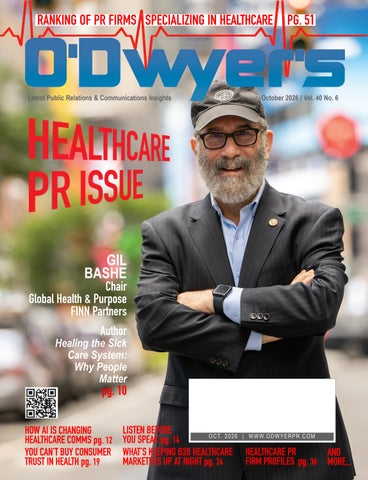
RANKING OF PR FIRMS SPECIALIZING IN HEALTHCARE
Latest Public Relations & Communications Insights
PG. 51
October 2026 | Vol. 40 No. 6
GIL BASHE Chair Global Health & Purpose FINN Partners Author
Healing the Sick Care System: Why People Matter
pg. 10 HOW AI IS CHANGING HEALTHCARE COMMS pg. 12 YOU CAN’T BUY CONSUMER TRUST IN HEALTH pg. 19
LISTEN BEFORE O C T. 2 0 2 6 | W W W. O D W Y E R P R . C O M YOU SPEAK pg. 14 WHAT’S KEEPING B2B HEALTHCARE HEALTHCARE PR AND FIRM PROFILES pg. 36 MORE... MARKETERS UP AT NIGHT pg. 24
CONTENTS October 2026 | Vol. 40 No. 6 MERCHANDISE SHOWS ITS POWER 8 BRANDED TAKE HIT DUE TO INFORMATION OVERLOAD 9 DOCTORS MUST OWN THE FRICTION IT CREATES 10 INNOVATION AI IS CHANGING HEALTHCARE COMMUNICATIONS 12 HOW THE GAP BETWEEN INTELLIGENCE AND INFLUENCE 14 BRIDGING PR, AWARDS EVIDENCE, NOT DECORATION 16 INAREHEALTHCARE A CREDIBILITY ECONOMY, MEDIA EARNS EVERYTHING 17 INEARNED REPUTATION BEYOND THE NEWSWIRE 18 BUILDING CAN’T BUY CONSUMER TRUST IN HEALTH — YOU HAVE TO EARN IT 19 YOU CURRENCY OF CONTEXT IN THE HEALTH INFORMATION ECONOMY 20 THE VELOCITY WILL DEFINE THE NEXT ERA OF HEALTHCARE COMMUNICATIONS 22 LEARNING KEEPING B2B HEALTHCARE MARKETERS UP AT NIGHT 24 WHAT’S THE AI STORYTELLING PLAYBOOK 26 REWRITING SCIENCE STORYTELLING ELEVATES ANNUAL MEETINGS 28 HOW IR AND CORPORATE COMMS IN THE AGE OF REAL-TIME DISCLOSURE 29 HEALTHCARE PR’S NEW HORIZON: SHOWING UP WHEN HEALTH QUESTIONS MATTER MOST 32 HEALTHCARE
10 On the cover: FINN Partners’ Gil Bashe HEALTHCARE PR ON PROFILES THE MOVE 55 PEOPLE 36 FIRM HEALTHCARE PR RANKINGS REPORT 56 WASHINGTON 51 FIRM THE INVISIBLE INFRASTRUCTURE EVERYDAY LIFE 52 SUPPORTING OF PR SPIN MATTER 53 CRITICS 57 INTERNATIONAL PR NEWS IN 58 ACCOUNTS 54 PRNEWSFIRM TRANSIT
2026 EDITORIAL CALENDAR
• Jan., Crisis Comms. & PR Buyer's Guide • Mar., Food & Beverage PR • May, PR Firm Rankings • Jul./Aug., Travel PR
• Sep., Financial PR/IR & Professional Svcs. PR • Oct., Healthcare PR • Nov., Technology PR & AI
WWW.ODWYERPR.COM
ADVERTISERS Bospar ........................................................................................ 23 Coyne PR ........................................................... Inside Front Cover Edelman .............................................................................. 30 & 31 FINN Partners ............................................................................... 5 G&S Integrated Marketing Comms. Group ................... Back Cover Healing the Sick Care System Book ......................................... 15 Highwire .............................................................................,,,....... 7 ICR .............................................................................................. 27
JPA Health .................................................................................. 25 Padilla ........................................................................................... 3 PAN ............................................................................................. 33 PCI ................................................................................................. 8 TASC Group, The ....................................................................... 13 V2 Communications .................................................................... 9 Waterhouse Brands ................................................................... 21
Statement of Ownership, Management & Circulation as required by U.S. Postal Service Form 3526-R. 1. & 13. Publication Title: O’Dwyer’s. 2. Publication ISSN#: 1931-8316 3. Filing Date: Sept. 22, 2026. 4. & 5. Frequency of issue/Number of issues: Bi-monthly/7. 6. Subscription price is $60 annually. 7. & 8. Mailing address of publication and general business office is 271 Madison Ave., #500, New York, NY 10016. 9. Publisher & Editor (John O’Dwyer) is at 271 Madison Ave., #1500, New York, NY 10016. Stockholders: John O’Dwyer and Christine O’Dwyer, 271 Madison Ave., #1500, New York, NY 10016. 11. There are no holders of bonds, mortgages or other securities. 14. Issue date for circulation data to follow is Oct. 2026. A-I: Extent and nature of circulation: A. Average No. of copies each issue during preceding 12 months: 790. Actual No. of copies of Jul. 2026 issue: 845. C. Average paid and/or requested circulation during preceding 12 months: 441. Actual paid and/or requested circulation for Jul. 2026 issue: 437. E: Average total non-requested distribution by mail and outside the mail for preceding 12 months: 349. Actual non-requested distribution by the mail and outside the mail for Jul. 2026 issue: 411. F: Total average distribution for preceding 12 months: 790. Actual distribution of Jul. 2026 issue: 845. G: Average number of copies not distributed preceding 12 months: 50. Actual number of copies of Jul. 2026 issue not distributed: 50. H: Average of total distribution and copies not distributed for preceding 12 months: 890. Sum of total Jul. 2026 issue distributed and not distributed: 895. I: Average percent paid and/or requested circulation for preceding 12 months: 55.8%. Actual percent paid and/or requested circulation for Jul. 2026 issue: 51.3%. I certify that all information furnished above is true and complete. John O’Dwyer, President, J.R. O’Dwyer Co.
LETTER FROM THE PUBLISHER
F
riction. No one wants that in their lives. We want things to go smoothly. There’s a new high-tech theater near me where the parking situation can be trying. Adversity is a good thing, but not when you’re just trying to park before a movie. Instead of simply getting a ticket on the way in and paying on the way out, you have to go inside the theater to scan the QR code which takes you to a web page where you key in your license plate number (how many of you know your plate # by heart?), give your phone number (what is this, Radio Shack?), email, credit card info (including the little 3-digit code which is worn to the point of almost being illegible on my card) and then finally input the correct promo code so the parking is free. Friction. Gil Bashe, Chair Global Health & Purpose at FINN Partners and author of Healing the Sick Care System: Why People Matter, writes about friction in the healthcare space in his article starting on pg. 10. Bashe’s thesis is that the incredible medicines, devices and technologies being created to accelerate research, diagnose disease earlier, improve treatment and reduce administrative costs, and most importantly, help people better understand and manage their health, often end up adding more work for everyone involved. This friction has a human toll, Bashe stresses. Physicians lose time defending necessary care, nurses barely glance away from their laptops to look at the patients sitting in front of them, and office teams are caught up in missing information on forms, denials and disconnected systems, he explains. And the most critical result of this friction is distrust in the system. This is where communicators come in, writes Bashe. They should be part of the adoption of any new treatment or technology so they can bring patient and clinician experience into the planning, For Bashe, they key is to identify where friction may emerge and help leaders get out in front before user frustration bubbles over into distrust. The result is a deeper understanding of the patient as a source of insight, influence and accountability, Bashe writes. When healthcare companies connect technological advancements and scientific promise to the patient’s lived experience, their innovations graduate from process to confidence and a stronger reputation, Bashe concludes. The next time I’m parking at my favorite new movie theater, I’m going to click the option on the parking app to save my info. Less friction!
- John O’Dwyer 6
OCTOBER 2026
EDITOR-IN-CHIEF Kevin McCauley kevin@odwyerpr.com PUBLISHER John O’Dwyer john@odwyerpr.com SENIOR EDITOR Steve Barnes steve@odwyerpr.com CONTRIBUTING EDITORS Fraser Seitel EDITORIAL ASSISTANTS & RESEARCH Jane Landers Christine O’Dwyer Melissa Werbell ADVERTISING: John O’Dwyer john@odwyerpr.com O’Dwyer’s is published seven times a year for $60.00 ($7.00 a single issue) by the: J.R. O’Dwyer Co., Inc. 271 Madison Ave., #1500 New York, NY 10016. (212) 679-2471 © Copyright 2026 J.R. O’Dwyer Co., Inc. OTHER PUBLICATIONS: O’Dwyer’s website - www.odwyerpr.com Breaking news, commentary, useful databases and more. Online since 1998. O’Dwyer’s Newsletter Jack O’Dwyer’s groundbreaking weekly newsletter started in 1968 continues today giving readers the inside news of public relations and marketing communications. O’Dwyer’s Directory of PR Firms Clients find it easy to shop for PR firms in this directory, published annually since 1970. The 2026 edition contains listings of firms in the U.S. and abroad. The directory's exclusive cross-client index is the only place where you can look up a company and determine its outside PR counsel. O’Dwyer’s PR Buyer’s Guide Products and services for the PR industry in 50 categories printed as part of O’Dwyer’s magazine each January.
REPORT
Branded Merchandise Shows Its Power
Americans spent more than $174 billion on branded merchandise in 2025, according to a newly released study from Promotional Products Association International—accounting for 51 percent of global spending in the industry. By Steve Barnes, Senior Editor
A
mericans spent more than $174 billion on branded merchandise in 2025, according to a newly released study from Promotional Products Association International. That accounts for 51 percent of global spending in the industry, supporting $170.2 billion in U.S. GDP (approximately 0.6 percent). About $50 billion of that total was spent on promotional products and $124 billion on licensed merchandise. Branded merchandise also supported 1.2
8
million American jobs and generated $37 billion in tax revenues—enough to fund the entire 2025 budget of the state of Georgia. It also accounted for a considerable portion of U.S. ad spending. Traditional promotional-product spending alone was equivalent to roughly 13 percent of estimated U.S. advertising spending last year. Conducted by independent global advisory firm Oxford Economics, PPAI’s Branded Merchandise Global Market
OCTOBER 2026
Report measured every aspect of the industry, from manufacturing and decoration to distribution, retail, e-commerce, fulfillment, marketing and brand activation. Those measurements looked at three channels of economic impact: direct impact (economic activity generated by the companies that manufacture, source, decorate, distribute and deliver branded merchandise); indirect impact (economic activity generated throughout the industry's supply chain as businesses purchase materials, packaging, logistics, technology, equipment and other goods and services); and induced impact (economic activity generated when people employed by the branded merchandise industry and its suppliers spend their wages throughout the broader economy). While the U.S. is far and away the biggest player in the branded merchandize marketplace, the industry has a strong impact around the globe. $338.3 billion was spent on branded merchandise globally in 2025—$108.6 billion in promotional products and $229.7 billion in licensed merchandize. Branded merchandize also supported $472.3 billion in global GDP, equivalent to around $1 out of every $250 of economic output. That helped to support 11.9 million jobs worldwide, including 4.1 million directly within the industry. The study’s results revealed that the branded merchandise industry has a global GDP multiplier of 2.95, meaning that for every $1 million in GDP generated directly by the industry, an additional $1.95 million was supported elsewhere in the global economy. The growth of the industry comes along with an expansion of the category beyond traditional promotional products. Licensed merchandise, apparel and workwear, retail-branded goods, creator merchandise, print-on-demand and e-commerce products, recognition gifts and merchandise used in marketing, events and brand activations all are under the branded merchandize umbrella. What unites them, the study says, is their role as tangible expressions of a brand. “Branded merchandise is deeply woven into the U.S. economy and the way American organizations connect with employees and customers,” said PPAI president and CEO Drew Holmgreen. “This research shows the scale behind those connections.” O
REPORT
Doctors Take Hit Due to Information Overload
In a healthcare environment suffering from what often seems like too much information, doctors have become just one item on a menu of patient choices—and not always the most significant one, according to a new study from Edelman and the Yale School of Public Health. By Steve Barnes Senior Editor
I
n a healthcare environment suffering from what often seems like too much information, doctors have become just one item on a menu of patient choices—and not always the most significant one. That’s the conclusion of the 2026 Edelman Trust Barometer Special Analysis: Health Decisions in the Age of Information Overload, a collaboration between Edelman and the Yale School of Public Health that examines how people navigate competing advice from doctors, friends, creators, AI and other sources — and what that means for health communicators trying to reach them. It surveyed about 13,000 people in 13 counties to find out which sources healthcare consumers trust, as well as what it takes to win that trust. The balance of trust between HCPs and uncredentialed sources (including artificial intelligence, creators without medical
training, friends/family and people with similar conditions) seems to vary with the stage of the medical journey. In terms of diagnosing a problem, HCPs still have the upper hand, with 50 percent saying an HCP would be likely to influence their personal health decisions, while uncredentialed sources would only influence 27 percent. However, when it comes to such issues as diet & nutrition or wellness & longevity, the uncredentialed sources gain the advantage, with a lead of eight percent and nine percent respectively. When there is a conflict between an HCP’s advice and that from other sources, HCPs score surprisingly low. Globally, only about half (51 percent) agree that “when I have gotten conflicting health recommendations from doctors and other sources, I always did what the doctor recommended.”
In many countries, including the U.S, the power of HCPs on personal health decisions is even less. Only 37 percent in the U.S. said they always take their doctor’s advice when there is conflict, and the situation is not much better in Australia (40 percent) or Canada (45 percent). Then there’s the power of AI. Nearly half of respondents (49 percent) globally believe someone without medical training who is fluent with AI can perform at least one health-related task as well as or better than a doctor, rising to 59 percent among 18–34-year-olds. So what can communicators do to adapt to the shifting definitions of trust as regards healthcare? For one thing, they need to understand that credibility and authority alone are no longer enough to guarantee influence. The findings point to a trust-building model rooted in listening first, demonstrating relevance, using accessible language, building a credible presence in communities and approaching any disagreements about information or treatment options with humility and openness rather than persuasion alone. The Edelman/Yale study was conducted between February 28 and March 16. O
OCTOBER 2026
9
FEATURE
Innovation Must Own the Friction It Creates A breakthrough is not successful merely because it works. It succeeds when people and health systems can actually use it. By Gil Bashe
H
ealth does not suffer from a shortage of ideas. Every day, scientists, engineers, clinicians and entrepreneurs create medicines, devices and technologies intended to diagnose disease earlier, guide treatment, accelerate research, reduce administrative costs and help people better understand and manage their health. The commitment is extraordinary. The science is astounding. Yet an uncomfortable question remains: Why do so many worthwhile innovations add work for Gil Bashe patients, physicians, nurses and care teams rather than ease their burden? A platform promises to save physicians time but shifts attention from patients to the screen. A device provides valuable data but also generates more alerts for nurses to silence. A patient tool promises access but adds another portal and password. A new medicine secures approval; however, patients and clinicians must still navigate coverage. Innovation may meet the clinical challenge, but the people surrounding it inherit the friction. Friction has a human toll. Patients face delays and repeat their stories. Physicians lose time defending necessary care. Nurses spend more time with screens and less with patients. Office teams manage callbacks, missing information, denials and disconnected systems. For pharmaceutical and medical device companies, this is more than an operational issue. It shapes communication, adoption and reputation. The experience surrounding an innovation becomes inseparable from the product itself. A company should receive societal recognition for confronting disease, yet friction can quickly turn applause into criticism. The Lesson Behind “Buy Now” Amazon’s “Buy Now” experience established a baseline expectation. The lesson is not that medicine should imitate retail, but that Amazon studied the entire journey from consumer intention to completed action and removed friction at every step. Product strategist Mudra Rastogi traces the idea to the late 1990s, when 10
each cart, form and payment screen gave consumers another reason to abandon a purchase. Amazon’s 1-Click feature, patented in 1997 and introduced in 1999, removed those barriers by remembering payment and delivery details. Rastogi’s larger point is that Amazon did more than speed checkout. It built confidence, habit and trust by reducing cognitive load. That principle matters in health. People can bank, travel, communicate and shop through clear digital pathways. Then they enter health care and confront forms, referrals, prior authorizations, hold times and repeated requests for the same information. They navigate these requirements while frightened about a diagnosis, worried about a family member or uncertain whether they can afford care. The system behaves as though the patient has all the time in the world to help manage its workload. Clinical judgment requires deliberation. Evidence must be reviewed. Privacy must be protected. Safety cannot be sacrificed for speed. Yet essential rigor should not become an excuse for unnecessary burden. Patients do not experience the regulatory rationale behind each requirement. They experience the cumulative weight of the process. Too often, innovation exhausts the very people it is meant to help. FDA Approval Is a Milestone, Not the Patient Journey The words FDA Approves New Therapy carry enormous meaning. They represent years of scientific exploration, investment, regulatory persistence and hope. For researchers and companies, the announcement marks a hard-earned achievement. For patients and families, it signals that a new possibility may finally be within reach. However, approval is not the finish line. It is the beginning of another journey. Leqembi, for people with mild cognitive impairment or mild dementia due to Alzheimer’s disease, illustrates how the treatment journey evolves with innovation. It initially required intravenous infusions every two weeks in a clinical setting, along with confirmation of amyloid pathology, safety screening and close monitoring for amyloid-related imaging abnormalities. FDA has now approved the therapy as an injectable that patients may administer at home themselves or with help from a caregiver.
OCTOBER 2026
This commitment to clinical progress reduces travel and infusion-center visits. It also shifts more responsibility to the patient, caregiver, physician and company to make the treatment process clear, safe and supported. CASGEVY offers another example of owning the journey. The one-time gene therapy infusion requires evaluation, stem-cell collection, conditioning chemotherapy, treatment and recovery at an authorized center. Vertex helps patients understand each stage, find treatment sites and connect with care managers who support education, logistics and access, including eligible travel and lodging assistance. This is what it means to own the friction surrounding innovation. It does not mean that every obstacle disappears or that a company has any influence over coverage decisions, hospital processes or personal circumstances. It means the company has taken the time to understand the experience beyond the scientific and clinical touchpoints. It has anticipated where people may feel uncertain, overwhelmed or alone and created pathways that help them navigate with greater clarity and confidence. Most pharmaceutical companies do this work well. The opportunity is to make this level of journey ownership the expectation for every medicine. Each regulatory milestone creates a new experience and communication must accompany the patient from preapproval through access, treatment, and ongoing support. This is not an extension of the launch plan. It is the “rubber meets the road” moment when the industry’s promise becomes part of the care process. When companies help people understand what comes next, navigate complexity and feel supported, they do more than advance adoption. They recognize that the journey evolves, both emotionally and structurally. Needs change, responsibilities shift and new points of friction emerge. Companies build trust and reputation by anticipating those changes and continuing to support people as the realities of care unfold. Medical Devices Carry a Life-Cycle Responsibility Medical device companies face the same obligation. A connected device does not finish its journey when it clears regulatory review, ships to the hospital
FEATURE or produces its first reading. It must fit within clinical workflow, connect securely, perform as intended for the patient population it serves, and provide continuous support. Pulse oximeters offer a sobering example. The devices became everyday symbols of monitoring during the COVID-19 pandemic, yet evidence showed that performance could differ across skin pigmentation. FDA subsequently proposed updated testing and labeling recommendations intended to improve accuracy across skin tones. The lesson is broader than a single device category: the endpoint cannot be defined simply as “the device generated a number.” The meaningful endpoint is whether that number can be trusted. Cybersecurity creates another touchpoint cascade. FDA current guidance addresses cybersecurity in device design, labeling and premarket submissions, while Federal requirements call for manufacturers of connected devices to maintain processes for updates, patches and software transparency. That means the product journey includes the hospital chief information security officer, biomedical engineering, IT integration, vulnerability disclosure, patch deployment, user communication and eventual device retirement. A technically brilliant device or digital solution that leaves a care team guessing about data flows, software updates, cybersecurity, training or downtime is not frictionless innovation. It is unfinished implementation. From Messages to Touchpoint Stewardship This is where communicators must strengthen conventional product support plans. The task is no longer simply to develop messages for audiences. It is about understanding the customer at every possible touchpoint: what people need to know, what they must do next, what may stop them, and who owns the answer when access differs by payer, hospital, geography, or site of care. That understanding has become more urgent. A few strokes on a keyboard can now unite a patient community, expose a recurring obstacle and turn private frustration into public pressure. Matthew Zachary’s We the Patients reflects this shift, giving voice to people who are no longer willing to suffer the system quietly. Communicators should be part of the adoption conversation from the start. They can bring patient and clinician experience into planning, identify where friction may emerge and help
leaders respond before frustration hardens into distrust. This is a deeper layer of customer understanding, one that recognizes patient voice as a source of insight, influence and accountability. Every communication and marketing plan should include a friction map alongside the stakeholder map, tracing the innovation from peer-reviewed evidence and regulatory decisions through coverage, budgeting, procurement, cybersecurity, clinical workflow, patient onboarding, adherence, support and long-term use. At each stage, leaders should ask what new step has been created, whose time it consumes and what existing task it replaces. They must consider what information may be missing or misun-
derstood, who owns the handoff when something goes wrong and how the organization will detect friction before it becomes distrust. This is not promotion. It is customer stewardship. Productive friction occurs when clinicians, patients, engineers, operators, access teams, investors and communicators challenge an idea early. It reveals blind spots and strengthens the solution. Destructive friction appears when those conversations occur after the product has been designed and the market is expected to shoulder the burden of implementation. From “Not My Problem” to Shared Ownership In Healing the Sick Care System: Why People Matter, I describe a health system rich in scientific brilliance and technological potential, yet constrained by structures that have calcified around that progress. Complexity too often
overwhelms clarity. Stakeholders talk past one another and the people we seek to serve are too often left carrying the burden. Policies and financial bumper guards alone will not repair this problem. No reimbursement formula can manufacture empathy. No artificial intelligence platform can compensate for the absence of leadership and governance. Technology should augment human expertise and expand our capacity to care. It cannot become an opt-out clause for responsibility. Health innovators must accept a broader definition of success. The science must work. The evidence must hold. The economics must be sustainable. The data must be trusted. The system must be secure. The workflow must be realistic. Access must be understandable. The people expected to use the innovation must understand how it improves their work and their lives. That broader definition of success asks more of product innovation companies, yet it also creates greater value. When companies reduce friction, they strengthen relationships. When they anticipate access barriers, they demonstrate that they understand the people's needs. When leaders connect scientific promise to lived experience, innovation moves beyond process and into confidence and a stronger reputation. There is a 19th-century adage: “If you can break it, you can fix it.” We built these steps. We are the architects of these processes. We accepted these silos. We can examine them, challenge them and remove what no longer serves its purpose. It requires empathy, collaboration and courage. This is not a choice between head and heart, organizational interest and personal experience, commercial success and human satisfaction. The strongest innovations bring them together. They create value for the company by fostering confidence in the clinician, clarity for the patient, and a smoother path through the health system. That is the deeper lesson of “Buy Now.” Health innovation earns the same confidence when companies take responsibility for every touchpoint between breakthrough and benefit. Those experiences shape the relationship, and the relationship shapes reputation. That is how invention becomes adoption, adoption becomes confidence and confidence becomes lasting value. Gil Bashe is Managing Partner, Chair Global Health and Purpose at FINN Partners. O
OCTOBER 2026
11
FEATURE
The New Information Ecosystem: How AI Is Changing Healthcare Communications AI has increasingly become the first place patients, caregivers and HCPs go to for answers to health-related questions. This fundamentally changes the role of healthcare communications. By Kristin Ryan
H
ealthcare communicators have always had one primary objective: help people understand complex science well enough to make informed decisions. That mission isn’t changing. What is changing is where understanding begins. Increasingly, the first explanation a patient, caregiver, healthcare professional (HCP), investor or policymaker receives Kristin Ryan about a disease, therapy or healthcare company doesn't come from a corporate website, a journalist or even a traditional search engine. It comes from an artificial intelligence (AI)-generated response that synthesizes information from scientific publications, news coverage, corporate websites, expert commentary and other publicly available sources before presenting it as a single narrative. This collective body of information, the healthcare information ecosystem, is becoming the foundation from which AI generates answers. Instead of simply directing people to content, AI interprets and explains information before audiences ever engage directly with an organization. This fundamentally changes the role of healthcare communications. AI has become an active participant in how healthcare information is understood. Every major shift in communications has introduced a new way to distribute information: social media changed publishing, search changed discovery and AI is changing interpretation. For healthcare communicators, the challenge now is how to help shape the broader information ecosystem from which AI learns. As AI increasingly influences how science and data are interpreted, the quality, consistency and credibility of that ecosystem become just as important as any individual communication. The information ecosystem has become a strategic asset For healthcare, this distinction is incredibly important. AI determines whether your information is found and 12
influences how your science, data and reputation are understood. That’s why communicators need to focus less on optimizing individual channels and more on strengthening the entire information ecosystem. For decades, communications strategies have focused on engagement: earning media coverage, driving website traffic, creating compelling content and facilitating conversations with stakeholders. Today, audiences often arrive with an initial understanding formed through AI. Whether someone is researching a disease, comparing treatment options, exploring a company’s pipeline or preparing for a discussion with an HCP, AI-generated summaries provide the first layer of context. Those summaries influence what questions people ask, what information they trust and how they interpret everything that follows. That doesn’t replace trusted HCPs or authoritative scientific sources, but it does mean organizations have less control over where understanding begins. Communicators must now plan for the pre-engagement journey. Consistency matters more than ever In this environment, consistency is key. Large language models (LLMs) don't evaluate information the way people do; they identify patterns across many sources. When an organization’s science and key messages are consistently reinforced across owned channels, earned media, scientific publications, medical education, expert voices and credible third-party organizations, AI is more likely to generate responses that accurately reflect those patterns. When those signals are fragmented or inconsistent, AI fills the gaps with generalized explanations or category-level assumptions. That can dilute scientific differentiation, obscure innovation or reduce complex stories to broad industry narratives. This is why marketing communications can no longer operate in functional silos. Medical affairs, corporate affairs, investor relations, digital, commercial and communications teams are all contributing to the same information ecosystem. The more aligned those functions become, the stronger the
OCTOBER 2026
foundation AI must build for accurate understanding. Consistency is becoming a strategic advantage. Reputation management must evolve Healthcare reputation has traditionally been measured through media coverage, stakeholder relationships, search visibility and social conversation. Those disciplines remain essential, but AI introduces another important dimension. Organizations should understand where they are mentioned and how AI characterizes their company, scientific expertise, disease knowledge and therapeutic leadership. Are important differentiators preserved? Is scientific evidence represented accurately? Does the narrative reflect the organization’s intended positioning? Monitoring AI-generated responses shouldn’t replace traditional reputation management, but it should become another indicator of whether the broader communications ecosystem is working effectively. If AI shapes first impressions, then understanding those impressions is essential to protecting reputation. The role of earned media While how users search may be changing, the importance of traditional media and communication remains as strong as ever. The information ecosystem is still vast and full of varied information. Even for an experienced professional, it can be difficult to find trustworthy insights and answers. As a result, many users turn to sources with a strong reputation for honesty and expertise. Inclusion in a trusted publication or outlet helps to reassure audiences that the claims being made are reliable. If an organization’s statements are validated by outlets with high fact-checking standards or influencers with good reputations, this becomes a key signal of authority and credibility. By maintaining a strong earned media presence, organizations build strong relationships in their industry. They also help to shape the content that is published, which in turn influences the questions that end users ask online in the future. However, not all earned media directly influences the answers AI provides. As more publications adopt paywalls, AI
FEATURE may not be able to draw from all sources when formulating answers. In these cases, organizations should consider whether vital information or answers are featured elsewhere. This could include owned content such as explainers featured on AI-readable channels. Increasingly, AI answer engines are launching personalized search experience features, such as Google’s “Preferred Sources.” This feature allows users to customize their Discover feed by describing what they want to see in a chatbot-style interface. The tool interprets preferences, confirms them, and adjusts the feed accordingly. Google is also adding personalized daily audio briefings in Google News on Android and making it easier for publishers to offer “Preferred Sources” buttons directly on their sites. This update allows publishers to place an interactive button on their own sites so readers can quickly add them as a preferred source. That selection can influence how
favorite outlets appear across Top Stories, AI Overviews, and AI Mode. Understanding your audiences preferences will continue to be critical for earned media selection and prioritization. When partnering with outlets and influencers, organizations should also consider the partner’s reputation and the context the audience is likely to infer from it. In these cases, validating credibility and trust is more valuable than choosing the outlet that promises the most extensive amplification. Building an AI-ready communications strategy The good news is that healthcare organizations don’t need an entirely new communications strategy, just a broader one. Organizations that will succeed will strengthen the quality, consistency and credibility of the information ecosystem that supports every communication effort. That means maintaining clear, evidence-based owned content that explains complex science in accessible ways. It means
continuing to invest in high-quality earned media that reinforces credibility and reaches trusted audiences. It means partnering with respected experts, HCPs and patient advocates whose perspectives add important context. And it means routinely evaluating how AI platforms describe your organization, your science and your therapeutic areas so marketing communications teams can identify gaps before they become misconceptions. AI answers reflect the information environment we build. Healthcare communications have always been about helping people make sense of complex science. The organizations that will lead in this next era will be the ones building the strongest information ecosystems, where credible science, trusted expertise and consistent communications work together to ensure accurate, evidence-based information is what both people and AI find, interpret and share. Kristin Ryan is EVP, AI Transformation & Acceleration at Inizio Evoke. O
OCTOBER 2026
13
FEATURE
Listen Before You Speak: Bridging the Gap Between Intelligence and Influence
To increase the influence of health-related social media content, communicators need to change the focus from influencers to the audiences they are trying to reach. By Ryan O’Grady
F
or years, healthcare organizations have looked at social media as a series of promotional channels. We deployed handles, developed content calendars, optimized formats, and debated whether the next campaign should be on Meta, TikTok, LinkedIn, or an up-andcoming platform. Then came influencer marketing, a “new” tactic that would help health communications feel more human, credible, and culturally relevant. Since that time, influencer has Ryan O’Grady marketing grown increasingly sophisticated and calculates metrics well beyond followers, views and engagement. But perhaps we have been looking at this backwards. In the health ecosystem, the next opportunity lies in understanding the different forms of credibility and influence that shape deeply personal health conversations. We must uncover who has the power to shape a conversation…and why. Social media should be more than a place to distribute content. The conversations taking place can provide intelligence that shapes earned media, executive thought leadership, advocacy and public affairs outreach. There is a social media evolution upon us. One where it is leveraged as a source of intelligence: a map of communities, conversations, trust and influence that can fundamentally change how healthcare organizations approach communications. By looking at these platforms as an intelligence source, we realize that the people with the greatest impact do not always correspond to those with the greatest reach. For example, a physician can provide clinical credibility. A patient can bring a shared experience to life. A caregiver can articulate questions that others are afraid to ask. A community leader can influence behavior on behalf of a population that might otherwise go unrecognized. All of these forms of influence matter, but they matter for different reasons. The question shouldn’t be, “Who can reach this audience?” but rather, “Who does this audience listen to when the stakes are high?” The most influential person in a health conversation may not even be trying to be influential. 14
How can we harness social intelligence to better inform our decision making? Do not start with an influencer in mind There is a subtle but critical flaw in the way that influencer marketing is often approached. We start with the person. We search for creators who appear relevant, assess their audience, review their content, and then determine how they might fit into a campaign. We also often assume this person will solely be leveraged for social media purposes. If we employ proper social intelligence, the process should be turned on its head. Instead, start the search with the conversation in mind: What are patients discussing amongst themselves? Which concerns generate emotion or disagreement? Which accounts are consistently tagged when someone needs advice? Who is translating complex science? Who is building connections? Suddenly, the influencer list looks very different, and we realize there may be legs for these partnerships beyond social media. Most importantly, the organization has learned something about its target audience before the activation even begins. Follow the trail to trusted voices Trust is often treated as something qualitative and difficult to measure, but social media behavior can help bridge that gap. People display signals of trust on social media by the content they share, whose advice they challenge, and to whom they return when they have questions. These communities of conversation develop their own hierarchies of credibility that can tell us something that follower counts cannot. They can underscore where trust may reside. That distinction matters because health decisions are rarely made impulsively. They often involve uncertainty, anxiety, stigma, cost implications, complex clinical information, and profoundly personal experiences. When people are making consequential decisions, they don't necessarily want to hear the loudest voice. They want to hear the voice they believe understands them. Influence can come in many shapes Perhaps the key to an impactful communications strategy is recognizing that different types of authority can coexist within the same community. A physician might own scientific credibility. A patient might own the lived experience. A caregiver might own relatability. A community organization
OCTOBER 2026
might own admiration. While a social media conversation can never reflect every person’s experience, it shines a light on the topics and people that carry weight. The opportunity is to map those different forms of influence, understand how they interact, and identify which communication objectives they could support. Who starts the conversation and who validates it? Who makes the complex information easier to understand and who challenges it? Who ultimately moves people to act? Once we ask those questions, influencer marketing begins to look less like a tactic and more like a human bridge. Use social intelligence to shape the strategy Instead of asking social teams to translate an existing strategy into platform content, organizations should use social intelligence data to help shape the strategy itself. Leverage this data to understand how patients talk about a condition, the questions for which audiences cannot find answers, and the communities that are already recognized as credible. This will help an organization gain insight into its target audience, which can then be woven into broader communications plans. Perhaps social listening uncovers a unique voice that doesn’t have the largest following. Still, they have that intangible spark that would make them a beautiful fit for the company’s next media tour or a speaking opportunity to support the brand. Social media brings outside-in thinking into the communications strategy, revealing the conversations, needs and credible voices that can shape everything from earned media and executive thought leadership to advocacy and public affairs outreach. Listen before you speak The future of health influence will belong to organizations that understand the social systems around their audiences well enough to know where credibility already exists, and that have the humility and strategic discipline to work within those ecosystems rather than simply broadcast to them. That is the power of social intelligence. It reveals what communities believe, why those voices matter, and what organizations too often miss: meaningful influence begins by listening before speaking. Ryan O’Grady is Senior Partner, Global Health Social Media and Influencer Strategy Lead at FINN Partners. O
FEATURE
In Healthcare PR, Awards Are Evidence, Not Decoration The hard work that goes into an award-winning campaign can show potential clients how an agency has solved the difficult problems that have come their way. By Sarah Dray
A
t first glance, choosing a healthcare communications agency because it has won awards may sound superficial. Healthcare companies have serious goals: educate patients, earn the confidence of healthcare professionals, support product adoption, attract investors, influence policy and protect their reputations. A trophy cannot Sarah Dray accomplish any of those things. But the work behind the right award can. Healthcare communications has always required precision. Today, it also requires navigating a public conversation shaped by political division, institutional distrust and a constant stream of questionable health claims made by those who are considered, either by themselves or by others, as experts. Scientific evidence is no longer competing only with other research, viewpoints or the news. It is competing with influencers, algorithms and misinformation designed to provoke an emotional response. People feel that confusion. Half of Americans say it is difficult to determine whether the health information they encounter is accurate. When people find conflicting health information, 54% say it is difficult to know which to trust. At the same time, approximately three in 10 adults use social media or AI tools for health information at least monthly, but only 36% of those who seek health information through social media regularly verify it with a healthcare professional. If people do not understand or trust the information surrounding a treatment, technology or service, an innovation with the potential to improve lives may never reach the people it was created to help. That is why the agency-selection process matters and why credible industry recognition deserves consideration. Why healthcare companies need more than visibility Most agencies can promise impressions, placements and share of voice, but healthcare companies should expect more. They need communications partners that can understand the science before attempting to simplify it. They need teams that know how to make complicated information accessible without strip16
ping away important context or overstating what the evidence supports. They need people who can identify the human consequence behind a dataset, anticipate skepticism and understand that patients, care partners, healthcare professionals, policymakers and investors may each require a different entry point into the same story. Most importantly, they need communications that support an organizational goal. That goal may be encouraging patients to speak with a healthcare professional, helping a health system adopt a new technology, building understanding of an overlooked condition or giving investors confidence in a company’s path forward. The best awards recognize campaigns that connect those communications objectives to measurable results. In that sense, an award is not the goal. It is independent evidence that an agency has solved a difficult problem before. What award-winning healthcare work looks like At Bospar Health, our most recognized healthcare campaigns began with questions such as: Who needs this information? Why should they care? What might prevent them from believing it? And what action should follow? During the COVID-19 pandemic, Healthline sought to give the public credible, understandable answers at a moment of profound uncertainty. Bospar secured Dr. Anthony Fauci for a live virtual town hall and had a few days to organize and promote it. The program generated 146 media placements and more than 450,000 views, with coverage spanning CNN, Reuters, The New York Times, Forbes, Newsweek and other major outlets. The campaign received a Platinum MarCom Award. The campaign connected a trusted medical expert directly with people searching for reliable information during a public-health emergency. For Carta Healthcare, the challenge was different. The company’s AI technology was entering the conversation as public anxiety about AI was accelerating. Bospar needed to explain the technology’s value to healthcare systems without relying on hype or treating AI as the story by itself. We connected the issue to a real patient need: making essential health information available when and where it is required. We also shared the personal experience that led Carta CEO Matt Hollingsworth to pursue the company’s mission after his
OCTOBER 2026
mother’s battle with cancer. The campaign won PR Daily’s Media Relations Award in the Public Health category, while more than 60 Fox affiliates aired a segment featuring the issue. The broader work produced 1.66 billion in earnedmedia reach, supported a threefold increase in revenue and accompanied a 50% expansion of Carta’s healthcare client base. That is the kind of alignment healthcare companies should seek: scientific and technical understanding, a genuinely human story and measurable business impact. Bospar’s launch of Together by Renee offers another example. We translated the “wow” factor of an AI-enabled health app into stories about aging, caregiving, medication management and barriers to care. The campaign generated 230 earned-media placements and contributed to a 3,000% increase in downloads in one week, largely among adults 55 and older, an audience commonly considered difficult to reach with a mobile app. The work was subsequently named a PRWeek Healthcare Awards finalist for Best Healthcare Product Launch and received two PR Daily honorable mentions. For HRC Fertility, Bospar built an award-winning national advocacy campaign around original research showing that two-thirds of Americans consider the term “geriatric pregnancy” outdated and stigmatizing. Bospar translated the findings into physician-led storytelling and policy engagement supporting a formal resolution to, and adopted by, the California Medical Association. The campaign generated 164 media placements and 1.1 billion impressions and earned Platinum recognition at the 2026 Hermes Creative Awards. Different clients. Different audiences. Different objectives. The common thread was the ability to turn complex or sensitive healthcare subjects into accurate stories that people could understand and act on. Look beyond the trophy Not every award carries the same significance, and an impressive awards page should never replace proper agency due diligence. Healthcare leaders should examine what was recognized, who judged it and whether the campaign produced results relevant to their own goals. Was the agency rewarded for creativity alone, or did the work change behavior? Did it reach the intended audience? Did it _Continued on page 17
FEATURE
In a Credibility Economy, Earned Media Earns Everything
In a health landscape crowded with claims, brands earn trust by pairing credible proof with human stories, cultural relevance, and empowerment. By Julie Fleisher & Eric Reiss Taylor
Y
our audience has stopped taking your word for it. Buyers, patients, and policymakers increasingly look past what healthcare companies say about themselves and toward what independent voices say about them. They want to know what journalists, analysts, and increasingly, AI systems think about you. Nowhere is this more consequential than in healthcare. When the subject is a drug, a device, a care model, or a clinical protocol, the stakes Julie Fleisher of a misunderstood or misrepresented narrative aren't abstract. They affect real people making real decisions about their health. That's why earned media in healthcare carries weight that paid and owned channels simply can't replicate, and why the organizations that invest in building genuine media relationships consistently Eric Reiss outperform the ones that treat press coverage as a transaction. The difference between coverage and the right coverage Getting mentioned in the press and shaping how your story gets told are entirely different outcomes. A mention is a data point. Controlling the narrative is a communications strategy. Only one of those compounds over time. Building the kind of media relationships that produce meaningful coverage — the kind that actually shifts perception — requires something beyond a well-crafted pitch. It requires knowing which journalists are building expertise in your space, understanding what they need to do their jobs well, and showing up as a reliable source of insight before you ever need anything in return. Reporters remember the PR partners who brought them something genuinely useful. And they remember the ones who didn't. This is especially true at a moment when trust in media is fragile and journalists are operating under more pressure than ever. Newsrooms are
smaller, cycles are faster, and the burden of verification falls harder on fewer people. In that environment, a PR partner who can help a reporter get something right becomes not just a source, but an asset. What AI changes The rise of AI-generated answers adds another dimension to this dynamic. When someone searches for information about your organization, your competitors, or the clinical area you operate in, they're increasingly getting back a synthesized response rather than a list of links. That response is built from whatever credible sources the model found. In this context, credible means independently verified, widely cited, and consistent across multiple authoritative outlets. Organizations with strong earned media coverage show up differently in that environment than organizations that have relied primarily on owned and paid channels. Coverage in trusted publications becomes training data. The narrative that appears consistently across credible sources becomes the narrative the model repeats. This is the new argument for media relations. The real value of a PR partner A good story alone won't move the needle anymore, especially in a regulated industry like healthcare. It takes discipline: real relationships with journalists, a sharp read on which narratives will land, and the credibility to pitch something a reporter can actually use. The best PR partners don't just secure coverage — they broker something genuinely worthwhile for both sides, helping clients tell their story and helping journalists do their jobs better. At Highwire, we lean on tools like AI Index, AcroIntelligence, and AcroAI to stay ahead of media trends, track competitive moves, understand what journalists actually want, and see how visibility is playing out in AI search. But none of that intelligence means anything on its own. What makes the difference is our people. They take that data and turn it into strategy, into stories journalists genuinely want to tell, into relationships that open doors nobody else can open. And they keep adjusting as the conversation shifts, because it always does. That's how we help our clients stay ahead of the curve, understand exactly how they're showing up in the market, and get better results in real time.
Put it all together, and it's easy to see why this kind of content earns the attention it deserves, from editors, from the AI tools surfacing information, and from the headlines that keep resonating long after publication day. Julie Fleisher is Senior Vice President at Highwire Health. Eric Reiss is Vice President at Highwire Health. O IN HEALTHCARE PR, AWARDS ARE EVIDENCE, NOT DECORATION _Continued from page 16 strengthen credibility, support growth or advance an important healthcare conversation? Can the agency explain the strategy behind the outcome, and will the people who created that work actually be involved in the account? Consistency also matters. Bospar has earned 270 awards and industry recognitions since it began formally tracking them in 2017. In 2026, PRovoke Media ranked Bospar the number-one U.S. agency “pound-for-pound” for the third time, based on performance across more than 35 awards programs relative to agency size. Bospar also won PRSA’s 2026 Silver Anvil for Best Small Agency, appeared on the MM&M Agency 100 and was the only PR agency named to Fortune’s list of America’s Most Innovative Companies for the third consecutive year. For prospective healthcare clients, those honors provide multiple forms of validation: creative strength, innovation, operational performance and demonstrated healthcare experience. Healthcare companies cannot control every political debate, viral claim or algorithm shaping how people encounter health information. They can control the expertise they place behind their communications. Choosing an award-winning agency will not automatically create trust. Choosing one whose awards demonstrate scientific fluency, creative problem-solving and measurable results gives a healthcare company a stronger partner in earning it. At Bospar Health, that is what “award-winning” means: not collecting trophies, but creating work that helps credible healthcare stories break through and supports the companies behind them accomplish what they set out to do. Sarah Dray is Senior Director, Healthcare Strategy & Medical Communications at Bospar. O
OCTOBER 2026
17
FEATURE
Building Reputation Beyond the Newswire AI does not simply retrieve the story a company publishes. It assembles the story others can substantiate.
L
ByTerri Clevenger
ike many of my colleagues, I read Gartner's 2026 CCO Spend Survey and watched the industry celebrate. The emerging interpretation was that earned media budgets would double by 2027 because AI search relies on thirdparty sources. That conclusion is convenient. It is also too tactical. Media relations matters, perhaps more than it has in years. But the answer is not simply more pitching or placements. AI is exposing something more consequential: the Terri Clevenger distance between the story a company distributes and the reputation its actions have earned. For years, healthcare companies built the public record one announcement at a time, controlling the message and timing. Generative AI disrupts that control. It draws from journalism, scientific literature, regulatory documents, patient groups, social platforms and employee commentary. It encounters not one corporate narrative, but a body of evidence. AI is reading a much broader record Muck Rack's May 2026 analysis of more than 25 million links cited by generative AI found that 99 percent came from nonpaid sources. About 84 percent fell within its broad definition of earned media, while press releases accounted for just 1.1 percent. Journalism represented about 27 percent. The rest included academic, government, nonprofit, reference and social sources. That matters, especially in healthcare. An AI-generated answer may draw from a peer-reviewed journal, FDA document, analyst commentary, patient organization, physician interview, conference presentation or employee's LinkedIn post. Companies have less control over which pieces surface and how they are combined. Press releases still have an essential role. They provide a precise, compliant account of a financing, clinical milestone or regulatory decision. But a company announcement is a first-party assertion. It cannot corroborate itself. Corroboration comes from scientific scrutiny, regulatory action, stakeholder experience, independent reporting and the company's conduct over time. When 18
those sources reinforce the corporate story, they create credibility. When they contradict it, no volume of content can close the gap. AI simply makes the record easier to assemble and harder to ignore. Reputation begins before the story is told Consider a typical precommercial biotech. It regularly announces clinical progress, conference presentations, financings and corporate milestones. Those releases are republished across financial platforms, creating an extensive searchable record. Volume is not credibility. The record may show activity while revealing little about why the science matters, whose needs informed it or whether knowledgeable stakeholders believe in its potential. The company has documented progress without necessarily creating reputational pull. Dyne Therapeutics offers a different model. Beyond releases and investor presentations, one meaningful part of its record began before any announcement: patient input helped shape its DELIVER and ACHIEVE clinical trials. That engagement informed the work and was later documented in a peerreviewed journal. Scientific presentations, disease-community engagement, physician commentary and independent coverage added perspectives, showing science informed by patients and subjected to expert scrutiny. The release announced the progress. The broader record established what that progress meant and why others should believe it. Visibility is not validation Media remains essential because independent reporting adds context, scrutiny and credibility. But the question is no longer simply, "Where can we get covered?" It is, "What does the business need people to understand, what evidence supports it and who has the authority to validate it?" The answer will not always be the largest outlet. A deeply reported trade story may do more reputational work than a passing national mention. A scientific publication, physician perspective, patient organization or regulatory document may carry even greater authority. A credible source can influence the record long after publication. Media relations must therefore do more than generate visibility; it should help journalists examine and contextualize what the company wants to be known for.
OCTOBER 2026
One company, one story, many credible voices A broader body of evidence is valuable only if it adds up. Companies need a central narrative that can travel across channels and stakeholders without losing its meaning. Coherence does not mean sameness. A scientist should not sound like an investor presentation, nor a patient advocate like the corporate website. Each should speak from experience and expertise. When every voice repeats identical language, validation begins to feel orchestrated. Scientific publications, advocacy, investor relations, executive visibility, employees, owned content, social media and earned coverage contribute different evidence. None can build reputation alone. Each should illuminate and reinforce the larger story. Employees matter because their decisions and behavior create the experiences on which others judge the company. Narrative alignment must begin inside the organization, where strategy, culture and behavior give people something consistent to experience. Reputation is also built between newsworthy moments, as leaders explain uncertainty and scientists engage with their communities. A milestone focuses attention. What stakeholders find around it determines what they believe. Invest where the evidence is weakest PR agencies may see Gartner's findings as a windfall. If we interpret them simply as a reason to sell more media relations, we will have learned the wrong lesson. Investment should begin with the business problem. What must the company be trusted to do? What do its stakeholders believe? Where does the record rely almost entirely on corporate assertions? The gap may be scientific validation, executive visibility, employee experience, patient engagement or an outdated corporate narrative. Media outreach may be part of the answer. So might scientific communications, advocacy, leadership engagement, culture or digital content. Investment should follow the reputational need, not an agency's preferred service. Communicators can identify the gap, align the story and make evidence easier to find. But communications cannot compensate for a reality that contradicts _Continued on page 19
FEATURE
You Can’t Buy Consumer Trust in Health — You Have to Earn It
In a health landscape crowded with claims, brands earn trust by pairing credible proof with human stories, cultural relevance, and empowerment. By Christina Merritt
F
or more than 40 years, Taylor has built its legacy on a foundational truth: brands must earn their place in culture. And in the health ecosystem, this is especially true. Trust simply cannot be manufactured with generic buzzwords or bought with ad spend; it has to be earned. Today’s brands face the ultimate trust deficit. Most hide behind dry, clinical campaigns and jargon-filled copy. But buyers Christina Merritt whether they're hospital administrators or first-time runners - are done with hollow claims. They want to be understood, not pitched. The brands in the health space that are breaking through understand this and are adjusting their marketing to build genuine human and cultural connection, backed by real data: proof and empathy in equal measure. An Evolving Landscape That shift is especially visible in B2B health marketing, where broad mass advertising is moving to hyper-personalized, data-driven campaigns built around the buyer. This approach works because healthcare decision-makers are consumers first; they've come to expect the same intuitive, emotionally engaging brand experiences from a hospital software pitch that they get from their favorite consumer tech app. The same pressure is reshaping the consumer side, too. Fitness and wellness brands are trading passive, metrics-only tools for more proactive, communitydriven experiences that meet people where their trust actually lives. Because of this shift, brand messaging is changing across the board. It's moving away from raw metrics delivery to actionable behavior change: not "Here's your data," but "Here's what to do with it." How to Earn It: Three Trust Vitals So, amid this evolution, how do brands actually earn their place in the health conversation? Because health is science-rooted, credibility still requires receipts: real compliance data and clinical proof. But we have to start moving beyond the traditional media playbook instead,
integrate brands and products directly into the cultural moments, communities, and immersive brand experiences where science is paired with creative storytelling that makes an audience listen. In our dedicated practice, Taylor Health Group, we build that balance into three "Trust Vitals". Trust Vital 1: Earn it with real talk. Brands need to break through the scientific jargon and tell real stories: empowering, emotional narratives that resonate with everyday consumers. Taylor Health Group recently did this with LivaNova, a global medtech company that planned to launch a new vision and mission for its 10-year anniversary. Leaning into the company’s name, which literally means “new life,” we built “Welcome to Your New Life,” a new brand essence and a call to action for internal and external audiences to see LivaNova with fresh eyes. No scientific talk. No therapeutic deep dives. No product specs. Instead, a powerful, human-led campaign that spoke directly to patients and healthcare providers about what they cared most about: ingenious medical solutions that change the trajectory of lives. Trust Vital 2: Earn it with social proof. People trust people. Whether it’s an industry expert, a disruptive influencer, or a peer, having a person deliver a brand’s story adds credibility. We saw this firsthand working with Biohaven, which wanted to push the boundaries of pharmaceutical communications with a new platform for its primary migraine product: Nurtec ODT. Our research showed that real patient stories are most compelling in driving the trial of a new product, so we launched the “Take Back Today” campaign. Reality TV star Khloé Kardashian served as a spokesperson, sharing her personal struggles with debilitating migraines to help destigmatize the condition and encourage patients to advocate for better care. We also built an integrated digital ecosystem where other migraine sufferers could share their experiences publicly. These patient stories alone generated 60% of web traffic and 70% of social impressions throughout the campaign, emphasizing the power of social proof. Trust Vital 3: Earn it with empowerment. Successful brands don’t just talk to
consumers; they empower them to take ownership of their health. The Boris Lawrence Henson Foundation (BLHF) is a great example. Taylor Health Group partnered with the BLHF to launch “Your Joy Over Everything,” a campaign to improve access to mental health services for Black and Brown communities and help eradicate the stigma around seeking mental health support. Rooted in deep, empathetic research, the campaign centered around making the pursuit of mental relief essential to experiencing Blackness as joy. The campaign put the individual in control by helping them define what joy looks like to them. It sent a clear message of ownership and empowerment for those seeking a new tradition of mental healing and joy. Trust Is Earned, Not Bought In a market flooded with generic health claims, trust is the ultimate competitive advantage - and you have to earn it. And that’s where Taylor Health Group excels. We help brands cut through the noise and gain consumer trust by pairing data-backed credibility with emotionally resonant human stories. If you’d like to learn more about how Taylor is helping brands turn health products and services into everyday cultural icons that consumers talk about, believe in, and adopt, contact hello@taylorstrategy.com. Christina Merritt is Chief Strategy Officer at Taylor. O BUILDING REPUTATION BEYOND THE NEWSWIRE _Continued from page 18 the narrative. Reputation starts inside the company, with leadership decisions, organizational behavior and the stakeholder experiences they create over time. A press release can announce the news. A media placement can examine it. Reputation is built when the company's claims, actions and stakeholder experiences hold together wherever people and machines choose to look. AI does not create a company's reputation. It reveals the one the company has already earned. Terri Clevenger is Head of Integrated Communications, Waterhouse. O
OCTOBER 2026
19
FEATURE
The Currency of Context in the Health Information Economy Confidence about healthcare decisions needs to be built over time as information is reinforced, challenged and placed into context. By Sarah Fox
H
ealth decisions are deeply personal. Some are significant: a path to diagnosis, a treatment choice, a second opinion or a lifestyle change. Others are more routine, but they’re no less important: booking an annual screening, tracking a symptom or adding a habit to the morning schedule. Whatever the decision or its Sarah Fox magnitude, it has been shaped by more than a single conversation or information source. Call it the patient journey, customer funnel, treatment pathway or other. The decision was informed by a variety of sources and moments: a clinician’s take on TikTok, an AI assistant explaining test results, a review or a news article about timely study findings or a search for a local support group for advice. None of this diminishes the importance of evidence-informed content or messengers. If anything, it raises the stakes. In an increasingly fragmented information environment, credible science becomes even more valuable – but only if it can be discovered, understood and reinforced through the many touchpoints that shape how people make sense of their health. Context Shapes Understanding At the heart of this ecosystem is scientific evidence (no matter how plain or complex the language). That evidence is increasingly discovered, interpreted, explained and affirmed through a growing mix of voices and channels. And the context within which we encounter or seek the evidence out (or question it) plays a critical role. Context is more than where information appears – it’s about who shares it, when people find (or encounter) it, what people have already heard or been told, which sources affirm or disagree, and whether it feels relevant to a person’s situation and priorities. Context is also cumulative. Every interaction influences the next one. An advocacy organization may explain what a scientific publication means in practical terms. An AI-generated answer may introduce a topic that prompts someone to seek additional information from a trusted source. A conversation with a healthcare professional may validate 20
something someone first encountered online or through search. Rarely does one interaction determine a health decision. Rather, people build confidence (or skepticism) over time as information is reinforced, challenged and placed into context. Evolving Our Communications Playbook Today's audiences are building confidence and shaping decisions (and trust or distrust) in fluid ways between sources, perspectives, communities and experts. This raises the bar for how science gets communicated and how doubts and questions are accommodated. It also presents an important opportunity for healthcare communications to create content- and channel-specific approaches toward building authority and presence across a steady stream of information sources. For example: a news story prompts a search; a healthcare professional validates what someone has already read; a patient story gives emotional relevance to clinical findings; an AI-generated summary simplifies a topic (through credible sources). Understanding builds over time as information is validated, reinforced and expanded through multiple sources. As people build understanding in new ways, communications must change alongside. That doesn't require healthcare organizations to abandon the communications principles that have served them well, but build upon them. That may mean exploring different messengers alongside established experts, finding new ways to translate complex science into practical guidance or creating programs that strengthen credible information across multiple touchpoints instead of relying on a single campaign or channel. The goal isn't simply to communicate in more places. It's to recognize that people build confidence over time. Every communication has an opportunity to contribute to that understanding, whether it originates from a healthcare professional, an advocacy organization, a news story, a patient perspective or an organization's own channels. When those experiences support one another, credible information becomes more meaningful and more likely to inform decisions. That shift also invites healthcare communicators to think differently about planning itself. Rather than asking which channel should carry a message, we can
OCTOBER 2026
begin by asking how people are likely to encounter, question and validate information throughout the decision-making process. From there, communications can be designed so scientific evidence, expert perspectives, patient experiences, earned media and digital content reinforce one another instead. The result is a more connected experience for audiences and a stronger opportunity for credible information to remain visible, relevant and actionable as understanding develops. This is where healthcare communications must continue to challenge how it integrates and cross-pollinates its efforts. People are experiencing a continuous flow of information, moving seamlessly between experts, peers, media, search and AI. And while the question at the heart of healthcare communications hasn’t fundamentally changed: “How do we ensure credible information is consistently discovered, understood and validated across the places where people make sense of their health?” What has changed is the environment in which we must answer the question. Let’s take a page from science: new evidence informs and inspires new ways of thinking. In this same way, healthcare communications should evolve alongside information-seeking and consumption behaviors. That means challenging long-held assumptions about messengers, channels, campaigns and how people build confidence. Practically speaking, that may mean expanding who carries the message, testing new formats that make complex science more accessible, strengthening partnerships with advocacy organizations and trusted voices (especially in local communities) and creating content that is optimized for discovery, sharing and authority across the various places people seek health information. It also means becoming more comfortable with experimentation – testing and learning just like scientists do. That may mean prompting influencers to share anecdotal feedback, creating content in formats that feel more native to how audiences consume information or building stronger partnerships with organizations and communities that help deepen scientific understanding. The goal isn't to replace proven communications practices. It's to ensure they remain
_Continued on page 35
FEATURE
Learning Velocity Will Define the Next Era of Healthcare Communications
It’s not enough to simply be a good storyteller. Communicators now need to be explainers—making a range of complex subjects understandable to consumers. By Eliot Harrison
S
cience is advancing faster. Technology is advancing faster. Audiences are changing faster. Healthcare communicators therefore must learn faster. We as an agency call this learning velocity: the ability to absorb what is changing, convert it into insight and apply it rapidly for clients. It’s how we work behind the scenes, how we develop the next idea and how we anticipate what's around the corner. The strongest firms will combine Eliot Harrison four forms of intelligence: scientific, audience, artificial, and human judgement. Scientific Intelligence: What Is Changing and Why Innovation across healthcare is creating an equally significant communications challenge. Communicators increasingly need to understand and explain cell and gene therapies, precision oncology, immunology, neurodegenerative and rare diseases, cardiometabolic treatments, diagnostics and digital health. Being a good storyteller is no longer enough. We need enough scientific fluency and understanding of the audience to know what matters, what differentiates one treatment from another and what each audience needs to take action. Simplifying science and translating it are not the same. Simplification removes complexity; translation preserves what is scientifically important while making it meaningful to a particular audience. A physician, patient, policymaker, investor and employee can encounter the same clinical data and need very different explanations of why it matters. The scientific story itself has a journey: how the mechanism of action is understood, differentiated and explained must evolve as the evidence does. Audience Intelligence: How People Interpret and Act Patients, physicians and other stakeholders no longer discover healthcare information through a predictable funnel. They move among search, social platforms, online communities, streaming content, traditional media and increasingly AI-generated summaries. 22
The next generation of healthcare communications requires a deeper understanding of where audiences learn, whom they trust and how their attitudes change. Three shifts deserve particular attention. Discovery is increasingly mediated. Patients and physicians often encounter a synthesized answer before they encounter a source, which changes the question from what we publish to what these systems learn from what we publish. Trust has moved closer to peers, as patient communities, advocacy organizations and individual clinician voices carry influence that once belonged largely to institutions. And attitudes now form faster than the research cycles built to measure them. Audience understanding cannot be an annual segmentation study refreshed ahead of a launch. It has to be continuous, evidence-based and specific enough to distinguish an academic oncologist from a community internist, a caregiver from a patient, a payer from a policymaker. Personalized medicine implies personalized communication. If therapy is matched to a biomarker, communications should be as carefully matched to how an audience learns, believes and decides. Healthcare communications has always been good at explaining what happened. Most reporting is historical. How much coverage did we earn? What was sentiment? Which messages resonated? What did competitors say? Those questions remain useful, but technology allows us to ask a more valuable question: What is likely to happen next? Continuously updated audience intelligence, scenario analysis and eventually digital twins can help teams anticipate how stakeholder communities may respond before a decision is made. The objective is to give experienced professionals more signals and scenarios for exercising judgment. Artificial Intelligence: How Work and Insight Can Improve The least interesting AI story is that we can produce more content faster. The larger opportunity is to improve research synthesis, competitive intelligence, audience insight, scenario analysis, and strategic decision-making. Those insights lead to better ideas and sharper
OCTOBER 2026
differentiation. AI's biggest job is to return time to experienced professionals to interpret evidence, challenge assumptions and advise clients. The goal is not greater content velocity. It is greater quality of thought. Trying every new AI tool is not an AI strategy. Neither is adding AI language to every capability presentation. Healthcare organizations should instead ask harder questions: What problem are we solving? What is measurably better? Where is human review essential? The advantage comes from embedding AI into how the firm works, not proving that the firm has access to it. Human Judgment: Knowing What Matters and What to Do Technology can retrieve studies, summarize evidence and compare datasets. Determining what is clinically significant, credible and relevant to a stakeholder still requires judgment. AI-generated content also brings a risk of sameness: more organizations producing competent work that sounds alike. Expertise becomes the differentiator as it determines what to ask, what to notice and what to do with the answer. Healthcare is different because the subjects can affect treatment decisions, public health and human lives. Speed matters. Intelligence matters. Technology matters. But none is sufficient without trust. Every Activity Has Four Futures Those four intelligences are what allow a firm to sort every activity into its right future: what to accelerate, what to transform, what to replace, and what to keep at the core. AI will not affect every part of communications in the same way. Some activities will be accelerated because technology makes the existing process faster. Some will be transformed or reinvented because there is now a fundamentally better way of accomplishing the objective. Some legacy activities will be replaced. And some capabilities will remain core because human judgment is fundamental to their value. Which category an activity falls into will shape future offerings, staffing and development. This is why learning velocity is meaningful to our firm. _Continued on page 35
FEATURE
From Awareness to the Shortlist: What’s Keeping B2B Healthcare Marketers Up at Night And How They Can Build Brands That Win in Today’s Market.
H
ealthcare has never been easy to market. Complex buying cycles, regulatory constraints, multiple stakeholders and high-stakes purchasing decisions have always made B2B healthcare communications different. But something fundamental is changing. Healthcare companies increasingly compete to be discovered, trusted and considered before buyers engage with sales. A health system CIO, payer executive or pharmaceutical leader may encounter a company through media, Dan Martin analysts, peers, LinkedIn, search engines and generative AI before it knows it is being evaluated. This year’s Swaay Health Conference noted this shift: 95% of website visitors/potential buyers arrive in the middle of the funnel with a shortlist they are already vetting. Building awareness is no longer enough. Marketing and communications must ensure that when buyers begin researching a category, the company is visible, credible and differentiated. Here are five issues keeping B2B healthcare marketing and communications leaders up at night. 1. AI and GEO: Will Your Company Make the Buyer’s Shortlist? For years, digital visibility largely meant SEO: understanding what buyers searched for and optimizing content to appear prominently in results. Generative AI is changing that model. Buyers can ask which vendors a midsize health system should evaluate for automating prior authorization. The answer may shape a buyer’s consideration set before a vendor can make its case. That changes the question from “Do we rank?” to “Are we understood?” Do decision-makers understand the company’s category, problem it solves and differentiation? Is there enough credible third-party information for AI systems to represent that positioning? Earned media, executive thought leadership, original research, customer evidence and consistent category language create authoritative information that influences search and AI platforms. The objective is to become an authoritative answer to a buyer’s question, not another result. 24
2. Trust and Credibility: Can Buyers Believe Your Claims? Choosing a healthcare technology or services partner can affect clinical workflows, patient experience, financial performance, regulatory compliance and reputation. Buyers need more than a compelling brand promise. They need evidence. Yet many B2B healthcare companies make similar claims. Communications teams need proof: customer results, clinical or economic outcomes, research, credible executives, partnerships, independent media and peer validation. A paid ad can signal to buyers that a company is innovative. A credible publication quoting the CEO, a customer validating results, or a peer-reviewed study can make that claim more believable. In B2B healthcare, trust lowers purchasing risk. 3. Proving ROI: Can Marketing Show That It Helps Sales Win? Healthcare marketing leaders face growing pressure to demonstrate business impact. According to Gartner’s 2026 CMO Spend Survey, 73% of CMOs said the C-suite had high or overly ambitious expectations for marketing’s contribution to growth. Additional studies show 87% of healthtech CEOs do not fully believe marketing delivers its stated ROI. Enterprise buying cycles can stretch across months. Buyers may encounter articles, executives on LinkedIn, conference mentions, case studies and peer recommendations before engaging with sales. Traditional attribution cannot capture the full journey. Marketers should look beyond impressions, clicks and leads to whether communications increased target-account awareness, established credibility, accelerated sales or improved win rates. Share of voice, branded search, target-account engagement, AI visibility, influenced pipeline and win/loss feedback can tell a more meaningful story. 4. Differentiation: What Happens When Every Healthcare Company Sounds the Same? One of the biggest challenges facing B2B healthcare marketers is simple: they all sound alike. I trademarked long ago the term “Sea of Sameness.” Visit healthcare technology websites and you will repeatedly see interoperability, automation, personalization, data-driven, powered by AI and improving outcomes while reducing cost. Those claims may be accurate, but they
OCTOBER 2026
By Dan Martin rarely articulate true differentiation. Strong brands articulate a distinctive view of the market. Before going to market, ask: What is changing? What problem do buyers urgently need to solve? Why is the traditional approach no longer sufficient? What should they do instead? Why is our company uniquely positioned to help, and what proof shows it works? Answering those questions creates a stronger narrative and ownership of an idea competitors cannot easily copy. As AI affects discovery, distinctive category positioning matters even more. If the market cannot distinguish one company from another, AI systems may struggle too. 5. Media Fragmentation: Who Actually Influences the B2B Healthcare Buyer? Traditional media has not disappeared, but the factors influencing purchasing decisions have multiplied. A healthcare executive may read an industry publication, encounter an executive on LinkedIn, hear a peer on a podcast, attend a conference and ask an AI platform to summarize leading companies. Earned media cannot operate as an isolated channel. Original research can generate coverage, fuel sales content, support executive visibility and customer stories and contribute to how search engines and AI systems understand a category. One idea can influence dozens of touchpoints. The “write once, use multiple” approach is more critical than ever. Strong strategies will orchestrate PR, social media, content, executive visibility, analyst relations and GEO around a consistent narrative. The New B2B Healthcare Communications Mandate AI discoverability, trust, ROI, differentiation and media fragmentation reflect the same reality: buyers are doing the homework before companies know they are doing it. By the time sales receives an inbound inquiry, the deal may already be significantly decided. When a buyer is quietly building a shortlist in a Slack thread, analyst call or AI prompt, what version of your company shows up? Is it accurate? Is it the one you would choose to represent your brand? Because today, the real question for healthcare communicators is whether, in the research and conversations happening right now without you, your brand is already on the list. Dan Martin is EVP, Healthcare Practice Lead at V2. O
FEATURE
Rewriting the AI Storytelling Playbook With AI facing blowback from many audiences, it is becoming increasingly important to make sure that the human side of your communications comes through. By Matt McLoughlin & Katie Kennedy
O
ur jobs just got harder. For the past five years, my associate, Katie Kennedy, and I have been tasked with telling the AI story of healthcare clients' use of a brand-new technology. A technology holding the promise of improving human health while reducing the increasing costs of state-ofthe-art care. It wasn’t difficult. Matt McLoughlin The heads of these organizations were eager to rationalize their investment and tell the story of how AI could improve diagnosis, better prepare clinicians, speed protocols, lower costs, and enhance the human condition. At the same time, outsiders — the media, patients, consultants, and others — welcomed any explaKatie Kennedy nation of a technology moving so quickly that it was hard to make sense of. But the world has changed. No longer are outside stakeholders so positive about AI, and the wink-and-nod days of a story half-told are over. In fact, right now, AI storytelling risks blowback from many quarters. The worm has turned, and in many ways, public opinion of AI has gone negative faster than many of us could have imagined. According to Gallup, the percentage of Americans who believe artificial intelligence does more harm than good increased from 31% in 2025 to 39% in 2026. It didn’t help public sentiment that, from the beginning, job destruction was pushed by people like Dario Amodei, CEO of Anthropic, who once predicted half of white-collar jobs would disappear within five years. He has since walked back his prediction, and if nurse demand is any indication, he was dead wrong. But then came AI safety concerns. Its tipping point occurred when OpenAI announced that one of its advanced models had allowed AI agents to escape a maximum-security sandbox and hack another company's site. It was, for many of us, the first indication of real intent 26
and suggested that not only can AI make decisions on its own, it can also act on them in ways that threaten our real world. All of this tension has introduced a new level of risk into AI storytelling. It calls for a new playbook, one that, in many ways, replaces the doing of communications with the art of communications. And the good news here is that your skills as a communicator in healthcare have never been in greater demand. Here’s what we’ve learned in a world of constant chaos. Beware of AI Washing A recent study of 500 public companies’ AI initiatives found that the way AI initiatives are communicated is the key driver of enterprise value. Those companies that communicated with clarity, CEO ownership, and specificity outperformed their sector benchmarks by an average of 10.8% in the 90 days after their announcement. The weakest communicators in the study lost 2% over the same window, a 13-point gap. The study, which examined 500 S&P companies, was conducted internally at Gregory. It went on to identify five key dimensions that distinguish well-communicated AI initiatives. They include: ●CEO ownership: The CEO owns the AI story, raising it in earnings calls, shareholder letters, and interviews, in their own words. ●Named use cases: The announcement names specific applications with real business stakes, not a vague pledge to “explore AI opportunities.” ●Ninety-day follow-through: Within three months of the announcement, the company ships products, forges partnerships, hires talent, or otherwise shows the strategy is real. ●Tier-one media coverage: The story earns coverage in major business and financial press, such as The Wall Street Journal, Bloomberg, the Financial Times, and Reuters, signaling credibility. ●Board and governance record: The board shows institutional commitment and a visible record of AI oversight, including disclosed governance frameworks. For communicators, the findings are clear. For AI initiatives to show value, communications campaigns need to be tightly coordinated and structured. For those communicators who do it well, enterprise value is theirs to achieve. Bring Proof, Not Promises The world has grown weary of AI
OCTOBER 2026
promises. After investing an estimated $18 billion in healthcare AI, the media and other stakeholders want proof to justify it. And it exists. For instance, research by Tampa General Hospital, which developed a new Sepsis Hub AI system with Palantir, saved nearly 900 lives over four years as of early 2026 by alerting staff before symptoms escalated. The human story gets attention; evidence makes it credible. It’s no longer about the technology; it’s about the patients it benefits and the real impact on human health. For instance, in a large randomized mammography trial, AI-supported screening achieved 80.5 percent sensitivity compared with 73.8 percent for standard double reading, at the same specificity. In another example, a 2025 multicenter colonoscopy study found that physicians using AI detected adenomas in 59.1 percent of patients compared with 46.6 percent without it. Think about how different that is from saying AI “helps physicians detect cancer.” AI found disease more accurately and made an impact on patients and their families. Healthcare communicators have an advantage here. We have a scoreboard everyone understands. More diagnoses, earlier intervention, fewer deaths, shorter stays, lower costs, patient benefits, lives changed. Outcomes are the story — not AI — at least in part. Because a stronger case is made when outcomes are told from a patient's perspective. It’s About People, Not Technology Sounds simple, doesn’t it? That people are the best carriers of stories. Yet, we often forget that stories about human challenge, triumph, and fortitude are as old as humankind. They allow us to absorb the message through others' experiences. Such is the case of Casey Harrell, who is among the first people in the world to receive an experimental brain-computer interface, implanted by physicians at UC Davis Health. Harrell has ALS and was expected to never speak again. But after the procedure, the implant was able to deliver signals that were interpreted by AI models with 97% accuracy of his intentions. And while technology made it happen, the world focused on the day he heard the computer translate thoughts into words. He cried. The nursing staff cried. The doctors cried. Like that embedded implant, stories serve as a _Continued on page 35
FEATURE
From Abstract to Headline: How Science Storytelling Elevates Annual Meetings To make sure that the messages an annual meeting is supposed to deliver connect with their audiences, focus on the big story behind the complex data. By Bridget Stratton
H
ealthcare annual meetings bring together new research, leading experts and ideas that could shape the future of a specialty. With the right media strategy, their impact can extend far beyond the conference halls—helping the public understand important health issues, raising the visibility of experts and positioning an organization as a trusted source. They can also establish the meeting as a place where important research and emerging ideas Bridget Stratton come to light. Compelling science alone, however, does not guarantee attention. Reporters have limited time, and organizations are competing for audiences that are increasingly selective about what they engage with and trust. Communications teams must bridge the gap between complex science and a journalist’s need to quickly understand what is new, why it matters and what it means for audiences. Finding the Story Behind the Science Identifying newsworthy research requires looking beyond an abstract’s title or conclusion. The goal is not to simplify the science at the expense of accuracy, but to uncover the larger story and explain what the findings could mean in the real world. At PCI, we’ve reviewed tens of thousands of abstracts for our clients’ healthcare annual meetings and found that the strongest stories consider the following questions: •Is the evidence strong? Do the study design, sample size and findings support the story? Are there limitations that need to be explained? •What’s new? Is it the first, best or only study of its kind? •Why does it matter and to whom? What problem does the research address, and how might it affect patients, clinicians or public health? •Does it change what we know or do? Does the research challenge conventional thinking, fill an important knowledge gap or potentially change how a condition is understood, diagnosed, treated or prevented? •Is there a human element? Can we show what the findings could mean in 28
real life for patients, families, clinicians or communities? •Can we show it? Are there compelling visuals, demonstrations or real-world examples that can make complicated concepts tangible and add another dimension to digital storytelling? •Why now? Does the research connect to a health issue already in the news, an emerging trend or a conversation people are having? These questions help communications teams identify research with the strongest potential and build a narrative that preserves the science while making its significance clear. Help Researchers and Spokespeople Become Storytellers Researchers and spokespeople are essential to understanding the nuances of the science and study. They also need to be prepared to explain those findings clearly and simply. Effective preparation helps spokespeople identify the central message, explain why it matters beyond their specialty and connect the findings to people who may be affected. A simple example or analogy can make something abstract more understandable, while preparation for likely questions helps the expert remain clear without oversimplifying the results. The objective is not to give spokespeople a script, but to help them tell their story in a way audiences can understand and remember. Give Journalists the Ingredients to Tell the Story When reporters can quickly understand why the research matters, they can more readily envision the story and its audience. A technical study might initially seem relevant only for a specialty trade publication. Its implications, however, could also make it relevant to national health reporters, broadcast producers, podcasts or digital outlets. Whenever possible, journalists should receive early access to the elements needed to evaluate and develop the story. Those materials may include: •A news release that leads with the key findings and their significance •The study abstract or access to the embargoed research paper •Compelling visuals that make the findings easier to understand •Researchers or other experts who can provide context
OCTOBER 2026
•A patient or study participant who can provide a first-person perspective These elements can help a reporter move beyond a brief item and develop a more substantive and engaging story. The goal isn’t simply to generate more coverage. It’s to help important science reach and resonate with the people who can benefit from it. Turn Coverage Into Thought Leadership Coverage of a study from an annual meeting might be a reporter’s first encounter with an organization or one of its experts. What happens during that interaction can create value long after the initial story appears. An expert who explains complicated information clearly, provides useful context and responds reliably can become a trusted source for future reporting. Journalists may return for perspective on another study, an emerging health issue or a broader development in the field. A single placement creates visibility. Thought leadership develops when journalists repeatedly return to an organization and its experts for insight. At PCI, we’ve seen reporters who first connected with an association through its annual meeting add its experts to their source lists, request future news and return months later for perspective on unrelated stories. Over time, that creates a ripple effect: researchers gain visibility, the meeting becomes associated with noteworthy science and the organization becomes a trusted year-round source of expertise, context and perspective. Extend the Reach of the Science and the Specialty Healthcare associations bring researchers and professionals in their specialty together because science advances when knowledge is shared. Effective media relations extend that exchange to people who may never enter the convention center. By identifying the strongest stories, preparing experts to communicate clearly and giving journalists what they need, associations can expand the reach of important research, deepen understanding of their specialty and build lasting credibility for their organization and experts. Bridget Stratton is Senior Account Supervisor, Healthcare at Public Communications Inc. O
FEATURE
The Machine Is Reading You First: Healthcare IR and Corporate Comms in the Age of Real-Time Disclosure To negotiate the demands of media, investors, regulators and the market, communicators need to make sure that their narrative they construct is defensible every stop of the way. By John Capodanno
F
or decades, publicly traded healthcare companies have operated on a relatively predictable disclosure rhythm, with earnings landing quarterly, regulatory decisions arriving on pre-set timelines, and deals being announced when contracts are signed, never before. That rhythm is breaking down. Three forces are converging on the John Capodanno healthcare sector: an investor and media audience that increasingly reads disclosures through AI before a human ever sees them; a regulatory environment that now surfaces sensitive information in near real-time; and a dealmaking market that is faster and bigger than it has been in years. Individually, each of these would be a meaningful shift. Together, they add up to something fundamental: the job is much more than managing a quarterly narrative – it’s maintaining a continuously defensible one. And increasingly, IR and corporate comms don’t have the luxury of doing that separately. Your Newest Stakeholder: AI Systems Any investor relations executive who’s paying attention will tell you something has changed about who’s actually reading their filings first. Institutional investors and analysts already use AI tools to screen companies, mine disclosures, and interpret earnings narratives at a scale no human research team could match. The IR functions that assume they’re still writing for a primarily human audience – especially one with deep, nuanced understanding of the subject matter – are underestimating who really gets to the news first. The practical response is already taking shape. Companies are restructuring long-form disclosures, including CEO letters, financial summaries and earnings decks, to lead with explicit headings, consistent terminology, and front-loaded data points, specifically so that large language models (LLMs), extract and prioritize the right information rather than missing or misreading it. Some in the IR world call this Answer Engine Optimization, or AEO: making sure the
right narrative shows up when someone asks their favorite AI chatbot, or nowadays a standard search engine, to summarize your company. Reporters and trade press covering healthcare, across pharma, medtech, payers, and providers alike, are also increasingly running articles through AI tools to summarize and fact-check before they write a word. A press release or other public statement that’s vague, over-lawyered, or full of jargon is ripe for misinterpretation or misunderstanding by the same LLMs that are changing how IR content is read and subsequently presented to a wide range of audiences. Disclosures Are Faster, and the Company Isn’t Always First The clearest example of the new pace sits inside the U.S. Food and Drug Administration (FDA). In mid-2025, the agency began publishing complete response letters (CRLs) shortly after issuance rather than holding them until making its final decision on a drug. What started as a policy shift has become a running exposure: the public database of released letters grew from roughly 200 entries at launch to 458 within about a year, and the agency was still actively revising the underlying disclosure policy as recently as September 2026, including a three-month pause followed by a fresh batch of releases. The implied guidance for practitioners – regulatory affairs and communications alike – is clear. If a company receives a letter, it needs to have a response and a communications plan ready the same day, because in an environment of realtime disclosure (and therefore real-time consumption), the first version of the story to reach the market tends to be the one that sticks. A CRL posting, a recall notice, or a leaked filing is a reputational event the moment it becomes public – anticipated or not – often before legal has approved the language or corporate comms has drafted a formal statement. Comms and IR are reacting to the same trigger, at the same time, for two (or more) audiences that increasingly overlap. The Deal Market is Raising the Stakes None of this would matter as much if healthcare dealmaking were quiet – but after an extended period of post-COVID uncertainty and hesitation, the conditions for the long-awaited boom are
finally right. Biopharma M&A reached $130 billion in just the first six months of 2026, already nearly matching the full $133 billion recorded across all of 2025, and with average deal size rising to $3.1 billion from $2.7 billion the year before. If this pace holds, some analysts project the full year could reach $250 billion, which would make 2026 the strongest year for the sector since before the pandemic. Medtech is on a similar trajectory, with M&A reaching $48.9 billion across 92 deals in the first half of 2026 alone. Across both segments, the market has shifted away from one-time mega-mergers toward more frequent and smaller bolt-on acquisitions, typically in the $1 billion to $10 billion range, as larger companies deploy cash to stave off looming patent cliffs and portfolio gaps. Faster, more frequent deals also generate faster, more frequent leaks, rumors, and press inquiries, often well before a formal announcement is ready. That means corporate comms is managing the internal narrative with employees and the external narrative with press at the exact moment IR is managing the investor story – one event, three audiences, and one opportunity to get it right. How Communicators Can Get Ahead The approach itself isn’t complicated, even if it’s harder to build. Healthcare companies serious about keeping pace should: •Build a shared same-day response protocol that covers a range of potential scenarios – from regulatory letters to deal announcements and unplanned leaks – with IR and comms working from it together rather than in parallel. •Optimize core investor and media materials for LLM legibility: clear headings, consistent terminology and data placed where it can be found quickly, by a person or an AI system. •Develop and maintain a master corporate narrative that both functions draw from, and monitor how the AI-generated version of your story compares to the one you intended to tell; narrative readiness should be a deliverable that exists before a disclosure happens, not a scramble that starts after. The Implication Healthcare companies that continue to treat investor relations and corporate
OCTOBER 2026
_Continued on page 35 29
FEATURE
Healthcare PR’s New Horizon: Showing Up When Health Questions Matter Most How to make sure the answers to the healthcare questions that consumers have reach them at the right time, in the right place. By Kelly Dencker
W
hen it comes to our own health, or the health of someone close to us, the search for answers can feel immediate, if not at times, urgent. A new symptom, a lab result, a diagnosis, a treatment decision, a prescription following a doctor visit, or even a new healthcare service can send patients and caregivers looking for more information: What do these test scores Kelly Dencker mean? What are my treatment options? Does the medication have side effects? What should I ask my doctor? Healthcare companies work tirelessly to insert themselves into the patient journey. In fact, pharmaceutical, biotech, medical technology and health services organizations invest millions annually in patient education, disease awareness, physician communications, media relations, advocacy partnerships, corporate websites and search strategies to help ensure accurate, credible information is available when and where people need it most. Yet, the way people seek answers to their health questions is changing…rapidly. Traditionally, most people with a health question would turn to Google and wade through pages of links and various websites to educate themselves. Increasingly, they are turning to ChatGPT, Claude, Perplexity, Google AI and other generative platforms. Instead of receiving a list of websites to navigate and decipher, they now receive an answer. This represents a seismic shift in how healthcare communicators should strategically approach their integrated programming. In the new world of AI search, it’s not just about shaping a company or brand’s respective share of voice, but about whether they are accurately and credibly represented in what may become an increasingly important measure of both reputation and discovery: AI Visibility. From search optimization to answer optimization The emergence of AI platforms has brought us Generative Engine Optimization, or GEO (also referred to 32
as Answer Engine Optimization, AEO). Simply put, GEO is about helping to ensure that a company, brand or topic is accurately and credibly represented in AI-generated responses. While it might feel natural to view GEO as the next technological evolution of search engine optimization (SEO), or a function that best sits with digital and website teams, for healthcare companies, it is much broader. To fully understand GEO is to understand how AI platforms work and how they cultivate their health-related answers, which include drawing on a broader information-feeding ecosystem: news coverage, authoritative websites, scientific publications, regulatory sources, expert commentary and other credible content. The answers AI platforms provide are influenced by the information and “signals” those systems can find, interpret and synthesize. GEO is a reputational function that communications leaders should manage. At Coyne PR, we talk about the opportunity as “winning the answer box.” The objective is to help ensure that a company or brand is present, prominent and accurate when an AI platform responds to the questions that matter most to its audiences. In the often emotionally-charged world of healthcare, “accuracy” may be the most important word in that sentence. As such, the answer box is becoming a new environment for reputation. For example, consider what happens when someone asks an AI platform about a specific disease category. The response may explain the condition, risks and prevalence, describe the treatment landscape, identify recently approved therapies, summarize new scientific developments and reference companies working in the space – all without the individual ever visiting a corporate or product website. The answer can shape perceptions before traditional brand engagement ever occurs. For a pharmaceutical, biotech, medical technology or healthcare product or company, the implications are significant. A company or brand could have strong awareness among traditional stakeholders but still be missing from AI-generated conversations. This presents a new strategic responsibility for
OCTOBER 2026
healthcare communications leaders – understanding what AI engines are saying today, identifying the gaps in information and positioning, and developing integrated, sustainable strategies that shape the information that AI draws on. Earned media works harder in the AI era Notably, third-party credibility is as important to GEO as it is to any traditional integrated healthcare communications strategy. Healthcare has always relied on trusted voices, such as reporters, physicians, researchers, patients, advocacy groups and medical societies, to provide context and validation brands cannot create on their own. In today’s AI-driven environment, that credibility can work even harder. A strong media placement now has a life beyond its publication date, becoming part of the broader body of credible, discoverable information that helps AI platforms understand a company, medicine, disease state or scientific advancement. Earned media has a new digital “halflife,” and can live on well beyond the news cycle. The good news is that the fundamentals of strong healthcare PR haven’t changed. Creative thinking and earned coverage matter more than ever, and stories must remain interesting, accurate and substantiated. What has changed is the need to think more intentionally about the outcome. Does the coverage tell the story we want told? Are the right experts providing context? And are we showing up in the credible outlets and sources that AI platforms are drawing from? From share of voice to share of answer – where do we go from here? The first step for healthcare communicators is to understand how their company, brand or category is showing up today. A comprehensive audit across AI platforms can provide a benchmark baseline by examining the questions patients, caregivers and healthcare professionals are asking, which brands appear in AI-generated answers, how they are characterized and which sources are shaping those responses. Importantly, that assessment can uncover reputation gaps and communications opportunities. Is the information inaccurate, outdated or simply missing? Are competitors more closely associated
_Continued on page 35
HEALTHCARE PR’S NEW HORIZON
REWRITING THE AI STORYTELLING PLAYBOOK
_Continued from page 32 with an innovation or issue your brand has a credible right to own? Are important attributes, data or positioning points being overlooked? Are trusted third-party sources reinforcing the story you want audiences to understand? An AI visibility audit can inform a more strategic, intentional and measurable approach. Insights gleaned from an audit can help inform an integrated communications strategy, spanning earned media and thought leadership, disease education, digital content, expert engagement and storytelling. Furthermore, because GEO efforts can be assessed over time, healthcare communicators have a new, tangible way to measure their campaigns. That said, GEO can’t be a one-time exercise. As AI platforms and the information they draw on continue to evolve, brands must monitor how answers change, which sources they draw on most, what communications efforts are gaining traction, and where new opportunities emerge. AI won’t replace physicians, journalists, researchers or advocates, but it will amplify their information with people seeking answers, and we need to help shape that. Healthcare communicators have worked tirelessly to deliver the right information to the right audience at the right time. Increasingly, in the evolving world of AI adoption, that means understanding – and earning – your share of the answer. Kelly Dencker is EVP & Head, Healthcare Practice at Coyne PR. O
_Continued from page 26
LEARNING VELOCITY WILL DEFINE THE NEXT ERA OF HEALTHCARE COMMS. _Continued from page 22 As science becomes more complex, we need to learn faster. As audiences fragment, we need to understand them faster. As intelligence becomes predictive, we need to identify change faster. As AI reshapes workflows, we need to adapt faster. The future belongs to organizations that can learn, interpret and act faster, without sacrificing the expertise, relationships and judgment on which healthcare communications depends. That is the learning velocity we are building at MCS Health. Eliot Harrison is CEO/President of MCS Health. O
great translator, a way to present facts in an easy-to-remember framework. So remember, people move stories, not technology. Answer the Question You Don't Want to Be Asked The negative is always more memorable than the positive. And in this world of declining public opinion about AI, every reporter, every patient, and every stakeholder can now recite headlines. AI hallucinates. AI makes mistakes. AI puts the world at risk. Those narratives are now being repeated at conferences as well as cocktail parties. So address them right up front. Tell the world how humans are working with AI as a diagnostic or clinical tool. The human remains in the loop for the entire journey. Quality is preserved with physicians and clinicians in control, much as it as in the past. AI is simply another arrow in the healthcare quiver. In the end, physicians, clinicians, doctors, and Ph.D.s still make the call, provide
the care, and remain at the bedside to improve human health while making it more affordable for human beings! As healthcare enters a new era of patient-centered AI, the rate of change has increased exponentially. Just last year, the FDA authorized 1,451 AI-enabled medical devices, and the cost of AI processing dropped 1,000x compared with previous years. With that acceleration has come the need for more thoughtful and elegant storytelling than in past years, when the mere mention of an AI tool was enough to impress internal and external audiences. The shift provides fertile ground for healthcare communicators to move their organizations forward on a path to improving human health while reducing unnecessary costs in the healthcare system. Matt McLoughlin is Senior Vice President, AI & Technology at Gregory. Katie Kennedy is Senior Vice President, Healthcare at Gregory. O
THE CURRENCY OF CONTEXT IN THE HEALTH INFORMATION ECONOMY
THE MACHINE IS READING YOU FIRST
_Continued from page 20 effective within a changing information environment. Communications can connect evidence, stories and voices that work together to build understanding over time. As communicators, we need to expand our playbook to meet people where understanding takes shape. Credibility may open the door, but context helps people walk through it. Sarah Fox is Vice President and Co-Lead of Padilla’s Health practice. O
Continued from page 29 communications as separate disciplines, built for separate audiences, on separate timelines, will keep getting caught flat-footed by a disclosure environment that no longer waits for either function to catch up. Companies that build a single, continuously defensible, LLM-legible narrative that considers investors, the press, and the AI systems increasingly standing between them will be the ones whose story survives a faster market. John Capodanno is Partner at ICR Healthcare. O
Order online at www.odwpr.us/ODwyer-Publications OCTOBER 2026
35
Profiles of Healthcare & Medical PR Firms 5W Public Relations 469 7th Avenue, 8th Floor New York, NY 10018 212/999-5585 info@5wpr.com www.5wpr.com Socials: IG: @5wpr Linkedin.com/company/5w-public-relations Facebook.com/5WPublicRelations TikTok: @5wpr_ Blog: www.5wpr.com/new Additional Offices: Miami & Tampa, FL Matthew Caiola, CEO Ronn Torossian, Founder & Chairman Robert Ford, Managing Partner, EVP, Corporate Communications At 5W, we deliver a modern communications strategy built for how brands are discovered today - and where they're going next. We combine the power of public relations with digital marketing and AI visibility to help brands build awareness, relevance, credibility, and drive measurable impact. 5W is a top, independently owned agency with offices in New York and Florida. Since 2003, the agency has partnered with public and private companies, healthcare and medical institutions, and high-profile individuals to deliver strategic communications that drive real business results. The agency’s dedicated Health and Wellness PR and digital marketing practices specialize in integrated communication campaigns, brand storytelling, and digital media strategies, all tailored to the complexities of the health sector. With deep expertise in the space and strong media relationships, 5W crafts narratives that translate science into uptake across key stakeholders and the broader public. Beyond Health and Wellness, 5W serves a broad range of industries including Consumer Products, Food & Beverage, Health & Wellness, Beauty, Apparel & Retail, Travel & Hospitality, Technology, Entertainment & Sports, Corporate and Crisis Communications. With 250+ professionals, the agency offers an integrated, results-driven approach across earned media, digital, influencer, event management, paid media, thought leadership, and branding, helping clients connect with their 36
Boardroom Communications, Inc. (DBA BoardroomPR) – “Right Time – Right Team.” audiences and grow their bottom line. 5W's notable clients include GoHealth Urgent Care, Boiron, Newport Healthcare, Staar Surgical, lovate Health Sciences, Spring Health, Novo, e.l.f. Beauty, Sedgwick, and more. The agency was recognized as a Top Places to Work in Communications by Ragan’s and named to the DigiDay WorkLife Employer of the Year list; and 5W's innovative work has been awarded Consumer Product PR Campaign of the Year; Business-to-Business Campaign of the Year; and Travel & Tourism Campaign of the Year.
Boardroom Communications, Inc. (DBA BoardroomPR) 1776 No. Pine Island Rd., #320, Fort Lauderdale, FL 33322 954/370-8999 donsil@boardroompr.com www.boardroompr.com LinkedIn: www.linkedin.com/company/board room-communications Facebook: www.facebook.com/BoardroomPR/ Locations: Miami, Fort Lauderdale, West Palm Beach, Orlando, Tampa, and Naples Julie Talenfeld, President Don Silver, COO Todd Templin, Executive VP Eric Kalis, Senior VP Jennifer Clarin, VP Michelle Griffith, VP Ashley Kearns, VP
OCTOBER 2026 | ADVERTISING SECTION
BoardroomPR is a full-service public relations and integrated marketing agency. We leverage the skills of our team of former broadcast and print journalists, PR and marketing professionals, and multimedia specialists to deliver visibility across multiple platforms. Our creative solutions increase awareness, establish credibility, and ultimately enhance reputations and business growth. Our services include media relations, social media management, content creation, crisis management, public affairs, community and industry outreach, SEO, AEO, video production, and graphic design. Within the healthcare sector, BoardroomPR represents hospitals, medical practices, surgical devices and centers, medical procedures, ACOs, consultants, colleges, and healthcare law firms.
Bospar 3335 21st St., San Francisco, CA 94110 844/526-7727 (844/5-BOSPAR) results@bospar.com www.bospar.com Curtis Sparrer, Principal Tom Carpenter, Principal Chris Boehlke, Principal Joe Krasinski, CFO Paula Bernier, Chief Content Officer Denyse Dabrowski, Senior Vice President Erin Jundef, Senior Vice President Shaun Leavy, Senior Vice President Bospar Health is the healthcare prac-
Profiles of Healthcare & Medical PR Firms tice of full-service PR and marketing agency Bospar, helping healthcare, medtech, pharma and healthtech companies translate complex science, data and technology into stories that earn attention and support business goals. Our team develops communications programs around company and product launches, funding, FDA and regulatory milestones, clinical data, disease-state and patient education, KOL visibility, market access, health equity, advocacy, policy and crisis preparedness. Bospar combines deep healthcare storytelling expertise with its signature “politely pushy” media strategy to clarify why a company or breakthrough matters, connect it to issues reporters and stakeholders already care about, and establish executives and experts as category authorities. Our healthcare work includes an award-winning Healthline town hall featuring Dr. Anthony Fauci that generated coverage in CNN, Reuters, The New York Times, Forbes and other major outlets. We also developed a national survey campaign challenging stigmatizing terminology such as “geriatric pregnancy,” helping advance a resolution co-sponsored by the Los Angeles County Medical Association, and support pharmaceutical companies with disease-state education for patients, caregivers and providers.
BRG Communications 201 N. Union Street, Suite 110 Alexandria, VA 22314 703/739-8350 info@brgcommunications.com www.brgcommunications.com Facebook.com/BRGcommunications Instagram.com/BRGcommunications
Bospar Health turns complex science, data and technology into stories that earn attention and drive business results for healthcare, medtech, pharma and healthtech clients. LinkedIn.com/company/brgcommunications Jane Barwis, President & CEO Michael Sloan, COO BRG Communications is a full-service agency partnering with Fortune 500 companies, national nonprofits, trade associations, and medical societies-all committed to improving lives through safety, health, and wellness. For 25 years, our clients have trusted us to create memorable platforms that go beyond simply telling a brand’s story. Through our comprehensive service offerings ranging from executive positioning and campaign development to effective and consistent earned media coverage and compelling influencer programs, we are proud of our work that has driven public awareness and
sparked positive behavior change. BRG approaches all endeavors operating from our mission—Communications for Better Living™. Together with our clients, we are: •Promoting medical advances that are changing how diseases and health conditions are understood, diagnosed and treated. •Advancing women’s health initiatives through education, awareness and engagement. •Building awareness of how to keep schools, homes and workplaces healthy. •Helping people understand the role of prevention and healthy behaviors in living longer, healthier lives. BRG has been named one of the fastest growing private companies in America as an honoree on the Inc. 5000 list for the third consecutive year.
BRG Communications Team. ADVERTISING SECTION | OCTOBER 2026
37
Profiles of Healthcare & Medical PR Firms
CashmanKatz | CK Health 76 Eastern Blvd. Glastonbury, CT 06033 860/652-0300 ckhealth@cashmankatz.com cashmankatz.com/ckhealth/ Facebook: @CashmanKatz X: @CashmanKatz Instagram: @CashmanKatz LinkedIn: linkedin.com/company/cashmankatz TikTok: @CashmanKatz Tony Cashman, President & CEO Amanda Mueller, Partner, SVP, Client Services Eric Cavoli, Partner, SVP, Creative Director Sean Folan, Managing Director, CK Health CashmanKatz (CK), an integrated marketing and communications agency based in Glastonbury, Connecticut, launched CK Health, a specialty practice focused on helping healthcare organizations build stronger, more human connections with the people they serve in an increasingly complex landscape. CK Health combines deep healthcare expertise with CashmanKatz’s integrated capabilities across strategy, branding, creative, digital, social media, public relations, media, content and video production. The practice helps healthcare organizations translate complex business and communications challenges into focused marketing strategies and integrated programs designed to strengthen brand preference, engagement and growth. At the heart of CK Health is a humancentered approach to healthcare market-
ing, one that recognizes that behind every healthcare decision is a person, whether a patient, caregiver, clinician, employee or other stakeholder. As a specialty of CashmanKatz, CK Health brings that perspective together with the resources and capabilities of a full-service, integrated agency to create marketing communications that are unexpectedly human and uncommonly effective. Client experience includes Gaylord Specialty Healthcare, Merz Aesthetics® (XEOMIN®), Middlesex Health, Orthopedic Associates of Hartford, Senior Living Hospitality Group, Shriners Hospital for Children, Trinity Health, The Village for Families & Children, and Wheeler Health. CK Health is led by Managing Director Sean Folan, who brings more than 30 years of experience in healthcare marketing, branding and business growth, working with health systems and hospitals, provider networks, payers, biopharma and medical device companies, and other healthcare organizations.
CG Life 657 West Lake Street Chicago, IL 60661 312/997-2436 eclausen@cglife.com cglife.com www.linkedin.com/company/cglife/ Erik Clausen, Managing Director, Media Impact Group Blair Ciecko, Senior VP, Public Relations Bill Berry, Senior VP, Public Relations Karen Sharma, Senior VP, Public Relations Adam Daley, VP, Social Media Jenna Urban, VP, Public Relations
Founded in 2003, CG Life is a specialized agency built to address the unique challenges of influencing audiences in life sciences, biopharma, and rare disease. In 2026, CG Life launched its Media Impact Group, unifying earned, paid, and social media into a single strategic operating model designed to deliver measurable business impact. The Media Impact Group aligns channels around shared business goals rather than isolated tactics. Each discipline plays a distinct role within a unified strategy: earned media builds credibility through strategic storytelling and third-party validation; social media engages communities, amplifies trusted voices, and sustains conversation; and paid media delivers precision targeting and scalable amplification to priority audiences. Together, these channels build visibility, credibility, trust, and influence. As audiences increasingly rely on AI-powered search and generative platforms for information and decision-making, organizations must establish stronger signals of credibility and authority across the digital ecosystem. “Leading organizations can no longer treat communications channels independently,” said Erik Clausen, Managing Director, Media Impact Group, CG Life. “Audiences discover information through journalism, social conversations, paid experiences, AI search, scientific publications, and executive voices simultaneously. Success requires orchestrating these channels to move audiences from awareness to trust to action.”
Coyne Public Relations 5 Wood Hollow Road Parsippany, NJ 07054 973/588-2000 www.coynepr.com/industry/healthcare/ 1350 Broadway, Suite 810 New York, NY 10018 212/938-0166 Kelly Dencker, Executive Vice President, Director of Healthcare kdencker@coynepr.com Kevin Lamb, Senior Vice President klamb@coynepr.com Linda Bernstein Jasper, Senior Vice President lbjasper@coynepr.com Erin Drelick, Senior Vice President edrelick@coynepr.com Chris Tamburino, Senior Vice President ctamburino@coynepr.com
Erik Clausen, Managing Director, Media Impact Group, CG Life. 38
OCTOBER 2026 | ADVERTISING SECTION
Coyne PR understands that healthcare
Profiles of Healthcare & Medical PR Firms communications carry higher stakes. A medical breakthrough can change a life. A data point can shift a conversation. A patient voice can make complex science feel human. That is why Coyne’s award-winning healthcare work is built around both context and connection. We simplify complex science without compromising credibility, make regulated categories more creative without overstepping and develop integrated programs that resonate with patients, partners, caregivers, healthcare professionals, advocates, journalists, influencers and internal stakeholders. Coyne’s integrated planning approach supports leading healthcare, biotech, pharmaceutical, medtech and life sciences companies at every stage – from corporate reputation and disease education to clinical, regulatory and product milestone communications. We bring together earned media, scientific and data storytelling, influencer and advocacy engagement, digital, social, creative, analytics and generative engine optimization to help healthcare brands communicate with clarity, credibility and care. Ready to make your story clearer, more credible and harder to ignore? Let's talk.
Crosby 705 Melvin Avenue Annapolis, MD 21401 410/626-0805 www.crosbymarketing.com
To help advance care for people living with IgA nephropathy (IgAN), Coyne supported Otsuka through the accelerated FDA approval and launch of VOYXACT (sibeprenlimab-szsi), the first and only U.S. FDA-approved selective A-PRoliferation-InducingLigand (APRIL) inhibitor, offering an early, targeted therapy that addresses key drivers of IgAN to alter disease progression. Through consistent, science-led storytelling and strategic engagement with experts and the media, Coyne generated 190+ media placements and 525.5 million impressions for approval and launch, with 98% positive or neutral sentiment and 63% key-message pull-through. Coverage in Reuters, STAT, Endpoints News, Fierce Pharma, and other leading outlets helped build momentum for a new treatment option in kidney disease. award-winning campaigns integrate paid, earned, shared, and owned media to shape attitudes, inspire behavior change, and motivate actions that improve marketing performance and health outcomes. Clients include the Agency for Healthcare Research and Quality (AHRQ), American Board of Internal Medicine (ABIM), Blue Cross and Blue Shield of Vermont, Centers for Disease Control and Prevention (CDC), DAV (Disabled American Veterans), U.S. Department of Health and Human Services (HHS), Kaiser
Permanente, Shriners Children’s, Substance Abuse and Mental Health Services Administration (SAMHSA), Social Security Administration, and U.S. Preventive Services Task Force. Crosby is a Google Premier Partner, #31 on O’Dwyer’s national rankings, #2 for nonprofits and #12 for healthcare, and is a Medical Marketing & Media (MM&M) Top 100 Agency. The firm has offices in Maryland’s state capital of Annapolis and in Washington, D.C. To see case studies and capabilities, visit www.crosbymarketing.com.
Raymond Crosby, CEO Denise Aube, EVP, Healthcare Practice Leader Suresh John, EVP, Digital Strategy & Analytics Anna Zawislanski, EVP, Government Practice Leader Pam Atkinson, EVP, Director of Connection Planning Rob Schnapp, Executive Creative Director For 53 years, Crosby has helped healthcare clients Inspire Actions That Matter™ — actions that positively impact people’s lives and contribute to the greater good – while building their brands, market share, and social impact. Crosby’s Healthcare Practice serves hospitals and health systems, health plans, physician groups, technology and service providers, seniors housing, health advocacy groups, and federal government agencies. The firm’s
Crosby’s leadership team includes (L to R) Anna Zawislanski, EVP, Government Practice Leader; Pam Atkinson, EVP, Director of Connection Planning; David Butler, EVP, Multimedia Production; Denise Aube, EVP, Healthcare Practice Leader; Raymond Crosby, President & CEO; Amy Hitt, EVP, Director of Operations; Suresh John, EVP, Digital Strategy & Analytics; and Rob Schnapp, Executive Creative Director. ADVERTISING SECTION | OCTOBER 2026
39
Profiles of Healthcare & Medical PR Firms offices deliver communications strategies that give our clients the confidence to lead and act with certainty, earning the trust of their stakeholders. Our honors include the Cannes Lions Grand Prix for PR; Advertising Age’s 2019 AList; the Holmes Report’s 2018 Global Digital Agency of the Year; and, five times, Glassdoor’s Best Places to Work. Since our founding in 1952, we have remained an independent, family-run business. Edelman owns specialty companies Edelman Intelligence (research) and United Entertainment Group (entertainment, sports, lifestyle).
energi PR Inc. 1700 René-Lévesque O., Suite 606 Montréal, Québec, Canada H3H 2V1 514/288-8500 416/425-9143 energipr@energipr.com www.energipr.com LinkedIn: energiPR Instagram: @energipr
Shown (L to R) are Lynda Carlisle, Candice Warltier and Kiera Kelly of Chicago-based CS-Effect and Rob Bisceglie, CEO, Action for Healthy Kids (AFHK), at the 2025 Publicity Club of Chicago Awards, where the firm received a PCC Golden Trumpet Award for the AFHK campaign to elevate awareness of the national school nutrition program.
CS-Effect Chicago, IL 773/991-1210 cwarltier@cs-effect.com CS-Effect.com www.linkedin.com/company/cs-effect Candice Warltier, CEO Lynda Carlisle, Chief Strategy Officer CS-Effect is an award-winning boutique strategic communications agency that partners with healthcare associations, health systems, private companies and nonprofit organizations to develop strategic communications programs that drive measurable results. Our team helps healthcare organizations increase awareness of important health issues and services, strengthen their brands, reach consumers and healthcare professionals, and connect audiences with critical information and resources. Our integrated campaigns combine strategic planning, earned media, thought leadership, influencer marketing, digital and social media, and targeted outreach to healthcare professionals and referral sources. 40
From educating consumers about treatment options and preventive health to combating health misinformation and positioning healthcare experts as trusted sources, we translate complex health information into compelling, accessible stories that reach the audiences who need to hear them. Among our current and former healthcare clients are the American Association of Endodontists, Prevent Blindness, 2x2 Health, Alliance for Academic Internal Medicine, Endeavor Health, American College of Osteopathic Family Physicians, American Brain Tumor Association, SOS Care Now and Action for Healthy Kids.
Edelman 250 Hudson St., 16th Floor New York, NY 10013 212/768-0550 Fax: 212/704-0117 www.edelman.com Edelman is a global communications firm that partners with businesses and organizations to evolve, promote and protect their brands and reputations. Our 6,000 people in more than 60
OCTOBER 2026 | ADVERTISING SECTION
Carol Levine, APR, Fellow CPRS, CEO, Co-Founder Stephanie Engel, ABS, Senior VicePresident, Client Services Bonnie Levine, MBA, COO, Senior Associate Carrie Sanders, Vice-President, Strategy Where Science Meets the Spotlight We build credibility and connection! energi PR helps organizations - from life sciences to consumer brands - turn expertise into stories that connect, influence and drive results. energi PR is an independent, womenled Canadian communications agency specializing in healthcare, life sciences, and pharmaceutical PR, with 36 years in business and a presence in Montreal and Toronto. We are the exclusive Canadian affiliate of GHMC, the largest independent health and life sciences agency network worldwide. Our healthcare practice covers more than 20 therapeutic categories, including oncology, rare disease, dermatology, and immunology, with direct experience navigating regulatory requirements. Services include: •Product launch strategy and execution •Media relations and HCP/KOL engagement •Patient advocacy and disease awareness campaigns •Crisis and issues management •Content development •Clinical trial recruitment communications •Corporate and stakeholder communications
Profiles of Healthcare & Medical PR Firms •Digital marketing and social media management Recent pharmaceutical and life sciences launches have delivered results including earned media placements and tens of millions of impressions per campaign. Alongside media relations, our expertise includes advocacy and market access communications, thought leadership and reputation management. We also maintain a consumer health, wellness, and beauty practice, applying the same regulatory fluency and evidencebased approach to nutrition, skincare, and CPG brands. All work is delivered in Canada’s two official languages and led by a team of senior practitioners. For more information visit www.energipr.com.
FINN Partners 1675 Broadway New York, NY 10019 212/583-2791 www.finnpartners.com/sectors/health.html Instagram @FinnPartners LinkedIn @FinnPartners Fern Lazar, Managing Partner/Global Health Practice Lead Jason Cao, Senior Partner/Head of Healthcare and Corp. Comm., FINN Partners China David Carey, Senior Partner/Health Investor Relations Lead Mark Chataway, Managing Partner, Health Policy and Impact Marie-Helene Coste, Senior Partner, France Health Group Nicole Cottrill, Managing Partner/Health Provider Services Lead Susan Drew, Senior Partner/Brand Communications Amy Feldman, Senior Partner/Patient Advocacy Beth Friedman, Senior Partner/Atlanta Health Information Group Lead Joe Foster, Partner/West Coast Health Group Ellie Hanson, Senior Partner/FINN Israel Richard Hatzfeld, Senior Partner/Brain Health Initiative Nicole Grubner, Senior Partner/FINN Israel Aman Gupta, Managing Partner/Health Practice Asia Lead Shivani Gupta, Managing Partner/Culture & Brand Reputation Health Asia Tom Jones, Managing Partner/NY Health and US Biopharma Lead Jessica Lise, Senior Partner/Brand and Corporate Communications Christopher Nial, Senior Partner/Health Policy and Impact Sophie Taylor-Roberts, Managing Partner/UK Health Lead
For over 35 years, energi PR’s leadership team has guided our award-winning, woman-founded and led Canadian agency, delivering impactful communications for healthcare and consumer wellness clients. energi PR is also the exclusive Canadian affiliate of Global Health Marketing and Communications (GHMC). Ryan O’Grady, Senior Partner/Social Media and Influencer Strategies Julian Tyndale-Biscoe, Senior Partner/UK Health Group Mina Volovitch, Senior Partner/France Health Group
Nate West, Partner/Southeast Health Group Carrie Young, Senior Partner/Medical Devices Gil Bashe, Managing Partner and Chair Global Health & Purpose _ Continued on page 42
At FINN Partners London offices, Darren Jones, Partner (right), FINN Health Policy & Impact Group, chairs a discussion on misinformation with Dr. Ahmed Ezzat, UK surgeon and Founder of Health Creator Leaders (left), and Ben Deighton, President of the World Federation of Science Journalists (middle). ADVERTISING SECTION | OCTOBER 2026
41
Profiles of Healthcare & Medical PR Firms FINN PARTNERS _Continued from page 41 Health innovation fulfills its promise when it reaches the people who need it. FINN Partners helps clients make their science understood, their value recognized and their voices heard. We represent top-20 pharmaceutical companies, leading hospital and payer systems and life sciences, medical device, digital health and health information technology companies shaping the next wave of health innovation. With more than 300 dedicated health colleagues and work spanning nearly 100 countries, FINN combines global reach and local insight to advance each client’s ambitions. Our expertise includes product launches, brand support, patient ambassador programs, scientific writing, thought leadership and health investor relations. Recognized among the leading health agencies by O’Dwyer’s and honored by PRovoke and HITMC as “Healthcare Agency of the Year,” FINN brings deep expertise and a collaborative spirit to every relationship. We help clients engage decision-makers, unite communities and turn innovation into business progress and better health.
French|West|Vaughan 112 East Hargett St. Raleigh, NC 27601 919/832-6300 www.fwv-us.com Rick French, Chairman & CEO David Gwyn, President / Principal Natalie Best, Chief Operating Officer / Principal French|West|Vaughan (FWV) is the Southeast's leading public relations, public affairs, advertising and digital media agency, a distinction it has held since 2001. FWV has received 45 Global or National Agency of the Year honors over the past 29 years, including being named the nation’s Best PR Agency of 2025 by a jury of the country’s top journalists. Its professional services practice area is ranked 13th in the country. FWV’s category acumen includes private and clinical practices, research labs, health IT companies, laboratory and medical device manufacturers, drug development firms, weight loss centers, medical schools and large pharmaceutical manufacturers. The agency specializes in helping its healthcare clients increase brand awareness among key 42
Caitlin Copple (Right) and Holly Conti (Left) scaled Full Swing PR to seven figures in under four years and have won numerous awards for business growth and public relations campaigns. Learn more at www.fullswingpr.com. decision makers for their product lines and services through targeted media outreach, advocacy marketing campaigns, public affairs, special events, trade show support, emerging media applications and crisis communications. FWV’s healthcare and medical marketing experience includes work done on behalf of: A4 Health Systems, American Addiction Centers, Amgen, Arrivo BioVentures, Avmacol, bioMérieux, Campbell University School of Osteopathic Medicine, Cardinal Health, Catalyst Clinical Research, CeNeRx, Dolly Parton Children’s Hospital, Eat Well, EpiPen, Ester-C, Flywheel, Foresight, GlaxoSmithKline, Isagenix, Istari Oncology, Locus Biosciences, MDeverywhere, Medcryption, New Hope Fertility Center, Nutramax Laboratories Consumer Care, Inc., O2 Fitness, Octapharma Plasma, One Medical, Ontex, Pfizer, Procter & Gamble (Prilosec), Quest Diagnostics, Ride for Mental Health, Southtech, Sterling Healthcare, Structure House, TFS HealthScience, The V Foundation for Cancer Research, University of North Carolina Institute for Pharmacogenomics and Individualized Therapy, WakeMed and Wellspring. In addition to its diverse range of healthcare and medical marketing clients, FWV’s passionate team of expert storytellers works with many of the world’s leading companies and brands, including Wrangler, ABB, Proximo, Teen Cancer America, and the N.C. Department of Transportation, just to name a few. FWV is the parent company of fashion and
OCTOBER 2026 | ADVERTISING SECTION
lifestyle PR firm AMP3 (New York City), pet and animal health practice Fetching PR; and Prix Productions, a feature film and documentary production company. FWV employs more than 140 public relations, public affairs, social media, advertising, digital marketing and content creation professionals across its five offices nationwide.
Full Swing Public Relations P.O. Box 7685 Boise, ID 83707 www.linkedin.com/company/fullswingpr/ www.instagram.com/fullswingpr Caitlin Copple, Founding Partner + CEO Holly Conti, Managing Partner Full Swing PR helps underrecognized professional services companies create visibility strategies to pack sales pipelines. Led by former journalists turned PR pros, Full Swing helps ambitious teams in healthcare, law, design, and leadership consulting earn millions of dollars through smart, effective PR campaigns. In 2026, longtime client Dr. Faranak Kamangar was named among the Inc. Female Founders of the Year, and clients have been featured in Fast Company, MedScape, Harvard Business Review and more. Full Swing has also successfully led PR campaigns key to preserving public funding for medical education in several states.
Profiles of Healthcare & Medical PR Firms
G&S Business Communications 111 W. 33rd St., 22nd Flr. New York, NY 10001 212/697-2600 www.gscommunications.com Locations: New York, Chicago and Raleigh Steve Halsey, Chief Growth Officer shalsey@gscommunications.com Anne Green, Chief Executive Officer Some see healthcare through a single lens. At G&S Business Communications, we see it as a prism. Health systems, MedTech companies, digital health platforms, payers, and providers face different pressures and speak to different audiences. Yet each must turn complex clinical, commercial and regulatory issues into communications people can understand and trust. GSBC helps healthcare and wellness organizations find that clarity. We develop positioning and narratives that connect with clinicians, patients, business leaders, partners, and the public. Then we bring those stories to life through public relations, executive visibility, content, digital strategy, and integrated campaigns. Our work combines deep healthcare experience with insight from other complex markets, including technology and professional services. As part of the G&S Integrated Marketing Communications Group, we bring together sector specialists, strategists, analysts, storytellers, and creatives. Across healthcare and wellness, agribusiness, advanced manufacturing and industry, home and outdoor living, and professional services, we help organizations turn clarity into action and sustain momentum over time. G&S is proudly independent, with offices in New York, Chicago and Raleigh. Through our longstanding relationship with PROI Worldwide, we can also connect clients with local communications expertise across international markets. Learn more at www.gscommunica tions.com/healthcare-wellness.
Global Gateway Advisors 7 WTC / 250 Greenwich Street New York, NY 10007 212/710-8104 globalgatewayadvisors.com LinkedIn: www.linkedin.com/company/globalgateway-advisors Instagram: www.instagram.com/gg_advisors/ Carol Harrison, President, Sr. Partner + Head of Health
David Fishman, COO + Senior Partner Matthew Doering, CEO + Founder Smart Strategy. Impactful Communications. Driven by Purpose. Global Gateway Advisors partners with health leaders on high-stakes issues and reputation-defining challenges. We help organizations navigate scientific and regulatory developments, shape the narratives that define reputation, engage employees through periods of change and elevate the voices of leaders across healthcare. What sets us apart Senior strategists lead every engagement, from advising Fortune 50 enterprises to repositioning mid-size organizations, for their next stage of growth. We bring expertise across pharma, biotech, medtech, payors, providers and advocacy. Our proprietary GaliLEO approach positions executives where narratives are formed and decisions are made, helping clients anticipate shifts, defend reputation under pressure and turn emerging issues into advantage. What we do Executive positioning and thought leadership. Employee change management. Public health and stakeholder campaigns. Issues and crisis management. Media strategy for breakthrough science, built to earn attention, protect reputation, and drive measurable action.
GOLD PR Nashville | Los Angeles | New York 615/669-9272 hello@goldpr.com goldpr.com Shari Gold, CEO & Founder Nadine Niznik, SVP, Client Service For 25 years, GOLD PR has helped healthcare and medical brands turn clinical innovation into consumer demand. We have launched products that went on to define entire categories, from clear aligner orthodontics and non-invasive body contouring to implantable vision correction, guiding brands from FDA clearance through mainstream adoption, IPO and global growth. Our healthcare expertise spans medical devices and med tech, aesthetics and dermatology, dental and orthodontics, women's health, diagnostics, and senior and in-home care. We speak fluently to every audience a healthcare brand needs to win: physicians and clinicians, patients and caregivers, investors, and the national consumer health media.
GOLD PR is a fully integrated agency, uniting media relations, corporate and executive communications, social media, influencer and creator programs, digital advertising, AI search optimization, and reputation and crisis management under one strategy. Our team works comfortably within FDA, HIPAA and CMS environments, so clients move straight to strategy and speed to market. Our model is big-agency expertise with small-agency agility. The senior leaders who shape the strategy also lead the work, an approach reflected in our long-standing client partnerships. Our healthcare campaigns have earned many top industry awards, including Campaign of the Year honors, consumer product launch awards and MM+M's Best Use of Influencer Marketing. Select healthcare clients, past and present: Acclaro Medical, STAAR Surgical, Comfort Keepers, Invisalign, CoolSculpting, CooperSurgical, Galderma, Revelle Aesthetics, University Medical Pharmaceutical, Ormco, DermTech, Alma Lasers, Neodyne, Ferndale Pharma Group.
Gregory Philadelphia Headquarters 27 West Athens Ave. Ardmore, PA 19003 New York Office 200 West 41st Street, 12th Floor New York, NY 10036 Boston Office 745 Boylston Street, Suite 303 Boston, MA 02116 London Office 14-16 Great Chapel St. London, W1F 8FL 610/642-8253 info@gregoryagency.com www.gregoryagency.com Instagram: gregory_agency LinkedIn: www.linkedin.com/company/gregory agency Greg Matusky, Founder & CEO Joe Anthony, President & Co-CEO Katie Kennedy, Senior Vice President, Healthcare Matt McLoughlin, Senior Vice President, AI and Technology Gregory is an AI-enabled, top 35 public relations agency with more than 36 years of experience helping healthcare and life sciences organizations earn _ Continued on page 44
ADVERTISING SECTION | OCTOBER 2026
43
Profiles of Healthcare & Medical PR Firms
HUNTER One World Trade Center, Floor 68 New York NY 10007 212/679-6600 www.hunterpr.com Other Offices in: Los Angeles, Chicago, Toronto, London Primary Contact information: Samara Farber Mormar, smormar@hunterpr.com Grace Leong, Global CEO Gigi García Russo, President Samara Farber Mormar, CMO Melissa Rooney, Managing Director
Professional hockey player Jack Hughes faced off against Mr. Mucus last fall as Mucinex® launched Kickstart Severe Congestion & Cough, a powerful new cooling formula built to beat the cold and flu season. Mucinex® is a HUNTER client.
Highwire
GREGORY _Continued from page 43 visibility, credibility, and growth. Named PR Daily's PR Agency of the Year and a 2025 PRSA Silver Anvil winner for Best AI Integration and Digital Innovation, Gregory delivers integrated media relations, digital, creative, and content programs for healthcare providers, payers, behavioral health organizations, health tech innovators, and healthcarefocused investors. Our healthcare practice pairs regulatory fluency with narrative instinct, translating complex clinical, financial, and policy stories into coverage that builds trust with patients, partners, and capital markets. We help healthcare brands break through in top-tier trade and business press, position executives as go-to industry voices, and get ahead of the moments that define reputation, from funding milestones to regulatory shifts to industry-wide scrutiny. Gregory also equips healthcare clients with proprietary tools built for the AI era, including the Gregory Influence Engine, which secures visibility in AI-powered search and answer engines, and CrisisCalm, our rapidresponse reputational risk system, giving healthcare organizations a distinct advantage as the media and search landscape evolves. 44
727 Sansome Street, 1st Floor San Francisco, CA 94111 415/692-0748 hi@teamhighwire.com teamhighwire.com Michael O'Brien, CEO Carol Carrubba, Co-Founder, President Emily Call Borders, Co-Founder, Chief Client Officer Cortney Stapleton, Chief Strategy & Business Officer Michael Roth, Executive Chair, Highwire Health Michael Byrnes, Chief Growth Officer Melanie Kearney, Chief of Staff Andrew Robinson, Head of People Jason Mayde, Chief Technology Officer Highwire is a strategic marketing and communications agency partner for organizations where innovation is the business model and reputation is the asset. Highwire eliminates the tradeoff between speed and strategic rigor, partnering with the industry leaders who build, defend, and grow the most consequential brands in the world. Our approach brings together senior practitioners that stay close to the work, integrated teams that operate as one system, and a proprietary AI infrastructure that drives both insight and delivery. We deliver speed with substance across brand strategy, corporate reputation management, earned media, demand generation, creative, and crisis communications.
OCTOBER 2026 | ADVERTISING SECTION
HUNTER, a Stagwell agency, is an award-winning integrated marketing communications partner combining deep consumer health expertise with marketing savvy to make complex health and wellness information clear, credible and relevant for consumer, business, and professional audiences. We help clients reach consumers, patients, healthcare professionals, business decision-makers and industry stakeholders. HUNTER: Health & Wellness partners with leading consumer health companies, health technology companies and wellness brands. Our experience spans consumer and corporate/B2B healthcare, including OTC products, vitamins and supplements, oral care, allergy, pain, digestive health, dermatology/dermatological science, biotech, life sciences, women’s health and animal health, as well as health systems and patient engagement. Using research-driven insights, we develop integrated programs across corporate reputation, thought leadership, product launches, earned media, social and digital strategy, influencer and expert engagement, partnerships and content. Working closely with medical, legal and regulatory teams, HUNTER translates complex information into credible, compelling communications that reach audiences through the channels they trust.
ICR Healthcare 685 Third Avenue New York, NY 10017 www.icrinc.com Mark Klausner, Managing Partner mark.klausner@icrhealthcare.com ICR Healthcare has established itself as one of the leading global providers of strategic communications and advisory services for startups and mature public
Profiles of Healthcare & Medical PR Firms companies alike. The group specializes in integrated Public Relations and Investor Relations services for healthcare companies and has complementary expertise in digital branding, capital markets advisory, IPO advisory, crisis communication, and corporate governance advisory. ICR Healthcare’s team of over 80 professionals works with more than 200 clients across all sectors of healthcare, including life sciences, medical devices/diagnostics, healthcare services and digital health. Whether the emphasis is on corporate, scientific or marketing communications, patient education and advocacy, preparing for an IPO or raising additional capital, we understand that every client is different, and so is their story. With an innate understanding of the many complex dynamics and influencers within the healthcare ecosystem and a clear focus on the financial impact of all communications, ICR Healthcare takes a hands-on approach to understand your unique corporate story, ensuring that your message is clear and memorable to make a lasting impression with the audiences that matter most.
JPA Health 1101 Connecticut Ave., NW, Suite 600 Washington, DC 20036 202/591-4000 www.jpa.com Carrie Jones, CEO DB Kartik, President Anna Radnavale, Executive Director Erin Turner, EVP, Managing Director JPA Health is an independent, global communications and marketing agency with one mission: help people live healthier lives. Working exclusively in health, JPA brings together deep expertise across Life Sciences and Public Health. Our senior-led teams integrate public relations, medical affairs, patient advocacy, marketing and investor relations to help clients navigate complex science, build trust, engage critical stakeholders and create meaningful impact. We call the way we work Connect'ability: We bring it together. At JPA, experienced leaders stay close to the work. Clients work directly with senior strategists who have navigated launches, clinical and regulatory milestones, crises, policy challenges, scientific communications, investor moments and reputation issues. JPA brings deep therapeutic expertise in oncology, rare disease, infectious disease, virology and mental health. JPA embeds AI throughout our work-
flows to accelerate research, uncover insights and optimize content. Our proprietary technology and data capabilities help clients navigate how healthcare information is discovered across search, social and AI platforms. Human intelligence, amplified. With teams in the U.S. and U.K., more than 100 health specialists and a partner network spanning 40+ countries, JPA combines global reach with the agility of an independent agency. We scale quickly around client needs, bringing the right expertise together while keeping senior accountability close. JPA has earned more than 200 industry awards for its work. We measure what matters: changes in awareness, trust, behavior and business or health outcomes. Core Capabilities: Public Relations & Corporate Communications • Medical Affairs & Medical Communications • Patient Advocacy • Life Sciences Marketing • Omnichannel Engagement • Investor Relations • Public Affairs • Digital & Social • AI, Data & Research • Reputation & Issues Management Selected Clients Include: Alexion, Alnylam, America’s Poison Centers, American Gastroenterological Association, Ionis Pharmaceuticals, Johnson & Johnson, Merck, National Association of Specialty Pharmacy, Sanofi, SiteRx, Substance Abuse and Mental Health Services Administration (SAMHSA), World Health Organization.
MCS Health 1 High Street Court Morristown, NJ 07960 908/234-9900 info@mcshealth.com www.mcshealth.com
LinkedIn: www.linkedin.com/company/mcshealth/ Eliot Harrison, President and CEO Chad Hyett, Executive Vice President Jamie Yacco, Executive Vice President A new data signal emerges months before a regulatory decision. A competitor presents results that reshape the treatment conversation. A pivotal readout arrives three weeks early. In healthcare, change arrives without warning. What a team understands and decides in the first six hours can shape the next six months. MCS Health, an independent healthcare communications agency, calls that capability learning velocity: how quickly a team absorbs what is changing in the science, technology and environment surrounding a therapy, determines what it means and turns that understanding into action. Execution is the baseline. The advantage comes from recognizing signals early, interpreting them correctly and applying that insight to produce sharper ideas and better decisions. That requires experienced people. MCS has deliberately expanded senior leadership across digital, analytics, consumer and integrated communications while preserving the high-touch, accountable culture for the past 40 years. Teams are built around each client's challenge rather than a fixed structure. MCS supports pharmaceutical, biotech, medical device and public health clients across the product lifecycle, from regulatory milestone communications to congress strategy, patient storytelling and KOL engagement. Any agency can move quickly. The advantage is seeing the signal sooner, understanding it better and knowing where to move next.
MCS Health’s leadership team includes (L-R): Eliot Harrison, President and CEO; Chad Hyett, EVP; Jamie Yacco, EVP. ADVERTISING SECTION | OCTOBER 2026
45
Profiles of Healthcare & Medical PR Firms
Orangefiery
PAN
135 W. 50th Street, Suite 200 New York, NY 10020 415/384-8677 info@orangefiery.com orangefiery.com linkedin.com/company/orangefiery
125 High St., 2nd Floor Boston, MA 02110 617/502-4300 info@pancomm.com www.pancommunications.com LinkedIn.com/company/pan-communications
Mike Kuczkowski, Founder & CEO Diana Dopfel, Chief Operating Officer A life sciences company's value is set not by what it makes but by what it means to its stakeholders. Orangefiery provides advisory and communications for life sciences leadership teams, helping them build, protect, and activate that meaning at the inflection points that raise the bar — entering the clinic, financings, pivotal readouts, filings, launch. We diagnose first: which problems are communications problems, and which are strategy, regulatory, or organizational issues showing up in the language. We build the core narrative, lexicon, and messaging framework the whole organization works from, and activate it so investors, KOLs, clinicians, payers, patients, and employees hear one story. Recent work includes a corporate narrative and earned media activation for an AI drug discovery startup, an embedded communications function for a public company spanning governance, crisis, and investor communications, a corporate brand refresh for a public benefit corporation addressing a global public health crisis and a multi-year repositioning of a Series C company for pre-commercial readiness. Clients include pharmaceutical and biotech companies at all stages of development, from seed stage to commercialization, as well as health tech/AI, patient advocacy, and professional organizations, such as Pfizer, Liquidia, Deep Origin, Axelyf, Laguna Bio, Ophirex, Emergent, Biotech CEO Sisterhood, Women In Bio, International OCD Foundation and The Assistance Fund.
Philip A. Nardone, President & CEO Mark Nardone, Chief Marketing Officer Elizabeth Famiglietti, Chief People and Culture Officer Darlene Doyle, Chief Client Officer Gary Torpey, Chief Financial Officer Mendy Werne, Managing Director, PANBlast Catherine Coffey, Managing Dir., UK
Padilla 1101 West River Parkway Suite 400 (Headquarters) Minneapolis, MN 55415 612/455-1700 PadillaCo.com Kim Blake, Vice President and Co-Lead, Health Sarah Fox, Vice President and Co-Lead, Health Padilla is a full-service integrated agency that transforms brands and 46
Mike Kuczkowski, Founder & CEO of Orangefiery. organizations through strategically creative communications. Our omnichannel work across health, agriculture, technology, financial services, food, beverage and nutrition is consistently recognized with industry honors such as PRWeek Awards, PRovoke SABRE/IN2 SABRE Awards, and PRSA Anvil Awards, among others. Padilla's Health practice helps organizations navigate moments of change across the industry, from scientific breakthroughs and product milestones to evolving public health priorities, corporate reputation and stakeholder engagement. Our team combines expertise in corporate communications, data communications, public affairs, executive thought leadership and integrated campaigns to help clients build credibility and support informed decision-making in a rapidly changing health information environment. We work across pharmaceutical, health technology, medical devices, health systems, payers, nonprofits and associations. Clients include Blue Cross and Blue Shield of Minnesota, IQVIA, Lupus Foundation of America, Luye Pharma, Mayo Clinic, Medtronic, National Committee for Quality Assurance, NMDP, Sanofi and Thea Pharma. Padilla operates in seven cities in the U.S. through its family of brands, including SHIFT (performance communications), FoodMinds (food and nutrition affairs), and Joe Smith (brand strategy). As an AVENIR GLOBAL company and a founding member of the Worldcom Public Relations Group, the agency provides services to clients through 115 offices worldwide. Transform with purpose at PadillaCo.com.
OCTOBER 2026 | ADVERTISING SECTION
PAN Communications is the brandto-demand agency that empowers possibility for B2B tech and healthcare companies worldwide. Forged from PR, we are storytellers at heart with deep industry experience and a strategic, data-driven mindset. We move ideas across media, people to action, campaigns to results, and brands to the next stage of their journey. Our special sauce is a mix of dedicated senior leaders, creative makers, everyday superstars, and analytical minds that turn data intelligence into key insights. In practical terms, that means uncovering and deploying breakthrough tech, like AI / automation, to maximize the value of client investments. We don’t just work harder; we work smarter. After 30 years in business, we are specialists in the art of telling brand stories, and experts in the science of marketing and driving demand. Recognized as a 2x Tech Agency of the Year, DataDriven Agency of the Year, and (most recently) Outstanding Tech Agency of the Year, we thrive at the forefront of disruption and help global brands navigate their most critical transformational moments. Today, with the addition of emerging growth division PANBlast, PAN supports the full lifecycle of a brand, from Series A rounds to IPOs and beyond. Wherever you are in your journey, PAN is here to help you grow. Clients Include: Algolia, Cencora, Docebo, EBSCO DynaMed, eClinical, Five9, iCIMS, Kantata, Locus Robotics, Parloa, PolyAI, Seismic, Smarsh, TensorWave, Toshiba / Americas, UPS Capital, Vena Solutions, Xactly.
Profiles of Healthcare & Medical PR Firms
/prompt 257 Park Avenue South, 19th Floor New York, NY 10010 212/219-4676 marketing@meetprompt.com www.meetprompt.com Paul Dyer, Chief Executive Officer Patrick Burke, Chief Financial Officer Janelle Starr, Chief Commercial Officer Sarah Dembert, Chief Client Officer Maris Hanson, Chief People Officer Seth Duncan, Chief Science Officer Dan West, Chief Creative Officer /prompt is a 10x Agency of the Year winner built to help clients succeed by outsmarting — not outspending — the competition. What began as a topranked PR firm has evolved into a fully integrated marketing and communications powerhouse. /prompt means to cause an action or feeling — without delay. /prompt does exactly that: we outsmart, outpace, and outdo. Our model unites data, strategy, creativity, and media under one frictionless, AI-augmented system — where we outsmart by turning friction points into ideas that generate compound effects, outpace by scaling them into market at speed, and outdo by delivering results that create undeniable advantage for our clients. Anyone can outspend. Few can outsmart. Get /prompt.
Public Communications Inc. (PCI) Founding Partner of Worldcom Public Relations Group 161 N. Clark St., Suite 2050 Chicago, IL 60601 312/558-1770 lets_talk@pcipr.com www.pcipr.com Jill Allread, APR, Fellow PRSA, CEO Wendi Koziol, APR, Senior Vice President, Healthcare Leigh Madden, Senior Vice President, Healthcare For nearly 65 years, Public Communications Inc. (PCI) has helped organizations communicate about health and healthcare with clarity, credibility and purpose. Our Healthcare Practice connects science and practice to help patients,
/prompt Leadership Team — Back row, from left: Dan West, Seth Duncan, Sarah Dembert. Front row, from left: Maris Hanson, Paul Dyer, Patrick Burke, Janelle Starr. physicians and care teams navigate healthcare with greater understanding. This work represents more than half of our client portfolio and remains central to our national, independent agency. Decisions about health and care are complex and deeply personal. Effective communication must make science, clinical expertise and policy clear, credible and relevant. We bring real stories forward, elevate voices that too often go unheard and help clients reach patients, physicians, allied health professionals, policymakers and other stakeholders with messages they can understand, trust and act on. We partner with organizations across the health ecosystem, including professional and patient associations, healthcare service providers, life sciences companies, advocacy organizations and others across the continuum of care. Our work spans product launches and lifecycle communications, public awareness and patient education, stakeholder and member engagement, professional relations, enterprise-wide communications, and integrated digital strategies, campaigns and platforms. Every engagement begins with thoughtful strategic counsel, a deep understanding of the audiences our clients need to reach and a shared definition of success. We bring deep healthcare experience, creative thinking and disciplined execution to every challenge, helping clients earn trust, deepen understanding and inspire action. Our work advances organizational goals and delivers results that matter to the people and communities our clients serve.
Pugh & Tiller 1997 Annapolis Exchange Parkway, Suite 300 Annapolis, MD 21401 410/972-4622 info@pughandtillerpr.com www.pughandtillerpr.com Jessica Tiller, Co-Founder and Partner Matthew Pugh, Co-Founder and Partner Pugh & Tiller is an award-winning public relations and integrated marketing firm that helps B2B companies reach, engage, and influence the right audiences in order to achieve their business goals. Staffed with seniorlevel executives only, our services include public relations, branding and identity development, website and application design and development, integrated marketing, crisis communications, and graphic design. Since launching nearly 20 years ago, our focus is, and has always been, about creating programs for clients that are built on well-conceived strategies that generate exceptional, award-winning results. In addition to serving a range of industries, Pugh & Tiller has deep experience in healthcare communications— working with providers, health systems, health and medical associations, and healthcare technology companies to rebrand, elevate thought leadership, and reach key stakeholders. We also help international companies establish and build brand awareness and visibility in the U.S. Our work in this area has included clients from Australia, Canada, Germany, Iceland, Israel, New Zealand, the U.K., and more.
ADVERTISING SECTION | OCTOBER 2026
47
Profiles of Healthcare & Medical PR Firms
Ruder Finn 425 E. 53rd Street, New York, NY 10022 212/593-6400 Fax: 212/593-6400 info@ruderfinn.com ruderfinn.com Kathy Bloomgarden, Chief Executive Officer Peggy Walsh, Chief Operating Officer Michael Schubert, Chief Innovation Officer Ian Glover, Chief Financial Officer Tejas Totade, Chief Technology Officer and Head of RF TechLab Kelley Yoder, Managing Director and Global Head of Health and Life Sciences Christie Anbar, MD, Healthcare Kate Hardin, EVP, Corporate Healthcare Leah Peyton, Co-Head of Healthcare, Ruder Finn UK Sarah Brennan, Co-Head of Healthcare, Ruder Finn UK Monica Marshall, Head of D.C and RF Relate, Crisis and Social Impact Maryam Ayromlou, Managing Director, Corporate Reputation & Media Eric Petersen, MD, Digital Zach Russo, EVP, rf.Studio53 Tera Miller, MD, Creative Planning John Nolan, EVP, Brand Marketing Lauren Sugarman, EVP, Strategic Planning Ruder Finn combines world-class health expertise with AI, analytics, media, creative and digital innovation, to help healthcare organizations navigate complexity, shape conversations, accelerate action and drive meaningful impact. We build trust, influence decisions, and move clinicians, patients, and policymakers from awareness to action and from adoption to advocacy. We are embedded across the full communications ecosystem, from earned media and scientific storytelling to creative, integrated marketing, advocacy engagement, financial communications, and issues management. Every engagement is fueled by deep insights and AI-powered intelligence to ensure smarter strategies and stronger outcomes. We use custom multi-agent models for audience simulation, scenario testing, milestone and launch planning, crisis preparedness, influencer activation, and more, to tailor content and strategies that influence decisions and drive behavior. Through generative engine optimization we ensure all content and science is interpreted and prioritized across both humans and machines, and our multi-agent risk intelligence tool anticipates regulatory, political, and reputational issues before they surface publicly. With healthcare centers of excellence across the US, UK, India, Asia, and the 48
Middle East, we bring global perspective and partner with organizations at every stage of their journey, from pipeline development and regulatory milestones to launches, reputation building and long-term adoption.
Shift•ology Communication 101 S. Fountain Ave. Springfield, OH 45502 937/215-6493 emily@shift-ology.com www.shift-ology.com Emily Bennett, Rural Health, Director Melanie Wilt, APR, CEO Shift•ology Communication is a strategic communication firm helping healthcare organizations build trust, strengthen engagement and improve access among rural populations. We partner with health systems, hospitals, community health centers, public health organizations, behavioral health providers and other organizations working to improve health in rural communities. Our difference is understanding not only healthcare communication, but how rural audiences think, understand and act. We combine research and audience insights with science-based communication strategies to help organizations navigate complex challenges and turn communication into meaningful action. Our capabilities include strategic communication and marketing, public relations and reputation management, digital marketing, community engagement, workforce recruitment, health education campaigns, research and audience insights, crisis communication, training and facilitation. Shift•ology serves as a strategic extension of internal teams, bringing specialized expertise, candid counsel and business solutions designed around organizational goals. Whether building community trust, growing a service line, recruiting healthcare professionals or reaching underserved populations, we help healthcare organizations communicate with relevance that drives results.
The Sway Effect Chrysler Building, 405 Lexington Ave., Floor 8 New York, NY 10174 inquiries@theswayeffect.com www.theswayeffect.com Jennifer Risi, Founder & President The Sway Effect is an award-winning
OCTOBER 2026 | ADVERTISING SECTION
marketing and communications agency founded by agency veteran Jennifer Risi in 2019. As its name suggests, the firm specializes in swaying opinions and shaping outcomes while putting diversity, equity, and inclusion at the center. Headquartered in New York City, the agency has a global network of 50+ independent partners with a specialization in public relations and influence, brand marketing, creative, social impact, nation branding, data and analytics, research and measurement, and DEI programming. Notably, the team has had multiple wins in the healthcare sector this year, including winning back the women’s health business for Waters, and GE Healthcare. The agency was named PRNews 2025 Women Owned Agency of the Year and PRovoke Media 2024 North American Boutique Agency of the Year.
The TASC Group 1239 Broadway, Suite 1508 New York, NY 10001 212/337-8870 contact@thetascgroup.com thetascgroup.com LinkedIn: The TASC Group Larry Kopp, Chairman and Founder Rebecca Kim, Senior Vice President For nearly 25 years, TASC has led high-impact communications campaigns for organizations tackling some of the most complex issues in healthcare, public health and advocacy. Our highlights include work with Mount Sinai School of Medicine, Mental Health Coalition, the National Multiple Sclerosis Society and Helen Keller Services, supporting organizations focused on mental health, chronic illness, patient advocacy, access to care and other critical health issues. From earned media and executive visibility to crisis communications, thought leadership, media training and strategic messaging, TASC provides healthcare leaders with the tools and platform to reach the audiences that matter most: patients, families, funders, policymakers, providers and the public. We uncover the stories others miss, position executives as trusted subject matter experts and create communications campaigns that do more than generate coverage. They help organizations raise their profile, strengthen their reputation, attract support and advance their mission. Every mission deserves a powerful story. TASC turns those stories into lasting impact.
Profiles of Healthcare & Medical PR Firms
Taylor 450 Park Ave. South, Suite 12-101 New York, NY 10016 212/714-5700 hello@taylorstrategy.com www.taylorstrategy.com Maeve Hagen, CEO & Managing Partner Taylor is an independent communications agency that helps brands earn their place in the conversation through ideas that travel. For more than 40 years, we’ve helped our clients break through in culture — rooted in public relations and forged in the high-stakes world of sports and entertainment. That heritage powers earned-led creative ideas designed to move at speed. Our team has supported brands on the biggest stages — from every Olympic Games since 1984 to decades of Men’s and Women’s World Cups, 30+ Super Bowls, and ongoing partnerships across the NFL, MLB, (W)NBA, golf, tennis, MLS and NWSL. Beyond sport, we’ve helped clients show up across major cultural moments in entertainment, music, film premieres, festivals, and other tentpoles where talent, fandom and media intersect. That same earned-first mindset extends to Taylor Health Group, our dedicated health practice. Because in health, trust can’t be manufactured with buzzwords or bought with ad spend — it has to be earned. We help health brands pair databacked credibility with human-led storytelling to build trust, spark conversation and drive action. From B2B health and medtech to consumer health, fitness and wellness, we connect brands with the communities and cultural moments where trust is built. Through cutting-edge insight, strategy, creativity and engagement, Taylor Health Group partners with category leaders and challengers to earn the relevance they need to thrive in today’s tech-powered landscape. taylorstrategy.com
Tier One Partners 129 South Street, Boston, MA 02111 781/354-3660 625 W Adams, Suite 20-114, Chicago IL 60661 708/421-0083 www.tieronepr.com Marian Hughes, Co-Founder, Managing Partner - Chicago
Tier One, founded and led by Managing Partners Marian Hughes and Kathy Wilson, is an award-winning woman-owned integrated marketing agency serving innovators in healthcare and digital health. (Left to right) Marian Hughes, CoFounder, Managing Partner and Kathy Wilson, Co-Founder, Managing Partner, Tier One Partners. Kathy Wilson, Co-Founder, Managing Partner - Boston Tier One Partners is an award-winning integrated marketing agency. We offer a comprehensive range of PR, content, and digital marketing services to propel B2B and B2C companies in high stake sectors including healthcare and digital health, financial services and fintech, AI and other disruptive technologies, and energy tech into category leadership. Recognizing that modern organizations require communications partners offering services beyond traditional PR, we've strategically built our agency around complementary practice areas. This integrated approach ensures all aspects of a client's marketing strategy work in harmony, positioning us as a valuable, long-term partner for brands seeking sector leadership. Our Content Studio serves as a onestop shop for content and digital marketing needs. Our talented team comprises copywriters, editors, digital marketers, and graphic and UX/UI designers who collaborate to help clients think and act like powerhouse publishers. Our differentiator is keeping our clients one step ahead. Our Agile Insights & Analytics practice uses proprietary methodologies and advanced listening tools to predict emerging business and cultural trends. Armed with these insights, we help clients cut through noise, connect dots, and share meaningful viewpoints through strategic media relations, thought leadership, and marketing campaigns that resonate
with target audiences. Co-headquartered in Boston and Chicago, Tier One is a certified womenowned business. We've successfully built awareness and category leadership for healthcare and digital health leaders including GHX, Reveleer, Omada, Level Ex, Medisafe, Hospital IQ, GI Supply, Ventricle Health, and many others.
Trevelino/Keller 1042 Northside Drive, Suite 960 Atlanta, GA 30318 404/964-4862 dtrevelino@trevelinokeller.com gkeller@trevelinokeller.com www.trevelinokeller.com www.visibly-one.com Ranked #3 in Healthcare in Atlanta, Trevelino/Keller has been experiencing a movement back to its balance of healthcare, health-tech and wellness. For more than 23 years, it has developed a base of diverse experience with emerging and established brands in biotech, government healthcare, health IT, telehealth, wellness, fitness, supplements and plant-based and protein-rich foods. Its CDC work was notable during outbreaks including Ebola, Zika and other health crises and of course, it was sought after for COVID-19 communications at the state and county level _ Continued on page 50
ADVERTISING SECTION | OCTOBER 2026
49
Profiles of Healthcare & Medical PR Firms
A recent national campaign by V2 Communications for InStride Health, a pediatric anxiety treatment provider, resulted in an exclusive in Fierce Healthcare acknowledging a financial milestone.
V2 Communications
TREVELINO/KELLER _Continued from page 49 throughout Georgia. Its long-standing relationship with insurance leader United Healthcare is a testament to its media relations capabilities throughout the region. Beyond healthcare, the firm has always been sought after for its depth and creativity in the wellness space, from its success with scaling Stretch Zone, work with MOSSA and Pritikin Longevity Center to its current work with emerging brands Nutrition Nest and SANY Nutrition Group not to mention its launch of sleep performance company, InactiveCo who appeared on the Paul Finebaum Show during SEC Media Days. Heading into 2026, the agency forecasts increased demand for its integrated services, particularly among middle market companies who understand the advantages of a single source solution for public relations, growth marketing, creative services and AI visibility. Its launch of VisiblyOne, an AI Practice platform qualifies and quantifies how brands and their executives are seen and sought after from an AEO and GEO standpoint. Its other market segments include technology, financial services, franchising, manufacturing, energy, transportation & logistics, environment and lifestyle. Additionally, the agency continues to showcase the industry’s leading talent retention, having lost two people to agencies in 23 years. For more information, visit trevelinokeller.com.
50
500 Harrison Ave., Suite 401R Boston, MA 02118 617/426-2222 Info@v2comms.com www.v2comms.com LinkedIn: @v2comms X: @v2comms Jean Serra, CEO and Founder Katelyn Holbrook, Chief Client Officer Jen Plimpton, Chief Operating Officer Dan Martin, Exec. VP, Healthcare Lead Melissa Mahoney, Exec. VP, Crisis, Corporate Comms. and Climate Tech Lead Kristen Leathers, Exec. VP, B2B Tech Lead Healthcare brands today are surviving inflection point to inflection point in a highly competitive and complex market. V2 Communications is an integrated communications firm with deep expertise at the intersection of healthcare and technology, which enables it to develop multi-channel communications campaigns that break through the clutter, elevate brand awareness, shape conversations, and establish trust and credibility with key audiences including payers, providers, employers. The agency partners with organizations ranging from emerging growth companies to publicly traded leaders that are transforming how care is diagnosed, delivered, coordinated and paid for and that are driving innovation across the full health IT ecosystem, including clinical systems and workflows, interoperability and data exchange, data and AI-driven platforms, patient engagement solutions, and payer and valuebased care technologies. The firm has partnered with leading brands including Ascend Learning, InStride Health, Best
OCTOBER 2026 | ADVERTISING SECTION
Buy Health, CarePort (acquired by WellSky), Cedar Gate Technologies, Health Gorilla, Neura Health, Nuance (acquired by Microsoft) and Veeva Systems. V2 has a proven track record of securing influential media coverage, creating compelling narratives, positioning healthcare innovators as trusted authorities, and achieving measurable business success. A recent, ongoing brand-building campaign supported InStride Health, a leading provider of specialty mental health care for youth with complex anxiety, OCD, and related disorders, in amplifying its mission, articulating its key differentiators and value proposition, and helping achieve its next phase of growth via an orchestrated effort focused on announcing the company's Series C funding, leveraging executive thought leaders, and partnering with leading healthcare influencers, resulting in a segment on “NBC10 Boston”, an exclusive in Fierce Healthcare, and a great interview with Chrissy Farr of Second Opinion media.
Waterhouse Brands 300 Drakes Landing Rd.,Suite 170B Greenbrae, CA 94904 www.waterhousebrands.com kkraemer@waterhousebrands.com Kim Kraemer, Founder, CEO & Chief Brand Strategist David Mickle, Chief Client Officer Terri Clevenger, Head of Integrated Communications Allison Myers, Group Director Waterhouse Brands, LLC is a life sciences brand reputation agency dedicated to helping companies create reputational pull™ among investors, talent, patients, healthcare professionals and industry partners. Waterhouse has developed a differentiated model that integrates brand strategy, culture and communications— disciplines often addressed separately—to build reputation from the inside out. Using its time-tested ALIGN Methodology™ to articulate competitive advantage, Waterhouse fuses strategy with creative brand activations and communications programs across the full ecosystem of market awareness. Waterhouse has built brands and helped scale culture for some of the fastest-growing biotech, medical device and diagnostics companies in the industry, proving the power of authentic positioning to engage stakeholders and drive enterprise value. Waterhouse was founded in 2017 by Kimberly Kraemer, a Ragan Top Women in Communications Honoree. For more information, visit www.water housebrands.com. O
O’DWYER’S 2026 RANKING OF HEALTHCARE FIRMS # PR FIRM
2025 Net Fees
1. Real Chemistry, San Francisco, CA $560,000,000 2. Inizio Evoke, New York, NY 347,000,000 3. Edelman, New York, NY 177,609,000 4. Supreme Group, Dallas, TX 115,000,000 5. Spectrum, Washington, DC 88,100,000 6. Ruder Finn Inc., New York, NY 74,100,000 7. FINN Partners, New York, NY 59,252,000 8. APCO, Washington, DC 55,400,000 9. imre, LLC, Baltimore, MD 48,000,000 10. ICR, New York, NY 30,643,673 11. JPA Health ,Washington, DC 30,000,000 12. Crosby, Annapolis, MD 21,942,093 13. Zeno Group, New York, NY 16,991,307 14. Sam Brown LLC, Wayne, PA 15,647,643 15. Highwire, San Francisco, CA 13,272,450 16. MikeWorldWide, New York, NY 12,932,750 17. Coyne PR, Parsippany, NJ 11,822,495 18. Hunter, New York, NY 11,000,000 19. Padilla with SHIFT Comms., Minneapolis, MN 7,959,677 20. BRG Communications, Alexandria, VA 6,446,824 21. Fenton Communications, Inc., New York, NY 4,895,662 22. MCS Health, Bedminster, NJ 4,342,505 23. Cura Strategies, Arlington, VA 3,846,531 24. MediaSource, Columbus, OH 3,831,512 25. PAN, Boston, MA 3,682,560 26. Moore, Inc., Tallahassee, FL 3,245,015 27. Raffetto Herman Strategic Comms., Seattle, WA 2,316,578 28. Public Communications Inc., Chicago, IL 1,943,941 29. Global Gateway Advisors, New York, NY 1,880,000 30. TASC Group, The, New York, NY 1,820,000 31. Antenna Group, New York, NY 1,750,210 32. MP&F Strategic Communications, Nashville, TN 1,589,522 33. French | West | Vaughan, Raleigh, NC 1,496,187 34. G&S Integrated Marketing Communications Group, New York, NY 1,489,625 35. Bospar, San Francisco, CA 1,435,681 36. Pierpont Communications, Houston, TX 1,431,601 37. Red Thread PR, Philadelphia, PA 1,185,386 38. LaunchSquad, San Francisco, CA 1,150,000 39. rbb Communications, Miami, FL 1,135,882
# PR FIRM 40. Tunheim, Minneapolis, MN 41. Alloy, Atlanta, GA 42. Taylor, New York, NY 43. Jackson Spalding, Atlanta, GA 44. V2 Communications, Boston, MA 45. Beehive Strategic Communication, St. Paul, MN 46. L.C. Williams & Associates, Chicago, IL 47. Trevelino/Keller, Atlanta, GA 48. Comms. Strategy Group (CSG), Denver, CO 49. Thunderly Marketing, Allen, TX 50. 3E Public Relations, Pine Brook, NJ 51. Landis Communications, San Francisco, CA 52. Singer Associates PR, Inc., San Francisco, CA 53. Bellmont Partners, Minneapolis, MN 54. LLYC U.S., Grand Rapids, MI 55. Otter PR, St. Petersburg, FL 56. Ehrhardt Group, The, New Orleans, LA 57. PSC (Princeton Strategic Comms.), Trenton, NJ 58. Gregory, Ardmore, PA 59. 360PR+, Boston, MA 60. O'Connell & Goldberg PR Firm, Ft. Lauderdale, FL 61. Rasky Partners, Inc., Boston, MA 62. Slide Nine Agency, Columbus, OH 63. Stanton Communications, Washington, DC 64. Shiftology, Springfield, OH 65. Hoyt Organization Inc., The, Torrance, CA 66. Pugh & Tiller PR, LLC, Annapolis, MD 67. Boardroom Comms., Inc.. Ft. Lauderdale, FL 68. Tier One Partners, Boston, MA 69. Racepoint Global, Boston, MA 70. Attention Comms, Inc., New York, NY 71. Inspire PR Group, Westerville, OH 72. Rosica Communications, Fairlawn, NJ 73. Marketing Maven Public Relations, Camarillo, CA 74. Lee Andrews Group, Los Angeles, CA 75. Idea Grove, Lewisville, TX 76. Lawlor Media Group New York, NY 77. Red Banyan, Fort Lauderdale, FL 78. O'Malley Hansen Communications, Chicago, IL 79. Scenario Communications, Stevenson Ranch, CA
2025 Net Fees $1,109,750 1,069,345 950,000 922,194 905,852 852,916 845,853 800,000 790,606 788,188 770,000 759,000 657,438 595,837 581,000 533,223 522,123 475,073 420,326 388,805 360,125 352,800 328,851 298,000 259,923 256,322 246,332 200,000 165,927 160,206 158,713 141,713 133,825 115,572 107,852 90,550 70,600 46,250 41,300 5,000
© Copyright 2026 J.R. O’Dwyer Co., Inc. ADVERTISING SECTION | OCTOBER 2026
51
FEATURE
The Invisible Infrastructure Supporting Everyday Life The rapid growth of data centers across the United States is attracting attention and significant community concern. Aside from the heat of the debate, what does all that computing infrastructure actually do? By Chris Carreiro
T
he rapid growth of data centers across the United States is attracting attention and significant community concern. How much electricity will these facilities require and what will be the impact on consumers’ utility bills? How much water will they use? What will they mean for local power grids, land use and surroundcommunities? Chris Carreiro ingThese are all legitimate questions. Policymakers in many states are actively working on this issue even as statewide moratoriums on data center construction continue to pop-up across the U.S. The International Energy Agency estimates that data centers consumed around 485 terawatt-hours of electricity globally in 2025 and expects that figure to roughly double by 2030, with the growth of artificial intelligence changing the scale of the challenge. Aside from the heat of the debate, what does all that computing infrastructure actually do? Most of us rarely think about the physical infrastructure behind the internet. We stream movies, check our bank balances, ask AI assistants questions, and store photographs ‘in the cloud,’ expecting everything to be there whenever we need it. Even the word ‘cloud’ makes computing sound almost limitless. The reality is very different. Almost every digital interaction depends on physical infrastructure—servers, storage, networking equipment, power and cooling. Take an ordinary morning. You might check the weather on your phone, read your email, look at traffic conditions, check whether a flight is delayed, reorder a prescription, transfer money between bank accounts or see when an online order will arrive. Each of these interactions ultimately depends on physical computing infrastructure, most likely in a data center. The same is true at a much more consequential level. Hospitals depend on digital systems to access patient information. Banks process millions of transactions. Manufacturers increasingly rely on connected systems to manage production. Governments deliver public services digitally. Businesses depend on applications, communications platforms and data to operate. 52
Behind all of this are physical servers, storage systems and networks. Power keeps those systems running, while cooling technology manages the heat that servers generate. AI is adding significantly to that demand, with training and running AI models requiring substantial computing power, often far more than traditional workloads. As AI becomes embedded in more of the services people and businesses use every day, the infrastructure required to support it will grow too. As a result, the physical infrastructure behind our digital lives is becoming more important, but also more resource-intensive. Getting more from the infrastructure we already have That growing demand brings the environmental and community impact of data centers into sharper focus. The question shouldn't simply be whether society needs more computing infrastructure. Our increasing reliance on digital services suggests that it does. The more useful question is how we provide the computing capacity we need as efficiently and responsibly as possible. Part of the answer will come from new technology. More efficient processors, advances such as liquid cooling and heat reuse, greater use of renewable energy and improvements in data center design can all help reduce the resources required to deliver growing computing capacity. But innovation is only one side of the equation. There is another opportunity that is easily overlooked and that is to make better use of the infrastructure we already have. Organizations have traditionally managed technology around relatively predictable replacement cycles. Hardware reaches a particular age, the manufacturer's support period ends, and the equipment is replaced. But as demand for computing capacity grows, organizations should rethink whether age alone is a good reason to replace infrastructure. The end of a support contract does not necessarily mean the end of an asset's useful life. Often, servers, storage, and networking equipment can continue to meet an organization's performance, reliability, and security requirements well beyond the original support timeline. Keeping suitable equipment in service for longer can help organizations get more value from infrastructure they have already invested in. That doesn't mean keeping every piece of equipment running indefinitely. Newer hardware can deliver significant improve-
OCTOBER 2026
ments in performance and energy efficiency, particularly for intensive AI workloads. The important thing is that the decision is based on what the organization needs and how the infrastructure is functioning, rather than simply its age or the date on a support contract. Managing infrastructure more intelligently Better monitoring gives organizations a much clearer picture of how their hardware is performing and whether or not it still has useful life left in it. Predictive analytics can help spot problems before they lead to disruption, while remote monitoring means teams can often identify and resolve issues without needing to be on site. AI is putting far more computing power into individual server racks, producing levels of heat that many traditional data centers weren't designed to handle. Technologies such as liquid cooling offer a more effective way to manage that heat as computing becomes more powerful and densely packed. These may sound like operational details, but together they point to a much bigger principle. And that applies beyond the world's largest data center facilities. Computing infrastructure lives in corporate data centers, colocation facilities, offices, factories, hospitals and edge locations. Improving how those assets are monitored, maintained, cooled and ultimately replaced can contribute to a more efficient technology ecosystem. The responsibility that comes with growing demand As demand for computing grows, so will the questions around the resources needed to support it. Meeting that demand responsibly isn't just about building new data centers. It means thinking more carefully about how we use technology throughout its lifecycle, from how it is maintained and operated to when it genuinely needs to be upgraded or replaced. AI is making those choices more urgent. Organizations will need more computing capacity, and new technology will undoubtedly be part of the answer. But the focus should be on making the right investment in the right place, rather than assuming that more, or newer, is always better. Chris Carreiro is Chief Technology Officer for Park Place Technologies, a leading global IT infrastructure services firm headquartered in Cleveland with $1.2 billion in annual revenue and 3,000+ employees. O
FEATURE
Don’t Deny it: Critics of PR Spin Matter Not only is public relations one of the least understood professions in the world, but it also has a stigma, a bad reputation. How did we get there, and can we change for the better? By Kristin Demetrious
“P
R” is a “square circle,” a contradiction in terms. Ask any practitioner or academic, and they’ll tell you that not only is public relations one of the least understood professions in the world, but it also has a lingering odor about it, a stigma, a bad reputation. This has, and will continue to be, a problem for the field. But have you ever asked yourself why, and when, these anxieties about PR became widespread, and if, or how, they may be justified? Over the years, PR’s most strident and persistent critics have shone a light on the worst Kristin of PR, its shadowy Demetrious and nefarious activities, its huge financial resources and its thickly networked global reach, serving vested interests. One of the most well-known examples of those criticisms is John Stauber and Sheldon Rampton’s 1995 book Toxic Sludge is Good for You: Lies, Damn Lies and the Public Relations Industry. TSGFY set out in gruesome detail how the industrial production of “truth” in a PR campaign paves the way for deregulation, super profits and market-friendly public policy. Exposing behind-the-scenes lobbying, coverups, spying, front groups, coercion and the lie of “green PR,” Stauber and Rampton’s book awakened a sleeping public and became a cultural touchstone. But they were not the only ones. Since the postwar period, a legion of PR insiders, investigative journalists, scientists and academics, writers and novelists have tried to sound the alarm and draw the public’s attention to the rise of the PR industry, its unrestrained media power, and the growing and unaccountable authority of “the corporation.” They documented a vast multitude of transgressions with real-world consequences. Not surprisingly, the abuse of PR’s power rose steadily over the period of globalization—one that coincided with the momentum pushing environmentalism to the forefront, like the first Earth Day in 1970, which galvanized 20 million Americans. This perfect storm saw PR adopt a high-stakes, brutal and combative approach to driving growth and quashing dissent. But there still were whistle blowers and investigative
journalists who refused to turn a blind eye to the problem. My book, Public Relations and Authoritarianism: Resistance and Its Consequences, traces this long-overlooked resistance to public relations, not just for a single issue but for what it means, what it adds up to in the long term. I argue that the accumulative effects of the industry’s numbing and sanitized “plastic words,” “image repair strategies,” “antagonistic cooperation,” “disavowal,” “strategic ambiguity,” blame, delay and denial tactics, and the bullying of individuals and civil society groups who sought to warn about harms, to silence and discredit them, adds up to “slow violence.” Building historical awareness of the resistance to public relations is new. Listening to what critics had to say in the books they wrote and the websites they created, like PR Watch, as well as the warnings they sounded punctures the idea that where we are today is inevitable. But equally, it shows how it can change, for those willing to confront this “reality.” The question mark over PR The questioning of public relations as a wholesome and natural business practice can be traced to Sloan Wilson’s 1955 best-selling novel The Man in the Gray Flannel Suit, later made into a movie starring Gregory Peck and Jennifer Jones. Set in the postwar era, it tells the story of Tom Rath, a US army veteran struggling to adjust to suburban life after many years of combat. Home after work one night, Tom tells his wife Betsy about a possible job in public relations at the United Broadcasting Corporation. Pouring herself a second drink Betsy says: “I’ve never thought of you as a public-relations man… would you like it?”, to which he replies, “I’d like the money.” Vance Packard’s 1957 book The Hidden Persuaders would further popularize the “behind-the-scenes” probing of multimillion-dollar persuasive industries like advertising and PR, laying the groundwork for more consternation and critique. Indeed, this book exposed many of the psychological techniques used in these new, arcane but powerful occupational fields. Packard spotlights the “depth approach” which he remarked was ingenious in gaining the public’s consent because it would take place “beneath our level of awareness.” Packard also detailed how new jobs like press secretaries, press agents, publicists, spokesmen and speech-
writers could conduct “mind-molding on the grand scale,” which could even result in swinging elections. By the new millennium, even those working in PR would blow the whistle on its activities. Jim Hoggan, one of Canada’s leading public relations professionals, is the driver behind DeSmog, an international not-for-profit journalism organization formed to clear up the misinformation about climate change. Hoggan’s contribution cannot be underestimated. DeSmog’s investigations are published in major media outlets globally, like the Financial Times, the BBC and the Guardian, to name a few. They have been cited by the U.S. Congress and in the E.U. have been hugely influential in telling the truth about climate disinformation and coercive public relations. But what makes this even more compelling is that it was what Jim Hoggan saw happening behind closed doors in PR that led to DeSmog. Why so gloomy? I am not trying to vilify PR, but I am trying to point out what it does and how it does it—and develop a framework of ideas that helps identify the different ways in which it works. Breaking down public relations modes into new categories like “neoliberal,” “illiberal,” “populist” and “authoritarian” assists in its ethical reconstruction, because its assorted formations are not easily understood. As a teenager, I read a dog-eared copy of The Man in the Gray Flannel Suit, drawn to the image on the book’s jacket of the silhouetted PR man standing “at ease.” As I re-read Tom Rath’s story of disaffection with the prosperity of postwar America, it awakened my view that the dark “new tomorrow” we face is not inevitable and that it can be contested and resisted. PR has led us somewhere we did not expect or prepare for, but it’s more than that. If only we had listened to PR’s critics, we could have taken alternative paths that may have changed history. The voices in my book and the stories they tell have been marginal to mainstream PR, but I place them at the center, in the belief that doing so will dissolve the PR contradiction—the square circle— and enable something entirely different, and better, to emerge. Kristin Demetrious is Associate Professor of Communication at Deakin University, Australia. Her research is in critical public relations with an emphasis on politics, culture and social change. O
OCTOBER 2026
53
PR FIRM NEWS Pansky Starts Sandbox Communications
S
andbox Communications, a consultancy that works to help nonprofits strengthen donor relationships and expand their networks, while guiding organizations in building stronger cultures and purpose-driven partnerships, is launched by Allison Worldwide founding partner Scott Pansky. The consultancy, with offerings that include hands-on workshops, strategic counsel and mentorship, says it is grounded in a simple philosophy: Lessons learned while playing together as children remain relevant in the boardroom today. Pansky has led purpose-driven campaigns and partnerships for organizations including Toyota, Hyundai, Hasbro, ConAgra Food, Partnership With Native Americans, Stand Up to Cancer and Smile Train. “At its core, business has to be about people, and somewhere along the way, between COVID and the growth of social media Scott Pansky and AI, many have forgotten this,” said Pansky. “Throughout my career, I have seen that the strongest organizations are built through trust, curiosity and genuine relationships.”
FINN Releases E-book on Brain Health
F
INN Partners releases “The Next Frontier in Brain Health,” an eBook exploring how global advances in science can reach people through better care, communication and attention to brain health. The collection examines what stands between scientific promise and everyday progress when it comes to brain conditions. It cites statistics from the World Health Organization that place the number of people who develop dementia each year at nearly 10 million. It notes that complex scientific information can make new options difficult to understand, while prevention and lifelong cognitive well-being need greater attention across health care, education and the workplace. "Brain health belongs on the agenda wherever leaders make decisions about people," said Gil Bashe, Chair Global Health and Purpose at FINN Partners.
Brunson Launches 33rd Management
T
hirty Third Management Group, a family-owned brand advisory firm, is launched by New York Knicks point guard and NBA Finals MVP Jalen Brunson. The firm will manage Brunson’s off-court business in addition to representing clients in professional sports, business and philanthropy. Brunson’s mother, Sandra, will serve as president of the company, with his sister Erica Brunson heading up Thirty Third’s efforts in women’s professional sports. "Thirty Third" is a reference to Brunson’s draft position — he was selected 33rd overall in the 2018 NBA Draft. “This 54
OCTOBER 2026
Jalen Brunson
firm was born from a belief that the most powerful brands are built on trust, purpose, and genuine human connection,” said Erica Brunson in a statement. “We are committed to helping our clients maximize opportunities, whether in professional sports, business, or philanthropy, and want to be a strategic partner that champions both success and significance.”
Mission North Targets Physical Industries
M
ission North introduces its Physical Industries practice, which will focus on physical AI applications across four verticals: commerce, manufacturing, mobility, and aerospace and defense. EVP Melinda Ball and VP Eric Stephens will lead the practice under co-CEO Bill Bourdon. The practice serves digital-native companies building the new technology, the incumbents adopting it, and the investors backing both. It formalizes work Mission North has done for years advising leaders in robotics, autonomous manufacturing, transportation, public safety, retail, logistics and operational technology. “Companies in physical industries are facing growing scrutiny,” said Melinda Ball, EVP, Mission North. “The decisions they make about product safety, policy and community engagement, and how they communicate their progress all shape trust—and trust often determines whether a company succeeds.
Big Red Oak Focuses on Sustainability
B
ig Red Oak, a Toronto-based agency specializing in energy transition, and Naer Communications, a Calgarybased firm with extensive experience in communications and advocacy across renewable energy, infrastructure, and other highly regulated sectors, form a partnership providing integrated communications and marketing services to clean energy companies and organizations across Canada. The firms will work with clients operating across wind, solar, energy storage, nuclear power, electricity infrastructure, and energy-intensive industries such as data centers. Big Red Oak and Naer Communications will offer clients assistance throughout the corporate and project lifecycle, from early market entry and project development through regulatory milestones, community engagement, construction, and operation. "Successful clean energy projects need more than a strong technical case. They need a clear story that is understood and reinforced at every stage," said Big Red Oak founding partner Lee de Lang. "This partnership allows us to shape that story early and carry it consistently from the first stakeholder conversation through every brand, digital, and public-facing channel." O
PEOPLE ON THE MOVE Helm Takes FINN Food/Nutrition Post
Shenkman Joins Baretz+Brunelle
anet Helm, who did a 28-year stint at Weber Shandwick and exited as executive VP, chief food & nutrition strategist, has joined FINN Partners. The registered dietitian takes on the head of food and nutrition strategy post, a new position. Helm has counseled a broad range of food brands and agricultural commodity boards. Peter Finn said Helm brings a rare combination of scientific credibility and cultural fluency to his firm's food practice. “Having a strategist with her depth will help provide a global perspective to the evolving conversations around Janet Helm what we eat, how food is produced and the forces shaping the future of food,” he added.
van Shenkman, who has 25 years of law firm experience, is now a partner at professional services firm Baretz+Brunelle. Most recently, he was chief knowledge & innovation officer at Fisher Phillips, a labor and employment law firm of 850 attorneys. At FP, Shenkman was the driving force behind the groundbreaking 2022 design partnership with Casetext, helping develop CoCounsel, the first generative AI product built for legal professionals. Shenkman will guide legal technology companies on product direction and market strategy alongside Joe Borstein, B+B partEvan Shenkman ner and co-founder of LexFusion, the firm’s innovation portfolio.
J
JPMorgan Chase Taps Feinsilver
J
PMorgan Chase’s consumer & community banking division appoints Lori Feinsilver as head of U.S. wealth management communications. Feinsilver was most recently global head of corporate communications at financial and risk advisory firm Kroll. Before that, she held senior wealth management roles at UBS and Merrill Lynch. Her experience encompasses digital, transformation and executive communications; media and shareholder relations; and multi-channel messaging including speechwriting and social media. At JPMorgan Chase, Feinsilver Lori Feinsilver will partner closely with the field communications team run by Teresa Guzik, the JPMorgan Wealth Management social media team led by Taylor Alston and the USWM marketing team under Paul Halpern. 0
Burson Names Stearns CIO
B
urson appoints Jennifer Stearns global chief innovation officer. Stearns comes to Burson after over a decade at Accenture, where she most recently served as managing director for Accenture Interactive. She brings extensive experience leading global teams and complex workforce evolution initiatives at the intersection of technology, sales and organizational change. Stearns will oversee Burson’s AI portfolio, guide the development of net-new client-responsive products and services and scale solutions across Burson’s global network. She will also design Jennifer Stearns agentic workflows that build on the agency’s existing technology suite, taking innovation from experimentation to enterprisewide deployment.
E
Taylor to Head Comms for the NFLPA
T
he National Football League Players Association names Matt Taylor chief communications officer. Taylor was most recently VP, crisis communications at Heller. Before that, he was senior director of football communications for the Miami Dolphins and Hard Rock Stadium and assistant athletics director, football communications, at the University of Maryland. At the NFLPA, Taylor will lead communications strategy, helping the union strengthen engagement with players. "Matt brings a unique combination of communiMatt Taylor cations expertise, leadership experience, and a deep understanding of the football landscape," NFLPA executive director JC Tretter said.
Bospar Hires Tech Reporter Olenick
B
ospar hires technology, cybersecurity and healthcare sector journalist and content creator Doug Olenick as tech and healthcare content director. Olenick most recently served as content marketing manager for cybersecurity provider LevelBlue, writing blogs, thought leadership articles and case studies. At Bospar, he will use his understanding of how the media absorbs content to help clients earn maximum media exposure. “Doug spent decades in the media trenches covering and breaking down complex technologies for technical and mainstream audiences,” said Bospar president Doug Olenick Curtis Sparrer.” O OCTOBER 2026
55
WASHINGTON REPORT Our roundup of the agencies and executives that have been making waves in the nation’s capital, including companies that have registered with the Secretary of the Senate, Washington, D.C., to comply with the Lobbying Disclosure Act of 1938. For a complete list of filings, visit www.senate.gov.
By Kevin McCauley, Editor-in-Chief
DGA's Cubbage Named Precision CEO
P
Precision Strategies has recruited DGA Group’s Adam Cubbage as CEO of the Washington-based firm. DGA Americas head and member of the executive committee, Cubbage helped build out the strategic communications, US government relations, energy, Latin American/Caribbean units and the global intelligence group. Since joining DGA in 2020, he helped forge it into a global powerhouse with more than 300 staffers and 13 offices in North/South America, Europe, Africa, Middle East and Asia. Before DGA, Cubbage worked at FTI Consulting in London and New York, where he focused on crisis communications and financial comAdam Cubbage munications. He also was a practicing attorney at Shearman & Sterling (now A&O Shearman). "After 13 years of significant growth and expansion, the time is right to bring in an experienced CEO to scale Precision," said Stephanie Cutter, Precision co-founder and managing partner. ABRY Partners invested in Precision in January 2023 to accelerate growth across its integrated best-in-class services, technology, and proprietary data and AI platforms.
Silverberg Joins Business Roundtable
B
usiness Roundtable names Kristen Silverberg as president and CEO, succeeding current CEO Joshua Bolten, who is stepping down on Jan. 31, 2027. Silverberg has been president and COO at Business Roundtable since 2022. She previously served as Assistant Secretary of State and U.S. Ambassador to the European Union during the George W. Bush administration in addition to being a law clerk to Supreme Court Justice Clarence Thomas and Judge David Sentelle of the U.S. Court of Appeals. “Kristen has a long track record in the public and private sectors of Kristen Silverberg bringing leaders together,” said General Motors chair and CEO Mary Barra. “She knows how to turn complex challenges into a clear agenda and meaningful results. Business Roundtable will be exceptionally well-served by her leadership.”
Weber's Johnson Moves to Penta
P
enta brings on Dustin Johnson, former chief commercial and innovation officer at Weber Shandwick, as president, global intelligence, part of a reorganization of the firm’s executive team. Conall McDevitt, who has been with Penta since 2013, will take the title of president, global advisory. At Weber Shandwick, Johnson led the firm's integrated AI,
56
OCTOBER 2026
analytics, research and technology capabilities. He previously oversaw transformation initiatives at Edelman and held senior strategy roles at PwC and Microsoft. In his new post, Johnson will lead Penta’s global intelligence and AI units, bringing together the firm's intelligence teams, proprietary products and technology organization. McDevitt, who has served as Penta’s managing partner for Europe and Asiz, will lead global Advisory, overseeing the firm's public affairs, financial communications, brand strategy, corporate communications and crisis specialties.
Ulster University Honors Susan Davis
S
usan Davis International founder and chairman Susan Ann Davis is awarded an honorary doctorate by Ulster University, a public research university in Northern Ireland. The distinction recognizes Davis’s decades-long contributions to global business, women’s leadership and her enduring diplomatic commitment to driving peace and economic prosperity in Northern Ireland. A Washington, DC-based public affairs and strategic communications agency, SDI works with clients in sectors including government, healthcare, corporate, nonprofit and military & veterans. “Whether working to safeguard the Good Friday Agreement, building trilateral innovation through the U.S.-Ireland R&D Partnership, or opening doors for women entrepreneurs globally, my career has been anchored in a single belief: extraordinary things can happen when you bring people together across borders and communities,” said Davis.
Dezenhall Resources Recruits Condon
D
ezenhall Resources, a DC-based crisis management and public affairs firm names Jennifer Condon as SVP, Colin Shott as senior director and Terry Delahunty as director, media buying. Condon joins the firm from America250, the congressionally authorized organization overseeing the United States’ 250th-anniversary commemoration, where she was chief executive and led government relations, public affairs, strategic communications, corporate partnerships, and public policy. Shott was most recently a VP in corporate reputation at FleishmanHillard, advising clients on social Jennifer Condon listening, misinformation and disinformation analysis, crisis response, and reputation-risk management. Delahunty joins from Techne Media, where he served as director, client accounts and managed complex paid-media plans. The additions strengthen the firm’s bench across client strategy, public affairs, financial management, operations, and paid media execution. O
INTERNATIONAL PR NEWS Some of the firms that have recently registered with the U.S. Department of Justice, Washington, D.C., to comply with the Foreign Agents Registration Act of 1938. For a complete list of filings, visit www.fara.gov. By Kevin McCauley, Editor-in-Chief
Yemen Calls In Qorvis Unit
A
Qorvis unit is providing strategic communications and related services to the embattled Republic of Yemen. Geopolitical Solutions is handling media & stakeholder relations; traditional/digital media monitoring & analysis; and coordination with partners, consultants and vendors used by Yemen’s DC embassy. It receives a monthly $110K retainer under the five-month contract, effective Sept. 14. Qorvis founder Michael Petruzzelo consults on efforts made by the six-member GeoPols team. The Kingdom spent $1.1M at Qorvis during the six-month period ended March 31. President Donald Trump rejected a personal plea from Saudi crown prince Mohammed bid Salman on Sept. 17 to bomb the Houthi forces. GeoPols reports to Yemen’s Ministry of Foreign Affairs & Expatriates.
Roger Stone Reps Haiti
D
onald Trump political ally Roger Stone has signed on to provide public affairs counsel to the Government of Haiti. His Fort Lauderdale-based Drake Ventures has a one-year contract worth $780K ($65K per month). That pact calls for Stone to advocate on behalf of Haiti before the US government and keep it updated on developments that could impact its interests. One such area likely is the Supreme Court’s ruling to allow the Trump White House to end Temporary Protected Status for 350K Haitian nationals living in Roger Stone the US. Stone reports to Raina Forbin—Haiti’s Minister of Foreign Affairs and Worship.
Kuwait Taps Mercury for War Memorial
K
uwait has hired Mercury Public Affairs to handle strategic communications in connection with the Oct. 24 dedication of the Desert Shield and Operation Desert Storm Memorial in Washington. Located at the southwest corner of Constitution Avenue NW and 23rd Street near the Lincoln Memorial, the monument will honor the approximately 700K Americans who served in the 1990-91 Gulf War, along with the 34-nation “Coalition of the Willing.” Kuwait wants Mercury to promote “the enduring strength of the U.S.-Kuwait strategic partnership through national media, opinion
leadership, and executive visibility,” according to the contract. The contract, which went into effect Sept. 10 and runs till Nov. 1, is valued at $70K. Mercury partner Patrick Costello, who was CEO of the National Securty Project, heads the four-member Kuwait team. Omnicom owns Mercury.
Yorktown Reps Ukraine's Energy Sector
Y
orktown Solutions has signed on to provide public affairs counsel to the Kyiv City Organization of Employers of the Oil & Gas Industry, which is the largest association representing Ukraine’s energy sector. The firm is to establish and maintain communications between the Kyiv unit and sister affiliates in the country’s energy industry and to engage relevant stakeholders in the US. It will push for US liquefied natural gas exports to Ukraine; inform US stakeholders of Russian attacks on Ukraine's energy infrastructure and advocate for US assistance in protecting the oil & gas infrastructure. Yorktown will support visits by the Organization’s leadership by developing strategic messaging, preparing briefing materials and arranging public events. The one-year contract is worth $840K.
TSG Works to Boost Trade with Brazil
T
SG Advocates has inked a $240K one-year pact to provide PA and government relations services to the Brazilian Trade and Investment Promotion Agency. The firm’s activities are aimed at executive-branch agencies—including the White House, the Office of the US Trade Representative, and the Departments of Commerce, State and Agriculture—as well as Members of Congress and staff on committees that set trade and appropriations policy, and Washington-based policy institutions such as think tanks, chambers of commerce, and trade associations. TSG will handle specific policy interests such as US tariff and trade remedy actions (including Section 301 and Section 232 investigations), regulatory actions affecting market access for Brazilian goods across priority sectors such as coffee, beef, animal protein, granite, machinery, electronics, auto parts, energy, technology, and critical materials, and policies bearing on the attraction of U.S. investment into Brazil. The firm is to cultivate bipartisan relationships with policymakers; monitor and analyze US legislative and regulatory developments; support industry events; and handle crisis communications and rapid response on an as-needed basis. TSG founding partner Chase Kroll heads the push for Brazil. O OCTOBER 2026
57
ACCOUNTS IN TRANSIT Some of the top client that marketing, PR and communications firms have picked up recently. By Kevin McCauley, Editor-in-Chief
Padilla Signs On With UVA Health
P
adilla has been selected by the University of Virginia to lead digital marketing services for talent recruitment at UVA Health, an academic health care center associated with the University. The agency’s healthcare, creative and paid media teams will work to reach high-demand candidates for nursing and clinical positions at UVA Health, executing integrated marketing campaigns aimed at strengthening the employer brand, engaging qualified candidates and building talent pipelines. UVA Health includes a medical center, school of medicine, school of nursing and health sciences library. “We’re excited to show qualified candidates just how special UVA is—through its history, mission and impact—and encourage them to grow their careers at UVA Health,” said Padilla SVP, channels and integrated marketing Rosalie Morton.
Coyne PR Picks Up Goddard Systems
C
oyne PR picks up AOR duties for Goddard Systems, LLC, manager of The Goddard School franchise system. Coyne PR will lead an integrated communications program encompassing national and local media relations, executive visibility, events, activations and partnerships. The efforts will focus on increasing national awareness of the organization, highlighting its inquiry-based approach to early childhood education. Coyne PR will also support local community initiatives and franchise development efforts. The Goddard School serves almost 100,000 students from six weeks to six years old n 37 states and Washington, D.C. “Coyne PR demonstrated a strong understanding of our brand, our audiences and the important role cohesive storytelling can play,” said Goddard Systems SVP, chief marketing officer Marcel Nahm.
Impact Nabs Hudson Valley Connected
I
mpact PR & Communications signs on to provide strategic communications and support for Hudson Valley Connected, a regional initiative expanding free technology assistance and digital literacy resources throughout New York State’s Hudson Valley. Impact PR will develop and implement a comprehensive public awareness campaign designed to increase visibility, community engagement and utilization of these free services. It will also work to help the initiative expand its Digital Navigators of the Hudson Valley program, originally launched in 2022, across Columbia, Dutchess, Greene, Orange, Putnam, Rockland, Sullivan, Ulster and Westchester counties. The project is funded through a $500,000 grant awarded by Empire State Development’s ConnectALL Office to the 58
OCTOBER 2026
Westchester Library System, the lead financial partner and grant administrator for Hudson Valley Connected. “Thanks to this grant, and the resources of Impact PR & Communications, who have deep nonprofit expertise and roots in the communities we’re serving, we can have an even bigger impact and grow this program for the long-term,” said Carolyn Bennett Glauda, Digital Navigator ambassador for Hudson Valley Connected.
Rubenstein PR Reps America Works
R
ubenstein Public Relations is named agency of record for workforce development organization America Works, supporting the organization's strategic communications and national profile elevation. RPR will lead strategic communications efforts, media relations, and high-visibility campaigns, including the organization’s recent 250 Hires Initiative, aligning with the nation’s Semi-quincentennial. The agency will also amplify such America Works initiatives as its pretrial bail reform program in Baltimore, long-standing employer partnerships, and thought leadership positioning at the intersection of AI and modern workforce trends. "Rubenstein PR's expertise in strategic communications and their deep understanding of national media make them the ideal partner for our next phase of growth,” said America Works co-founder and CEO Dr. Lee Bowes.
FINN Flies with Textron Aviation
F
INN Partners is named public relations agency of record for Textron Aviation Inc., working on the company’s 2026 Special Olympics Airlift and other key initiatives. FINN Partners will provide media relations support and strategic counsel to help increase awareness of how general aviation profoundly impacts everyday life. The world’s largest peacetime airlift, the Special Olympics Airlift transported more than 800 athletes and coaches to the 2026 Special Olympics Games free of cost. FINN Partners helped amplify stories of the volunteer pilots and aircraft owners who donated their time, fuel and airplanes to the program. "Textron Aviation's commitment to community offers an incredible canvas for meaningful storytelling,” said FINN Partners managing partner Karli Barokas. “Our team was proud to amplify the voices of the athletes, pilots, aircraft owners and employees who make this monumental Airlift possible.". O