2026 Oregon Veterans Benefits Magazine

Page 1


VETERAN HOME LOAN

Since 1945, the Oregon Department of Veterans' Affairs (ODVA) has offered home loans exclusively to Oregon veterans, typically at lower than market interest rates, for the purchase of owner-occupied, single-family residences in the state of Oregon.

This veteran program is separate and distinct from the federal VA Home Loan Guarantee program, as ODVA is the lender and servicer of all loans made. ODVA has proudly helped more than 335,000 veterans achieve their dream of home ownership since the program's inception.

The ODVA Home Loan Program criteria expressed below are general. They should not be construed as the only and final authority on eligibility or lending decisions. Currently, ODVA offers eligible veterans fixed-rate financing for:

• Owner-occupied single-family residence

• Financing up to $832,750 (Federal Housing Finance Agency Loan 2026 Max)

• Purchase only (no refinancing)

• Four (4) home loan(s) maximum

• Lifetime benefit

• Property must be located within the state of Oregon; however, veteran borrowers are not required to be Oregon residents upon application. More program information can be found on page 36 .

Contact ODVA at 800-633-6826 or visit www.orvethomeloans.com

EVERY VETERANS JOURNEY STARTS HERE

Whether you have recently transitioned from military service or have been part of your community for many years, this magazine is designed to serve as a trusted starting point and ongoing guide to the state and federal veteran benefits you have earned through your service to our nation.

Oregon is home to more than 260,000 veterans representing every era of service and every walk of life. Our commitment is clear: Every Veteran, no matter when or where they served, where they live, or what their needs may be, deserves equitable access to the benefits, services, and support they have earned. And the options are vast. From purchasing a home or pursuing higher education, to navigating disability compensation or pension claims, special advocacy services, health care, or burial benefits, Oregon offers a wide range of veteran-specific programs designed to meet you where you are on your journey.

Within these pages, you will find a comprehensive guide of state and federal benefits available to veterans and their families. This magazine is intended to help you understand your options, connect programs and resources, and take the next step with confidence. And when questions arise, you do not have to navigate them alone. The Oregon Department of Veterans’ Affairs team is here to help—by phone, online, and in communities across the state.

Wherever your journey has lead you to this point, know that Oregon remains committed to serving you. We welcome you home and thank you for your service to this nation.

Dr. Nakeia Council Daniels is a proud U.S. Army veteran and the director of the Oregon Department of Veterans' Affairs (ODVA), overseeing services for more than 260,000 veterans. Previously, she served at the Oregon Youth Authority and in various roles including equity director for former Governor Kate Brown. With a Ph.D. in business administration, she's a renowned speaker and author on leadership and equity, lecturing at prestigious universities like Harvard. Dr. Daniels is certified in Equal Employment Opportunity law and is dedicated to equity, drawing from her military and familial ties to the Army.

IN THIS ISSUE

This magazine is produced and published by the Oregon Department of Veterans’ Affairs to assist and educate veterans in learning about state and federal veterans' benefits.

Information is updated annually. Please reach out to your local veteran services office or the ODVA customer service team if you need assistance navigating your benefits.

OREGON DEPARTMENT OF VETERANS’ AFFAIRS

97301

503-373-2085 or 800- 692-9666 www.oregon.gov/odva

Need help navigating veterans' benefits or programs in Oregon? customer.service@odva.oregon.gov

Want a veterans service officer to contact you for assistance? oregon.gov/odva/pages/vetform.aspx

Scan to order copies of this magazine or visit qrfy.io/r/ vbmagazine.

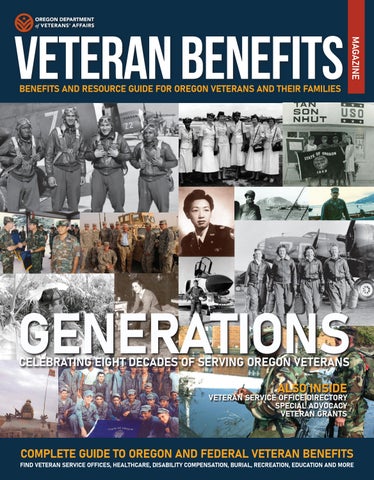
On the cover: 1) 555th Parachute Infantry Battalion (“Triple Nickles”), the first allBlack airborne unit in U.S. military history, trained in Oregon during World War II; 2) U.S. Air Force women, Korean War era, early 1950s; 3) Oregon service members, Vietnam War; 4) Oregon National Guard, first Guard unit mobilized for federal active duty since 1940, during Operation Desert Shield, 1990; 5) Oregon World War II veteran Bob Malarkey, later known through Band of Brothers, visiting Oregon troops deployed to Iraq and Afghanistan, bridging generations of service; 6) Hazel Ying Lee, Portland native and first Chinese American woman to fly a military aircraft, World War II; 7) Oregon WWII veteran Harlan Roth aboard USS Lancewood, 1943; 8) Lt. Brian Briggs, Da Nang, Vietnam, May 1966; 9) Jon Mangis, former Director, Oregon Department of Veterans’ Affairs; 10) Korean War MASH nurse, frontline medical care in combat zones; 11) Denny Smith, Oregon veteran, Vietnam combat pilot and U.S. Congressman; 12) Women Airforce Service Pilots (WASP), including Oregon veteran Blanche Osborn (far right), World War II; 13) Oregon National Guard engineers, Operation Iraqi Freedom, 2003; 14) Oregon Marine Corps Reserves, activated for the Korean War, 1950; 15) Oregon National Guard, Hurricane Katrina response, New Orleans, 2005. See feature story on page 24

ACCESSING VETERAN SERVICES ANYWHERE IN OREGON

STARTS WITH A VSO

WORKING WITH A VETERANS SERVICE OFFICER IN ANY OF OREGON'S 36 COUNTIES OR FOUR TRIBAL LANDS IS A FREE SERVICE

MEET WITH A VETERANS SERVICE OFFICER EVERY FOUR TO FIVE YEARS — OR AS SERVICE-RELATED CONDITIONS WORSEN

Oregon is proud to offer veterans a robust network of veteran services offices accessible in all 36 counties and Tribal lands across the state — enabling veterans to be served in and by their own communities.

The Oregon Department of Veterans’ Affairs (ODVA) partners with counties and Tribal nations to train and certify veterans service officers who provide veterans and their families with these free, confidential and critically important services that are accessible in every corner of Oregon.

When you need assistance, a veteran services office is where every veteran should start. ODVA also recommends meeting with a local office every four to five years, even if you have previously been denied.

Not only do health conditions develop and change as we age, but the federal VA is continuously implementing new programs and expanding benefits and associated eligibility that could positively impact the disability claim process begins

the moment you file a claim through a veteran services office.

To file, veterans must sign a power of attorney (POA) that authorizes ODVA to act on a veteran's behalf when preparing, presenting and prosecuting a claim for all benefits from the federal VA. If your disability claim is denied and you would like to appeal, ODVA's appeals team will represent you in adjudicating your claim in the Board of Veterans Appeals. These services, from filing to final rating decision, are a free benefit provided by the State of Oregon to support our state's most honorable.

Even if you are unsure about the benefits for which you or your family may qualify or have been denied in the past, scheduling an appointment with a county or Tribal VSO will ensure you can make informed decisions about accessing the full range of earned state and federal veteran benefits and programs to which you are entitled.

A directory of veteran services offices in Oregon can be found on page 7 .

WORKING WITH A VETERANS SERVICE OFFICER IN OREGON

SUBJECT MATTER EXPERTS IN FEDERAL VA LAW

ODVA trains and certifies all Oregon county, Tribal and state veterans service officers for U.S. Veterans Benefits Administration accreditation to provide claims representation for Oregon veterans and their families. The state's VSOs operate under ODVA’s power of attorney on file with the federal VA. ODVA trains and accredits VSOs to file defensible claims for disability compensation and pension benefits based on Title 38 federal law. All filed claims are reviewed and filed by ODVA and then rated by the USDVA.

WHO CAN WORK WITH A VSO?

All veterans and their families are eligible for services through their local veteran services office. Filing a claim for disability benefits in Oregon is free and confidential. You must file a claim proving eligibility through legal, military, and medical evidence to receive compensation or pension benefits. Though it is possible to file a claim yourself, it is highly recommended that you work with an accredited veterans service officer in any of Oregon's 36 counties and on some Tribal lands.

SCHEDULE AN APPOINTMENT WITH A VSO FOR CLAIMS AND MORE

Even if you are unsure about the benefits, you or your family may qualify for or have been denied in the past, scheduling an appointment with a local VSO will ensure you have access to the full range of earned state and federal veteran benefits and programs to which you are entitled. A list of VSOs can be found on the opposite page.

VSO SERVICES: FREE, TRUSTWORTHY, CONFIDENTIAL

EXPERT SUBJECT MATTER ASSISTANCE FOR VETERANS AND FAMILIES

Accredited representatives and veteran service organizations in Oregon play pivotal roles in assisting veterans with understanding and applying for various VA benefits. These professionals offer a wide range of services to ensure veterans receive the support they need and deserve.

UNDERSTANDING AND APPLYING FOR BENEFITS

Accredited representatives and VSOs help veterans comprehend the full range of VA benefits. These benefits may include financial support such as monthly payments, educational assistance, Veteran Readiness and Employment (VR&E) programs, home loans, life insurance, pension benefits, healthcare coverage and burial benefits.

GUIDANCE AND ASSISTANCE

Trained and certified VSOs aid veterans in navigating the complexities of the benefit system. They provide detailed explanations about eligibility criteria and help veterans determine which benefits are applicable to their circumstances.

DOCUMENT PREPARATION AND SUBMISSION

One crucial aspect of filing a VA claim is gathering supporting documentation. Accredited representatives and VSOs assist veterans in obtaining necessary documents such as medical reports or test results, ensuring that claims are well-supported and comprehensive.

FILING CLAIMS AND APPEALS

VSOs are authorized to file claims and appeals on behalf of veterans. They guide veterans through the application process, ensuring that all required paperwork is completed accurately and submitted promptly. If a claim is denied or the veteran wants to appeal an adverse decision or rating, VSOs continue to provide representation, support and valuable advice.

ADDITIONAL SUPPORT SERVICES

Beyond benefits application, VSOs offer additional resources tailored to veterans' needs. This may include assistance with transportation to medical appointments, accessing emergency funds, or navigating other challenges veterans may encounter.

When you need assistance accessing veterans' benefits in Oregon, a county or Tribal veteran services office is where every veteran and family member should start. Trained and certified county or Tribal VSOs are available in all 36 counties and on four Tribal lands. Tribal veteran representatives (TVRs) and national service officers (NSOs) are also available to serve eligible veterans.

COUNTY VETERAN SERVICES OFFICES

BAKER: 541 523 8223 rgloria@bakercounty.org

BENTON: 541 368 7100 veterans@ocwcog.org

CLACKAMAS: 503 650 5631 veterans@clackamas.us

CLATSOP: 971 308 1045 clatsopvso@ccaservices.org

COLUMBIA: 503 366 6580 enolan@cat-team.org

COOS: 541 551 0222 coosvets@co.coos.or.us

CROOK: 541 447 5304 veterans@co.crook.or.us

CURRY: 541 247 3205 voudya@co.curry.or.us

DESCHUTES: 541 385 3214 vets@deschutes.org

DOUGLAS: 541 440 4219 veterans@douglascountyor.gov

GILLIAM / SHERMAN / WHEELER 541 705 0051 veteranservice@co.sherman. or.us

GRANT: 541 620 8057 hoffmank@grantcounty-or.gov

HARNEY: 541 573 1342 brian.j.needham@co.harney. or.us

HOOD RIVER: 541 386 1080 vsomanager@hoodrivercounty. org

JACKSON: 541 774 8214 jcvso@jacksoncountyor.gov

JEFFERSON: 541 475 5228 veteransserviceoffice@ co.jefferson.or.us

JOSEPHINE: 541 474 5454 lpickart@josephinecounty.gov

KLAMATH: 541 883 4274 kpierce@co.klamath.or.us

LAKE: 541 947 6043 jpereyra@co.lake.or.us

LANE: 541 682 4191 veterans@lanecountyor.gov

LINCOLN: 541 265 0570 vets@co.lincoln.or.us

LINN: 541 967 3882 linnvet@co.linn.or.us

MALHEUR: 541 889 6649 veterans@malheurco.org

MARION: 971 707 4400 info.vso@mwvcaa.org

MORROW: 541 922 6420 mcvets@co.morrow.or.us

MULTNOMAH: 503 988 8387 veteran.services@multco.us

POLK: 503 751 1644 vso@co.polk.or.us

TILLAMOOK: 503 842 4358 ntorres@co.tillamook.or.us

UMATILLA: 541 278 6363 vets@umatillacounty.gov

UNION: 541 962 8842 bblais@chdinc.org

WALLOWA: 541 426 0539 vets@co.wallowa.or.us

WASCO: 541 506 2502 russellj@co.wasco.or.us

WASHINGTON: 503 846 3060 HHSDAVSInfo@ washingtoncountyor.gov

YAMHILL: 503 434 7503 wilsonj@co.yamhill.or.us

TRIBAL VET SERVICES

BURNS PAIUTE TRIBE TVR | 541 573 8004

CONFEDERATED TRIBES OF COOS, LOWER UMPQUA AND SIUSLAW INDIANS: TVR | 541 997 6011

CONFEDERATED TRIBES OF GRAND RONDE

TVSO | 503 879 1484

CONFEDERATED TRIBES OF SILETZ INDIANS: TVR | 541 444 8330

CONFEDERATED TRIBES OF THE UMATILLA INDIAN RESERVATION TVSO | 541 429 7389

CONFEDERATED TRIBES OF WARM SPRINGS

TVSO | 541 460 0605

COQUILLE INDIAN TRIBE TVR | 503 879 1484

COW CREEK BAND OF UMPQUA TRIBE OF INDIANS TVSO | 541 677 5513

THE KLAMATH TRIBES TVR | 541 882 1487, ext. 408

NATIONAL SERVICE OFFICERS

AMERICAN LEGION 503 412 4706

DISABLED AMERICAN VETERANS 503 412 4750

NATIONAL ASSOCIATION FOR BLACK VETERANS OF AMERICA

503 412 4159

PARALYZED VETERANS OF AMERICA | 503 362 7998

VETERANS OF FOREIGN WARS 503 412 4757

VIETNAM VETERANS OF AMERICA

541 604 0963

DISABILITY COMPENSATION

Disability compensation is a tax-free monetary benefit paid to veterans who are disabled by an injury or illness incurred or aggravated during active military service. Disabilities or conditions stemming from or aggravated by military service are often termed “service-connected.” Disability compensation is paid monthly and varies with the degree of the disability, the impairment of the veteran’s earning capacity, and the number of dependents the veteran has. Veterans with specific severe disabilities or combinations of disabilities may be eligible for additional compensation.

PENSION BENEFIT

Non-Service-Connected Pension is a benefit paid by the federal VA to wartime veterans who have limited or no income, who are permanently and disabled, are 65 years of age or older, are a patient in a nursing home because of a disability or are receiving Social Security Disability Insurance or Supplemental Security Income. The monthly pension award amount depends on the amount or type of income received by the veterans and their family, the number of dependents the veteran has, and whether the veteran requires assistance from another person to complete activities of daily living or is unable to leave their home due to their disabilities.

DEATH (SURVIVORS) PENSIONS

Death, or Survivors, Pension is a needs-based benefit paid to an unremarried surviving spouse or an unmarried child who meets certain age or disability requirements of a deceased wartime veteran. To qualify for this needs-based benefit, the amount received is determined via a mathematical formula of income received minus out-of-pocket medical expenses. The dependent or surviving spouse may be eligible for this pension if the income is below a certain level.

SPECIAL MONTHLY PENSION (SMP)

Veterans who qualify for veterans' improved pension may receive a higher pension award amount if they require the regular aid and attendance of another person to perform daily living activities, are bedridden, are housebound,

or are a patient in a nursing home due to mental or physical incapacity. The two levels of SMP are Aid and Attendance and Housebound.

AID AND ATTENDANCE (A&A)

Aid and Attendance is a benefit paid in addition to the monthly pension and compensation. It may not be paid without eligibility. A&A is allowed if the veteran requires the aid of another person in order to perform his or her daily living activities, is bedridden, or is a patient in a nursing home due to mental or physical incapacity.

HOUSEBOUND BENEFITS

Alternatively, veterans and survivors who qualify for federal VA compensation or pension and are confined to the home because of a permanent disability may be eligible for additional Housebound benefits. Qualifying veterans must have a single permanent, service-connected disability (rated 100% disabled) and need assistance, or have a single permanent, serviceconnected disability (100% disabled) and another disability, or disabilities evaluated as 60 percent or more disabling. A veteran cannot receive both A&A and Housebound benefits simultaneously.

SPECIAL MONTHLY COMPENSATION (SMC)

The federal VA offers additional compensation, called Special Monthly Compensation, to veterans with very severe service-connected disabilities, or who have lost (or lost the use of) limbs, organs or extremities as a result of their military service.

The VA may also pay higher compensation rates if you have lost or lost the use of more than one limb, organ or extremity, or if it is combined with another service-connected disability or condition, such as blindness or deafness.

SMC may also be paid to veterans, spouses, surviving spouses, and parents if they are bedridden, housebound, or require the aid and attendance of another person to perform the basic functions of everyday life, such as eating, dressing, bathing, and going to the bathroom. More information can be found on the federal VA's website at www.benefits.va.gov/compensation

ARE YOU ELIGIBLE FOR VA DISABILITY COMPENSATION?

You may be eligible for VA disability benefits or compensation if you meet both of the following requirements: You have a current condition (injury or illness) that affects your mind or body; and you served on active duty, active duty for training, or inactive duty training.

At least one of the following must also be true: You got sick or injured while serving in the military — and can link your condition to this illness or injury (called an in-service disability claim); you had an illness or injury before you joined the military — and serving made it worse (called a pre-service disability claim); or you have a disability related to your active-duty service that didn’t appear until after you ended your service (called a post-service disability claim).

For more information on eligibility criteria for service-connected disabilities, visit www.va.gov/ disability/eligibility

PRESUMPTIVE CONDITIONS

WHAT ARE PRESUMPTIVES?

For the purpose of disability compensation, there are specific health conditions that the federal VA assumes to be service-connected because of the unique nature of certain veterans’ military service. These are called presumptive conditions. If you have a presumptive condition, you don’t need to prove that your service caused the condition. You need only to meet the service requirements for that presumption. When in doubt, talk to a VSO.

RECENTLY SEPARATED VETERANS

The first year after service is known as the "presumptive year." In most cases, if you have a presumptive condition and file your claim within one year of separation from active service, the effective date is when you first got your disability. Veterans within one year after release who have been diagnosed with chronic diseases are encouraged to apply for disability compensation.

EXPOSURE TO HAZARDOUS MATERIALS

Veterans may have been exposed to a range of chemical, physical, and environmental hazards during military service, and may be entitled to disability compensation if exposure to these hazards resulted in a disease or injury. Examples include exposure to atomic radiation, mustard gas, asbestos, burn pits, chemical fires, and contaminated drinking water at Camp Lejeune. The PACT Act expanded health care and benefits to those veterans exposed to hazardous materials while in service. All veterans potentially exposed are encouraged to get a VA screening and file a claim.

GULF WAR ILLNESSES

Veterans who served in the Southwest Asia theater of operations during the Gulf War may receive disability compensation for disabilities resulting from undiagnosed illnesses, which may include chronic fatigue syndrome, fibromyalgia, functional gastrointestinal disorders, and others.

AGENT

ORANGE-RELATED ILLNESSES

If you served in Vietnam anytime between January 9, 1962, and May 7, 1975, or in or near the Korean demilitarized zones anytime between April 1, 1968, and August 31, 1971, or various other locations around the world where Agent Orange was sprayed and stored, the VA presumes that you were exposed to Agent Orange and other herbicides used in support of military operations. This entitles you to disability compensation for related medical conditions, which may include veterans’ dependents and survivors.

PRISONERS OF WAR (POWS)

Former POWs, regardless of the amount of time they were held in captivity, have conditions that the VA will presume were caused by their captivity if they become at least 10 percent disabled any time after military service. If you are a former POW who has been diagnosed as having one or more specific medical conditions to a degree that is at least 10 percent disabling, you are entitled to disability compensation.

VETERANS DIAGNOSED WITH ALS

Veterans diagnosed with amyotrophic lateral sclerosis (ALS)/Lou Gehrig’s disease at any time after discharge or release from qualifying active service may be eligible for compensation if they served a minimum of 90 consecutive days of active service.

DEDICATED OUTREACH TO UNDERSERVED POPULATIONS

Some veterans face circumstances that require specialized knowledge, targeted advocacy, and additional support. ODVA’s Special Advocacy Services are designed to ensure that veterans who experience complex barriers are not navigating the benefits system alone.

Through these services, ODVA provides focused assistance, priority benefit representation, and coordinated support for veterans whose needs may fall outside traditional pathways. This includes advocacy for aging, women, LGBTQ+, student and tribal veterans, and extend to those affected by service-related trauma, health and behavioral health challenges, justice involvement, housing instability, and other life circumstances that can complicate access to earned benefits.

AGING VETERANS

With more than half of Oregon's veterans being 65 or older, ODVA's Aging Veteran Outreach Coordinator provides services directed to aging veterans, especially those receiving in-home care or care in long-term facilities around the state. The position is an integral part of the Oregon Department of Veterans' Affairs' mission to ensure aging and vulnerable veterans receive the highest quality of veteran programs and benefits and priority representation from an accredited veterans service officer specializing in assisting veterans with benefits as they age. ODVA also offers priority representation to ensure each aging veteran has applied for benefits and receives all entitlements through the federal VA and other government and nonprofit entities.

Email: ODVA_Outreach@odva.oregon.gov

Web: www.oregon.gov/odva/Resources/Pages/Aging-Veterans.aspx

HOUSELESS VETERANS

As Oregon has one of the highest rates of veteran homelessness in the nation, ODVA's Houseless Veterans Program collaborates with federal, state, county, and Tribal agencies, veteran services offices, and community homeless service providers to meet the urgent and unique needs of Oregon veterans challenged with housing stability. In addition to advocating for Oregon veterans experiencing or at risk for houselessness, the program provides direct service to veterans and their families seeking federal and state veterans' benefits, including access to local VA health care, documentation of service, as well as other available state benefits, and local homeless services organizations and low-income assistance programs.

Email: houselessvets@odva.oregon.gov

Web: www.oregon.gov/odva/Resources/Pages/Homeless-Veterans.aspx VA Resource: www.benefits.va.gov/persona/veteran-homeless.asp

INCARCERATED VETERANS

First established in 2016, the Incarcerated Veterans Program works with veterans and the families of veterans entering or transitioning from the state prison system. Depending on the circumstances, justice-involved veterans may still be eligible for federal VA and other benefits. ODVA Incarcerated Veteran Coordinators work with the Oregon Department of Corrections to determine eligibility and provide assistance to connect veterans and their families with these resources. This work allows veterans and their families to establish stability and mitigate adverse outcomes during and after incarceration with state and federal veteran benefits, health and behavioral health care, re-employment and education programs, and more.

Email: Incarcerated.VETS@odva.oregon.gov

Veteran Courts: Contact your district attorney's office to see if a veteran docket or court is an option for your circumstance.

SPECIAL ADVOCACY AND SUPPORT FOR OREGON VETERANS

LGBTQ+ VETERANS

Oregon is proud to have been the first in the nation to establish a dedicated LGBTQ+ Veterans Program offering direct services to LGBTQ+ veterans to assist with military records corrections, discharge status upgrades, and service-connected disability compensation claims filing for VA benefits. The program also provides extensive outreach to engage and foster the community with LGBTQ+ veterans and assists veterans in enrolling in specialized health care through a Veterans Health Administration LGBTQ+ Veteran Care Coordinator. Through these efforts, veterans within the Oregon LGBTQ+ community now receive trauma informed and dignityaffirming care while also connecting with needed federal, state and local services.

Email: ODVA_LGBTQVets@odva.oregon.gov Web: www.oregon.gov/odva/Resources/Pages/LGBTQ-Veterans.aspx

TRIBAL VETERANS

An estimated 3,128 of Oregon veterans are American Indian and Alaska Native, representing Oregon's nine federally recognized and non-recognized Tribes. Tribal members have one of the highest records of military service per capita of any ethnic group, and Native American communities in Oregon have a long and rich history of honoring and supporting all veterans. Working with Oregon’s Tribes, ODVA continues to appreciate Tribal sovereignty and strong partnerships, providing annual Tribal veteran advocate training while supporting outreach events that honor Tribal veterans and raise awareness of veterans' benefits, programs, and services across the state. A directory of Tribal veterans service officers and reps can be found on page 7

Email: Tribal.Veterans@odva.oregon.gov Web: www.oregon.gov/odva/Resources/Pages/Tribal-Veterans.aspx

WOMEN VETERANS

The Women Veterans Program was established to improve outcomes for women veterans in five specific areas: outreach, advocacy, data, research, and policy. Focused outreach and advocacy are achieved via listening sessions and ongoing outreach to women veterans across Oregon. This work increases awareness of women veterans and their unique experiences, issues, and needs as veterans. This program specializes in assisting in the claims process with women veteran specific expertise, especially related to complex or challenging claims involving military sexual trauma. The Women Veterans Program also supports women veterans in accessing their earned benefits, including specialized health care and other care needs.

Email: ODVA_ORWomenVets@odva.oregon.gov Web: www.oregon.gov/odva/Resources/Pages/Women-Veterans.aspx VA Resource: www.va.gov/womenvet

CAMPUS VETERANS

ODVA's Campus Veterans Coordinator works directly with veterans resource coordinators at public universities and community colleges to help build a supportive community for veteran-serving campus professionals through advocacy, training, and regular meetings. The Campus Veterans Coordinator facilitates connections between campus partners and regional resources such as county and Tribal VSOs, VA medical and mental health care services, and others.

Email: campusvets@odva.oregon.gov Web: www.oregon.gov/odva/Services/Pages/Campus-Veteran-Services.aspx

BASIC ELIGIBILITY

A person who served in the active military service and was discharged under conditions other than dishonorable may qualify for federal VA health care benefits. Reservists and National Guard members may also qualify for federal VA health care benefits if they were called to active duty by a federal order and completed the period for which they were called or ordered to active duty, or have a service-connected disability.

ENROLLMENT

For most veterans, entry into the federal VA health care system begins by applying for enrollment. If you are not enrolled, you can apply at any time. If you served in the U.S. Armed Forces, you can use the federal VA Health Benefits Explorer to learn about the benefits you could receive if you are enrolled with the federal VA for your health care.

To apply or use the federal VA Health Benefit Explorer, visit www.va.gov/health-care

ONLINE HEALTH INFORMATION MANAGEMENT

Managing your health information — appointments, prescriptions, labs, blood tests, and even exchanging messages with your health care team — has never been easier.

My HealtheVet, your online Personal Health Record, helps you better understand your health status and will enable you to explore various ways to monitor and improve your health, 24 hours a day/seven days a week. To get the most out of My HealtheVet, veterans are urged to visit their local federal VA health care facility to get an upgraded account, known as In-Person Authentication (IPA). To begin using My HealtheVet, register at www. va.gov/health-care/manage-health

NON-VA MEDICAL CENTER EMERGENCY CARE

Veterans are eligible for emergency care at non-VA facilities under certain circumstances. The 2010 Veterans Emergency Care Protective Act enables the federal VA to reimburse veterans enrolled in federal VA health care for the remaining cost of emergency treatment if the veteran has outside insurance that only covers part of the cost. Learn more at www.va.gov/resources/gettingemergency-care-at-non-va-facilities

Eligible veterans may also visit authorized urgent care centers for free, depending on their priority group, which is based on a veteran's serviceconnected disabilities and other factors. Learn more at www.va.gov/resources/getting-urgentcare-at-va-or-in-network-community-providers

WOMEN VETERANS HEALTH CARE

1-855-VA-WOMEN (1-855-829-6636)

Comprehensive health services are available to women veterans, including primary care, specialty care, mental health care, and reproductive health care services. The federal VA provides management of acute and chronic illnesses, preventive care, contraceptive services, menopause management, cancer screenings, including pap smear and mammograms, gynecology, maternity care, and some child care. Infertility evaluation and limited treatments are also available. For more information, visit www.womenshealth.va.gov

TRIBAL VETERANS HEALTH CARE

To improve access to care for American Indian and Alaska Native (AI/AN) Veterans, VA works with the Indian Health Service (IHS), Tribal Health Programs (THP) and Urban Indian Organization (UIO) (I/T/U) to reimburse the cost of care provided to eligible AI/AN Veterans at IHS, THP and UIO facilities. Through the VA Reimbursement Agreements Program (RAP), care is provided to Veterans closer to home in a culturally sensitive environment at an I/T/U facility. Visit www.va.gov/ COMMUNITYCARE/programs/veterans/ihs or email tribal.agreements@va.gov .

VA DENTAL INSURANCE PROGRAM

VADIP offers eligible individuals the opportunity to purchase discounted dental insurance coverage that includes diagnostic services, preventive services, endodontic and other restorative services, surgical services and emergency services. Multiple plan options allow individuals to select a plan that provides benefits and premiums that meet their dental needs and budget.

For more information, call Delta Dental at 1-855370-3303 or MetLife at 1-888-310-1681. For information regarding VA dental care and the VADIP, visit www.va.gov/healthbenefits/VADIP .

OREGON VETERAN DENTAL CARE PROGRAM

Veterans who do not get dental care from the Oregon Health Plan may now qualify for dentalonly OHP benefits. OHP’s Veteran Dental Program is different from the dental care offered by the Veterans Health Administration (VADIP). The Veteran Dental Program has the same dental care as OHP Plus, including teeth cleanings, fillings and extractions, emergency dental care, and some dentures. For more information or to find out if you qualify, visit ONE.Oregon.gov . Paper applications may also be obtained at OHP.Oregon. gov/Apply or by calling 1-800-699-9075

FEDERAL VA MEDICAL CENTERS

The Veterans Health Administration is the most extensive integrated health care system in the United States. Every federal VA medical center has at least one patient advocate who ensures all veterans receive needed care.

PORTLAND VA MEDICAL CENTER

3710 SW US Veterans Hospital Rd 503 220 8262 or 800 949 1004 www.portland.va.gov

VANCOUVER VA MEDICAL CENTER

1601 E 4th Plain Blvd., Vancouver, WA | 360 759 1901 www.portland.va.gov

BOISE VA MEDICAL CENTER

500 W Fort Street, Boise, ID 208 422 1000 www.boise.va.gov

ROSEBURG VA HEALTH CARE SYSTEM

913 N.W. Garden Valley Blvd. 541 440 1000 or 800 549 8387 www.roseburg.va.gov

COMMUNITY- BASED OUTPATIENT CLINICS (CBOC)

WHITE CITY (VA SORCC) 8495 Crater Lake Highway 541 826 2111 or 800 809 8725 www.southernoregon.va.gov

VA WALLA WALLA HEALTH CARE 77 Wainwright Dr, Walla Walla, WA 509 525 5200

www.wallawalla.va.gov

Community-based outpatient Clinics (CBOCs), which have 17 locations across Oregon, provide local and routine outpatient services, including health and wellness visits.

ASTORIA VA CLINIC

3196 Marine Drive 503 220 8262, ext. 52593

BEND VA CLINIC

2650 NE Courtney Drive 541 647 5200

BROOKINGS VA CLINIC

840 Railroad Street 541 412 1152

EASTERN OREGON VA CLINIC

635 Highway 20 North, Ste 4 Hines, OR 97738-9462 541 573 4009

EUGENE VA CLINIC

3555 Chad Drive 541 607 0897

GRANTS PASS VA CLINIC

1877 Williams Highway 541 955 5551

HILLSBORO VA CLINIC

1925 NE Stucki Avenue, Ste 300 503 906 5000

KLAMATH FALLS VA CLINIC 2225 N El Dorado Blvd 541 273 6206

LA GRANDE VA CLINIC

202 12th Street 541 963 0627

LINCOLN CITY VA CLINIC 1105 SE Jetty Avenue, Ste C 541 265 0547

MORROW COUNTY VA CLINIC 2 Marine Drive, Ste 103 Boardman, OR 97818 541 481 2255

NEWPORT VA CLINIC

36 Southwest Nye Street 541 265 4182

NORTH BEND VA CLINIC 2191 Marion Avenue 541 756 8002

SALEM VA CLINIC 1750 McGilchrist Street SE Suite 130 971 304 2200

WEST LINN VA CLINIC 1750 Blankenship Road, Ste 300

TRAVEL REIMBURSEMENT

The federal VA has the authority to provide eligible beneficiaries reimbursement for mileage, special mode of transportation, and in certain circumstances, a taxi or hired car. Veterans must meet certain service-connected disability and other criteria to be eligible.

Scheduled appointments qualify for round-trip mileage. Unscheduled visits may be limited to return mileage only. To be eligible for travel benefits when transporting to VA care or treatment, a veteran must be incurring an expense. Should one or more veterans travel together in a private vehicle, only the vehicle owner is actually incurring expenses and, therefore, is the only person entitled to travel reimbursement.

However, should multiple veterans share a vehicle where passengers must pay for their transport, such as a taxi, or where one veteran pays another veteran for transport, then all are entitled to travel reimbursement either at the mileage reimbursement rate or actual expense, whichever is less. Such persons must provide a receipt to receive reimbursement. More information online at w ww.va.gov/health-care/file-travel-payreimbursement

VETERANS TRANSPORTATION PROGRAM (VTP)

The federal VA has a transportation program for non-ambulatory and remote VA patients. The Veterans Transportation Program provides transport for veterans to federal VA medical centers (VAMCs).

While all veterans with federal VA-funded medical appointments are eligible to ride Veteran Transportation Service, a first priority is given to wheelchair-bound patients without other transportation alternatives. VTS is establishing a community and volunteer transportation service provider network to improve access to VA health care, including the Portland VAMC.

Reservations are needed for transportation at least four full business days before the date transport is needed. Specific information about the veteran is also required. To make a reservation, call the Portland VA Medical Center at 800-949-1004 , ext. 57804 ; the Roseburg VA Medical Center at 541-440-1000, ext. 41293 ; or the White City VA Medical Center at 541-826-2111, ext. 3619

ADAPTIVE EQUIPMENT

The federal VA will pay for the installation of adaptive equipment for automobiles considered

necessary to ensure that eligible veterans will be able to safely operate vehicles and to satisfy the applicable state standards of licensure. This equipment includes power steering, brakes, power window lifts, power seats, and other special equipment necessary to assist the person into and out of the vehicle or other conveyance.

The federal VA will also repair, replace, or reinstall adaptive equipment determined essential for the operation of a vehicle acquired under this program, or for the operation of a vehicle an eligible veteran may previously or subsequently have acquired. Work with a local VSO (see page 7) for more information.

DAV TRANSPORTATION NETWORK

Because many veterans lack transportation to and from VA medical facilities for needed treatment, Disabled American Veterans (DAV) operates a nationwide transportation network to meet this need. DAV volunteers drive veterans to and from VA medical facilities through the Transportation Network for treatment.

The Transportation Network is a clear example of veterans helping veterans. DAV has 189 Hospital Service Coordinators nationwide who coordinate the transportation needs for disabled veterans. Contact your local medical center (page 13) for more information.

DAV is always looking for volunteer drivers. If you are interested in volunteering at the DAV Transportation Network, please visit www.dav. org/get-involved/volunteer/drive-a-vehicle .

VHA-UBER HEALTH CONNECT (VUHC) INITIATIVE

The VHA-Uber Health (VUHC) Initiative is a partnership between the federal VA and Uber that provides supplemental rides for eligible veterans who need assistance traveling to and from VA medical appointments. The program is designed to help reduce transportation barriers by offering access to ride-share services. Eligibility is based on service and other criteria, including medical and financial need. Veterans may contact their local VA medical center’s (see page 13) veteran transportation office to learn more.

AUTOMOBILE ASSISTANCE PROGRAM

The federal VA offers qualified disabled veterans and active-duty service members a one-time payment to be used to purchase a car or other conveyance.

To qualify, a veteran or service member must have

one of the following disabilities, including loss, or permanent loss of use, of one or both feet; loss, or permanent loss of use, of one or both hands; or permanent impairment of vision in both eyes to a certain degree. For more information, visit www.va.gov/disability/ eligibility/special-claims/automobileallowance-adaptive-equipment .

REDUCED TRIMET FARE FOR VETERANS

Veterans, active-duty service members and Reservists may qualify for reduced TriMet fares and can now apply for this benefit online. Visit trimet.org/military to apply for the military fare card and have it mailed to your home or business. You will need a government-issued photo ID as well as one of the following: Common Access Card (CAC) for active-duty military, Uniformed Services ID card or a copy of your DD 214. An Oregon driver license with veteran designation may also be used to confirm military status. You may also apply in person by visiting the TriMet Customer Support Center at Pioneer Courthouse Square in Portland, which is open weekdays 8:30 a.m. to 5:30 p.m.

FREE AIRPORT PARKING FOR DISABLED VETERANS

Free parking for disabled veterans at PDX and Eugene airports is available to disabled veterans. To receive this benefit, you must present your valid driver license, vehicle registration, and proof of veteran status and service-connected disability at a staffed cashier booth when exiting the lot.

Eugene Airport: Disabled veterans and Wounded Warriors can park without charge in the Short- Term Lot up to a maximum of fourteen (14) consecutive days, upon meeting the requirements. $13 (Economy Rate) will be applied for any stay beyond the fourteen (14) days. Wounded Warriors are authorized to park in an ADA space. Disabled veterans without an ADA placard must park in the standard space. Click on accessibility at www. eugene-or.gov/1720/Airport-Parking

PDX: Disabled veterans of the United States Armed Forces can park without charge in the Economy Lot for up to a maximum of fourteen (14) consecutive days, upon meeting the requirements below. The established parking fee for the Economy Lot will be applied for any stay beyond the fourteen (14) days. Click on Disabled Parking at www.flypdx.com/Parking

RURAL TRANSPORTATION FOR MEDICAL APPOINTMENTS

One of the long-standing barriers to health care for veterans who live in rural areas of Oregon is transportation to appointments.

To help remedy this barrier, the Oregon Department of Veterans' Affairs receives both federal and state grant funding to administer two programs aimed at ensuring medical-related transport is available to veterans living in rural areas: the state-funded Rural Veterans Health Care Transportation Grant Program and the federally backed Highly Rural Transportation Grant Program.

Veterans participating in these programs are picked up and delivered back to their own homes at no cost to the veteran.

LOCATE SERVICES

Locate services online at www.oregon.gov/ odva/Services/Pages/Transportation-Services. aspx or contact a county veteran services office (page 7) to learn more about using this service.

BEHAVIORAL HEALTH CARE

BEYOND THE MILITARY UNIFORM

BeyondTheMilitaryUniform.com is a veteran-centered resource created to help veterans and their families find practical tools to approach wellness. Veterans can explore information at their own pace and find support that aligns with their individual experiences. Learn about ways to get active with other veterans, connect with peers, and build community through recreational and social experiences.

Outdoor Activities – Explore hiking, biking, fishing, skiing, group rides, and other outdoor opportunities that bring veterans together.

Indoor Activities – Discover indoor or virtual activities like gaming communities, fitness programs, art, cooking events, and more.

Volunteering - Opportunities for veterans to serve again by giving back, sharing their skills, supporting community events, or helping fellow veterans.

Community - Build meaningful connections and access support networks with other veterans, including:

Support & Therapy – Links to counseling, mental health support groups, peer support, and therapeutic programs.

Meetups – Veteran-led meetups and social gatherings to foster camaraderie and connection.

Recovery & Rehabilitation – Resources and programs supporting recovery and reintegration into family and community life.

Women Veterans – Community activities and support specifically for women who served.

Family & Caregivers – Support and tools for military families and caregivers.

Self-Preparedness Toolkit – Downloadable guides and planning tools to support emotional wellness, crisis planning, and daily wellbeing.

Lethal Means Safety – Information on safety planning and reducing access to lethal means during crisis.

Community and VA Mental Health – Local and VA mental health providers, peer support, and therapy resources.

BeyondtheMilitaryUniform.com is paid for by Chartitable Check-off donations to the Veteran Suicide Prevention Fund made by Oregon tax payers supporting efforts like this which connects vets to crucial mental health & community resources, preventing suicide by fostering connection and purpose.

VET CENTERS

Vet Centers are community-based counseling centers associated with the federal VA in all 50 states and U.S. territories. They provide a wide range of social and psychological services, including professional readjustment counseling to eligible veterans, service members — including National Guard and Reserve components — and their families.

Counselors and outreach staff, many of whom are veterans themselves, are experienced and able to discuss the tragedies of war, loss, grief, and transition after trauma. To learn more, contact the nearest Vet Center in Oregon. Virtual appointments are available.

OREGON VET CENTER 1645 NE Forbes Road, Ste 105 541 749 2112 EUGENE VET CENTER 190 E 11th Avenue | 541 465 6918

PASS VET CENTER 135 NE Steiger Street | 541 479 6912

PORTLAND VET CENTER 1505 NE 122nd Avenue, Ste 110 503 688 5361 SALEM VET CENTER 2645 Portland Road NE, Ste 250 503 362 9911 BOISE VET CENTER 2424 Bank Dr, Boise, ID 83705 208 342 3612 WALLA WALLA VET CENTER 1104 West Poplar Street Walla Walla, WA 99362 509 526 8387

VET CENTER CALL CENTER 1-877-WAR-VETS (877-927-8387)

Around-the-clock confidential call center where combat veterans and their families can call to talk about any issue they are facing. www.vetcenter.va.gov/index.asp

ODVA HOUSELESS VETERANS COORDINATOR

If you are a veteran facing housing instability or are trying to avoid homelessness, contact the ODVA Houseless Veterans Program coordinator for assistance navigating available state and federal housing and stability resources including disability claims assistance. Call ODVA's main phone line at 800-692-9666 or email houselessvets@odva. oregon.gov

HUD-VASH

This joint Housing Choice Program between the federal VA and the U.S. Department of Housing and Urban Development (HUD) provides permanent housing and ongoing case management treatment services for homeless veterans who would not be able to live independently without the support of case management.

HUD’s Housing Choice Voucher Program has designated vouchers for veterans who are homeless to public housing authorities (PHAs) throughout the country. These vouchers allow veterans to live in communities served by their VA medical facility where case management services can be provided.

Visit the HUD-VASH website for more information at www.va.gov/homeless/hud-vash.asp

VA’S COMPENSATED WORK THERAPY

The federal VA’s Compensated Work Therapy (CWT) consists of three unique programs that assist homeless veterans in returning to competitive employment: Sheltered Workshop, Transitional Work, and Supported Employment. Veterans in CWT are paid at least the federal or state minimum wage, whichever is higher.

The Homeless Veteran Supported Employment Program provides vocational assistance, job development and placement, and ongoing support to improve employment outcomes among homeless veterans and veterans at risk of homelessness. Veterans in CWT have been successfully employed over the years in competitive positions including health care, information technology, manufacturing, warehousing, construction trades, clerical, including health care, information technology, manufacturing, warehousing, construction trades, clerical, and office support.

CWT programs develop an individual rehabilitation plan for each veteran and provide a wide

range of support services to the veteran at CWT locations. VA benefits, including serviceconnected compensation and non-serviceconnected pensions, cannot be reduced, denied, or discontinued based on participation in CWT. For more information, visit va.gov/health/cwt

TRANSITIONAL RESIDENCE PROGRAM

The Transitional Residence Program is a -based residential rehabilitation treatment program offering a therapeutic residential setting for veterans involved in CWT. The TR program provides a rehabilitation-focused residential setting for veterans recovering from chronic mental illness, chemical dependency, and homelessness.

The TR Program provides a bridge between hospitalization or intensive outpatient treatment and successful community reintegration. It utilizes a residential therapeutic community of peer and professional support, with a strong emphasis on increasing personal responsibility and achievement of individualized rehabilitation goals. For more information, visit www.va.gov/homeless/ gpd.asp.

STAND DOWNS

Stand downs are typically one- to three-day events providing supplies and services to homeless veterans, such as food, shelter, clothing, health screenings and benefits counseling. Veterans can also receive referrals to other assistance, such as health care, housing solutions, employment, ID cards, and access to other programs to meet their immediate needs. They are collaborative events, coordinated between local VA medical centers, state and federal agencies, veterans service organizations and local nonprofits. For information on stand-down dates and locations in Oregon, visit oregon.gov/odva/Resources/Pages/HomelessVeterans.aspx or va.gov/HOMELESS/events.asp

DROP-IN CENTERS

These programs provide a daytime sanctuary where homeless veterans can clean up, wash their clothing, and participate in various therapeutic and rehabilitative activities. Links to longer-term assistance are also available. Locations vary.

For more information: Contact your local Vet Center or federal VA Community-Based Outpatient Clinic (CBOC) for locations and services in your area. A directory of those services can be found on pages 13 and 17 .

GRANTS AND EMERGENCY FINANCIAL ASSISTANCE

COMMUNITY RELIEF AND VETERANS ORGANIZATIONS

VETERANS EMERGENCY RELIEF PROGRAMS AND OTHER SERVICES IN OREGON

Many military and veteran service organizations have emergency relief programs designated to help veterans and their families. Inquire at local organizations about programs such as the Air Force Aid Society, American Legion Temporary Financial Assistance, Army Emergency Relief, Disabled American Veterans Disaster Relief Grants, Navy-Marine Corps Relief Society, Oregon National Guard Emergency Relief, Salvation Army Home Front War Relief Program, and VFW Unmet Needs.

COMMUNITY ACTION AGENCIES

Community Action Agencies (CAAs) are local, nonprofit organizations that support low-income families in Oregon. They are also known as grant subgrantees. CAAs can help families gain self-sufficiency and overcome hardships. They can also provide short-term financial assistance for housing, transportation, employment, and energy bills. CAAs have offices in all 36 Oregon counties and programs specifically funded for veteran assistance. Learn more online at caporegon. org

VETERANS’ EMERGENCY FINANCIAL ASSISTANCE

The Oregon Veterans’ Emergency Financial Assistance Program provides a one-time grant to veterans or their immediate family members who need emergency financial assistance. Grants are awarded monthly to veterans who experience sudden and unanticipated financial instability.

Most grant requests support keeping veterans in their homes by assisting with expenses such as past-due monthly rent and mortgage payments, utility payments, home and vehicle repair, and dental and medical expenses.

Applicants are also connected with a local veteran services office for access to other veterans' benefits and services and community resources to encourage financial stability.

Learn more at oregon.gov/odva/Benefits/Pages/EmergencyAssistance.aspx .

VETERANS EDUCATIONAL BRIDGE GRANT

ODVA administers the Veterans Educational Bridge Grant to help veterans achieve their educational goals. This grant is specifically designed to support veterans who are unable to complete their academic or training programs on time due to the unavailability of a required class or training hours or debt on a student account that prevents registration.

As a result of these types of issues, veterans in these programs may be under financial strain and decide to go to work without completing their post-secondary goals.

The Veterans Educational Bridge Grant alleviates some of the financial stress encountered when attempting to complete a program by offering grants of up to $5,000 to veterans who meet the eligibility requirements.

Learn more and apply online at oregon.gov/odva/agencyprograms/grants/Pages/Educational-Bridge-Grant.aspx .

VETERAN SERVICES GRANT FUND

ODVA administers the biennial Oregon Veteran Services Grant Program, which provides funds to leverage existing community programs and resources available to veterans across the state.

Eligible grant recipients are nonprofit organizations, local and Tribal governments, and other entities that provide direct services to veterans in Oregon.

Services provided free of charge to veterans include legal assistance, housing support and services, outreach to tribal veterans, behavioral health services, peer-to peer support services, and employment assistance programs.

More information can be found at oregon.gov/odva/agencyprograms/grants/Pages/Veteran-Services-Grant.aspx .

Program details and application materials are available on ODVA's website at www.oregon.gov/odva/ agency-programs/grants/Pages/Educational-Bridge-Grant.aspx or contact the program with further questions at EBG@odva.oregon.gov.

EDUCATION BENEFITS AND PROGRAMS

VETERANS EDUCATIONAL BRIDGE GRANT

The Veterans Educational Bridge Grant was established in 2019 to provide financial assistance grants of up to $5,000 to eligible veterans to alleviate the financial stress during a gap period when required courses are not available or when debt is on a student's account, allowing them to remain enrolled in school or their apprenticeship training. Grant funds may also be used to pay off debt on a student account that is preventing enrollment in future terms. Learn more and apply online at oregon.gov/odva/agency-programs/ grants/Pages/Educational-Bridge-Grant.aspx .

ODVA CAMPUS VETERANS COORDINATOR

ODVA's Campus Veteran Coordinator works directly with veteran resource coordinators at public universities and community colleges to help build a supportive community for veteran-serving campus professionals through advocacy, training, and regular meetings. The coordinator facilitates connections between campus partners and regional resources such as county and Tribal VSOs, VA medical and mental health care services, and others. The coordinator can be reached via email at campusvets@odva.oregon.gov .

COLLEGE CREDIT FOR MILITARY TRAINING

All universities and local community colleges in Oregon use the American Council on Education recommendations to award academic credit toward a degree for education and training received in the military. Request a transcript from your military service branch to claim college credit for military training. Each service branch will provide official copies to schools at no charge.

NONRESIDENT VETERAN IN-STATE TUITION

Nonresident veterans pursuing undergraduate studies pay tuition rates and fees no greater than the Oregon resident rate. Veterans must establish Oregon residency within one year of enrollment at one of the seven university campuses. To qualify, the nonresident veteran must have served in the Armed Forces and been relieved or discharged from that service under honorable conditions. Eligible nonresident student veterans should contact the financial aid office at Oregon universities to request this benefit.

STATEWIDE APPRENTICESHIPS

Eligible apprentices may receive benefit payments from the GI Bill® while training in an apprenticeship program. If an existing apprenticeship program is not currently approved to administer GI Bill benefits, they may contact the State Approving Agency by phone at 503-3737367 or email at ODVA_OregonSAA@odva.oregon.

gov to apply for approval. Search for approved apprenticeship programs on the GI Bill Comparison Tool: www.va.gov/education/gi-bill-comparisontool .

STATE TUITION ASSISTANCE FOR THE OREGON ARMY NATIONAL GUARD

The State of Oregon now offers eligible members of the Oregon National Guard the chance to get an education without having to worry about paying for school tuition, provided they attend an Oregon community college or public university and are working toward an associate or bachelor’s degree. For more information or to find out if you qualify, visit www.oregonarmyguard.com/education

CAMPUS VETERAN RESOURCE CENTERS

ODVA administers the Campus Veteran Resource Center Grant Program to support campus veteran resource centers at all Oregon's community colleges and public universities.

Resource centers help veterans transition from military service to college life, complete their education, and achieve their vocational goals. Find campus veteran services online at www.oregon. gov/odva/services/pages/campus-veteranservices.aspx .

SURVIVORS' AND DEPENDENTS’ EDUCATION ASSISTANCE (DEA)

Both the state and federal VA have a dependent education benefit that provides education and training opportunities to eligible dependents, spouses, and survivors of 100% service-connected veterans. More information can be found in the Family Benefits section on page 38 .

POST-9/11 GI BILL®

The Post-9/11 GI Bill® provides financial support for tuition and housing to honorably discharged veterans with at least 90 days of aggregate service on Title 10 Active Duty or Title 32 Active Guard Reserve Duty after September 10, 2001, or individuals discharged with a service-connected disability after 30 days. The Post-9/11 GI Bill® may pay eligible individuals up to the cost of full tuition and fees at the in-state rate for public schools.

A monthly housing allowance based on the basic allowance for housing for an E-5 with dependents may also be available. This benefit provides up to 36 months of education benefits and is now a lifetime benefit for veterans discharged after January 1, 2013. to discharge, this benefit may be transferred to dependents and spouses based on a number of years of active service. More information online at www.gibill.va.gov

TILLMAN SCHOLARS PROGRAM

The Pat Tillman Foundation’s Tillman Scholars Program supports our nation’s active-duty service members and veterans and their families by removing financial barriers to completing a degree or certification program of choice. The scholarships cover direct expenses such as tuition, fees, and other needs, including housing and child care. More information online at pattillmanfoundation.org/apply

MONTGOMERY GI BILL ® PROGRAMS

The Montgomery GI Bill® Active Duty (MGIB-AD) can help you pay for education and training programs if you’ve served at least two years on active duty. The amount you’ll receive depends on your length of service, the type of education or training program you choose, and other factors. The Montgomery GI Bill® Selected Reserve (MGIB-SR) program offers up to 36 months of education and training benefits for members of the Army, Navy, Air Force, Marine Corps, or Coast Guard Reserve, Army National Guard, or Air National Guard. More information online at www.va.gov/ education/about-gi-bill-benefits

YELLOW RIBBON PROGRAM

The Yellow Ribbon Program can help you pay for higher out-of-state, private school, foreign school, or graduate school tuition and fees that the Post-9/11 GI Bill® doesn’t cover. To be eligible, the student must be a veteran receiving benefits at the 100% benefit rate, a transfer-of-entitlement-eligible child, or the spouse of a veteran. The federal VA will match the school’s percentage (up to 50%) to reduce or eliminate out-ofpocket costs for eligible participants.

To receive this benefit, your school must agree to participate in the Yellow Ribbon Program. Many Oregon universities, colleges, and institutions participate. Learn more online at www.va.gov/education/aboutgi-bill-benefits/post-9-11/yellow-ribbon-program , or search for your school at www.va.gov/education/ yellow-ribbon-participating-schools

VETERAN READINESS AND EMPLOYMENT

The Veteran Readiness and Employment (VR&E) Program helps veterans with service-connected disabilities with job training, education, employment accommodations, resume development, and jobseeking skills coaching. Other services may be provided to assist veterans and service members in starting their businesses or independent-living services for those severely disabled and unable to work in traditional employment. Eligibility and entitlement for VR&E are two different things. You may meet eligibility criteria, yet not be entitled to services. The first step in the VR&E process is to be evaluated to determine if you qualify for services. More information online at www. benefits.va.gov/vocrehab

ON - THE -JOB TRAINING

Did you know that your military service education benefits can be applied to on-the-job training opportunities as a first responder, electrician, plumber, and many other quality trade and apprenticeship opportunities?

On-the-job training allows eligible veterans to use their Post-9/11 GI Bill®, Montgomery GI Bill® Active Duty, Montgomery GI Bill® Selected Reserve or the Veteran Readiness and Employment (VR&E) benefits toward apprenticeship and on-the-job training opportunities rather than formal education.

Depending on your circumstances, this benefit can provide a monthly tax-free stipend on top of your base salary while still in probationary status. Dependents or survivors may also qualify.

For more information, contact ODVA at va.gov/education/about-gi-bill-benefits/ how-to-use-benefits/on-the-job-trainingapprenticeships .

World War II

Steve Piter U.S. Army Air Forces

Korean War Eugene Robinson U.S. Army

Jesus “Monty” Montes U.S. Army

Vietnam War

Darlene Johnson U.S. Army

Peacetime/Gulf War

Rex Emery U.S. Navy

Post-9/11: Afghanistan

Will Coker U.S. Army

Post-9/11: Iraq

Hector Carrion U.S. Army

GENERATIONS OF SERVICE

CELEBRATING EIGHT DECADES OF SERVING OREGON VETERANS

Since 1945, the Oregon Department of Veterans’ Affairs (ODVA) has stood beside those who served—adapting, expanding, and evolving to meet the changing needs of Oregon’s veterans and their families. Established in the wake of World War II to support returning servicemembers, ODVA has grown into a comprehensive, statewide agency committed to ensuring every veteran has access to the benefits, care, and recognition they have earned.

As ODVA marked its 80th anniversary in 2025, this milestone is best understood not through dates or statutes alone, but through the lived experiences of veterans across generations. The six Oregon veterans featured here represent distinct eras of military service—and together, their stories reflect how ODVA’s mission has grown alongside them.

WORLD WAR II ERA

Steve Piter

U.S. Army Air Forces Veteran

When Steve Piter left his Oregon hometown to serve in the U.S. Army Air Forces during World War II, the stakes could not have been higher. As a crew chief stationed in the European theater, Steve was responsible for maintaining aircraft used in bombing missions over enemy territory—work that demanded precision under constant pressure.

“We knew lives depended on those planes,” Steve recalls. “There wasn’t room for error.”

After the war, Steve returned home to a nation reshaping itself around its veterans. He used the GI Bill to pursue higher education, built a career in engineering, and raised a family in Oregon. Veterans like Steve inspired the creation of ODVA in 1945, when the state recognized the need for long-term support beyond wartime service.

ODVA’s earliest mission—administering home and farm loans to returning servicemembers—helped veterans like Steve put down roots, stabilize communities, and build the postwar Oregon we know today. That foundational promise still guides the agency’s work.

KOREAN WAR ERA

Eugene Robinson

U.S. Army Veteran

Eugene Robinson entered military service with a strong academic foundation, having earned a master’s degree in genetics from the University of Nebraska before deploying to Korea.

Serving in the U.S. Army during the Korean War, Eugene experienced firsthand the dangers of combat when he was injured in a blast. His injuries required extensive treatment, and he spent more than 100 days recovering in a military hospital in Japan.

Eugene served three years in the Army, completing his service in June 1955. For his courage and sacrifice, he was awarded both the Bronze Star and the

Purple Heart—recognition of his dedication under extraordinary circumstances.

After returning home, Eugene continued a lifetime of service through education, ultimately dedicating himself to developing others—a path shaped by resilience, leadership, and a deep commitment to growth that began with his service during the Korean War.

KOREAN WAR ERA

Jesus “Monty” Montes U.S. Army Veteran

Jesus “Monty” Montes was a teenager when he enlisted in the U.S. Army and was deployed to Korea. Stationed on the frigid and volatile front lines, Monty and his fellow soldiers were charged with defending South Korea from the spread of communism.

The conditions were brutal — sub-zero winters, constant shelling, and a sense of political ambiguity that made it difficult for many to understand the purpose of their sacrifice.

Monty returned home to Oregon to a quiet welcome. The Korean War was often overshadowed by the more publicized conflicts that came before and after. But Monty never let that diminish the pride he felt in serving his country. He became an outspoken advocate for Korean War veterans, working to ensure that their contributions were not forgotten.

“We didn’t have a parade,” Monty says. “But we had each other. That’s what mattered.”

During this period, ODVA was expanding rapidly. By the mid-1950s, the agency had helped more than 40,000 veterans purchase property through its loan programs, reinforcing Oregon’s commitment to veterans’ economic stability and long-term well-being. ODVA’s role was no longer just transitional—it was becoming lifelong.

VIETNAM WAR ERA

Darlene Johnson U.S. Army

Veteran

Darlene Johnson served stateside during the Vietnam War as a communications and medical support specialist. While she did not deploy overseas, her work ensured that soldiers were prepared, tracked, and cared for— often determining whether they returned home safely.

World War II

World War II marked a turning point for women in military service. One notable “first” was the creation of the Women’s Airforce Service Pilots (WASP)—an experimental program established to address the shortage of male pilots. Oregon veteran Blanche Osborn (far right) was among these pioneering women. This photograph, widely used in wartime advertisements and fashion magazines, later became an iconic image of the era and now hangs in the Smithsonian Institution.

“I wasn’t on the front lines,” she says. “But I made sure people came back.”

Women veterans like Darlene were pioneers, serving in roles that were often overlooked or undervalued. Their contributions shaped the military—and later, veteran advocacy—long before they were widely acknowledged.

Korean War

When the Korean War began in July 1950, Oregon National Guard and Reserve units were among those called to active service. Many of these servicemembers were veterans of World War II, returning once again to defend the nation. Oregon veteran Richard Jackson, who joined an Oregon Marine Corps Reserve unit in May 1947, is pictured kneeling in the second row, fourth from the left.

As Vietnam veterans returned home to a divided nation, ODVA began expanding its role beyond financial assistance. In 1965, the agency established Conservatorship Services, providing fiduciary support for veterans unable to manage their financial affairs. This marked a pivotal shift: ODVA began addressing not only economic needs, but vulnerability, dignity, and long-term care.

That evolution continued with the establishment of the Oregon Veterans’ Homes, beginning with The Dalles in 1997 and later Lebanon in 2014—facilities that provide skilled nursing, memory care, and community for aging veterans. Today, Darlene resides at the Lebanon Veterans’ Home, surrounded by peers and supported by a system designed to honor her service.

Vietnam War

More than 108,000 Oregonians served during the Vietnam War, which at the time became the longest conflict in U.S. history. Today, Vietnam-era veterans remain the largest veteran population in Oregon, representing more than one-third of the state’s veterans. Their service profoundly shaped both the military and the veteran support systems that followed

PEACETIME/GULF WAR ERA

U.S. Navy Veteran

Rex Emery served aboard a U.S. Navy minesweeper in the early 1980s, patrolling the Pacific during the Cold War—an era defined by tension and a constant need for readiness rather than a specific and declared

“It wasn’t glamorous,” Rex says. “But it was about being prepared. That mindset never leaves you.”

After his military service, Rex dedicated his career to public service in Oregon, eventually joining ODVA as Chief Operating Officer in 2023. His leadership reflects ODVA’s modern focus on equity, accountability, and veteran-centered systems.

During the late 20th century, ODVA broadened its reach significantly—expanding claims and appeals representation, launching emergency financial assistance, and becoming an early leader in advocacy for women veterans. The agency also strengthened partnerships with counties veteran service offices and communities, ensuring veterans had access services close to home.

POST-9/11 ERA - AFGHANISTAN

Will Coker

U.S. Army Veteran

Will Coker served as a combat medic in Afghanistan, where he was responsible for tending to the physical wounds of soldiers in some of the most dangerous and emotionally taxing environments imaginable. But when he returned home, he faced another battle: posttraumatic stress, depression, and a struggle to find meaning in civilian life.

Vietnam Veteran Darlene Johnson

Cold War / Peacetime Service

Between declared wars, Oregon service members continued to serve during the Cold War through readiness missions, training, intelligence, and global deterrence efforts. This era reflects a generation of veterans whose service often occurred without combat recognition, yet required constant vigilance, adaptability, and long-term commitment to national security.

Post-9/11 Era

Following the attacks of September 11, 2001, Oregon service members were activated at historic levels to support national emergencies and wars in the Middle East. Oregon World War II veteran Bob Malarkey (center)—later made widely known through the HBO miniseries Band of Brothers—visited Oregon troops deployed to Iraq and Afghanistan, bridging generations of service. Today, Post-9/11 veterans make up more than 20% of Oregon’s veteran population, many having experienced multiple deployments during the longest wars in U.S. history.

After an attempt to end his life and a long period of recovery, Will found healing through faith, therapy, and community.

“Being seen — that’s what saved my life,” Will says. Will now devotes his life to mentoring youth and fellow veterans, creating spaces where trauma can be acknowledged and transformed into strength. His journey mirrors that of many post-9/11 veterans, for whom the invisible wounds of war have become the defining challenge.

Veterans like Will shaped ODVA’s newest chapter. In response to rising behavioral health needs, ODVA launched BeyondTheMilitaryUniform.com (BTMU)—a statewide initiative focused on connection, purpose, and suicide prevention. BTMU brings together community activities, peer support, and crisis resources, reinforcing the message that no veteran has to struggle alone.

POST-9/11 ERA - IRAQ

Hector Carrion

U.S. Army Veteran

Hector served two years in the Army Reserve as an enlisted Soldier, and went on to complete ten years of active-duty service as a commissioned officer—leading soldiers in complex, high-risk environments across two deployments in support of Operation Iraqi Freedom, as a Convoy Security and Fuel Platoon Leader, responsible for protecting personnel and sustaining critical supply operations, and as a Force Modernization Officer, helping units adapt equipment and systems to meet evolving mission demands.

Certified in Transportation and Logistics, Mortuary Affairs, Unit Movement Operations, and Safety Risk Management, Hector also served as Company Commander of a newly established Field Maintenance Company at Camp Casey, South Korea, where he led the development and readiness of a new unit.

A PROMISE ACROSS GENERATIONS

Veterans of the Iraq War era, like Hector, represent a generation shaped by sustained deployments and complex missions—informing ODVA’s continued focus on assisting veterans through transitioning to civilian life through programs and advocacy aimed at serving every generation of veterans who call Oregon home.

In response to the generational evolving needs, ODVA has embraced a new era of care. In 2016 ODVA began offering special advocacy services and became the first state in the nation to offer focused services for LGBTQ+ veterans. Following the passage of Measure 96 that allocated 1.5% of net Lottery proceeds to veteran services, ODVA programs grew to include grants, outreach to hisorically under served veterans and implemented education services.

From post-war home loans to comprehensive longterm care, from claims advocacy to suicide prevention, ODVA’s 80-year evolution reflects the changing realities of military service—and the enduring responsibility to those who serve.

The department’s legacy is not defined by programs alone, but by veterans like you.As ODVA looks ahead, one promise remains constant: Oregon will continue to serve every veteran—not just with programs, but in response to the evolution of needs of veterans today, tomorrow and into the future.

PUBLIC SECTOR OREGON VETERANS' PREFERENCE

Under Oregon law, a public employer must grant preference to a veteran or disabled veteran who applies for a vacant civil service position or seeks promotion to a job if the veteran successfully completes an application screening, exam or civil service test, and meets the minimum and any special qualifications for the job.

The law calls for public employers to add five percentage points for a veteran and 10 percentage points for a disabled veteran to their total examination score. If the employer doesn’t score applicants for promotions, then the agency must “devise and apply methods” to give special consideration to veterans and disabled veterans. More information on veterans' preference within Oregon public sector jobs can be found on BOLI’s website at oregon.gov/jobs/pages/veterans.aspx.

FEDERAL VETERANS’ PREFERENCE

Veterans’ preference gives eligible veterans preference in appointment over many other applicants. Veterans’ preference applies to virtually all new appointments in both the competitive and excepted services.

Veterans’ preference does not guarantee veterans a job, and it does not apply to internal agency actions such as promotions, transfers, reassignments, and reinstatements.

Veterans’ preference can be confusing. Under Title 5 of the United States Code, Section 2108 (5 USC 2108), veterans’ preference eligibility is based on dates of active-duty service, receipt of a campaign badge, Purple Heart, or a service-connected disability. Not all active-duty service members may qualify for federal veterans’ preference.

Only veterans discharged or released from active duty in the armed forces under honorable conditions are eligible for veterans’ preference. This means the discharge must have been under honorable or general discharge conditions. Retired members of the armed forces are eligible if a disability rating has been awarded by the military or federal VA, or the retirement was below the rank of major or its equivalent.

There are three types of preference eligibles, disabled (10-point preference eligible), nondisabled (5 point preference eligible) and sole survivorship preference (0 point preference eligible). Zero-point preference eligible means that no points are added to the passing score or rating of a veteran who is the only surviving child in a family in which the father, mother, or one or more siblings are deceased.

Learn more about eligibility for veteran preference for federal jobs at www.opm.gov/fedshirevets .

WORKSOURCE OREGON PRIORITY OF SERVICE

Through WorkSource Oregon, veterans and their spouses may qualify for priority of service in employment and training services. This includes priority referrals to jobs and other services over non-veteran applicants with the same qualifications.

WorkSource staff give priority of service if:

• You are a veteran that served at least one day in the active-duty military service, and were discharged or released under conditions other than dishonorable; or

• You are an eligible spouse of a veteran; or

• You are a National Guard member who has been mobilized by federal authorities (i.e., activated and deployed under presidential orders).

OREGON DISABLED VETERAN AND VETERAN EMPLOYMENT REPRESENTATIVES

Veterans can find employment information, education and training opportunities, job counseling, job search workshops, and resume preparation assistance through the Employment Department at state Workforce Career or One-Stop Centers. These offices have specialists who work directly with veterans and disabled veterans to find employment.

Disabled Veterans Outreach Program Specialists (DVOPs) and Local Veterans Employment Representatives (LVERs) assist veterans in applying for federal, state, local government, and private sector employment.

DVOPs and LVERs have offices serving veterans in more than 20 Oregon cities. Find eligibility information or locate a veteran employment rep at www.worksourceoregon.org/jobseekers

DIRECT PROFESSIONAL LICENSING FOR MILITARY EXPERIENCE

Under Oregon law, you may be able to attain official accreditation for skills gained from your military experience.

The program, designed to quickly get service members back to work after serving in the military, requires certain professional licensing agencies and boards in Oregon to accept military training or experience as an allowable substitution for traditional civilian education or experience required for licensure, certification, or registration. That means veterans in specific fields don’t need to return to school for training they have already received in the military.

Direct licensing does not apply to all vocations; however, professions that are named include: private security professional, teacher, engineer,

land surveyor, psychologist, occupational therapist, occupational therapy assistant, physician assistant, nursing assistant, denture technology, chiropractor, physical therapist, radiologist, hemodialysis technician, athletic trainer, respiratory care, pharmacist, pharmacy technician, cosmetologist, mortician, embalmer, polygraph examiner, private investigator, and commercial driver.

Certain professions may have special requirements that must be met besides military education or experience.

STATEWIDE APPRENTICESHIPS

Oregon Apprenticeship opportunities are offered through the Oregon Bureau of Labor and Industries (BOLI). If eligible, an apprentice may use veterans´ educational benefits while registered in an apprenticeship program.

If an existing apprenticeship program does not have an approved veteran’s program in place, veterans can coordinate establishing a new training program by communicating with an employer and the Apprenticeship and Training Division.

Typically, an apprenticeship lasts two to five years, depending on industry requirements.

Contact the Oregon Bureau of Labor and Industry at 971-673-0761 or www.oregon.gov/boli

ON-THE-JOB TRAINING

Did you know that your military service education benefits can be applied to on-the-job training

opportunities as a first responder, electrician, plumber, and many other apprenticeship opportunities?

On-the-Job Training (OJT) allows eligible veterans to use their Post-9/11 GI Bill®, Montgomery GI Bill®, Montgomery GI Bill-Selected Reserve, or the Veteran Readiness and Employment (VR&E) benefits toward apprenticeship and on-thejob training opportunities rather than formal education.

Depending on your circumstances, OJT can provide a monthly tax-free stipend on top of your base salary while still in probationary status. Dependents or survivors may also qualify.

For more information, contact the ODVA Campus Veterans Coordinator at CampusVets@odva. oregon.gov or visit va.gov/education/about-gi-billbenefits/how-to-use-benefits/on-the-job-trainingapprenticeships

COMPANY VETERAN PROGRAMS

Often, private companies, such as banks, technology corporations, and other competitive fields have programs designed to attract, prepare, and hire veterans and transitioning service members, based on the proven leadership skills and other talents veterans bring to the workplace. Look for such programs on company websites or through major private sector employer focused veteran hiring resources like www.militaryfriendly.com/employers , www. hiringourheroes.org , www.recruitmilitary.com , and www.hireveterans.com .

PRE-NEED BURIAL ELIGIBILITY DETERMINATION

The federal VA has implemented a pre-need burial eligibility determination program to assist anyone who would like to know if they are eligible for burial in a VA national cemetery. Veterans and their eligible family members are encouraged to plan to use federal VA burial benefits that veterans have earned through their military service. Planning for a veteran’s or loved one's final resting place can eliminate unnecessary delays and reduce stress on a family at a difficult time.

Burial in a national cemetery is open to all members of the U.S. Armed Forces and veterans who have met minimum active-duty service requirements, as applicable by law, and were discharged under conditions other than dishonorable. Spouses, minor children, and, under certain conditions, dependent unmarried adult children are also eligible for burial even if they die before the veteran.

For more information or to apply, work with a local VSO (see page 7) or visit www.va.gov/burialsmemorials/pre-need-eligibility

SERVICE-CONNECTED DEATH

If a veteran’s death is service connected, the VA will pay a burial allowance. If the veteran is buried in a VA national cemetery, some or all of the cost of moving the veteran’s body to the national cemetery nearest the veteran’s home may also be reimbursed. There is no time limit for applying for a service-connected burial allowance. The person who bore the veteran’s burial expenses may claim reimbursement from any VA regional office. For full eligibility requirements, visit www.va.gov/ burials-memorials/veterans-burial-allowance .

NON-SERVICE-CONNECTED DEATH

Under certain circumstances, the federal VA may pay a non-service-connected burial allowance if it determines the veteran’s passing was not related to their military service. The non-service connected burial allowance amount paid depends on the circumstances of the veteran’s passing, such as if they were hospitalized by the VA at the time of their death.

A claim for this non-service-connected burial allowance must be filed within two years of the veteran’s burial or cremation. For full eligibility

requirements, visit www.benefits.va.gov/ compensation/claims-special-burial.asp

BURIAL PLOT ALLOWANCE

When a veteran is buried in a cemetery not under U.S. government jurisdiction, the federal VA may also pay a plot allowance, provided that the veteran was discharged under a condition other than dishonorable and meets other qualifications similar to those of a non-service-connected death.

FILING A CLAIM FOR REIMBURSEMENT OF EXPENSES

To file for reimbursement of burial expenses, an Application for Burial Allowance form must be submitted to the VA. The person filing the claim must also provide a certified copy of the veteran’s death certificate, proof of the veteran’s military service (Form DD 214), and itemized funeral and burial expenses.

BURIAL FLAG

At no cost, a United States flag is provided to drape the casket or accompany the urn of a deceased veteran who served honorably in the U.S. Armed Forces. It is furnished to honor the memory of a veteran’s military service to his or her country. When burial is in a national, state, or post cemetery, a burial flag will automatically be provided. When burial is in a private cemetery, the funeral director will help the next of kin with this process.

BURIAL AT SEA

The VA National Cemetery Administration cannot provide burial at sea. For information, contact the U.S. Navy Mortuary Affairs office toll-free at 866787-0081.

PRESIDENTIAL MEMORIAL CERTIFICATES

A Presidential Memorial Certificate (PMC) is an engraved paper certificate, signed by the current president, to honor the memory of honorably discharged deceased veterans. More information can be found online at www.va.gov/ burials-memorials/memorial-items/presidentialmemorial-certificates

MILITARY FUNERAL HONORS

The Department of Defense is responsible for providing dignified military funeral honors to

veterans who have defended our nation, including folding and presenting the United States burial flag and playing “Taps.”

More information is available at www.cem. va.gov/military_funeral_honors.asp .

HEADSTONES, MARKERS, AND BRONZE MEDALLIONS

The federal VA furnishes, upon request, at no charge, a government headstone or marker for the unmarked grave of any eligible veteran in any cemetery around the world, regardless of their date of death.For eligible veterans who died on or after Nov. 1, 1990, and whose grave is marked with a privately purchased headstone, the VA may also furnish a headstone or marker to supplement the grave or a medallion to be affixed to the privately purchased headstone. Eligible veterans are entitled to either a government-furnished headstone or marker, or the medallion, but not both. For more information, visit www.cem.va.gov/hmm/ types.asp

COMMEMORATIVE URN AND PLAQUE

The federal VA offers a commemorative urn or plaque as a federal benefit for deceased veterans who were cremated and whose remains won't be interred in a cemetery. This serves as a tribute instead of a traditional headstone, but choosing one means forfeiting eligibility for burial in a VA cemetery and a standard government marker. Families should be certain of their choice. If the family chooses to receive an urn or a plaque to commemorate their veteran, their decision cannot be undone. For more information, visit www.cem. va.gov/urn-plaque

PLAN A VETERAN BURIAL

It is always a good idea for families of veterans to know where military discharge paperwork (DD 214) is located. This document is proof of a veteran's eligibility for burial benefits. If you cannot locate this document, an Oregon Funeral Home can assist you in requesting an expedited copy from the National Archives.

OREGON NATIONAL CEMETERIES

POINT NATIONAL CEMETERY 2763 Riley Road Eagle Point, OR 97524 541 826 2511

STEVENS NATIONAL CEMETERY 1198 Russell Drive Hammond, OR 97121 541 273 5250

NATIONAL CEMETERY 913 N.W. Garden Valley Blvd. Roseburg, OR 97471 541 677 3152

11800 S.E. Mount Scott Blvd. Portland, OR 97086-6937 503 273 5250

GOVERNOR LEADS ON VETERANS' SERVICES

Oregon Governor Tina Kotek has been a steadfast supporter of the Oregon Veterans' Homes and a strong leader in expanding services and benefits for veterans throughout her time in office. From visiting the Oregon Veterans' Home in Lebanon to meet with honored residents, family members, staff, and community members (pictured above) to her early and pivotal backing of the effort to build a third Veterans' Home in Roseburg, Governor Kotek has been a vocal and visible advocate for ensuring access to the highest possible care and services for our state's most vulnerable veterans.

The governor has emphasized funding for veterans' services in the critical areas of housing and homelessness, mental and behavioral health (especially suicide prevention and intervention), and education. She has also underscored her support for aging, vulnerable, and other underrepresented veteran communities through her numerous appearances at veterans' events, including ODVA's Oregon Remembers Statewide Memorial Day Ceremony at the Oregon World War II Memorial in Salem and the Korean War Remembrance Day Ceremony at the Oregon Korean War Memorial in Wilsonville. Additionally, she appointed Dr. Nakeia Council Daniels as the first Black woman to lead the state veterans' affairs department in its 80-year history.

OREGON VETERANS' HOMES

STATE VETERANS' HOMES

A veterans' home is a facility that offers skilled nursing, rehabilitation, and memory care to veterans, spouses, and surviving spouses of veterans, and Gold Star parents who need this care. The Oregon Veterans' Homes are owned and operated by the Oregon Department of Veterans' Affairs. One of the main differences between the Oregon Veterans' Homes and other skilled-nursing facilities is that we have the privilege of concentrating on serving veterans and their families. We take pride in serving our residents with the honor and dignity they deserve after their service and sacrifice for our country. We do this through recognizing military culture, honoring traditions, and respecting each resident’s personal experiences.

SKILLED NURSING CARE

To be admitted to any Oregon Veterans' Home, a resident must need 24-hour nursing care as recommended by their primary care physician, and the federal VA must concur with the physician on this assessment. Skilled nursing care is when a person needs assistance with activities of daily living, such as bathing, dressing, eating, and ambulation. The Homes' nursing model features individualized, goaloriented care, including comprehensive around-theclock services, on-call physician coverage, medication administration, a quality memory care unit, certified physical rehabilitation, and speech and occupational therapists.

REHABILITATION

Rehabilitation care includes services that help you keep, get back, or improve your activities of daily living and can include physical, occupational, or

speech therapy. This skilled service is available to any resident at an OVH who requires short-term rehabilitative aid during their recovery to allow them to return home after hospitalization. The Home’s nursing team is complemented by physical, occupational, and speech therapists who provide specific physician-ordered services that help our guests meet their maximum rehabilitative potential.

MEMORY CARE

We are dedicated to serving the unique medical needs of individuals with Alzheimer’s disease and other memory-related conditions. We focus on the individual needs of each respected resident and family we serve. Our primary goal is the highest possible quality of life for our honored guests.

COST

Veterans who have a 70% or greater serviceconnected disability and need skilled nursing care due to their disability may be eligible to have their cost of care covered by the federal VA. The Homes are also Medicare- and Medicaid-certified, and the veteran’s private pay rate is significantly lower than most nursing homes in Oregon. Veteran residents can also combine private, federal and/or Medicare or Medicaid to cover daily costs. Specialized memory care is an additional cost.

ADMISSIONS

Our staff will gladly assist veterans and their families in determining the best options for financing their living arrangements and cost of care. Visit our websites below or call today to speak with our admissions teams or learn more about our Oregon Veterans' Homes.

CONSERVATORSHIP SERVICES

The Oregon Department of Veterans' Affairs Conservatorship Program serves veterans, their surviving spouses, minor children, or helpless adult children of veterans, and dependent parents.

Professional Trust Officers assist Oregon veterans in managing their financial affairs and property while helping ease the burdens often associated with paying bills, collecting funds on debts owed to the veteran, corresponding with creditors, buying or selling real estate, or other investments. Trust officers are experts in Oregon law, administrative rules, veterans law, and regulation. Whenever possible, they work closely with family members in planning for the welfare and best interests of the veteran, their spouse, or dependent.

A conservator is granted possession of all income and assets, establishes a personal budget, and pays for care, individual needs, dependent support, property maintenance, etc., according to that budget. A conservator applies for all benefits for which the protected person may be eligible and invests or conserves unused funds.

An accounting of financial activities is submitted to the court, the federal VA, protected persons, and others as required by law. For a person with substantial income, assets or property who cannot manage his or her finances well enough to provide adequate care, a conservator may be needed. Causes may include mental illness or deficiency, physical illness or disability, chronic use of alcohol or controlled substances, disappearance or confinement, or helpless or minor children.

A petition asking for the appointment of a conservator may be submitted to a court by anyone interested in the person's estate, affairs, or welfare. The court appoints a conservator, and the order remains in effect until the person’s condition improves, the age of majority is reached, or until death.

REPRESENTATIVE PAYEE

ODVA also offers Representative Payee Services for veteran clients and their dependents. As a representative payee, ODVA acts in a limited capacity to pay the bills on behalf of its clients. Contact ODVA to learn more about the Conservatorship or Representative Payee Program at 503-373-2085.

OREGON VETERANS' HOMES

Oregon currently has Veterans' Homes located in

The Dalles and Lebanon. These homes offer skilled nursing, rehabilitative, and memory care in an environment that understands veterans' unique needs. More information is on pages 32-33

PATIENT ADVOCATE

The federal VA Patient Advocacy Program is for all veterans and their families who receive care at any federal VA health care facility and need someone to help with care concerns. If you need help getting care or resolving your problems, talk to the Patient Advocate at your nearest federal VA Medical Center ( listed on page 13 )

OREGON OMBUDSMAN OFFICE

The Oregon Ombudsman Office helps residents living in licensed long-term care facilities address issues of quality of care, residents’ rights, service charges, and more. Services are free and confidential. Anyone concerned about the care and well-being of residents can call 1-800-5222602.

PROGRAM OF COMPREHENSIVE ASSISTANCE FOR FAMILY CAREGIVERS (PFAFC)

The Program of Comprehensive Assistance for Family Caregivers (PCAFC) is for eligible veterans who have incurred or aggravated a serious injury in the line of duty. This program may provide resources, education, support, a financial stipend, health insurance, and beneficiary travel to caregivers of eligible veterans. For more information, visit www.va.gov/family-memberbenefits/comprehensive-assistance-for-familycaregivers or call the toll-free Caregiver Support Line at 1-855-260-3274

CAREGIVER SUPPORT COORDINATORS

Caregiver Support Coordinators are stationed at every federal VA medical center and can help caregivers navigate the services and support that are available to them. Learn more about the VA’s Caregiver Support Program or locate the caregiver support coordinator closest to you at www. caregiver.va.gov .

RESPITE CARE

This service provides supportive care to veterans on a short-term basis to give the caregiver a planned period of relief from the physical and emotional demands of delivering care. Respite care can be provided in the home or other non-institutional settings. Learn more at www.va.gov/geriatrics/ pages/Respite_Care.asp.

GERIATRICS AND EXTENDED CARE RESOURCES

The federal VA's website serves as a

comprehensive hub of information and support for aging veterans and their caregivers, offering resources to help navigate the complexities of geriatric care within the VA system. The site provides detailed information on geriatric and extended care services offered by the VA, including specifics on programs, initiatives, and resources tailored to meet the unique needs of aging veterans, such as:

Caregiver Support: Information, resources, and support for caregivers of elderly veterans, including details on caregiver support programs, respite care options, and educational materials to assist caregivers in delivering quality care to their loved ones.

Advanced Care Planning: Information on advanced care planning resources and tools to help veterans and their families make informed decisions about end-of-life care preferences and advance directives.

Community Resources: Links to communitybased resources and organizations that provide support and services for older veterans, including information on veteran service organizations, senior centers, and community healthcare providers.

Visit the federal VA's website at www.va.gov/ GERIATRICS/index.asp for more information about geriatrics and extended care.

OREGON VETERAN HOME LOAN PROGRAM

ODVA HOME LOAN PROGRAM

The ODVA Home Loan was the first official benefit offered by the State of Oregon to veterans when the Oregon Department of Veterans' Affairs was established in 1945, and it remains one of the agency's signature programs to this day. Oregon is one of only five states that offers a veteran home loan program. This state benefit is available exclusively to Oregon veterans, separate and distinct from the federal VA's home loan guaranty and has lent approximately $8 billion in low-interest home loans to more than 334,000 veterans since its inception.

HIGHLIGHTS

The ODVA Home Loan Program offers eligible veterans fixed-rate financing for:

• One owner-occupied, single-family residence.

• Up to the Fannie Mae limit.

• Purchase only.

This is a lifetime veterans benefit and may be used up to four times by an eligible veteran.

LOAN SERVICING

ODVA is the lender and servicer for all home loans issued through our program. This allows for excellent and familiar customer service for veteran borrowers and flexibility over the life of the loan. We aim to help all Oregon veterans achieve their dream of home ownership. With eight decades of exclusively serving Oregon veteran borrowers, ODVA is your Oregon veteran home loan expert!

ELIGIBILITY

To be eligible, a veteran must meet at least one of the following three service criteria:

1) Have served on active duty:

• For more than 90 consecutive days beginning on or before Jan. 31, 1955; or

• For more than 178 consecutive days beginning after Jan. 31, 1955; or

• For 178 days or less and discharged because of a service-connected disability; or

• For 178 days or less and has a disability rating from the federal VA; or

• For at least one day in a combat zone.

2) Received a combat, campaign or expeditionary ribbon or medal for service; or

3) Is receiving a non-service-connected pension from the federal VA.

GETTING STARTED

After establishing eligibility with ODVA, veterans collaborate with local brokers and lenders to secure their state home loan benefit. Partnering with a local broker or lender for an ODVA home loan is straightforward. To locate a participating mortgage loan originator or lender in your area, please contact our Home Loan Program specialists.

Call us toll-free at 1-800-633-6826 , email us at orvetshomeloans@odva.oregon.gov , or visit www.orvethomeloans.com .

ODVA HOME LOAN PROGRAM RATES*

VA HOME LOAN GUARANTY

Unlike the ODVA Home Loan Program, the federal VA does not lend money directly to veterans. Instead, VA-guaranteed loans are issued by private lenders such as banks, savings and loans, or mortgage companies. The VA guaranty protects the lender if the veteran fails to repay the loan. Veterans may apply with any mortgage lender that participates in the VA home loan program. Eligible spouses may also apply for home loan benefits. For more information, visit www.benefits.va.gov/ homeloans or call the Home Loan Eligibility Center at 888-768-2132.

SPECIAL HOME ADAPTATION AND SPECIALLY ADAPTED HOUSING GRANTS

Through the Special Home Adaptation (SHA) Program, the federal VA may approve a grant covering the actual cost of adaptations to a veteran’s residence, up to $25,350 (fiscal year 2026), when deemed reasonably necessary by the VA. A temporary Residence Adaptation Grant of up to $9,100 may be available to adapt a qualifying family member’s home.

Through the Specially Adapted Housing (SAH) Program, the federal VA may cover covering up to half the cost of building, buying, or remodeling an adapted home, or paying off qualifying indebtedness, up to $126,526 for fiscal year 2026. Veterans must be entitled to compensation for a permanent and total service-connected disability to qualify. A temporary Residence Adaptation Grant of up to $50,961 may be available to adapt a qualifying family member’s home.

For more information about SHA and SAH grants,visit www.va.gov/housing-assistance/ disability-housing-grants.

HOME IMPROVEMENTS AND STRUCTURAL ALTERATIONS (HISA)

The HISA program provides funding for disabled veterans to make medically necessary home improvements for treatment or disability access, including essential lavatory and sanitary facilities. Eligibility is based on medical necessity or appropriateness for effective and economical treatment of a service-connected disability. For more information about the HISA program, visit www.prosthetics.va.gov/psas/HISA2.asp.

SUPPLEMENTAL FINANCING LOAN GUARANTY

Veterans with available loan guaranty entitlement may obtain a guaranteed loan, or possibly a direct loan from the federal VA, to supplement grants for acquiring a specially adapted home. For more information,visit www.va.gov/housing-assistance/ disability-housing-grants.

OREGON DOWN PAYMENT ASSISTANCE (DPA)

Oregon down payment assistance funds are awarded to organizations statewide to create, continue, or expand existing DPA programs. Funding is provided through the state’s document recording fee and certain jurisdictions’ Construction Excise Taxes when available. Please contact the awarded organization serving your area for program availability and requirements. A list of current awarded organizations and more information about DPA can be found at www.oregon.gov/ohcs/homeownership/pages/ downpayment.aspx.

OREGON PROPERTY TAX EXEMPTION

Disabled veterans, as well as surviving spouses or registered domestic partners of veterans, may be eligible to exempt $26,303 or $31,565 (in 2025) from their homestead property’s assessed value for property taxes. The exemption increases by 3% annually and is applied first to the home and then to taxable personal property. Active-duty service members, including National Guard and reserve members, and surviving spouses of veterans may also qualify. For more information, visit www. oregon.gov/dor/forms/FormsPubs/veteran-spouseexemption_310-676.pdf or contact your county assessor's office.

OREGON PROPERTY TAX DEFERRAL FOR SENIOR OR DISABLED HOMEOWNERS

Deferral of property taxes is available to all senior Oregonians who meet the income and other specifications. That includes Oregonians age 62 or older and those homeowners collecting Federal Social Security Disability. The program allows homeowners to delay paying their property taxes until they sell or transfer ownership of their home, with interest at 6%. Deferral can be combined with the disabled veteran property tax exemption (see above). For more information, visit www.oregon. gov/dor/programs/property/Pages/Senior-andDisabled-Property-Tax-Deferral-Program.aspx and download the deferral application booklet. Or contact your county assessor's office.

DEPENDENCY AND INDEMNITY COMPENSATION

Dependency and Indemnity Compensation (DIC) is the primary monthly monetary benefit payable to the surviving dependents of a deceased veteran and is equivalent to disability compensation for veterans. This benefit is payable if the veteran died while on active duty, in the line of duty, and not due to willful misconduct; or, if death occurred after service, if it was caused or attributed to a service-connected disability. DIC may also be awarded if a veteran was 100% service-connected disabled for 10 consecutive years and a spouse was married to the veteran for at least one year prior to the veteran's passing

DEATH (SURVIVORS) PENSIONS

Death, or Survivors, Pension, is a needs-based benefit paid to an unremarried surviving spouse or an unmarried child who meets certain age or disability requirements of a deceased wartime veteran. To qualify for the federal VA Death Pension, the VA calculates income received from most sources by the surviving spouse and any eligible children, deducting out-of-pocket medical expenses. If the income is below a certain level, the dependent or surviving spouse may be eligible for this pension.

SURVIVOR BENEFIT PLAN

When a military retiree dies, their retirement pay stops. One option for surviving spouses is the Survivor Benefit Plan (SBP). The SBP is an insurance plan that pays the veteran’s surviving spouse a monthly annuity to help make up for the loss of retirement income. The qualifying veteran must opt in and agree to contribute a monthly stipend from their retirement benefits to qualify. For more information, call 800-321-1080

BURIAL BENEFITS

Dependents and surviving spouses of an eligible veteran may be interred in national cemeteries (see page 30). When a death occurs and eligibility for interment in a national cemetery is confirmed, grave space is assigned by the cemetery director in the name of the veteran or family member. One gravesite is allowed for the interment of all eligible family members, unless soil conditions or the number of deceased family members require more than one grave. There is no cost for burial in a national cemetery.

VA HOME LOAN GUARANTY

The spouse of a veteran can also apply for home loan eligibility under one of the following conditions: an unremarried spouse of a veteran

who died while in service or from a serviceconnected disability; or a spouse of a service member who is missing in action or a prisoner of war; or a surviving spouse who remarries on or after attaining age 57.

CHAMPVA AND TRICARE

Civilian Health and Medical Program of the VA (CHAMPVA) is a comprehensive health care program in which the VA shares the cost of covered health care services and supplies with eligible beneficiaries. Due to the similarity between CHAMPVA and the Department of Defense (DoD) TRICARE program, the two are often mistaken for one another.

CHAMPVA is a federal VA program, whereas TRICARE is a regionally managed health care program for active duty and retired members of the uniformed services, their families, and survivors. In some cases, a veteran may appear to be eligible for either program on paper. However, if you are a military retiree or the spouse of a veteran who was killed in action, you are and will always be a TRICARE beneficiary.

Learn more about CHAMPVA at www.va.gov/ health-care/family-caregiver-benefits/champva or call TriCare at 888-874-9378

POST-9/11 GI BILL TRANSFER OF ENTITLEMENT

Some sservice members may be eligible to transfer Post-9/11 GI Bill® benefits to their family members. An individual approved to transfer months of benefits entitlement under this section may choose to transfer entitlement to their spouse, one or more children, or any combination of spouse and child.

A service member must be on active duty or actively serving in the reserves to be eligible to transfer benefits. Eligible family members must be enrolled in the Defense Eligibility Enrollment Reporting System (DEERS) and must be eligible for benefits at the time of transfer. Visit www.va.gov/ education/transfer-post-9-11-gi-bill-benefits.

OREGON VETERANS DEPENDENT TUITION WAIVER

This state benefit offers a full tuition waiver (excluding fees) for a bachelor’s, master’s, or associate degree at a public university or community college for children and spouses (who have not remarried) of a member of the U.S. Armed Forces who either died in active duty, became 100% disabled due to military service

(universities only), or killed as a result of a disability sustained during active duty.

Family members of recipients who earned a Purple Heart after September 11, 2001, are also eligible for a tuition waiver from Oregon universities. Eligibility varies slightly between community colleges and universities. Contact the college admissions department or check the school's website for detailed information on this benefit.

SURVIVORS’ AND DEPENDENTS’ EDUCATIONAL ASSISTANCE (DEA)

If you’re the child or spouse of a veteran or service member who has died, is captured, is missing, or has disabilities, you may be able to get help paying for school or job training through the Survivors' and Dependents' Educational Assistance (DEA) program — also called Chapter 35. The program offers up to 36 months of education benefits for various types of education and training, including degree programs, certificate courses at private career schools, apprenticeships, or other on-thejob training.

You may also receive educational and career counseling. For more information, including current DEA payment rates, visit www.va.gov/ education/survivor-dependent-benefits/ dependents-education-assistance

JOHN DAVID FRY SCHOLARSHIP

Children or surviving spouses of a member of the Armed Forces or the Selected Reserve who died on or after September 11, 2001, may be eligible for the Marine Gunnery Sergeant John David Fry Scholarship (Fry Scholarship). The Fry Scholarship provides benefits similar to the Post 9/11 GI Bill®. Learn more about eligibility and apply online at www.va.gov/education/survivor-dependentbenefits/fry-scholarship.

PROGRAM OF COMPREHENSIVE ASSISTANCE FOR FAMILY CAREGIVERS

The Program of Comprehensive Assistance for Family Caregivers (PCAFC) is designed for eligible veterans who have incurred or aggravated a serious injury in the line of duty on or before May 7, 1975, or on or after September 11, 2001. This program may provide resources, education, support, a financial stipend, health insurance, and travel for beneficiaries of eligible veterans.

For more information, visit www.caregiver.va.gov/ support/support_benefits.asp or call the toll-free Caregiver Support Line at 1-855-260-3274.

ODVA’s email or text service is provided to Oregon veterans and family members completely free of charge and can be discontinued at any time.

Subscribe only to the topics and benefit areas that interest you — as many as you’d like, with dozens of topics to choose from. By law, ODVA will never sell or share your information with outside parties. Standard messaging rates will apply.

To subscribe, scan the QR code or visit qrfy.io/r/ODVAsubscribe . For more information or questions, email us at ODVAPUBLIC_INFO@odva.oregon.gov.

ODVA INCARCERATED VETERANS PROGRAM

ODVA’s Incarcerated Veteran Coordinators assist veterans transitioning into state prisons and back to their communities. Coordinators work to mitigate the negative effects of incarceration for veterans and their families. This includes ensuring timely notification to the federal VA of the veteran’s incarceration to minimize overpayments, addressing those overpayments by establishing payment plans, and transferring withheld monetary benefits to family members if financial need is established. A key goal is to help veterans access resources upon release, ultimately aiding in their successful reintegration into communities and reducing the likelihood of recidivism. For more information, email incarcerated.vets@odva.oregon.gov

BENEFITS FOR INCARCERATED VETERANS

Federal VA benefits are impacted if a beneficiary is convicted of a felony and imprisoned for more than 60 days. Disability compensation paid to an incarcerated veteran rated 20% or more disabled is capped at the 10% rate. Payments are not reduced for participants in work-release programs, those residing in halfway houses, or individuals under community control. Failure to notify the VA of a veteran’s incarceration can lead to overpayment of benefits and the eventual loss of all VA financial support until the overpayment is recovered. The VA may allocate a portion of the amount that an incarcerated veteran is not receiving to his or her dependents, if they can demonstrate need. When a veteran is released from prison, their compensation or pension benefits may be restored. Depending on the type of disability, the VA may schedule a medical examination to determine if the veteran’s condition has improved or deteriorated. For more information, contact your local veterans service officer (page 7), or visit www.benefits.va.gov/persona/veteranincarcerated.asp.

VETERANS TREATMENT COURTS

Oregon’s Veterans Treatment Courts (VTCs) are designed to serve eligible justice-involved service members and veterans dealing with substance use disorders, mental health disorders, or trauma. Treatment courts follow an evidencebased model that has proven effective in promoting accountability, facilitating treatment and recovery, and reducing recidivism. These courts assist participants in achieving stability and contributing productively to their communities. VTCs connect military participants with local, state, and federal benefits and services and frequently involve volunteer veteran mentors

who provide non-clinical support. In addition to offering a range of support services, treatment courts emphasize accountability through regular attendance, engagement with the court, treatment compliance, and drug testing.

As of 2025, there are seven VTCs in Oregon, serving Clatsop, Columbia, Klamath, Lane, Marion, Multnomah, and Washington counties. Even if there isn’t a VTC in a specific county or community, service members, veterans and their families may also be engaged with other treatment court types, depending on factors such as eligibility requirements and location. For more information about local treatment courts and eligibility requirements, contact your attorney, a Veteran Justice Outreach Specialist, or your local circuit court. You can also contact Oregon’s Office of the State Court Administrator by email at sca.esd.treatment.court.staff@ojd.state.or.us .

VETERANS JUSTICE OUTREACH PROGRAM

The federal VA’s Veterans Justice Outreach (VJO) Program provides outreach and case management to veterans involved in law enforcement encounters, overseen by treatment courts, and incarcerated in local jails. The purpose of the VJO initiative is to prevent the unnecessary criminalization of mental illness and prolonged incarceration among veterans by ensuring that eligible justice-involved veterans have timely access to mental health and substance abuse services when clinically indicated, as well as other VA services and benefits as appropriate. Each VA medical center has been asked to designate a facility-based Veterans Justice Outreach Specialist, responsible for direct outreach, assessment, and case management for justice-involved veterans in local courts and jails, and liaison with local justice system partners. For more information or to find VJO contacts near you, visit www.va.gov/ homeless/vjo.asp.

HEALTH CARE FOR REENTRY VETERANS (HCRV) SERVICES AND RESOURCES

Most veterans in jail or prison will eventually reenter the community. The federal VA’s HCRV program is designed to promote success and prevent homelessness among veterans returning home after incarceration. HCRV services include outreach and prerelease assessment services for veterans in prison; referrals to medical, mental health, and social services, including employment services upon release; and short-term case management assistance. Learn more at www. va.gov/homeless/reentry.asp.

OREGONBUYS STATEWIDE e PROCUREMENT SYSTEM

All procurement and contract opportunities within the State of Oregon enterprise are now posted online on OregonBuys. To bid on state opportunities, a vendor must be registered in the OregonBuys eProcurement system.

To register or for more information, visit OregonBuys.gov and click “Complete Registration.” There is no cost to sign up. For assistance, contact support.oregonbuys@das. oregon.gov or 1-855-800-5046

DISABLED VETERANS PREFERENCE IN STATE PROCUREMENT

In carrying out a goal, action, or program, Oregon state agencies may limit competition for any public contract up to $50,000 to service-disabled veteran-owned businesses as defined under Oregon Administrative Rules 125-246-0314(2).

To qualify, the service-disabled veteran or veterans must own or control at least 51% of the applicant business. Procuring agencies may require proof of service-connected disability, including a federal VA award letter or card.

CERTIFICATION OFFICE OF BUSINESS INCLUSION AND DIVERSITY (COBID) www.oregon.gov/biz/programs/cobid/pages/ default.aspx

COBID is the certifying agency for Veteran Business Enterprise (VBE) Certification (see below). Other certifications include Minority Business Enterprise (MBE), Women Business Enterprise (WBE), Emerging Small Business (ESB) and Disadvantaged Business Enterprise (DBE) certifications.

VETERAN BUSINESS ENTERPRISE (VBE) CERTIFICATION

503-986-0075

biz.cobid@biz.oregon.gov www.oregon.gov/biz/programs/COBID/SDV/ Pages/default.aspx

Veteran Business Enterprise (VBE) certification is designed for service-disabled veteran-owned and veteran-owned businesses seeking opportunities in state, county, and city government contracts, as well as those from special jurisdictions (e.g., hospitals and universities). The SDV certification is based on the individual rather than the size of the business. Certifications do not expire.

ODVA PROCUREMENT OFFICE www.oregon.gov/odva

The Oregon Department of Veterans' Affairs Procurement Office secures goods and services for ODVA and the Oregon Veterans’ Homes in areas such as trade services (painting, plumbing, signage, etc.), construction services, repair and maintenance, and service contracts. ODVA strongly supports veterans' and disabled veterans' preference for contracts up to $50,000 whenever possible.

VETS FIRST VERIFICATION PROGRAM

Help Desk: 866-584-2344

Status: verificationfollowup@va.gov

Profile Questions: vip@va.gov

The federal VA has developed a Verification Assistance Program to help veterans understand the verification policy and process. The program's goal is to reduce the risk of denial due to a lack of understanding or misinterpretation of the regulation.

OTHER HELPFUL RESOURCES FOR VETERAN - OWNED BUSINESSES

BUSINESS OREGON

503-986-0123 or 866-467-3466 www.oregon.gov/biz/Pages/default.aspx

GOVERNMENT CONTRACT ASSISTANCE PROGRAM www.gcap.org

DAS PROCUREMENT SERVICES

www.oregon.gov/das/procurement/pages/index. aspx

OREGON EMPLOYMENT DEPARTMENT

SELF-EMPLOYMENT ASSISTANCE PROGRAM

503-451-2400 or 877-345-3484 unemployment.oregon.gov/self-employment

SCORE

503-326-5211

www.score.org/portlandor

OREGON OFFICE OF SMALL BUSINESS ASSISTANCE

503-986-2200 or 844-469-5512

Business.SOS@sos.oregon.gov www.oregon.gov/smallbusiness/Pages/default. aspx

SECRETARY OF STATE CORPORATION DIVISION

503-986-2200 www.FilingInOregon.com

SMALL BUSINESS MANAGEMENT PROGRAM AND SMALL BUSINESS DEVELOPMENT CENTERS www.bizcenter.org

U.S. SMALL BUSINESS ADMINISTRATION

503-326-2682 pdxhelp@sba.gov www.sba.gov/OR or www.sba.gov/district/boise

Want to make a difference in the lives of veterans across Oregon? Join ODVA’s Veteran Volunteer Program today! Prior military service is not required to apply. As long as you’re 18 years or older, we welcome you to join our cause.

As a volunteer, you'll receive training to raise awareness about federal and state veterans benefits and help expand outreach efforts alongside the Oregon Department of Veterans’ Affairs and our partners. Your efforts directly impact the lives of veterans by providing crucial information and support. You'll assist veterans in understanding and accessing state and federal services, guide them to state-certified VSOs or other agencies, and contribute to expanding our outreach initiatives.

Let’s work together to empower our veterans and ensure they receive the benefits they've earned!

READY TO LEND A HAND TO THOSE WHO'VE SERVED OUR COUNTRY?

Visit www.oregon.gov/odva/benefits/pages/volunteer-program.aspx to learn more and fill out our interest form. For any inquiries, contact us at 503-373-2057 or v eteran. volunteer@odva.oregon.gov.

VETERAN IDS, MILITARY RECORDS, AND DISCHARGE UPGRADES

VETERAN DESIGNATION ON OREGON DRIVER LICENSE

Oregon Driver & Motor Vehicle Services offers a veteran designation that can be voluntarily placed on Oregon driver's licenses. To receive the designation, you must be a United States veteran, provide proof of veteran status and meet all other Oregon requirements for a driver license or identification card including payment of the original, renewal or replacement fee. There is no additional fee for the veteran designation. Call your local DMV for more details.

VETERAN HEALTH IDENTIFICATION CARD

A Veteran Health Identification Card (VHIC) is a photo ID card used to check in at federal VA health care appointments. The VHIC is issued only to veterans enrolled in VA health care and may be obtained in person at a VA medical center or online. It cannot be used as a credit or insurance card, and it does not authorize or pay for care at non-VA facilities. Learn more at www.va.gov/health-care/get-health-id-card.

VETERAN ID CARD

A Veteran ID Card (VIC) is a photo ID to get veterans' discounts offered at restaurants, hotels, stores, and other businesses. It is distinct from the ID cards the military issues to current service members, retirees, and certain veterans with a 100% disability rating. You may be eligible if you served on active duty, in the Reserves, or the National Guard, and received an honorable or general discharge. As of September 2022, all Veteran ID Cards are digital. To apply, visit www.va.gov/ records/get-veteran-id-cards/vic

MILITARY RECORDS & MEDALS

Veterans or their next of kin who need assistance obtaining service records, a DD 214, or replacement awards and medals must formally request them through the National Personnel Records Center (NPRC). The NPRC is the records custodian for most discharged and retired members of all branches of service. Requests can be made by mailing or faxing a Standard Form 180. The forms are available in any veteran service office or online at www.archives.gov/veterans

CORRECTION OF MILITARY RECORDS

Requests to correct military records are handled through each branch’s Board for the Correction of Military Records. Requests must be filed within three years of discovering the error and supported by evidence, such as signed statements from witnesses or copies of other records that support your case. Applying for a correction is a simple process; however, it is recommended you use the services of a VSO or special advocate (pages 7 and 10-11).

APPLYING FOR REVIEW OF DISCHARGE

An application to upgrade the condition of your discharge status must be filed within 15 years of your discharge. If your discharge is older, you must apply for a change to your military records using the process detailed above. A VSO or special advocate can obtain the required forms and other assistance (pages 7 and 10-11).

DEERS LOCATIONS

If you are an active-duty, Reserve or National Guard service member, dependent or retiree, you can get a military identification at any DEERS location within Oregon. Call ahead to your local DEERS location for details.

BEND

Bend Armory

875 SW Simpson Avenue Bend, OR 97702 971 355 7629

KLAMATH FALLS

Kingsley Field

211 Arnold Ave, Bldg 211 Rm 306 Klamath Falls, OR 97603 541 885 6133

NORTH BEND

U.S. Coast Guard 2000 Connecticut Avenue North Bend, OR 97459 206 815 7197

PORTLAND

Oregon Air National Guard Base 6801 NE Cornfoot Road, Bldg 170 Portland, OR 97218 503 335 4046

Naval & Marine Corps Reserve Center 6735 N Basin Avenue Portland, OR 97217 503 285 4566, Ext 525

SALEM

Oregon National Guard

Anderson Readiness Center 3225 State Street NE, Rm 231 Salem, OR 97301 971 355 4376

SPRINGFIELD

Armed Forces Reserve Center 3106 Pierce Pkwy, Ste A Springfield, OR 97477 971 915 2391

WARRENTON

U.S. Coast Guard 2185 SE 12th Place Warrenton, OR 97146

VETERANS' LICENSE PLATES AND DISABLED VETERAN PARKING

PERMANENT DISABLED VETERAN LICENSE PLATE

Oregon offers a Permanent Disabled Veteran License Plate to honor veterans with a service-connected disability. This specialty plate provides a one-time registration fee and permanent registration for as long as you own the vehicle, meaning you do not pay regular renewal fees like other plates once it’s issued. Visit the Oregon DMV Disabled Veteran Plates page at www.oregon.gov/odot/DMV/pages/vehicle/ plates.aspx . Permenent license plate DMV form: www.oregon.gov/ odot/Forms/DMV/6736fill.PDF

VETERANS' RECOGNITION LICENSE PLATE

ODVA and the Oregon Department of Transportation (ODOT). The Oregon Department of Motor Vehicles offers specialty license plates to veterans, disabled veterans, and qualifying family members. Plates indicating branch of service, campaign, or service medals are available, along with some specialty plates that support veteran service organizations.

To obtain a veterans' recognition plate, proof of honorable military service (DD 214) or proof of the award of a military-related medal must be presented upon application at the DMV. For more details, visit www.oregon.gov/ODOT/DMV/pages/vehicle/plates.aspx

VETERAN RECOGNITION PLATES FOR MOTORCYCLES AND MOPEDS Starting in 2026, veterans will be able to purchase veteran recognition plates for their motorcycles and mopeds. Net proceeds of the surcharge go to the Oregon Veterans’ Homes Trust. Veteran recognition plates are issued only to qualifying veterans with proof of honorable military service. For more details, visit www.oregon.gov/ODOT/DMV/pages/ vehicle/plates.aspx .

OREGON WOUNDED WARRIOR PARKING PLACARD

Disabled veterans may obtain the Oregon Wounded Warrior parking placard from the Oregon DMV. The Oregon Wounded Warrior parking placard is a disabled parking placard or decal with the “Oregon Wounded Warrior” sticker affixed to it.

This parking placard exempts the driver from paying fees in public parking areas that have metered parking. It also allows veterans to park in time-limited spaces for longer than the posted limit (except in zones designated for 30 minutes or less). There is no fee for the placard, and it will have the same expiration as the veteran’s driver license.

Eligibility includes Oregon veterans who qualify for a disabled parking permit from the Oregon Department of Transportation’s Driver and Motor Vehicles Division (DMV) and have a service-connected disability rated by the VA at 50% or greater.

You will need to complete Form 735-265, the DMV’s application for a disabled parking permit, and check the box for the Wounded Warrior placard. If you do not already have a disabled parking placard, your physician must complete and sign the Certificate of Disability section of this form to confirm your eligibility for the handicap placard.

The completed form may be turned in at any DMV field office in the state or by mail to: DMV Driver Issuance Unit, Parking Permits Clerk at 1905 Lana Ave. NE, Salem, OR 97314 or call (503) 945-5000. For more information about Oregon disabled parking permits, visit www.oregon. gov/ODOT/DMV/pages/driverid/disparking.aspx.

VETERAN RECREATION

OREGON HUNTING AND FISHING LICENSES

A free hunting and angling license is available for disabled war veterans rated at 25 percent or more service-connected disability with the VA, provided by the Oregon Department of Fish and Wildlife. Veterans must have been Oregon residents for at least six months. Hunting licenses are available at half-price ($16) for resident uniformed service members. Nonresident uniformed service members can hunt or fish in Oregon for the exact cost as a state resident (non-service member). Visit www.myodfw.com/articles/hunters-andanglers-disabilities for more information.

SPECIAL ACCESS FOR DISABLED VETERANS

Service-connected disabled veterans and activeduty service members on official leave can apply for this pass from the Oregon Parks and Recreation Department. Passes are valid for four years and allow free parking at 26 Oregon state parks, as well as free camping for up to 10 nights at a time at state RV and tent sites. Active-duty members receive the same benefits, but they must pay upfront and then file for reimbursement. Furthermore, all active-duty service members can visit Oregon state parks for free on Memorial Day, Independence Day, and Veterans Day.

Visit www.oregonstateparks.org/?do=v.page&id=19 for more information.

FREE HUNTING TAGS FOR DISABLED VETERAN ORGANIZATIONS

The Department of Fish and Wildlife currently operates a program to provide terminally ill children with hunting and fishing opportunities at no charge by issuing a certain number of free tags to nonprofit entities that organize and sponsor such adventures. The Legislature has expanded this by incorporating disabled veterans and Purple Heart recipients into the existing program.

A maximum of 35 tags will be made available each year for both terminally ill children and veterans, with the former receiving precedence but limited to 15. The measure also restricts eligible veteran beneficiaries to one tag per year.

ACTIVE DUTY LEAVE REIMBURSEMENT

Active duty military on official leave are eligible to be reimbursed for state park visits. After your visit, send the camping receipt for the dates of your stay along with a letter from your CO on official letterhead stating you were on leave for the dates you camped.

The refund request must be submitted no later

than 30 days after the departure date of your stay. Send a receipt to Oregon Parks and Recreation Dept., ATTN: Veterans Pass Program, 725 Summer Street NE, Suite C, Salem, OR 97301.

AMERICA THE BEAUTIFUL — THE NATIONAL PARKS AND FEDERAL RECREATIONAL LANDS PASS SERIES

The America the Beautiful Parks Pass Series is your ticket to over 2,000 federal recreation sites. Included in this series are two passes that benefit current service members and disabled veterans. A free annual pass (normally $80) is available to active-duty military, reserve, and National Guard members and their dependents. A free access pass is also available to U.S. citizens or permanent residents with a permanent disability.

Each pass covers entrance fees at national parks and national wildlife refuges, standard amenity fees at national forests and grasslands, and at lands managed by the Bureau of Land Management and Bureau of Reclamation. You can obtain a pass in person, with the proper documentation, from a participating federal recreation site or office.

For more information, visit www.nps.gov/ planyourvisit/passes.htm

ADDITIONAL PREFERENCE POINTS FOR DISABLED VETERAN HUNTERS

Oregon law allows individuals issued a resident disabled veteran hunting license to gain additional preference points in Oregon. Controlled hunt permit system. The Oregon Department of Fish and Wildlife issues tags for general hunting seasons for limited-entry, controlled hunts. Most big game hunting in Oregon is limited entry. Controlled hunts are organized by location and species, and hunters must apply in advance for an opportunity to participate in a random drawing to receive tags.

The system is designed to increase unsuccessful applicants' chances of obtaining a deer or elk tag over time, by giving preference points every year they don't receive a tag. Current law also allows for additional preference points to individuals issued a resident annual pioneer combination hunting and angling license (for persons at least 65 years old who have lived in Oregon at least 50 years).

Senate Bill 593 adds individuals issued a resident disabled veteran hunting license to those eligible to receive additional preference points for controlled hunts.

Turn static files into dynamic content formats.

Create a flipbook
Issuu converts static files into: digital portfolios, online yearbooks, online catalogs, digital photo albums and more. Sign up and create your flipbook.