BY LUKAS CHUNG
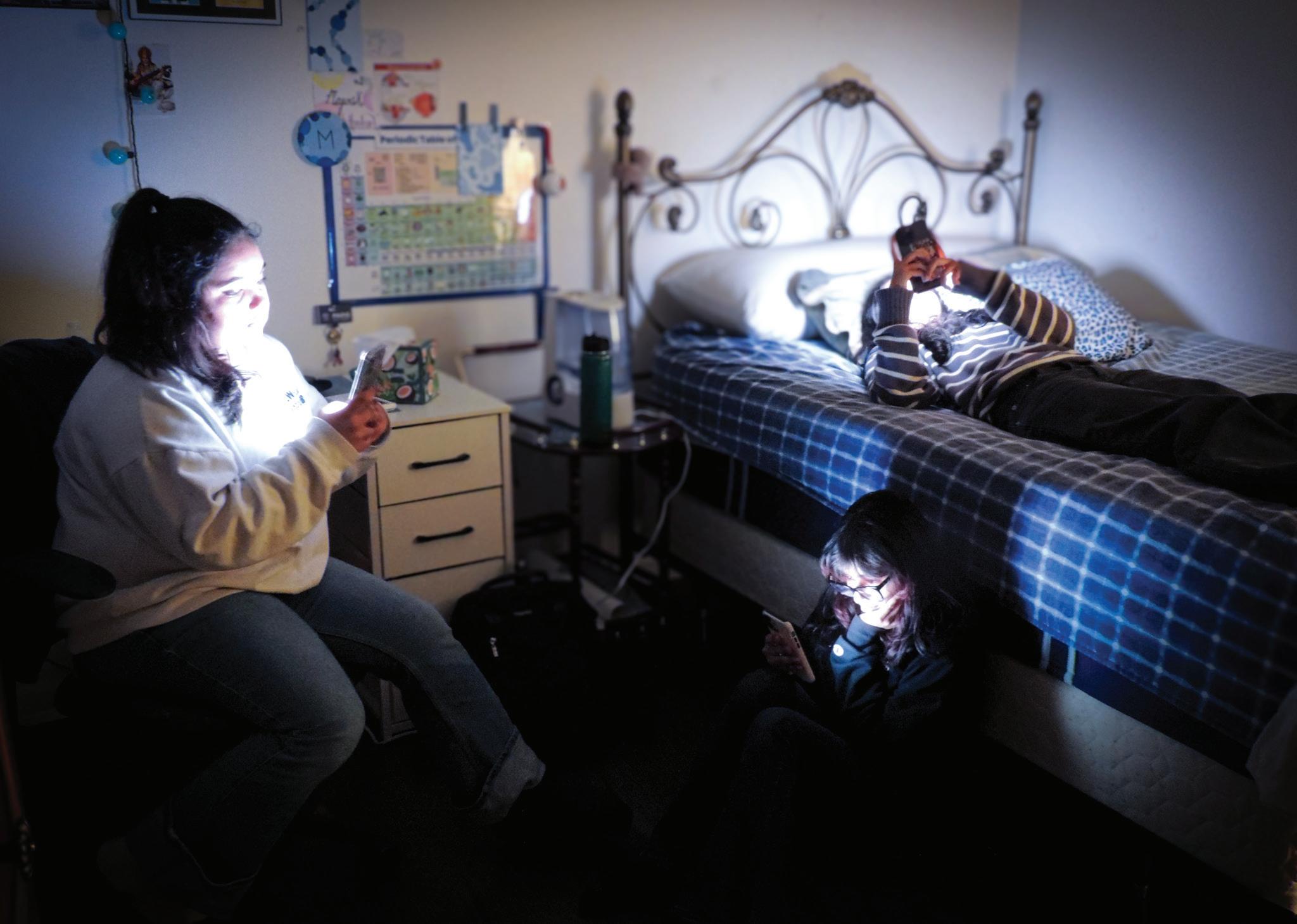
It’s 3 a.m., and the room is almost pitch black, illuminated only by the light coming from your phone. Your eyes are halfclosed as your thumb moves autonomously. While you know you have school the next day, and sleep is only an off-button press away, your thumb keeps swiping, keeping you locked in a TikTok-scrolling trance. While this is just one personal anec-
dote (full disclosure: it’s mine), Sacramento Country Day students have reported issues with short-form content consumption habits. These include disrupted sleep, shortened attention spans and an inability to stop scrolling once they start.
A survey of 25 Country Day high school students was conducted Dec. 26 by email.
The results reflect only the 25 students who responded. 92 percent of students reported that they knew someone who is addicted to
screen time. In regards to screen time over winter break, 24% reported an average of 10 or more hours of screen time per day, 20% of students reported seven to nine hours, 36% reported four to six hours, 20% reported one to three hours and no students reported zero hours. Nearly half of respondents reported that they spent seven or more hours on their phone per day.
Despite these numbers, only 56% of students said that screen time over winter break
was a problem for them. One student, who requested anonymity, reported a 14-hour daily average, with one day of their week reaching 23 hours of screen time. Despite this, the student said that they were only “half addicted.” Short-form content addiction is real, and it’s affecting students throughout Country Day’s high school.
SHORT-FORM CONTENT page 3 >>
BY NOOR ALAMERI & KHIVI SINGH
The Octagon asked senior Ferishta Halim; junior Gabby Dos Santos Gonzalez; sophomores Henry Reynen, Patrick Tse and Brenden Yu; and freshman Emma Sullivan about the pressure to participate in extracurricular activities at Country Day.
While no teachers or faculty were part of the panel, middle and high school counselor Kelly Clancey reflected on the answers provided by students.
Dos Santos Gonzalez volunteers her time translating between Portuguese and English for her church.
Reynen is on Country Day’s basketball team, is in Mock Trial and is in Country Day’s chapter of DECA.
Tse is an outreach director for California Association of Student Councils (CASC), resells shoes and volunteers at Itsie Bitsie Animal Rescue.
Yu is part of the Ragazzi Boys Chorus in Redwood City, Calif. He also participates in
Halim currently tutors students at TRU Tutoring, is the vice president of Kindness Club, is on Country Day’s Varsity Girls Soccer team and is the president of the senior class.
BOYS VOLLEYBALL
The boys varsity volleyball team will have their first game at home on Feb. 24. They will be going against Aspire Alexander Twilight College Preparatory Academy. They willl also have a game on Feb. 26 at home against Pine Hills Adventist.
COUNTRY DAY DECA CHAPTER
The new Country Day DECA chapter, a business oriented elective, will be attending the State Career Development Conference in Anaheim, Calif. from Feb. 26 to March 1. They will compete individually and in teams.
Mock Trial and is vice president of marketing for Country Day’s DECA chapter.
Sullivan is a soccer player for the San Juan Soccer Club. She plays for two teams: the San Juan 09 Elite Club National League (ECNL) team as well as the U16 U.S. Women’s National Soccer Team. Sullivan was most recently ranked as the #15 player and the #2 defender for the 2029 in the nation class by Prep Soccer in January 2026.
Q: Do you feel like you have very little free time between school and other obligations?
Yu: My free time is luck-based. If the stars all align, and the moon is rising at this angle, then I get some free time to hang out with my friends. It feels like everything is demanding my attention — DECA, mock trial and choir outside of school.
Dos Santos Gonzalez: I don’t really do any extracurriculars or anything outside of school, but I still feel like I have limited free time. It’s so much work — the commute to school, all the hours we spend at school and then the homework that takes forever.
PICKING PRIORITIES page 3 >>

EDITORS-IN-CHIEF
Rehan Afzal
Eesha Dhawan
Anisha Mondal
Zema Nasirov
COPY EDITORS
Eesha Dhawan
MaddyRyanSchank Xu
NEWS EDITOR
Kate Barnes
FEATURE EDITOR
Jacob Rabe
SPORTS EDITOR
Parsiny Nijher
A&E/OPINION EDITOR
Anika Nadgauda
PHOTO EDITOR
Rehan Afzal
TECHNOLOGY STAFF
Ryan Xu, manager
Sid Shukla, assistant
PAGE EDITORS
Rehan Afzal
Noor Alameri
Lukas
BY LUKAS CHUNG
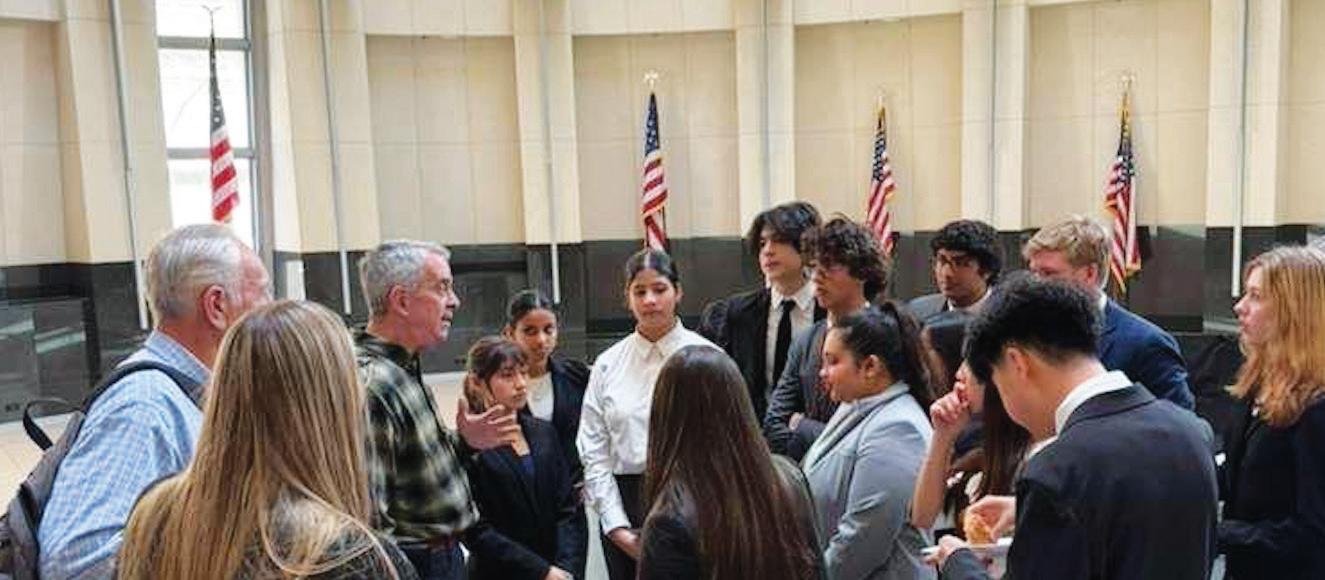
According to Mock Trial Coach Rick Lewkowitz, Sacramento Country Day’s Mock Trial team’s “real season” starts with the Gordon D. Schaber Mock Trial Competition (County Competition).
Held at the William R. Ridgeway Family Relations Courthouse from Jan. 22 to Feb. 12, the County Competition is the Mock Trial team’s first formal tournament against other schools in the state (all previous tournaments were scrimmages).
The Mock Trial team has won the County Competition for three consecutive years.
This year, the first round took place on Jan. 22, with the varsity team winning three ballots to zero against El Camino High School. The second round played out similarly for Country Day, with the team again winning 3-0 against Casa Roble Fundamental High School. In the third round, Country Day lost to Natomas Pacific Pathways Prep High School (NP3 Charter) 2-1, and Country Day lost to St. Francis High School 3-0 during the fourth round.
that,” Lewkowitz said.
Varsity defense opener sophomore Mayuri Kasturi felt as though she did well in the second round, where she won the award for “Most Valuable Player.” This is her second year of Mock Trial and her first on varsity.
“Before the trial, I was practicing with [Lin] and a few other people. I was stuttering, quiet and I kind of forgot my examinations,” Kasturi said. “Then, in trial, I locked in. I didn’t stutter during my opening. I was confident and loud.”
During the third round, senior co-captain Liam Donohue felt like the defense performed one of their best rounds.
“It was clean, no mistakes. I did an impeachment, catching someone in a lie. I thought we won — Coach thought we won — but even though the middle gave us an extra 30 points, the other two scorers had us on a two point to five point deficit,” Donohue said.
Due to these issues, Lewkowitz talked to the people running the tournament.
“They were like, ‘sorry, this shouldn’t happen,’ and they let the judge know in the future, like, ‘hey, this can’t happen.’ It was solved, but still annoying,” Donohue said.
The Mock Trial team ended up tying with Tamalpais High School and placed below them in fifth place. Donohue is still proud of this placement, as he notes that these teams were some of the best in the state.
Both the varsity and junior varsity (JV) teams are competing in the County Competition. Only the varsity team can advance to quarterfinals, as eligible teams are limited to one team per school. The junior varsity team could still compete in the four rounds of the tournament if they managed to place top two in the junior varsity qualifying rounds.
JesseChung
Dizon
Vivian Li
Anisha Mondal
AnikaZemaNadgauda Nasirov
Jacob Rabe
Sid Shukla
Zachary Vando-Milberger
BUSINESS STAFF
Sid Shukla, manager
Ammar Hussain
Parsa Salari
SOCIAL MEDIA STAFF
Anika Nadgauda, editor
REPORTERS
Chloey Fang
Trisha Gandhi
Lucas Holz
Ammar Hussain
Ethan Minton
MaggieParsaNuñez-Aguilera Salari
Maddy Schank
Khivi Singh
Susie BrendenWang Yu
PHOTOGRAPHERS
Rehan Afzal, editor
Zema Nasirov
MULTIMEDIA STAFF
Ryan Xu, editor
Rehan Afzal
GRAPHIC ARTISTS
Claire Gemmell
Zema Nasirov
Gavin Wang
ADVISER
Andrea Todd
During the quarterfinals round, Country Day faced Folsom High School and won by a tiebreaker of eight points after tying ballots. Country Day won the semifinals against Cosumnes Oak High School 3-0 and will compete Feb. 12 in the finals round against Elk Grove High School.
Senior co-captain Anika Nadgauda feels the pressure.
“The past three years, we have gone to the state finals, and we’ve done really well as a team,” Nadgauda said. “Being co-captain now, I feel like I really want to get this team as far as we can go. And so there’s definitely that pressure on my shoulders during these county rounds.”
This year’s case, People v. Fromholz, centers on Chef Haley Fromholz, a contestant on the reality TV show “Recipe for Success,” who is charged with first-degree murder for putting poisonous mushrooms into a rival chef’s dish during the semifinals. In this trial, the prosecution will argue that Fromholz did commit first-degree murder, while the defense will try to defend Fromholz.
During the first round of the County Competition, senior witness Lillian Wang felt like she did not perform her best.
“Score-wise we did really well, but I think that because it was the first round, it was a little bit rocky. It was also right after final exams,” Wang said.
Like Wang, senior Rebecca Lin faced issues with the timing of the first round, as it began at 6 p.m. on the last day of first semester finals.
“I had two finals that day. It was pretty bad. I had to study for those and also memorize the script for Mock Trial,” Lin said.
Lewkowitz’s main concern for the varsity team was tackling early-round objections. According to Lewkowitz, the students needed more practice with making objections and arguing against objections made by the other team.
“We’re going to be working a lot on
While Donohue felt like the defense performed well, Donohue notes that the prosecution team still needed work with small memorization issues and catching the weaknesses of the opponents. Despite this, Donohue attributes the win of the quarter and semi final rounds to the prosecution team.
“Until recently, I would say there was a big gap between the prosecution team and the defense team, but in the most recent trials, the prosecution team locked in,” Donohue said.
Best in State Clash at Bay Area Bash Bay Area Bash is an annual Mock Trial tournament held in early January. It features the best teams in the state, and is held at Hillsdale High School in the Bay Area.
The Top Witness award was given out to the top four witnesses out of around 80 total witnesses at the tournament. Senior Rya Allen, playing the roles of two witnesses, Alden Mitchell and Jean Kronstadt for the prosecution and defense respectively, won the Top Witness award at the tournament. The varsity Mock Trial team placed fifth place out of ten teams.
“I love being a witness. I did theater as a kid, so I’m very into acting,” Allen said. Allen attributes her success mainly to being able to get into character as a witness. Having taken French for many years, Allen says that she confidently speaks French at a C1 level — the level just before fluency — allowing her to pronounce French words used by the French character Kronstadt, a friend of the defendant and a defense’s witness.
This year, Allen also plays what she describes as a “vegan influencer.”
“I feel like there’s a lot of room there to be able to stand out, especially on cross examination. I think that the French accent gives a lot of character in itself, because you have to stand out in some way,” Allen said.
Nadgauda believes competing against the best in the state provides valuable experience and a morale boost.
“It’s really tough competition, and to see that we are somewhat able to measure up to these teams provides a lot of our team members this boost of confidence,” Nadgauda said.
According to Wang, County Day’s varsity team suspected perceived favoritism when competing against Tamalpais High School during Bay Area Bash.
“It was really weird. [Donohue] would try to argue an objection, and the other team just wouldn’t listen. The judge was just letting this happen,” Wang said.
During the Bay Area Bash competitions, there was a different rule where both teams had to agree to the type of trial: a bench trial (the judge will make the decision) or a jury trial (made up of peers who make the decision).
“I said that we do a bench trial, no jury, so you can’t look at the scorers. They essentially ignored that, and the judge went along with them. I just had to allow that, because I couldn’t fight with the judge,” Donohue said.
Before the qualifying rounds, the JV team faced an issue that put a “damper” on the team, where the team had to move courthouses with little notice, according to Lewkowitz.
Despite this, the JV team won second place, allowing them to compete in the County Competition in an actual courtroom, added sophomore Henry Reynen, a JV witness.
“It was fun being in an actual courtroom. Usually, it’s just a school, but this was an actual courtroom with a witness stand,” Reynen said.
Country Day’s JV Mock Trial team lost their first and second rounds of the County Competition, but won 3-0 in the last round.
In the final round of the County Competitions, the varsity team will face Elk Grove High School.
“I think we definitely have a shot of making it to states,” Donohue said. “Elk Grove is who we’re going against, and they have been historically really good. For a while, we went back and forth on the championship, so this will definitely be an interesting round.”

(continued from page 1)
Why is short-form content so addicting?
“Once I start, I just can’t stop scrolling,” junior Sunny Sui said.
This is called “doomscrolling,” a term coined by psychiatrist Ariane Ling that describes scrolling indefinitely on social media.
The Brown Undergraduate Journal of Public Health studied what makes short-form content so addictive, specifically how TikTok uses a format that mirrors a slot machine. Each swipe on TikTok gives the brain the same patterns that a slot machine would.
The algorithm for this short-form content also directly appeals to a person’s likes and their sense of humor. This makes the kind of content that each person finds funny or entertaining appear more often, “rewarding” them for scrolling more and making their brain want to scroll continuously for that dopamine hit.
Issues with “Doomscrolling”
The endless scrolling aspect of short-form content also prevents people from reaching stopping points, like with normal long-form content. For example, a long YouTube video has an ending, while with short-form content, the video repeats until the user scrolls to the next video. This allows people to continue scrolling for as long as they please, making it even harder for some to stop doomscrolling.
Head of High School Brooke Wells shares his concern with short-form content.
“I think what people need to be careful to make sure they develop the longer term concentration, so you still need to be able to learn to sit down and read a book,” Wells said.
A 2025 American Psychological Association (APA PsycNet) study found that watching shortform videos is directly associated with poorer attention spans. Continuous use of social media makes it much harder to stay focused on tasks
that require sustained efforts.
Freshman Abby Hageman finds herself having trouble with that exact issue.
“I don’t want to be doing homework, so in the middle of me doing homework, suddenly I’m just scrolling,” Hageman said.
Along with ruining attention spans, APA PsycNet’s research has found that memory and mental health also declined in individuals who consumed short-form content. Despite these harmful effects, Wells emphasizes that short-form content isn’t inherently harmful.
“My United States history students get most of their current events from TikTok. It’s not a bad thing as long as it’s moderated,” Wells said.
Students also use short-form content as a way to relax after a long day of school.
“I’m a pretty spontaneous person, so I like to just wind down by scrolling,” a student who chose to stay anonymous said.
Solutions
While short-form content has existed for years in Vine (2013) and Snapchat (2015) — TikTok was where it boomed in popularity. This spike in popularity led to short-form content becoming an essential item on numerous social media apps, like Instagram Reels and YouTube Shorts. Just abstaining from one app is not enough.
If you’ve ever tried to delete TikTok or a different social media app, you may find yourself suddenly engrossed in a different but similar shortform content platform.
Senior Ryan Xu has found a solution that works for him.
During the summer of 2025, Xu went on a trip where he didn’t have access to his phone for five weeks.
“I remember during this time, I felt a clear and obvious increase in my attention span, and once I got back, I realized that I actually didn’t want to scroll Instagram reels or do anything like that,” Xu said.
Although Xu quickly saw results from his short-form content detox, he reported that he found himself gradually spending more and more time on Instagram Reels after coming back from his trip.
According to Xu, a detox may work, but it could also lead to a relapse quite easily.
“Just uninstall Instagram, but then again, everybody uses Instagram for communication and keeping up with friends,” Xu said.
An alternative to a complete detox is by limiting usage of these apps.
Limiting Usage
One strategy sophomore Mayuri Kasturi found effective for limiting short-form content use is setting a timer for how long a person can watch short-form content for.
“I just set 15-20 minute timers on my phone to scroll, and when they go off, I make myself do my homework,” Kasturi said.
For Instagram users, a helpful feature is the “Time Management” feature, where users can track Instagram usage and set reminders that pop up after a set amount of time on the app.
If setting timers don’t work, senior Rebecca Lin has found using time management apps helps limit her phone usage.
“I have this app, Fatty Cat. It locks your phone and starts a timer for when you can use your phone again. Every time you complete a cycle, it feeds food to your cat. If you starve your cat, you get a really sad animation.,” Lin said, “I use another app called Screen Zen. That’s the one with the streak. I get to unlock my phone five times per day for five minutes each. If you break the streak, it also gives you a sad animation.”
Junior Carson Yu finds that a major part of procrastination is due to the amount of resistance there is to doing harder work.
“I mainly scroll to avoid things I don’t want to do, like homework,” Yu said.
This makes it hard to even start homework, as
there are so many easier and more gratifying options, such as scrolling.
According to a 2023 Frontiers in Psychology study, short-form content provides almost immediate pleasure and satisfaction, as the algorithm is based on what each individual likes the most. This makes doing homework impossible, as a path that has a way easier alternative is so easily accessible nearby.
A solution to this is to add more resistance to scrolling. For students, a way to add more resistance is by removing short-form content apps from their home screen and suggested apps list. This way, students have to specifically search for these apps to use.
For students that really can’t focus on their work, instead of going through with opening these apps, they can take a small break unrelated to scrolling, which can help reset the brain.
Consuming short-form content before bed is also a major hurdle for many students. Sui finds this to be his main problem.
“I usually scroll before sleep. I just open my phone and keep scrolling. Next thing I realize, it’s two in the morning,” Sui said.
Harvard Health Publishing also presents a possible solution to Sui’s issue: keep your phone far away from your bed.
Instead of having a phone readily accessible nearby, like on a nightstand or on the floor, simply moving the phone farther away, can add a lot more resistance to scrolling. This can also be applicable when doing homework. Instead of bringing a phone everywhere, students can just leave their phone in another room if they’re trying to do homework.
For a student at Country Day, it could be 3 a.m., but instead of doomscrolling, the student could be peacefully asleep, with their phone charging in another room.
(continued from page 1)
When I get home, I’m so exhausted it takes me forever to do anything. Even if I just have homework, sometimes it takes me hours and I get very few hours of sleep, about four or five per night.
Reynen: I’m kind of on the opposite end of the spectrum. I have a couple extracurriculars — DECA, basketball and Mock Trial — and I take some AP classes, but I still have a lot of free time. I think that’s because I don’t have a lot of homework each night. I just study. I get about five hours of free time per day.
Q: Do you ever get burnt out from the combination of extracurricular activities and schoolwork?
Sullivan: I definitely do get burnt out. I play soccer at a really high level. When I get a lot of accomplishments in a short amount of time, I want to keep playing. But, honestly, when I have a lot of free time and I’m not in a team environment, it’s hard for me to continue working and training for it.
Halim: For me, most of my time is spent working. Especially on Tuesdays, I tutor three students back to back for four hours in total. They’re all math. It takes a lot of my brain energy. Then I get home and I think, “Oh, now I have to do math homework.” So that’s five hours of math in total. It’s draining.
Q: How do you choose your extracurricular activities? Did you select any for college admissions?
Sullivan: I play on a team where the majority of my teammates have already committed to colleges. So for me, my sport is what is taking me to college on a scholarship.
Even if I didn’t play soccer, I think I would get into a good university, maybe not the highest, but a good level. I am an optimistic person, and I like doing things and maintaining good grades. But my strength is in writing, so I feel as though I would pursue English-based activities if I couldn’t get recruited.
Yu: Choosing something just for a college is probably the worst decision that you could ever make. If you’re using that to motivate you and find something that you love, I think that’s great, and I think that that can lead you to great places. I think if you choose something because it will look great on college apps, you might get to that activity and think, “I really hate this place, but I need to stay on board so that this looks amazing on my college apps.”
If you can combine something that you find impressive, not just pleasing a college, but pleas-
ing yourself, and you combine that with your passion, I think that brings you so much more in the long run.
For me, if I’m choosing extracurriculars, it’s whatever my heart leads me to, whatever I’m passionate about and something that I can do without being frustrated.
Tse: A lot of my extracurriculars I do because I like them. But, there’s one — CASC — where last year I was kind of scared about getting into college, and I was talking to a senior, Garrett Xu ‘25, and he set me up with his thing.
At CASC, we hold conferences and create bills to propose to government officials. I work as an outreach director, so I email schools and ask them if they want to participate.
At first, I just did it because I thought it looked really good for college apps. But as time went on, I realized that this is something I really want to do. I didn’t initially think that I was a “policy person.” I thought I was more of a “STEM person.” But I realized there’s so much power in policy making, it’s what I want to do.
Q: Do you think that Country Day has a culture of prioritizing academics and getting into colleges over your mental health, over your sleep?
Halim: Even if it’s not pressure, everyone in the school is always like, “This person committed to this place,” or “This person got into that college?” and I was like, “There’s no way I’m gonna get into a good college.” The pressure from everyone, even from your classmates, is a lot.
I would sacrifice so much of my sleep. I remember last year, I had an average two to three hours of sleep every night, and in every single class I was dead asleep. I was not doing great. I feel like that was because there’s just pressure at school and it feels like everyone is doing really good compared to you.
Before I started applying for colleges, I felt a lot of pressure to stack extracurriculars. I was always worried that I wasn’t doing enough. Like I wasn’t doing this extracurricular, or that thing.
Clancey: It is not good if a student is involved in so many extracurriculars that they are not getting enough sleep. While you’re learning and while you’re in your teenage years (especially middle school to 9th grade), you need as much sleep as a toddler. Sleep is super important. So when extracurriculars are getting in the way of getting good sleep, they’re getting in the way of your health and your ability to finish homework and have normal teenage time, that’s out of balance.
Tse: I think Country Day cares a lot about passions and not overloading you with college be-
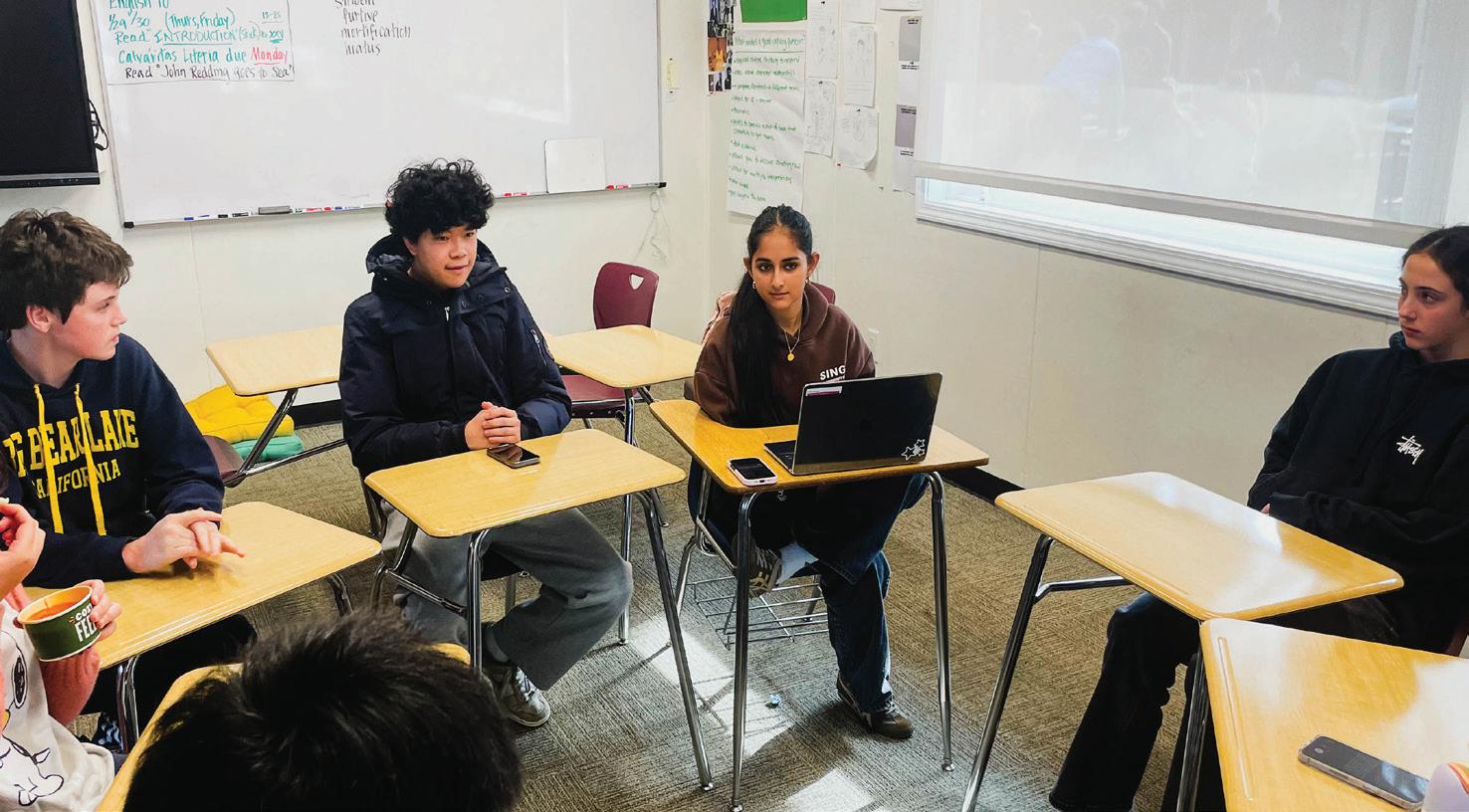
PEERS AND PRESSURE Students come together in order to discuss academic pressure they are facing. PHOTO BY AMMAR HUSSAIN
cause I, on average, have one hour of homework per night. These high schools that really want to push you to go to the best school you can go to, they’re averaging three or four hours of homework per night.
At Country Day, you have a lot of free time. That’s my experience. Teachers are really nice about your grades. They give you a lot of time to explore other things. And I know because I do more stuff outside of school than I do inside of school.
Dos Santos Gonzalez: I’m a first-generation immigrant, and I am going to be a first-generation college student in my family. And there’s a lot of pressure from outside. Even if people aren’t saying it, they’re like, “Oh, you’re so smart. You work so hard. You’re gonna go to great places.”
You don’t want to disappoint these people who have put their hopes on you. Students are very nice to you, but, unintentionally, they do end up putting pressure on you.
I also have a [Sacramento Country Day] scholarship, and I also feel that pressure to do really well, because I have to live up to what people expected me to be, or what they thought my potential should be.
Q: What do you want your parents to know about the pressure that you’re feeling? Your teachers?
Sullivan: For teachers: I have a lot of absences for soccer so I have a lot of work to make up, and I don’t really have time while I’m absent to do it. So, just having some lenience and not pushing to complete all these assignments in such a short amount of time, when I’ve been gone for one to
two weeks, and I’ve been missing a ton of review or new topics would be helpful.
There’s an idea that you can ask your peers for the notes or this and that, and in reality, that’s not how it always works.
I think that it is fair for me to get more time than other students because what I am doing is my future and what I will most likely do as an adult, and it takes up such a large amount of time and dedication that’s only fair.
On my trips, I have meetings and homework from my sport, which usually requires me the amount of time that is left for homework and quite frankly takes my motivation and brain power to do assignments.
Tse: I’m growing up with a lot more advantages than my father, and he was able to go to college and build a career, and it’s pretty scary that maybe I won’t be able to live up to that because I’m starting at a higher place than he is. It’s nobody’s fault. It’s this made-up thing in my head. But I just want them to know about it.
Clancey: If students are feeling a lot of academic pressure, they first and foremost should go talk to their teachers. Teachers are humans too. If a student is going through something, some sort of circumstance that’s beyond their control, then first and foremost, go talk to the teacher, and absolutely come talk to me too. Walk in as long as their teacher knows where they are or during free periods. If I’m here in my office without a student, everyone’s welcome to just come in, even if it’s just to vent or to ask advice. I’m here to help, and I have experience on a high school level.

AT YALE Irene Jung fills her day with fencing, time with friends, wandering the college grounds and finding her rhythm of college.
BY ANIKA NADGAUDA
Irene Jung, ’25, attends Yale University in New Haven, Conn. She is undecided on her major but is planning to pursue law.
Q: How did you end up choosing Yale?
A: I was recruited for fencing so the process was a little different for me. At the beginning, I was stuck between Yale and Princeton but when it comes to recruiting you have to pick one school and really zero in on it. They recruited me during November of my junior year.
I had visited both the campuses, but when I went to Yale I just felt drawn to it for some reason. Also, I knew a lot of the people on the fencing team there, so I would be going into a community where I already had friends so that was a big bonus for me.
Q: What was the application process like for you?
A: I still had to go through the Common Application and answer all the questions; the main difference was that I only applied to one college and I basically knew what the outcome was going to be.
So during the time that everyone else was applying it wasn’t as stressful for me, but a majority of the stress was in my junior year. That’s when all the recruiters start to really watch you, your performance and your grades. From junior year on I had to really stay on top of my games and my performance.
In terms of qualifying, for these schools, you obviously have to be good at fencing, but also you have to maintain good academics. I had to keep a high GPA, take a rigorous course load and score well on standardized testing through my senior year.
Q: What is the fencing community like at Yale?
A: I think there are nine freshmen across all three weapons [foil, epee and saber]. Overall the team consists of a pretty equal distribution of boys and
girls. That’s just because you need at least four or five men and women per weapon. So if someone graduates or leaves we try to recruit someone who can fill that specific gap.
We have a really great dynamic too. We have dinners together and outside of practice a lot of us take the same classes so we study together or help each other out if we miss a class.
On top of that, before I even joined the team, I had all these friends and people I had already spent so much time with. I think a lot of people get anxious about not finding their people or their friends in college, but because of fencing and already knowing people, that really wasn’t an issue for me.
Q: What is your practice schedule like?
A: I have practice Monday through Thursday in the mornings or afternoons. Then we have competitions back to back on weekends in November and December.
We had a competition with University of Pennsylvania last weekend and we have “Ivies” this weekend which is with all the Ivy Leagues. All of the competitions are really time consuming, but I enjoy it. I mean it’s really fun and I’ve never really had issues managing time. The academics are difficult, but if you put in the effort to balance your time.
Q: What classes have you taken/are you taking?
A: I take four classes each semester. My first semester was a lot of STEMbased classes because, at that point, I was kind of interested in a STEM-based major. But at Yale you don’t have to declare your major until your junior year so I am still keeping my options open.
I had already decided before school started that first semester I would take more STEM classes and second semester I would take more humanities classes so that I could kind of explore everything early on.
Q: What is your favorite class so far?
A: My favorite class is my level five
Korean class [KREN 1540A]. In this class you’re supposed to be able to speak fluently about emotions and conflicts. We also watch a lot of different shows in Korean and then we have to analyze them. It’s a really cool way to learn new words because I always say I’m fluent in Korean but I’m still able to learn these new words and phrases.
Q: What is Yale’s average class size?
A: For lectures, probably 200 to 300 people. In more seminar type classes, or my Korean class, for example, there’s only 15.
I know there’s some seminar classes that only have like, nine or 10 students, and so it really just depends.
Last semester I took a lot of lecture-based classes, and it was difficult because the professor wasn’t able to focus on specific students.
People take seminar classes as a good thing and a bad thing. A good thing because they pay attention to you a lot more, but it’s also a negative if you are skipping class or goofing off.
Q: What do you do for fun?
A: I hate to say this, but my friends and I have a lot of fun when we’re — quote, unquote — studying. We go to a coffee shop and we’re like, “okay, let’s study.” But then we never study, and it’s basically just like a yap session.
But other than that, the student council puts on a lot of social events. We’ve had snowball fights and food competitions that I’ve really enjoyed.
Q: What’s your dorm like socially?
A: I know in my residential college, Silliman, it’s considered like the best one, I guess, just because everyone in here is like our family, and also the food is really good.
What I like about my college specifically is that Silliman, the Residential College, has a really good group of “FroCos,” which are freshman counselors, and they basically do a really good job of having weekly events. I think one time they did movie night with popcorn, and another time they ordered catering.
Q: What do you do for food?
A: I think we did have a mandatory meal plan this year. Basically, we just have swipes at the dining hall, plus we have like points and you can use them at cafes when you’re studying.
Each of the 13 residential colleges has their own dining hall. And so a lot of people just go to each dining hall and kind of try out all the different options. My favorite is definitely Silliman and I might be biased but I think the food is really good but the workers make a big difference. Some of the options they have are grilled cheese Thursdays or chicken tender Thursdays. They also always have hamburgers, a salad bar and grilled chicken options.
Because I go to the dining hall on a regular basis, I’ve gotten to know a lot of the workers there and they’re so kind and funny that you have a good experience while eating good food.
Q: What was the transition like from Country Day to Yale?
A: I think it was definitely a big switch from having a small group of people to a large group of people. Going from such a small school to literally seeing people that I’ve never seen before even a semester into school.
Today, for example, I met someone that I haven’t seen before, and she said, “Oh, I’m a freshman,” and I was like, “Oh, wow.” I feel like in high school, I knew everyone, and I knew everything about everyone. I kind of miss that family aspect of it. But, I definitely think that a larger group of people and a larger environment is also really nice, just because you get to meet new people all the time.
FIVE STAR OR SUBPAR?
Quality of classes:
School Spirit: Food:
Social Scene: Location:
Student-Teacher
Interactions:





hut up and listen!
That’s the name of Jackson Whited’s band, and he’s here to take the stage.
“Shut up and Listen” started as a continuation of the band the “Grubs” the year after lead singer of the band and Sacramento Country Day alum Harper Livesey ’24 graduated.
The band consists of senior Kale Patel on electric gui tar, junior Kai Finley tickling the ivories, and lead singers sophomore Mayuri Kasturi and junior Connor Hannafin. Whited plays the electric bass.
Due to an increase of students joining the musical pro gram at school, people needed to be distributed to differ ent bands, so Whited decided to stay a part of the band “Shut up and Listen.” The band’s name was a result of a discussion (debate?) Whited had with his friends.
“I talked to people about how hard it was to name a band, and they also felt like no one ever could agree on the same thing. One person said, ‘Just tell them to shut up and listen, and go with it,’ and we all stopped, and we decided that was it,” Whited said.
Whited has been at Country Day since pre-K, making him one of the lifers of the senior class. He started play ing instruments at the age of six, beginning with the pi ano in first grade, and broadened his range in fifth grade by teaching himself the electric bass. He has recently picked up guitar-playing — both electric and acoustic.
According to Whited, he has a musical family — his dad plays piano and played the drums in high school, and his grandfather and brother are drummers.
“I think the more I played music, the more interested I got, and the more I kept pursuing it. So my passion just built off itself,” Whited said.
Right now Whited is learning how to play the harmon ica, possibly the drums and the mandolin.
Whited has played for other Country Day bands. He joined middle school orchestra in fifth grade and middle school jazz band in sixth grade. During Whited’s fresh man and sophomore year in high school, he was in Coun try Day’s concert band, and he continues to help out on occasions. He joined the school’s garage band as a fresh man.
Garage band has broadened Whited’s music taste, and helped fuel his passion for music.
“If it wasn’t for garage band, I would be a very different person. I didn’t really listen to a lot of rock music until I started garage band, and after, I listened to rock almost every day. It’s just helped me become more invested in music, and it’s given me one of my favorite hobbies,” Whited said.
Being a part of the band is time consuming.
“I spend at least five to seven hours — with probably a little more with outside practice time — plus a week prac ticing,” Whited said.
“Shut up and Listen” practices twice a week, on Tues day and Thursday mornings. During practice, the mem bers spend their time rehearsing covers of songs and lis tening to recordings to decide who will do what parts and how they can give each song their own personal touch. Whited describes the band as both talented and awesome.
“Some of the other band members might say that’s corny, but I think it’s awesome. There are talented mu sicians like Kale — I don’t know if there are many people who can do the guitar solo of ‘Crazy Train’ and make it look easy,” Whited said.
“Garage band was really instrumental — no pun intended — in helping me appreciate the music I listened to. I remember showing up for auditions for garage band. They were looking for new people, and I ended up loving it — I didn’t want to stop,” Whited said.
As Whited’s love for music grew, so did the lists of artists who shaped his playlists. At the top of the list sits



Before big concerts, “Shut up and Listen” preps by hyp ing each other up, encouraging one another, and making sure everyone’s energy is excited before the show.
If Whited makes a mistake before a show, he makes sure to keep his poise and continue playing like nothing happened.
“I just tell myself, ‘No one knows the song more than you do, or that no one knows your part more than you do.’ The biggest thing is to act like what you played is what you meant to play — it’s all about confidence,” Whited said.
Whited advises that the more you believe in yourself and build confidence, the more immersed into music you can become. He also expresses that the more you can get into it, the more fun you could have.


I’ve known them longer than I haven’t known them,” Whited said.
Whited hopes to continue pursuing his passion for music in college, minoring in music.
He also wants to leave a lasting impact on the band program and hopes that people continue to improve and add to it even after he leaves. He also would like to be







“I was required to dumb down my sentences,” one respondent wrote about resubmitting flagged work. Others described feeling as if they had to show their document history to teachers.
Junior Kimberley Yin, currently enrolled in AP English Language and Composition (AP Lang), has been flagged two times — the first being for an essay describing Charles Nahl’s painting “Little Miss San Francisco.”
“I heard stories of it happening, but I didn’t expect that I would be affected by it,” Yin said.
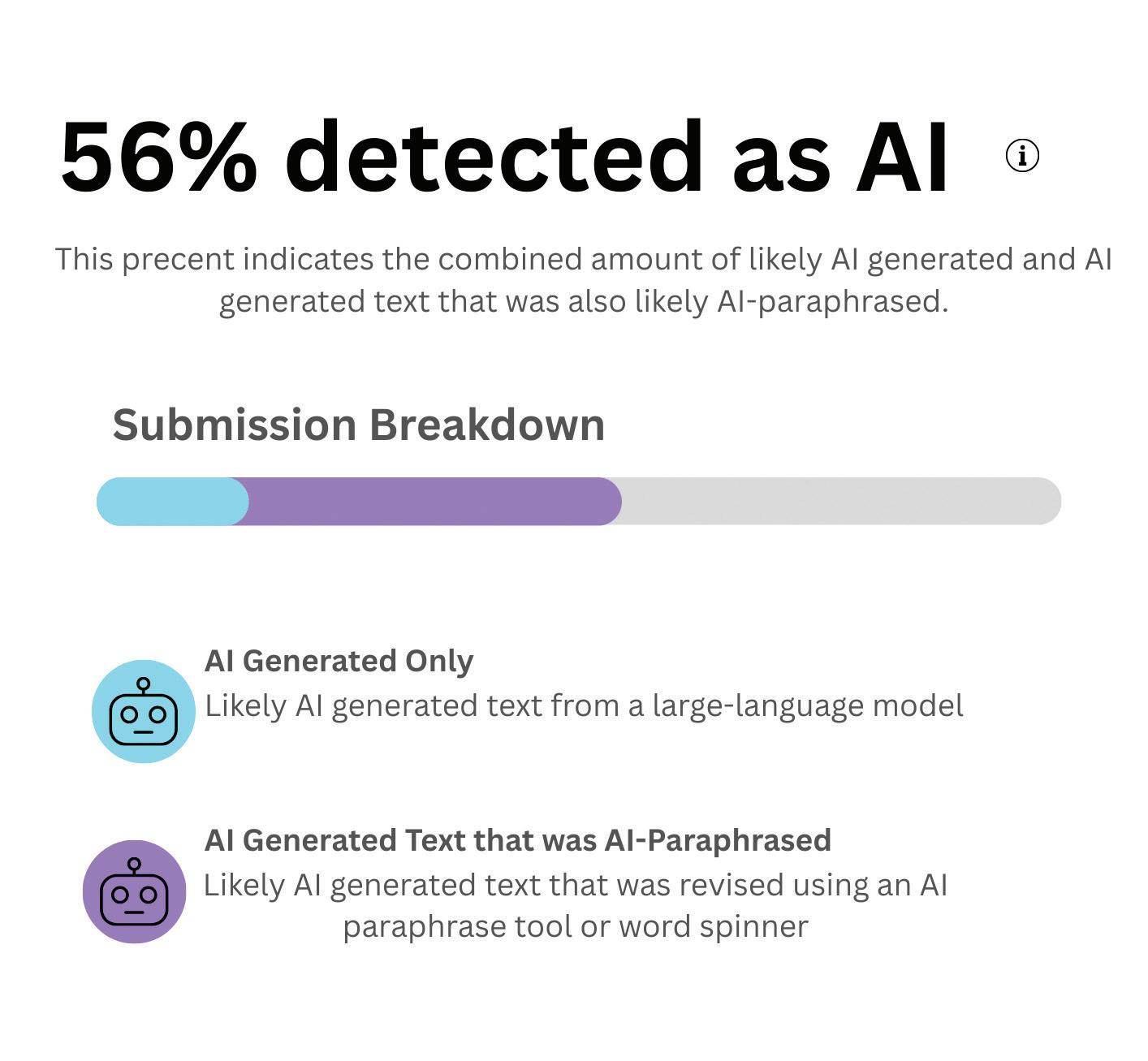
The second flag came on an essay about “a remembered event.” The AI score was 41%.
“I was like, ‘there’s no way I’m going to get flagged the second time.’ And then it did get flagged,” Yin said.
Agyeman found out that her essay was flagged for 46% AI two weeks after submitting it. While others received grades, hers remained blank. She reached out to English 10 teacher Hannah Hohle to ask why.
“I thought it was a mistake,” Agyeman said. “How would I even be able to use AI in a personal essay? I wouldn’t be connecting with my reader if I were to use AI.”
To address AI claims, Yin included screen recordings of her version history and external studies on AI detector inaccuracies in an email to her AP Lang teacher, Jane Bauman. She had already replaced all instances of em dashes — punctuation she’d learned could trigger flags — with alternatives before resubmitting.
Yin spoke privately with Bauman shortly after-
A National Research suggests A study by Berkeley tested identify AI-generated When adjusted little as 0% of Turnitin itself
Officer Annie “real-world use released guidance made another Turnitin did Reliability issues York University Contrary to Turnitin’s itives being closer speaking students.
wards on Jan 26. The meeting involved going through the flagged sections of her essay, where Yin explained certain vocabulary or phrasing choices.
Outcomes varied. Agyeman shared her document history and wasn’t required to rewrite her essay.
“I’m glad I didn’t have to rewrite it, but I just don’t like how it was perceived as AI when it wasn’t,” Agyeman said.
Others faced harsher consequences: a peer of Agyeman’s at Country Day was flagged for 100% AI content. That person was required to rewrite the entire essay by hand and had all teachers and parents notified.
“It was this whole big thing,” Agyeman said.
Sophomore Sorelle Berger had been flagged at around 20% for a separate essay in Hohle’s class.
“I literally haven’t opened ChatGPT in five months,” she said. “Teachers need to look into it. I think Turnitin gives them the thought that it’s doing the work for them.”
Teachers are aware of Turnitin’s unreliability.
“I was naive to think that this wouldn’t be a factor in my English classes, but I was really wrong,” Bauman said. “It’s hard to prove that somebody has used AI to generate an answer or to clean up their writing.”

CASE FILE
SUBJECT: KIMBERLEY
Assignment:
Response: Quizzed
Outcome: Rewrite
Problem suggests Bauman’s concerns are well-founded. researchers at Carnegie Mellon and University of California, tested seven popular AI detectors and found they struggled to AI-generated text without also flagging human writing. adjusted to minimize false positives, some detectors caught as of AI text.
itself acknowledged issues early on. In June 2023, Chief Product Annie Chechitelli told education trade publication K-12 Dive that use is yielding different results from our lab.” The company guidance for educators on handling false positives but has not another public media acknowledgement of the issue. not respond fo issues have prompted institutional action elsewhere. New University (NYU) disabled Turnitin’s AI detection in September 2023. Turnitin’s 1% claim, NYU found the percentages of false poscloser to 4% — a rate that increased for non-native English students.
“There is no reliable AI detection tool we can recommend to faculty,” NYU’s administration wrote in a memo to faculty.
Boston University disabled the tool in July 2023, citing “false positives and lack of supporting evidence for its efficacy.” As has Georgetown University and University of California, Los Angeles in the same year for similar reasons.
Bauman experimented with Pangram Labs, another AI detector. It was “not worth it.”
“Turnitin will say something is 100% and Pangram will say it’s 0%,” Bauman said. “That can’t be true. One is too highly-attuned, and the other wasn’t.”
Bauman continued using Turnitin for the final exam.
The flags themselves often seemed arbitrary. Bauman noticed that when students removed em dashes from their writing, their AI scores dropped.
“I have seen where a student has taken out dashes and the AI flag has gone down,” Bauman said. “Well, that’s just silly. It’s utterly silly. Dashes are a wonderful punctuation mark, and students should use them.”
“If you get AI to write an essay for you, you don’t have a voice. Your voice is gone,” Bauman said.
She recalled asking ChatGPT for its opinion of Frankenstein, the character: “It gave me a lot of information about Frankenstein, but it didn’t take a point of view,” Bauman said. “That is probably changing.”
Brooke Wells, Head of High School, weighed in.
“I think we need to protect you all from the temptation of taking a shortcut for what you think is a short term goal of getting an A but the end result being that you can’t write a paper,” Wells said.
Jason Hinojosa, head of the English department, has noticed writing quality improving.
“Student writing seems much more polished in the last few years, which I think may be attributable to AI,” Hinojosa said. “But I don’t know, and that’s sort of the puzzle.”
When seniors wrote handwritten essays in his class, he was pleased with the results.
“I told my seniors that their handwritten essays were excellent, which was a wonderful affirmation of their skills,” Hinojosa said.
With take-home essays, he might have wondered if AI was involved. Having these essays done in-class removed that doubt.
Still, he remains uncertain as AI keeps evolving.
“I just have to admit that I haven’t really wrapped my head around it yet,” Hinojosa said. “It seems like a bit of a moving target because the improvements in AI are happening so rapidly.”
Solutions include Lockdowns Browsers, Handwritten Exams
Hinojosa noted that faculty first met to discuss the implications of AI “three or four years ago.” Discussions about detection tools like Turnitin “have been happening more frequently since last spring.”
The school is considering lockdown browsers, according to Wells. Hinojosa said trial runs have already begun, alongside a shift to pen-and-paper exams.
“Because I feel like I can’t rely on [AI detectors], I don’t have very many options other than in-class essays,” Hinojosa said.
Agyeman’s English 10 class already experienced a shift to handwritten assignments, including their final. Because the work was completed at home, the possibility of AI use remained.
“There were so many chances where people could have used AI in the paper when we took it home,” Agyeman said.
Handwritten assignments come with their own complications. A 2024 study published in the Journal of Emerging Technologies and Innovative Research found that “the mental effort required just to form letters inhibits higher-order thinking, such as organizing ideas, choosing rich vocabulary, and developing arguments.”
For their final exam in AT English, students were required to write two cold-prompt essays by hand. Senior Kale Patel said that the essay itself “wasn’t bad” — he just would have found it “100 percent easier” to type.
“My right hand was super sweaty and cramping up, especially during the last hour,” Patel said.
Beyond physical discomfort, handwriting made revisions difficult. When Patel realized he had included body paragraph material in his introduction, he had to erase an entire section and rewrite it below.
Typing would have allowed him to “correct that error in a few seconds.” He was left with “a couple of minutes left to revise [his essays], which definitely wasn’t enough.”
Some students pushed back on the premise itself. After being flagged twice, Yin said that she won’t change her approach.
“I don’t believe that I should change how I write just to satisfy the AI detector.”

“Studying Abroad” by Claire Gemmell
BY EDITORIAL STAFF
At Sacramento Country Day School, education blends with culture, and the school’s international exchange program is distinctly praised by students and families alike for its academic excellence, community involvement and student growth commitment. Country Day’s administration partners with UC Educations (UCE), a company involved in handling visa paperwork and assisting the process of enrolling international students.
Additionally, UCE assesses English proficiency for prospective students, conducts background checks on host families and coordinates placements. The organization also manages payments from students to schools and host families. Program costs vary based on services and individual student needs but generally total about $95,000, covering tuition, housing, health care, transportation and related expenses.
The program’s strong reputation among international students and their families suggests a partnership that functions smoothly and effectively. Or so we thought.
Accounts from some families and host parents point to a more complicated reality. Their concerns invite closer examination of UCE’s role, operations, communication and place within the Country Day community.
Some students remain anonymous out of concern for possible “retaliation,” the reason we excluded their names. A host parent who provided detailed written exchanges with UCE about communication and payment issues requested the same. Apart from admissions, UCE coordinates healthcare coverage for students. In the company’s “Supervisory Service Agreement of UCE American High School Students,” a discrepancy exists under the section “The Obligation of Party B,” which, in this case, refers to the student.
Between the English and Mandarin translations, only the English version mentions that “Parents are responsible for all expenses relating to vaccinations.” For parents who are familiar with Mandarin, such discrepancies can lead to misunderstandings, especially when the English version of the contract prevails.
A copy of the “Agreement to Serve as Host Family” contract was provided to The Octagon by an anonymous source. Among other things (such as
a requirement to keep the content of the contract confidential from the student and any third parties), it restricts students to taking “showers no longer than seven minutes.” Practical? Sure. Enforceable? Doubtful. Reason for the stipulation? The Octagon was never provided a chance to ask for one.
Transportation has also posed challenges. The Octagon found that when host families were unable to provide transportation, some students relied on Lyft or Uber. Lyft prohibits transporting unaccompanied minors under its company policy, while Uber requires minors to use teen accounts that allow parental location tracking.
Jiayu Tang, a Country Day alum, recalled a time UCE quoted $300 for each passenger for the pickup from the San Francisco International Airport back to Sacramento.
“We thought the quote was unacceptable, so after our 11-hour international flight we had to pick up our luggage at San Francisco International Airport, re-check it, and then continue on to Sacramento,” he said.
In the end, his host family was willing to pick him up voluntarily without charges. There were no notifications sent to the host family that the agency was compensating for the ride. However, despite no driving being involved on UCE’s behalf, the agency charged the transportation fee.
The pandemic strained Country Day’s international program. Participation declined, host family housing became more crowded and placement options narrowed.
An anonymous host parent said it was unclear what system, if any, UCE used to match students with compatible host families and added that vetting appeared limited to basic screening paperwork.
The host parent said they were initially expected to serve as a temporary placement for a student but found that responsibility for securing a permanent host family largely fell to them, requiring repeated follow-ups with UCE. They also said the organization provided little ongoing support for either the host family or the student and offered minimal check-ins regarding the student’s adjustment, academics or social experience.
On UCE’s website, two service hotline numbers are provided. One of them at the bottom of the webpage is 400-666-8888, a placeholder number which does not connect.
Despite these challenges, many host families reflected the positive experiences of hosting.
Chauncey Hayes, who has hosted international students for seven years, said that hosting students helped him and his wife avoid “empty nest syndrome” after their daughter left for college.
Dean of Student Life and former UCE host Patricia Jacobsen says that her only regret from hosting international students was not having the time to take them on exploratory, ‘sightseeing’ day trips.
Jacobsen suggests international students, with the school’s help, organize field trips to places the region is famous for (Lake Tahoe, Apple Hill) so the students would be able to have these opportunities that individual host families may be unable to provide.
Several families and host parents worry about the high cost of the international program relative to what they describe as “minimal” support provided. Jacobsen shared that after COVID, host family compensation remained unchanged despite rising costs of living.
Jacobsen said international students are often accustomed to navigating life far from home, in independent environments such as boarding schools. That independence can sometimes lead to challenges. Head of School Lee Thomsen said there have been instances in which a student traveled to another city overnight without first informing a host family. In situations like these, Thomsen said, the school steps in.
Thomsen added that building the experience and systems needed to support a growing program takes time, particularly as both the school and the agency expand.
We sent Peter Xie, the founder and managing director of UCE a list of questions pertaining to company policies via email on Jan. 2.
Xie declined to comment, stating that the questions pertained “to confidential company matters, including contracts signed with past and current students, as well as internal aspects of the business.” At the same time, Xie wrote that “nearly 60 students” have graduated from the program at Country Day and are now “doing exceptional work across China, the United States and Europe.”
UCE has worked with Country Day for decades, but as the international program rebuilds after the pandemic, the moment calls for closer attention to persistent concerns and an opportunity to strengthen the program for students, families and the school community.
BY PARSA SALARI
“This time is going to be different, I feel it.”
These are the words from one of my immediate family members, living in the United States, after watching the news about the protests in Iran at the beginning of the new year.
Life in Iran, however, has become the same monotonous routine for my grandmother, who describes it as such: “Wake up, put your hijab on, leave the house and don’t say anything Ayatollah won’t like.”
Ayatollah Ali Khamenei is the ultimate authority in the Iranian government. His ancient Persian title “Ayatollah” roughly translates to “messenger of god.”
Millions of people all across Iran have had their basic human right to freedom stripped from them. Women are forced to wear hijabs and the residents of Iran cannot speak their mind without consequence.
Since late December 2025, mass protests have spread wildfire-like, scorching citizens’ lives throughout the country.
The Iranian currency has collapsed as well. Previously, $1 was worth about 42,000 Iranian rials. Now $1 is worth around about 1.2 billion rials.
Initially organized to protest the collapse of the Iranian currency, Iranians have taken to the streets peacefully to protest against the 46-year-old regime.
According to The Guardian, as of Jan. 27, 2026, the total death count from the repression of these recent peaceful protests of unarmed civilians is around 30,000 people.
In response, on Jan. 8, the Islamic Republic of Iran implemented a nationwide internet and telephone blackout, restricting access to the outside world until twenty days later on Jan. 28.
This was especially shocking for me and my family. One moment we were talking
with relatives about meeting up somewhere in California and the next thing we knew, the internet was cut off. When we called back, all we could hear was the ring of the phone.
Since this blackout, countless protests have been shut down via mass shootings that have resulted in tens of thousands of deaths carried out by law enforcement.
Iranians have become prisoners in their own country.
The United Nations Universal Declaration of Human Rights (UDHR) — the most translated document in the world according to the Guinness Book of World Records — asserts that “All human beings are born free and equal in dignity and rights.”
Iran is a signatory of the UDHR, meaning the government acknowledges universal human rights standards, alignment with UDHR principles and promises to protect individual human rights.
However, they choose to ignore the articles that conflict with their Islamic laws, such as ones regarding gender inequality, freedom of religion and freedom of expression.
Since June 4, 1989, Khamenei has had total control over armed forces, intelligence and security. The rejection of certain articles of the UDHR puts Khamenei at shame for breaking that natural law.
The Human Rights Activist News Agency and the United Nations (UN) have both also been in talks for a plan to support the citizens of Iran since mid-January of 2026. No actions from either organization have actually had any impact on protests or the regime, leaving the citizens’ attempts at protest futile.
Until 1979, Iran was ruled as a monarchy under Mohammad Reza Pahlavi as a shah (a historical title for “king” in Iran). In terms of everyday life, it was very similar to that of America. Freedom of speech was not punished and religion was not embed-

“Stolen Voices” by Gavin Wang
ded into the government. Policies requiring women to wear hijabs at all times were not a concern before Khamenei’s rule.
After the revolution that overthrew him in 1979, Mohammad Reza and his son Reza Pahlavi were exiled and have lived in Washington D.C. since.
Today, from films that oppose the regime and proper women’s rights to the imprisonment of journalists that post the truth, Iranians cannot catch a break when it comes to the harsh reality of their everyday lives.
Not only do Khamenei’s actions violate basic human rights — they inhibit the country’s development.
Things such as the economic future of the country and reduced innovation only scratch the surface of Iran’s possibly grim future.
Currently, the average protester in Iran ranges from ages 18 to 30. With a lot of these protests ending in bloodshed or nu-
merous arrests, many of the younger people are put at risk, leaving the country susceptible to failure on all fronts.
Most Iranians I have spoken with prefer the old monarchy as opposed to the new regime. Many Iranians call Reza’s name in protest as an act of defiance against the current regime and Khamenei’s rule.
Members of my own family — and arguably all of Iran — can no longer walk outside without the fear of something horrible happening to them.
Iran is being brutalized and destroyed by the man who is their leader.
Khamenei must be removed, and the world must demand that happen. The Iranian people are ready for a real difference — but without outside support, that help will never come.
The Iranian people are dying for change; they need the world to listen, and hold their leaders accountable for their crimes against humanity.
BY PARSINY NIJHER
The second the clock chimed midnight on Dec. 31, 2025, people began posting their throwbacks with captions and tags including “Wake up it’s 2016” and “2026 is the new 2016.”
Current Sacramento Country Day High School students — who were between the ages of 5 and 8 in 2016 — were arguably barely old enough to remember the trends which defined 2016 and made it nostalgic for most people in our generation — let alone make those trends marketable to us.
So…why?
Selling stuff? Maybe?
“Young adults,” for purposes of this argument, mainly those of Generation Z (who were 6 to 19 years old in 2016) are supposedly focusing on how great 2016 was and how everyone wishes they could go back to what they are marketing as the “good old days” (and are between the ages of 16 and 29 now).
While “doomscrolling” (the constant and excessive consumption of content) on social media apps like Instagram or TikTok, one is immediately bombarded with reels and photo dumps supposedly of people’s lives and memories during this time period.
Through these reels, you’re forced to re-experience the unfortunate 2016 “classics”: a playlist that might include “Panda” by Desiigner, “NO” by Meghan Trainor, “I Took a Pill in Ibiza” by Mike Posner and “Heathens” by Twenty One Pilots.
Didn’t participate in these musical experiences? Remember them fondly, however?
Here’s the explanation: Scrolling through videos attempting to capture the atmosphere of 2016 can actually cause one’s mind to invent memories. Meaning: if we didn’t directly participate in trends ourselves, we vividly feel like we remember, which may not just be nostalgia. It may be something else.
“Anemoia” is a term created by John Koenig who’s famous for coining terms which represent feelings and emotions that don’t have a name (“sonder,” “astrophe,” “lacheisism”). Anemoia is an emotional experience defined by Koenig as “a yearning for a past that you never actually experienced.”
Research shows imagination heavily contributes to anemoia. In an article about the relationship, Duke University professor Felipe De Brigard said that anemoia can be influenced by positive propaganda about the past and “is more likely if you’re feeling dissatisfied with your current situation.”
Even if you don’t feel dissatisfied with your current situation (or don’t want to admit that you are) you may still feel drawn to 2016 because it was in the general world view a “simpler time.” After all, trends were easy and social media wasn’t constantly filled with advertisements and people reporting on bad or depressing news.
And while 2016 may look comparatively simpler in the rear view mirrors of our minds, it’s had its share of catastrophes. Europe experienced multiple terrorist attacks. California’s agriculture economy was depleted by severe drought. The Zika virus swept through South America and the Caribbean. An opioid addiction surged and resulted in nationwide deaths.
Racial unrest, fueled by the election of a black president, married misogyny as our country’s first woman presidential candidate was selected.
We all self-soothe with nostalgia. We, teenagers included, feel connections to and longing for the past which causes us to ignore the more troubling aspects. Seeing the past through this optimistic lens is a uniquely human phenomenon called rosy retrospection.
As defined by National Library of Medicine’s Frank Romanelli, rosy retrospection is a form of bias based on the human tendency to see the past as “disproportionally superior to the present.” People view the past through a “rosy” lens, resulting in false perspectives.
Similarly to anemoia, rosy retrospection can be seen as a mental escape, just as a way to take a break from impending stress, anxiety and uncertainty.
Romanelli argues that rosy retrospection is “marred with discrepancies in perceptions that involve the denial, discounting, and indifference towards any shortcomings, impediments, or difficulties of associated past events.”
Ignoring unwholesome and unhappy events proves to be detrimental to mental health, no matter how much it may seemingly help you.
Ask yourself: Do you actually have vivid memories regarding your experience with the Mannequin Challenge, the peak of the notorious “Hi, Sisters!” and the rise of cut crease eyeshadow?
Nostalgia has likely filled in the gaps of your memory to make you crave and “remember” events of the past that made you happy.
No one is saying nostalgia is bad. Nos-
talgia serves as a mood booster, and studies reveal it can actually increase creativity and your self-esteem. But its use as comforting food for thought needs to be moderated.
A 2025 University of Florida Health article describes how as we transition into adulthood, “nostalgia evolves into a useful coping mechanism for managing life’s pressures, such as career changes, starting a family or navigating other significant milestones.”
Nevertheless, far-too-deep trips down memory lane — especially with increasing reluctance to return to the present — is harmful. It can lead to internal struggles which consequently hinder your future, fueling a lack of ambition and even an increase in anxiety.
According to a study done by the European Journal of Social Psychology, “after being exposed to nostalgic stimuli, participants who exhibited a ‘strong worry habit’ showed ‘enhanced symptoms of anxiety and depression’ compared to those with the same predisposition in the control group.”
In other words, if you’re a habitual worrier, nostalgia can make you feel worse about what’s going on here and now.
The entrance of a new year should allow you to create a new chapter in your life without the influence and constant lurking of the past. Great memories (even imaginary) from 2016 (or any other time period) have their place.
Party like it’s 2026. It’s closing time for 2016. Don’t be held back by memories of the Snapchat dog filter, the release of Zootopia, the water-bottle flipping challenge and the (unfortunate) 2016 NBA finals champion (thanks, Draymond!).

On Feb. 8, fans lined up in front of Levi’s Stadium in Santa Clara in the hopes of an exciting football game between the Seattle Seahawks and New England Patriots — but also for the entertainment that took place during the National Football League’s Super Bowl LX.
Performers, including Green Day, Brandi Carlile and Charlie Puth sang in the excitement building up to the game.
Undoubtedly, the star of the show was Puerto Rican rapper and singer Benito Antonio Martínez Ocasio, known as Bad Bunny, who headlined the Apple Music Super Bowl LX Halftime Show.
Dubbed as the “King of Latin Trap,” Bad Bunny was long anticipated for his halftime show that would bring fans together, from San Francisco to Puerto Rico and the rest of the globe.
After selling out 31 residency shows in Puerto Rico — skipping the contiguous United States altogether due to fear of U.S. Immigration and Customs Enforcement (ICE) agents making arrests outside his venues — Bad Bunny was named the first solo male Latin artist to headline Super Bowl LX in September 2025.
Five days after the announcement, Secretary of Homeland Security, Kristi Noem, joined by President Donald J. Trump, repeatedly and publicly slammed the NFL for the decision.
Fueling an already-tense atmosphere surrounding Latin American immigrants in the U.S., President Trump called the decision “crazy” and “ridiculous” while admitting he didn’t know who the artist was and that he had never listened to him. Conservatives nationwide followed Trump’s lead, calling the decision a “slap in the face to our country.”
The NFL, however, stood by it.
Bad Bunny was already on the map for revolutionizing Latin music and his distinct blending of Reggaeton and Latin Trap, releasing seven studio albums and putting himself on the radar for global music that spoke to many around the world.
Bad Bunny kicked off February by winning Best Global Music Performance, Best Música Urbana Album and Album of the Year at the Grammys for his 2025 album “DeBÍ TiRAR MáS FOToS.”
Perhaps the most prevalent theme of Bad Bunny’s year thus far has been the stunning display of support for immigrants from the musical community. This includes calling out President Trump’s management of ICE under the uniting label used by many: “ICE OUT.”

Bad Bunny made that statement during his speech at the Grammys while accepting his award for the Best Música Urbana Album:
“Before I say thanks to God, I’m gonna say ‘ICE OUT.’ We are not savages, we are not animals and we are not aliens. We are humans and we are Americans.”
His show was the first ever Super Bowl Halftime Show head
er language, representing both a diversifying musical taste across the U.S. and the NFL’s desire to expand to an ever more present international market.
Bad Bunny opened with his song “Tití Me Preguntó” featuring dembow — a high-paced Jamaican/Dominican Republic beat — and tells the story of commitment phobia, using Puerto Rican slang in his lyrics.
Among the most notable portrayals of Puerto Rican culture was the artist’s implementation of sugar cane fields, paying homage to the island’s long history of colonial manipulation through the cash crop that is now a core fiber of the heritage in Puerto Rico.
Performers lined the crop fields wearing traditional Puerto Rican Pava hats. Many atmospheric pillars of Puerto Rican culture were incorporated into the opening act, such as coco frío, taco and piragua stands.
Puerto Rican grandpas played dominoes on the streets and a vibrant corner store was displayed, lovingly titled “La Marqueta” (The Market). Notably, Puerto Rican boxers Emiliano Vargas and Xander Zayas were also featured in the vividly-recreated environment.
In addition to the physical set, Bad Bunny’s signature coquí frog named Concho was displayed on a miniature screen as an animatronic, guiding the show to its finish.
The whole set was designed to represent the charming memory of Bad Bunny’s hometown in Puerto Rico, Vega Baja.
From the perspective of a viewer at home, it was stunning how a literal forest of lushness surrounding a Puerto Rican town was brought up in mere minutes to the middle of Levi’s Stadium.
As Bad Bunny had mentioned prior to the show, it was less important for someone to understand the Spanish lyrics than for them to know how to dance. At the core of the entire performance, dancing was incorporated in multiple ways.
Many Latin American celebrities appeared dancing at the “casita” (the small party house), including musical artist Cardi B, actor Pedro Pascal and Atlanta Braves outfielder, Ronald Acuna Jr.
Bad Bunny sang to the crowd in a custom jersey from Zara, bearing his family name and the number 64, a number honoring late uncle Cutito Ocasio (born in 1964).
Ocasio was a San Francisco 49ers fan — the team headquartered in the same stadium where Bad Bunny gave the performance. In Ocasio’s honor in remembrance, Bad Bunny tributed his show to his late uncle.
Bad Bunny’s setlist consisted of hit songs including “EoO,” “MONACO” and “NUEVAYoL,” among many more.
Throughout the entire show, the story of a marriage was told, from an initial proposal in the sugar cane field to a grand rooftop wedding. After the performance, it was revealed that a real-life couple had been married on stage during the show.
Another scene within the performance included a vintage television playing Bad Bunny’s Grammy acceptance speech, with Bad Bunny on the set handing his physical Grammy to a child that appeared to represent his younger self.
This touching scene led to the performance by Ricky Martin (Puerto Rican singer-songwriter and actor) who, with a background resembling the album cover of “DeBÍ TiRAR MáS FOToS,” performed Bad Bunny’s song “LO QUE LE PASÓ A HAWAii.”

The following scene
poles, representing Puerto Rico’s struggle during Hurricane Maria, as well as the blackouts the island still faces today.
With the powerlines standing behind him, Bad Bunny emerged from the tall sugarcane bushes with the Puerto Rican flag of independence flying high in his hands.
Bad Bunny shouted “God Bless America,” a message synonymous with anthems, blessings and slogans repeated here in the U.S., before chanting all the names of countries in North, Central and South America. Alongside the flags of these countries, Bad Bunny held out a custom football that read “Together, we are America.”
Behind him, a billboard proclaimed “THE ONLY THING MORE POWERFUL THAN HATE IS LOVE,” which he also stated in his Grammy acceptance speech.
It was the artist’s way of conveying how the Latin American population is part of America, despite previous statements made by the Trump Administration and other prominent public figures denoting the place of immigrants in the U.S.
Bad Bunny’s statement draws on a common misconception that Puerto Rico is not part of the U.S. This often leads to discrimination and controversy despite the legal status Puerto Ricans have as citizens.
ICE officials had previously suggested agents might be present at the stadium. The announcement sparked fear among Santa Clara residents and NFL fans, particularly in immigrant communities already on edge from heightened enforcement nationwide.
Despite ICE threats, it was later confirmed that ICE operations would not be conducted at the Super Bowl, according to the NFL’s Chief Security Officer, Cathy Lanier.
Critics, including Turning Point USA (TPUSA) hosted their own ‘All-American Halftime Show’ featuring artists Kid Rock, Brantley Gilbert, Lee Brice and Gabby Barrett. TPUSA’s all-white performer lineup was in stark contrast to the diverse show offered by Bad Bunny and the NFL.
TPUSA’s performance reportedly drew around 6 million views, while Bad Bunny broke records for the most viewed halftime show ever at an estimated 135.4 million views.
No matter what, Bad Bunny’s Super Bowl performance made history. It also treated the world to a passionate, unapologetically Puerto Rican performance, leaving us all with a message of unity and pride in being American.






Ever been riveted by a championship pingpong match?
Thought so.
“Marty Supreme” transforms a boring sport into the subject of an Academy-Award nominated cinematic masterpiece.
Directed by Josh Safdie (known for directing Good Time, 2017 and Uncut Gems, 2019) and co-written by Ronald Bronstein (known for co-writing John’s Gone, 2010 and Heaven Knows What, 2014), the “real life” story of fictional character Marty Mauser (Timothée Chalamet) pays homage to the real life story of Marty Reisman — a Jewish shoe salesman who became a champion international table tennis player.

Chalamet helped lead a viral press tour for the film — collaborating with British/Scouse rapper EsDeeKid, creating a must-have brand-specific jacket — the campaign grabbed my attention months before the film was set to release.
Full disclosure: Chalamet is my favorite actor. This helped.
I was excited to see how he would transform the life of a table tennis savant into that of an international superstar. When the movie begins, Mauser is a shoe salesperson in New York, working to make enough money to attend the British Open, a world-renowned table tennis tournament. He hopes to cement his status as a table tennis legend. When his paycheck doesn’t arrive on time, he steals the necessary funds from his shoe shop and hops on a plane to London.
Viewers get their first glimpse of Mauser’s arrogance when he arrives in the United Kingdom for the tournament. Mauser is unhappy with the cramped barracks the athletes are forced to sleep in. He confronts the president of the Table Tennis Association then relocates to the Ritz Carlton.
At the Ritz, he meets Kay Stone (Gwyneth Paltrow), an internationally famous actress, and persuades her to attend his semifinal table tennis match along with her husband Milton Rockwell (Kevin O’Leary), the owner of Rockwell Inc., a famous pen company. He ends up defeating the former World Champion, Hungarian Béla Kletzki (Géza Röhrig) in the match. He then fell to Japan’s Koto Endo (Koto Kawagushi) in the finals. Rockwell arranges an exhibition match between Mauser and champion Endo in Japan, weeks before the Table Tennis World Championships in Tokyo. The only issue? Mauser must lose the match on purpose. Rockwell hopes to encourage Japanese fans to buy his products, while also getting them ready for the championships. Mauser would gain a massive paycheck, but he declines the offer. He can’t bring himself to lose yet again to his rival. Mauser’s narcissism makes most of his professional decisions; his recklessness and selfishness make most of his personal and moral ones: upon returning home to the United States, he is arrested, confronted by an ex-girlfriend and
ordered to pay a $1,500 fine for fraudulently funding his stay at the Ritz. Otherwise, no World Table Tennis Championship for him!
Overall, “Marty Supreme” is a chaotic, often uncomfortable experience.
Over the years, Chalamet has notoriously walked home empty-handed at every major award ceremony. But after winning a Golden Globe a couple of weeks ago and receiving “Best Actor” at the Critics Choice Awards, the odds of receiving the best actor Oscar are looking good. I firmly believe this is the movie that gets him over the hump.
Chalamet does an excellent job portraying the narcissism and selfishness of his character, while at the same time making the movie watchable.
It felt as if Mauser was doomed to fail at everything he worked towards multiple times. Yet, he always managed to find a way to come out on top no matter the circumstances.
It’s often difficult to root for such a self-absorbed character, but there’s something about Mauser that viewers can connect with. I think he embodies people’s intrusive thoughts. Sometimes we ask ourselves, “what if I cheated on this test?” or “what if I tried a kickflip with my skateboard?” Most people shut these thoughts down, but to Mauser, no idea is a bad idea.
Mauser’s story takes place in the 50’s, but 80’s music fans will enjoy the soundtrack, which features Reagan-era chart toppers including “Everybody Wants to Rule the World” and “Change” by Tears For Fears, as well as “Forever Young” by Alphaville.
Non-actors have significant cameos in this film as well: pop-culture icons Tyler, The Creator (a renowned rapper), Kevin O’Leary (Mr. Wonderful, star of “Shark Tank”) and Luke Manley (who was discovered by Safdie in a Knicks “Sidetalk” video). All give convincing performances, but Manley shines as Dion, a friend and business partner of Mauser.
Purchasing the ticket, I found myself wondering how much of “Marty Supreme” was based on the adventures of the real Marty. After leaving the theater, wondering if Marty was indeed “supreme” or only supreme in his own mind.
I Googled him. The film had many facts straight, including the accommodations debacle at the British Open, but it was very dramatized overall. The majority of the spectacle, however, was staged.


“Marty Supreme” is not your typical manifestation of the American Dream, wherein our hero works hard and does good. Mauser slithers his way to stardom as a hustler, cheater, liar and bloviator. But perhaps the darkest message of “Marty Supreme” is that — in our present timeline — a dreamer must do all these things to achieve his goals.
Despite that depressing observation, our character’s vulnerability does emerge (eventually) and thanks to Chalamet — who embodies the future of acting — we can’t help but tear up as the dreamer, Mr. Supreme, crashes back down to Earth.




In light of the 2026 Winter Olympic Games held in Milan and Cortina d’Ampezzo, Italy from Feb. 6-22, The Octagon hosted its own version of the international games. Our staff carefully selected student and teacher nominees to represent Country Day in various winter sport events including curling, bobsleigh, snowboarding, hockey, pairs figure skating and alpine ski. Medal winners of the 2026 Country Day Winter Olympics were decided in a Jan. 29 poll sent to all students and faculty. Congratulations to our champions! GRAPHICS BY ZEMA NASIROV