
Turnkey Delivery of Digital Infrastructure
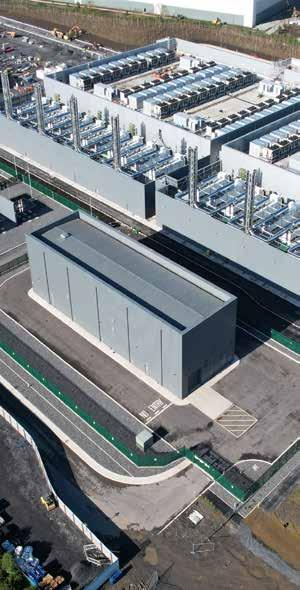
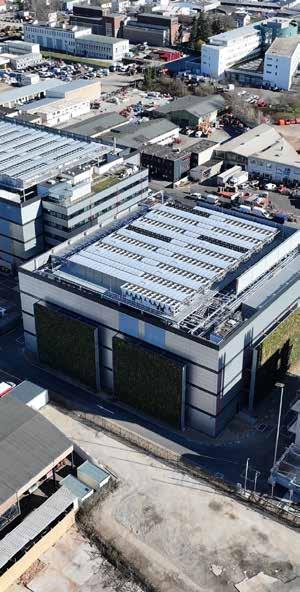
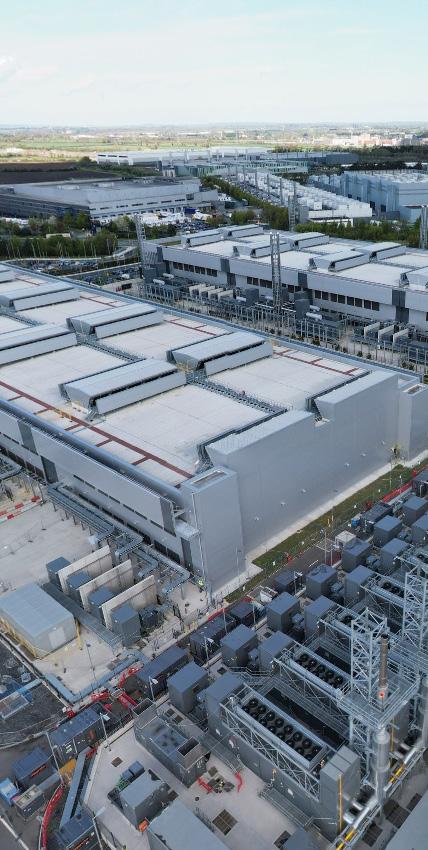
A dedicated data centre delivery partner, headquartered in Dublin and delivering throughout Europe

A dedicated data centre delivery partner, headquartered in Dublin and delivering throughout Europe
Welcome to Construction Management Ireland and our latest round-up of news, views, products and services as well as trend analysis and profiles from the industry!
And there’s much more besides, as usual.
We cover a wide range of topics here. What binds them together is that they are all representative of the professionals – and the professionalism that is such a hallmark of our industry.
From mental health awareness and personal development through to educational initiatives and our various news items and profiles, professionalism shines through like a beacon.
Examples include the work of the Irish Green Building Council, where we link in for our usual update and hear about decarbonization.
We also visit third level institutes like ATU, where we read –among other updates – about how the University and Donegal ETB have signed a contract for a new apprenticeship training facility in Letterkenny.
And of course, we take a look back at some major awards ceremonies that have taken place since our last outing and hear from some of the leading providers of products and services to the sector.
We round it off on a positive note as always in ‘The Final Say’ where it’s all about goal setting!
There really is a lot going on, as we like to say!
Talk to you soon, Martin & Dermot
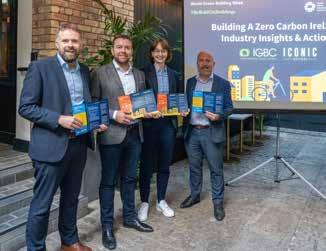
L to R - Lenny Antonelli (Project Manager at the Irish Green Building Council), Eoin Joy (Chief Property Officer at Iconic Offices), Cristina Gamboa (CEO of the World Green Building Council) and Pat Barry (CEO of the Irish Green Building Council) see page 18.
* The articles herein represent a snapshot in time. Always check with those concerned for the latest.
Construction Management Ireland Published by Ocean Publishing, 14 Upper Fitzwilliam St, Dublin 2
Tel: 01 678 5165
Fax: 01 678 5191
Printed by WG Baird Ltd Antrim
P ublisher Patrick Aylward Editor Martin Foran martin@constructionmanagementireland.ie National Sales Manager Dermot Casey Dermot@constructionmanagementireland.ie Graphic Design Niall McHugh Ad Production Audrey Fitzgerald
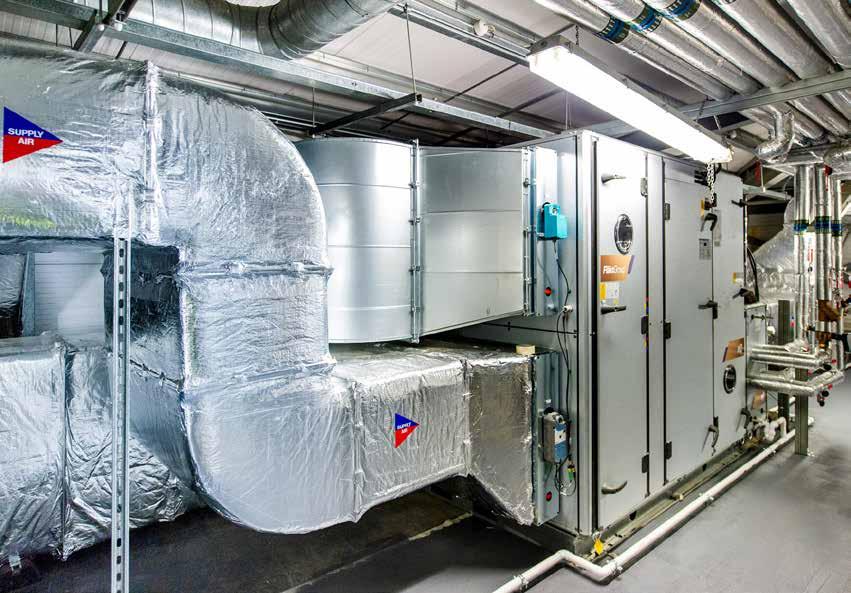
Alpha Facilities Maintenance are Ireland’s leading Contractors, specialising in the design, supply and installation to all sectors, nationwide from concept to completion.
Unit 8, Willsborough Business Centre, Willsborough Industrial Estate, Clonshaugh Business & Technology Park, Clonshaugh, Dublin 17, D17 K193.
Tel: 01 533 4276
Email: info@alphamech.ie

The Construction Industry Federation is pleased to announce Andrew Brownlee as its new Chief Executive Officer.
Retire
Andrew Brownlee took up the role on 1 October 2025. He replaced Hubert Fitzpatrick, Director General, who retired on 30 September 2025.
Andrew has been CEO at SOLAS, the state agency responsible for further education, construction skills and apprenticeship, having previously served as Executive Director for Strategy and Knowledge.
He joined SOLAS from the Higher Education Authority, where he was Head of System Funding from 2015 to 2019.
Prior to that, Andrew had a long and distinguished career in management consulting, working for Fitzpatrick Associates, PA Consulting and PwC.
Andrew has a Masters in Economics and Accounting from the University of Edinburgh.
Excited
Andrew Brownlee said: ‘I am really excited to be joining the Construction Industry Federation at this critical time for the construction industry.
‘Housing and infrastructure are pivotal to Ireland's next phase of social and economic transformation, and I will be working intensively on behalf of the industry to ensure that the investment and supports are in place to drive growth and success.
‘I am proud to become CEO of such an important and longstanding organisation and look forward to engaging with members to understand their needs and ensure that the CIF delivers for them.’

Lean Construction Ireland (LCi) and Build Digital have formally signed a Memorandum of Understanding (MoU) setting out the shared ambition of both organisations to work together to support the Irish construction sector achieve greater efficiency with construction project delivery.
LCi is a community of learning and practice that advocates for the transformation of the Irish construction sector through collaboration, and the adoption of Lean thinking and practices and continuous improvement by the entire sector to enable and sustain enhanced effectiveness, efficiency, productivity, and profitability for all stakeholders in the value chain.
Richard Fitzpatrick (Chair, LCi) said: ‘Lean Construction Ireland and Build Digital have been collaborating for several years on a range of sector initiatives, and I am delighted that we have been able to formalise this working relationship through the MoU.’
Build Digital is a government-funded initiative that supports the digital transformation across our sector. The adoption of digital workflows, tools and practices can transform the efficiency, productivity, sustainability and competitiveness of the construction and built environment industries in Ireland.
Robert Moore (Digital Lead, Build Digital) said: ‘The drive to have the sector adopt digital technologies, continuous
improvement and Lean to become more efficient has been led by Lean Construction Ireland and Build Digital, and this MoU demonstrates both organisations’ commitment to continue to support the Irish construction sector with this adoption.’
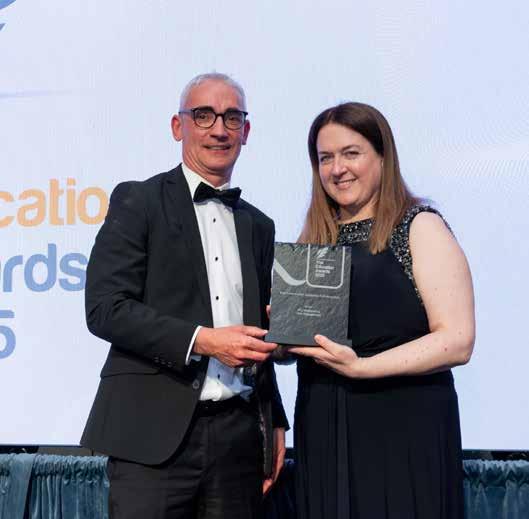
ATU School of Engineering won the 'Best Community Academic Collaboration' at the National Education Awards (2025).
The award is for the Civic Engagement module on the Bachelor of Engineering in Software & Electronic Engineering programme which saw students teach programming and electronics to 306 children, teenagers and young adults during the academic year.
The aim of the module is for students to share their knowledge and skills with young people in the community while at the same time awakening them to the possibility of attending university.
The project connects ATU Galway to people in the city for whom, previously, the university may have been just a large building with little relevance to their lives.
Collaborating organisations in 2024 were Galway City Community Training Centre, International Protection Centre Salthill, and five local schools as well as Creagh National School from Ballinasloe. Four of the participating schools have DEIS status.
Des O’Reilly, Head of Department, ATU Galway School of Engineering, said: ‘The collaboration is designed to enhance ATU students’ understanding of their role in global citizenship and partnership in the community, and to expose the participating partners to the joys of learning and to the real possibility of they, someday, becoming students like their ATU mentors.
‘The background to the Engineering Civic Engagement programme started in 2010 when lecturers tossed around a few ideas as to how their students could use their skills to benefit the community.
‘The first community partner was Camara, which is a charity that recycles old computers and sends them to the Developing World.
‘The next milestone was to integrate Civic Engagement into the degree programme so that students gained academic credits for their work.’
Lecturers on the Civic Engagement Module were Des O’Reilly, Emer Cahill and Natasha Rohan.
Three of the 22 ATU students shared their experience of teaching what they learned to school children:
Said student, Alex Paton from Athlone, Co Westmeath: ‘My engagement with Galway City Community (GCC) was not just about teaching Arduino circuits.
‘It was a journey of self-discovery, growth, and empowerment.
‘It reminded me of the profound impact that education and community engagement can have in shaping individuals' lives and driving positive change in society. Moving forward, I am committed to continuing my journey as a lifelong learner and advocate for inclusive, hands-on education for all.’
‘This was a wonderful experience helping within the community,’ said Ellen McIntyre from Cloonagh, Co Offaly. ‘We'd love to do it again,’ said Sean Maloney from Galway city.
Professor Graham Heaslip, Head of School of Engineering, says:
‘This recognition is a testament to the dedication of our 22 students who shared their knowledge of programming and electronics with over 300 young people this year.
‘Their work exemplifies the power of hands-on learning and the positive impact that university-community partnerships can have.
‘This award belongs to every student, mentor, and young learner who made this initiative a success.’
For further information on programmes in the ATU GalwayMayo School of Engineering, see: Study at ATU - Atlantic Technological University
Chadwicks lays the foundations for transformative home projects on the show, supplying materials and services to help some of the nation’s most deserving families
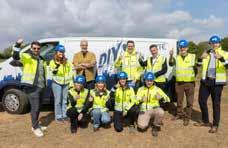
Chadwicks is proud to once again be the exclusive building materials supplier for DIY SOS: The Big Build Ireland.
The new four-part series returned to RTÉ One recently.
For this season, Chadwicks supplied essential building materials and expertise to help transform homes for some of Ireland’s most deserving families.
Across the projects, the company provided rough and treated timber, plywood, cement, plasterboards, insulation, internal doors, fittings, exterior plaster, Velux roof windows, and much more, helping show presenter, Baz Ashmawy and the DIY SOS volunteers deliver lifechanging results.
Opening doors in Tallaght
In the first episode, Chadwicks Lucan, Heiton Steel, Proline, and The Panelling Centre supported adaptations for nineyear-old, Tallaght resident Cayden, who was confined largely to his living room due to narrow doorways.
Wider doors, ramps, and a new accessible bedroom and bathroom
were built, giving Cayden newfound independence.
Raising the roof in Mooncoin
The second project took the crew to Kilkenny, where Aoibhínn, aged nine, lives with spina bifida and hydrocephalus.
After years of stalled progress on a self-build, the Chadwicks Waterford team and Proline supplied the materials needed to complete the project.
The result: a safe, comfortable home for Aoibhínn and her family.
Building up families, brick by brick
Episode three, set in Clarecastle, Ennis, saw the team at Chadwicks Ennis support the transformation of Franek’s family home.
Franek, a 13-year-old with cerebral palsy and scoliosis, needed a downstairs bedroom and accessible bathroom.
The DIY SOS team stepped in, and with Chadwicks’ materials and local expertise, created the safe, practical spaces the family urgently needed.
Strengthening independence in Wicklow
The final episode focuses on 17-yearold Kyle, who uses a wheelchair and had long relied on others to navigate stairs at home.
With support from Chadwicks Bray and Proline, the DIY SOS team delivered an accessible space, allowing Kyle more freedom and dignity, while easing pressure on his carers.
Breaking barriers: Free virtual work experience in engineering now available to all Transition Year students
Transition Year offers students a valuable opportunity to explore potential career paths but securing meaningful work experience placements can be challenging – particularly for students in rural areas or schools with limited industry connections.
Local companies may not offer programmes or students may not be able to access them due to location or
other commitments.
In response to these challenges, Engineers Ireland’s STEPS Engineering Your Future Transition Year initiative is now available in a fully online format.
This free virtual work experience is designed to give students across Ireland a meaningful insight into the world of engineering – without the barriers of geography or limited placement availability.
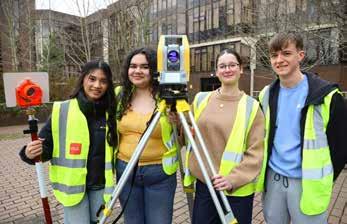
Students can explore a wide range of engineering disciplines, engage with real-world projects, and hear directly from Irish engineers working across various sectors – all from the comfort of their own homes or classrooms.
The programme includes reading material, video and interactive content, and webinars recorded by Irish engineers, and is structured to be flexible, allowing schools to integrate it into their Transition Year schedule with ease.
‘We are delighted to offer a solution that makes engineering work experience more inclusive,’ said Roseanne O’Leary, STEPS Team Leader, Engineers Ireland.
‘By offering this virtual work experience, we are ensuring that every student has the opportunity to discover the exciting possibilities of a career in engineering.’
This online programme complements the STEPS Engineering Your Future inperson experience that takes place in third-level institutes and organisations around Ireland.
The STEPS Engineering Your Future programme is open to all Transition Year students in Ireland and will run until 18 January 2026.
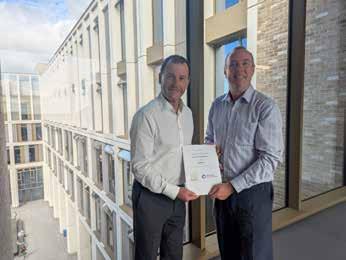
MFA Consulting Engineers has been awarded Engineers Ireland’s Continuing Professional Development (CPD) Accredited Employer Standard.
Established in 2023 and with offices in Ballina and Sligo, the Irish-owned firm provides expert services across large-scale residential, commercial, and industrial developments, as well as infrastructure projects in the energy, roads, and water/wastewater domains.
MFA's portfolio includes foul and watermain network design, SuDS, flood relief schemes, road and junction design, structural engineering and analysis, BCAR compliance, and environmental assessments.
Redevelopment
Among its current projects is the redevelopment of the former VEHA site in Wicklow, a landmark mixeduse scheme that includes 107 new homes, a 116-bedroom hotel, a crèche, and extensive public realm spaces overlooking the Irish Sea.
The CPD Accredited Employer Standard is designed to help
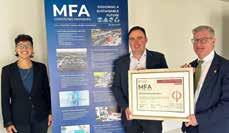
Bianca Fachin, BIM Engineering
Technician and Mark Forbes, Director, MFA Consulting Engineers with Damien Owens, Director General
of Engineers Ireland.
organisations improve the competence of their engineers, developing employees who are agile and adaptable, creating a workforce that is encouraged to create and innovate, and develop new solutions.
Organisations that have achieved the Standard find they are better placed to deal with business change and disruption, while also being capable of attracting and retaining better workforce talent.
In its drive to secure the Standard, MFA Consulting Engineers has made significant strides in formalising and expanding its commitment to Continuing Professional Development.
A key milestone has been the launch of the firm’s Graduate Career Programme, designed to guide earlycareer engineers through a structured development path, from graduate level to project engineer, and onward to senior and chartered roles.
This programme focuses on mentoring, technical training, and the development of consultancy specific skills such as communication, project delivery, and client engagement.
Speaking, following the award of the Standard, Mark Forbes, Director, MFA Consulting Engineers, said:
‘Achieving CPD Accredited Employer status from Engineers Ireland is a proud milestone for us, especially as a company established in 2023.’





Donegal County Council, Atlantic Technological University (ATU), Trinity College Dublin (TCD), ESB, and Enterprise Car Club have launched a new sustainable transport initiative, the ROBUST eMobility Hub at Justice Walsh Road, Letterkenny.
Shared
Two shared electric vehicles (EVs), one e-cargo bike and four e-bikes are available to book by the public for an hour or by the day to suit a range of travel needs.
Funded by the Sustainable Energy Authority of Ireland (SEAI) under the SEAI Research, Development & Demonstration Funding Programme, the academic lead partner is Trinity College Dublin supported by ATU academics in the Galway and Sligo campuses.
The launch in Letterkenny was attended by Charlie McConalogue, TD, Minister of State at the Department of Culture, Communications and Sport, Cllr Paul Canning, Cathaoirleach of Donegal County Council, Cllr Ciaran Brogan, Mayor of the Letterkenny Milford Municipal District and Dr Orla Fylnn, ATU President.
Guests
The event was also attended by local Oireachtas members, elected members from the Letterkenny Milford Municipal District, members of the ROBUST project team and invited guests.
Letterkenny is one of four eMobility hubs in Ireland that were opening this year, one each in Waterford and Galway city, and Dundrum, Dublin.
They are part of a wider strategy in Ireland to encourage public use of shared transport, help reduce congestion and parking problems in our cities and towns and meet emission targets.
Shared mobility is increasingly recognised as a practical solution to the challenges posed by urban development and climate and environmental concerns.
Suitable
The eHub sites will allow people to select the most suitable mode of transport for their needs, aiming to provide a range of shared public travel options.
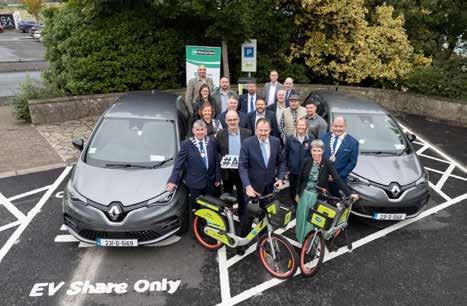
Minister of State at the Department of Culture, Communications and Sport, Charlie McConalogue TD with Cathaoirleach of Donegal County Council, Cllr
Paul Canning, Leas-Chathaoirleach of Donegal County Council, Cllr Donal ‘Mandy’ Kelly, President of ATU, Dr Orla Flynn, Mayor of Letterkenny, Cllr Ciaran Brogan, Pádraig Mac Lochlainn TD, Geraldine Moloney, Head of Net Zero Ventures, ESB, Brian McCann, ATU, with representatives of ATU, Donegal County Council and ESB, and Enterprise Car Club at the launch of the new sustainable transport initiative, the ROBUST eMobility Hub at Justice Walsh Road, Letterkenny.
By providing alternative solutions, it will help to encourage people to try different mobility options.
Charlie McConalogue, TD, Minister of State, welcomed the launch of the eHub in Letterkenny which underlines the commitment from the Government to offer sustainable mobility options to our citizens.
He said: ‘I am pleased to launch this facility with Donegal County Council and its partners. Our National Sustainable Mobility Policy aims to deliver at least 500,000 additional daily active travel and public transport journeys by 2030 and a 10% reduction in the number of kilometres driven by fossil fuelled cars.
'In order to do this we need to make it easier for people to choose walking, cycling, to use public transport daily and to have alternatives to having to use a petrol or diesel car.’
Pleased
Cathaoirleach of Donegal County Council Cllr Paul Canning commented that Donegal County Council was pleased to work with partners to deliver
the first of its kind facility in the county. He said that: ‘This eHub will offer both residents in Letterkenny and visitors alike an alternative, pay-asyou-go, sustainable mobility option to explore the town and its hinterland or the wider county.
‘Donegal County Council has a wide range of transport projects at various stages of delivery that will support the continued development of Letterkenny as a strategic regional centre for the North-West, and this eHub will support this also.’
Dr Orla Flynn, ATU President, said: ‘I am delighted to see ATU’s continuing involvement in the expansion of the eMobility hubs initiative across the northern and western region.
‘I’m particularly pleased to see the kind of engaged research that we envisaged in our strategic plan, with tangible impacts in communities, businesses and the environment.’
For more information, please visit the ROBUST project webpage.
Engineers Ireland, the national representative body for the engineering profession, welcomed an increase in the proportion of students sitting the higher-level Leaving Certificate maths paper this year.
Increased
The number of students taking the honours maths paper this year increased to 39% compared to 36% in 2024.
• Increase in students sitting honours maths paper +3%
• Greatest number of students sitting honours maths since 2011 (23,450)
Literacy in maths is a skill highly sought after by employers in an increasingly technological age, with roles in science, technology, and engineering highly reliant on strong mathematical ability.
skills
Many disciplines of engineering feature on the State’s Critical Skills Occupations List and speaking about this year’s Leaving Certificate results, Engineers Ireland Director General, Damien Owens, said:
‘This statistic is very positive, given the 22,000 additional engineers required over the next ten years to build the infrastructure and technology Ireland needs to meet our housing, transport and climate challenges.
‘Engineering is a gateway to some of the most exciting and diverse careers in the world, yet engineering graduates make up less than 10 per cent of all graduates.’
For those considering a career in engineering, there are various
routes, including college courses, industry apprenticeships and QQI FET programmes.
‘I wish to congratulate all students on their achievement in what has been the culmination of years of hard work,’ said Damien Owens.
‘There are many pathways into engineering, with apprenticeship routes into the profession becoming increasingly popular.’

The Irish Green Building Council (IGBC) celebrated Ireland’s National Biodiversity Week with the launch of the first set of Irish case studies to protect and enhance biodiversity within the built environment.
For more see Green Building, this issue.
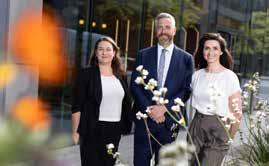
At the event were: Susan Vickers, Chair of IGBC’s Biodiversity & Built Environment Community of Practice; Christopher O’Sullivan TD, Minister of State at the Department of Housing, Local Government and Heritage with special responsibility for Nature, Heritage and Biodiversity and Aoibhinn Ní Shúilleabháin, Chair of the Advisory Committee for Ireland’s Nature Restoration Plan.
In the UK, Bauder Limited, a leading manufacturer of flat roofing systems, celebrated the official opening of its new UK distribution centre in Stowmarket, near Ipswich.
The facility is located within Gateway 14, East Anglia’s largest business, innovation, and logistics park.
A sustainability-focused event
Bauder invited all head office staff to join the warehouse team in celebrating the distribution centre’s opening, alongside UK managing directors Yvonne Higgins and John Llewellyn.
Guests enjoyed a ‘street feast’ and tour of the facility before the official unveiling ceremony.
The event prioritised sustainability by transporting guests on dedicated shuttle buses, providing reusable cups, and ensuring all clean waste was recycled after a staff-led litter collection at the site and surrounding area.
These efforts represent the facility itself, which boasts sustainable features including an EPC A rating, EV charging points, LED lighting, solar PV, smart energy systems, rainwater harvesting, wide wildflower borders at ground level, and nesting boxes for swifts.
The wider Gateway 14 site also includes integrated walking and cycling routes, public transport connections, and
biodiverse landscaping, helping to support local wildlife and promote a healthy work environment for staff.
A reflection of Bauder’s growth
‘The opening of our Gateway 14 distribution centre is a proud moment for us,’ Jan Bauder, managing director at Paul Bauder GmbH, commented.
‘This state-of-the-art facility is a reflection of both our growth in the UK market and our confidence in meeting the increased demand for our products.
‘That we have been able to achieve this in line with our sustainability programme, is just fantastic – not to mention the employment opportunities it has brought to the region.’
Bauder, a fourth-generation family-owned business, developed its first products in Germany in 1857.
It is one of Europe’s leading manufacturers and suppliers of flat roofing solutions, including waterproofing, insulation, PV, and green and blue roofs.
It is an Investors in People (IIP) Platinum award-holder for its commitment to high performance through good people management.


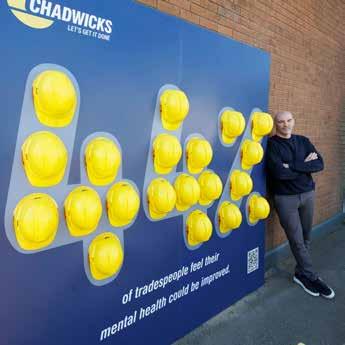
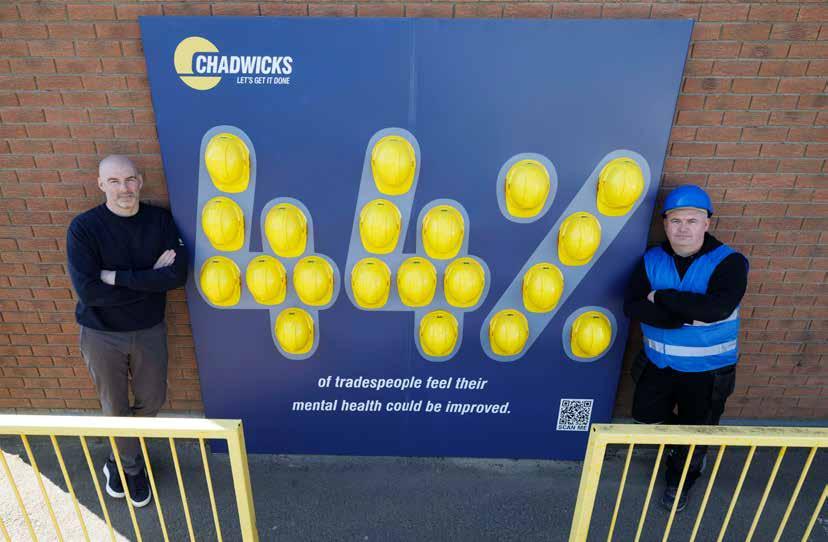
Over 2 in 5 (44%) of tradespeople say their mental health could be improved and 29% admit to prioritising their physical fitness over their mental health. That’s according to research from Chadwicks, the builders' merchants.
The research of 100 tradespeople into their attitudes towards their mental health was carried out to launch the second year of ‘How’s the Head?’, a Chadwicks campaign aimed to equip tradespeople with the tools to improve their mental health.
Chadwicks partnered with broadcaster and psychotherapist Richie Sadlier, who was sharing tips on how to boost mental fitness on his Instagram profile, arming tradespeople with simple steps on how to prioritise mental fitness while leading busy lives.
We asked them to tell us about the fundraising elements of the campaign with Aware:
As part of the campaign and for the second year running, Chadwicks donated €1 from every sale of PPE (personal protective equipment), which includes high vis jackets, hard hats and safety boots in all branches nationwide, to Irish mental health charity, Aware.
Aware provides essential support to individuals affected by mental health conditions throughout Ireland.
HH: Mental health management is a vital part of our health can you tell us some of the details that have come to light in the recent research?
According to the survey, of those that struggle with their mental health, 32% say they don’t talk to anyone about it while 36% say they confide in their partner.
Low moods (70%) and feeling stressed or anxious (64%) are the main symptoms experienced.
But despite this, only 2% of those who struggle with their mental health say they would speak to a professional.
HH: We understand the research shone a light on peoples’ recognition of the need to do more for mental wellbeing?
Over a third (36%) say they are actively trying to take steps to improve their mental fitness with spending more time with loved ones (55%) and getting a good night’s sleep (31%) some of the key steps they are taking.
HH: Chadwicks explored tradespeople’s work habits as part of the study, and the research revealed
some interesting facts?
• Not taking regular breaks (37%) and working too many hours (31%) are some of the habits they have developed that can have a negative impact on their mental health.
• Over half (58%) admit to losing sleep over work in the past year.
Recognising the importance of mental health to colleague’s wellbeing, Chadwicks, in conjunction with VHI, runs an ongoing mental health awareness programme, designed to
‘Over 2 in 5 (44%) of tradespeople say their mental health could be improved and 29% admit to prioritising their physical fitness over their mental health.’
‘Encouraging to see tradespeople becoming more aware of their mental health’
Patrick Atkinson, CEO of Chadwicks stated ‘It’s encouraging to see tradespeople becoming more aware of their mental health and taking steps to stay mentally fit, but the research makes it clear –this conversation needs to stay front and centre.
‘At Chadwicks, we recognise the unique pressures tradespeople can face and know it’s our responsibility to use our platform to bring more attention to this, driving meaningful change.
‘Through “How’s the Head”, we are committed to shining a spotlight on how mental health impacts tradespeople, breaking down stigma, and encouraging more people in the trades to open up.
‘Equally, we understand that supporting mental health starts from within and that’s why, in conjunction with VHI, we run an ongoing mental health awareness programme for our colleagues, reinforcing our commitment to fostering a culture where mental health and colleague wellbeing are a top priority.’
Dr Susan Brannick, Clinical Director at Aware, concluded: ‘We are very grateful to be the charity partner for Chadwicks’ “How’s the Head” campaign again this year.
‘Initiatives like this are so important, not only to spark conversations and break down stigma but to ensure that those in the trades have access to the support they need.
‘While self-awareness and reaching out for help are vital steps, it’s equally crucial that well-funded, accessible services are in place for those who do.’
help colleagues manage their mental health better.
At least one colleague at every Chadwicks location will complete the programme as part of the company’s on-going commitment to colleague well-being, and new hires to Chadwicks also go through well-being awareness training as part of their induction process.
To officially launch the campaign, Richie Sadlier visited a specially commissioned installation at Chadwicks Sandyford, which shone a further spotlight on the campaign findings.
HH: What was his message about the campaign?
Richie Sadlier said: ‘I am delighted to once again partner with Chadwicks to help raise awareness for this campaign and encourage tradespeople to talk more openly about their mental health.
‘It was interesting to see from the findings that many tradespeople prioritise their physical fitness over their mental health, but as anyone
working in health and wellbeing will tell you, your mental wellbeing is a crucially important area.
‘And just like your physical fitness, your mental fitness can be built up and maintained if you follow the right suggestions..’
HH: He also referred to lessons from his football career?
Richie Sadlier said: ‘One of the biggest lessons my football career taught me was that if I was mentally in a good place, I played better and enjoyed things more. I’ve since learned that it’s the very same for me off the pitch, too.
‘I’ve been given so many tips over the years from coaches, teammates and therapists about how to keep myself mentally fit and well, and as part of this campaign, I’m going to share some on my Instagram.
‘In the meantime, I’d really encourage tradespeople to talk more with each other, check in, and open up to build a healthier, stronger community.’
• 44% of tradespeople believe their mental health could be improved
• Over 1 in 4 (29%) prioritise their physical fitness over their mental fitness
• Of those who struggle with their mental health, 32% say they don’t talk to anyone about it
• Low mood (70%) and anxiety or stress (64%) are the most common symptoms
• More than half (58%) have lost sleep over work in the last year


At Le Chéile Group, our dedicated Surety team specialises in securing Surety bonds with competitive rates designed around your needs. Whether you’re building, bidding, or managing projects, we provide reliable, tailored solutions every step of the way.
ü Performance Bonds
ü Development Bonds
ü Irish Water Bonds
At Le Chéile Group, our dedicated Surety team specialises in securing Surety bonds with competitive rates designed around your needs. Whether you’re building, bidding, or managing projects, we provide reliable, tailored solutions every step of the way.
At Le Chéile Group, our dedicated Surety team specialises in securing Surety bonds with competitive rates designed around your needs. Whether you’re building, bidding, or managing projects, we provide reliable, tailored solutions every step of the way.
At Le Chéile Group, our dedicated Surety team specialises in securing Surety bonds with competitive rates designed around your needs. Whether you’re building, bidding, or managing projects, we provide reliable, tailored solutions every step of the way.
At Le Chéile Group, our dedicated Surety team specialises in securing Surety bonds competitive rates designed around your needs. Whether you’re building, bidding, managing projects, we provide reliable, tailored solutions every step of the way.
Our Expertise Covers Every Type of Bond You Need:
Our Expertise Covers Every Type of Bond You Need:
Our Expertise Covers Every Type of Bond You Need:
Our Expertise Covers Every Type of Bond You Need:
Group, our dedicated Surety team specialises in securing Surety rates designed around your needs. Whether you’re building, projects, we provide reliable, tailored solutions every step of the
ü Performance Bonds
ü Performance Bonds
◊ Performance Bonds
ü Expert, personalised support from industry-specialist brokers
ü Performance Bonds
ü Development Bonds
ü Development Bonds
ü Advance Payment Bonds
ü Bid Bonds
ü tailored solutions for each bonding requirement
Development Bonds ◊ Irish Water Bonds
ü Development Bonds
ü Irish Water Bonds
ü Consistent, high- quality service
Advance Payment Bonds ◊ Bid Bonds
Irish Revenue Bonds
ü Irish Water Bonds
ü Irish Water Bonds
Why Choose Le Chéile Group?
Advance Payment Bonds ü Bid Bonds ü Irish Revenue Bonds
Advance Payment Bonds
Bid Bonds
ü Irish Revenue Bonds
ü End-to - end service from bid to build, and beyond
Irish Revenue Bonds
Covers Every Type of Bond You Need:
We also offer Structural/Latent Defects Insurance for the Irish market, available for: ◊ Residential Inherent Defects ◊ Social Housing Inherent Defects
We also oLer Structural/Latent Defects Insurance for the Irish market as part of our comprehensive support package, available for:
ü Expert, personalised support from industry-specialist brokers
ü Expert, personalised support from industry-specialist brokers
Commercial Inherent Defects
ü Expert, personalised support from industry-specialist brokers
ü tailored solutions for each bonding requirement
New Builds
ü tailored solutions for each bonding requirement

ü Consistent, high- quality service
Renovations
ü Consistent, high- quality service
ü Residential Inherent Defects
ü Consistent, high- quality service
ü Social Housing Inherent Defects
ü Commercial Inherent Defects
ü End-to - end service from bid to build, and beyond
ü End-to - end service from bid to build, and beyond We also oLer Structural/Latent Defects
ü tailored solutions for each bonding requirement ü End-to - end service from bid to build, and beyond
We also oLer Structural/Latent Defects Insurance for the Irish market as part of our comprehensive support package, available for:
ü Residential Inherent Defects ü New Builds

Cover marcus.heather@lecheilegroup.ie 086 106 1655
each
End-to - end service from
‘At Le Chéile Group, we don’t just provide insurance – we build enduring partnerships.’
Le Chéile means ‘together’ in Irish, and that spirit defines our approach.
Our Group has brokerages in Ireland and the UK, with a dedicated team specialising in the procurement of Surety Bonds and Latent Defects Insurance policies.
In construction and development, every project carries risk.
At Le Chéile Group, we understand these risks, and work alongside you to mitigate them.
Our mission is to protect your projects, strengthen your credibility, and deliver the confidence you need to succeed.
Surety Bonds – Strengthening Your Contractual Foundations:
Having capacity to deploy Surety bonds is an essential tool in today’s construction environment.
These bonds provide your clients, and their beneficiaries, with the confidence that their contractual and legal obligations will be fulfilled.
We offer a comprehensive range of bond solutions – including performance bonds, bid bonds, development bonds, and Irish Water bonds – each tailored to your unique project and regulatory framework.
Because we maintain strong relationships across international surety markets, we can source competitive rates and structures –helping your projects stay on track and your capital working where it’s needed most.
Latent Defects Insurance –Protecting Against the Unseen: Structural defects can emerge years after completion, creating costly liabilities.
Through our partnership with ICW Europe, we provide Latent Defects Insurance (LDI) for residential, commercial, and social housing developments.
Our policies can apply to both new builds and, where feasible, existing structures.
We accommodate a wide range of modern construction methods – modular, precast, or hybrid – and accept INAB or KIWA certification. By incorporating LDI, you not only protect your balance sheet – you

also enhance your development’s marketability and reassure investors, funders, and homeowners alike.
Insurance for Construction Companies – Comprehensive, Connected Protection: Beyond surety and defects cover, we provide a full spectrum of construction insurance solutions tailored to your operations.
Our services cover the full project lifecycle – from early planning and tender through completion and handover, including:
• Contract Works / Material Damage
• Third-Party & General Liability
• Contractor’s Plant & Equipment (owned or hired-in)
• Owner Controlled Insurance Programs (OCIPS)
• Contractor’s All Risks (CAR) insurance
We integrate these protections into cohesive, cost-efficient risk structures, ensuring every coverage element aligns with your contracts and financing obligations.
Working Together: At Le Chéile Group, we don’t just provide insurance – we build enduring partnerships.
By utilising our expertise in surety bonds, latent defects insurance, and construction risk management, we help you navigate complex projects with confidence.
When you work with us, you gain a partner who understands your industry, speaks your language, and stands with you every step of the way – from concept to completion.
If you’re ready to strengthen your next project, we’d love to hear from you.
Get in touch with our team today at bondsteam@lecheilegroup.ie and let’s build your future—together.

The downturn in the Irish construction sector gathered pace at the end of the third quarter of 2025.
Sharper reductions in activity and new orders were recorded, while employment decreased for the first time in seven months.
Firms also scaled back their purchasing activity, while the rate of input cost inflation eased to the weakest since last November.
Looking to the future, business sentiment ticked down and remained relatively muted.
The headline seasonally adjusted AIB Ireland Construction Total Activity Index dropped to 43.7 in September from 45.9 in August, below the 50.0 nochange mark for the fifth consecutive month and signalling a sharp monthly contraction in total activity.
Moreover, the rate of decline was the fastest since December 2022.
In line with the picture for total construction activity, work on housing projects decreased for the fifth consecutive month during September.
The latest fall was marked, albeit softer than that seen in August and the weakest of the three monitored categories.
The sharpest reduction was in civil engineering activity, while commercial posted a much steeper decline than in August.
In fact, the drop in commercial activity was the most pronounced since December 2023.
Anecdotal evidence pointed to a wider economic slowdown and delays in decision making by customers, while some reports suggested that the ability of firms to secure new orders was also impacted by a competitive pricing environment.
New orders decreased for the second month running in September.
Although modest, the pace of decline was the fastest in just over a year-and a-half.
In line with the picture for new orders, employment decreased at the end of the third quarter.

‘Indeed, the September reading is the lowest since December 2022.
‘The index has now been below the key breakeven level of 50 for five consecutive months.
‘From a sectoral viewpoint, the weakness in activity remained broadbased, with all three sub-sectors recording a decline in activity, as was the case in August.
‘Residential construction activity contracted for a fifth successive month, albeit at a marginally slower pace compared to the previous month.
‘Meanwhile, the commercial sector remained in contraction territory for a second month running, with the pace of decline accelerating.
‘Civil engineering continued to report the sharpest falls in activity, with the pace of contraction at its most pronounced since October 2022.
‘A weak end to the third quarter for building activity.’
The slight fall in staffing levels ended a six-month sequence of job creation. Purchasing activity was also scaled back, and at a solid pace.
Despite the drop in demand for inputs, suppliers' delivery times continued to lengthen amid reports of staff shortages at vendors and issues importing items.
That said, the latest decline in supplier performance was slightly less marked than in August.
Where firms did purchase inputs, they were faced with a further sharp increase in costs.
The pace of inflation eased to a tenmonth low, however. Rates charged by sub-contractors also rose sharply, but at the weakest pace in three months.
Commenting on the survey results, John Fahey, AIB Senior Economist, said:
‘The AIB Irish Construction PMI survey for September indicates a weak end to the third quarter for building activity.
‘The headline index fell to 43.7 in the month, from 45.9 in August, implying a faster pace of contraction in the sector.
‘The new orders category, which is viewed as a leading indicator, also paints a weak backdrop for the sector.
‘This component contracted for a second consecutive month, with the rate of decline worsening.
‘Not surprisingly, against this backdrop of falling activity levels, there was a reduction in employment in the sector, ending a six-month period of jobs growth.
‘However, despite this challenging operating environment, firms retained an optimistic view that activity levels will increase over the coming 12 months.’

SCSI report shows commercial construction costs increased by 1.5% in H1
A report by the Society of Chartered Surveyors Ireland (SCSI) showed that while commercial construction costs were continuing to rise, the rate of increase had remained relatively stable over the past two years.
The Tender Price Index (TPI) published by the SCSI shows the median rate of commercial construction inflation increased nationally by 1.5% in the first half of 2025, the same rate as the three preceding six-month periods.
According to the SCSI’s Tender Price Index, (TPI) ‘which is the only independent assessment of commercial construction tender prices in Ireland’, the annual median national rate of inflation for the past 12 months was 3%.
The report indicated some variation across the regions over the previous six months with the highest median rate of inflation of 2% recorded in Munster and Connacht / Ulster.
‘Critical investment is also required across the transportation,
residential
and
healthcare sectors.
In Dublin the figure was 1% while Leinster (Excl. Dublin) had the lowest rate of increase at 0.5%.
The Vice President of the SCSI, Tomás Kelly described the continuing moderation in the rate of increase over the past two years as a welcome development.
‘The reduction in the rate of increase which we’ve seen over the last couple of years is due in the main to reduced supply chain disruption and price volatility for construction materials.
‘The relative stability we’ve seen over the last couple of years is in marked contrast to the 2021 / 2022 period when tender price inflation increased significantly.
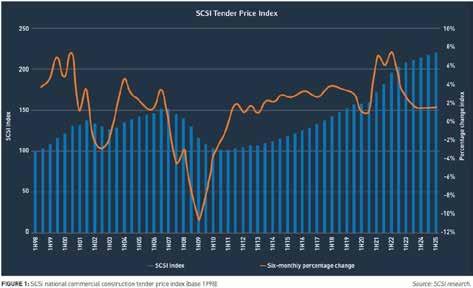
Tender Prices 1998 – 2025 Research for the latest edition of this sentiment survey, which is based on responses from Chartered Quantity Surveyors from all around the country, working on commercial projects, was conducted in July and August 2025.
‘However, while overall inflationary pressures have moderated, ongoing geopolitical uncertainty, over conflicts and the potential introduction of reciprocal tariffs between the US and the European Union have the capacity to cause fresh supply chain disruption.
‘While we believe tender prices will continue to edge higher in the second half of 2025, given global uncertainty it is very difficult to predict if the moderate rates we have seen over the past two / two and a half years will continue.
‘While it’s true that fears of a tariff war may be receding at the moment, that may change.’
Among other challenges identified were access to labour, with surveyors highlighting continuing labour shortages and constraints, as well as the inflation of labour prices.
While overall inflationary pressures have moderated, feedback from quantity surveyors indicates that labour-related costs continue to influence tender pricing across certain projects.
Mr Kelly reiterated the SCSI’s call on the Government to invest in key economic infrastructure while price inflation remains at more sustainable levels.
‘We welcome the recently published update of the National Development Plan as a long-term strategic infrastructure plan of €275 billion up to 2035.
'The current period of tender price stability provides a great opportunity for Government to push forward with the much-needed infrastructure investment across a range of sectors.
‘For example, with regard to utilities urgent investment is required in the water supply network, in wastewater treatment and in the electricity grid.
‘Critical investment is also required across the transportation, residential and healthcare sectors.
‘We would also urge the Government to publish the sectoral investment plans in order to provide specific details of the projects and pipeline up to 2030.’
The building industry stands ready to decarbonise, but needs support, clear guidance and ambitious regulation to meet its climate targets – that’s the message of a major new report, Building A Zero Carbon Ireland: Industry Insights & Actions, published by the Irish Green Building Council this September as part of World Green Building Week.
Embracing
‘As this new report shows us, by embracing Whole Life Carbon (WLC), circularity and collaboration across the entire building and construction sector, Ireland can deliver on its climate targets and inspire Europe.’
So said World Green Building Council CEO Cristina Gamboa, who launched the report at an event in Dublin.
‘This is a vital roadmap for turning ambition into action and aligns with World Green Building Council's global call to the world to #BeBoldOnBuildings – because together, we can show that buildings are one of the greatest opportunities of our time to construct a better future for people, communities, business, and the planet. I commend the Irish Green Building Council for leading this transformation.’
Meanwhile, Irish Green Building Council CEO Pat Barry said: ‘The building industry is willing to take ambitious action on carbon emissions, but as our research shows, it also needs support and guidance, including the removal of regulatory barriers and the introduction of limits on lifecycle greenhouse gas emissions, to drive change and innovation.’
Construction and the built environment are responsible for 37% of Ireland’s greenhouse gas emissions, the same as agriculture.
This new publication provides an update on the IGBC’s original Building A Zero Carbon Ireland roadmap (2022).
The report also includes practical actions and case studies for those in the industry.
The report found that SMEs in particular need support and guidance to decarbonise, and that collaboration around carbon reduction isn’t happening effectively on many construction projects.

L to R - Lenny Antonelli (Project Manager at the Irish Green Building Council), Eoin Joy (Chief Property Officer at Iconic Offices), Cristina Gamboa (CEO of the World Green Building Council) and Pat Barry (CEO of the Irish Green Building Council) launching the report at the Masonry, Dublin 8. Photo by Danny Fitzpatrick
See below for a text of the report summary.
The theme of this year’s World Green Building Week was #BeBoldOnBuildings – highlighting how greener buildings aren’t just good for the planet, they’re smart for business too.
As well as highlighting how the industry is ready to act, this year’s lineup of events showcased businesses taking steps to construct a low-carbon, resource-efficient and more biodiverse built environment.
Events scheduled for this year’s World Green Building Week in Ireland included:
• Guided tours of the Seven Mills development in Dublin with Cairn Homes, showcasing Europe’s largest development of passive homes
• Launch of a new Community of Practice for construction professionals to learn about reducing the whole lifecycle carbon footprint of buildings
• Guided tours of Ireland’s first net zero energy supermarket in Maynooth with Lidl, and the sustainable redevelopment of Wilton Park on Dublin’s Grand Canal with IPUT
• Guided tour of EcoPark, Clayfarm in Leopardstown with Park Developments – showcasing how nature can be protected and enhanced in new residential developments

Building A Zero Carbon Ireland: Industry Insights & Actions
Key Findings & Recommendations
Construction and the built environment are responsible for 37% of Ireland’s greenhouse gas emissions. Ireland cannot reach its climate targets without decarbonising the built environment across its full life cycle, from material extraction to each building’s end-of-life stage.
In 2022, the Irish Green Building Council published Building a Zero Carbon Ireland, our roadmap to decarbonise Ireland’s built environment. Three years on, how is the industry performing against the roadmap’s targets, what barriers stand in the way, and what actions should be taken next?
Overall
The industry is willing to act
A large majority of organisations are eager to decarbonise and play their part in tackling the climate crisis, and many already are. Some, especially larger organisations, have detailed plans for reducing emissions and know that decarbonisation makes good business sense too.
Regulatory, cultural and financial barriers remain
Some of the common barriers to decarbonisation cited included: 1) Regulations that restrict the use of low carbon construction materials; 2) The investment required to decarbonise including the cost of low carbon materials; and 3) Lack of effective collaboration around carbon reduction on construction projects.
SMEs urgently need more direct support
Smaller organisations struggle to invest the time and money required to measure their carbon emissions, develop decarbonisation plans and take action. These organisations need direct support in terms of finance, resources and clear guidance. This is critical as SMEs comprise a large portion of Ireland’s construction sector.
Culture & Collaboration
Lack of early, effective collaboration around carbon reduction on construction projects is a barrier to decarbonisation
A rapid culture change is needed within the industry to mainstream low carbon, biobased materials
Creating a culture of sustainability within organisations requires time and effort and must be resourced properly at all levels
‘By embracing Whole Life Carbon (WLC), circularity and collaboration across the entire building and construction sector, Ireland can deliver on its climate targets and inspire Europe.’
Lifecycle carbon emissions
Under the EU’s Energy Performance of Building’s Directive (EPBD), to be transposed into Irish law in 2026, Ireland must measure and limit lifecycle carbon emissions 2030 at the latest. Many organisations want an earlier timetable for these limits to be introduced. Uncertainty leads to inaction and creates the impression that reducing lifecycle emissions is not a priority.
The link between circularity and lifecycle carbon emissions is not clearly understood. More education is needed to disseminate the importance of this link and highlight the opportunities for addressing lifecycle emissions through the circular economy.
Many organisations support the introduction of clear limits on lifecycle carbon emissions for buildings before the EPBD deadline of 2030
Green public procurement could be a powerful tool for stimulating decarbonisation and innovation, but its application remains weak and inconsistent. Many organisations would like to be rewarded more for their sustainability efforts in procurement processes.
Key regulations (e.g., TGD B & D) must be reviewed to facilitate rapid uptake of low carbon materials
Recommendations for policymakers
Regulation
Introduce a clear, ambitious timetable for the regulation of lifecycle carbon emissions
Update key regulations to facilitate rapid uptake of low carbon materials
Policy
Put sustainability at the heart of public procurement and thoroughly implement existing green public procurement policies
Support the industry to embrace circularity– e.g, through physical and digital infrastructure (digital product passports and material exchanges)
Strengthen the electricity grid to enable lower carbon manufacturing of construction products and decarbonised building sites.
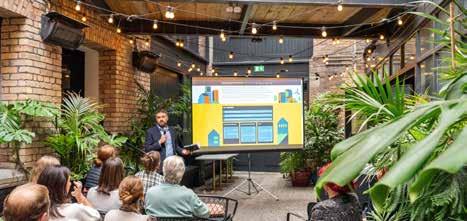
Prioritise electricity uses that support decarbonisation.
Recommendations for industry bodies
Research & Education
Produce short, simple, targeted guidance on critical pieces of regulation, key sustainability concepts and examples of good practice
Disseminate the concept of life cycle costing and its relationship to low carbon construction more widely
Research the carbon performance of different forms of MMC (modern methods of construction) and disseminate the results to the industry
Develop a clear, agreed definition of net zero carbon for the industry to work towards
Develop guidance and tools to make post-occupancy evaluation (POE) the norm on projects
Tools & processes
Scale a collaborative, design for performance approach to sustainability into all construction projects, building upon the work completed as part of projects such as Design for Performance (RIAI & IGBC)
Prioritise education around Environmental Product Declarations, to help the industry understand these documents and how to use them in specifications.
The IGBC is Ireland’s leading authority on green building best practices, with a network of over 480 green building organisations spanning the entire built environment industry. The IGBC is affiliated with the World Green Building Council. This is a network of over 80 national Green Building Councils worldwide with a total membership of over 27,000 of the most progressive international organisations and businesses, making it the largest organisation globally influencing the sustainable building market. www.igbc.ie
About World Green Building Week (WGBW)
World Green Buildings Week is a global campaign led by the World Green Building Council (WorldGBC) that takes place every September. This year it was hosted from 8 September until 12 September and celebrates the power of sustainable buildings for business as well as the environment. https://www.igbc.ie/ be-bold-on-building-wgbw25/
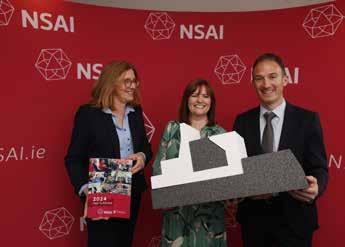
The National Standards Authority of Ireland (NSAI), Ireland’s official standards body, has published its 2024 Year in Review, highlighting a transformative year of progress in areas critical to Ireland’s future, such as housing innovation.
Vital role
Minister of State with responsibility for Employment, Small Business and Retail, Alan Dillon said:
‘The NSAI plays a vital role in strengthening Ireland’s business ecosystem.
‘From enabling housing innovation through Modern Methods of Construction (MMC) and Building Information Modelling (BIM) to advancing cybersecurity and sustainability, NSAI’s Year in Review displays how the organisation supports our industries to grow safely, smartly, and compete internationally.
‘The Year in Review reflects the important role NSAI plays in supporting Irish businesses and setting and maintaining world-class standards, measurement services and certification systems.’
Committed
Geraldine Larkin, NSAI CEO, said, ‘NSAI is committed to supporting businesses to enable growth, competitiveness and long-term success.

‘We’re proud to act as a bridge between innovation and assurance, empowering Irish businesses of all sizes to operate with confidence, integrity, and international credibility.
‘Whether it's bringing a new MMC housing system to market or achieving ISO certification in information security, we ensure companies can move faster, meet expectations, and lead by example.’
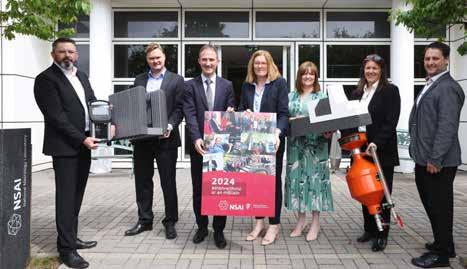
to Right: Thomas Holmes of the Medical Supply Company in Dublin (calibration and certification client); Neville Champ of Altherm ICF in Dublin (certification client); Minister of State for Small Businesses and Retail, Alan Dillon TD.; Geraldine Larkin, CEO of NSAI; Caroline Ashe Brady of Kore Group in Cavan (certification client and contributor to standards development); Siobhán Keogh of PumpWatch in Kildare (works alongside NSAI’s Legal Metrology Service) and Dr. Zdenek Chaloupka of Timing Solutions in Dublin (collaborator with NSAI’s National Metrology Laboratory).
Key highlights from the Year in Review report include:
Supporting housing innovation: With 80 new MMC enquiries and 48 new applications received in 2024, NSAI’s MMC department is supporting faster, safer and more efficient construction outcomes.
NSAI’s Sustainability and Built Environment department approved 1,132 construction products in 2024 and NSAI established a dedicated Building Information Modelling department before Christmas.
Agrément certification is specifically aimed at products or building systems that are new or innovative. The KORE group in Cavan, for example, achieved MMC Agrément certification through NSAI for its insulated concrete formwork system and its insulated foundation system.
Caroline Ashe Brady, Commercial Director with the Kore Group said: ‘DRAFT NSAI’s rigorous assessment process has been crucial in enabling us to bring next-generation construction solutions to market with confidence.
‘MMC Agrément certification helps manufacturers in the construction industry, like ours, to meet both compliance requirements and sustainability goals.’
A full copy of the Year in Review, which features all NSAI certification departments, the standards division, the legal metrology service and the national metrology laboratory, is available on the NSAI.ie website
science says the 10-minute rule Is a (literally) effortless way to learn faster, improve recall, and boost memory
Research says you really can rest your way to better longterm memory and recall
I had spent a couple of weeks preparing to speak at the Arabian Business Awards. Felt good. Felt ready. Flew to Dubai.
Different topic
Woke up the morning of, worked out, had lunch… and got a message from the organizers asking if it was possible for me to speak on a different topic, one that had suddenly become timely.
I said yes, since I like to be a team player and hate to disappoint.
I was dying inside, since I now had about eight hours to create and learn a new 22-minute presentation – and the stakes felt extremely high, since literal heads of state would be in attendance.
Reinforce
My approach? Use every minute possible rehearsing.
Repetition reinforces. Plus, making mistakes aids learning.
After all, studies show self-testing is an extremely effective way to improve retention.
I rehearsed while I snacked. I rehearsed while I showered. I rehearsed while I dressed.
I felt good about the words I would say, but I struggled to reliably remember slide cues. (My Achilles heel is remembering when to click to a new slide.)
Right before I went onstage, I wished there had been time to run through it a few more times.
The presentation went well. (I missed one slide cue but recovered in a way no one noticed.)
But as for wishing I could have crammed a few more run-throughs into the time I had to prepare?
10 minutes to better recall
That was probably a mistake. I recently came across a 2022 study published in Nature Reviews Psychology that found

that taking a 10-minute break between study sessions significantly improves recall compared to immediately engaging in another task, even if that other task is engaging in another study session. As the researchers write:
Periods of offline waking rest can facilitate the consolidation of newly formed memories. Even a few minutes of rest with closed eyes can improve memory, perhaps to the same degree as a full night of sleep.
The last point is significant. According to a study published in Psychological Science in 2016, people who studied before bed, then slept, then did a quick review the next morning not only spent less time studying, they also increased their long-term retention by 50 percent.
‘Sleeping on it’ not only helps your brain file away what you’ve learned, it makes that information easier to access.

‘Studies show self-testing is an extremely effective way to improve retention.’

As the Nature Reviews Psychology study authors write:
The memory benefit of offline waking rest is comparable to the effect of post-learning sleep, and has been demonstrated for a wide array of types of learning and memory.
Periods of offline rest permit the reactivation of recently formed memory traces.
This iterative reactivation of memory could strengthen and stabilize newly formed memories over time, contributing to early stages of memory consolidation during the first few minutes following encoding.
For my new presentation, I had about eight hours to prepare, and I assumed that cramming as many runthroughs as possible into that time – using every second to learn – was the best way to go.
It turns out that I would have been better off taking a few breaks. As long as they were the right kind of break.

‘Offline’ rest
For offline waking rest to be comparable to post-learning sleep in terms of its effect on recall, the key is to make your breaks as similar to sleep as possible.
No music. No screens. No chatting with friends. Just quiet downtime, preferably with your eyes closed, or if that’s not possible, doing something mindless.
Taking a walk. Looking out the window. Or even exercising. A study published in Psychology of Sport and Exercise found that exercising after learning significantly improves memory, recall, and retention.
In fact, a study published in Journal of Epidemiology and Community Health in 2023 found that just six to 10 minutes of moderate to vigorous exercise can improve your working memory and significantly improve higher-level cognitive skills like organization, prioritization, and planning –regardless of when that exercise session takes place.
That’s what I should have done. Even if I had known that periodically sitting and closing my eyes for 10 minutes would have helped me learn faster, I was too keyed-up to actually do it.

Exercising for 10 minutes? That would have burned off a little stress and helped me retain more.
Try it. The next time you need to learn something – a presentation, a sales demo, an investor pitch – add a few 10-minute periods of offline rest to your learning routine.
Rehearse a couple of times, then sit and chill. Give your brain a chance to consolidate and strengthen the memories you’ve formed.
See taking a break as a feature, not a bug. As the researchers write, ‘moments of unoccupied rest should be recognized as a critical contributor to human waking cognitive functions rather than a waste of time’. It sounds like they were talking to me.
The opinions expressed here by Inc.com columnists are their own, not those of Inc.com
@jeff_haden
The winners of the 2025 RIAI Architecture Awards demonstrated the quality being delivered in Architecture across Ireland and internationally.
The most recent Awards recognise projects across 12 categories showcasing the depth and diversity of architectural achievement with buildings and places that are central to our everyday lives.
From carefully restored heritage buildings and reclaimed public spaces, to innovative new housing, schools and workplaces – the winning projects highlight Architecture’s powerful role in shaping sustainable, inclusive, and vibrant communities.
Revealed
In addition to the jury Awards, the RIAI Public Choice Award –where the public votes for their favourite building or public space – was also revealed.
The Benedictine Monastery at Kylemore Abbey by Axo Architects was voted Ireland’s favourite building in 2025, topping a shortlist of 48 projects.
The runners-up included: Arklow Wastewater Treatment Plant by Clancy Moore Architects in collaboration with Ayesa Engineers (2nd Place), and Scoil Naomh Bríd Culleens by SJK Architects (3rd Place).
Recognised
The RIAI Awards 2025 recognised Two Grand Parade by Henry J Lyons as the winner of the Adaptation and Re-Use category.
Trinity College’s beloved Campanile, restored by Howley Hayes Cooney Architecture, won one of two Conservation Awards, the second going to a beautifully restored Georgian home by Elizabeth Burns Architects in collaboration with Camille O'Sullivan.
In Public Buildings, the jury recognised diverse projects that positively impact on society – including water infrastructure, a
The winner of the prestigious 2025 RIAI Public Choice Award was the Benedictine Monastery at Kylemore Abbey by Axo Architects.
Votes
With 14,000 votes cast in total, the Benedictine Monastery emerged as the winner.
The project has captured hearts across the country, reflecting its exceptional architectural merit and deep connection to its environment and community.
Nestled on the edge of Pollacappul Lough, beneath the rugged Duchruach Mountain and near the historic Kylemore Abbey, the new monastery harmoniously integrates with its dramatic surroundings.
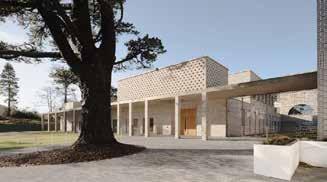
primary school and a public space with Awards going to: Arklow Wastewater Treatment Plant by Clancy Moore Architects in collaboration with Ayesa Engineers; Harcourt Terrace Educate Together National School by tún - architecture + design; and Monaghan Peace Campus by Hall Black Douglas.
The International Award went to Westminster Coroner’s Court by Lynch Architects.
In the largest category, Living, the jury recognised different types of homes, including House Adaptions, with Awards going to Rathdown by Scullion Architects and Sundial by Donaghy + Dimond Architects.
The Award for a New Build Home went to Beechville Gate Lodge by A2 Architects, while the winning Housing projects were 49 - 51 Amiens Street by Lawrence and Long Architects and the Benedictine Monastery at Kylemore Abbey by AXO Architects.
The Workplace and Fit-Out Award went to a new Architects' Studio by O’Donnell + Tuomey, while the Award for large Workplaces went to Work IQ by McCullough Mulvin Architects.
The importance of well-designed public spaces was highlighted by the Awards for Urban Design which went to Church Square, Monaghan, by Henry J Lyons and Tolka Estuary Greenway by Darmody Architecture and TTT (thirtythreetrees).
The Universal Design Award, which is supported by the Centre for Excellence for Universal Design at the National Disability Authority, went to Monaghan Peace Campus by Hall Black Douglas.
Sustainability in Architecture was recognised with two awards: Arklow Wastewater Treatment Plant by Clancy Moore Architects in collaboration with Ayesa Engineers and The Jackson Library, Oxford by Nex—.
Benefits
In addition to built work, the RIAI Awards also recognise the importance of research and the benefits it can bring to our communities by driving innovation and engagement.
The Research Winners were: The Reason of Towns Exhibition by McCullough Mulvin Architects, the Irish Architecture Foundation and AP+E; and Mulranny - . WAY – a project by Brock Finucane that arose from an RIAI architectural commission for Mulranny TidyTowns
Adaptation and Re-Use
Winner: Two Grand Parade
Architects: Henry J Lyons
Client: Hines
Highly commended: Bailieborough Bridewell
Architects: Cooney
Architects
Client: Cavan County Council

Adaptation and Re-Use Winner: Two Grand Parade by Henry J Lyons Architects
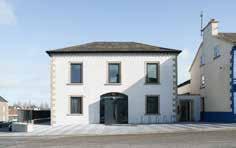
Highly Commended: Bailieborough Bridewell by Cooney Architects.
Construction Industry Federation calls for streamlining of judicial review and ‘overly prescriptive’ planning process to fast-track vital infrastructure, at its annual conference.
The Construction Industry Federation called for streamlining of the judicial review and ‘overly prescriptive’ planning process to fast-track vital infrastructure, at its annual conference.
Effective and efficient
Addressing the Federation’s national conference, Hubert Fitzpatrick, retiring Director General of the Construction Industry Federation, called for more effective and efficient use of regulatory requirements for planning and delivery of strategic infrastructure critical to support housing and population growth.
‘The government should designate key critical public infrastructure projects, which are considered an absolute necessity to support and maintain housing and economic growth for Ireland, which has the fastest growing population in Europe,’ he stated.
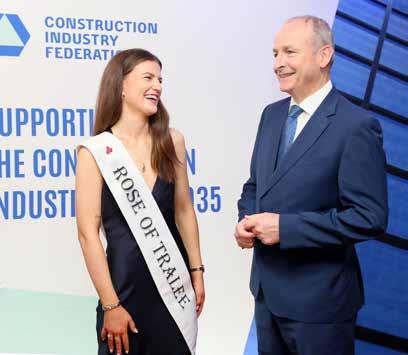
‘The forward planning process for such infrastructural projects is overly prescriptive, and the judicial review process available for challenging these critical projects must be streamlined so that unacceptable delays are minimised.
Crucial
‘Infrastructure referred to includes water, wastewater, transport and energy projects, which are crucial to support housing targets.
‘The planning process for such projects should be enabling and facilitative rather than the restrictive approach often perceived by supporters of such key projects, which
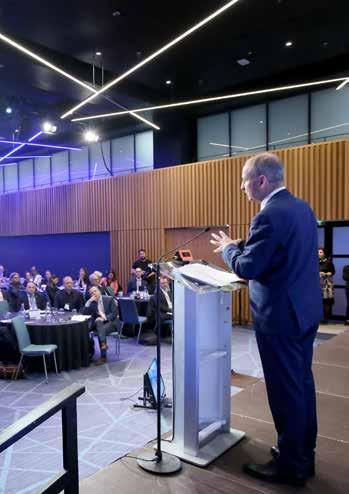

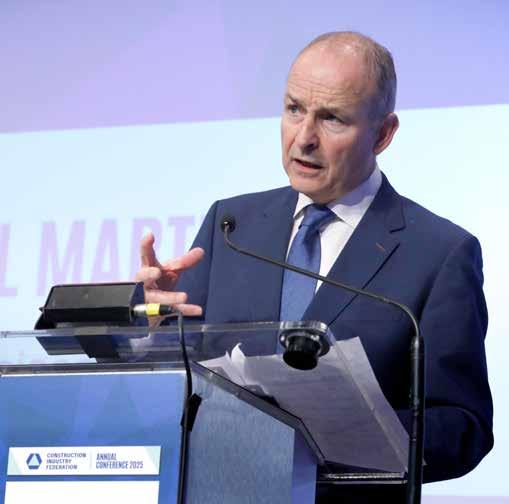
‘The conference was titled: CIF at 90: Building a competitive Ireland for people, prosperity and progress.’
the economy is so dependent upon.
‘The “public good”, to be determined by government, should be the overriding principle to enable these infrastructural projects to come to fruition.’
Hubert Fitzpatrick, who was retiring as Director General of the Construction Industry Federation, said: ‘The construction industry has the capacity to deliver the key infrastructural projects that the economy is dependent upon.
‘We’re seeing strong growth among Irish construction companies in overseas markets where the available pipeline of works is much more transparent and reliable.’
Hubert congratulated his successor, Andrew Brownlee on his appointment as Chief Executive, with effect from 1 October 2025.
Darragh O'Brien TD, Minister for Climate, Environment and Energy and Minister for Transport gave the Keynote Address at the Engineers Ireland Energy, Environment & Climate Action division’s AGM. Pictured at Engineers Ireland headquarters, (L-R): Damien Owens, Director General Engineers Ireland; Darragh O'Brien TD, Minister for Climate, Environment and Energy and Minister for Transport and Dave Linehan, Outgoing Chair of Energy, Environment & Climate Action Division, and Head of Policy at Wind Energy Ireland.
He thanked Construction Industry Federation members, stakeholders in government departments and agencies for their support over the years and wished the Federation well in representing members and addressing the many challenges facing the construction sector into the future.
The Construction Industry Federation marks its 90 th anniversary this year, having been founded in May 1935. The conference was titled: CIF at 90: Building a competitive Ireland for people, prosperity and progress.
Excellence in concrete design and construction was celebrated at the Irish Concrete Society’s Awards Evening, which took place in the Clayton Hotel, Burlington Road, Dublin
This was the Society’s 42nd Annual Awards Evening and with over 270 in attendance, is always one of the highlights of the construction industry’s calendar.
Adjudicated by a distinguished, independent jury of industry professionals, the Awards recognise excellence in both design and construction in concrete.
The Main Awards Jury reviewed a total of 26 projects nominated in three categories of Infrastructure, Element and Building.
Sponsored by Enterprise Ireland, there were also nine projects nominated for the 12th International Award.
In addition, the winner of the annual Sean de Courcy Student Award was announced from three entries and the biennial Sculpture Award was chosen from four entries.
Speaking at the awards evening Chair of the Society, Robert Laird, stated: ‘Now being held for the 42nd time, our awards are a chance to showcase the high calibre of concrete execution in Ireland and by Irish companies abroad.
‘On behalf of the Society, I would like to thank all jury members who gave of their time and expertise to pick the winners in each category.
‘While this evening we honour these winners in particular, I would like to pay tribute to all who entered into the competitions.
‘These entries showcase the excellence which continues to be achieved in the use of concrete in Ireland.
‘I would also like to thank the many members who, throughout the year, have given of their time freely to assist the Society by presenting at technical seminars or by offering technical guidance and support.
‘Finally, I would like to thank members, guests and award entrants, for attending and supporting the celebration of the 42nd Irish Concrete Society Awards.’
The main awards jury consisted of Steven Connoly (Grafton Architects), Pauraic Matthews (CSEA) and chaired by Adrian Cunningham (BAM Ireland).
Building category and overall winner
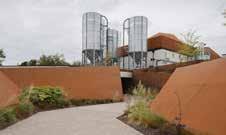
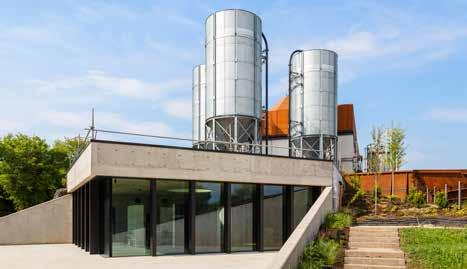
Church of Oak Distillery Chosen from a total of 14 Building Category entries and 26 entries for the Overall Award.
Jury Quote: ‘The Church of Oak Distillery stands as a landmark restoration and adaptive reuse of the historic Ballykelly Mills, positioned along the Grand Canal in Monasterevin, Co. Kildare.
'This transformation exemplifies a sensitive balance between contemporary sustainable construction and the preservation of the site’s rich industrial heritage.
‘The design approach carefully integrates modern interventions within the existing fabric, with concrete playing a pivotal role in both structural performance and architectural expression.
Refined
‘The project showcases a refined palette
of concrete finishes, demonstrating exceptional craftsmanship while reinforcing the authenticity of the historic structure.
‘The jury particularly noted the seamless integration of concrete in preserving original building elements, ensuring continuity between past and present.
‘Architectural fair-faced concrete, combined with a commitment to lower-carbon materials, highlights the material’s versatility – simultaneously enhancing the aesthetic language of the intervention while upholding sustainable principles.
Compelling
‘The result is a compelling dialogue between old and new, where materiality, texture, and form celebrate both the mill’s legacy and its contemporary rebirth.’
Project Client: Jewelfield
Architect: ODOS
Project Engineer: JJ Campbell & Associates
Project Contractor: Ormonde
Construction
Major Supplier: Kilsaran
‘These entries showcase the excellence which continues to be achieved in the use of concrete in Ireland.’
Jones Engineering, a global leading engineering contractor, is making strides on its sustainability journey as showcased in its recently published 2024 Responsible Business Report.
Jones Engineering’s ambition is simple:
To continue to grow their business in a responsible and sustainable manner with consideration to the environmental and social impacts of everything they do.
This report highlights Jones Engineering’s commitment to decarbonisation, responsible sourcing and innovation in its efforts to reduce environmental impact.
A framework for responsible growth
Jones Engineering first launched their Responsible Business Framework in 2022.
It guides sustainability action across four pillars: Our People, Our Planet, Our Products & Services and Our Community.
Key achievements for Jones Engineering in this reporting cycle include a Silver Accreditation from the Irish Centre for Diversity, a CDP B Score and an A Score from the CDP from their Supplier Engagement Assessment.
Aoife O’Donnell, Head of Sustainability, noted:‘Our Responsible Business Framework underpins every
aspect of our sustainability strategy.
‘In 2024, we made meaningful progress across our key priorities, and this has been recognised through improved CDP scores.
‘Our progress is driven by the collective efforts of our teams, suppliers and partners as we continue to build a more sustainable future.’
Jones Engineering’s long-term success is underpinned by investment in its people.
With a workforce of more than 4,500 across 19 countries, the business lives by its core value of engineering through people.
Highlights from the 2024 report include furthering our commitment to diversity and inclusion, opening of the Apprentice Training Academy in Co. Carlow and over 19,000 hours of nonmandatory professional development training for staff across the company.
Carbon management
Last year, Jones Engineering announced their Science Based Targets, to reduce Scope 1, 2 and 3 greenhouse gas emissions by 2032.
In 2024 Jones Engineering reported progress against their greenhouse gas reduction targets and outlined the key measures that will help them to achieve them, including alternative


fuels, self-generation of electricity and electrification of fleet and equipment.
Collaboration and community Collaboration remains at the heart of Jones Engineering’s responsible business strategy.
Jones Engineering works closely with its suppliers and partners to promote sustainable business practices.
Since 2023 Jones Engineering has hosted 60 of its top suppliers at workshops to encourage dialogue on sustainability, collaborative initiatives and set measurable goals to improve supplier sustainability performance.
Jones Engineering endeavours to make a positive impact on the communities in which they live and work.
In 2024, Jones Engineering exceeded their target for community support by investing €630,217 in communities across Ireland and overseas.
They also became members of Ireland’s leading network for responsible businesses, Business in the Community Ireland (BITCI).
Looking ahead
Jones Engineering will continue to embed sustainability into our operations, from innovation in carbon reduction to deeper supplier collaboration.
The focus remains on delivering lasting value for clients, communities, and the planet through Jones Engineering’s Responsible Business Framework.
Arup has received the prestigious Engineers Ireland Continuing Professional Development (CPD) Employer of the Year Award for its Personal and Career Development Programme, an initiative designed to support mid-career staff at a pivotal stage in their careers.
Presented
The award, which was presented at a ceremony at Engineers Ireland’s headquarters in Dublin is a leading indicator of excellence for employers of engineering professionals and is awarded for demonstrations of exceptional commitment to continuous professional development.
Arup is one of over 170 leading organisations that holds the Engineers Ireland CPD Employer Standard, a benchmark for learning and development excellence, innovation and best practice.
Joe Burns, Ireland Country Leader at Arup, expressed the company’s pride in receiving the award.
Supporting
‘Supporting our people to grow and succeed is at the heart of how we work at Arup,’ he said.
‘Through our learning and development programmes, we are helping our staff build confidence, grow their skills and bring their best to the multidisciplinary projects we deliver for clients worldwide.
‘We’re honoured to receive this award, which celebrates our commitment to unlocking potential, nurturing talent and building a culture where everyone feels inspired to make a difference.’
Structured
The Personal and Career Development Programme, now in its second year, includes structured coaching sessions that allow individuals to reflect and reconnect with what motivates them and prepare for the next stage of their professional journey.
Prathiba Marimuthu, Senior Engineer at Arup, shared her experience of the programme:
‘One thing that stood out for me is how focusing on awareness, decision making and goal setting could transform
‘This
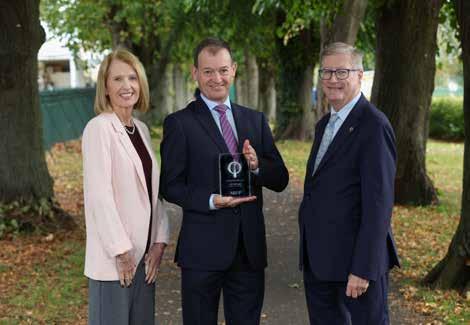
how you approach challenges.
‘Coaching gave me the tools to step back, see the bigger picture and move forward with intention.’
Initially designed for mid-level professionals and now extended to senior leaders, the initiative promotes a culture of continuous learning and purposeful development.
Speaking following the award, Engineers Ireland’s Director General, Damien Owens, said:
‘Engineers Ireland is delighted to award Arup the 2025 CPD Employer of the Year Award in recognition of its strategic approach to the progression of its mid-career staff, creating a tailored approach that is relevant and impactful.
‘This award demonstrates to Arup’s colleagues and clients the importance it places on the personal and professional development of its staff.’
award demonstrates to Arup’s colleagues and clients the importance it places on the personal and professional development of its staff.’
Engineers Ireland’s Director General, Damien Owens
With over 30,000 members,
Engineers Ireland is the voice of the engineering profession in Ireland.
Engineers Ireland was established in 1835, making it one of the oldest and largest professional bodies in Ireland. Members come from every discipline of engineering, and they range from engineering students to fellows of the profession. For more information, see www.engineersireland.ie
Arup is a global built environment consultancy providing advisory and technical expertise for clients across more than 130 disciplines. For more information, see www.arup.com .

www.nvm.ie (041) 983 7435
DUST MONITORING
DUST MONITORING
DUST MONITORING
EQUIPMENT HIRE
EQUIPMENT HIRE
EQUIPMENT HIRE
VIBRATION MONITORING
VIBRATION MONITORING
VIBRATION MONITORING
www.nvm.ie (041) 983 7435
MONITORING EQUIPMENT HIRE VIBRATION MONITORING
www.nvm.ie (041) 983 7435 DUST MONITORING
HIRE
HIRE VIBRATION MONITORING
ENVIRONMENTAL SERVICES
ENVIRONMENTAL SERVICES
MONITORING ENVIRONMENTAL SERVICES NOISE MONITORING
NOISE MONITORING
NOISE MONITORING
MONITORING
WATER MONITORING
WATER MONITORING
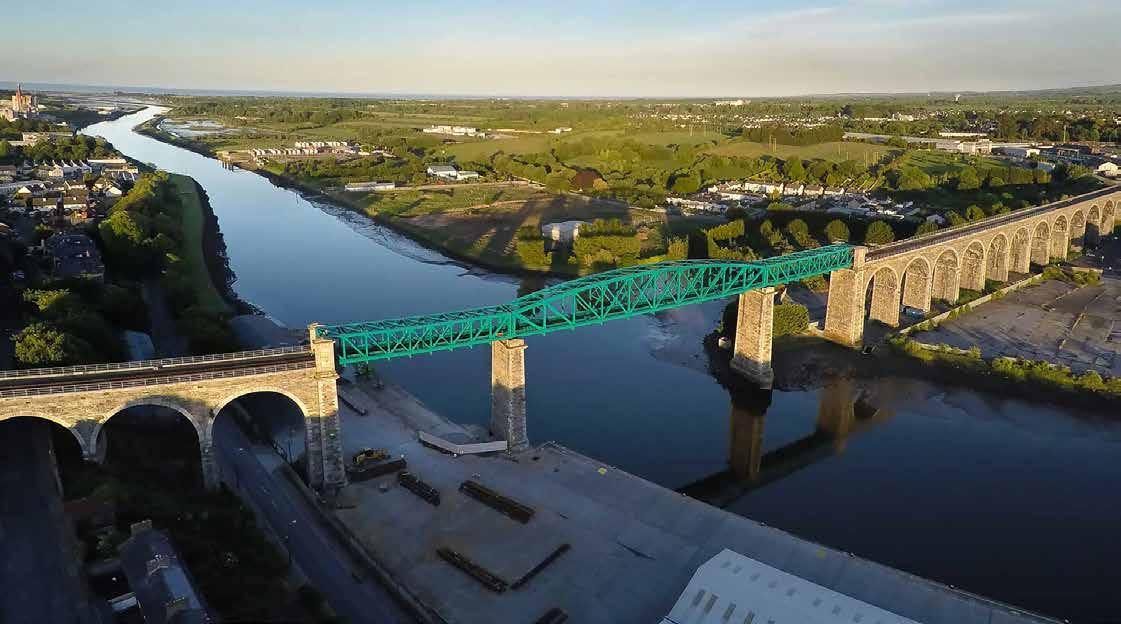

A state-of-the-art apprenticeship training facility is under development in Letterkenny following the signing of a construction contract between Atlantic Technological University (ATU) and Boyle Construction.
The fitout of an existing building at Drumnahoagh, funded by the Department of Further and Higher Education, Research, Innovation and Science under Project Ireland 2040, will enable a significant expansion of apprenticeship training across the region and nationally.
Accommodate
The building, which spans over 1,600 square metres together with an additional external compound and associated parking, will accommodate more than 200 apprentices annually.
The facility will house advanced workshops and learning environments for apprenticeships in Metal Fabrication and Refrigeration & Air Conditioning.
The project represents a collaboration between ATU and Donegal Education and Training Board (ETB), with both institutions sharing the facility and delivering programmes under one roof.
Strategically located close to ATU’s Letterkenny campus and the ETB campus, the development will strengthen tertiary cooperation and enhance access to apprenticeship education in the northwest.
Delivery
Delivery of the project has been led out by the University and developed in collaboration with the ETB though each stage.
This is the last of five projects the University has successfully delivered as part of a €10m Apprenticeship Expansion programme announced in 2023, with electrical apprenticeships facilities already delivered in Killybegs, Mayo and Sligo, for more than 800 apprentices annually.
Minister for Further and Higher
‘Delivery
of the project
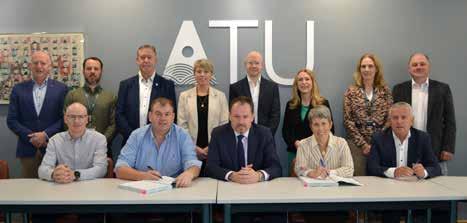
Education, Research, Innovation and Science, James Lawless said:
‘This project is a powerful example of what can be achieved when institutions work together with purpose. Donegal ETB and ATU Donegal have combined their strengths to create a single, purpose-built hub for high-quality apprenticeship training.
‘My Department has provided significant funding through the Higher Education Apprenticeship Expansion Programme and the Further Education and Training Apprenticeship Equipment Fund to make this vision a reality.’
The Minister added: ‘Investing in local training infrastructure is about more than bricks and mortar, it’s about backing people, strengthening communities, and securing the future of our economy.
‘This facility will give apprentices in Donegal the tools to thrive, while helping Ireland meet the skills challenges of tomorrow.’
has
been led out by the University and developed in collaboration with the ETB though each stage.’
Minister of State, Marian Harkin said: ‘Donegal ETB continues to demonstrate leadership in delivering high-quality apprenticeship training that meets the needs of local industry and learners.
This collaboration with ATU Donegal is a powerful example of how our education and training boards are driving innovation and regional development.
The investment from my Department recognises the critical role ETBs play in expanding access to apprenticeships and equipping people with the skills they need to thrive in today’s economy.’
The signing, attended by Minister of State for Sport and Postal Policy and TD for Donegal, Charlie McConalogue, welcomed the investment as a major boost for skills development and regional employment opportunities:
‘This new facility represents a strong investment in Donegal’s future workforce,' the Minister said.
‘It will give local apprentices access to top-class training and facilities right here in the northwest, ensuring that young people and career changers alike can gain qualifications and experience that are essential to meeting Ireland’s future skills needs.’
Dr Orla Flynn, President of ATU, said:
‘This investment represents a major commitment to strengthening apprenticeship education across the region.
‘By working collaboratively with our partners Donegal ETB, we are creating opportunities for students to gain practical, industry-focused training in high-demand trades.
‘The Drumnahoagh facility will help meet Ireland’s growing need for skilled metal fabricators and refrigeration and air conditioning technicians while supporting sustainable regional growth.’
Henry McGarvey, Vice President with responsibility for campus
infrastructure and IT, said:
‘The signing of the contract with Boyle Construction, for the development of Metal Fabrication and Air Conditioning & Refrigeration apprenticeship facilities is part of a €10m investment in the expansion of apprenticeship provision in our university.
‘A total of €5.9m is being invested in this facility at Drumnahoagh in Letterkenny, which will offer students the opportunity to undertake Metal Fabrication and Air Conditioning & Refrigeration apprenticeships for the first time outside of Dublin or Cork.
This initiative will also be the first time that apprenticeships will be undertaken in a shared building with the ETB, where Donegal ETB will
provide phase 2 Metal Fabrication training, in a single tertiary campus.’
Eoin Bradley, ATU’s Head of Capital Development, acknowledged the progress made by the university’s Buildings and Estates team:
'It’s great to see this important project moving ahead. The team has worked closely with Donegal ETB and other stakeholders to bring a complex and collaborative development to this stage.
‘We look forward to welcoming apprentices to the facility early next year and to seeing the pipeline of highly skilled tradespeople contribute to the national workforce.’
The new training facility is expected to open to apprentices in January 2026. This is a Project Ireland 2040 funded project.
ATU students James Swift and Killian Smith were named as joint overall winners of the Undergraduate Engineering Competition at the 2025 ATU Galway annual Engineering Exhibition and Competition.
Project James, from Castlebar, Co Mayo, also claimed the Energy Engineering
ATU Energy Engineering award winner James Swift from Castlebar pictured with ATU Head of Department Des O’Reilly, and Ken Gleeson, Engineering Leader, ThermoKing.
‘Mayo and Cavan students named joint winners of ATU Engineering Competition – Harnessing Hydrogen and Designing easy-lift mechanism are 2 winning projects.’
Award for his winning project, Harnessing hydrogen – A study into renewable energy storage using hydrogen.
‘My project aims to provide a means of storing excess renewable electricity during times of low demand using a hydrogen fuel cell system,’ he explained.
‘The prototype I developed uses electrolysis to produce and store hydrogen, which can later be converted back into electricity through galvanic operation when needed.
‘The system is entirely emissions-
ATU Mechanical Engineering Joint Competition Winners, Killian Smith from Ballyjamesduff and James Swift from Castlebar with ATU and Engineering judging panel representatives from Aerogen, Boston Scientific, CBRE, CF Tooling, Chanelle Pharma, Collins Plastics, Cook Medical, Engineer Ireland and Engineers Ireland West, Fort Wayne Metals, Glanua, Hollister, Impact Metals, JFC, Major Equipment, Mathworks, McHale, Medtronic, Merit Medical, PEM, Portwest, RPS Group, Transitions Optical, TE
free, with water as the only byproduct’, he said.
Killian, from Ballyjamesduff, Co Cavan, was also awarded the Agricultural Engineering Award for his project titled:
Engineering design & development of an easy-lift mechanism for efficient handling of vacuum hoses on trailed & mounted vacuum tankers.
‘The prototype I developed helps operators of vacuum tankers lift heavy vacuum hoses onto the side of the tanks without risking injury,’ he explained.
‘It’s especially beneficial for elderly farmers, helping them continue working safely’, he said.
ATU Agricultural Engineering award winner Killian Smith from Ballyjamesduff, pictured with ATU Head of Department Des O’Reilly, and Noel Sheridan, Senior Design Engineer, McHale.
Recently we saw a landmark celebration at Combilift’s global headquarters in Monaghan, marking the tenth anniversary of the highly successful OEM Engineering Traineeship –a collaborative initiative between Combilift and the Cavan and Monaghan Education and Training Board (CMETB).
Cornerstone
The event, which welcomed past graduates, current trainees and local educators, underscored the programme’s evolution from a local skills initiative to a cornerstone of regional industrial development.
Launched in 2015, the OEM Engineering Traineeship was born from a shared vision to tackle the skills gap in engineering and manufacturing with an industry-led approach.
Today, with over 150 trainees having passed through its doors to achieve a QQI level 5 qualification, and with job placement rates above 80%, the programme stands as a model for how industry and education can collaborate to mutual benefit.
Success
Combilift, a global leader in materials handling solutions, has been central to this success.
As the primary industry partner, Combilift has not only provided cuttingedge workplace experience but also ensured the course content remains aligned with real-world demands.
‘We wanted to create more than just a training programme – we wanted to build a pathway into meaningful careers,’ said Combilift managing director, Martin McVicar.
‘This traineeship has delivered exactly that, time and time again.’
The nine-month programme blends 26 weeks of classroom-based learning at Monaghan Institute with 12 weeks of hands-on work experience in Combilift.
Over the years, the course content has evolved to reflect changes in the manufacturing landscape, now including modules in Hydraulics, Lean Manufacturing, and, more recently, Mathematics to prepare students for greater work or educational opportunities.
CMETB has played a vital role in coordinating and delivering the educational aspect of the programme. Their ongoing commitment to adapting the curriculum, securing government funding, and expanding the scheme to include other regional employers from 2025 reflects their strategic approach to workforce development.
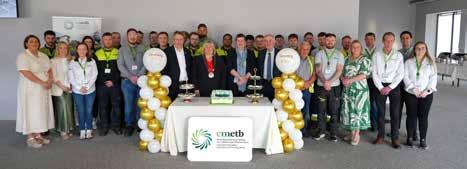
‘It’s about staying ahead of the curve,’ said Sinead McKenna of CMETB.
‘We’ve created a flexible, forwardlooking course that equips learners with in-demand skills and supports local industry at the same time.’
One of the most compelling aspects of the programme is its accessibility.
Fully funded through government and EU support, it removes financial barriers for participants and trainees are offered a €300 bursary per week during practical placements within Combilift.
Trainees also benefit from additional qualifications, including City & Guilds module in Hydraulics and a Lean Six Sigma White Belt.
The 10-year milestone was marked not only by reflection but by ambition for the future.
Attendees at the celebration event heard first-hand from past graduates who have gone on to build thriving careers – many still with Combilift, some even progressing to degree-level study or engineering apprenticeships.
Both Combilift and CMETB are doubling down on their commitment to the next generation.
As Martin McVicar put it, ‘The demand for talent in this sector is only growing, and we’re proud to continue building that talent right here in Monaghan.’
Video Link: https://youtu.be/vm1Qp-onV1E
‘It’s about staying ahead of the curve,’ Sinead McKenna, CMETB.
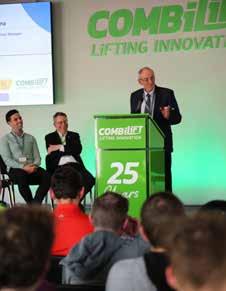
ENHANCE THE SAFETY, STORAGE & EFFICIENCY OF YOUR LOGISTICS WITH COMBILIFT
Combilift’s range of multidirectional forklifts, pedestrian reach trucks, straddle carriers and container loaders will allow you to maximize the capacity, improve efficiency and enhance the safety of your facility.
Contact Us Today
To find out how Combilift can help you unlock every inch of your storage space.



Lewisham Park Towers is a pioneering flat roof refurbishment project that highlights the carbonreduction benefits of BauderECO FF insulation, a finalist at the Irish Construction Excellence (ICE) Awards 2025 in the Construction Product Innovation category.
Commitment
Part-funded by the Social Housing Decarbonisation Fund (SHDF), the project achieved carbon savings of almost eleven tonnes of carbon dioxide equivalent (tCO₂e), reflecting Bauder’s commitment to energy-efficient and sustainability-focused flat roofing solutions.
The roof refurbishment encompassed three high-rise buildings that house 204 residential units.
It addressed long-standing roof issues such as leaks and poor insulation.
At the heart of the project is the installation of BauderECO FF insulation, which helped Bauder’s client L&Q make considerable carbon savings.
Differentiates
Using Lewisham Park Towers as an example, the following outlines what differentiates BauderECO FF from traditional polyisocyanurate (PIR) insulation boards, the opportunity it offers organisations to make an environmentally responsible procurement decision, and the benefits to be gained from doing so.
‘BauderECO FF: An innovation in PIR’
A responsible purchasing decision
At a time when organisations are held increasingly accountable for their greenhouse gas emissions, selecting BauderECO FF over traditional PIR insulation represents a more environmentally focused purchasing decision and a commitment to reducing carbon emissions.
Thermally efficient PIR insulation with up to 80% less embodied carbon
BauderECO FF is an innovative rigid thermoset PIR insulation board with lower embodied carbon than any other PIR insulation board available in the UK and Irish markets.
Approximately 80% of raw material feedstock used in the production of BauderECO FF is sourced from processed renewable biomass and renewable inorganic raw materials, replacing derivatives obtained from fossil sources and thereby reducing embodied carbon.
The biomass balance approach
This carbon reduction is made possible by Bauder adopting the biomass balance approach in its manufacture of BauderECO FF.
The biomass balance approach is a chain of custody model used to track the total amount of renewable plantbased raw material content through a manufacturing process/supply chain.
Bauder works with REDcert to ensure that any claims made about ECO FF are accurate, verifiable, and certified.
Demonstrates
Lewisham Park Towers clearly demonstrates how specifying BauderECO FF can significantly reduce project carbon emissions.
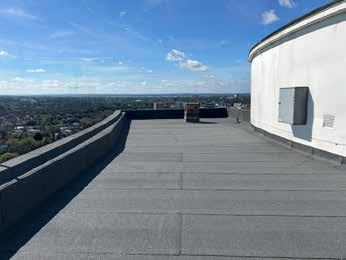
As Bradley Green, Head of Delivery at L&Q explains:
‘Partnering with Bauder and their innovative biomassbased ECO FF insulation, we (reduced) our carbon and construction impact, using resources more efficiently and supporting a transition away from fossil fuels.’
As a direct result of following Bauder’s advice to incorporate BauderECO FF in the refurbishments at Lewisham Park Towers, L&Q achieved carbon reductions of 10.96 tCO₂e (the approximate carbon emissions of a commercial return flight from London to Syndey).
In addition, BauderECO FF successfully enhanced the buildings’ thermal performance, creating warmer, more energy-efficient homes.
In turn, enduring social sustainability outcomes such as reduced heating and cooling costs for the residents of Lewisham Park Towers were achieved.
Tom Raftery, Head of Sustainability at Bauder, underlines these sustainability and performance benefits, adding:
‘Lewisham Park Towers is a great scheme to have been part of.
‘Through the utilisation of our BauderECO FF insulation, L&Q have shown their commitment to reducing the overall carbon impact of this project whilst improving the comfort of residents, without compromising on technical standards.’
Backed by a 25-year guarantee, the Lewisham Park Towers refurbishment ensures long-term reliability and represents Bauder’s commitment to providing environmentally focused roofing upgrades.
For further information on how BauderECO FF can help reduce the embodied carbon of your roofing scheme, visit www.bauder.ie or call +353 (42) 9692 333

BauderSOLAR G LIGHT
Combine
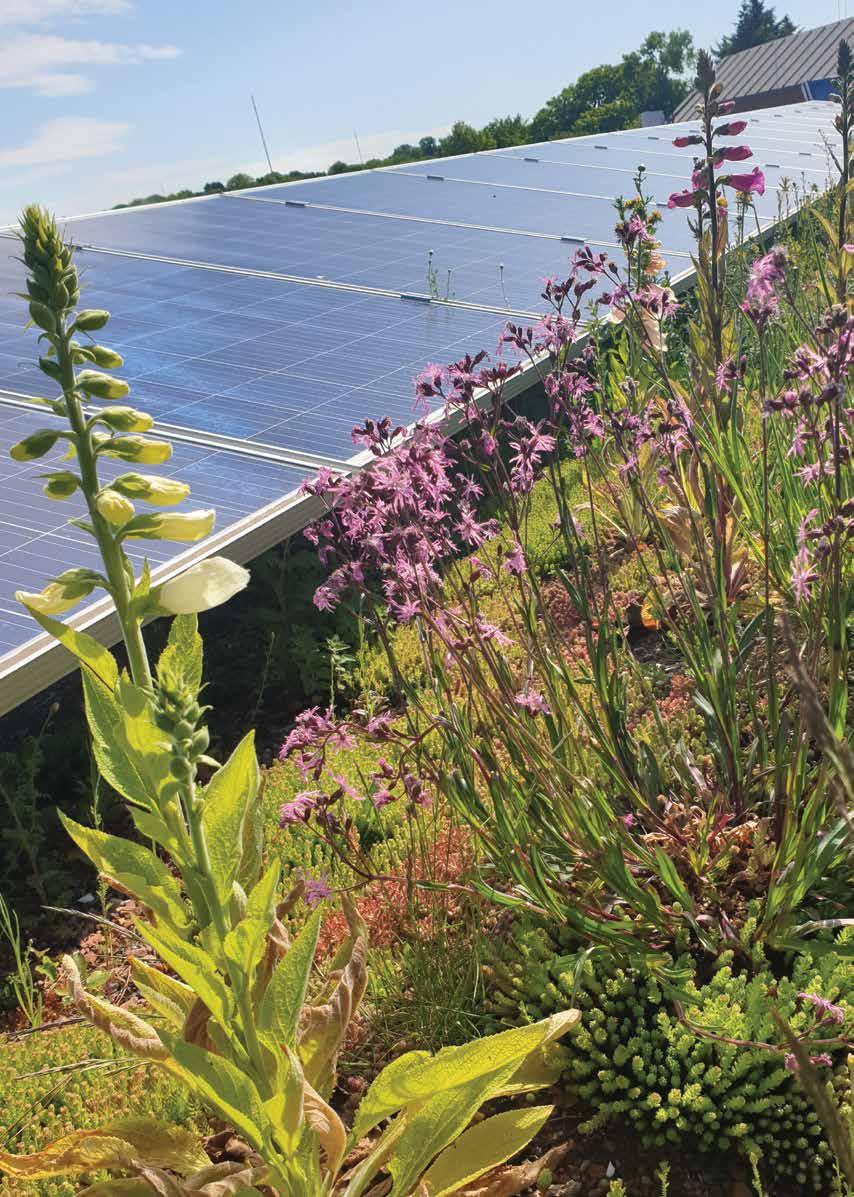
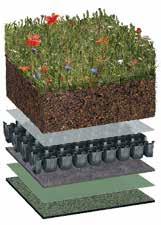

A series of CPD seminars being delivered by the Technical Manager for Marmox Ltd., Mark Bowman, have been providing architects and other Irish construction professionals with a fresh dimension on the challenge of addressing heat loss around the ground floor perimeter to various building types, while maintaining structural load-carrying capacity.
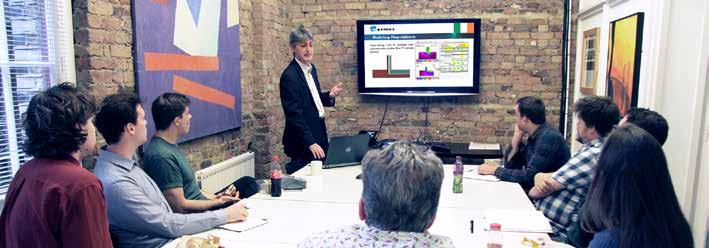
Available
Thermoblocks are available in widths of 100, 140 or 215mm and are formed from sections of extruded polystyrene – XPS –encapsulating two rows of high strength, epoxy concrete pillars or mini-columns. These are attached at either end to the top and bottom layers of glass-fibre reinforced polymer concrete, to ensure a good bond with the rest of the structure.
Importantly, the columns themselves offer a very low thermal conductivity so do not create a cold bridge, while being able to support a loading of 9N; higher than the typical dense or aerated concrete block.
Crucially
Set within the highly insulating XPS section, the units achieve a combined thermal conductivity of 0.047 W/mK and crucially being able to deliver a very low transmittance, derived by thermal modelling and actual measurement, offer significantly superior performance compared to ‘acceptable construction details’ listed under Part L.
'RIAI recognition of Marmox Thermoblocks offers new solution to cold bridge at floor wall junction.'
Although the insulation manufacturer made Thermoblocks available through its Irish distributors a couple of years ago, the product achieved crucial RIAI recognition in October last year, since then Mark Bowman has been making monthly visits to Dublin to present 60-minute CPD seminars to a growing number of architectural practices, where many of those taking part were being introduced to Thermoblock for the first time.
Reactions though have been very positive as the technical benefits and ease of installation become apparent for both domestic and non-domestic situations.
Additionally, as well as typically being used at the base of the blockwork inner leaf in the UK over the past decade, they are also deployed beneath solid masonry, timber frame and even modular volumetric buildings.
Mark Bowman reports: ‘I have been getting very good feedback from the architects we have delivered the CPD seminars to, within their own offices and we’re currently arranging further sessions.
‘Although the Irish Part L Building Regulations are quite distinct from those in Northern Ireland and the UK mainland, the thermal principles
remain the same – and the values for Thermoblock are able to be used in DEAP and NEAP calculations for domestic and non-domestic projects.
‘We are on the RIAI website as a CPD Network provider and importantly, Thermoblock will help achieve compliance as well as making buildings more thermally efficient overall.
‘Avoiding the risk of a thermal bridge around the floor-wall junction further prevents condensation occurring, which of course can lead to mould growth.’
While Thermoblocks are laid on a bed of conventional mortar around the footprint of the building or in some circumstances beneath internal walls, the stepped overlaps to the 600mm long units are bonded using Marmox 360 adhesive. Data sheets and further technical guidance are available from the company.
For further information, please contact: Marmox (UK) Ltd. Caxton house 101-103
Hopewell Drive, Chatham, Kent ME5 7NP. Tel: 01634 835290 Fax: 01634 835299
Email: sales@marmox.co.uk
Web: www.marmox.co.uk

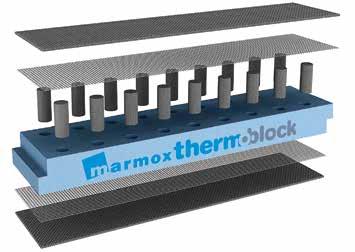





UValue Insulation, a leading distributor of high-performance insulation and building products, is pleased to announce the development of a new headquarters and state-of-theart distribution centre in Dunshaughlin, County Meath.
This significant investment reflects the company’s continued growth and long-term commitment to supporting customers across Ireland and the UK, we are told
‘Strategically located to enhance logistics and operational efficiency, the new 90,000 square metre site will serve as the central hub for U Value’s Irish operations.
‘The facility will include modern office space, enhanced warehousing capacity, and upgraded infrastructure to support improved distribution and customer service capabilities.’
Construction of the new facility is already underway, with completion scheduled in the coming months at time of writing.
Niall McEvoy, Managing Director of U Value Insulation, said: ‘This is a major milestone for U Value Insulation and a proud moment for our entire team.
‘From our origins in Dublin to our expansion across Ireland and the UK, this new HQ represents the next chapter in our story.
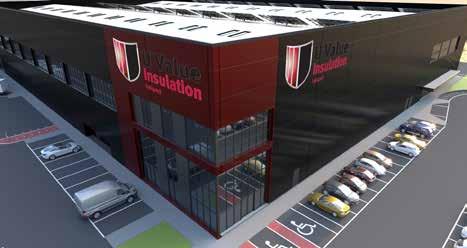
The new HQ is designed to support the next phase of expansion
‘It will allow us to operate at a greater scale, deliver improved service, and offer a modern, purpose-built workspace for our growing workforce.’
The Dunshaughlin facility will support:
• Greater stockholding to meet increasing demand
• Improved logistics and faster delivery times
• Sustainable operations aligned with U Value’s commitment to responsible growth
• New jobs and investment in the local community

With five locations already operating across Ireland and the UK, U Value has positioned itself as a trusted partner in supplying materials for residential, commercial, and modular construction projects.
The new HQ is designed to support the next phase of expansion and provide the infrastructure needed to continue offering leading insulation solutions for modern, energy-efficient builds. Further updates, including construction progress and behind-thescenes visuals, will be shared via the company’s LinkedIn and website.
With branches in Dublin, London, Manchester & Birmingham, U Value Insulation is a specialist distributor of insulation and building products, serving contractors, builders, architects, and modular manufacturers across Ireland and the UK.
With a focus on innovation, in-depth technical expertise, and high-quality customer service, U Value supports projects of all sizes with tailored solutions that meet modern building regulations and energy efficiency standards.
For more info visit https://uvalue.ie/

- Innovative Design
- Exceptional Performance
- Ultra-Low Noise Levels
- Outputs from 4kW – 16kW


With the increasing demand for low-carbon heating technologies, higher building standards, and futureready heating systems, construction professionals need solutions that tick all the boxes – performance, compliance, and homeowner comfort.
Comprehensive
Grant’s Integrated Heating Packages offer a fully comprehensive approach, streamlining the heating specification process for new builds across Ireland.
Designed by Grant’s in-house technical team, these packages combine three key components: a primary heat source, hot water storage, and carefully selected heat emitters with the additional option to add smart heating controls.
Every package is tailored to the property’s unique layout, energy requirements, and building regulations, ensuring maximum performance with minimum hassle.
At the centre: The Aerona R290 Heat Pump
At the core of Grant’s Integrated Heating Packages is the Grant Aerona R290 air-to-water heat pump, a highefficiency system that uses refrigerant R290 – a natural refrigerant with an exceptionally low Global Warming Potential (GWP) of just 3.
With R32 and other high-GWP refrigerants slowly being phased out, R290 offers a compliant, future-proof alternative that also delivers on heat output and system responsiveness.
The Aerona R290 is already gaining traction on new build developments and within single dwelling properties, with many developers impressed by its proven performance, easy installation, and Grant’s robust aftercare.
When coupled with the technical specification heating design service from Grant, it becomes an ideal choice for those seeking low-carbon compliance.
Design support from start to finish
To support the specification process, Grant offers a free heating design service, which ensures that each individual heating system is accurately tailored to the needs of the property.
This service includes full system sizing, heat loss calculations, product specification, and technical support –all provided by Grant’s in-house specialists.
Whether working on a one-off dwelling or a large-scale development, construction professionals benefit from expert guidance to ensure the system design aligns with current building regulations.
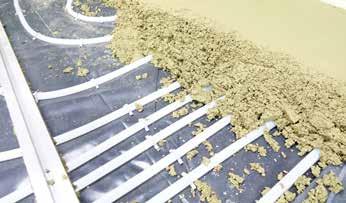
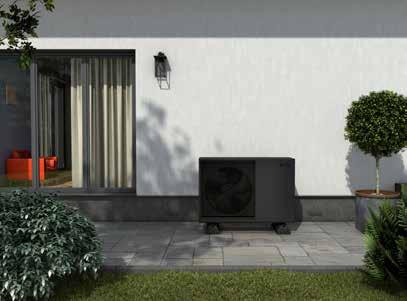
The result is a fully integrated heating package that helps to simplify both the planning and heating installation stages of a new build project.
Complete system design
To complement the Aerona R290, Grant’s team specifies a compatible hot water storage solution, such as the Grant Integrated Unit, and selects the most appropriate heat emitters.
These include Grant Uflex underfloor heating for highefficiency radiant heat or Afinia aluminium radiators, which provide quick responsiveness and a sleek finish. Hybrid systems using both options are also common, depending on project needs.
Intelligent control
Bringing the system together is the Aerona Smart Controller, which offers intuitive scheduling, weather compensation, and remote access through a mobile app or online portal.
It enables homeowners to easily manage their heating while also allowing installers and engineers to monitor performance, adjust settings, and carry out diagnostics remotely.
Grant’s integrated heating packages take the complexity out of low-carbon system design.
For those involved in delivering new-build residential schemes, they offer a smart, compliant and future-ready solution, supported by a trusted manufacturer with over 45 years of experience.
Think heating. Think Grant.
Send your house plans and heating preferences to heatpump@grant.ie to get started, or visit grant.ie for more on integrated heating, control options, and case studies from the field.
Follow Grant on Facebook and X @GrantIRL, Instagram @ grant_irl and LinkedIn @GrantEngineeringULC.
Blocked channels, corroded gratings, and standing water in car parks are familiar frustrations for engineers and contractors.
Detail
Although drainage is often treated as a minor design detail, poor systems quickly become liabilities once a site is in use.
This is where Galco Recyfix Monotec stands apart.
Traditional channels struggle with today’s demands. Heavy rainfall events are more frequent and overwhelm shallow or narrow systems, leaving unsafe pools of water.
Add constant traffic: cars, vans, and lorries passing over access points, and weaker materials begin to crack or corrode.
Hurdle
Cost is another hurdle. In urban infill projects, utilities often sit just below the surface.
Excavating for heavy concrete channels can be prohibitively expensive or even impossible.
Maintenance compounds the problem: corroded gratings need replacement, blockages demand constant cleaning, and theft of metal covers adds further expense.
What looks cost-effective at first often proves expensive in the long run.
A new approach with Recyfix Monotec
This is where Recyfix Monotec stands apart. Manufactured from fibre-reinforced polypropylene, it is built as a single monolithic unit using mirror welding.
That makes it exceptionally robust, resistant to vandalism, and permanently protected against corrosion.
The integrated Fibretec grating provides a heel-safe, attractive finish while removing the risk of stolen metal gratings.
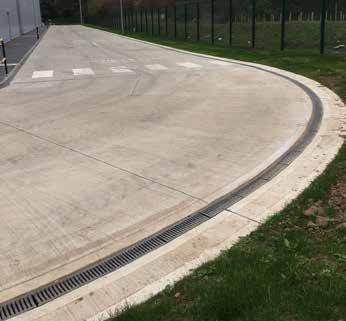
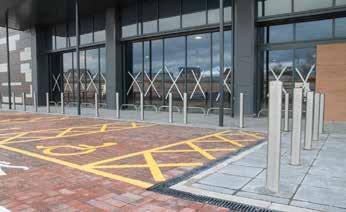
Despite its lightweight design, Monotec is rated up to Class D400, meaning it can handle heavy traffic loads in car parks, supermarkets, and industrial sites.
Being significantly lighter than concrete channels, it can be installed quickly by fewer workers, without cranes or large machinery.
Faster installation means lower costs and fewer delays on site.
Hydraulic performance has been carefully engineered. Slim channel walls maximise the drainage cross-section, giving Monotec the ability to cope with sudden inflows of rainwater.
The largest profile reaches over 746 cm², providing the capacity to manage extreme weather without flooding.
Sustainability at its core
Monotec is also a step forward in environmental responsibility.
It is produced from recycled materials such as bottles and packaging and is fully recyclable after use.
The system carries the Blue Angel environmental label, highlighting its role in reducing waste and conserving resources.
Durability adds to this sustainability story: channels that resist frost, UV light, de-icing salts, and chemicals simply last longer, reducing the need for replacements.
By combining durability, hydraulic performance, ease of installation, and sustainability, Galco Recyfix Monotec addresses every challenge that typically undermines drainage systems.
For engineers, it means confidence in design. For contractors, it means faster builds and fewer callbacks.
For clients, it ensures safer, cleaner surfaces with lower lifetime costs.
Next step
Looking to go deeper into best practice? Our Engineers Ireland–approved CPD course ‘Design Considerations For Channel Drainage Systems’ explores these issues in detail. Book your CPD today: charlie.byrne@galco.ie
The Residential Zoned Land Tax (RZLT) is now effective and 3% of the value was due in May 2025.
Get the right advice from the development land experts at Hooke & MacDonald who have been successfully advising clients for over 50 years.
The Hooke & MacDonald team are familiar with the latest legislation, research, current trends, purchasers and pricing having advised on or sold over €2 billion in land over recent years.
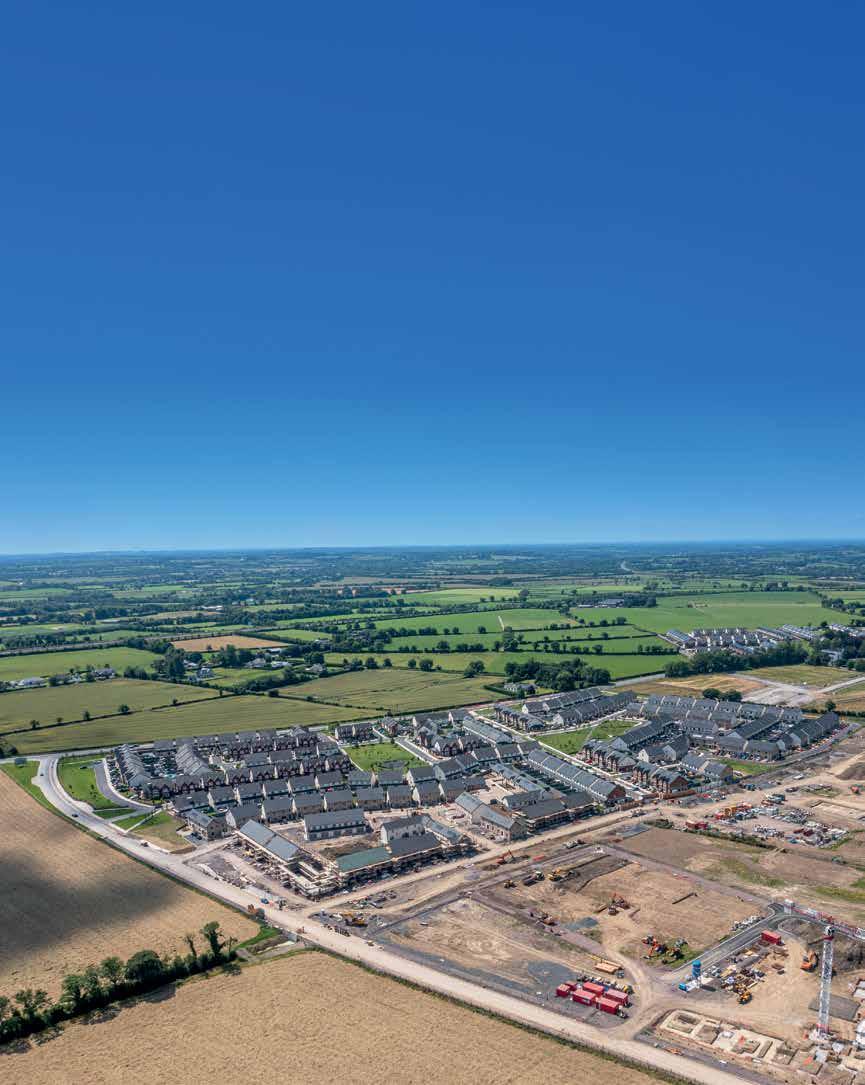
Contact Hooke & MacDonald to discuss your options.
David Cantwell T 086 256 3852 E davidc@hmd.ie
Donald MacDonald T 087 207 0283 E donaldm@hmd.ie
Enda Moore T 086 255 6445 E endam@hmd.ie WINNER 2022, 2023 & 2024

Institutional funding of new apartment developments for the private rental market has collapsed due to the unfavourable conditions prevailing in the State for this sector.
This funding has fallen from 15 per cent of new homes purchased in 2022 to 5.5 per cent in 2024, a fall of 63 per cent.
The 5.5 per cent mainly related to transactions that took place in 2021 and 2022 that are just now being completed, so the figure of 5.5 per cent actually overstates the level of funding due to the lag in sale closures.
The new Government measures on rent pressure zones (RPZs), while helpful in some respects, mainly for tenants, fail to recognise the seriousness of the position or to remove the blockages to pension funds and institutional capital supporting housing supply.
The VAT reduction on apartments is welcome but more incentives are needed.
There were no new residential units purchased by institutional investors in 2024, marking a complete withdrawal of this cohort from the market.
Sales activity has virtually ceased apart from some stabilised (existing and tenanted) stock.
This stands in contrast to claims made by some commentators, and it is regrettable that certain analyses of the CSO housing data have been inaccurate and misleading.
According to Hooke & MacDonald Research’s analysis of the latest CSO/Eurostat figures, the biggest movers in the 2024 figures showing the composition of purchasers of new homes are first-time buyers, followed by the public sector category which includes the Land Development Agency (LDA), approved housing bodies (AHBs), local authorities and the Housing Agency.
First time buyers increased their percentage of new home purchases from 33 per cent in 2023 to 36.5 per cent in 2024. Other owner-occupiers constituted 22 per cent, down from 23 per cent in the previous year.
Institutional entities and pension funds have been responsible for funding the construction of more than 20,000 apartments, mostly in Dublin, in the past eight years providing accommodation for approximately 50,000 people based on an estimated occupancy of 2.5 persons per property.
If these had not been built, the rental market would now be in a far worse position than it currently is in terms of supply – these properties would not have been built if it wasn’t for these sources of capital.
Added to these figures would be the substantial number of public sector housing units funded by the institutions.
The State can only fund less than half of the €20 billion-plus required annually for the funding of a minimum of 50,000 new homes, so it is imperative that radical conditions are created as a matter of urgency for international capital funders to re-enter the market and make up the difference
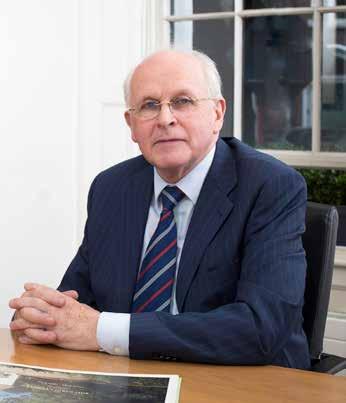
in the funding shortfall.
The damage done by the 2 per cent rent cap is now plain for all to see. The unintended negative consequences, in terms of reduced supply and increased rents, far outweigh any perceived positives.
Funding by the Government for the different typologies of housing needed in the public sector is an absolute necessity and must continue.
It is such a pity that funding for the private sector is being impeded by measures preventing institutions from supporting the private rental sector housing market in Ireland.
Ken MacDonald Hooke & MacDonald
118 Lower Baggot Street
Dublin 2
T: 01 661 0100
E: info@hmd.ie
W: www.hmd.ie
PSRA No. 001651



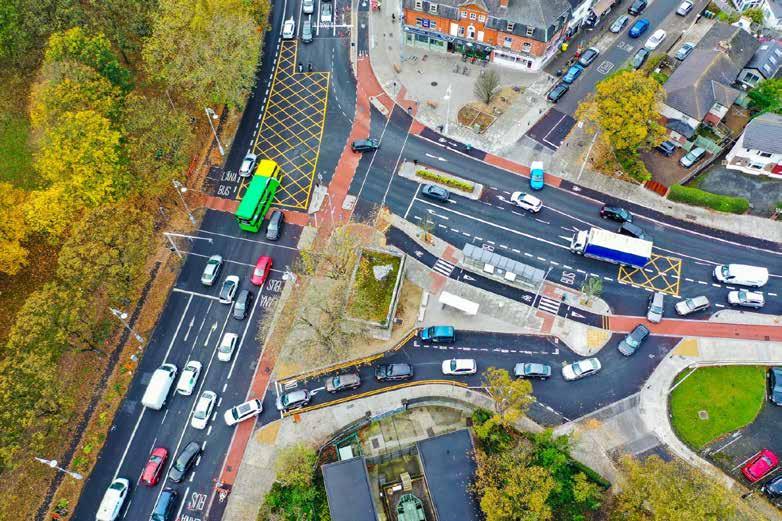








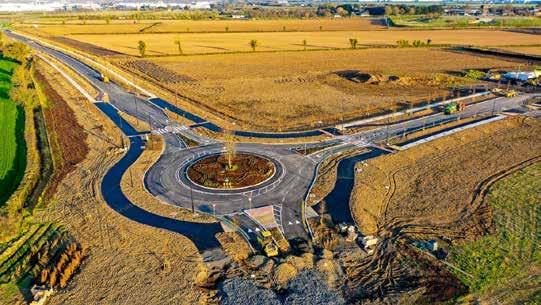
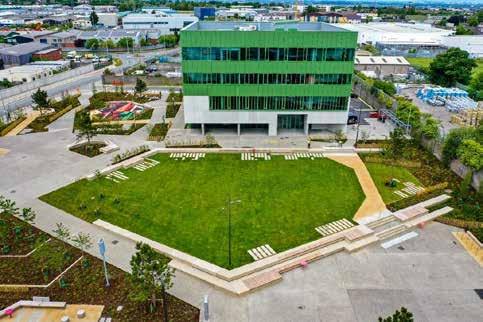
Expert opinion by jeff haden @jeff_haden

When I worked on the shop floor, my supervisor asked if I wanted to spend time in production control developing a better way to improve workflow throughout the department.
I wanted to move into management someday, so I jumped on the opportunity.
That ask, according to Mark Cuban, is a perfect example of leadership.
During a 2024 episode of The Draymond Green Show podcast, Mark Cuban talked with the famous basketball player about how great leaders understand that company goals should align, whenever possible, with employee goals.
As Cuban said:
Leadership is having a vision. What’s my goal? Part two is getting to know the people who are working with me, and what their goals are.
And then the real definition of leadership is making those two merge.
This makes sense. My supervisor’s goal? Improve our department’s productivity.
My goal? Show that I had the skills to be a supervisor and, eventually, run a plant. Our goals merged. One goal worked, on multiple levels.
The hidden benefits
But what if you don’t have employees? You should still take the same approach.
You should still choose to pursue goals that work on multiple levels for you, because we all lead ourselves.
To be sure, the most important person you will ever lead is yourself, because everything you do – every person you lead, or influence, or impact – flows from there.
What’s more, because pursuing a goal that works on multiple levels makes it much more likely that you’ll stay the course and actually achieve that goal.
Take exercise for example. Most of us want to be healthier. Even so, with everything else on your plate, ‘get in better shape’ doesn’t rise to the top unless you dig a little deeper:
• Exercise makes you a better leader. Studies show that chronic stress can cause leaders to become uncertain and unmotivated, and to focus on themselves rather than on their teams.
• Exercise makes you smarter. A study published in Journal of Comparative Physiology in 2014 shows that increased blood flow also improves brain plasticity and enhances the functional aspects of parts of the brain involved in cognition. As the researchers write, ‘More
active or higher fit individuals are capable of allocating greater attentional resources toward the environment and are able to process information more quickly.’
• Exercise improves your mood . Researchers at the University of Vermont found that 20 minutes of moderate intensity aerobic training improved participants’ mood for up to 12 hours.
• Exercise makes you happier. A study published in International Journal of Environmental Research and Public Health found that participants with moderateto-high activity levels had significantly higher life satisfaction and happiness than those less active.
One goal, multiple benefits for you, and for the people around you – at work and at home.
Strategic goal setting
Or, say you’ve always wanted to learn a language. With all the other things on your plate, learning to speak Spanish doesn’t rise to the top unless you dig a little deeper.
Learning a language:
• Improves executive functions like attention control, problem-solving skills, and task-switching abilities.
• Improves working and long-term memory in unrelated tasks.
• Increases brain plasticity by activating different brain regions – auditory, visual, motor, and others – and strengthens connectivity between hemispheres.
• Improves empathy and cultural understanding
One goal, benefits on multiple levels.
Try it. Think about a goal you’ve always wanted to accomplish. Then look past the obvious outcome.
Managing yourself
For example, the benefit of building a bigger business is self-evident, but not particularly meaningful on an emotional level.
Dig a little deeper, though, and more benefits emerge. Building a bigger business helps ensure you can take care of your employees.
‘To be sure, the most important person you will ever lead is yourself, because everything you do – every person you lead, or influence, or impact – flows from
there.’


(When I walked around his 400,000-square-foot race shop with Joe Gibbs, I asked him what he thought about when he stepped back and looked at it all. ‘The first thing that comes to mind,’ he said, ‘is all the times I wondered if we would be able to make payroll the next Friday.’)
Building a bigger business creates opportunities for your employees to learn and grow – and to take care of their families.
Greater financial stability means you can take better care of your customers and serve more customers.
Building a bigger business means you can take better care of your family.
Multiple
One goal, multiple benefits – for you, and for the people around you. Those are the kinds of goals you want to pursue.
And because they now have greater personal meaning, you will be more likely to achieve them.
The opinions expressed here by Inc.com columnists are their own, not those of Inc.com.

As a leading Irish mechanical engineering contractor, MSL Engineering Ltd are the partner of choice across many industries including Life Sciences and Semi-conductor.
With over 45 years of construction and engineering expertise and a flexible project management approach, we deliver best in class projects utilising BIM design and off-site modular construction processes to the highest standards of workmanship, safety, quality and reliability.
SERVICES:
• Pipe Fabrication & Installation
• Offsite Modular Assemblies
• Heavy and Process Equipment
• Process Drainage
• Commissioning and Testing
• Mechanical and Design Solutions
• Platforms and Steelwork