Eight years since leaving New Zealand, the last four of which have been spent sailing in the Mediterranean, we are now ready to continue our journey home to complete this circumnavigation on our 44ft yacht Mai Tai. Once we leave the Straits of Gibraltar, we will sail to the Canary Islands, then Cape Verde Islands before crossing the Atlantic Ocean to the Caribbean.
To do this safely we need to make sure that all systems on Mai Tai have been checked, repaired or replaced, so we decided to book a berth at Alcaidesa Marina on the south coast of Spain, until we were ready to leave.
So, after spending the summer months cruising in the Mediterranean from Malta, via Sicily, the Aeolian Islands,
Sardinia, the Balearic Islands, then down the Spanish coast as far as Aguilas. Aguilas is a delightful fishing port where we stayed on anchor waiting for the weather window to sail the 230 miles to round the Rock of Gibraltar to Algeciras Bay.
What a treat that passage was. At daybreak on the third day, while motoring in choppy seas and against a strong easterly current, we got a glimpse of the famous Rock of Gibraltar. It was shrouded in cloud but what an iconic and welcoming sight. We dodged our way through the dozens of boats, large and small, that were anchored in the bay east of Gibraltar, then made our way to the protected anchorage in front of La Linea, dropping our anchor in 4m, on sand, along with half a dozen other yachts.
Although we had booked a berth at the Alcaidesa Marina a few weeks before our arrival, we decided to spend four days
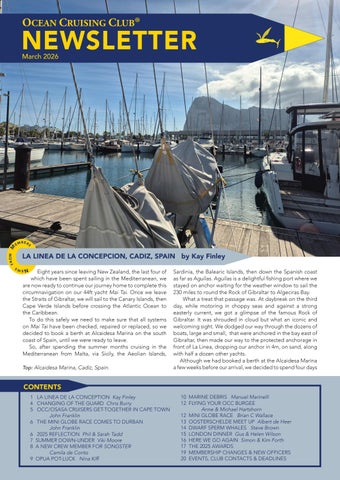
Top: Alcaidesa Marina, Cadiz, Spain.
LA LINEA DE LA CONCEPCION, CADIZ, SPAIN by Kay Finley
at anchor since we arrived earlier than we planned. There is plenty of room in the large well-protected anchorage, and even when strong westerly winds came up, there was relatively little swell. We were keen to go ashore to visit the town of La Linea, but the long sandy beach lining the shoreline was off limits to dinghies. We did find a spot on the outer wall of the marina to leave the dinghy, as there is no place to take a dinghy inside the marina area.
Checking in to the marina was very easy. We called on VHF Channel 9 to let them know we wished to enter the marina and were advised to tie up on the pier, next to the fuel dock, in front of the office. The staff were very welcoming and efficient and spoke good English. I had paid a deposit, so the paperwork was straight-forward and I was told that I could pay the balance when we departed. I was advised that if we wanted to stay for one month and paid in advance, then we would get a 9% discount, which we did.
Once in the marina, we were able to have spare parts and equipment shipped there. With our lifestyle, always on the move, it is often very difficult to have an address to have mail or packages sent to. So, it is very much appreciated to be able to use the Alcaidesa Marina address. However, it is important that your boat has arrived and is in the marina before getting any packages sent here. The office staff are
incredibly helpful in sorting the numerous packages that they keep safely in their back room.
Alcaidesa Marina came highly recommended by several friends as a safe, reasonably priced marina and, as an OCC member, we even get a discount on daily berthing rates. Don’t forget to mention your OCC affiliation when booking in, as they may not think to ask.
The visitors docks were in a good condition and each one had a floating finger dock and plenty of room to manoeuvre. Water and power are available at added cost. Our gate pass let us in and out of the secure locked gates and into the bathrooms, with lovely hot showers and laundry room.
The marineros are very friendly and available to help if necessary, plus large trash and recycling bins are everywhere.
It was a pleasure to meet with Tony (POR Cadiz-GibraltarMalaga), the marina port captain, who was very welcoming and happy to share information on the facilities, some of their projects they have planned for the future, and ideas of places to visit in the area.
We always look out for other OCC members and we enjoyed meeting Francesca and Jack on Calidris Alba
The Alcaidesa Marine Store, near the haul-out yard, a 10-minute-walk away, is well stocked with basic items, and will order items if they are out of stock.
Clockwise from left: Rounding Gibraltar under sail in Mai Tai; the Rock of Gibraltar.
Clockwise from above: View over Alcaidesa Marina from the office; Mai Tai at the marina dock; Dinner out with cruisers.
For shopping, we found everything we needed in La Linea town. There are several supermarkets within walking distance of the marina, a Lidl or Carrefour a little further away. The town is very clean with open air spaces, trees and parks and very friendly local people.
There are many restaurants and cafes serving drinks and tapas, along with a big variety of local dishes. We have had some fun get together dinners in town, with other cruisers.
We ended up spending four weeks in Alcaidesa Marina, and are very happy with our decision to go there. We don’t often go into marinas, but it was the perfect place to wait for our packages to arrive, check all the systems on Mai Tai, and we needed a safe place to leave the boat for several days for some road trips to Portugal and Southern Spain.
We took the opportunity to hire a car to visit some of the wonderful places nearby. The famous towns of Ronda and Setenil de las Bodegas
Clockwise from above: OCC members; Our road trip took us into the mountains; Setenil de las Bodegas is well worth a visit.
CHANGING OF THE GUARD
by Chris Burry
editor’s Note Gary passed away peacefully on Wednesday, 4 February 2026, just as this Newsletter was going to press. He will be cremated, and his ashes will be scattered in the Gulf Stream when the weather is better. The Club offers our deepest condolences to Greta.
The OCC has an invaluable worldwide network of Port Officers. Shortly after the Club’s establishment in 1954, the Port Officer network began forming as a volunteer system of local contacts around the world. By 1960–2, there were over 20 helping visiting members with local knowledge, berthing advice, provisioning and support in key cruising areas. Today, there are 288 Port Officers (PO) or Port Officer Representatives (POR) in 81 countries. Some serve for long periods of time, such as Founder Member Ian Nicolson, the Club’s longest serving PO who has held the post on the Clyde since 1959 (67 years). Herb Weiss, aged 107, who with his wife Ruth became PO for Boca Raton, Florida in 2018, holds the ‘oldest PO’ title. Honorary Member Alfredo Lagos, who was PO for Spain’s Ría de Vigo, served for 63 years from 1954 until 2017 (when his son Alberto took over), and Dick Davidson, who joined the OCC in 1956, served 65 years as PO for Dover and the South East of England.
Being a PO can be a very rewarding experience, especially for members who are no longer actively cruising for extended periods. It’s a great way to connect with members travelling through your local waters and gives you the opportunity to impart your local knowledge: I should know because my husband Bill and I serve as PO for Deltaville & Mathews, VA, on the Southern part of the Chesapeake Bay.
Recently, we attended a zoom annual update with the Member Services Network Co-ordinator for the Americas, Joerg Esdorn. We didn’t know until we attended the update that our friends and fellow PO for Norfolk, VA, Greta Gustavson & Gary Naigle had retired from their post and passed the baton to a new couple, Jack & Buffy Devnew.
Greta and Gary were appointed in January 1993, a few months after they returned from a 12 month ‘Atlantic Circle’ trip. That means they clocked up an impressive 30 years of service! They met Commodore Fiona Jones and her husband Chris on Three Ships in Antigua in 2002 when they attended a BBQ hosted by Mike Tyson (former PO Antigua).
Greta and Gary were famous for their dockage offered at the Norfolk Pilot House Condominium where they live. They
Top: Gary and Greta at Mathews Yacht Club.
are near Mile Marker 0 on the Intercoastal Waterway. Gary served as Dock Master and used to go out in his runabout to find Flying Fish burgees anchored out and invite them into their docks. Gary would drive a sailor anywhere they needed for supplies, services, dental referrals, etc. They arranged with the condo association that anyone with a Flying Fish burgee could use the unused docks for a few days (a suggestion was a bottle of wine or box of candy for the condo owners of the slip). Now, it’s a maximum of three nights.
Over their years as PO, they hosted an impressive average of 15–20 cruisers per year. Their favourite memories of visitors include pot-luck dinners on the dock and pizza parties in their condo. Their most difficult dock guests were those who insisted on showing the ship’s colours by hanging wet laundry in the rigging.
Greta and Gary were regular attendees at the annual OCC dinner at the Mathews Yacht Club that we host in October. Greta is the North America point of contact for all regalia, including the burgees that you fly and the shirts and ball caps that you wear. She always arrives at the dinner
PORT OFFICER PRACTICALITIES
How do I find a PO/POR where I’m cruising?
You can find a full listing of current PO/POR on the members’ side of the website at oceancruisingclub. org/members/PortOfficers or via the App map. You can search by country or location where you are cruising. On the map, there are markers to get more information about that port with a link to the PO and their information sheet: oceancruisingclub.org/members/PortOfficersMap
How do I volunteer to become a PO or POR?
PO are largely member volunteers who want to give back to the Club. POR come to the Club in a variety of ways – either a member has had such great service that they recommend them or they could be a person providing marine business services who is willing to be a wider point of contact. In either case, the appointment process is the same. The relevant Member Services Network Coordinator for Americas, Europe or Asia-Pacific vets them and then puts them forward to the General Committee for approval. The Club requires a commitment to service for a number of years and the creation of an information sheet for the location.
Current co-ordinators
Americas Joerg Esdorn: network_americas@oceancruisingclub.org Europe (currently Linda Lane Thornton but will change to Rhys Walters after the AGM): network_europe@oceancruisingclub.org Indo-Pacific Neil McCubbin: network_indopacific@oceancruisingclub.org
OCC Port Officer Map
with a box of Flying Fish burgees for members in need of a new one. The best way to contact her is via e-mail or cellphone.
Anne Hammick, Past Commodore, comments, “When I became Commodore in 2016 Greta mailed me a cap with a Commodore’s burgee on it, above Wrestler’s name. I wore it with pride for three years, and when I handed over to Simon Currin I added a white border to the burgee to make it a ‘Past Commodore’ burgee. It was such a kind gesture on Greta’s part and totally unexpected!” Another member wrote, “I was to meet Greta at the AGM in Annapolis where I was to buy an embroidered vest she’d made for me and I asked her, ‘How will I find you?’ She said, ‘I’ll be the one with a halo over my head.’”
Upon learning of the changing of the guard, Bill and I called Greta to catch up on how she and Gary are doing. She said, “Due to failing health, Gary has moved to the Memory Support unit at Harbor’s Edge, a nearby retirement community in Norfolk, where he also is receiving hospice services.” Greta got a visitor’s permit for their Jack Russell terrier, Rosie, so she could see Gary when Greta visited him. The dog jumped right on his lap to give him a kiss.
Greta said, “Being a PO has been the best job a person could wish for and it was a difficult decision to give that up. Fortunately, we have several OCC members living in our condo who have helped us the past couple of years with docking and, most importantly, entertaining! I was very pleased that Jack and Buffy were willing to take it on.”
We know that Greta would love to hear from you, wherever you are around the globe. Take a minute to thank her for her and Gary’s long-time service as PO for Norfolk, VA: greta.gustavson@verizon.net
Marion, MA. USA to St Davids Head, Bermuda at 50 years, is the oldest offshore race designed specifically for Corinthian cruising sailors.
H ADVENTURE – A 645 NM bluewater adventure from historic Marion, Massachusetts to the turquoise waters of Bermuda managed in the most safe and supportive way.
H CRUISER FRIENDLY FOCUS – No professional crews or high tech race boats. Focused on family crews, shorthanded teams and cruising designs.
H COMMUNITY AND CAMARADERIE – You’ll meet like-minded sailors, share stories, and become part of a welcoming offshore community.
H FAIR HANDICAPPING – The race uses state of the art VPP programs to rate boats ensuring the best available handicapping system.
2027 being the 50th Anniversary of the Marion Bermuda Race will be celebrating over the next two years with special videos, promotional events and human interest stories. The 2027 race will be a not to be missed experience, one you will talking about for years to come.
RACE START – June 18, 2027
For more information, visit our website at marionbermuda.com, and be sure to sign up for our race eNewsletter. Also visit our Facebook page and YouTube channel. If you have a specific question, please email race@marionbermuda.com for a prompt response.
IN CAPE TOWN by John Franklin
A small gathering of visiting cruisers got together for drinks and lunch at the Royal Cape Yacht Club on the morning of Saturday 3 January 2026.
Members present were John & Susan Simpson (Casamara), sailing with the World ARC, Wayne & Kerry Versfeld (South African members visiting Cape Town without their boat, Metzi), Americans Andrew & Anna Bereson and their children Katherine and Nathan (Second Sun), last but not least Paul Downie (Stella Polaris), who recently arrived in Cape Town from Tristan da Cunha and has since signed up as an OCC member. Welcome to the Club, Paul!
We were joined by visiting cruisers Robert & Martha Bone (Salinity) and Ken Denholm (Mahina Tiare III), both sailing with the World ARC, and Brazilian cruisers Bruno dos Santos and Eliz Modolo.
Accompanying the party were Robert Ravensburg (PO Cape Town), Jenny Crickmore-Thompson and John Franklin (RRC South Africa) and Linsay Ferguson (OSASA) with her partner Sheldon and young family.
Whilst sipping an introductory glass of champagne and waiting for lunch we were entertained by a succession of ‘tall stories’ from some of the cruisers present.
Being a very busy period in Cape Town it was difficult to arrange a suitable date with many visiting cruisers either away in their home countries or working on their boats preparing them for onward passages to St Helena, Brazil and
From left to right: Kerry Wersfeld, Jenny CrickmoreThompson, Wayne Wersfeld and John Franklin
the Caribbean. Many thanks to Jenny and Robert for putting together a very successful and enjoyable meeting and to the Royal Cape Yacht Club for allowing us to use their beautiful premises yet again.
Photo by Spectrum Photo
THE MINI GLOBE RACE COMES TO DURBAN
The Mini Globe Race (MGR) – a solo stopping race around the world in 5.8m boats, conceived by Australian adventure sailor Don McIntyre – reached their stopover in Durban in November 2025 after a 1,500-mile ocean leg from Mauritius. This treacherous ocean passage with no fall-back ports of call en route crosses the notorious Mozambique Channel and the Agulhas current before reaching the sanctuary of Durban.
The 11 competitors reached Durban safely after a storm -free passage. Australian Eric Marsh (aboard Sunbear) miraculously survived falling overboard and fortunately managed to recover himself but with great difficulty. A very lucky outcome.
During the passage from Mauritius, OCC member Jasmine Harrison managed to establish a fleet record of 179 miles in 24 hours, with some assistance from the current. Just to stress the achievement, that’s an average 7.5 knots in a 19ft boat with a hull speed of 5.5 knots . . . and this from a
Top left: Happy party goers, including Jasmine Harrison (second from left), Vince Nel (centre), John Franklin and Jenny Crickmore-Thompson (far right).
Top right: Jenny Crickmore-Thompson, Jasmine Harrison, John Franklin and Vince Nel.
by John Franklin
young lady who had minimal sailing experience before she set off from Lagos, Portugal, in November 2024. These are remarkably capable little boats and Jasmine has become a remarkably capable young sailor.
Vince Nel (POR Durban) had worked for weeks to plan for the MGR visit, arranging their berthing at Durban Marina and free access for the competitors to all the facilities of the Royal Natal Yacht Club (RNYC), as well as arranging a myriad of maintenance and supply contacts for the fleet.
To tie in with their arrival, Vince also organised a joint OCC/OSASA evening event at RNYC which was attended by about 75 people, including all the MGR competitors, their families and supporters, local yachtsmen and crews of several visiting foreign yachts. Among the OCC boats were Chinook, Paradise Falls, Saphir and, of course, Numbatou!
RNYC put on a magnificent South African braai –enormous portions and lots of succulent meat – which was much enjoyed by all, particularly the MGR crews who have been living on iron rations for weeks. The meal was followed by an excellent and informative illustrated presentation by retired British Naval Captain Kerri Harris about the Globe 580 boats specifically and the MGR race in general.
A very successful evening was enjoyed by all thanks to the hard work and organisation of the indefatigable Vince.
REFLECTION by Phil & Sarah Tadd
Our cruising has been limited in 2025 as we spent much of the time in the boatyard and marina at Pangkor, Malaysia, preparing our ‘new to us’ boat, Meikyo, for passage making: upgrading the battery installation and electrics, installing Hydrovane self-steering, replacing failed (and failing) navigation instruments and the million-andone other jobs needed on a boat that has been somewhat neglected.
We have now cruised as far as Thailand, where we are anchored off Phuket Island . . . and continuing to work!
The time in Pangkor was made enjoyable by the company of a number of OCC boats, new friends and old: Tim Chapman & Nancy Martiniuk (Larus), Zoë Peace & Bill
Warburg (Into the Blue), Allen & Maria Wadsworth (Jamala), Alison & Andy Nelson (Venture Lady).
In July, Garmin threw a curveball at sailors in this region when they withdrew their South East Asia charts, without notice. The issue was a problem within the Indonesian government and the charts have now been restored, but it prompted much discussion about reliance on one source of navigation software and the general reliability of Navionics charts in more remote areas. OCC member Sherry McCampbell (Soggy Paws) ran a series of seminars in the marina on the use of Open CPN as an alternative.
We are hoping to leave Thailand soon for a year cruising the Indian Ocean towards South Africa.
After arriving in New Zealand or Australia on the Island Cruising Pacific rally, many OCC members have been having a fabulous time cruising this summer and taking advantage of the excellent marine facilities on offer to undertake some much-needed refit and maintenance jobs. Others have left their boats safely docked and taken the opportunity to head home for Christmas and spend time with their families or having adventures on land, knowing their floating home is safe and being well looked after.
Many joined me in Auckland to visit some marine suppliers and factories for a really fascinating behind-the-scenes look at how sails and winches are made.
Dave Berg & Mary Schempp-Berg (PO Whangārei, North Island) and Tony & Nina Kiff (PO Bay of Islands, North Island) have been busy hosting social events in Whangārei and Bay of Islands, and giving lots of local tips and advice.
The boats who headed for Sydney were able to watch the spectacular New Year’s Eve fireworks display and the start of the Sydney–Hobart Race, with many following the race down to stunning Tasmania which has some incredible cruising grounds.
Other members have taken the opportunity to join the Island Cruising South Island Rally and head down to explore Marlborough, Fiordland and Stewart Island, while others are enjoying cruising Northland, Bay of Islands and the Hauraki Gulf.
They’ll all enjoy their cruising in New Zealand and Australia while they wait out the South Pacific Cyclone season before heading north – either back to the Pacific or on to Indonesia. There is so much to see in this part of the world, it is well worth factoring in at least two or more seasons in the Southwest Pacific to ensure you get to cover all the spectacular places on offer!
The Southwest Pacific cruising season begins again in May when boats head north to Tonga, Fiji, Vanuatu and New Caledonia – over 30 members are already registered on the Island Cruising Pacific Rally 2026, and those heading west from French Polynesia can also join in the fun. Get in touch with Viki (viki@islandcruising.nz) if you are interested or if you have any other questions about visiting the Southwest Pacific. To look at the rallies on offer, visit the website: islandcruising.nz
Top, left to right: Waiheke Island Oneroa Bay, busy with local summer cruisers; Sydney fireworks. Bottom, left to right: Smokehouse Bay, complete with a pizza oven on the shoreline which is free for all to use; Vetus Maxwell Factory tour with Regional Rear Commodore Viki Moore.
laNoiger
Commodore SUMMER DOWN-UNDER by Viki Moore
A NEW CREW MEMBER FOR SONGSTER by Camila de Conto
Songster welcomed a very special new crew member.
On 12 November 2025, Juliette Mareva Kloek De Conto was born in Whangārei, New Zealand, completing our family.
From French Polynesia to New Zealand, Juliette was already an ocean cruiser before she was even born. We found out we were expecting in March 2025 while spending the South Pacific cyclone season in Gambier. We immediately knew that our time in that paradise was coming to an end –and that our plans for the year would need reshaping.
With a due date in the first week of November, we considered several scenarios: staying another year in French Polynesia, sailing to Australia or New Zealand for the birth, or storing Songster for the cyclone season and flying home. The last option was quickly discarded. While we love French Polynesia, we also felt it was time for change – so we decided to sail on.
The plan was simple: if everything went well with the pregnancy, we would spend the first trimester enjoying French Polynesia, the second trimester crossing the South Pacific and the third trimester in New Zealand. As this was my second pregnancy, I felt confident. With our first child, Christopher, we had followed a similar path – sailing the Caribbean during the first trimester, crossing the North Atlantic in the second and spending the third trimester in Portugal.
And so we did. Between March and September 2025, I logged approximately 3,200 miles sailed between Gambier and Fiji, passing through the Tuamotus, the Society Islands,
Niue and Tonga – and as we sailed west, my belly grew with every mile.
The most challenging leg was the 700 miles between Gambier and Tahanea in the Tuamotus. At around nine weeks pregnant, I still don’t know whether to blame morning sickness or sea conditions. The rest of the journey was perfect, and we truly made the most of those miles, enjoying our final year sailing as a family of three.
Undertaking a pregnancy across an ocean is entirely possible, but it requires organisation, planning and trust in the process. We completed first-trimester checks in Tahiti, second-trimester checks in Fiji and then Christopher and I flew to New Zealand when I was eight months pregnant, while Jurriaan sailed Songster to Whangārei.
I had a healthy and happy pregnancy, and Juliette was born healthy and content at Whangārei Hospital. Her second name, Mareva, has Polynesian roots and honours her early journey – it means ‘ocean traveller’ in Tahitian.
For now, we are enjoying a quieter season of dock life, carrying out boat work to prepare Songster for the next chapter while watching our little sailor grow. In May, when our ocean traveller turns six months old, we plan to leave New Zealand and return to the tropics – this time as a crew of four. Welcome to the world, Juliette!
30 weeks
anchored
Left to right: Camila, Jurriaan, Christopher and Juliette when she came home from the hospital; Juliette’s nursery on Songster; Juliette is a happy two-month-old baby now!
Top, left to right:
pregnant,
in Marsden Cove, Fiji; Jurriaan, Camila and Juliette on board Songster, at Whangārei Marina, New Zealand.
OPUA POT-LUCK by Nina Kiff
There were 34 guests at the annual pot luck dinner in Opua on 5 December 2025. As always, there was a very varied selection of dishes brought along and we were delighted to have a warm evening so everyone could enjoy eating outside. Stories were shared and old acquaintances reunited.
Back in 1992, Tony and I met Rod Slater on his yacht, a Baba 30. He subsequently settled in New Zealand. Although not a member, he joined us for the evening having recently completed his solo circumnavigation over the last three years. Several people who are planning to continue westwards spent some time chatting to him about his voyage.
David Nicolson also came along. His father, Ian, is a Founder Member of the OCC and continues to sail in Scotland. We also welcomed Past Commodore Simon Currin and his wife Sally who are halfway through their circumnavigation. Simon presented Wim and Elisabeth van Blaricum with the David
Wallis Trophy for their contribution to Flying Fish
Attendees: Dean & Nola Herrmann (Masterplan); Simon Stephenson & Robin McGregor (Kallisti); Hazel Arnold & Paul Edwards (Susimi); Mary Schempp-Berg (PO Whangārei) & Dave Berg; Simon & Sally Currin (Shimsal); Wim & Elisabeth van Blaricum (Bengt); Mary Connaughton & John Schnellback (Beyond the Stars); Richard Foster & Janet Wilson (Pursuit II); Mike & Nicki Reynolds (Zen Again); Tom & Harriet Linskey (Ocean); Joerg Esdorn, Jim Immer, Iain Wright & Jim Clarke, (Kincsem); Lenny & David Vogel (ex-Perigee); Kiki & David Nicolson, non-members; John Perkins (Anahere); Rod Slater, non-member; Peter Hallet (Coral Moon); Nina (PO Bay of Islands) & Tony Kiff.
Top, left to right: Group photo at the Kiffery; Simon presenting Wim & Elisabeth with the 2024 David Wallis Trophy.
MARINE DEBRIS by Manuel Marinelli
For two years now, we (Project Manaia) have run a dedicated project on ‘Marine Debris’ – our Mediterranean Cleanup Mission on board Waya Waya. This, however, by no means implies that we didn’t run cleanups on a regular basis before.
For everyone who spends even a little bit of time on the water, it will not be news to learn that the amount of plastic and other debris drifting around at sea is increasing. While it may appear like an aesthetic issue, the problem is a lot more serious and complex.
A single straw made headlines around the world when it got stuck in a turtle’s nostril, which admittedly is something that does happen. This single, very powerful image led to several laws taking single-use plastic straws out of restaurants and cafes around the world. A small victory for ocean conservation organisations around the world!
However, the plastic straw was merely the tip of an iceberg. The number of animals (not only marine) dying of plastics – first, second or third-hand implications – is staggering! Turtles, who feed widely off jellyfish, can easily confuse a drifting plastic bag with their preferred food. Ingesting a plastic bag can lead to serious digestion issues and it is very rarely just a bag that passes through the digestive system.
The same is true for seabirds (the issue got a lot of attention several years ago with a documentary called ‘Midway’ after the island group where albatrosses go to breed). The parents collect drifting plastic pieces to feed to their offspring, thinking they are small fish (as the glittering effect on the surface is similar).
Those are just two of many possible examples. And with all the plastic that is out there (only one third of plastic in the oceans actually floats, so the vast majority is already on the bottom of the sea), those materials also find their way into the ecosystem. Plastic is built to last for ever: in fact, the first plastic bags ever made were made with the intention of being useable for ever. Sadly, we took a wrong turn at some point and now the majority of plastics are singleuse items or packaging. However, although the material is almost indestructible, it does break down under longer exposure to UV and harsh environments like salt water. This means that the particles just get smaller, and eventually become small enough to be confused with plankton. When that happens, they sneak into the food chain. As plastic can’t be digested by us, it is not a big deal yet; however, we tend to mix it with various chemicals either to dye it specific colours, increase its elasticity, or all the many other features that we demand of plastic items. And those toxic chemicals
Left to right: Volunteer briefing in the saloon of Waya Waya; Recycled plastic pellets; Clips printed on a 3D printer using recycled plastic pellets.
Top, left to right: Volunteers after their beach clean-up at the Greek Island of Salamina; Huge amounts of single-use plastic found on a beach; Milos underwater cleanup with freediving.
start to accumulate: as a rule of thumb, we say with every step in the food chain by a factor of ten. So, by that logic, if we have a small amount of those toxins in the sea already, it doesn’t really affect us. But those particles being eaten by animals small enough to drift in the water, which get eaten by shrimp, get eaten by sardines, get eaten by a tuna, which gets eaten by us. So, the density of those chemicals inside the tuna is about 10,000 times higher than it was in the water – and this can seriously affect our bodies, leading to various medical issues.
While we can’t easily change what is already in the sea (or at least to do so would take an unimaginable global effort and vast amount of money), it is an easy task to remove small amounts during beach cleanups, or even during snorkelling and diving. In the last year alone, we – together with our crew on board – have collected more than one metric ton of marine debris from beaches throughout Italy, Greece and Malta. While it is not a lot given the global scale of the issue, it is a start. And better yet, as plastic is a precious resource and incredibly useful for the right purposes (everyone on a fibreglass boat should certainly agree), trash is not particularly popular. With a small model setup of shredders, extruders and moulds, we are able to take (part of) the trash collected on beaches and recycle it into beaners, clips or filament for
a 3D printer, which in return can print almost anything your imagination can come up with.
By now, there are quite some cleanup efforts underway, from small-scale to giant operations, and there is headway to be made. However, the important thing to keep in mind is that just because someone is cleaning, it does not mean that we can continue littering. Saying this to a group of people who live on boats and love the sea probably has a strong sense of preaching to the converted, but in many ways, we are also ambassadors for the sea. We should spread the word, encourage people to do better, minimise their use of plastic and – whenever it is not avoidable – encourage others to properly dispose of the material: in the end, it is millions of small acts that will make the biggest difference to the ecosystem!
Our website also has more information on our project: projectmanaia.at/projects/marine-debris/ And the detailed reports of 2025 are at: mcm-2025.pages.dev
Project Manaia’s marine research boat, Waya Waya
Top: School children in Menidi, Greece, learning about the voluntary work they can get involved with by Project Manaia.
Why would you want to fly your burgee from your masthead ? The main reason is because it’s the correct place to fly it and it shows respect for your club. However, it can also be flown from your spreader, which is the most used location. There are other reasons for flying your burgee from the masthead e.g. wind direction and strength, or stopping large birds from using the masthead as a perch!
When we cruised Alaska for two years, the raptor birds used the mastheads to perch and look for prey. You may ask how do we get an indication of wind strength? There is an amount of very light tapping on the mast, as the burgee moves, but as the wind strength increases, so does the tapping. In addition, as not many sailors use the masthead, we find it much easier to locate Nimue in an anchorage or marina. Just look up and you can see your burgee making it easy to locate your boat.
So how do we fly our burgee at the masthead? On some mastheads, you can have a small block on the side; if not we have used a small length of stainless plate, screwed or riveted, to attach one. Measure the distance above your mast, so the burgee clears the wind instruments and aerials when flying. Add the depth of the burgee and double the length, which gives you the length of your pig stick. My first
pig stick was a hard wood dowel, but now I have an old carbon fibre 12mm diameter sail baton. Using an old coat hanger, or stainless steel welding rod, form the swivel for the burgee holding it in place with the stainless washers and jubilee clamps. The washers are to help the burgee to turn.
Use stainless steel mousing wire to attach the burgee. Take 2–3mm line double the height of your mast, whip one end from the middle and the other from the bottom of the pig stick, having passed it through the masthead block (whipping deadens the pig stick from making noise on your mast when moving). Now pull the pig stick up your mast, pull tension on the line and secure at the bottom of the mast. Stand back and proudly look at your club’s burgee flying from your masthead.
The only thing that could cause a problem, is that we have always found Nimue in an anchorage using our burgee, but if you have acted on this article, we may mistakenly board your vessel. If so, please put the kettle on and send us on our way, once we have located the correct burgee over Nimue!
Most swimmers train for months for lesser events, Jasmine had swum only a handful of times in the last 12 months, usually cleaning the hull of her boat! With minimal equipment (only a costume, hat and goggles aboard), she borrowed a safety tow float and used her boat tracker to record her attempt at a new record: being the first person to swim around St Helena Island. St Helena Tourism sponsored a dive boat and crew to accompany her. She set off into the waves at 2am, finally returning to Jamestown at 8.30pm: a
very impressive 30 miles in 19 hours. Conditions were unkind with 25-knot winds and rolling waves. No one knew the best direction to swim round the ‘Rock’ – as it is affectionately known. Jasmine chose clockwise, hugging the coastline and encountering counter currents at the southwest tip which slowed her progress when she was most tired.
MINI GLOBE RACE by Brian C Wallace
FLYING YOUR OCC BURGEE by Anne and Michael Hartshorn
On Saturday 27 September 2025 an informal Oosterschelde OCC get-together was held at the sailing club in Zierikzee. This picturesque and monumental town received its first city rights in 1217.
On the menu were delicious local mussels from Zeeland which were caught by the chef himself that very morning. Sailing stories were exchanged, plans were made and friendships were struck.
A special welcome was given to Tom and Teri Wikman, who came all the way from the USA .
The event was organised by Tom Dujardin (PO Zeeland) and Albert de Heer (PO Rotterdam).
Attendees: Liza & Akko van de Veen, Bojan Michiels van Kessinich, Teri & Tom Wikman, Nanda van Mil, Greet & Dirk Spinnewyn, Giuliana & Albert de Heer, Tom Dujardin.
Top, left to right: Dinner at the sailing club; Sunset; A feast of local mussels.
by
During last year’s Atlantic crossing from St John’s, Newfoundland to Kinsale, Ireland we encountered a small group of mammals that we later were able to identify as the rare and elusive dwarf sperm whales.
We were intrigued by their behaviour as they followed the boat at around 7.5 knots for many hours during the day. We could not understand why they chose to follow so closely, never more than 20m behind and frequently alongside. Later, we thought that they may have been attracted to the boat’s very noisy autopilot that creaks and groans endlessly and whose sound must carry through the water.
I was both fascinated and curious, not only by their behaviour but also by their similarity to their larger relative and decided to try and find out more about them. A trawl through the wonders of the internet confirmed that by comparison with other whales, little was known about them, but this intriguing marine mammal, belonging to the Kogiidae family, is often overshadowed by its larger relatives, yet it possesses unique traits and behaviours that make it a remarkable species worthy of study.
generally dark grey to bluish-grey, often with lighter patches or scars.
Unlike many other whale species, dwarf sperm whales have a unique dental structure. Males have between two and eight teeth in their lower jaw, which are often not visible unless the mouth is open.
Dwarf sperm whales are found in deep offshore waters around the globe, primarily in tropical and temperate regions. They prefer depths of around 500m (1,600ft) or more and are rarely seen in shallow coastal areas.
They primarily feed on squid, fish and crustaceans and are known to dive to substantial depths to hunt, sometimes reaching up to 900m (3,000ft).
It is thought that they are typically solitary or found in small groups of two to four individuals. But our one encounter was with a larger group of eight to ten animals. They communicate using clicks and other sounds, similar to other members of the toothed whale family, although their vocalisations are less understood.
They are elusive and often difficult to observe in the wild with much of what is known about them coming from the very rare strandings. Consequently they are often misidentified due to their small size and elusive nature, and are often confused with other whale species, leading to gaps in research and understanding.
The breeding season for dwarf sperm whales is not well documented, but it is believed to occur year-round in some regions. Females typically give birth to a single calf after a gestation period of about 10–11 months. Dwarf sperm whales are thought to live for 20–30 years in the wild, although exact data is limited.
They have a unique defence mechanism: when threatened, dwarf sperm whales can expel a cloud of reddish-brown ink, similar to squid, to confuse predators.
The conservation status of dwarf sperm whales is not well defined due to a lack of comprehensive population studies. However, they face threats from by-catch, habitat degradation and climate change.
They are relatively small, typically measuring about 2.6–3.5m (8.5–11.5ft) in length and weighing between 250 and 500kg (600 to 1,100lb) and have a robust, cigar-shaped body with a distinctively large and bulbous head. Their skin is
The dwarf sperm whale and their slightly larger cousin the pygmy sperm whale are two fascinating species that play a crucial role in marine ecosystems. Continued research and conservation efforts are essential to ensure the survival of these enigmatic creatures. As we learn more about their behaviour and ecology, we can better appreciate the complexity of ocean life and the importance of protecting these unique marine mammals and I feel privileged to have had an encounter with these fascinating creatures.
The 2025 London Dinner was once again held upstairs at Zizzi’s Restaurant in the Victorian Ivory House in the middle of the St Katharine Docks, a fabulous location on the River Thames adjacent to the Tower of London.
Zizzi’s is a chain restaurant and their downstairs space is a fairly conventional ‘chain restaurant’ setting. They rarely use the upstairs which has the Victorian wooden beam structure exposed and ‘varnished’, creating a warm atmosphere. This year we ordered off their Christmas menu with one drink included and subsequent drinks paid individually. One of the managers was our waiter, and he worked very hard throughout the evening looking after us all and making the event a great success.
We had 23 in attendance including the crews of the OCC boats in the marina this winter: Emmanou, Cadenza, Flight, Spellbound, Lema, Inspiration Lady and Wings’ Duet. Seven of the attendees were based locally in and near London. Commodore Fiona Jones and husband Chris were there, Fiona made a warm speech welcoming the attendees.
An added treat this winter was a presentation by Nigel Jollands (Novara). Many will remember Novara from the Club’s AGM at the RNLI College in Poole in 2024. Novara was moored alongside to enable attendees to have a tour and Nigel and Veroncia gave a fascinating presentation. Their cruising goal is to find ways to aid remote villages in coping with rising sea levels and in the Arctic the changes in ecosystems as surface sea ice coverage diminishes. Nigel presented details of their recent Northwest Passage including some spectacular drone images of the Arctic ice. One of these provided scale with Novara dwarfed by surrounding ice floes.
In the past, we would expect to find ourselves in the company of 13–14 cruising boats every winter in our home
WATERSPORTS INSURANCE AND
PAYING CREW MEMBERS
port here at St Katharine Docks. The numbers of boats spending the winter here decreased after 2013 due to an ownership and management change in the marina, but after 2016 wintering cruisers were once again warmly welcomed and sought after. Covid resulted in another hiatus but now St Katharine Docks again encourages cruisers and this 2025/26 winter in London we have several cruising boats, including the OCC boats listed above, forming a nice social group.
If anyone is considering it for next year, do get in touch –and do remember that members are eligible to a discount at St Katharine Docks.
by Willie Ambergen
Most boat insurance policies have an exclusion clause for paying crew members: if the boat has any paying crew aboard, then the boat is not insured. It is important to understand the definition of ‘paying crew members’.
We asked this question to a number of insurance companies. The answer was that when the costs of the trip such as food, drinks, port dues and fuel are shared between the crew and the skipper, then although money may exchange hands, they are not considered paying crew
members. A gift from people who board is also not seen as payment.
It did become clear that a payment to sail along as a crew is seen as payment; it is actually a form of charter. We recommend that anyone considering taking extra crew checks with their insurance company to make sure you understand fully what your insurer considers to be the definition of paying crew members.
VerreBestemmingen@toerzeilers.nl
LONDON DINNER by Gus & Helen Wilson
Above, left to right: Nigel and Veronica gave a fascinating (well-illustrated) talk about their NWP transit.
Top: We were well looked after for dinner at Zizzi’s.
“Are you sure you want another boat?” I asked for the umpteenth time. Hoping for a different answer but knowing it was unlikely. The constant tyre-kicking had kept him occupied for only so long. After a few half-hearted offers to test the market, one had finally taken the bait. All systems were go! As this process advanced, I went through several emotions: trepidation, anxiety and excitement. I’m not a sailor through nature or nurture. I am a country girl with my feet firmly planted on terra firma. What excites me is the prospect of adventure: visiting new countries, experiencing different cultures and meeting people who will become great friends for years to come.
We sold our last yacht over seven years ago. Aura was a 50ft Beneteau Sense we purchased in Turkey. She was an Australian-flagged vessel whose owners had to cut short their sailing adventure due to health reasons. We sailed through the Med, crossed the Atlantic and spent a season exploring the Caribbean and the Bahamas, then a summer in Bermuda and the east coast of the US, before returning to the Bahamas and the Caribbean. It was a hard decision to sell, but with scoliosis and back-related issues, a monohull was not ideal: we often found ourselves sailing on one tack for several days. After two-and-a-half years of sailing, we said goodbye to Aura in Trinidad and returned to Australia, reentering the rat race.
I am a creature of habit and routine, so before long, sailing life was a distant memory. I could plan holidays again without having to make allowances for ‘the boat’. We caught up with sailing friends around the world. I secretly hoped these short interludes would be sufficient to scratch Simon’s itch, which was festering under the surface. The continual stream of ‘boat for sale’ emails was a consistent reminder that the next boat was only a ‘nod of approval’ away.
A year ago, Simon asked me if I was ready for another boat. I knew I couldn’t put it off any longer, so I finally agreed.
The look on his face was priceless! He then proceeded to tell everyone that I had come around and agreed to a new boat . . . there was no going back. The next decision was what to buy. We knew it had to be a catamaran, but what type? The following 12 months involved watching a lot of YouTube and looking at various yacht sale sites and Facebook groups. We needed to decide both size and configuration. Was a 42ft boat big enough? We agreed we didn’t want to buy something in the US or Europe. Something closer to home was important as we both have ageing parents. We really liked the Fountaine Pajot Helia, but the ones for sale were either a little outside our price range or on the other side of the world.
One of the potential sticking points was whether I would settle for a four-cabin layout. In the end, I compromised on the four-cabin option, only because we agreed to renovate one of the cabins to include additional storage, a writing desk and a workbench. So, what have we landed on? An excharter Leopard 45ft catamaran located in Raiatea.
Our first yacht, Woodsia, was an ex-chartered Dufour from St Martin that we sailed to Australia in 2008. She was a great boat, but compared to boats today, she was one step up from camping: no AIS, watermaker or air conditioning. Even the freezer was only large enough for a couple of ice trays. What prompted us to consider another ex-charter vessel? 18 years on, we are still in touch with the broker who sold us Woodsia
Once we identified the right boat and agreed on the price, Simon travelled to Raiatea for the survey. Anyone who has travelled to Papeete from Australia via Auckland knows the flight arrives at 1.30am, so sleeping at the airport before the 7.30am flight to Raiatea is achievable. The survey went better than expected. Simon had done his research and had visited a fellow sailor who had recently purchased the same boat from a different charter company in Tahiti, who was happy to share his experience and ‘things to consider’ for the survey. He was very pleased with his Leopard, increasing our comfort level. The common issue of leaking and cracked port lights was identified as something that needed to be fixed, along with several minor issues, such as backfilling toilets, water-damaged flooring (where the freezer had been defrosted) and a missing shade cloth (I was delighted that they existed at all). All of which the base manager was more than happy to fix. It comes with all the kit, except for a washing machine, but Simon has willingly accepted this chore until we can source one. She needs some work, but that is a story for another time.
We are currently working with the broker to determine when these items will be resolved and when the ‘Acceptance of Vessel’ (AOV) can be executed. This is only the next step, with a few activities to complete before we are allowed on board. These include the transfer of funds, the seller discharging the mortgage, de-flagging the vessel, obtaining insurance and registering the vessel with the Australian Maritime Safety Authority (AMSA). We have purchased a flexible one-way ticket to Papeete, hoping to be on board by the end of February. All activities require close management, as any delay could push the final handover out by several weeks. In the meantime, we are having fun during the postChristmas sales, buying items for the new boat. How we are going to get all our newly acquired purchases to Raiatea is a problem for another day. As we slowly move closer to being owners of a new boat, Simon’s excitement is contagious, and I am once again looking forward to the adventure ahead.
laNoiger
Commodore
HERE WE GO AGAIN by Simon & Kim Forth
Top: Simon and our new project.
THE 2025 OCC AWARDS
Winners of the OCC’s awards for 2025 were announced by the Commodore in February. Detailed accounts with accompanying photos will appear in Flying Fish 2026/1, but in the meantime:
THE OCC BARTON CUP
German singlehander Susanne Huber-Curphey is clearly one of those people who finds her greatest happiness at sea. She has now completed La Longue Route for a second time. After leaving the Azores on 15 July 2024 she sailed eastabout south of the Five Great Capes to reach New Zealand on 18 April 2025, 270 days and 33,532 miles later. It was a particularly difficult passage, bedevilled by storms and calms, and of the six starters only three completed the challenge non-stop.
THE OCC LIFETIME AWARD
Anne Hammick‘s contribution to the cruising community through her pilotage books and articles is enormous. She was editor of Flying Fish for more than 30 years (three of which were whilst she was also OCC Commodore). Anne continues to look after Book Reviews and Obituaries. The wealth of information in the articles remain available to everyone thanks to Anne’s diligence and commitment as OCC Archivist, a role which she still holds to this day.
THE OCC SEAMANSHIP AWARD
In the second quarter of 2025, Craig Wood completed a feat few thought possible as a triple-amputee: a solo, non-stop, unsupported crossing of the Pacific Ocean (indeed, of any ocean) in a sailing yacht. Having departed Puerto Vallarta, Mexico at 1645UTC on 25 March he arrived in Hiroshima, Japan at 0001UTC on 24 June, a total of 7,506 miles sailed in 90 days. As the first person ever to do this, Craig’s achievement has been recognised by Guinness World Records (craigwoodsails.com).
THE OCC JESTER AWARD
Jasmine Harrison is an exceptionally determined young sailor. She qualified for OCC membership in 2021 by rowing solo across the Atlantic at age 21. In 2022, she completed a 120-day swim from Land’s End to John O’Groats, raising substantial funds for charity. Since then she has sailed over 21,000 miles singlehanded from Antigua to Cape Town via Panama, the Marquesas, Tahiti, Tonga, Fiji, Australia, Cocos (Keeling), Réunion, Mauritius and Durban in a 5.80-metre plywood vessel (jasmine-harrison.com).
THE OCC AWARD (MEMBERS)
Helen Holden and David Wilkie are both long-standing OCC members who founded the OCC Charitable Trust and have retired as Trustees having each served two full terms. Helen served as a diligent Secretary to the Trust and David as its Treasurer. Nobody should underestimate the work involved in founding and administering this charity which distributes funds to sailing good causes throughout the world. Raising money is definitely hard work and sometimes giving it away is not easy!
THE OCC AWARD (OPEN TO ALL)
When the South African Department of Transport introduced a requirement for Pre-Arrival Authorisation Notification for all vessels arriving from international waters, John Franklin & Jenny Crickmore-Thompson set up OSASA (osasa.org. za) to facilitate the process and ensure that cruisers were not discouraged from visiting South African waters. There are plenty of us who are committed to sailing but very few who go to this extreme level of commitment to benefit others.
THE VASEY VASE
Harry Anderson undertook an unusual singlehanded voyage to all seven continents, emulating his previous feat of flying solo to all seven continents. He completed the voyage in 2.5 years, but still managed to stop at many of the places that more commonly take cruising circumnavigators two or more times that period (phywave.com).
THE OCC PORT OFFICER SERVICE AWARD
Alasdair Maclean (PO St Lucia) always makes folk most welcome and provides support to anyone who reaches out, whether visiting yachts or those that reside in Rodney Bay. Recently he arranged for a sailmaker to be primed and ready for a member’s arrival, and attended himself to ensure everyone was happy.
THE OCC EVENTS & RALLIES AWARD
Vince Nel went above and beyond in welcoming the Mini Globe Race fleet to Durban in November 2025 (see page 6). He arranged berthing, guest passes at the Royal Natal Yacht Club, organised extra meals, met each participant on their arrival at the pontoon with a beer, organised country flags for each sailor to sign in the club house and was an all-round nice guy.
THE OCC ENVIRONMENT AWARD
Larissa Clark & Duncan Copeland have been cruising with their children since July 2024, purposefully carrying out citizen science projects and encouraging others to do so. They set up a not-for-profit organisation ‘Free Range Ocean’ to promote this along with colloaborating with local initiatives, and using their boat as a platform for outreach and innovation. In 2025 they sailed through the eastern Pacific carrying out high seas research, contributing to mapping ocean surface life and plankton and microplastic prevalence (freerangeocean.org).
THE OCC WATER MUSIC TROPHY
In his article ‘Notes from the North’ (Flying Fish 2025) Brian Russell provided a succinct but comprehensive description of his preparation and execution of a cruise to Faroes, Iceland, southern Greenland and eastern Canada. His article provides valuable information, essential for any OCC member planning to sail the Viking route.
THE QUALIFIER’S MUG
There are not many female sailors raising their children aboard as a single parent, and that was just the first challenge that Heather Richard faced in preparation for her qualifying passage. Together with her son, she completed the Pacific Cup Race in 2024 – arguably one of the heaviest wind years on record – doublehanded and without using autopilot. Their boat was 50 years old, not competitive with the others, yet they managed to make the crossing within the time limit and without significant damages, unlike many in the fleet (finedayforsailing.com).
THE DAVID WALLIS TROPHY
David Southwell was chosen by the Flying Fish editorial subcommittee for his engaging account of his participation in OSTAR 2025, a single-handed trans-Atlantic race (Flying Fish 2025). David crossed the finish line unaware he had done so as the winner, a pretty impressive qualifying passage! It was hard to disagree with one of the judges who commented that the article was “written by someone who clearly loves the immensity of the sea and not just the goal of winning”.
MEMBERSHIP CHANGES
NEW MEMBERS
Dave Akerlind, Paragon II
Dennis Bailey (Associate)
Lindsey Bolger (Associate) & Alec Brecher
Juan Borg Manduca, B Emz
Cory Boyer & Luc Lalonde, Solana V Tony Bracegirdle, Raider
Rebekah Bromwell
Betul & Kerem Calik (Associates), Shere Khan
Jim Clarke
Chrystie & Ken Cole, Remedy
Lynn (Associate) & Craig Connolly, Serenity Now James Coomer, Liberty2
Oliver Crosse & Jules Mackay, Supertramp of Sydney
Jack Crossfield & Francesca Saunders (Associates), Calidris Alba
Sietse de Man
Damon Decker & Marcella Steele, Wanderlust
David DePlanche & Cathy Trant, Ketch 22
Bridget & Graham Dibb, Piccolo
Paul Downie, Stella Polaris
Ryan Doyle & Kathleen Letchford (Associates), Dawnpiper
David & Sonja Dullaway, Gannet
Lee & Tamara Duncan, Athena
Mark Elert & Penny Mohr
Martin Elstow & Sharon Morley, Sonsy Lass
John Finlayson, Charlotte
Jane
Mary & Travis Fowler, Devona
Guy Grafius, Trouble
Howard Graham, Catatonic
Andy Hay (Associate), Halycon
RECENTLY QUALIFIED FULL MEMBERS
Andy Ardron, Arabella, aboard Arabella, 2025, from Gran Canaria to St Lucia
Mark Berlinger, Sweet T, aboard Galini, 2025, from Martinique to Colon, Panama
Ric Crane, Mack 3, aboard Mack 3, 2025, from Cape Verde to Barbados
Harald Hart, Steppingstone, aboard Steppingstone,
NEW OFFICERS
Tim Good & Emmie van
Biervliet
Roving Rear Commodores
Tim and Emmie (Shadowfax) left Falmouth in 2025 and are cruising full time with their four-year-old daughter Celestine. They plan to cross the Atlantic to South
2025, from Faroe Is to Greenland
Dawn Jukes & Ken Overdevest, Adiona, aboard Adiona, 2026, from Tenerife to Antigua
Leonardo Kjellström, Lyra, aboard Lyra, 2025, from Gran Canaria to Guadeloupe
Frederieke Kroon & David Westcott, Yuma, aboard Yuma, 2026, from Cape Verde to Brazil
America, explore Brazil and Patagonia before moving up the Chile coast and across the Pacific. Tim is a member of the Challenge Grant Committee, co-author of a pilot guide to the Isles of Scilly and a contributor to Sailing Today
Moose Henderson, Castaway
Kendra Delvaux Hendrikx (Associate) & Gie Delvaux, Rosco
Thorsten Junge, Olivia
Steve Konieczka & Jen McAdams, Second Half
Ken & Kirsten Kopp (Associates), Moonfleet
Christa Lenz & Thomas Paine, Seaquel
Cindy Levy, Luffin’ Life
Mark Lowe (Associate), Swagman
Brigid McMahon & Eamonn Naughton, Mor Toad
John & Susie Mellers, Limosa
Rob & Shannon Miller, Paradise Falls
Bryan Miller, Vela
Hannah Pearse & Crispin Waterhouse, Ganesha
Thach Pham & Karin Render
Pham, Emmanou
Joanne Pilkington & Scott
Sibbald, Fundango
Corey Provencher & Kazuya Tokunaga, Atlas
Brian Regan
Frank Roberts & Qamar
Schuyler, Shamaness
Robert Snyder (Associate), Red Baron
René & Skip Spires, Lunakai
Heiko Strebel, Flying Fish
Johan Strömbäck, Sundance Allen & Summit Sularz
Wade Thomas, Galene Roseann & Scott Waterhouse, Helia2
Chalks White, Justine Gabrielle
Karen & Mark Williams, Chaos
Jo & Paul Masters, Skybird, aboard Skybird, 2025, from Gran Canaria to Barbados
Carole Milward, Simara, aboard Simara, 2026, from Mindelo to Antigua
Mike Neave, Falken, aboard Falken, 2025, from Gran Canaria to St Lucia
Anne Nisenson, Vellamo, aboard Vellamo, 2025,
Iain Wright from Cape Verde to Guadeloupe
Charlotte Seyger-Vesters, Grutte Pier, aboard Grutte Pier, 2025, from Cape Verde to Antigua
Lee Smith, Quasar V, aboard Quasar V, 2025, from Tenerife to Grenada
Bibi Warmerdam, Pelagie, aboard Pelagie, 2026, from Cape Verde to Grenada
Jack & Buffy Devnew
PO Norfolk, Virginia
Gary and Greta handed over the reins (see page 4) to Jack and Buffy who live nearby and have a wealth of local knowledge and sailing experience. They have been members since 2022.
Jeremy Firth
PO Hobart, Tasmania
Erstwhile Editor of this Newsletter (2016–22) and recipient of the OCC Award, Jeremy has seven decades of experience cruising in Tasmanian waters to qualify him for this role.
EVENTS
DATE
5–12 April 2026
CLUB DETAILS
OCC Easter Mini-Cruise to Cartagena and Ibiza
Cartagena to Ibiza, Spain
14 April 2026 AGM Zoom
17–18 April 2026
Annual Dinner & Awards Weekend
8–10 May 2026 Solent Rally
The Royal Scots Club, 29–31 Abercromby Street, Edinburgh
RSYC Gins Clubhouse, Beaulieu & RORC, Cowes
22 June–1 July 2026 Long Island Sound Cruise Long Island Sound: Oyster Bay to Newport RI
1–2 September 2026 Islesboro Gam Maine
Bob & Brenda Osborn: robertosbornjr@gmail.com
Rachelle Turk: secretary@oceancruisingclub.org
Stewart Henderson: sjsh4135@gmail.com
Mary Phypers: mary@phypers.net
Bruce Bachenheimer & Chris Thom: bruce@bachenheimer.com
Dick De Grasse: dickdeg71@gmail.com
Please check the website oceancruisingclub.org/members/events for full Events listings and more information.
CLUB DATES, DEADLINES & CONTACTS
eBulletin Monthly 24th of each month
ebulletin@oceancruisingclub.org Newsletter Quarterly 20 January, 20 April, 20 July, 20 October newsletter@oceancruisingclub.org Flying Fish Bi-annually 1 February, 1 August flying.fish@oceancruisingclub.org
AGM papers etc Annually 28 days prior to the AGM secretary@oceancruisingclub.org Club Awards Annually 31 December awards@oceancruisingclub.org
Membership renewal Annually 1 February secretary@oceancruisingclub.org
NEWSLETTER ADVERTISERS
We appreciate our advertisers and encourage you to give consideration to their products or services. Please mention the OCC and the Newsletter when replying to adverts. Note, however, that the appearance of an advertisement in this Newsletter does not imply endorsement by the Club.
CONTACTS
General enquiries: secretary@oceancruisingclub.org
Media: pr@oceancruisingclub.org
members ’ s su PP ort N etwork ( ms N )
MSN Global Lead network_global@oceancruisingclub.org
Also, while our membership is global, some companies may only be licensed to operate in certain jurisdictions or offer limited products or services.
If you would be interested in advertising in this publication, please contact advertising@oceancruisingclub.org
Americas network: network_americas@oceancruisingclub.org Europe network: network_europe@oceancruisingclub.org Indo-Pacific network: network_indopacific@oceancruisingclub.org
Ocean Cruising Club Ltd
Registered in England No. 4919549.
Registered Office: Westbourne House, 4 Vicarage Hill, Dartmouth TQ6 9EW, UK
UK ✆ +44 (0)20 7099 2678
USA ✆ +1 844 696 4480
NOTICE
Information published in this Newsletter is intended solely for personal use by OCC members.
Photographic or facsimile reproduction on social media or elsewhere is expressly forbidden without written consent of the editor.