Risky business:
How companies can avoid supporting illegal, unreported and unregulated (IUU) fishing
Guidelines for companies doing business with fishing vessels, refrigerated transport vessels, and supply ships on how to identify and avoid business contracts with vessels or companies associated with illegal, unreported, and unregulated (IUU) fishing.
IUU fishing constitutes one of the most serious threats to sustainable fisheries and to a healthy ocean. Weaknesses in international fisheries governance make IUU fishing a notoriously difficult issue to tackle, and assistance from the private sector is critical. All companies that offer services to the fishing sector can play a significant role in helping to combat this problem. Operators that engage in illegal fishing, much like legitimate operators, rely on businesses that repair or maintain vessels, or that provide fuel, logistical support, crews, satellite communications, classification or statutory services, or risk and compliance services. By providing services to vessels engaged in illegal fishing, companies may unknowingly expose themselves to multiple risks: non-compliance with national and international legislation, financial losses, reputational damage, and association with crime, environmental destruction, and human rights
What is IUU fishing?
abuses. By limiting their services to only legitimate operators, companies can reduce such risks, and make it more difficult for illicit operators to continue fishing and maintain financial viability.
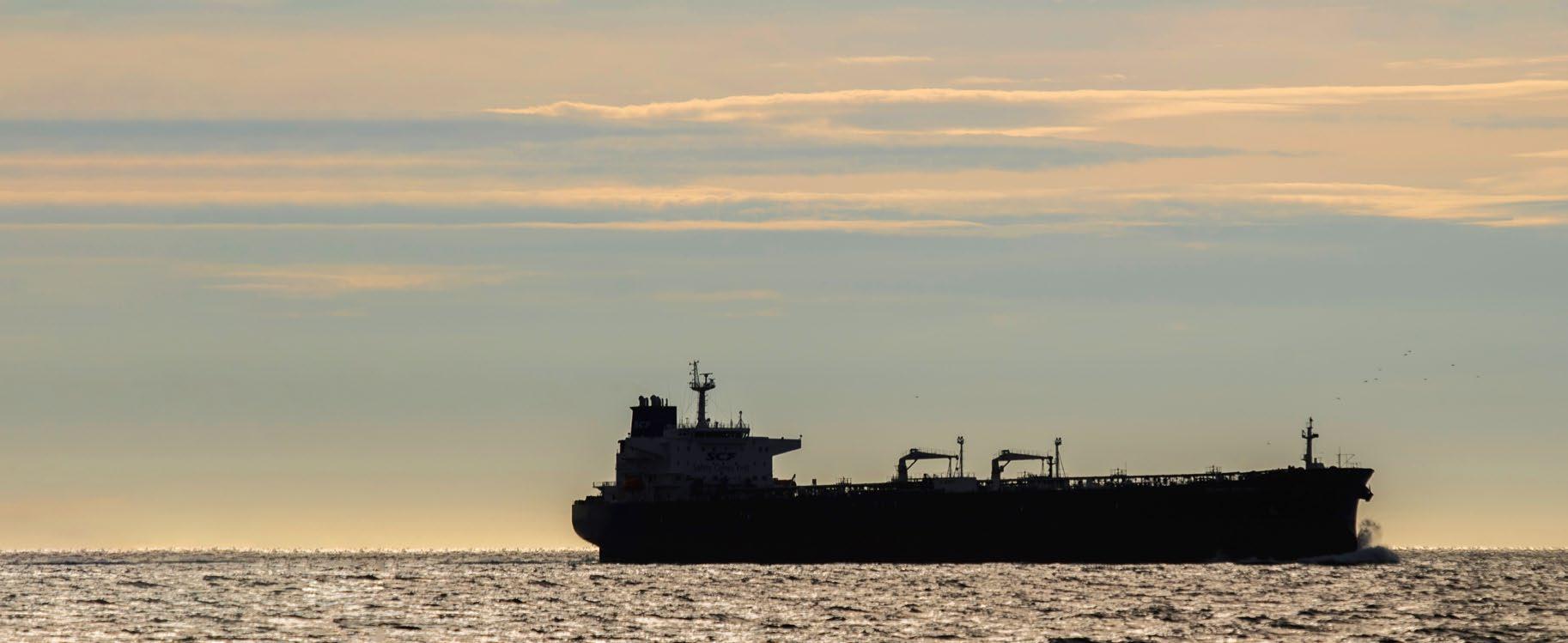
Oceana is calling on companies that do business with the global fishing industry to support efforts that can help reduce and ultimately eliminate IUU fishing. This document provides guidelines for these companies to reduce their risk of supporting illegal fishing activity. It is intended for risk managers, surveyors, agents, brokers, and other relevant parties within businesses that provide services to fishing vessels. By integrating the risk mitigation measures presented in these guidelines within existing risk management processes, companies and associations can manage their reputational risk, enhance regulatory compliance, and play a key role in stopping IUU fishing and ensuring the long-term sustainability of fisheries management.
Illegal, unreported, and unregulated (IUU) fishing is an unresolved and internationally pervasive problem. Those that participate in illegal fishing break or avoid fisheries management rules and operate outside the effective reach of government control.
Illegal fishing is fishing that is carried out without appropriate authorisation or licences, and may involve overfishing, catching and retaining non-permitted species or species over or under a permitted size limit, and fishing in a closed area, during a closed season, or using banned gear.
For further details, refer to the formal definition of IUU fishing outlined in the International Plan of Action to Prevent, Deter and Eliminate IUU Fishing (IPOA IUU) developed by the Food and Agriculture Organization of the United Nations (FAO).1
References:
1Food and Agriculture Organization. (2001). International Plan of Action to Prevent, Deter and Eliminate Illegal, Unreported and Unregulated Fishing. https://www.fao.org/documents/card/en/c/71be21c9-8406-5f66-ac68-1e74604464e7
1
© OCEANA / Juan Cuetos
Why is IUU fishing a problem?
IUU fishing is one of the greatest unresolved threats to sustainable fisheries management. IUU fishing can deplete overfished populations, destroy vital habitats, disrupt marine food webs, and threaten species survival. It can impact law-abiding fishers, who suffer reduced fishing opportunities when their targeted fish stocks are also targeted by illegally fishing vessels. Illegal fishing can also trigger economic losses in coastal developing countries; distort the market value of fish stocks; endanger food security; and foster military conflict over scarce resources. It undermines global efforts to attain a sustainable ocean economy and contributes to falling short in meeting international targets, such as under the United Nations Sustainable Development Goal 14.4—to end IUU fishing and overfishing by 2020. Illegal fishing is also often intertwined with international criminal networks, criminal activities, and human rights violations.2
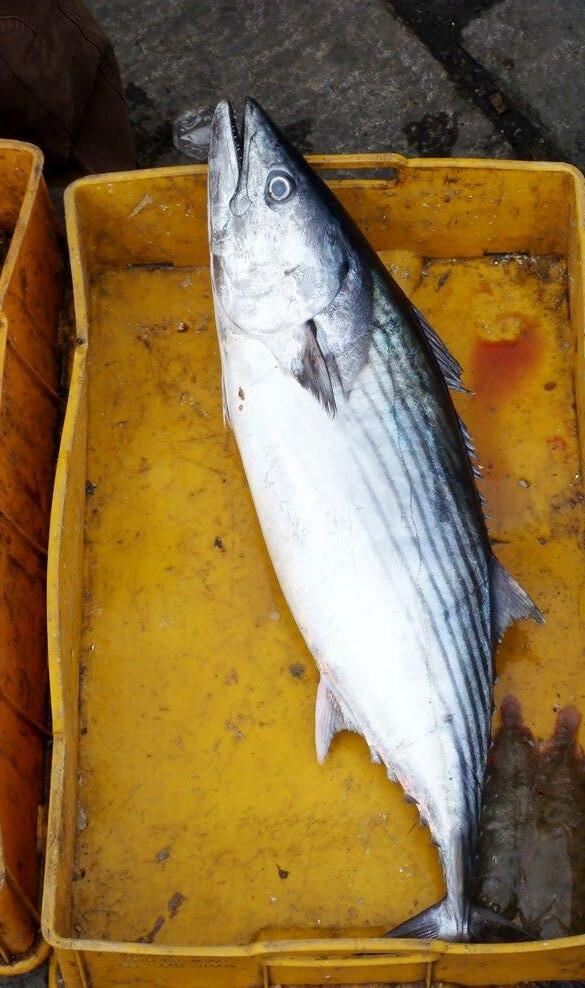
The current global scale of IUU fishing is difficult to calculate. It has been estimated that the total value of illegal and unreported fishing losses worldwide is between US $10 and $23.5 billion annually,3 and that up to one in every five wild-caught fish is illegal or unreported.4
References:
2 United Nations Office on Drugs and Crime. (2011). Transnational organized crime in the fishing industry. https://www.unodc.org/documents/human-trafficking/Issue_Paper_-_TOC_in_the_Fishing_Industry.pdf
illegal and unreported One in every five
How can companies stop fishing vessels from engaging in illegal fishing?
Effective collaboration between policymakers, enforcement agencies, and all stakeholders involved in the maritime and seafood industry is needed to detect, monitor, prevent, prosecute and eliminate operators that benefit from or support illegal fishing.
Illegal fishing capitalises on the vastness of the ocean and the opaqueness of the fishing sector. This lack of transparency, a lack of control at sea, and a lack of enforcement capacity mean that vessels fishing illegally face a low chance of sanctions, while illegally caught fish can be laundered easily by mixing them with legally caught fish. Oceana believes that if companies restrict access to their services to IUU fishers, fewer would be able to participate in illegal fishing because of the exposure to higher financial risk. For example, without services from businesses, illegal fishing operators may face enormous financial losses should a vessel accident occur. Unscrupulous operators may feel forced to cease illegal fishing activities and modify their operations to align themselves with legal operators’ standards to regain access to services that keep them operationally afloat.
Companies can also increase transparency and accountability within the global fishing industry by encouraging the use of vessel tracking devices and unique vessel identification numbers. They can also discourage registration under the flags of countries that have failed to tackle IUU fishing (see Set basic transparency requirements and Box 1).
The total value of fishing losses wild-caught
worldwide illegal fish unreported
US $10 $23.5
is between or is
and billion annually
3 Agnew, D., Pearce, J., Pramod, G., Peatman, T., Watson, R., Beddington, J., & Pitcher, T. (2009). Estimating the Worldwide Extent of Illegal Fishing. Plos ONE, 4(2), e4570. doi: 10.1371/journal.pone.0004570
4 Interpol. (2021). Environmental Security Programme: Strenghtening Law Enforcement Cooperation Against Fisheries Crime. https://www.interpol.int/ar/content/download/16314/file/INTERPOL%20ENS%20Fisheries%20Crime%20Prospectus%202021.pdf
2
© OCEANA / LX
Box 1:
Who is responsible for ensuring compliance with international, regional, and national laws at sea?
Every vessel has a nationality: that of the country it is officially registered under, and which has allowed the ship to fly its flag. That country is responsible for controlling the vessel’s activities under national and international laws, and should also provide effective enforcement of those laws, no matter where in the ocean violations may occur.
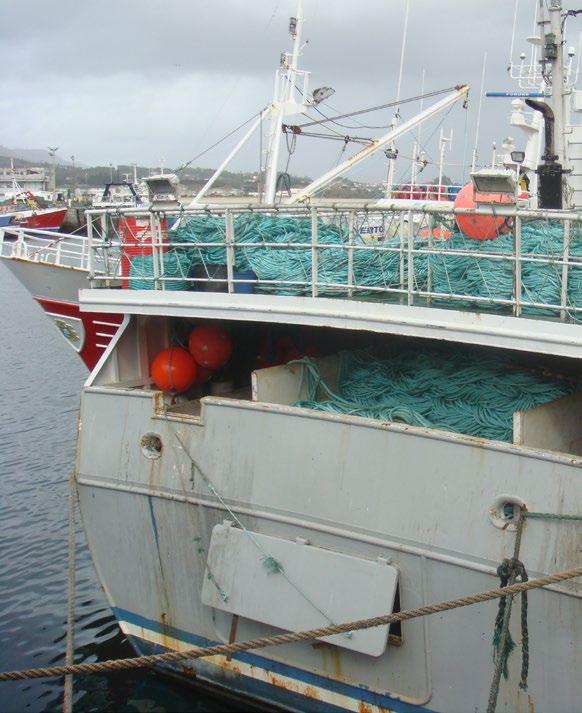
Under international law, there must be a ‘genuine link’ between a vessel and the country whose flag it flies. 5 In practice, this is not always the case. A vessel may be registered under a flag of convenience : a flag of a country that bears no association to the nationality of the vessel’s owner or operator. Registering under a flag of convenience may allow a vessel to access new fishing grounds or to evade fisheries rules or penalties. It may also allow owners of vessels to retain their anonymity by offering them the possibility of registering under shell companies, which makes it nearly impossible for authorities to identify the real owners. 6 It may also facilitate abusive reflagging behaviour , a practice where operators repeatedly change their vessels’ flags to another flag.
In some cases, vessels operate under flags of non-compliance : flags of countries which exhibit consistent patterns of failure in compliance with international obligations.
Vessels that engage in illegal fishing are often registered in ship registers of countries that lack the capacity or will to control their fleets, under flags of non-compliance and under flags of convenience, in an effort to conceal their illicit activities and to circumvent laws and to avoid sanctions. 7
References:
5 United Nations. (1982). United Nations Convention on the Law of the Sea. https://www.un.org/depts/los/convention_agreements/texts/unclos/unclos_e.pdf
6 Oceana. (2010). Halting IUU fishing: Enforcing International Fisheries Agreements. https://oceana.org/reports/halting-iuu-fishing-enforcing-international-fisheries-agreements/
7 Petrossian, G., Sosnowski, M., Miller, D., & Rouzbahani, D. (2020). Flags for sale: An empirical assessment of flag of convenience desirability to foreign vessels. Marine Policy, 116, 103937.
https://www.sciencedirect.com/science/article/abs/pii/S0308597X19306372
3
© OCEANA / LX
© OCEANA / Keith Ellenbogen
What could be the impacts of doing business with a vessel fishing illegally?
Illegal fishing operators rely on a variety of businesses for their day-to-day functioning. Companies can unwittingly be providing services to illicit operators due to a lack of information exchange or a lack of due diligence.
Businesses that provide services to vessels that participate in or support IUU fishing may be at risk of:
Non-compliance with national and/or international legislation
Businesses that provide services to vessels recognised as having engaged in IUU fishing may be liable to criminal, civil, or administrative sanctions under the following European, national, and international laws:
For businesses based in the EU:
i. Article 39(1) of the EU Regulation establishing a Community system to prevent, deter and eliminate illegal, unreported and unregulated fishing states that “[n]ationals subject to the jurisdiction of Member States… shall neither support nor engage in IUU fishing”.8
Formal recognition of the need for businesses to avoid supporting IUU fishing is underscored by the European Commission’s 2002 Community Action Plan to eradicate illegal, unreported and unregulated fishing proposal to implement measures “to ensure that importers, transshippers, buyers, consumers, equipment suppliers, banks, insurers, and other service providers do not maintain business relations which they might have with vessels identified as engaging in IUU fishing”.9
References:
For businesses based in the UK:
ii. Article 9(7) of The Sea Fishing (Illegal, Unreported and Unregulated Fishing) Order 2009 states that “It is an offence for a person to conduct business directly connected to IUU fishing, within the meaning of Article 42(1)(b) of the Council Regulation”.10
For businesses globally:
iii. Several Regional Fisheries Management Organisations (RFMOs) (see Box 2) have adopted binding measures such as Conservation Measure 10-08 (2017) of the Commission for the Conservation of Antarctic Marine Living Resources (CCAMLR) which requires States “to verify if their nationals or any natural or legal persons subject to their jurisdiction are responsible for, benefiting from, supporting or engaging in the activities described above (e.g., as operators, effective beneficiaries, owners, logistics and service providers, including insurance providers and other financial service providers)...and to take appropriate action in response to any verified activities...”.11
8 European Commission. (2008). Council Regulation (EC) No 1005/2008 of 29 September 2008 establishing a Community system to prevent, deter and eliminate illegal, unreported and unregulated fishing, amending Regulations (EEC) No 2847/93, (EC) No 1936/2001 and (EC) No 601/2004 and repealing Regulations (EC) No 1093/94 and (EC) No 1447/1999. https://eur-lex.europa.eu/eli/reg/2008/1005/oj
9 European Commission. (2002). Communication from the Commission - Community action plan for the eradication of illegal, unreported and unregulated fishing. https://eur-lex.europa.eu/legal-content/EN/TXT/?uri=celex%3A52002DC0180
10 The Sea Fishing (Illegal, Unreported and Unregulated Fishing) Order 2009. https://www.legislation.gov.uk/uksi/2009/3391/pdfs/uksi_20093391_en.pdf
11 Commission for the Conservation of Antarctic Marine Living Resources. (2017). Conservation Measure 10-08: Scheme to promote compliance by Contracting Party nationals with CCAMLR conservation measures. https://cm.ccamlr.org/en/measure-10-08-2017
Association with criminal or human rights violations
Illegal fishing is a high-reward and low-risk activity, which is estimated to be the sixth largest transnational criminal enterprise by revenue. Vessels that engage in illegal fishing often have characteristics that allow them a greater state of anonymity and lower safety standards, such as operating under a flag of convenience, using shell companies, engaging in abusive reflagging, and lacking or improperly using Automatic Identification System (AIS) vessel tracking. Greater anonymity on vessels fishing illegally may facilitate other transnational organized crime at sea, or human rights abuses. Such activities include document forgery, money laundering, acts of terrorism, forced labour, and the illicit traffic of humans, drugs, weapons, or wildlife. 12
References:
12Oceana. (2019). Illegal Fishing and Human Rights Abuses at Sea: Using Technology to Highlight Suspicious Behaviors. https://respect.international/wp-content/uploads/2019/06/Illegal-Fishing-and-Human-Rights-Abuses-at-Sea.pdf
4
Exposure to fraud
Companies conducting business with illicit operators may be at higher risk to attempts of fraud by these unscrupulous operators. Vessels added to an RFMO IUU list are at high risk of detainment and/or having their products seized. This increases the risk of abandonment of the vessel and crew in port. Facing or fearing apprehension, illegal fishing vessel operators may opt to scuttle their vessel and file a fraudulent insurance claim. If this attempt at fraud is successful, the profits of illegal fishing can be “whitewashed” if, for example, the claim award is reinvested in the purchase of a vessel with a clean fishing record.
Case study: Illegal fishing and the insurance sector
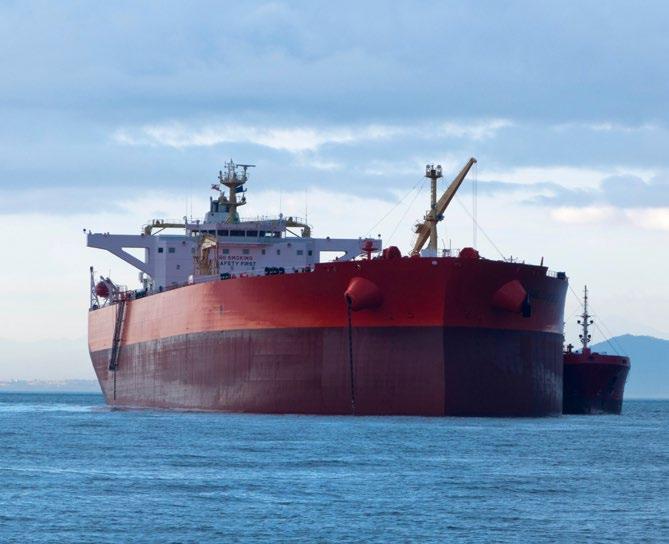
Illicit operators can purchase insurance with ease, with links found between high-profile IUU fishing vessels and internationally reputable insurance providers. In 2015, Thunder, a trawler well known to Interpol and enforcement agencies, sunk off the coast of São Tomé after being chased for 110 days by the Sea Shepherd Conservation Society. Following the sinking incident, the owner of Thunder also reportedly tried to file an insurance claim.13
Some insurance companies have taken steps to deny and reduce their risk of conducting business with IUU fishing vessels. In 2017, over 30 leading insurers, brokers, reinsurers
References:
and agents announced their commitment to supporting efforts that may help to reduce and eliminate IUU fishing, through an insurance industry statement, facilitated by Oceana and UN Environment’s Principles for Sustainable Insurance.14 A number of these companies have also introduced due diligence requirements into their internal processesAXA XL requires IMO numbers for all vessels and refrigerated cargo vessels that it insures and has included additional checks for IUU fishing in their underwriting guidelines, such as screening vessels against IUU fishing lists, assessing whether fishing vessels have all the correct licences and consistent application of their tracking systems.15
13 Miller, D., Sumaila, U., Copeland, D., Zeller, D., Soyer, B., Nikaki, T., Leloudas, G., Fjellberg, S., Singleton, R. & Pauly, D. (2016). Cutting a lifeline to maritime crime: marine insurance and IUU fishing. Frontiers in Ecology and the Environment, 14(7), 357-362
14 Oceana. (2017). The Insurance Industry’s Statement Against Illegal, Unreported and Unregulated (IUU Fishing).
https://europe.oceana.org/en/assisting-ocean-stewardship-through-marine-insurance
15 AXA XL. (2022, January 17). Plenty more fish in the sea? How the insurance industry can help put an end to illegal fishing.
https://axaxl.com/fast-fast-forward/articles/plenty-more-fish-in-the-sea-how-the-insurance-industry-can-help-put-an-end-to-illegal-fishing
Financial losses and reputational damage
Businesses that enable illegal fishing may be at risk of financial losses from non-compliance with national or international law, reputational damage, association with criminal activity or human rights violations.
As countries tighten the net on IUU fishing, companies exposed to be involved or engaging in illegal fishing may face legal sanctions and fines that can reach more than 11 million euros.16 It may also become a significant reputational issue for companies and cause further financial damage if customers, investors, and other key stakeholders become concerned, and if action is not taken.
Reference:
16 Oceana. (2015, June 23). Record-breaking fines imposed on beneficiaries of illegal fishing. https://oceana.org/press-releases/record-breaking-fines-imposed-beneficiaries-illegal-fishing/
5
© OCEANA / Gorka Leclercq
Binding measures within Regional Fisheries Management Organisations:
Regional Fisheries Management Organisations (RFMOs) are international organisations with mandates to manage internationally shared fishing stocks or areas. Vessels identified to have engaged in IUU fishing within RFMO management areas are added to RFMO IUU vessel lists.
Such lists have been adopted by four regional fisheries management organisations. Under these RFMOs, listed vessels are unauthorized to fish for, retain on board, tranship or land species within their area of competence.17 These binding measures apply to countries that are party of RFMOs and conducting business with IUU vessels within these countries is against these measures. Companies found to be providing services to IUU-listed vessels may face prosecution and legal action, under the following RFMOs:
Commission for the Conservation of Antarctic Marine Living Resources (CCAMLR)18
General Fisheries Commission for the Mediterranean (GFCM)19
South Pacific Regional Fisheries Management Organisation (SPRFMO)20
Southern Indian Ocean Fisheries Agreement (SIOFA)21
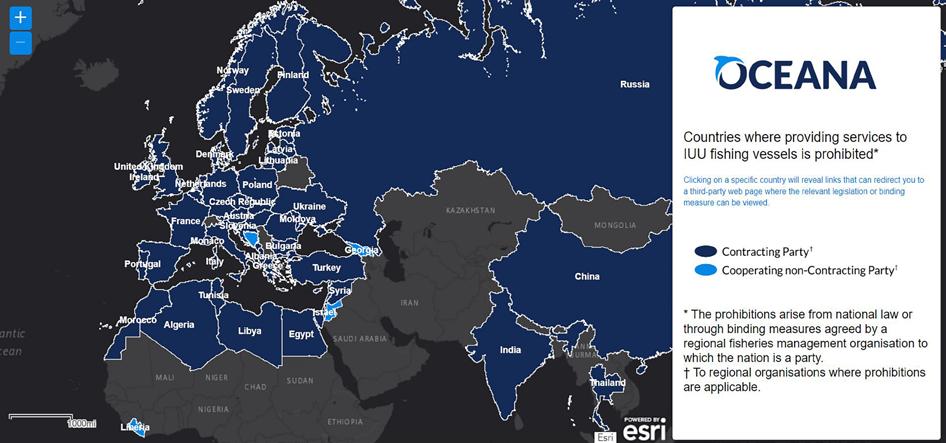
Businesses can consult Oceana’s interactive online Legal Map to find out in which countries it is a legal obligation to not enter into business with vessels that have been officially recognised for their involvement in IUU fishing.22
References:
17 The Royal Institute of Internal Affairs. (2007). Recommended Best Practices for Regional Fisheries Management Organizations: Report of an independent panel to develop a model for improved governance by Regional Fisheries Management Organizations. ISBN: 978 1 86203 188 3. https://www.oecd.org/sd-roundtable/papersandpublications/39374297.pdf
18 Commission for the Conservation of Antarctic Marine Living Resources. (2022). https://www.ccamlr.org/en/compliance/illegal-unreported-and-unregulated-iuu-fishing
19 General Fisheries Commission for the Mediterranean. (2009). REC.MCS-GFCM/33/2009/8 on the establishment of a list of vessels presumed to have carried out IUU fishing in the GFCM area repealing recommendation GFCM/30/2006/4
https://gfcmsitestorage.blob.core.windows.net/documents/Decisions/REC.MCS-GFCM_33_2009_8.pdf
20 South Pacific Regional Fisheries Management Organisation. (2019). CMM 04-2019 Conservation and Management Measure Establishing a List of Vessels Presumed to Have Carried Out Illegal, Unreported and Unregulated Fishing activities in the SPRFMO Convention Area.
https://www.sprfmo.int/assets/Fisheries/Conservation-and-Management-Measures/2019-CMMs/CMM-04-2019-5Mar2019.pdf
21 Southern Indian Ocean Fisheries Agreement. (2016). CMM 2016/06 Conservation and Management Measure on the Listing of IUU Vessels (IUU List). https://www.apsoi.org/sites/default/files/documents/cmm/CMM%202016_06%20IUU%20Vessel%20Listing%20%282016.10.18%29%20edited%202017.pdf
22 Oceana. (2022). Legal Map. https://oceana.maps.arcgis.com/apps/webappviewer/index.html?id=26011d10704c4396afc2cb5f89835a0b
How can companies minimise the risk of association with IUU fishing?
Businesses can minimise the risk of providing services to vessels that participate in or support illegal fishing by enhancing risk management and due diligence processes, including:
Consult the IUU fishing Vessel Characteristics
Checklist for Businesses:
This checklist details common characteristics of fishing vessels that have been known to facilitate illegal fishing and associated crimes. Companies should consult this checklist to help identify clients that may be at high-risk of involvement in IUU fishing, and to determine whether to provide services to new potential clients.
6
Box 2:
© OCEANA
© OCEANA / Enrique Pardo
The IUU fishing Vessel Characteristics Checklist for Businesses:
DENY SERVICES TO A VESSEL IF IT HAS:
Been listed (by name and/or IMO number) on the Combined IUU Vessel List, which includes all RFMO-listed IUU vessels23
BE CAUTIOUS OF A VESSEL IF IT HAS:
Frequently changed its name
Frequently changed its flag
Been registered under the flag of a country recognised for its failure to combat IUU fishing 24
No IMO number but weighs over 100 gross tons (GT) 25
Been identified through Oceana’s Pull the Plug on Pirate Fishing information exchange tool 26
Not been classed by a classification society
Been classed but has not carried out all recommendations demonstrably
No records to demonstrate regular maintenance
Any previous convictions
Any fines or prohibitions
Been operating in areas known to have IUU fishing activity
Been targeting high-risk species, as defined by the Petrossian List 27
Not been using legally required vessel tracking systems (e.g., VMS or AIS)
No evidence of required fishing licences/authorisations
References:
23 Trygg Mat Tracking. (2022). Combined IUU Fishing Vessel List. https://iuu-vessels.org/
24 European Commission. (2021). IIlegal fishing overview of existing procedures third countries. https://ec.europa.eu/oceans-and-fisheries/system/files/2021-07/illegal-fishing-overview-of-existing-procedures-third-countries_en.pdf
25 Food and Agriculture Organization. (2022). Global Record of Fishing Vessels, Refrigerated Transport Vessels and Supply Vessels. https://www.fao.org/global-record/tool/extended-search/en/
26 Oceana. (2022). Pull the Plug on Pirate Fishing’s Information Exchange Portal. https://pulltheplugonpiratefishing.org/
27 Petrossian, G. A., & Clarke, R. V. (2014). Explaining and controlling illegal commercial fishing: An Application of the CRAVED Theft Model. The British Journal of Criminology, 54(1), 73–90. http://www.jstor.org/stable/23640289
Deny services to vessels officially listed on RFMO IUU-Lists
Lists of vessels known to have engaged in IUU fishing are maintained by the European Union, 28 and by twelve Regional Fisheries Management Organisations with mandates to manage internationally shared fish stocks or areas. Businesses should use these lists as a simple tool for screening new and existing clients and deny services to any vessels that are included on any of these official IUU fishing vessel lists.
The Combined IUU Fishing Vessel List is a user-friendly platform created by the non-profit organisation Trygg Mat Tracking. It is free to use and provides the best available, up-to date information on all fishing vessels that appear on the IUU vessel lists published by individual RFMOs and related organisations. 29
References:
28 European Commission. (2022). European Union IUU fishing List. https://ec.europa.eu/fisheries/cfp/illegal_fishing/info (see “Overview of existing procedures as regards third countries” under the heading “Implementation of the IUU fishing Regulation as regards third countries”).
29 Trygg Mat Tracking. (2022). Combined IUU Fishing Vessel List. https://iuu-vessels.org/
7
Introduce contractual wording to exclude services to IUU fishing vessels
Businesses can develop and include wording within their contracts that explicitly excludes the provision of services to vessels that have been officially listed for their involvement in IUU fishing and their fishing products, including those that may have been lost or damaged at sea and those denied entry into markets due to their IUU fishing origin.
Set basic transparency requirements
Strengthening the monitoring, control, and surveillance of fisheries is an integral part of curbing IUU fishing. There are three basic transparency requirements that fishing vessels should meet, including:
Installation and operation of a Vessel Monitoring System (VMS) and Automatic Identification System (AIS). Both transmit a vessel’s location to its flag state authority but were created for different purposes: VMS helps fishers prove that their catch is compliant with management and conservation measures, while AIS is intended to improve safety for crew and vessels at sea, as the signal is public and can be seen by any vessel at sea. Possession of an international Maritime Organisation (IMO) number, a unique seven-digit vessel number that stays with a vessel until it gets scrapped and cannot be modified regardless of attempts to conceal other identifying features. IMO numbers are not mandatory for fishing vessels, which severely hampers the ability of authorities to trace and reprehend vessels engaged or involved in IUU fishing activity.
© OCEANA / LX
Businesses can both reduce their risk and promote transparency across the global maritime industry by requiring VMS, AIS and IMO number as basic requirements to be met by their clients and by denying services to vessels that do not use essential tracking technology (including VMS 30 or AIS 31,32) and to vessels of 100 GT and above that are found to lack the legally required IMO numbers. 33
References:
30 European Commission. (2005). Commission Regulation (EC) No 2244/2003 of 18 December 2003 laying down detailed provisions regarding satellite-based Vessel Monitoring Systems. https://eur-lex.europa.eu/legal-content/EN/TXT/?uri=LEGISSUM%3Al24261
31 European Commission. (2011). Commission Directive 2011/15/EU of 23 February 2011 amending Directive 2002/59/EC of the European Parliament and of the Council establishing a Community vessel traffic monitoring and information system.
https://eur-lex.europa.eu/legal-content/EN/TXT/PDF/?uri=CELEX:32011L0015&from=DE
32 International Maritime Organization. (2015). Resolution A.1106(29) REVISED GUIDELINES FOR THE ONBOARD OPERATIONAL USE OF SHIPBORNE AUTOMATIC IDENTIFICATION SYSTEMS (AIS).
https://wwwcdn.imo.org/localresources/en/OurWork/Safety/Documents/AIS/Resolution%20A.1106(29).pdf
33 International Maritime Organization. (2016). Implementation of resolution A.1078(28) – IMO ship identification number scheme.
https://wwwcdn.imo.org/localresources/en/OurWork/IIIS/Documents/CL.1886-REV.6%20(E)_IMO%20Number%20Scheme.pdf
OCEANA IN EUROPE
European Headquarters: Madrid, Spain europe@oceana.org
European Union Office: Brussels, Belgium brussels@oceana.org
United Kingdom Office: London, UK oceanauk@oceana.org
Baltic and North Sea Office: Copenhagen, Denmark copenhagen@oceana.org
europe.oceana.org
8
This publication may be reproduced in whole or in part and in any form for educational or non-profit purposes without special permission from the copyright holder, provided acknowledgement of the source is made. Oceana would appreciate receiving a copy of any publication that uses this publication as a source. No use of this publication may be made for resale or for any other commercial purpose whatsoever without prior permission in writing from Oceana.
© Oceana
