Protecting C abliers : Exceptional Mediterranean coral reefs

PROPOSAL FOR A NEW FISHERIES RESTRICTED AREA IN THE ALBORAN SEA
Ecological significance of the Cabliers reef
June 2021
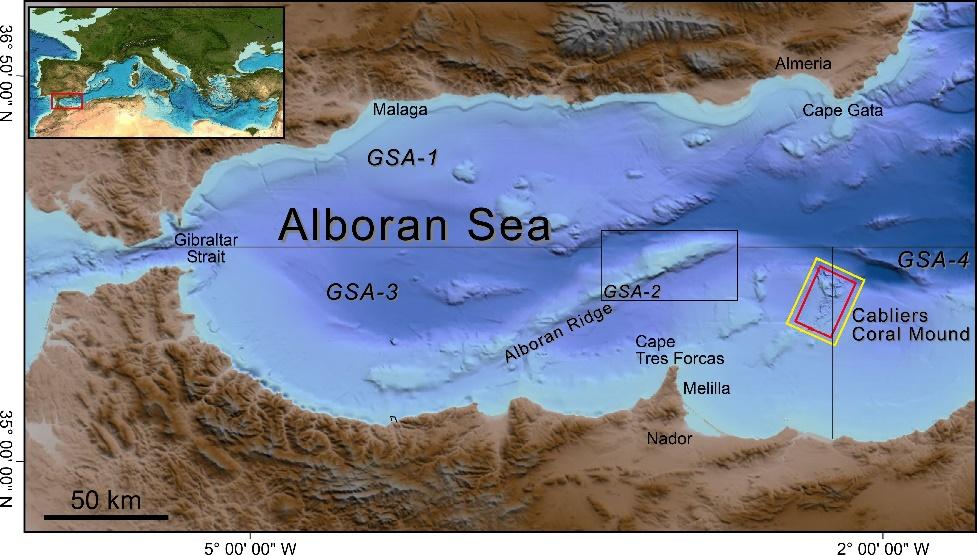
The Cabliers Coral Mound Province is located in the Southern Alboran Sea (GSA 3 and 4 – see Figure 1). It comprises several elongated ridge-like mounds mainly composed of cold-water corals (CWC). The seamount here, a volcanic outcrop that extends for 25 km with depths ranging from 250-710 m, currently hosts one of the densest and largest CWC reefs in the Mediterranean Sea and the only known growing CWC reefs in the entire Mediterranean basin.
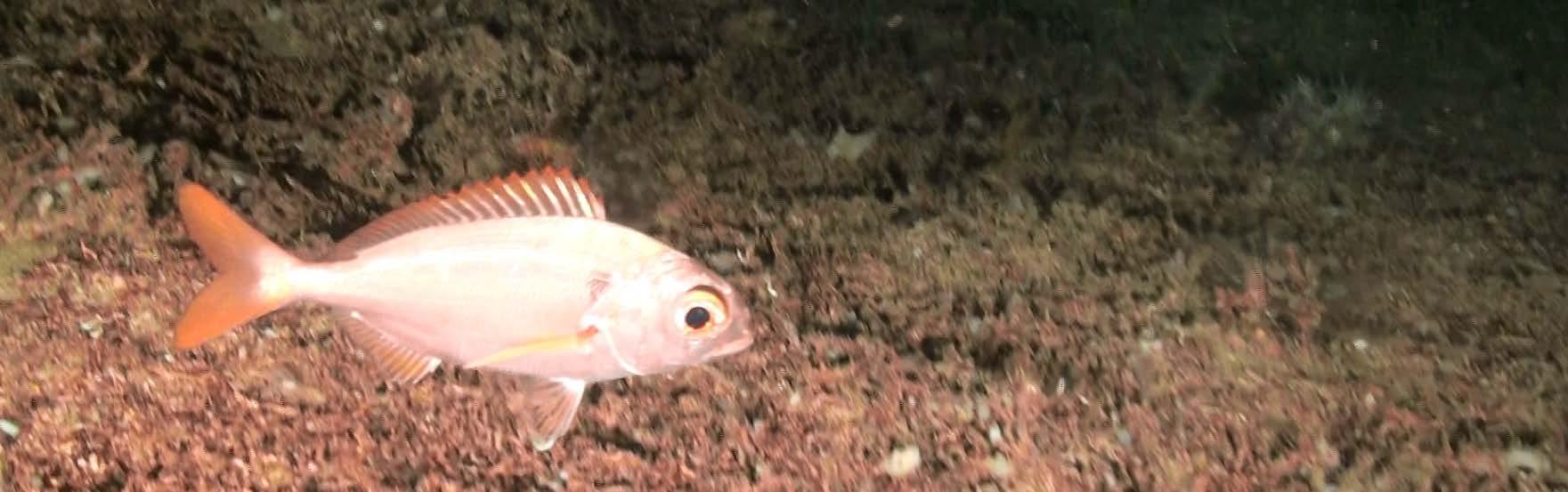
The area is an exceptional semi-pristine oasis in the deep sea according to scientific evidence which shows its coral richness, along with the fact that Cabliers is relatively undisturbed by human activity. Its reefs are mainly composed of the framework-building stony corals Desmophyllum pertusum (=Lophelia pertusa) and Madrepora oculata, together with other threatened species that include dense aggregations of deep-sea gorgonians, black corals, and glass sponges. Various commercial species are found in the reef system, including blackspot seabream (Pagellus bogaraveo), European conger (Conger conger), blue whiting (Micromesistius poutassou), greater forkbeard (Phycis blennoides), red scorpionfish (Scorpaena scrofa), pink spiny lobster (Palinurus mauritanicus), and Norway lobster (Nephrops norvegicus) Observations of small-spotted catshark egg cases, cuttlefish eggs, juvenile blackbelly rosefish, and schools of blackspot seabream indicate the potential importance of the Cabliers reefs for species’ life cycles
Vulnerable Marine Ecosystem protection in the GFCM
The protection of vulnerable marine ecosystems (VMEs) has become a greater priority within the GFCM’s conservation work in recent years. In 2018, Protocols for the protection of VMEs in the GFCM area of application were adopted at the GFCM’s 42nd Annual Commission (Appendix 17), and in 2019 the GFCM adopted Resolution GFCM/43/2019/6 on the establishment of a set of measures to protect vulnerable marine ecosystems formed by cnidarian (coral) communities in the Mediterranean Sea
The unique characteristics of the Cabliers Coral Mound Province make it an obvious candidate for protection. According to the GFCM, seamounts are features known to potentially support VMEs; habitats such as CWC and glass sponge communities are VME indicator habitats; and black corals (Antipatharia) and stony corals (Scleractinia) are VME indicator taxa. All these VME indicators are present in Cabliers, many of them in exceptional conservation condition, and they should be protected from the impact of fisheries. The MedFish4Ever Declaration, signed in 2017 and reaffirmed in 2019, also committed to ensure adequate protection of vulnerable species and sensitive habitats and urged Mediterranean riparian states to cooperate to establish new fisheries restricted areas (FRAs). There are currently no GFCM FRAs in the Alboran Sea (GSA 1-4) and creating a FRA to protect the Cabliers reefs would address an important gap in VME and coral protection, while also potentially supporting key fisheries in this region.
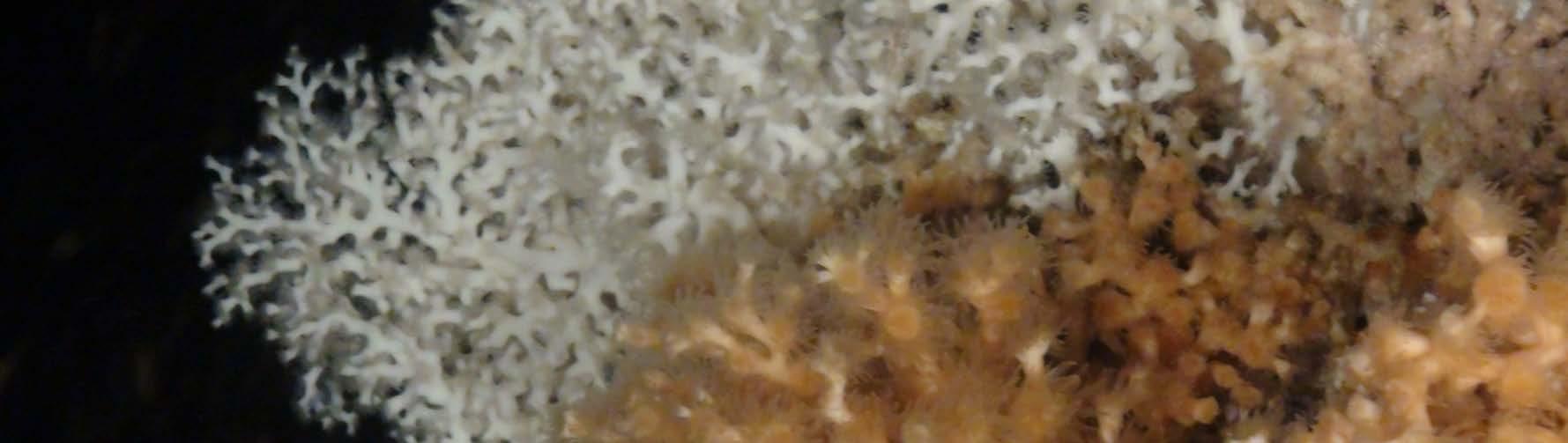 Figure 1. Location of Cabliers Coral Mound Province
An exceptional reef province
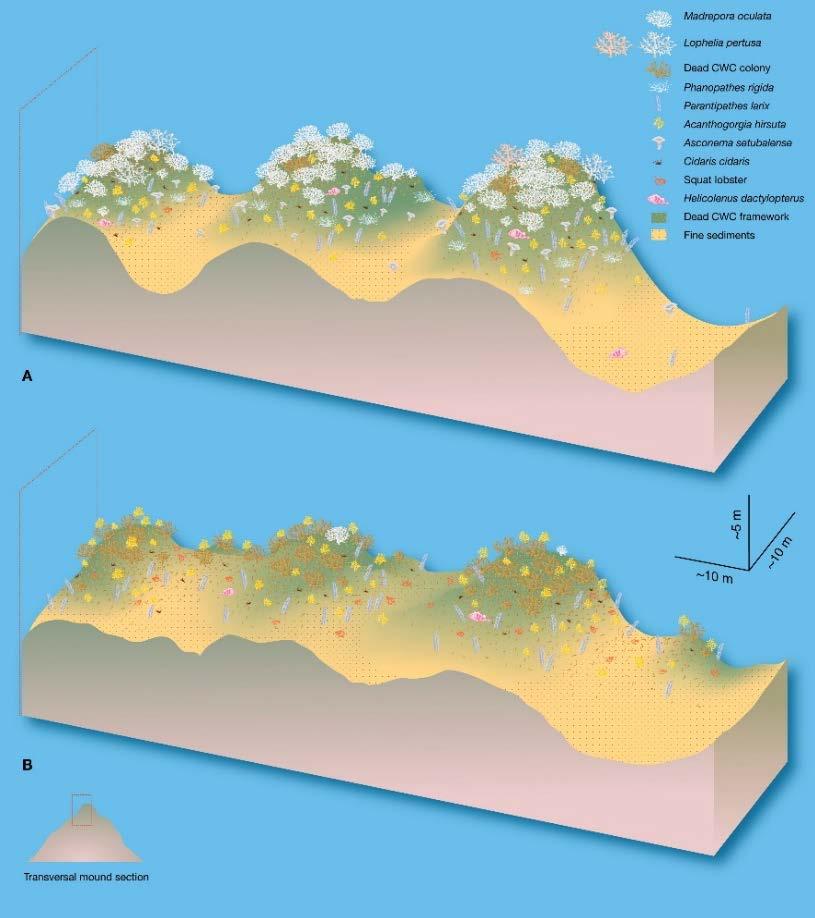
Near-pristine CWC reefs found growing on the top of Cabliers Bank (see Figures 2 and 3) contrast with the small, scattered, and patchy colonies on other surrounding mounds in this part of the Alboran Sea, like the West and East Melilla Mounds around Cape Tres Forcas. Living CWC reefs (i.e., extensive, longlived bioconstructions with complex geomorphic expressions) are very limited in the Mediterranean Sea. Where they do occur, their conservation status is generally poor due to the impacts of fishing and other human activities. The Cabliers reefs are therefore exceptional examples of healthy CWC reef ecosystems in the Mediterranean Sea.
In terms of hydrodynamics, the Alboran Sea is an area where the interactions between Atlantic and Mediterranean waters are extremely important. This interaction helps to sustain a system of two anticyclonic gyres which stimulate the formation of upwelling areas that bring nutrients up to shallower waters The Cabliers Bank is close to the path of the highly productive Eastern Alboran Gyre The vertical velocities this gyre produces play an important role in transporting organic sediments to the deep sea, creating suitable environmental conditions for the maintenance and growth of the CWC reefs.
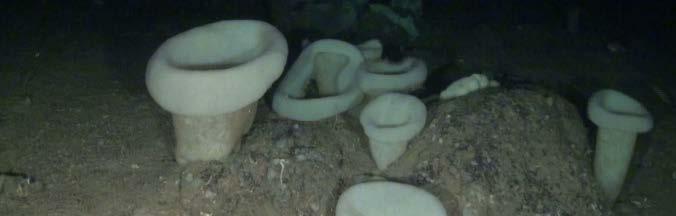
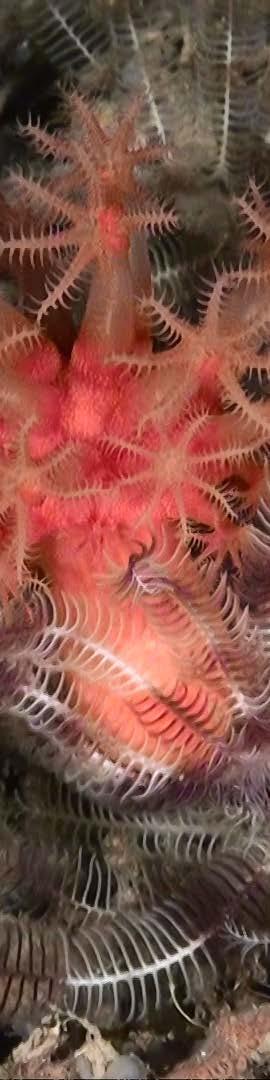
Another exceptional feature of Cabliers is its dense populations of the glass sponge Asconema setubalense (see Picture 2), which have been reported in just three other Mediterranean locations: the adjacent Catifas, Chella, and Avempace volcanic banks. This is a long-lived species, which reaches 95% of its maximum size (over 100 cm) at 98 years of age. In Cabliers, A. setubalense grows to heights of more than 50 cm
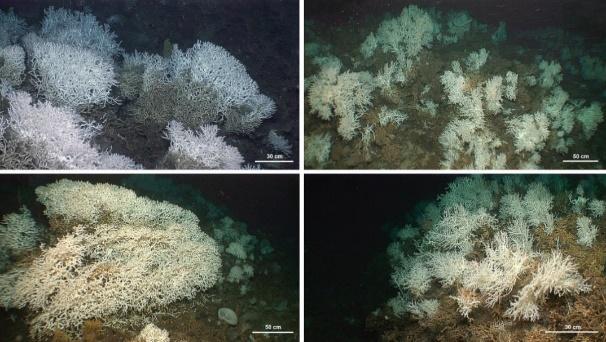 Figure 2. Schematic representation of the megabenthic assemblages on the summit of the (A) northern and (B) southern Cabliers Coral Mound Province (Source: Corbera et al., 2019)
Picture 1. Blackspot seabream (Pagellus bogaraveo) in Cabliers Bank
Figure 3. Living Madrepora and Lophelia reefs in the northern summit of the Cabliers Coral Mound (Source: ROV footage from the EU Eurofleets-2 IRIS Cruise)
Figure 2. Schematic representation of the megabenthic assemblages on the summit of the (A) northern and (B) southern Cabliers Coral Mound Province (Source: Corbera et al., 2019)
Picture 1. Blackspot seabream (Pagellus bogaraveo) in Cabliers Bank
Figure 3. Living Madrepora and Lophelia reefs in the northern summit of the Cabliers Coral Mound (Source: ROV footage from the EU Eurofleets-2 IRIS Cruise)
A seamount home to threatened species and GFCM VME indicators
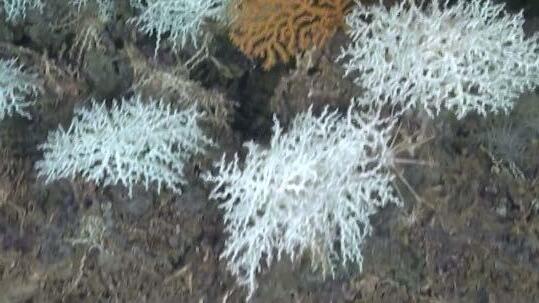
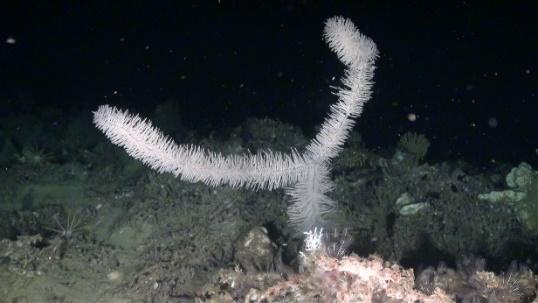
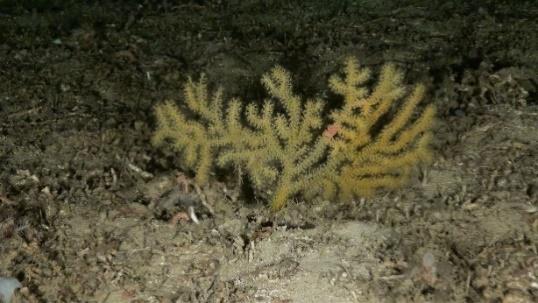
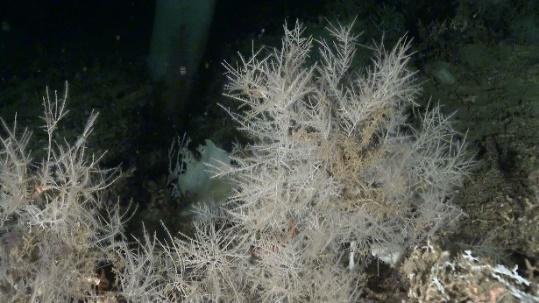
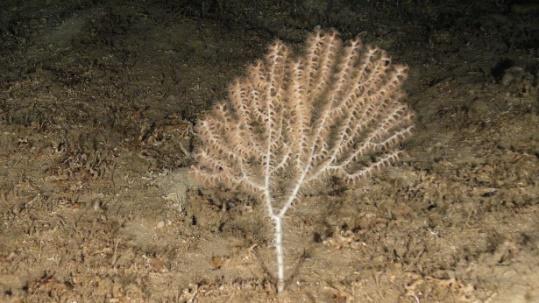
The most abundant habitat-forming species in Cabliers is the black coral Phanopathes rigida, followed by the gorgonian Acanthogorgia hirsuta and the stony coral Madrepora oculata Colonies of M. oculata and D. pertusum in the northern reefs are exceptionally dense, exceeding reported densities of other Mediterranean CWC assemblages by up to two orders of magnitude. M. oculata and D. pertusum colonies from the northern reefs reach sizes of over 50 cm in diameter, and the high proportion of small M. oculata colonies observed there suggests either a high recruitment rate or frequent fragmentation of larger colonies into smaller ones. The glass sponge Asconema setubalense and the black coral Parantipathes larix were also commonly observed (see Figure 4).
Cabliers is one of the few known sites where two of its most common species – the black coral P. rigida and the hexactinellid glass sponge A. setubalense – can be found in the Mediterranean Sea. P. rigida, which is remarkably abundant and forms dense aggregations in the area, is originally an Atlantic species and was observed for the first time in the Mediterranean Sea in the Cabliers Coral Mound Province. Similarly, A. setubalense is also of Atlantic origin
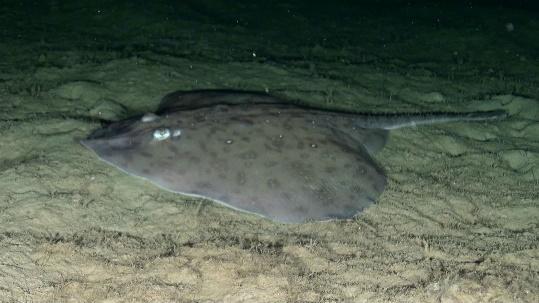
The Cabliers Coral Mound Province is home to 20 species that are listed as threatened or protected under international agreements or are considered by GFCM as priorities according to the Data Collection Reference Framework (DCRF). Threatened species documented in the area include the sandy ray Leucoraja circularis and bamboo coral Isidella elongata, both Critically Endangered species according to the IUCN Red List (see Figure 5).
All the above-mentioned coral species are listed as endangered and/or threatened in the Mediterranean basin according to UNEP-MAP (Annex II SPA/BD Protocol). As GFCM VME indicator taxa, they are key species to consider for creating spatial and/or temporal fishing restrictions under Resolution GFCM/43/2019/6.
Figure 4. The most common coral species found in Cabliers
Figure 5 Critically Endangered species found in Cabliers
Phanopathes rigida
Acanthogorgia hirsuta
Picture 2. Glass sponge (Asconema setubalense) aggregation in Cabliers Bank
Leucoraja circularis
Isidella elongata
Parantipathes larix
Madrepora oculata
A relatively undisturbed area
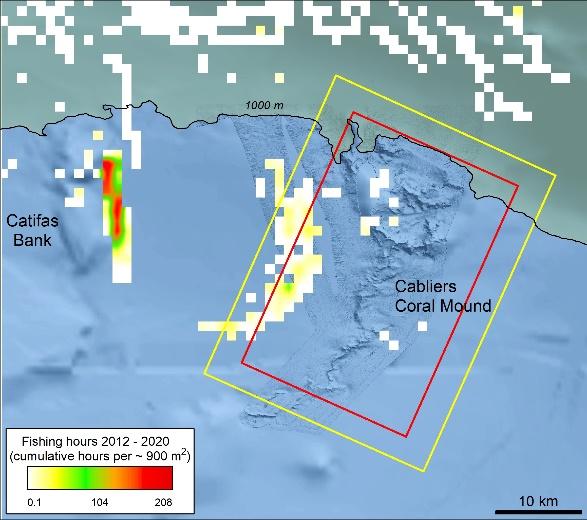
According to publicly available data and consultation with local experts from academic institutions, the Cabliers reef is subject to very limited fishing pressure. Few fishing vessels were found to operate in the area, with low levels of annual fishing activity inside the proposed FRA. Most of this recorded fishing was carried out by bottom trawlers.
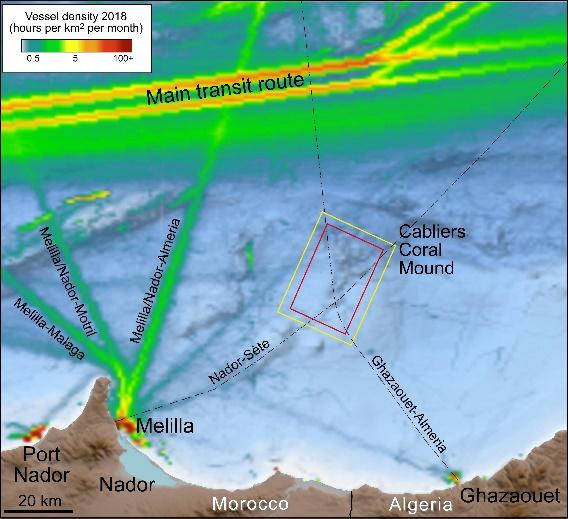
The Cabliers mound is also relatively undisturbed by other human activities. Its isolated location means that, to date, it has not been subject to direct impacts from major maritime traffic routes, submarine cables, or pipelines (see Figure 6)
Cabliers as a Fisheries Restricted Area
FRAs are effective fisheries spatial management tools to minimise unwanted interactions between fishing activities and sensitive marine ecosystems, particularly VMEs.
Scientific information indicates that the designation of a FRA in the Cabliers Coral Mound Province would help to safeguard the healthy and undisturbed CWC reefs while supporting the sustainability of fisheries in the area. In addition, the FRA would serve a scientific objective of creating a valuable reference area for monitoring deep-sea ecosystems and VMEs in the Mediterranean basin. Its creation would also foster institutional and scientific cooperation between GFCM countries, and between the GFCM and the UNEP/MAP (Barcelona Convention).

Central Office Madrid, Spain europe@oceana.org European Union Office Brussels, Belgium brussels@oceana.org United Kingdom Office London, UK oceanauk@oceana.org North Sea and Baltic Office Copenhagen, Denmark copenhagen@oceana.org www.eu.oceana.org
Lophelia and Madrepora colonies in Cabliers are among the largest observed in the Mediterranean
Figure 6 (A) Total cumulative fishing hours during 2012-2020 (all fishing gears); and (B) density of maritime traffic in the vicinity of the Cabliers Coral Mound Province
(A)
All pictures ©Oceana, unless otherwise indicated
(B)
