VOLUME 7 ISSUE 16
$3
First Friday Art Walk Page B2
April 10 - 16, 2026
signs Marion County stalls on CSX lawsuit DeSantis ‘domestic terrorist’ naming law By Jim Turner The News Service of Florida
G
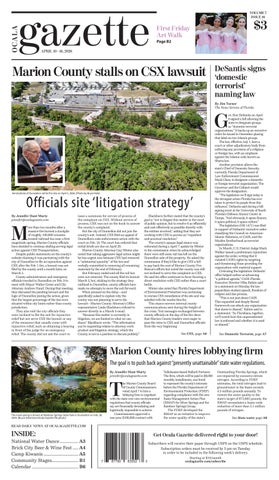
Aerial photo of Dunnellon rail tie fire site on April 5, 2026. [Photo by Bryce Hale]
Officials site ‘litigation strategy’
By Jennifer Hunt Murty jennifer@ocalagazette.com
M
ore than two months after a massive fire burned a stockpile of roughly 100,000 creosotetreated railroad ties near a first magnitude spring, Marion County officials have decided to continue stalling serving legal action against CSX Transportation. Despite public statements on the county’s website claiming it was partnering with the city of Dunnellon to file an injunction against CSX after the Feb. 1 fire, a lawsuit was not filed by the county until a month later, on March 3. County administrators and emergency officials traveled to Dunnellon on Feb. 9 to meet with Mayor Walter Green and City Attorney Andrew Hand. During that meeting, they discussed the pending lawsuit and the logic of Dunnellon joining the action, given that the largest percentage of the ties were situated within city limits rather than county jurisdiction. They also told the city officials they were inclined to file the suit for injunctive relief but not serve CSX the lawsuit or any of the measures that usually come with injunctive relief, such as obtaining a hearing in front of the judge for an emergency relief. The county did not ask the court to
issue a summons for service of process of the complaint on CSX. Without service of process, CSX was not on the hook to answer the county’s complaint. But the city of Dunnellon did not join the county’s suit. Instead, CSX filed an appeal of Dunnellon’s code enforcement action with the court on Feb. 18. The court has ordered that initial briefs are due on April 29. Marion County Attorney Guy Minter also noted that taking aggressive legal action might be less urgent now because CSX had removed a “substantial quantity” of the ties and verbally committed to removing all remaining materials by the end of February. But February ended and all the rail ties were not removed. The county filed its lawsuit March 3, but, sticking to the strategy they outlined to Dunnellon, county officials have made no attempts to move the suit forward. When pressed on the delay—and specifically asked to explain why the county was not planning to serve the lawsuit—Marion County Attorney’s Office representative Linda Blackburn refused to answer directly in a March 5 email. “Because this matter is currently in litigation, we are limited in what we can share,” Blackburn wrote. “The information you’re requesting relates to attorney work product and litigation strategy, which the County is not in a position to discuss publicly.”
Blackburn further stated that the county’s goal is “not to litigate this matter in the court of public opinion, but to resolve it as efficiently and cost-effectively as possible directly with the entities involved,” adding that they are working with CSX to pursue an “expedient and practical resolution.” The county’s opaque legal stance was reiterated during a April 7 update by Minter to the commission when he acknowledged there were still some rail ties left on the Dunnellon side of the property. He asked the commission if they’d like to give CSX a bill to pay back the cost of Marion County Fire Rescue’s efforts but noted the county was still not inclined to serve the complaint on CSX. He said his office continues to favor favoring a direct resolution with CSX rather than a court battle. Minter also noted that Florida Department of Environmental Protection was continuing to oversee CSX remediation of the site and was satisfied with the results thus far. This stance mirrors internal county communications sent during the height of the crisis. Text messages exchanged between county officials on the day of the fire show that Marion County leaders were eager to pass the reins to CSX and Dunnellon officials from the very beginning. See CSX, page A6
ov. Ron DeSantis on April 6 signed a bill allowing the state to designate groups as “domestic terrorist organizations.” It backs up an executive order he issued in December placing that label on two Islamic groups. The law, effective July 1, bars a court or other adjudicatory body from enforcing any provision of a religious or foreign law, with an emphasis against the Islamic code known as Sharia law. Another provision allows the state’s Chief of Domestic Security, currently Florida Department of Law Enforcement Commissioner Mark Glass, to designate a domestic or foreign terrorist organization. The Governor and the Cabinet would approve the designation. “The legislation we’ll sign today is the strongest action Florida has ever taken to protect its people from this influence,” DeSantis said during a bill signing event at the University of South Florida’s Gibbons Alumni Center in Tampa. “And obviously, it spans finance, it spans political, it spans culture.” The legislation (HB 1471) was filed in support of DeSantis’ executive order classifying the Council on AmericanIslamic Relations, or CAIR, and the Muslim Brotherhood as terrorist organizations. In March, U.S. District Judge Mark Walker issued a preliminary injunction against the order, writing that it violated CAIR’s rights by targeting and threatening those providing the organization with material support. Criticizing the legislation DeSantis’ office helped author as advancing “a political agenda,” CAIR-Florida Executive Director Hiba Rahim said in a statement on Monday the law jeopardizes student speech, freedom of religion and due process. “This is not just about CAIR. This expanded and deeply flawed framework can attack any organization that dares to dissent,” Rahim said in a statement. “As Floridians, together, we’ll watch how this unprecedented law is enforced and whether it is used or abused.” See Domestic Terrorist, page A7
Marion County hires lobbying firm The goal is to push back against “presently unattainable” state water regulations. By Jennifer Hunt Murty jennifer@ocalagazette.com
T The main spring is shown at Rainbow Springs State Park in Dunnellon on Feb. 28, 2024. [Bruce Ackerman/Ocala Gazette file photo]
he Marion County Board of County Commissioners voted April 7 to hire a lobbying firm to negotiate with the state over new environmental regulations that county officials say are financially devastating and logistically impossible to achieve. Commissioners approved a one-year, $108,000 contract with
Tallahassee-based Ballard Partners. The firm, which will be paid in $9,000 monthly installments, was hired to represent the county’s interests before the Florida Department of Environmental Protection (FDEP) regarding compliance with the new Basin Management Action Plan (BMAP) for Silver Springs and the Rainbow Springs Group. The FDEP developed the BMAP as an initiative to improve the water quality of the state’s
Outstanding Florida Springs, which are impaired by excessive nitrate nitrogen. According to FDEP estimates, the total nitrogen load to groundwater in the basin exceeds 4.3 million pounds annually. To restore the water quality to the state’s target of 872,862 pounds, the BMAP necessitates a basin-wide reduction of more than 3.1 million pounds of nitrogen. See State water page A9
READ DAILY NEWS AT OCALAGAZETTE.COM
INSIDE:
National Water Dance................. A3 Brick City Beer & Wine Fest...... A4 Camp Kiwanis............................... A5 Community Stages........................ B1 Calendar......................................... B6
Subscribers will receive their paper through USPS on the USPS schedule. Subscription orders must be received by 5 pm on Tuesday in order to be included in the following week’s delivery. Starting at $10/month ocalagazette.com/subscribe